




Abstract
The methanolic extract from Campomanesia reitziana fruits and the main active principle, identified as 4′,6′-dihydroxy-3′,5′-dimethyl-2′-methoxy chalcone or dimethyl cardamonin (
M
We report here the chemical composition and antinociceptive effects of methanolic extract and its main constituent from fruits of Campomanesia reitziana, a native Brazilian plant known popularly as guabiroba or guavirova, analyzed by two classical models in mice.
The fruits of C. reitzianus were collected in Itajaí-SC (Brazil), in October 2012. The species was identified by professor Oscar B. Iza (UNIVALI), and the respective exsiccate was deposited at the Barbosa Rodrigues Herbarium (Itajaí-SC), under number VC Filho 95.
Fresh fruits (60 g) were macerated with methanol for 7 days. The solvent was then evaporated under reduced pressure (50°C), yielding the respective crude methanolic extract (3.9 g; 6.45%).
Part of the methanolic extract (1.3 g) was directly chromatographed on silica gel column eluted with chloroform–methanol gradient (8:2), resulting in 10 fractions of 10 mL each. Fractions 3–5 furnished the pure substance
A Shimadzu liquid chromatograph, model LC-20AT, operated at 355 nm, with a SunFire C18 column (100 × 2.1 mm i.d.), 3.5 μm particle size, was used, with the following gradient elution: mobile phase A: ultra pure water, mobile phase B: MeOH, kept constant at 2%, and mobile phase C: acetonitrile (HPLC grade).
Swiss mice (25–35 g), housed at 22°C ± 2°C under a 12-h light/12-h dark cycle and with access to food and water ad libitum, were acclimatized to the laboratory for at least 1 h before testing. The experiments reported here were carried out in accordance with the current ethical guidelines for the care of laboratory animals and the investigation of experimental pain in conscious animals. 5 The experiments were approved by the local Ethics Committee of this Institution (113/2005-03 UNIVALI).
For the writing test,
6
male Swiss mice (25–30 g) were pretreated with the methanolic extract (10 mg/kg) and compound
Another procedure used, formalin test, was similar to that described by Hunskaar et al. with minor modifications.
7
The mice were treated with a solution of methanolic extract of C. reitziana fruits (10 mg/kg), compound
The results are presented as means of six experimental values, except for the mean ID50 values (i.e., the dose of extracts and compound
Experiments by TLC and HPLC with the methanolic extract indicated four phenolic compounds, one of them as majority, which was isolated by column chromatography and identified by NMR spectroscopic data as 4′,6′-dihydroxy-3′,5′-dimethyl-2′-methoxy chalcone (

Molecular structure of 4′,6′-dihydroxy-3′,5′-dimethyl-2′-methoxy chalcone or dimethyl cardamonin (
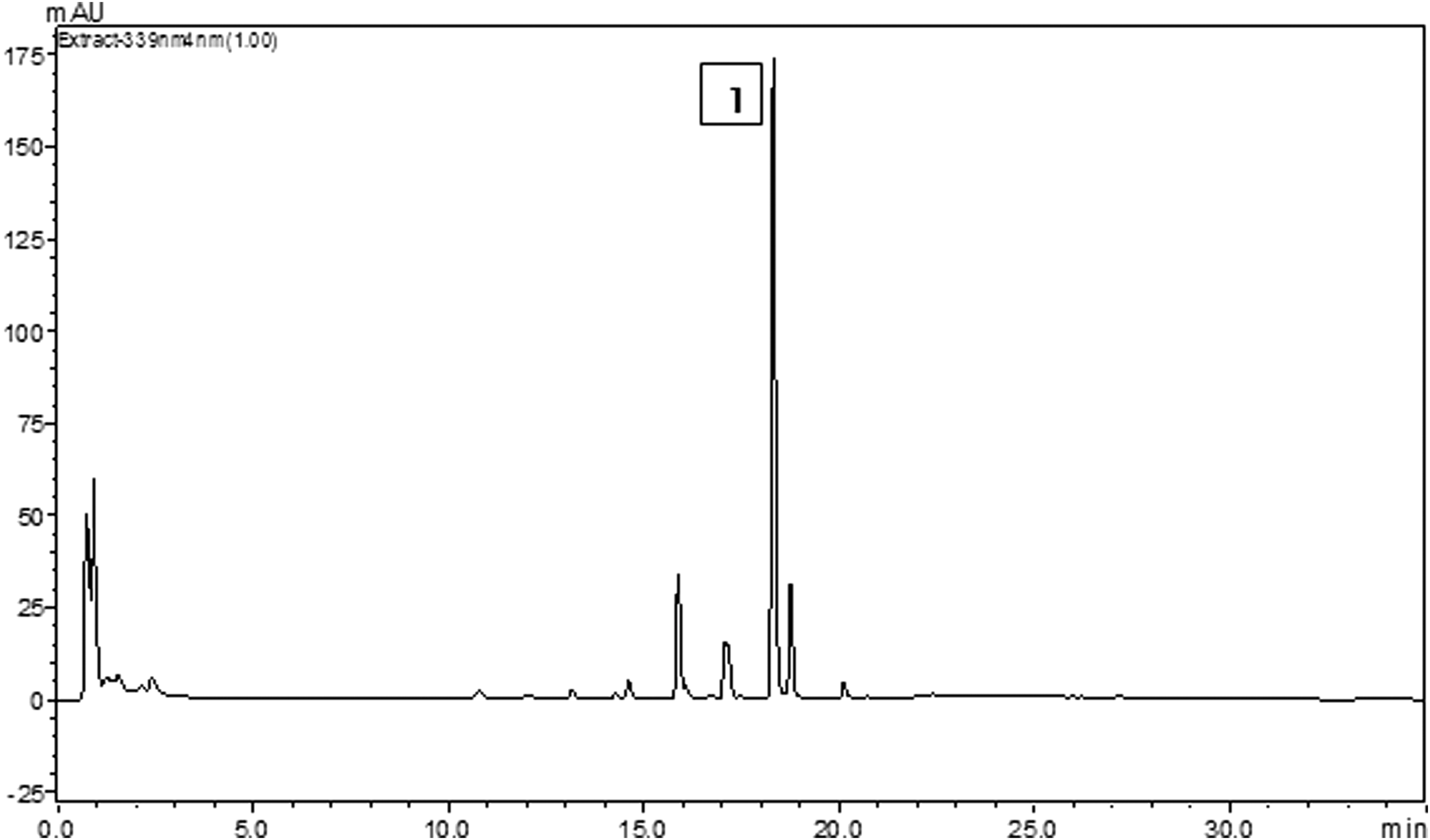
Chromatographic profile by HPLC of methanolic extract from the fruits of C. reitziana, with detection at 335 nm.
The methanolic extract exhibited significant antinociceptive effects in mice, by the intraperitoneal or oral routes, causing 59% and 49% inhibition at 10 and 100 mg/kg, respectively, against acetic acid-induced abdominal constrictions (results not shown).
Although this experimental model is considered a nonspecific antinociceptive model, since anticholinergic and antihistaminic agents, among others, sometimes present activity, it is commonly used for antinociceptive screening for natural and synthetic compounds 8 and involves local peritoneal receptors (cholinergic and histamine receptor) as well as acetylcholine and histamine mediators. 9
Dimethyl cardamonin (
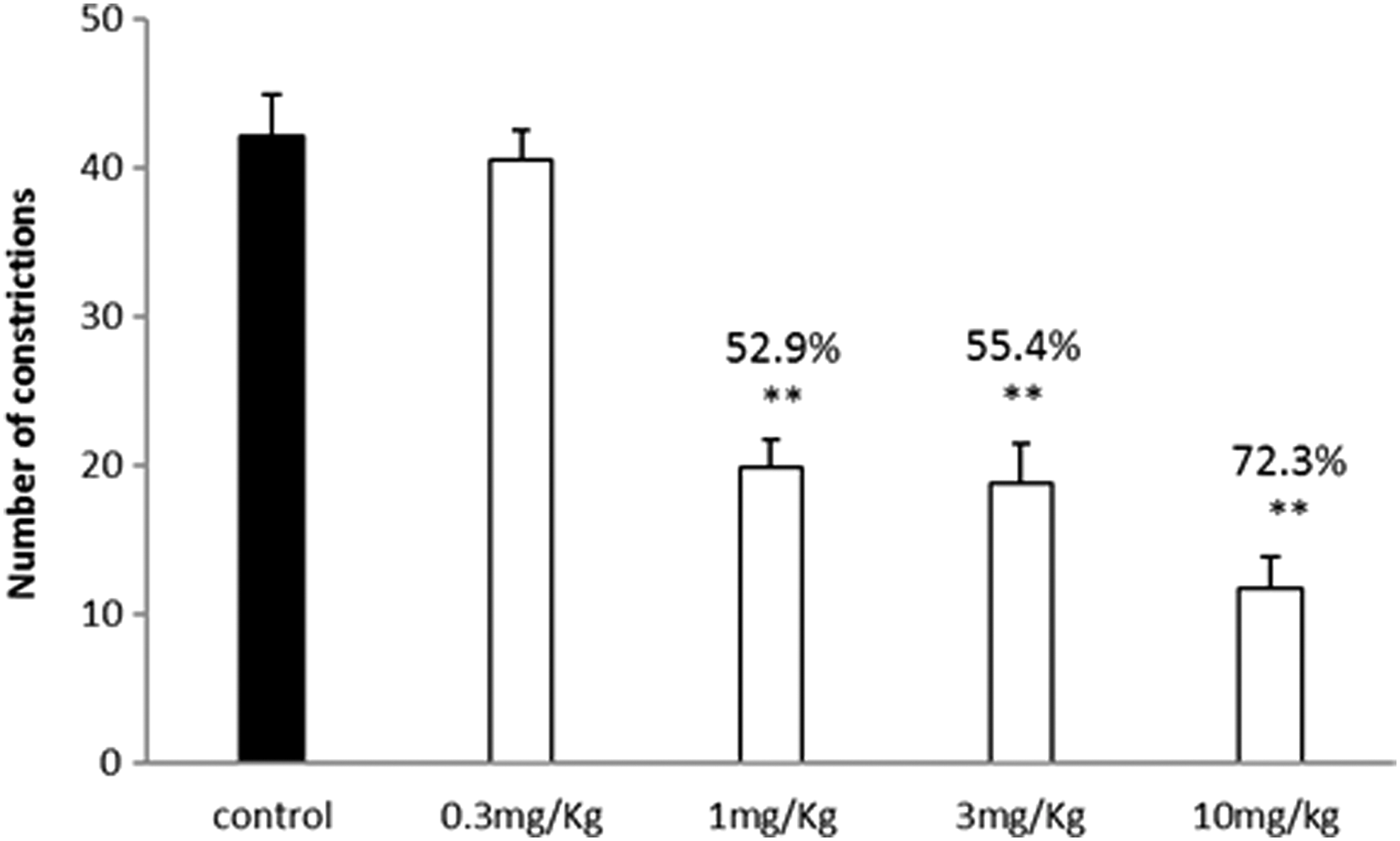
Effects of the dimethyl cardamonin (
Compound
Each group represents the mean ± SEM of six to eight experimental values.
P < .01 compared with the respective control values.
In the formalin test, the methanolic extract (10 mg/kg) inhibited both phases of pain by the intraplantar route, causing reductions of 39.9% and 26.8% for the first and second phases, respectively (Table 2). Paracetamol, used as a reference drug, at the same doses, caused inhibition of 33% against the second phase, but was inactive in the early phase. Compound
Each group represents the mean of six to eight animals.
First phase (0–5 min) and second phase (15–30 min).
10 mg/kg.
5 mg/kg.
P < .05 and ** P < .01.
NT, not tested; PAR, paracetamol.
The effects of the methanolic extract and its main component,
These results, demonstrated here for the first time, indicate that the fruit of C. reitziana exhibit pronounced antinociceptive effects in mice, and a chalcone, dimethyl cardamonin (
Footnotes
Acknowledgments
This work was supported by grants from the Brazilian institutions Conselho Nacional de Desenvolvimento Científico e Tecnológico (CNPq), the Coordenação de Aperfeiçoamento de Pessoal de Nível Superior (CAPES), and the Fundação de Apoio a Pesquisa Científica e Tecnológica do Estado de Santa Catarina (FAPESC).
Author Disclosure Statement
No competing financial interests exist.