




Abstract
Ala-His-Leu-Leu (AHLL) was isolated and purified from the loach (Misgurnus anguillicaudatus) hydrolysate in our previous study. The aim of this study was to investigate the antihypertensive effects of angiotensin-I-converting enzyme (ACE) inhibitory peptide AHLL in spontaneously hypertensive rats (SHRs). AHLL showed good antihypertensive effects in SHRs during the long-term oral administration and no allergic reactions or coughing were observed. After 2 months of oral administration of AHLL, the body weight growth was normal. The decrements in systolic blood pressure of the high dose (5 mg/kg bw) and the low dose of AHLL (1 mg/kg bw) treatment groups were 22.1 and 5.0 mmHg at week 8, respectively. Compared to the control group, the concentrations of triglyceride and sodium in serum were reduced significantly in the high-dose group after 2 months. The ACE activity of kidney and lung decreased significantly, which indicated that AHLL exerted an antihypertensive effect on kidney and lung and they were the target sites of AHLL. These results strongly supported the in vivo antihypertensive mechanism of AHLL.
Introduction
L
Hypertension is defined as arterial systolic and/or diastolic blood pressure above 140/90 mmHg in the resting status. The prevalence rate of hypertension is about 15–20% worldwide. 6 Blood pressure is regulated by many factors, among which the balance the boost system (Renin–Angiotensin System [RAS]) and depressurization system (Kallikrein–Kinin System [KKS]) are the most important ones. The angiotensin-I-converting enzyme (ACE, EC 3.4.15.1), a dipeptidyl carboxypeptidase (EC 3.4.15.1), belongs to the class of zinc proteases and plays a crucial role in the regulation of blood pressure through its action on the two body systems. 7 In the KKS, ACE inactivates antihypertensive vasodilator bradykinin; while in the RAS, ACE acts on the inactive decapeptide (angiotensin I) to hydrolyze His-Leu from its C-terminal and produces the potent vasopressor octapeptide (angiotensin II). 8 If ACE activity is inhibited, blood pressure goes down. Therefore, ACE becomes an ideal target for the treatment of hypertension disease.
The ACE inhibitors, for instance captopril, alacepril, lisinopril, and enalapril, officially used for clinical treatment of hypertension are synthetic drugs. Their use is often accompanied by many undesirable side effects such as cough, pruritus, taste disturbances, and excessively low blood pressure. 9 Therefore, the interest in finding nontoxic and efficient alternative antihypertensive substances from food resources is growing and becomes an area of great interest. Many protein hydrolysates from milk, garlic, rice, soybean, corn, rapeseed, and edible mushroom and their isolated peptides have shown antihypertensive activity. 10 –16 Hydrobionts are a promising resource for the discovery of new antihypertensive peptides. Many antihypertensive peptides from sardine, 17 shark, 18 and yellowfin sole 19 have been found. As a traditional hydrobiont in China, loach has medical efficacy and plays a positive role in adjuvant therapy of hypertension, anemia, and cardiovascular diseases.
In the previous study, we isolated and characterized a novel ACE inhibitory peptide Ala-His-Leu-Leu (AHLL) from loach (M. anguillicaudatus) on the basis of loach protein controllable enzymolysis. It was found that AHLL exhibited strong ACE inhibitory activity. 20 Nevertheless, the degradation and the performance of AHLL in the digestive tract of the human body are unclear. Therefore, the objective of the present study was to investigate the antihypertensive activity of AHLL from loach (M. anguillicaudatus) in a simulated gastrointestinal digestion and in spontaneously hypertensive rats (SHRs). A two-stage digestion model system was employed to simulate the process of human gastrointestinal digestion. Principally, the in vivo antihypertensive effect on the progression of chronic administration of AHLL in SHR was investigated. In addition, the biochemistry indexes and ACE activity in tissue and serum were also studied after chronic administration of AHLL.
Materials and Methods
Materials
Live loach (M. anguillicaudatus) weighing 8.0 ± 1.5 g body and with 9.0 ± 2.5 cm body length was purchased from a local market in Nanjing of China and raised in clean water for 1 week before use. After killing, the loach meat (without head, tail, skin, bone, and blood) was collected and ground twice through a meat grinder with a plate with 4 mm holes (MM12; Dajin Food Machine Co., Shaoguan, China). The ground meat was stored in a polyethylene bag at −18° C until use, with a maximum of 3 months.
Bromelain with a nominal activity of 3 × 10⁵ U/g was obtained from Shanghai Kayon Biological Technology Co., Ltd. (Shanghai, China). N-[3-(2-Furyl) acryloyl]-Phe-Gly-Gly (FAPGG) was obtained from Sigma-Aldrich (St. Louis, MO, USA). All other chemicals used were of analytical grade and were obtained from Tianjin Kemiou Reagent Co. (Tianjin, China).
Animals and treatments
Nine-week-old, specific, pathogen-free male SHRs with body weights of 220–280 g were obtained from Beijing Vital River Laboratory Animal Technology Co. Ltd. (Beijing, China). The SHRs were housed individually in steel cages in a room kept at 23 ± 0.5°C with a humidity of 55%, 12-h light–12-h dark cycle, and free access to a P.R. China national standard laboratory diet and water. Before the administration of LPH, the blood pressures of the rats were measured thrice during a 1-week period, and the rats were selected for further tests based on their average blood pressures. All the procedures were in strict accordance with the P. R. China legislation on the use and care of laboratory animals and with the guidelines established by China Pharmaceutical University and were approved by the ethics committee of the university.
The test group rats were grouped as control, captopril, high dosage, and low dosage (n = 8 in each group) randomly. Control group was administrated with 0.5% saline solution. The high dosage group (5 mg/[day · kg · body weight]) and low dosage group (1 mg/[day · kg · body weight]) were given the AHLL dissolved in the same volume of saline solution through gastric intubation. Captopril (1 mg/[day · kg · body weight]) was injected by the same method.
After a 2-month oral administration, the animals were fasted for ∼18 h before blood withdrawal. The SHRs were exsanguinated under anesthesia with sodium pentobarbital (60 mg/kg). The blood samples were collected early in the working day to reduce biological variation, and serum was isolated by centrifugation at 1509 g for 15 min. The tissues of kidney, lung, and heart were removed immediately and stored in 10% formalin solution at 4°C. Before use, the tissues were dehydrated in graded ethanol solutions and were weighed after drying on filter paper.
Preparation of AHLL from loach
One hundred grams of loach meat was mixed with 200 mL of distilled water and homogenized at a speed of 10,000 rpm for 1 min using a T25 basic homogenizer (Ika, Staufen, Germany). To extract ACE inhibitory peptide from loach protein, enzymatic hydrolysis was performed with bromelain; the ratio of enzyme to substrate was 3:1000 (w/w). The hydrolysis was conducted in a 55°C water bath shaker (SHZ-22; Huamei Biochemistry Instrument Factory, Taicang, China) with stirring for 6 h at a pH of 5.5; the reaction was terminated by heating in a boiling water bath for 10 min. The hydrolysates were centrifuged in a 4°C centrifuge (UniCen MR, Herolab, Germany) at 11,800 g for 20 min. The supernatants were filtered by ultrafiltration with a molecular weight cutoff membrane of 2.5 kDa. The 2.5 kDa filtrate was then lyophilized (FDU-1200; Tokyo Rikakikai Co., Ltd., Tokyo, Japan). Then, the filtrate was isolated and purified by consecutive purification steps of gel filtration chromatography and reverse-phase high-performance liquid chromatography to afford a purified peptide AHLL with an IC50 (the peptide concentration required to produce 50% ACE inhibition under the described conditions) of 18.2 ± 0.9 ìg/mL. 20
Measurement of systolic blood pressure
The systolic blood pressure (SBP) of each rat was measured by the tail-cuff method with a BESN-II Multichannel Noninvasive Pressure Measurement System (Beijing Success Technology Development Co., Ltd., Beijing, China). Before the measurement, the rats were kept in a thermostatic box at 30°C for 5 min to make the pulsations of the tail artery detectable. In the 8-week-experiment, all measurements, including SBP and weight, were conducted between 9:00 am and 11:00 am weekly. To establish the values of SBP, five measurements were taken, and the average was calculated. To guarantee the reliability of the measurements, the rats were accustomed to the procedure a week before starting the experiments. To minimize stress-induced variations in blood pressure, all measurements were taken by the same person in the same peaceful environment.
Determination of the biochemistry index in serum
Triglyceride (TG), total cholesterol (TC), high-density lipoprotein (HDL), low-density lipoprotein (LDL), and Na+ and K+ concentration in serum were analyzed by the enzymatic colorimetric method (Spectra MR; DYNEX Technologies, Inc., Chantilly, VA, USA) using commercially available kits (purchased from Nanjing Jiancheng Bioengineering Institute, Nanjing, China).
Determination of ACE inhibitory activities in vivo
The lung, heart, and kidney were sheared and homogenated with a fourfold prechilled 75 mM Tris-HCl buffer. Samples were then centrifugated at 10,000 rpm for 15 min at 4°C. The supernatants that contained the crude ACE were collected.
ACE activities in serum and tissues were assayed by the method described by Shalaby, Zakora, and Otte. 21 Briefly, 150 μL preheated (37°C) FAPGG (1 mM in 50 mM Tris-HCl containing 0.3 M NaCl, pH 7.5) as substrate was added to 10 μL samples. The absorbance at 340 nm was recorded at 1-min intervals during the incubation at 37°C for 25 min with constant shaking in a Tristar LB-941 Microplate Reader (Berthold Technologies, Bad Wilbad, Germany). One unit of activity is defined as the 0.001 absorption decrease per minute at standard assay conditions.
Statistical analysis
Results are expressed as means ± SDs. The results obtained were subjected to one-way analysis of variance. Duncan's multiple range tests were performed to determine the significant difference using SPSS 13.0 software (SPSS, Inc., Chicago, IL, USA). P < .05 was considered statistically significant.
Results
Weight changes of SHRs during long-term oral administration
Hypertension is often associated with sodium potassium pump activity abnormities, cardiac output, and blood volume increases, which may easily induce body fat accumulation. 22 Therefore, obesity is one of the diseases typically associated with hypertension. In our previous study of AHLL in Wistar rats, there was no significant difference of body weight between the high-dose group and control group. The influence of AHLL on body weights of SHRs was observed during the long-term administration (Table 1). The weight rose with age in all groups, but the growth rates were different. From the third week, the high-dose group and captopril group showed slower rates of body weight growth compared to model control significantly. The average weights of captopril and high-dose AHLL-administrated SHRs were 261.5 ± 7.3 and 259.0 ± 6.9 g at week 8, which were lower than the control group (274.1 ± 6.1 g). Therefore, AHLL suppressed body weight gain during long-term oral administration.
Data values are reported as mean ± SD.
Different lowercase letters indicate significant differences among different groups at the same time (P < .05); Different capital letters indicate significant differences within one group at different times (P < .05).
Antihypertensive effect of AHLL on SHRs during long-term oral administration
For the practical purpose of using food-derived materials as a physiological modulator, the antihypertensive effect of AHLL in vivo was evaluated by measuring changes in the SBP of SHRs over 8 weeks. As shown in Table 2, only the SBP of model control rose at week 8 among all groups. Blood pressure of rats decreased from 192.0 to 172.8 mmHg within 1 week, and to 160.1 mmHg at week 4, then increased slightly in the high-dose group. Compared to the model control, captopril and high-dose groups showed significant SBP reduction from the first week, and the SBP of the low-dose group was decreased significantly from week 4 (Fig. 1). The decrements in SBP of the high-dose and the low-dose treatment groups were 22.1 and 5.0 mmHg at the eighth week, respectively. Furthermore, no allergic reactions or coughing was observed during the long-term experiments. These results indicated that AHLL had a good long-term antihypertensive effect.
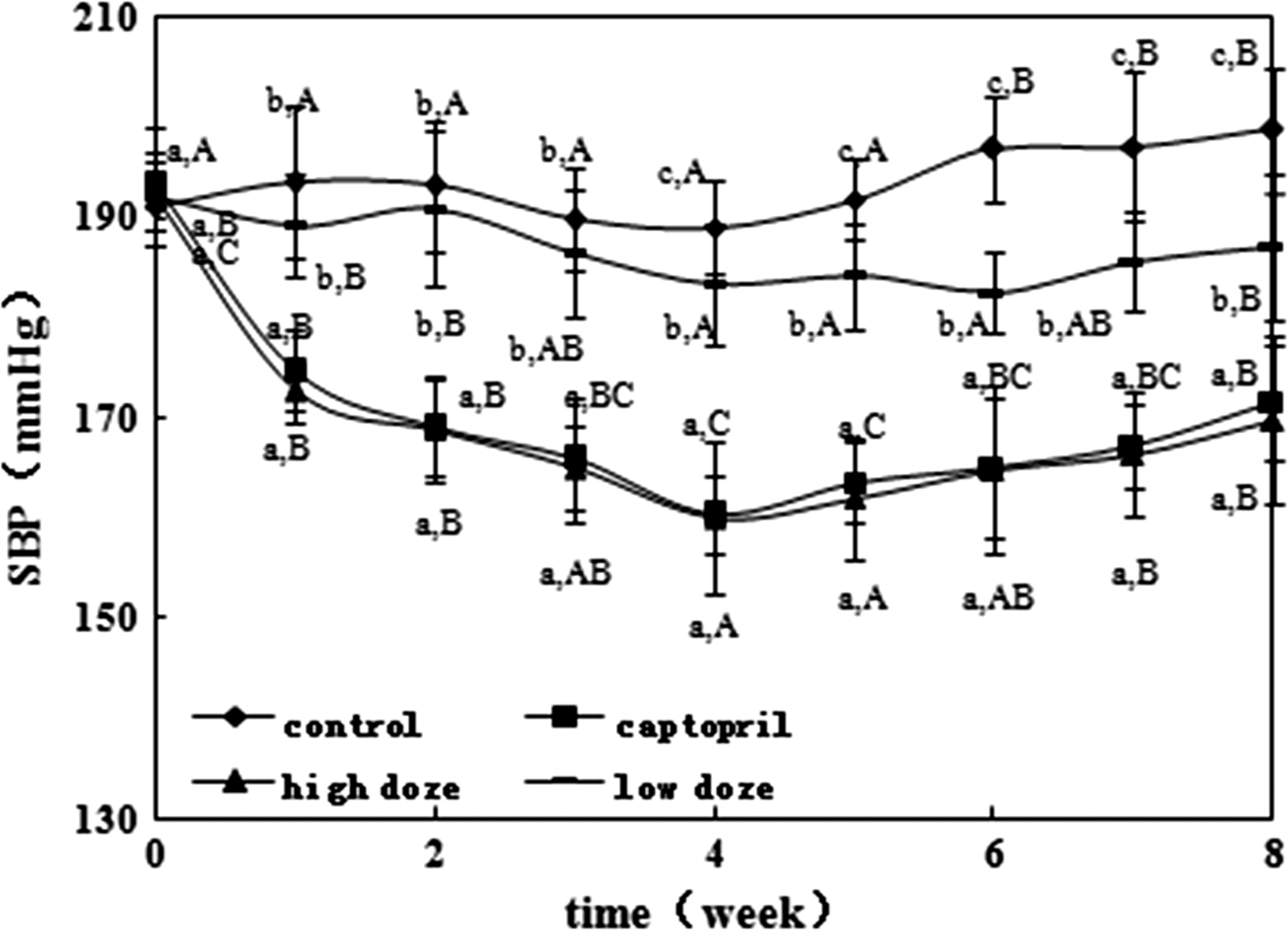
Changes in systolic blood pressure (SBP) of spontaneously hypertensive rats (SHRs) over long-term administration (Mean ± SD). Different lowercase letters indicate significant differences among different groups at the same time (P < .05); different capital letters indicate significant differences within one group at different times (P < .05).
Data values are reported as mean ± SD.
Different lowercase letters indicate significant differences among different groups at the same time (P < .05); Different capital letters indicate significant differences within one group at different times (P < .05).
SBP, systolic blood pressure.
Serum biochemistries after long-term oral administration of AHLL
Compared to the model control group, TG in serum was significantly lower in the captopril and high-dose groups as shown in Table 3. The other indexes among all groups were not significantly different from the control. The concentration of sodium was significantly lowered in both AHLL groups and the captopril group compared to the control. The AHLL and captopril as ACE inhibitors promoted sodium excretion. This result suggested that the antihypertensive effect of AHLL on the blood pressure of SHR was probably due to the improvement or regulation of the salt balance in addition to the simplicity of inhibition of ACE. Wu and Ding 23 found that the sodium content in serum was significantly decreased after a month of oral administration of soybean peptides. Although the relation between trace elements and the pathogenesis of hypertension is not clear, most of the findings and analyses agree that excessive sodium intake is easy to cause hypertension.
Data values are reported as mean ± SD.
Different lowercase letters indicate significant differences among different groups in one index (P < .05).
TG, triglyceride; TC, total cholesterol; HDL, high-density lipoprotein; LDL, low-density lipoprotein.
ACE activities of tissues and serum after long-term oral administration of AHLL
To clarify the antihypertensive mechanism of AHLL, we measured the ACE activities in various organs and serum. As shown in Table 4, lung tissue showed the highest ACE activity among all tissues and they were decreased significantly in captopril and high-dose AHLL-administrated SHRs compared to the model control group. ACE activity in the kidney was also reduced significantly by 8.8% and 9.0% in captopril and high-dose AHLL-administrated SHRs. It demonstrated that the kidney and lung were the target sites that AHLL exerted its most antihypertensive effect. The ACE activities in the serum, heart, and kidney among all groups were not significantly different from the model control group.
Data values are reported as mean ± SD.
Different lowercase letters indicate significant differences among different groups in one tissue (P < .05).
ACE, angiotensin-I-converting enzyme.
Discussion
This is the first time the antihypertensive effects of the new antihypertensive peptide AHLL from loach in SHRs have been investigated. The main finding of this study is that long-term oral administration of AHLL attenuated and even reversed progression of hypertension in SHRs. With the increase in body weight in the long-term oral administration experiment, the blood pressure decreased first and increased slightly later in both the captopril group and AHLL groups. The decrement of SBP in a high dose of the AHLL-administrated group was 24.3 mmHg compared to the model control group at the eighth week. AHLL exhibited a well control of SBP in SHRs and no allergic reaction or coughing was produced for 2 months.
Hypertension is a major risk factor for cardiovascular disease, stroke, and end-stage renal disease. 20 Generally, there are some hemorheology and lipid metabolism changes in spontaneously hypertensive patients. Controlling blood viscosity and lipid disorders play a positive role in the control of hypertension. Most antihypertensive drugs can reduce both TC and TG levels significantly. 24 Increased high-density lipoprotein cholesterol (HDL-C) and decreased TC and TG were often associated with a decreased risk of developing heart disease and hypertension. 25 Liu showed that the protein hydrolysates from the jellyfish Rhopilema esculentum decreased total serum cholesterol and TG and increased HDL-C in rats fed with a high-fat diet in SHR. 26 In our study, we revealed that the concentrations of sodium and TG in the serum were decreased significantly in SHR with a high dose of AHLL after 2 months. On the basis of the theory of RAS, an increase in the level of Ang II would increase the concentration of Na+, whereas ACE inhibitor intakes would decrease the formation of Ang II; thus, the concentration of Na+ decreased. These results indicated that AHLL may be a promising peptide for the prevention and treatment of hypertension and hyperlipidemia.
ACE is widely distributed in animals, mainly in the plasma, lung, kidney, heart, brain, and other tissues. ACE can also be in the form of a membrane-bound enzyme in the jejunum of the brush border of epithelial cells. 27 Researchers think that the prolonged antihypertensive action of ACE inhibitors might be related to persistent inhibition of ACE activity of tissues. 28 Kidney and lung are important organs in the body, which are closely connected with hypertension. 29,30 The individuals with low respiratory function, especially low formed vital capacity, usually have a greater risk of hypertension, coronary heart disease, congestive heart failure, and stroke. More and more scholars begin to pay attention to the role of the lungs on hypertension protection as a target organ. 31,32 The kidneys regulate water and sodium in the body. 33 Once renal function is impaired, water and sodium could not be efficiently excreted, causing blood pressure increase. On the contrary, the vascular wall is constantly under strong pressure when maintaining the status of hypertension, and blood vessels are damaged, which leads to arteriosclerosis. Due to the hardening of the arteries and poor blood circulation, the blood flowing into the kidney will be reduced, resulting in renal disease or accelerating the impairment of the kidney. 34 Renal disease and hypertension are reciprocal in causation. Pulmonary arterial hypertension is a newly recognized disease in patients with renal disease. 35 The ACE activities of kidney and lung were significantly decreased after oral administration of AHLL (5 mg/kg bw), which showed antihypertensive effects through inhibition of the ACE activity in the kidney and lung, which were the target sites of AHLL. This study provides a theoretical basis for the application of the new antihypertensive peptide AHLL in the treatment of hypertension.
Footnotes
Acknowledgments
This study was cofunded by the National Science Foundation of China (No. 31301439) and the Agriculture Innovation Fund of Jiangsu Province (No. CX(13)5059).
Author Disclosure Statement
No competing financial interests exist.