




Abstract
Aerial parts of Medicago sativa L. have been used as food and its consumption has been associated with health benefits, one among the most important being menopausal symptoms control. This work was aimed to explore possible pharmacological effects of two new alfalfa-derived products that have recently emerged as daily beverage preparations. In exploring their potential estrogenic effects, they produced no relevant alteration in the uterus. However, lowering glucose levels until normal values without causing further hypoglycemic effect were observed, when rats were treated with 1.5 g/kg/day samples. In vivo acute toxicity was not found when the alfalfa products were tested up to 3 g/kg rat weight. Furthermore, in vitro studies were conducted to assess their possible toxic effects. 3-(4,5-dimethylthiazol-2-yl)-2,5-diphenyltetrazolium bromide (MTT) and lactate dehydrogenase tests were carried out on the Caco-2 cell model to determine cell viability and membrane integrity. A concentration-dependent effect was observed, with a significant decrease in cell viability after exposure to concentrations of alfalfa product up to 100 mg/mL (after 3 h of incubation) and 50 mg/mL (after 24 h of treatment). Although in vitro level, the decrease in cell viability at these still low doses may underlie some toxicity, making necessary additional studies before any recommendation of a sustained consumption of these products by humans.
Introduction
A
Alfalfa biosynthesizes a wide variety of natural products. These include sterols, steroidal saponins, coumarins, flavonoids, and other phytonutrients, all responsible for various pharmacological properties. 1 Several effects such as neuroprotective, hypocholesterolemic, antioxidant, antiulcer, and antimicrobial have been attributed to alfalfa consumption along with its use to treat atherosclerosis, heart disease, and stroke. 3,4 In some countries, this plant has also been used in traditional medicine for diabetes treatment. 3 Hypoglycemic effects have been attributed to its capability of supplying minerals that have been identified as cofactors in modulating insulin action and key enzymes of glucose metabolism. 4 An in vitro study corroborated that alfalfa extract, among other plants, decreases glucose diffusion across the gastrointestinal tract, leading to a reduction of its absorption, 5 while an in vivo study showed that adding alfalfa in the diet of streptozotocin-induced diabetes mice reduces hyperglycemia. 3 Also, correlations between phytoestrogen intake and hypoglycemic effects have been established. 6 Alfalfa is recognized as a rich source of such compounds. Clinical studies have reported potential beneficial effects of phytoestrogen consumption on glycemic parameters in postmenopausal women, but inconsistent results have also been found in similar studies where a short-term phytoestrogen intake has not been proven to produce the aforementioned effects. 7
Currently, natural sources of phytoestrogens such as alfalfa are highly valued as nutraceutical ingredients, especially for the treatment of menopausal symptoms and some diseases resulting from the decrease of endogenous estrogens. 8 Alfalfa consumption plays an important role in the treatment of menopausal symptoms, such as hot flushes, night sweat, mood swings, and insomnia, which frequently affect the quality of life of menopausal women. Its therapeutic effects have been attributed to high amounts of phytoestrogen. 9,10 These phenolic compounds, which have a similar chemical structure to that of estradiol, are mainly produced by species of the Fabaceae family. Like this endogenous compound, they are capable of mimicking the estrogen actions. Their effects can either be produced by acting directly or indirectly on the estrogenic receptors. 11
Hence, estrogenic effects should be expected when alfalfa is consumed, but antiestrogenic actions can also occur depending on the type and amount of phytoestrogens consumed, as well as their in vivo metabolism. 12 Reproductive disruptions have been reported in cattle feed with red clover and these side effects were attributed to phytoestrogen action. 13 However, the studies of toxic effects caused by phytoestrogens in humans are still limited and inconsistent. These studies have tried to explore through clinical assays the effects of products containing phytoestrogens in menopausal women. However, in these attempts, side effects such as those observed in the gastrointestinal tract level arose, leading patients to withdraw from the treatment. 14
In vitro strategies have been developed as alternative approaches to determine toxicity of foods or any of their chemical constituents. 15,16 Treatment of cultured Caco-2 (human Caucasian colon adenocarcinoma) cell line is among the most used. 17 Caco-2 cells serve as a model due to their morphology and other characteristics that enable them to mimic the intestinal epithelia. 15,18 This cell line is also used to study drug absorption at the intestinal epithelial level. Furthermore, in vitro anticancer activity in Caco-2 has also been reported. 19 In Mexico, alfalfa is grown in large areas due to its relatively low cost of production. Recently, a Mexican company (Productora Sativa SPR de RL de CV) launched two new alfalfa-derived products (ADP) for human consumption: freeze-dried juice (FDJ) obtained from the fresh aerial parts by squeezing and the dried and powdered residual material (RM), both as ingredients for daily beverage preparations.
This study was undertaken to evaluate possible advantageous pharmacological effects of these two ADP and their safety. The study assessed the hypoglycemic and estrogenic activities of the two products and their in vitro and in vivo acute toxicities. These analyses were conducted on two batches of products (B1 and B2) manufactured with alfalfa harvested in two different months of 2014.
Materials and Methods
Standards and reagents
3-(4,5-dimethylthiazol-2-yl)-2,5-diphenyltetrazolium bromide (MTT, CAS No. 298-93-1) and Triton X-100 (CAS No. 9002-93-1) were purchased from Sigma-Aldrich Co. Dimethyl sulfoxide (CAS No. 37-68-5) was bought from Merck KGaA. Cell culture media components were all Invitrogen™ and purchased from Thermo Fisher Scientific, Inc.
Commercially available estradiol valerate (PRIMOGYN®) and estradiol (Patector N.F.®) were used as positive controls to uterotrophic assay.
Samples
Samples were provided by Productora Sativa SPR de RL de CV, Guanajuato, Mexico. Both ADP were manufactured from the aerial parts of alfalfa harvested in the late dub stage of maturity from two different harvests, one in May (B1) and the other in August (B2) 2014.
Animals
Adult Wistar rats (250–300 g) were used for in vivo assays. The rats were maintained with food and water ad libitum during experimental periods and kept under standard conditions as outlined in the institutional guidelines for caring of experimental animals. All in vivo experiments were performed in accordance with The Mexican Official Standard NOM-062-ZOO-1999 for the production, care, and use of laboratory animals.
Glucose tolerance
Five experimental groups were established to assess glucose tolerance. Two groups were treated with 0.5 g/kg of FDJ from B1 and B2 in a single dose, while other two groups were treated with the RM from B1 at the same concentration; the last group was used as a control. The equivalent concentration of human blood normal level of glucose (75 mg/dL) was administrated to all experimental subjects.
Acute toxicity study
Seven experimental groups (n = 3) were assigned randomly. The ADP were orally administered at 1.5 and 3 g/kg at a single administration to three independent experiments and one group was used as control (treated only with water). The survival rate was measured 24 and 48 h after treatment and results were reported as percentage of survival.
Uterotrophic assay
For uterotrophic assay, female rats were subjected to ovariectomy 15 days before treatment. After recovery, seven experimental groups were formed randomly with five ovariectomized rats in each group. Administration of all treatments was carried out between 8 and 10 h in the morning during three consecutive days. One group was orally treated with 800 mg/kg/day of estradiol valerate (PRIMOGYN) and a second group subcutaneously with 30 μg/kg/day of estradiol (Patector N.F.), both as positive controls. A negative control group was treated with water (vehicle) only. The two types of ADP were administered in two different doses (0.4 and 2 g/kg/day) to the remaining four experimental groups. Twenty-four hours after the last treatment, animals were decapitated and the uterus was dissected. Increase in uterine weight was used as an indicator of the estrogenic activity produced after treatment.
Cell viability, membrane integrity, and cell recovery
The Caco-2 cell line was obtained from the European Collection of Cell Cultures and cultured in Dulbecco's modified Eagle's medium supplemented with 10% heat-inactivated fetal bovine serum. Cells were incubated in a humidified atmosphere with 5% CO2 at 37°C. To carry out the experiments, 10,000 cells were seeded in 96-well plates (flat bottom) and allowed to adhere overnight at 37°C. Four ADP were tested for cytotoxicity: (1) RM from B1, (2) RM from B2, (3) FDJ from B1, and (4) FDJ from B2. For cell treatment, they were incubated at 37°C for 3 and 24 h in the presence of ADP in concentrations ranging from 1 to 100 mg/mL in addition to a negative (cell culture medium without ADP samples) and positive control (Triton X-100, 1% in cell culture medium).
MTT assay 16 was used to test the potential effects of samples on viability of Caco-2 cells. Absorbance was measured at 570 nm using a Cambrex ELX808 microplate reader (KC4; BioTek). Lactate dehydrogenase (LDH) (a measure of cell membrane disruption) present in cell culture medium was measured using a commercial kit (Roche Diagnostics Corp.), according to the manufacturer's instructions. Absorption was measured at 490 nm with a reference wavelength of 655 nm using a Cambrex ELx808 microplate reader (KC4; BioTek). LDH release was calculated according to a previously described procedure. 20
To determine whether cells treated with ADP samples recovered their proliferative capacity after removal of treatment, the cell recovery assay was used. After 3 and 24 h, treatments were removed, and then, a fresh cell culture medium was added to cells and incubated for further 24 h. The degree of cell recovery was determined using MTT assay and following the same procedure mentioned above.
Three independent experiments (three replicates in each experiment) were performed for each experimental condition tested.
Statistics
For in vitro testing, statistical analyses were performed using SPSS for Windows statistical package (version 22.0). Nonparametric tests—Mann–Whitney U-test (differences among groups) and Spearman's correlation (associations between two variables)—were used for the statistical analysis of these data. Nonlinear regression fitting of the dose–response curve in the Hill equation was performed to derive the in vitro cytotoxicity IC50 (i.e., concentration at which cell viability was inhibited by 50%), using PRISM 6.0 (GraphPad Software, Inc.).
Results of in vivo tests were analyzed using Minitab 15 (Pennsylvania, RI, USA). One-way analysis of variance (ANOVA) and two-way ANOVA were used to determine the difference between treatments. Post hoc comparisons of the means were performed according to Tukey and Bonferroni tests depending on the experiments. In both in vitro and in vivo analyses, P < .05 was considered significant.
Results
Glucose tolerance
Figure 1 shows glucose tolerance curves for the two ADP. Significant difference in lowering glucose level was found between control and FDJ from B1 (P < .05) and from B2 (P < .01) after 60 min. The highest decrease was induced by RM from B1 (P < .001). As can be seen in Figure 1, the glucose levels were normalized to control values after 2 h of treatment. These results suggest that the ADP are capable of decreasing glucose levels until normal values and, at the same time, hypoglycemic effects do not occur.
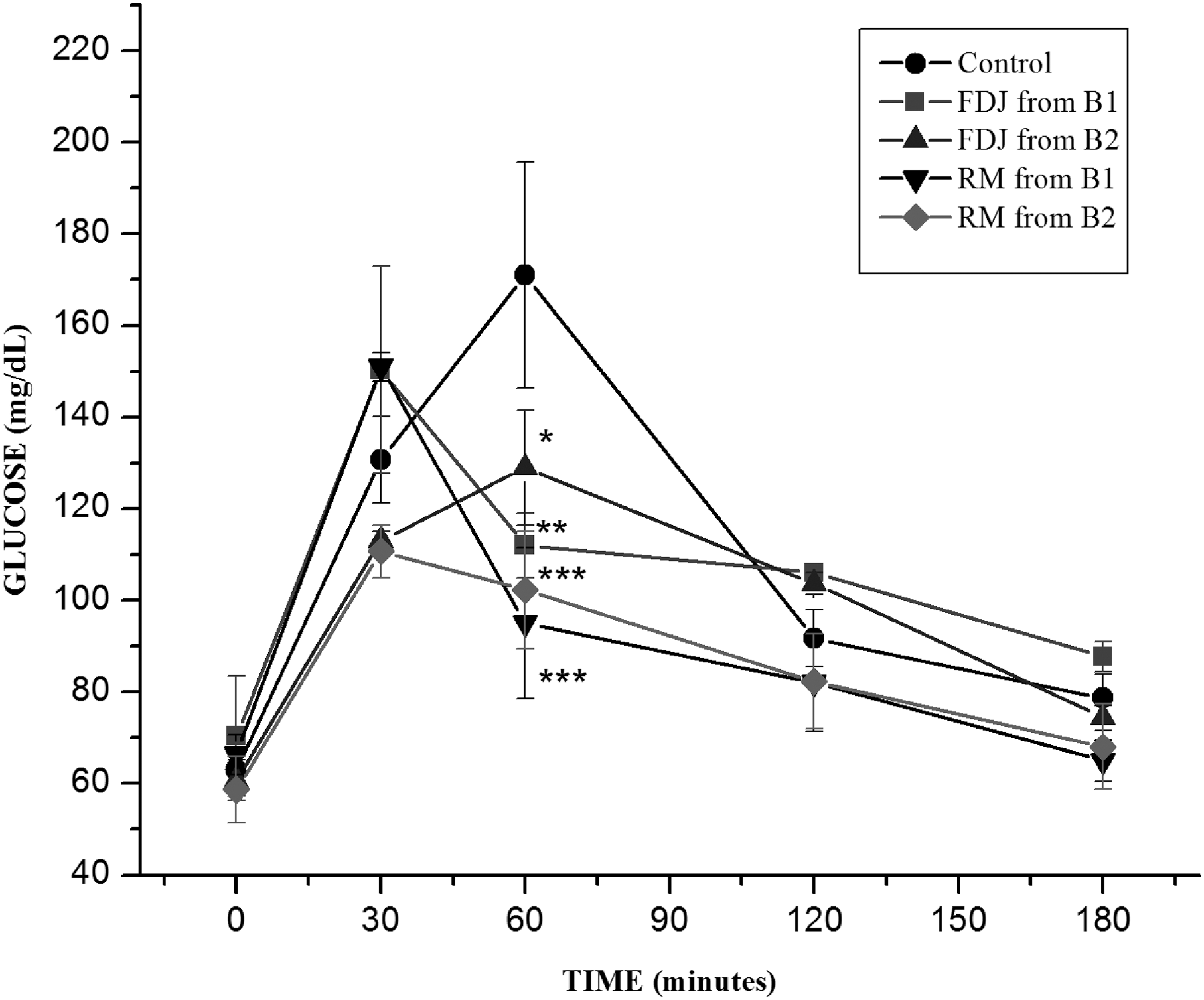
Glucose tolerance curve. Significant difference with respect to negative control. *P < .05; **P < .001; ***P < .0001. FDJ, freeze-dried juice; RM, residual material.
Acute toxicity
To determine in vivo toxicity of the ADP, samples from B1 and B2 were evaluated in rats using two different concentrations. No alterations on survival were observed with 1.5 g/kg of ADP after 24 and 48 h of treatment. However, after 48 h, only 88% of survival was found when 3 g/kg of FDJ from B1 was administered. It is important to consider that administration of 3 g/kg of sample represents a very high concentration (100 times) compared with the daily intake recommended by the manufacturer for human consumption (3 g).
Estrogenic activity
Uterotrophic assay is the most used in vivo procedure to assess the ability of a sample to bind to estrogen receptors and activate them. This assay uses rodents as animal models as they have a short estrus cycle. The two types of ADP were assessed for estrogenic activity following the uterotrophic assay aforementioned. According to the manufacturer, 3 g of ADP suspended in 30 mL of water is the daily dose recommended. This dose was the lowest used in the uterotrophic assay, while the highest dose was five times more. The results showed an increase of the uterus weight in the case of subcutaneous administration. Although two different high concentrations of ADP from B1 were administered, no significant difference was observed in the effects obtained when compared with that of vehicle. The same result was obtained even at very high concentration (2 g/kg/day) of FDJ from B2.
Cell viability, membrane integrity, and cell recovery
Caco-2 cell cultures were used to determine the cytotoxic potential of the two ADP from the two batches (B1 and B2). For all samples, five different concentrations and two exposure periods (3 and 24 h) were tested. Figure 2 (A and B) shows the results obtained during the MTT assay.
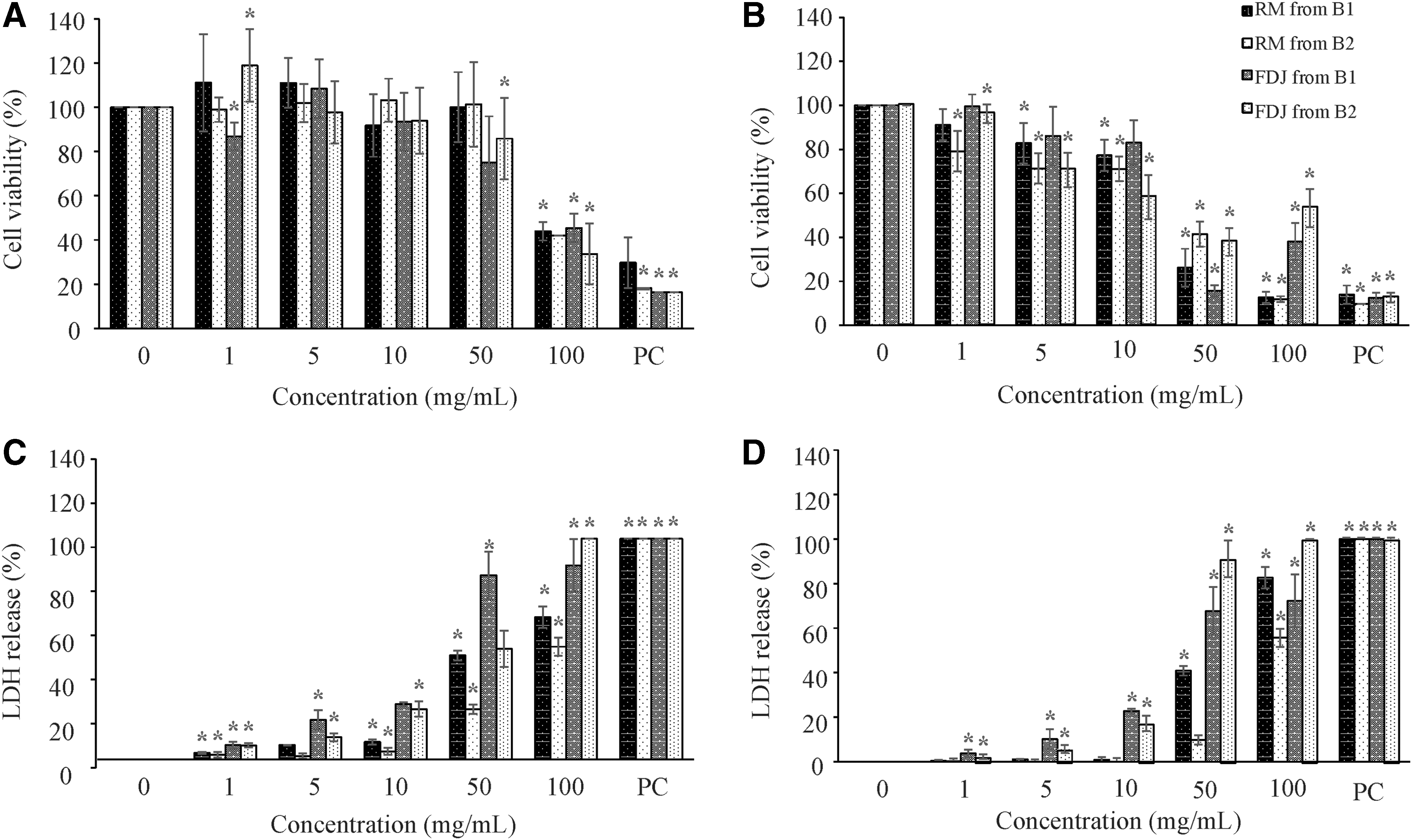
Cytotoxicity assays in Caco-2 cells.
Decrease in cell viability was found to be concentration dependent during both studied exposure periods (Table 1).
CI, confidence interval; DP, derived products; FDJ, freeze-dried juice; LDH, lactate dehydrogenase; MTT, 3-(4,5-dimethylthiazol-2-yl)-2,5-diphenyltetrazolium bromide.
Nevertheless, after 3 h of exposure, a significant decrease in cell viability was observed only on cells treated with the ADP at 100 mg/mL. After 24 h of exposure, similar values of cell viability (40%) were observed for treatments of 50 mg/mL. For all samples, a lower correlation value was obtained after 3 h of treatment, showing that the decrease in cell viability observed with the MTT assay is not only concentration dependent but also time dependent.
Membrane integrity was also tested by measuring the LDH released by Caco-2 cells after 3 and 24 h of treatment with the two ADP from B1 and B2 (Fig. 2C, D). In accordance with the MTT assay, the release of LDH induced by ADP was also concentration dependent (Table 1). The results suggested that LDH release was higher in cells treated with FDJ than in those treated with RM samples in the two periods of exposure. Similar correlation values were obtained for all studied samples and periods of exposure.
Table 1 summarizes the IC50 determined for all treatments. As described above for MTT assay, the IC50 obtained after 3 h of exposure is higher than that resulting from 24 h. On the contrary, the IC50 based on LDH assay results is very similar for both periods of exposure.
Higher concentrations of RM were needed to produce the same effects as those of FDJ, suggesting that the cytotoxic potential of FDJ is higher than that of the RM. The IC50 obtained for the two batches was different among the two ADP, reflecting the variation of cytotoxic potential over the period of harvest.
To determine the ability of Caco-2 cells to recover from the eventual cell damage caused by the treatment with the ADP, cells were allowed to recover for 24 h after exposure to ADP for 3 and 24 h. Results showed no significant recovery (data not shown).
Discussion
The use of plant-based products to improve health is reemerging due to both the increased knowledge of pharmacological potential of their secondary metabolites and also the inability of modern medicine to provide safe alternatives for disease treatment. However, the idea that nature is healthy and safe has been the origin of several misadventures, making evident the need to study not only the effectiveness but also the possible side effects of plant-based products.
In Mexico, the consumption of alfalfa as daily food is relatively limited, but its beneficial properties make it a good raw material to manufacture products for human consumption. However, phytoestrogens and other chemical constituents present in alfalfa can produce either positive or negative effects, depending on several factors such as their concentration and in vivo metabolites. 21 In the present study, some beneficial pharmacological and possible toxic effects of the ADP were evaluated.
The assessment of the hypoglycemic effect conducted in vivo found consistent results with those previously reported, where a decrease in glucose levels after alfalfa administration has been described. 22 The hypoglycemic effects by some natural compounds such as vitexin, isovitexin, and apigenin present in plants have been previously reported. 19 Apigenin has been shown to be able to regulate diabetes mellitus as well as diabetes-induced thyroid dysfunction and lipid peroxidation in alloxan-induced diabetic mice. 23 Hypoglycemic effects of Medicago species may also be due to triterpene saponins and some flavonoids such as those aforementioned. 1
With respect to hypoglycemic effects produced by phytoestrogens, many studies have explored the action mechanisms of these compounds. Some authors mention them as hypoglycemic agents capable of producing a decrease in glucose levels. The present study proves that the two ADP cause the stabilization of glucose levels after 2 h of treatment, and at the same time, these do not decrease beyond normal levels. In a previous study, we identified genistein and daidzein as the most abundant isoflavones present in the two ADP. 24 Other authors indicated that these two compounds display hypoglycemic effects after individual administration at 0.1% in the diet in mice. 25,26 However, a direct correlation was not found between the isoflavone content and the hypoglycemic effect of the two ADP, not even for the FDJ that had the highest content of the two isoflavones.
In fact, RM that contained less quantities of these two compounds 24 produced the highest glucose-lowering effect. It is then plausible to assert that, rather than the isoflavones, the high content of fiber in RM plays an important role in regulating the blood glucose levels in the experimental animals. 27,28
On the contrary, several compounds present in plant-derived products are metabolized into more or less active products having different effects in vivo. This fact depends entirely on the metabolic system of each individual and can easily be observed in phytoestrogen consumption by sheep, which may suffer from reproductive dysfunctions after constant consumption of high amounts of phytoestrogens. Conversely, humans did not suffer from these effects after phytoestrogen intake as the amount of compounds needed to produce them should be high. For this reason, in vivo evaluations of the effects of the ADP are required before their consumption.
In this work, in vivo acute toxicity was assessed in rats, finding no toxicity for the two ADP when consumed at single dose; however, this does not guarantee their long-term safety. Their pharmacological evaluation should be extended, as toxic effects have been reported following the consumption of the aerial parts of alfalfa. The possible acute toxicity of individual constituents of alfalfa has been extensively studied. Genistein and daidzein showed no toxic effect after in vivo administration (140 and 250 mg/kg). 29 According to the previously reported data, 24 the isoflavone content of the two ADP analyzed contained very low concentration of isoflavones, ruling out any correlation between their isoflavone content and any potential acute toxicity.
Regarding estrogenic activity, no effect was observed in uterotrophic assays. This can be due to the low phytoestrogen concentration found in the samples analyzed. Studies reported by Soto-Zarazúa determined that the total isoflavone content in the ADP extracted with water was 36 mg/100 g and 48 mg/100 g in RM and FDJ, respectively. 24 These amounts of phytoestrogens are low when compared with those found in some food supplements containing phytoestrogens used by menopausal women for the treatment of hot flushes. 8 Although the two ADP analyzed here contain isoflavones (mainly genistein and daidzein), their amount was not enough to produce estrogenic effects.
Some studies have evaluated the estrogenic actions of plant-based products containing phytoestrogens. Concentrations of 100 and 300 mg/kg of the standardized extract of Angelica sinensis (known to cause estrogenic effects) had been sufficient to produce estrogenic activity in ovariectomized rats. 30 In contrast, in the present study, no estrogenic effects were produced despite the high concentrations of extracts used, reflecting again the low content of phytoestrogens in the samples.
It is well known that pharmacological actions such as estrogenics are affected by the matrix containing bioactive compounds. The two ADP are complex products that did not suffer from any previous extraction more than extrusion process. In addition to the low concentrations of phytoestrogens, some compounds present in the alfalfa matrix may act as antagonists and then avoid the estrogenic effect.
Another fact to take into account is the metabolism of natural compounds when they are consumed. Phytoestrogens are metabolized in the gut to give more potent estrogenic agents. Some isoflavones found as glycosides in their natural sources can be hydrolyzed to aglycones. For example, genistin and daidzin are converted into genistein and daidzein, respectively, which are best absorbed; these compounds can be transformed into equol, which is more potent than initial molecules. 31
The estrogenic effect could be produced by the two ADP if an optimum concentration of individual phytoestrogens is achieved. One hundred milligrams per kilograms of individual flavonoids such as apigenin, phloretin, and myricetin is reported to produce an increase of uterine tissue in ovariectomized rats. 32
The present work demonstrates, in part, the beneficial pharmacological potential and safety of the two ADP. However, further studies are needed to discover other pharmacologic benefits of alfalfa consumption, mainly those related to the important protective role of phytoestrogens, as many studies show the impact of these compounds in the treatment of osteoporosis, menopausal symptoms, and cardiovascular diseases. Also, positive effects can be found in the prevention of different types of cancer. 8 The optimization of the production process of these two ADP can lead to their standardization as alfalfa products with high nutraceutical value, as well as to choose the optimal maturity for its harvesting time to achieve better amounts of the functional ingredients.
Regarding the in vitro toxicity assays, Caco-2 cell cultures were used since the two ADP are orally ingested and these cells provide a good biological model of intestinal cells. MTT and LDH assays were used to assess the mitochondrial activity and membrane integrity, respectively. The yellow tetrazolium salt MTT is reduced by metabolically active cells into purple formazan, which can be solubilized and quantified by spectrophotometric measurements. An increase in the ADP concentration led to a decrease in Caco-2 cell viability assessed by MTT assay, suggesting that ADP are able to interfere with the mitochondrial function, leading to cell death under tested conditions.
Also, release of LDH was determined as a measure of membrane integrity as this is a stable cytoplasmic enzyme present in all cells. When the membrane is damaged, this enzyme is rapidly released into the cell culture supernatant and its activity can be easily determined through addition of the substrate, which is transformed into a colored compound that can then be measured by spectrophotometry. Results obtained in the current study showed that the two ADP are able to interfere with cell membrane integrity even at low concentrations.
In addition to the classical cytotoxicity assays, a recovery assay was used to assess the ability of the cells to recover from potential damage caused by exposure to ADP. Results obtained suggest that Caco-2 cells were not capable of recovering as no difference in viability was observed in comparison with nonrecovery tests. The inability of cells to recover proves the nonreversible damage caused by the chemical constituents of ADP. The effects observed were more notorious with FDJ than with RM, suggesting that FDJ may have either a different or a greater amount of cytotoxic compounds.
Regarding the compounds responsible for these effects, the cytotoxicity of compounds such as genistein and daidzein on Caco-2 cells has been previously reported. 33 A high percentage of viability was observed when these compounds were assayed at 150 μM (equivalents to 17.28 mg genistein and 32 mg daidzein), suggesting they have low cytotoxicity. In contrast, when the ADP were tested for cytotoxicity, lower viability (close to that of the positive control) was found. In fact, the highest dose of these samples applied (100 mg/mL) on Caco-2 cells contained even smaller quantities of genistein and daidzein, calculated, respectively, as 0.14 and 0.27 mg in the two FDJ evaluated, which were the richest samples in these compounds. 24
These results suggest that other chemical constituents are responsible for this effect. It has been fully documented that saponins, recognized as normal chemical constituents of M. sativa, 34,35 have hemolytic and cytotoxic effects on cells, 36 including colon cancer cell line. 37 So, the low viability of cells observed in the present study may be ascribed to these compounds, in part responsible for the foam produced during the extrusion process.
The present study provides the first evidence of the effects caused by the two ADP, needed to establish the optimal daily doses for human consumption. However, it is worth mentioning that results obtained in vitro present some limitations, as they only give some insights into the behavior of the nonmetabolized chemical constituents of samples, but not of their metabolites produced in vivo.
These results, in conjunction with the nutritional value of the two ADP, 38 support their use as nutraceutical products.
In conclusion, the two kinds of products evaluated in the current study were capable of decreasing in vivo glucose concentration until its normal levels. In vivo acute toxicity was not observed at the recommended human daily intake for a short period of time. At the same time, these alfalfa products did not produce estrogenic activity. However, the cytotoxicity in vitro found on Caco-2 cells may be suggestive of some potential toxicity of these products under the test conditions, while they can also act to retard the growth and invasiveness of the in vivo human colon carcinoma cells. Then, long-term studies are necessary to assess their antiproliferative effects and their safety at the in vivo level, which should better reflect the effects of the products resulting from their metabolism.
Footnotes
Acknowledgments
This work was supported by Consejo Nacional de Ciencia y Tecnología (CONACyT, México) (Project INNOVAPYME No. 213408). Guadalupe Soto is thankful to CONACyT for her grant during master degree studies. The authors are thankful to Productora Sativa S.P.R. de R.L. de C.V. for providing samples to carry out this work and to M.M.E. González Tello for her technical support. Francisca Rodrigues is thankful to the Foundation for Science and Technology (Portugal) for her PhD grant (SFRH/BDE/51385/2011) financed by POPH-QREN and subsidized by the European Science Foundation. This work also received financial support from the European Union (FEDER funds through COMPETE) and National Funds (FCT, Foundation for Science and Technology) through project LAQV UID/QUI/50006/2013. The work also received financial support from the European Union (FEDER funds) under the framework of QREN through Project NORTE-07-0124-FEDER-000069. To all financing sources, the authors are greatly indebted.
Author Disclosure Statement
No competing financial interests exist.