




Abstract
Tamoxifen is effective in breast cancer therapy in postmenopausal women; however, it causes adverse effects that alter the glycolytic pathway and induce hyperglycemia. Quercetin, a flavonoid with antioxidant potential, inhibits butyrylcholinesterase (BuChE), which is positively associated with hyperglycemia. Therefore, this study investigated the effect of quercetin on tamoxifen-induced hyperglycemia, using BuChE activity as a bioindicator in adult ovariectomized Wistar rats. The ovariectomized rats were treated orally for 14 days with different concentrations of quercetin (2.5, 7.5, 22.5, and 67.5 mg.kg−1 b.w.) and tamoxifen (5 mg.kg−1 b.w.). Subsequently, they were euthanized; blood and tissue samples were collected. The following biochemical parameters were analyzed: plasma glucose levels and BuChE activity in the plasma, liver, intestine, and adipose tissue. The most effective dose of quercetin in reducing hyperglycemia was 22.5 mg.kg−1 b.w. (Que/TAM 4.5/1, P < .00000), although the doses of 2.5 (Que/TAM 0.5/1, P < .05) and 7.5 mg.kg−1 b.w. (Que/TAM 1.5/1, P < .05) were also effective. The BuChE activity decreased in the intestine at all tested doses of quercetin coadministered with tamoxifen (P < .01); however, in adipose tissue, there was a biphasic activity with a decrease (P < .05) and increase (P < .05) in activity at doses of 7.5 and 22.5 mg.kg−1 b.w. of quercetin, respectively. However, the correlation between BuChE and glucose levels was not significant (P > .05). In summary, the findings of the present study suggest that quercetin when associated with tamoxifen decreases in plasma glucose levels. Furthermore, in these cases, BuChE should not be used as an indicator of hyperglycemia.
Introduction
T
An adequate intake of plant foods such as vegetables, fruits, and grains containing flavonoid and polyphenol compounds has shown effects in the prevention and treatment of diabetes. 6 Among the flavonoids, quercetin (3,3′,4′,5,7-pentahydroxyflavone), which is found in a variety of commonly consumed plants, has shown promising results in reducing the incidence of type 2 diabetes, 7 particularly in individuals with high levels of oxidative stress. 8 In addition, it inhibits the isoform 3A4 of cytochrome P450 (CYP3A4), one of the main enzymes responsible for the biotransformation of tamoxifen. 9 Based on this, its combination with TAM was previously investigated to improve the efficacy of anticancer therapy by minimizing the oxidative stress induced by tamoxifen and by increasing the bioavailability of TAM. 10
Furthermore, quercetin has inhibitory effects on the activity of butyrylcholinesterase (BuChE, EC 3.1.1.8). 11 BuChE is found in plasma and in several tissues such as the liver, brain, intestine, and adipose tissue. Although BuChE is widely distributed throughout the body, its real function has not been established yet. Like acetylcholinesterase (AChE, EC 3.1.1.7), BuChE is involved in the hydrolysis of acetylcholine in the cholinergic system. 12 It plays an important role in drug metabolism and is recognized as a drug bioscavenger. 13 Moreover, studies have demonstrated an increase in its activity in hyperlipidemia and diabetes. 14 Although the mechanism is unknown, there is evidence of a direct relationship between the activity of BuChE and the development of metabolic syndrome, as well as increased insulin resistance, 15,16 both of which lead to type 2 diabetes.
TAM and quercetin have distinct positive effects in anticancer therapy; therefore, their combination merits further study, especially in relation to glucose levels. Inhibition of BuChE by quercetin may be a protective mechanism against the development of diabetes. Therefore, this study evaluated the effect of coadministration of quercetin and TAM on glucose levels and the possibility of using BuChE as a bioindicator of hyperglycemia.
Materials and Methods
Animals
Adult female ovariectomized, albino Wistar rats (200–250 g) were used. They were kept in polypropylene boxes at 22°C ± 2°C under a 12-h light:12-h dark cycle. The rats were fed ad libitum with the standard laboratory diet for rodents, Nuvilab® (Nuvital, PR, Brazil), and were provided free access to drinking water throughout the experiments. All experimental procedures followed the protocol approved by the Ethics Committee on Animal Use of the State University of West Paraná (CEUA/UNIOESTE).
Treatments
After a 30-day recovery period from the ovariectomy, 36 rats were randomly divided into six groups (n = 6). All rats were treated daily for 14 days as follows: OVX: Control group treated with 1.0 mL.kg−1 b.w. of canola oil. TAM: tamoxifen administered at 5 mg.kg−1 b.w. TQ2.5: tamoxifen 5 mg.kg−1 b.w. and quercetin 2.5 mg.kg−1 b.w., quercetin/tamoxifen (Que/TAM) ratio 0.5/1. TQ7.5: tamoxifen 5 mg.kg−1 b.w. and quercetin 7.5 mg.kg−1 b.w., Que/TAM ratio 1.5/1. TQ22.5: tamoxifen 5 mg.kg−1 b.w. and quercetin 22.5 mg.kg−1 b.w., Que/TAM ratio 4.5/1. TQ67.5: tamoxifen 5 mg.kg−1 b.w. and quercetin 67.5 mg.kg−1 b.w., Que/TAM ratio 13.5/1.
The dosages of tamoxifen and quercetin were based on previous experiments. 9,17
Preparation of homogenates
The liver, intestine, and adipose tissue homogenates were prepared as reported earlier with some modifications. 18 The tissues were cut into small pieces and homogenized in a Dounce homogenizer with Ringer-phosphate buffer (pH 7.4). For the intestine and adipose tissue, Ringer-phosphate buffer (pH 7.4) with 0.5% Triton X-100 was used. Cell debris was separated by differential centrifugation at 1085 g for 10 min. This was followed by centrifugation at 2778 g for 10 min for preparation of the liver homogenates and at 2377 g for 15 min for the preparation of intestine and adipose tissue homogenates. The supernatant was collected to determine the BuChE activity. The protein content of the homogenates was measured as described by Lowry et al. using the Folin reagent; bovine serum albumin was used as a standard. 19 The results were expressed in mg of protein per mL of homogenate.
Concentration of glucose and BuChE activity in plasma
The blood samples were centrifuged at 1085 g for 10 min and the plasma was separated. A BioLiquid® Kit (Pinhais, PR, Brazil) was used to determine the glucose concentration and the results were expressed in mg of glucose per dL of plasma. BuChE activity was analyzed as described by Ellman et al., 20 using 0.025 mM 5′,5′dithiobis-(2-nitrobenzoic acid) (DTNB; Sigma Chemical Co., St. Louis, MO, USA) in 50 mM phosphate buffer (pH 7.2) and 0.147 mM butyrylthiocholine substrate (DiaSys, Holzheim, BY, DE). The reaction was read at 405 nm for 90 s. The activities were expressed in μKat per liter (μKat/L), where 1 μKat corresponds to 60 U of enzymatic activity (U), which is required to hydrolyze 1 mmol substrate per minute.
Determination of BuChE activity in homogenates
The activity of BuChE in homogenates of liver, intestine, and adipose tissue was analyzed as reported by Ellman et al. 20 using 0.05 mM DTNB (Sigma Chemical Co.) and 1.0 mM propionyl thiocholine (PTCh; Sigma Chemical Co.) in 114 mM phosphate buffer (pH 7.4). The amount of homogenate added to each reaction was equivalent to 0.25 mg of protein. The reaction was started by addition of the substrate and read at 405 nm for 90 s. The results were expressed in nmol of hydrolyzed substrate per minute per milligram of protein.
Hippocratic test
The effect of quercetin on the general behavior was evaluated in rats, as described by Malone and Robichaud.
21
Briefly, male and female rats (n = 5/group) received the maximal dose (67.5 mg.kg−1 b.w.) by gavage. One control animal per group, received the vehicle (canola oil). Animals were observed individually during the first 6 h after administration and at every 24 h for 7 days, noting any clinical signs or mortality if any. More specific details about all methodology is described in Supplementary Data (Supplementary Data are available online at
Results
There was a significant increase in the plasma glucose levels in rats treated only with tamoxifen compared to that in the control group (OVX, P < .01; Table 1 and Fig. 1A).

Effect of the administration of different doses of quercetin with tamoxifen on glucose levels.
Results are mean ± SEM. Values in parentheses represent the number of animals in each group.
P < .05 and ### P < .001 for the OVX group.
P < .05, ** P < .01, and *** P < .001 for the TAM group.
Effect of coadministration of quercetin and tamoxifen on glucose level
Glucose levels decreased in all groups compared to the group that received only tamoxifen (Fig. 1). The potential of quercetin coadministered with tamoxifen to reduce the glucose levels was as follows: TQ22.5 (40.9%, P = .000000) > TQ2.5 (14.7%, P < .05) > TQ7.5 (14.2%, P < .05) > TQ67.5 (11.2%, P > .05) (Fig. 1B). The dose of 22.5 mg.kg−1 b.w. quercetin was the most effective (P = .000000) and restored the glucose levels to normal, compared to the OVX group (Fig. 2). However, the reduction of glucose levels in the group treated with 67.5 mg.kg−1 b.w. quercetin was not significant (P > .05) compared to that observed for the TAM-only group (Fig. 1). The remaining groups, TQ2.5 and TQ7.5, showed a slight and significant reduction (P < 0.05).
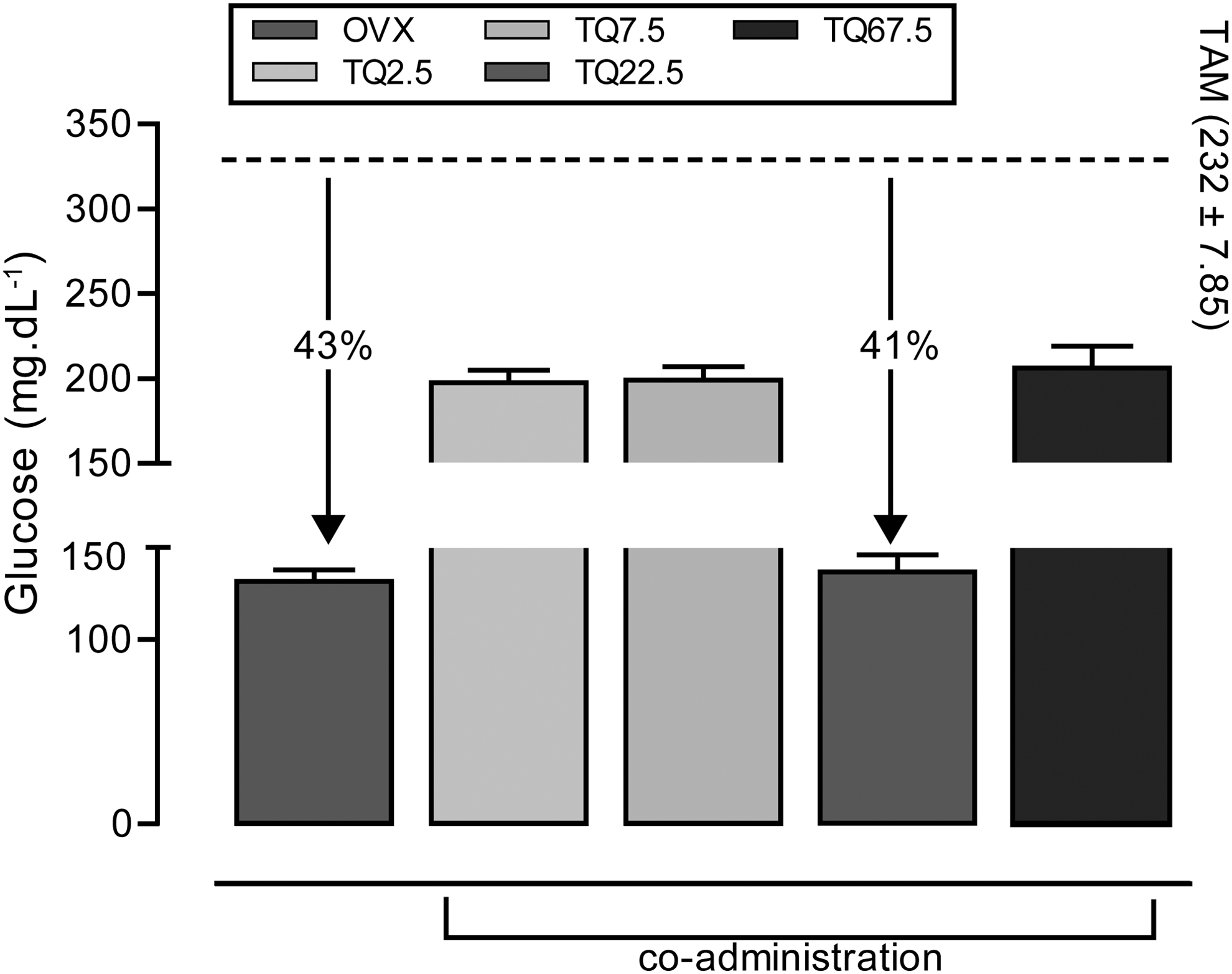
Antagonistic effect of quercetin at a concentration of 22.5 mg.kg−1 body weight on hyperglycemia induced by tamoxifen. The figure shows that the group receiving 22.5 mg.kg−1 b.w. quercetin (TQ22.5) and coadministered tamoxifen showed lower glucose levels than the control group (OVX).
Effect of coadministration of tamoxifen and quercetin on BuChE
There was no significant change in plasma BuChE activity in the groups that were coadministered quercetin and tamoxifen, compared to the TAM group (P > .05) (Fig. 3A). Liver homogenate also showed similar results (Fig. 3B). In contrast, for the intestine homogenate, all groups treated with quercetin and tamoxifen showed significantly lower BuChE activity than the group treated only with tamoxifen (P = .000386; Fig. 4A). The dose–response curve of log quercetin (Fig. 4B) shows a U-shaped curve, where the doses of 7.5 (log = 0.875; P = .000046) and 22.5 mg.kg−1 b.w. (log = 1.35; P = .000075) were more effective in decreasing the BuChE activity than the doses of 2.5 (log = 0.398; P < .01) and 67.5 mg.kg−1 b.w (log = 1.83; P < .01). Interestingly, in adipose tissue, the dose–response curve of log quercetin (Fig. 4D) showed that 7.5 and 22.5 mg.kg−1 b.w. quercetin interfered significantly with the BuChE activity (P < .05), decreasing and increasing the BuChE activity, respectively. The remaining doses did not interfere with the BuChE activity in this tissue (P > .05) (Fig. 4C). Furthermore, it was only in this tissue that the treatment with tamoxifen significantly decreased the BuChE activity compared to the BuChE activity in the control group (P < .05). In the other tissues and in plasma, there was no statistically significant change (P > .05, Table 1).
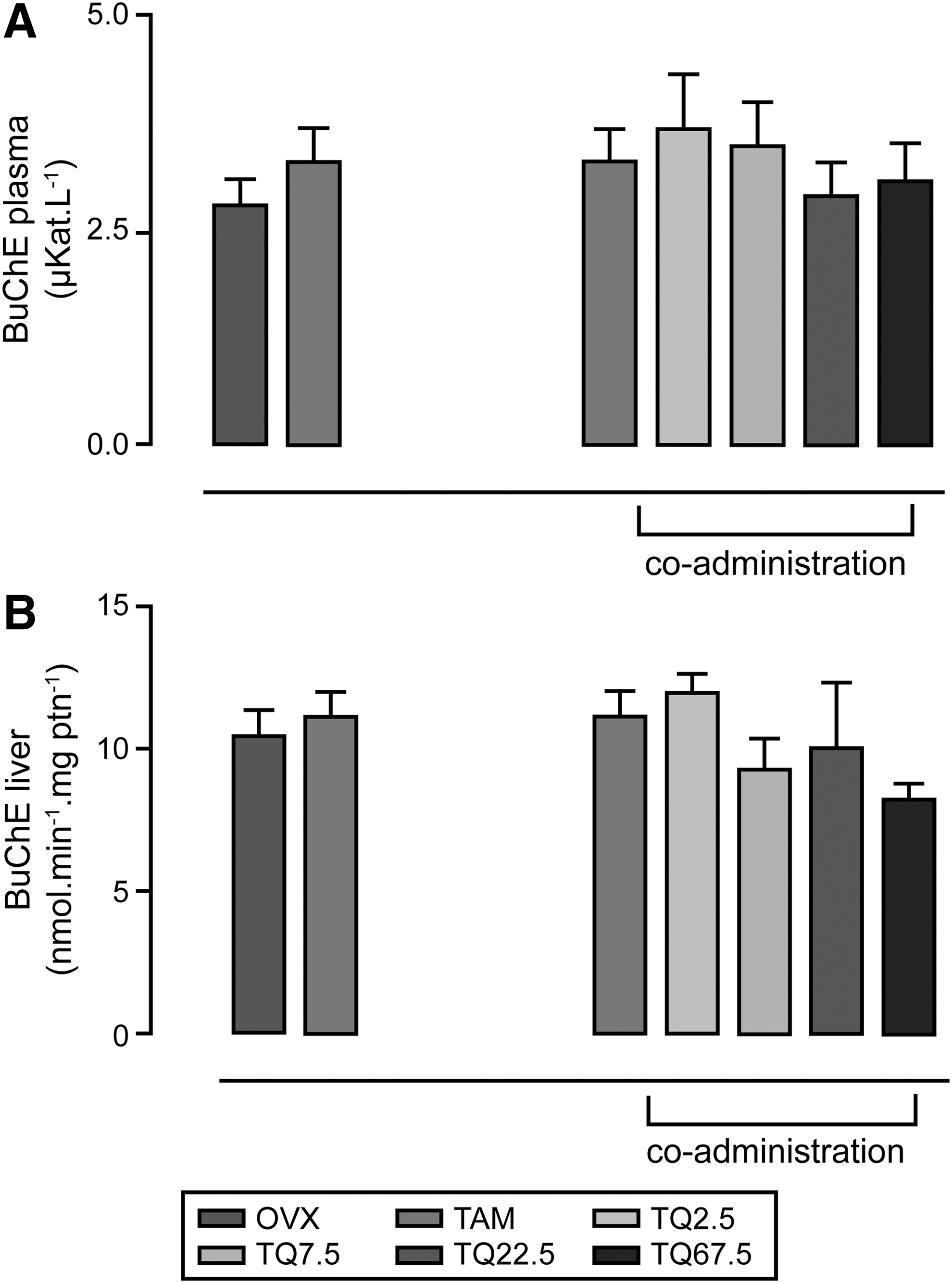
Effect of coadministration of tamoxifen and quercetin on butyrylcholinesterase activity in the liver and plasma. There were no significant changes in the activity of butyrylcholinesterase in the plasma
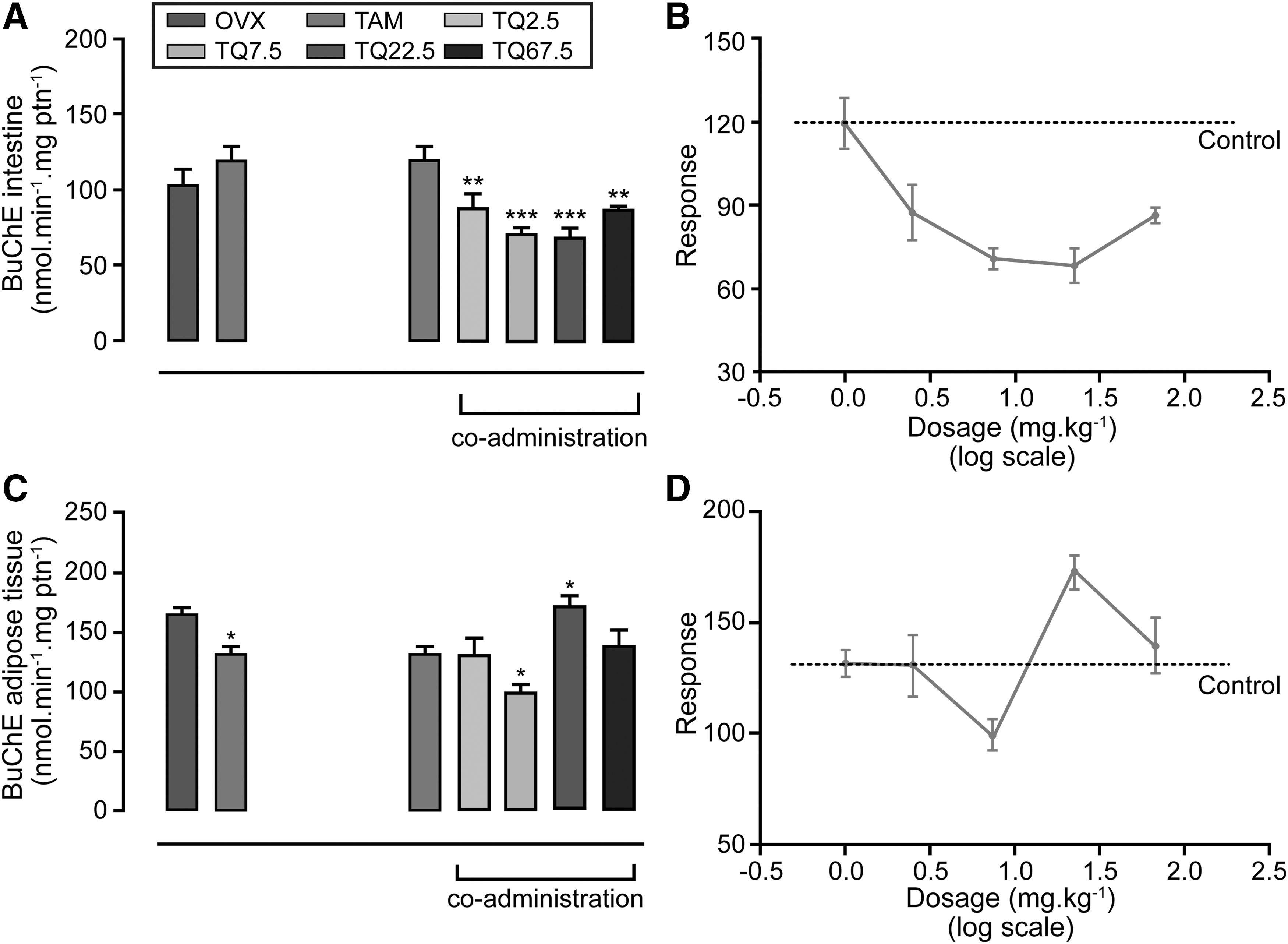
Effect of coadministration of quercetin at different concentrations and tamoxifen on butyrylcholinesterase activity. The effects in the intestine
Correlation between the activity of BuChE and glucose levels
The Pearson correlation coefficient (r) of the correlation between the activity of BuChE in plasma and homogenates of liver, intestine, and adipose tissue and the glucose levels in the various groups treated with quercetin and tamoxifen is shown in Figure 5. There was a strong positive and moderate correlation between BuChE activity in the intestine and glucose level (r = 0.7773, P = .1219; Fig. 5A) and between BuChE activity in the plasma and glucose level (r = 0.5184, P = .3708; Fig. 5B), respectively. In adipose tissue, a moderate correlation was observed between the two variables (Fig. 5C). However, the possible dependence was inversely linear, because when a variable increased the other tended to decrease (r = −0.6601, P = .2253). The liver showed a weak correlation between the variables (r = −0.3063, P = .6162; Fig. 5D).
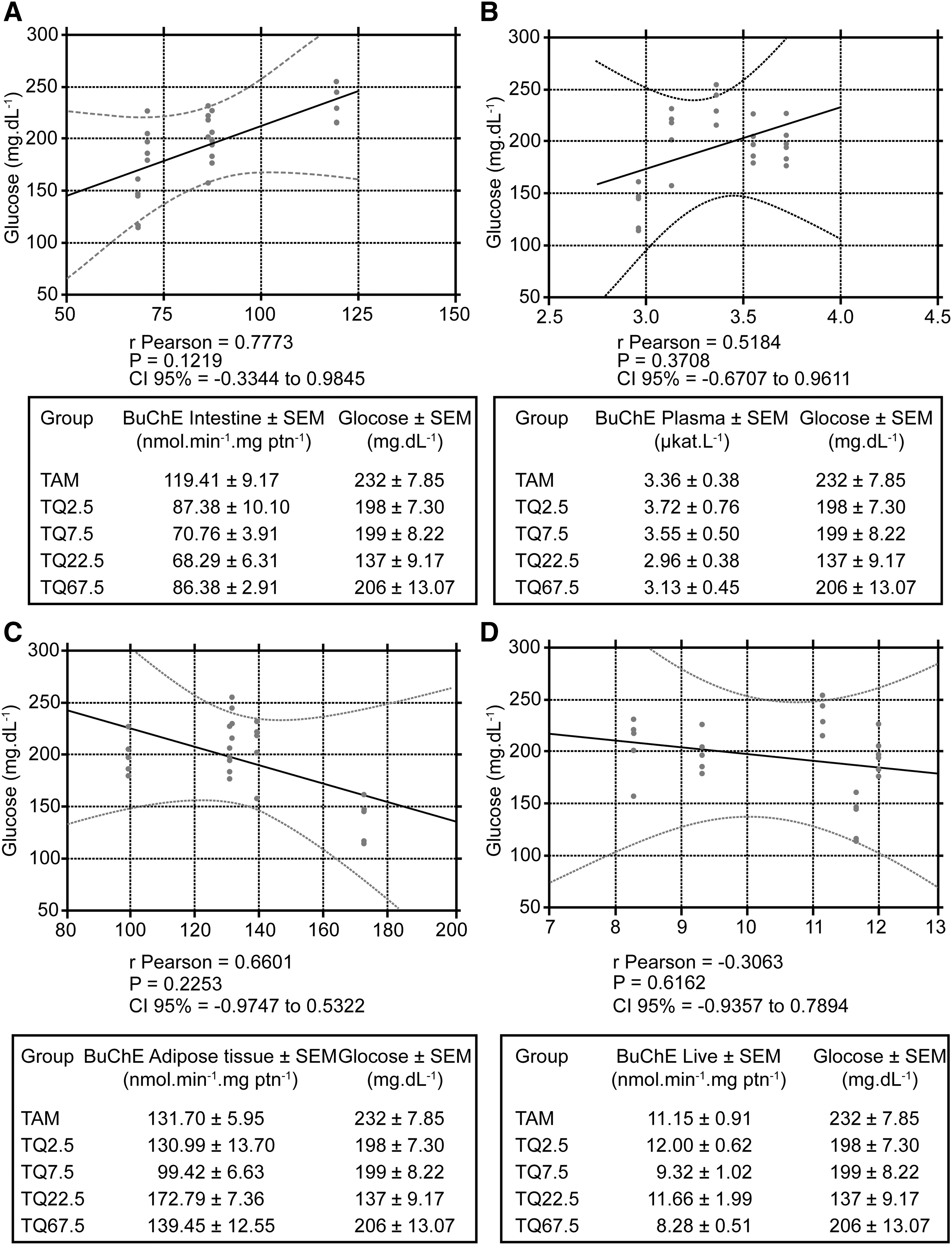
Correlation between the activity of butyrylcholinesterase and glucose levels in groups treated with tamoxifen and different concentrations of quercetin. The figure shows the positive correlation between butyrylcholinesterase activity in the intestine and glucose level
Hippocratic test
Administration of quercetin at dose 67.5 mg.Kg−1 b.w. resulted in slow response of corneal and pineal reflex of both sexes (data not shown). These effects began at 4 h after administration and ceased within 6 h. No other signs and symptoms or occurrence of deaths was observed. The internal organs of both sexes did not show any unusual signs and were found to be normal in both size and color.
Discussion
There has been an increasing evidence of the link between these two diseases, indicating that there is a high risk of breast cancer development in women with diabetes, as well as increased risk of developing diabetes in women being treated for breast cancer. 22 Treatment with tamoxifen can contribute to this increased risk due to the development of hyperglycemia by inducing changes in glucose metabolism.
These changes may be caused by inhibition of the estrogen receptors or may occur owing to a direct action of tamoxifen on the mitochondrial respiratory chain of hepatocytes. In the pancreatic β cells, estrogen binds to its receptor, activating guanylyl cyclase that stimulates the secretion of insulin. 23 Tamoxifen binds to estrogen receptors and acts as an antagonist by interfering with the regulatory processes. 24 There is also an association between the antiestrogenic activity of tamoxifen and weight gain, leading to increased insulin resistance. 22 In mitochondria, tamoxifen affects membrane potential by altering membrane fluidity, electron transport by altering the redox state through excessive free radicals generation with consequent decrease in ATP synthesis, and alters the glucose regulation pathways. 4
The current study showed that relatively short-term use of tamoxifen induces hyperglycemia in ovariectomized rats; and the use of quercetin is a viable alternative for reducing plasma glucose levels, as long as the Que/TAM ratio is approximately 4.5/1. At this ratio, the plasma glucose values decreased drastically to the plasma glucose values very close to those found in control group ovariectomized rats (without the use of tamoxifen). The other doses of quercetin showed minimal effects under the studied conditions. Other studies have reported different doses of quercetin to be effective, indicating that the results vary according to the experimental procedure and according to the type of combined treatment. 25
Regardless of the study type, there is a consensus that the mechanisms involved in the hypoglycemic activity of quercetin result from its antioxidant activity. These include maintaining the integrity of β-pancreatic cells and therefore improving the insulin secretion 26 and the decrease in gluconeogenesis and stimulation of the glycolytic pathway; increased glucose storage in the form of liver and muscle glycogen, 27 and due to antioxidant activity either directly by scavenging reactive oxygen species or indirectly by stimulating enzymes of the antioxidant system. 28 Quercetin can cross cell membranes and is stored in large quantities in the mitochondria. This redistribution could prevent both intramitochondrial and cytosolic oxidative damage, thus contributing to the protection and integrity of cellular metabolism. 29
Although the Hippocratic test has shown that quercetin at a dose of 67.5 mg.kg−1 slightly depressed corneal and pinnal reflex, this action was not considered toxicologically relevant because the effect is temporary and spontaneously reversible within a short period of time. However, at this dose was observed a decrease in their hypoglycemic ability. This is important considering that quercetin also has a pro-oxidant effect. 30 Perhaps at this dose this effect is overlapping, thus decreasing its protective effect on β-pancreatic cells and consequently their hypoglycemic capacity.
Quercetin also exhibits modulatory and interfering activities against a variety of enzymes, including BuChE. 11 Although the exact function of this enzyme is still unknown, studies have shown its wide distribution in the body and related it to several different body functions, 14 including a positive association with diabetes. 16 Our study shows that coadministration of quercetin with tamoxifen interferes with the activity of BuChE in some tissues at different magnitudes.
Because of the different toxicokinetics of tamoxifen and quercetin in particular tissues, the intestine, adipose tissue, and liver were selected in addition to plasma to evaluate the BuChE activity and correlate it with blood glucose levels. A few studies have previously examined the BuChE activity in the intestine, a region responsible for absorption of substances, where contact with tamoxifen and quercetin is probably higher than other tissues. In the intestine, all quercetin doses used significantly decreased the BuChE activity; 22.5 mg.kg−1 b.w. showed the highest inhibition. BuChE in the intestine is primarily associated with cell renewal and lipid absorption. 31 Changes in lipid absorption can increase the production of free radicals, consequently leading to hyperglycemia. 32 Therefore, more studies using the intestine should be performed.
Although previous studies have reported that a small amount of quercetin is present in adipose tissue, 33 BuChE activity in this tissue was affected in the current study. Coadministration of tamoxifen and quercetin showed a biphasic effect on the BuChE activity, with a significant decrease at a dose of 7.5 mg.kg−1 b.w. and an increase at a dose of 22.5 mg.kg−1 b.w. Moreover, it was only in the adipose tissue that the administration of tamoxifen alone led to a significant decrease in the BuChE activity. However, an in vitro study with liver homogenates (unpublished data) showed that tamoxifen at a concentration of 37.5 μM caused approximately 50% inhibition of the BuChE activity. It is suggested that because of its high lipid solubility, 1 tamoxifen may be stored in the adipose tissue and possibly achieve a physiological concentration capable of enzyme inhibition. The biphasic effect observed may be related to tamoxifen concentrations in the adipose tissue. It can be hypothesized that if the bioavailability of tamoxifen is increased by a decrease in its concentration in fatty tissue, the BuChE activity will be less affected. Therefore, a lower BuChE activity in the adipose tissue in the TQ2.5 group may be due to a greater accumulation of tamoxifen, and a higher BuChE activity in the TQ22.5 group may be due to a lower accumulation of tamoxifen in the tissue. A previous study showed a possible interference of quercetin with the bioavailability of tamoxifen. 9 The bioavailability of tamoxifen at Que/Tam ratio of 4.5/1 is high, which has a clinical relevance, because it is known that the BuChE plays an important bioscavenger role by inactivating several xenobiotics. 13
Several studies have shown the inhibitory effect of quercetin on plasma BuChE activity 11 ; however, this was not observed in the present study. Similarly, no inhibitory effect was seen in the liver. BuChE is found in higher concentrations in the liver and plasma than in other tissues, 13,14 because it is synthesized in the liver and released into the bloodstream in free form. Therefore, the coadministration of quercetin and tamoxifen has no effect on the BuChE activity in the liver or in the plasma when administered at the doses studied. It may be due to the greater affinity of quercetin for other enzymes present in the liver, for example, CYP3A4. 9 Further studies are needed to confirm and validate these findings once the result was negative using BuChE as a bioindicator of hyperglycemia.
Investigation of the enzyme activity showed that the applied treatment interferes with the BuChE activity uniquely and at different intensity in each region of the body. This may be associated with the bioavailability of quercetin and tamoxifen in each tissue. To confirm this hypothesis, a study is necessary, where concentrations of quercetin and tamoxifen, as well as of their major active metabolites, are quantified in each tissue.
Although previous studies have shown a positive correlation between BuChE activity and glucose levels, 12,15,16 this study showed no significant correlation (P > .05). It is an important observation, since there are no data in the literature describing this association in the tissues investigated in this study.
Taken together, this relationship should be carefully evaluated considering that the function of BuChE is still unclear. Therefore, it is early to describe it as a biomarker for diabetes. Although studies have shown that quercetin inhibits BuChE, its action is not simple and is probably associated with multiple processes. Further studies in each tissue and particularly in plasma are required to obtain detailed information about the mechanisms involved.
Conclusion
The results of this study show that when quercetin is coadministered with tamoxifen at a ratio of 4.5/1, it is effective in reducing hyperglycemia induced by tamoxifen, but further investigations are needed to detail the mechanisms of action that explains the effect of this association. In addition, BuChE should be used carefully as a possible bioindicator for hyperglycemia, as there is no significant correlation between its activity and glucose levels when there is a combined treatment.
Footnotes
Acknowledgment
The authors thank the Graduate Program in Pharmaceutical Sciences - UNIOESTE.
Author Disclosure Statement
There is no conflict of interest associated with the publication of this work.
References
Supplementary Material
Please find the following supplemental material available below.
For Open Access articles published under a Creative Commons License, all supplemental material carries the same license as the article it is associated with.
For non-Open Access articles published, all supplemental material carries a non-exclusive license, and permission requests for re-use of supplemental material or any part of supplemental material shall be sent directly to the copyright owner as specified in the copyright notice associated with the article.
