




Abstract
Hypertension could cause significant worldwide health problems that affect 15–20% of all adults; according to National Health and Nutrition Examination Survey, about 29% of the adult population in the United States are hypertensive. Recent research has shown that peptides derived from the hydrolysis of food proteins can decrease blood pressure. This study was carried out to evaluate the hypotensive and antihypertensive potential of Mucuna pruriens protein hydrolysates in in vitro and in vivo models. M. pruriens protein concentrate was prepared by wet fractionation and enzymatically hydrolyzed using Alcalase®, Flavourzyme®, and the sequential system Alcalase-Flavourzyme at different times (5–120 min). The biological potential was measured in vitro based on the IC50 value as well as in vivo effect, measuring the systolic (SBP) and diastolic (DBP) blood pressure in normotensive and antihypertensive Wistar-Kyoto rats by the tail-cuff method. Hydrolysis of M. pruriens protein concentrates with commercial enzymes generated extensive hydrolysates with angiotensin-converting enzyme (ACE-I) inhibitory activity (IC50: 0.589–0.993 mg/mL) and hypotensive (SBP: 0.6–47.43%, DBP: 1.94–43.47%) and antihypertensive (SBP: 8.84–27.29% DBP: 16.1–29.37%) effect. These results indicate that Mucuna pruriens protein hydrolysate (MPPH) could be used as a functional ingredient to prevent blood pressure increase.
Introduction
H
In the Framingham Heart Study, the risk ratio for coronary heart disease, stroke, peripheral artery disease, and cardiac failure was about 2–3 times higher for hypertensive subjects than for normotensive subjects. 4 Hypertension was also associated with about a four-fold risk of atherothrombotic brain infarction in comparison with normotension. 5 Clinical trials have shown that, in hypertensive subjects, lowering the blood pressure reduces the risk of CVDs. 6 Decreases in diastolic blood pressure (DBP) of 5, 7.5, and 10 mmHg have been associated with at least 34%, 46%, and 56% reductions, respectively, in the incidence of stroke, and with at least 21%, 29%, and 37% lower rates of coronary heart disease. 7 On the other hand, a 20 mmHg increase in systolic blood pressure (SBP) or a 10 mmHg increase in DBP doubles the risk of CVD in the blood pressure range of 115/75 to 185/115 mmHg. 8
The genus Mucuna, belonging to the Fabaceae family, covers perhaps 100–150 species of annual and perennial legumes. This legume is native to Malaysia, South China, China, and India, but nowadays is widely distributed in many tropical regions. Cultivated and wild varieties from America and Africa were originally introduced and propagated by humans along various commercial routes. 9 The main differences among cultivated species are in the character of the pubescence on the pod, the seed color, and number of days to harvest the pod. So far, improved cultivars have only been produced in (a) Australia (White, Mauritius, Black Mauritius, Somerset, Marbilee, and Smith and Jubilack), (b) USA (Georgia, Alabama, Osceola, Yokohama, and Florida), and (c) Zimbabwe (Bengal, White Stigless, SES 30, SES 45, SES 68, SES 74, and SES 108).
Throughout its distribution range, the species has also been given various scientific names, among them M. deeringianum Bort, M. utilis (Wall) Baker ex Burck, M. pruriens (L.) DC, M. cochinchinensis (Lour) Burk, M. nivea (Roxb.) Kuntze, M. capitata, M. aterrima Piper & Tracy, M. hassjo, M. diabolica, M. cinerum, M. haltonii, and M. sloanei are some of which are just synonyms, but others may represent valid names referring to different taxa. 9 The dry weight composition of Mucuna seeds is as follows: 10.0% moisture; 19.0–37.5% protein; 4.7–9.0% fat; 51.5% nitrogen-free extract (NFE); 81.7% total digestible nutrients; 5.3–11.5% raw fiber, and 2.9–5.7% ash. Among the amino acids found in seeds, the aspartic and glutamic acids are found to be predominant (8.9–19 and 8.6–14.4%, respectively), whereas the levels of other amino acids are found to be low. 10
Alkaline extractions are a technological alternative for protein isolation from M. pruriens. Recent research has focused on the properties of food protein-derived peptides, their biological activities, and potential health benefits. Peptides extracted from partial enzymatic protein hydrolysates of food proteins as M. pruriens can provide specific health benefits such as antihypertensive or antioxidant activities. For the above mentioned, the objective of this study was to evaluate the in vitro ACE inhibitory activity and hypotensive and antihypertensive effect of M. pruriens protein hydrolysates in experimental animal models.
Materials and Methods
Materials
Mucuna pruriens seeds were obtained from the 2007 harvest in the state of Yucatán, México. Reagents were of analytical grade and purchased from J.T. Baker (Phillipsburg, NJ, USA), Sigma Chemical Co. (St. Louis, MO, USA), Merck (Darmstadt, Germany), and Bio-Rad Laboratories, Inc. (Hercules, CA, USA). Alcalase® 2.4 L FG and Flavourzyme® 500 mg enzymes were purchased from Novo Laboratories (Copenhagen, Denmark).
M. pruriens flour
Impurities and damaged seeds were removed. Sound seeds were milled in a Mykros impact mill until passing through a 20-mesh screen (0.85 mm), and then in a Cyclotec 1093 (Tecator, Höganäs, Skåne län, Sweden) mill until passing through a 60-mesh screen (0.24 mm).
Nitrogen solubility of M. pruriens flour
Nitrogen solubility was determined by the method of Chel-Guerrero et al.
11
M. pruriens flour (125 mg) was dispersed in 25 mL deionized water and adjusted to pH 3.5, 4.0, 4.4, 4.5, 4.6, and 5.0 with either 0.01 or 1.0 N NaOH or HCl. The dispersions were shaken for 30 min at ambient temperature and centrifuged at 43,503 g for 30 min. Nitrogen content in the supernatant was determined by the Bradford method,
12
and the percent soluble protein was calculated as follows:
Protein concentrate
A single protein extraction was done with the legume flour. This was processed using the wet fractionation method of Herrera-Chalé et al. 13 Briefly, whole flour was suspended in distilled water at a 1:6 (w/v) ratio, pH adjusted to 11 with 1 mol/L NaOH, and the dispersion stirred for 1 h at 400 rpm with a mechanical agitator (Caframo RZ-1, Heidolph Schwabach, Germany). This suspension was wet-milled with a Kitchen-Aid® mill and the fiber solids separated from the starch and protein mix by straining through 80- and 150-mesh sieves, followed by five washings of the residue with distilled water.
The protein–starch suspension was allowed to sediment for 30 min at room temperature to recover the starch and protein fractions. The pH of the separated solubilized protein was adjusted to its isoelectric point (4.6) with 1 mol/L HCl. The suspension was then centrifuged at 1317 g for 12 min (Mistral 3000i; Curtin Matheson Scientific, Inc., Morris Plains, NJ, USA), the supernatants discarded, and the precipitates freeze-dried at −47°C and 13 × 10−3 mbar, then stored in polyethylene bags at room temperature until its use.
Proximate composition of M. pruriens flour and protein concentrate
Standard AOAC 14 procedures were used to determine nitrogen (method 954.01), fat (method 920.39), ash (method 925.09), crude fiber (method 962.09), and moisture (method 925.09) contents in the M. pruriens flour and protein concentrate. 14 Nitrogen content (N) was quantified with the Kjeldahl method using Kjeltec Digestion System (Tecator). Protein content was calculated as N × 6.25. Fat content was obtained from a 1 h hexane extraction. Ash content was calculated from sample weight after burning at 550°C for 2 h. Moisture content was measured based on sample weight loss after oven-drying at 110°C for 2 h. Carbohydrate content was estimated as NFE by difference from the sum of the protein, fat, ash, and crude fiber content. The protein content of the M. pruriens hydrolysates was determined by the Lowry et al. method. 15
Enzymatic hydrolysis
Protein extract hydrolysis was performed using a totally randomized design. Treatments were the enzymatic systems: Alcalase 2.4 L FG, Flavourzyme 500 mg (Novo Laboratories), and Alcalase-Flavourzyme sequential system. The response variable was the degree of hydrolysis (DH). The M. pruriens protein concentrate (5 g/100 mL) was hydrolyzed for 5, 15, 30, 45, 60, 90, and 120 min with Alcalase, Flavourzyme, and the Alcalase-Flavourzyme sequential system. In this case, half the hydrolysis time was used with each enzymatic system.
Hydrolysis was done under controlled conditions (temperature, pH, and stirring) in a reaction vessel equipped with a stirrer, thermometer, and pH electrode. Hydrolysis temperature was 50°C in all cases and other parameters with Alcalase 2.4 L FG and Flavourzyme 500 mg were as follows: enzyme/substrate ratio, 0.3 AU/g for Alcalase and 50 leucine aminopeptidase units per gram for Flavourzyme; and pH 8 for Alcalase and pH 7 for Flavourzyme. 16 In all treatments, the reaction was stopped by heating to 80°C for 20 min, followed by centrifuging at 9880 g for 20 min to remove the insoluble portion.
Degree of hydrolysis
DH was calculated by determining free amino groups with o-phthaldialdehyde following the methodology described by Nielsen et al. 17 : DH = h/htot × 100; where htot is the total number of peptide bonds per protein equivalent, and h is the number of hydrolyzed bonds. The htot factor is dependent on the raw material amino acid composition and was determined by reverse-phase high-performance liquid chromatography (HPLC). 18 Samples (2–4 mg protein) were treated with 4 mL of HCl (6 mol/L), placed in hydrolysis tubes, and gassed with nitrogen at 110°C for 24 h. Then, they were dried in a rotary evaporator and suspended in 1 mol/L sodium borate buffer at pH 9.0.
Amino acid derivatization was performed at 50°C using diethyl ethoxymethylenemalonate. Amino acids were separated using HPLC with a reversed-phase column (300 × 3.9 mm, Nova Pack C18, 4 mm; Waters, Massachusetts, USA) and a binary gradient system with 25 mmol/L sodium acetate containing (A) 0.02 g/L sodium azide at pH 6.0, and (B) acetonitrile as solvent. Flow-rate was 0.9 mL/min, and elution gradient was: time 0.0–3.0 min, linear gradient A:B (91:9) to A–B (86:14); time 3.0–13.0 min, elution with A–B (86–14); time 13.0–30.0 min, linear gradient A–B (86:14) to A–B (69:31); time 30.0–35.0 min, elution with A–B (69:31).
In vitro ACE inhibitory activity
The ACE inhibiting activity of protein hydrolysate was analyzed according to Hayakari et al.
19
ACE hydrolyzes hippuryl-
The ACE inhibiting activity was quantified by a regression analysis of ACE-inhibiting activity (%) versus peptide concentration, and the IC50 value (i.e., the peptide concentration in μg protein/mL required to produce 50% ACE inhibition under the described conditions) defined and calculated as follows:
where A represents absorbance in the presence of ACE and sample, B is absorbance of the control, and C is absorbance of the reaction blank.
where b is the intersection and m is the slope.
Hypotensive effect of M. pruriens protein hydrolysates in animal models
For this experiment, normotensive Wistar-Kyoto rats (8–10 weeks old; 240–320 g initial weight) were housed in individual cages under controlled conditions (12-h light:12-h dark period; 25 ± 1°C; 65 ± 5% relative humidity). 20 All animal experimentations have been conducted in accordance with the guidelines for care and use of experimental animals of the European Communities Council Directive 86/609/EEC. 21 Free access was provided to feed and water. After one week of adaptation period, the rats were randomly divided into groups (five rats per group): each group with three concentrations (5, 10, and 15 mg/kg body weight, diluted in 0.3 mL physiological saline solution [PSS]) of selected hydrolyzed with the best in vitro activity, and additionally two groups as positive and negative control. (Captopril® and PSS were used as positive and negative control, respectively).
Before the determination of blood pressure, animals were anesthetized (20 min) with a single dose (30 mg/kg) of sodium barbital by intraperitoneal (IP) injection. The measurements of SBP and DBP were recorded for at least 160 min using an electric sphygmomanometer on the tail. The original method for measuring arterial blood pressure using the tail cuff provides SBP and DBP values detected by a physiographer (CPM Physiograph Narco Bio-System, Inc., Houston, TX, USA). The blood pressure signals were acquired (at 1.0 kHz) on a computer using the analog-digital converter Mini Digi B (Axon Instruments, California, USA) and software AxoScope 10.2. To analyze the blood pressure reading, a 10.2 Clampfit (Axon Instruments) was used.
Blood pressure was recorded for at least 160 min for each rat. The first 20 minutes of this time period were used to measure basal blood pressure and then administered via IP evaluate treatments: negative control (PSS), positive control (Captopril) and hydrolysates. The same person took all measurements to minimize stress-induced variations in blood pressure, in the same peaceful environment. Moreover, to guarantee the reliability of measurements, we established a training period of 2 weeks before the actual trial time, and during this period, the rats were accustomed to the procedure. Determinations were made in triplicate. The percentage of hypotensive effect was calculated from the following formula:
where
PA Exp = SBP and DBP observed after administration of PSS, captopril, and hydrolysates,
PA Ctrl = basal blood pressure observed during the first 20-min registration.
Antihypertensive effect of M. pruriens protein hydrolysates in animal models
Adult male Wistar rats (8–10 weeks old) weighing 240–320 g were used in this study. The animals were housed at 25 ± 1°C on a 12-h light:12-h dark cycle and had free access to standard rat chow and drinking water. Fifty rats were used for all treatments and these were divided into seven experimental groups (five rats per group). Hypertension was induced by oral administration of the nitric oxide synthase (NOS) inhibitor N
ω-nitro-
Two hydrolysate concentrations with higher hypotensive effect were evaluated: 5 and 10 mg/kg body weight, diluted in 0.3 mL PSS. Captopril and PSS were used as positive and negative control. Before the determination of blood pressure, animals were anesthetized with a single dose (30 mg/kg) of sodium barbital by IP injection. Measurements of SBP and DBP blood pressure were recorded for at least 160 min using an electric sphygmomanometer on the tail as described before. Also, during treatment, the bodyweight of rats was monitored for 2 weeks, and each week, the chemistry of urine was evaluated to assess their renal function using qualitative analysis with test strips from Axmilab® brand, Uricheck10.
Statistical analysis
A t-student test was carried out for comparison of proximate analysis of flour and concentrate, and a one-way analysis of variance was run to evaluate protein extract hydrolysis data, in vitro ACE inhibiting activity as well as in vivo hypotensive and antihypertensive effect. A Duncan multiple range test was applied to determine differences between treatments. All analyses were done according to Montgomery 23 with the Statgraphics Plus version 5.1 software.
Results and Discussion
Nitrogen solubility of M. pruriens flour
Solubility characteristics of protein are among the most important functional properties since many functional performances of proteins depend upon their capacity to go into solution initially. For that reason, the solubility profile of M. pruriens flour was determined (Fig. 1). The nitrogen solubility was pH dependent (P < .05) and ranged from 5.5% to 9.0%. The lowest solubility registered in this study was at pH 4.6, which was statistically different to others pH assayed. This result was similar to that reported by Adebowale et al. 24 for M. pruriens (4–5%) as well as by Chel-Guerrero et al. 11 for Phaseolus lunatus and Canavalia ensiformis (4.5%). The lowest nitrogen solubility value (4.6) was used as reference to separate the solubilized protein during protein concentrate extraction.

Nitrogen solubility of Mucuna pruriens flour. Data are mean ± standard deviation (n = 3). abcDifferent letters indicate statistical difference (P < .05).
Proximate composition of M. pruriens flour and protein concentrate
Proximate assay is an important criterion to assess the overall composition and nutritional status of any ingredient intended for food use. In this context, M. pruriens flour and protein concentrate were analyzed for different quality attributes such as moisture, crude protein, crude fat, crude fiber, ash, and NFE. Proximate composition showed significant variations among samples. The M. pruriens flour and protein concentrate had moisture of 9.29% and 3.18%; ash of 3.56% and 7.12%; crude fiber of 3.71% and 3.45%; fat of 6.85% and 13.11%; protein of 31.28% and 55.12%, and NFE of 45.31% and 18.01%, respectively (Table 1). These findings regarding proximate composition are in conformity with values described in previous literature.
Different superscript letters in the same row indicate statistical difference (P < .05).
NFE, nitrogen-free extract.
The chemical composition of M. pruriens flour and protein concentrate was analyzed by Segura-Campos et al. 25 and observed that moisture, ash, fiber, fat, protein, and NFE were 7.61–3.26%, 1.13–0.09%, 1.13–0.13%, 5.59–15.22%, 26.5–57.88%, and 58.05–23.42%, respectively. In array of investigations, variations in proximate composition of different legumes have been observed owing to different environments, genotype, and analytical methods. It was further reported that protein content is sensitive to rainfall, light intensity, length of growing season, day duration, temperature, and agronomic practices. 26
The proteins are polymers of amino acids and their relative proportion represents its quality that is dependent on the genetic makeup of legumes. According to Sadiq and Batool, 27 variations in protein contents of different protein isolates or concentrates could possibly by due to the extent of soluble proteins present in raw materials as well as the used extraction method. The protein content of M. pruriens protein concentrate (55.12%) makes from this legume a viable alternative to obtain biologically active peptides.
Enzymatic hydrolysis
Protein hydrolysates from M. pruriens were obtained by treatment with the endoprotease Alcalase, the endo/exoprotease Flavourzyme, and the sequential system Alcalase-Flavourzyme. Theses proteases are used in the food industry to improve the functional and nutritional properties of protein preparations. According to Pedroche et al., 28 the controlled liberation of biologically active peptides from protein by enzymatic hydrolysis is one of the most promising trends concerning medical applications of protein hydrolysates with DH higher than 10%, while hydrolysates with a low DH (lower than 10%) are used for the improvement of functional properties of flours or protein isolates. Therefore, the results indicate that M. pruriens proteins are an appropriate substrate for producing these bioactive peptides when hydrolyzed enzymatically (Fig. 2).
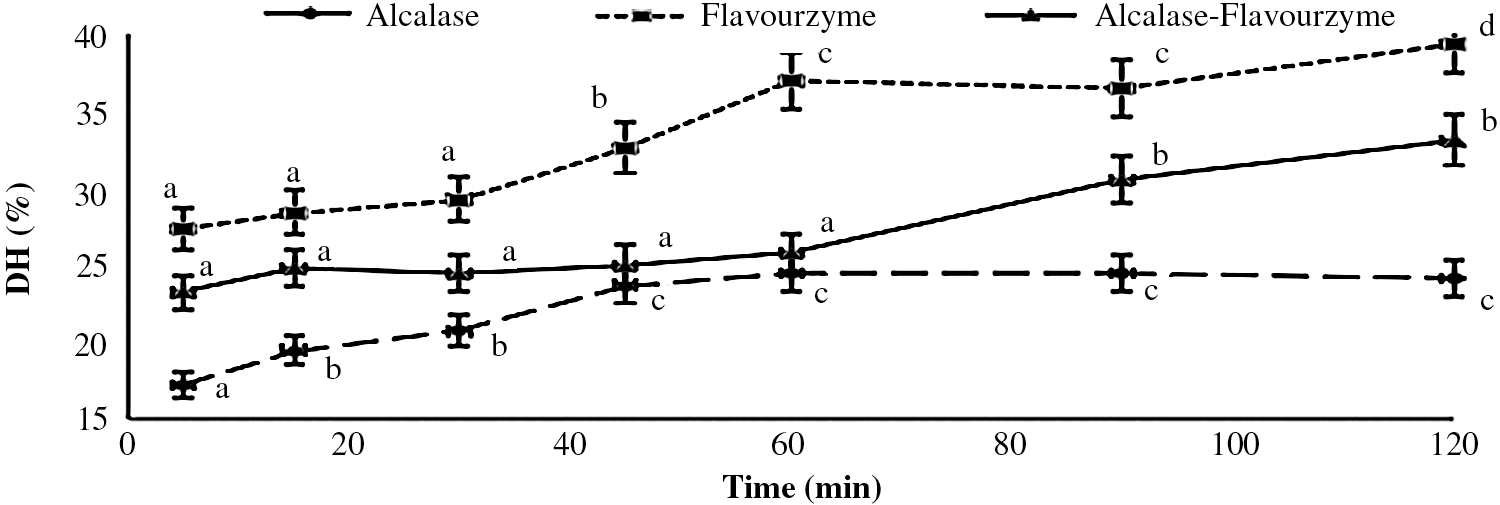
Degree of hydrolysis of Velvet bean (M. pruriens) protein hydrolysates. abcdDifferent letters in the same system indicate statistical difference (P < .05).
The highest DH for the M. pruriens protein concentrate was produced with Flavourzyme at 120 min reaction time (39.39%), while the lowest DH (17.23%) was produced with Alcalase at 5 min reaction time. Variation in DH values among these results was probably the result of protease specificity. The highest DH produced using Flavourzyme to hydrolyze the M. pruriens protein concentrate resulted from it being a protease complex produced by Aspergillus oryzae, which contains endoproteinases and exoproteinases. This fungal protease complex has a broader specificity, which, when combined with its exopeptidase activity, produces DH values as high as 50% and dipeptides in the hydrolysate. 29
The highest DH obtained in the M. pruriens protein concentrate by hydrolysis with Flavourzyme was lower than that reported by Megías et al. 16 for chickpea hydrolysates produced sequentially with Alcalase and Flavourzyme (65% DH) at 150 min. All these hydrolysates had higher DH than mung bean (Vigna radiata) protein hydrolysates produced with neutrase (12%) at 10 h, and higher than for soy protein hydrolysates produced with pepsin for 60 min (11% DH) and 180 min (17% DH). 30
In vitro ACE inhibitory activity
The M. pruriens protein hydrolysates obtained with Alcalase (90 and 120 min), Flavourzyme (5 and 120 min), and the sequential system Alcalase-Flavourzyme (90 and 120 min) were selected to evaluate the ACE inhibitory activity. These hydrolysates registered IC50 values ranging from 0.589 to 0.993 mg protein/mL, similar to that reported for enzymatic hydrolysates from different protein sources (IC50 = 0.2–2.467 mg protein/mL) with antihypertensive activity in spontaneously hypertensive rats. 31
After extensive hydrolysis with Alcalase (DH = 24.5% and 24.14%) for 90 and 120 min, an M. pruriens concentrate had a 0.809 and 0.589 mg/mL IC50, while with Flavourzyme (DH = 27.31% and 39.39%) the IC50 was 0.789 and 0.630 mg/mL at 5 and 120 min. When M. pruriens was hydrolyzed for 90 and 120 min with Alcalase-Flavourzyme sequential system (DH = 30.54% and 33.14%), the resulting IC50 was 0.940 and 0.993 mg/mL (Fig. 3). This suggests that size of generated peptides is important, since these must fit into slit between ACE domains that contain their active sites. This restricts the access of large polypeptides into active sites. Also the sequence of these is important because the presence of hydrophobic amino acids for ACE inhibitory activity is required. 32 This may occur in the case of Alcalase that has demonstrated great ACE inhibitory activity according to Murray and Fitzgerald. 33
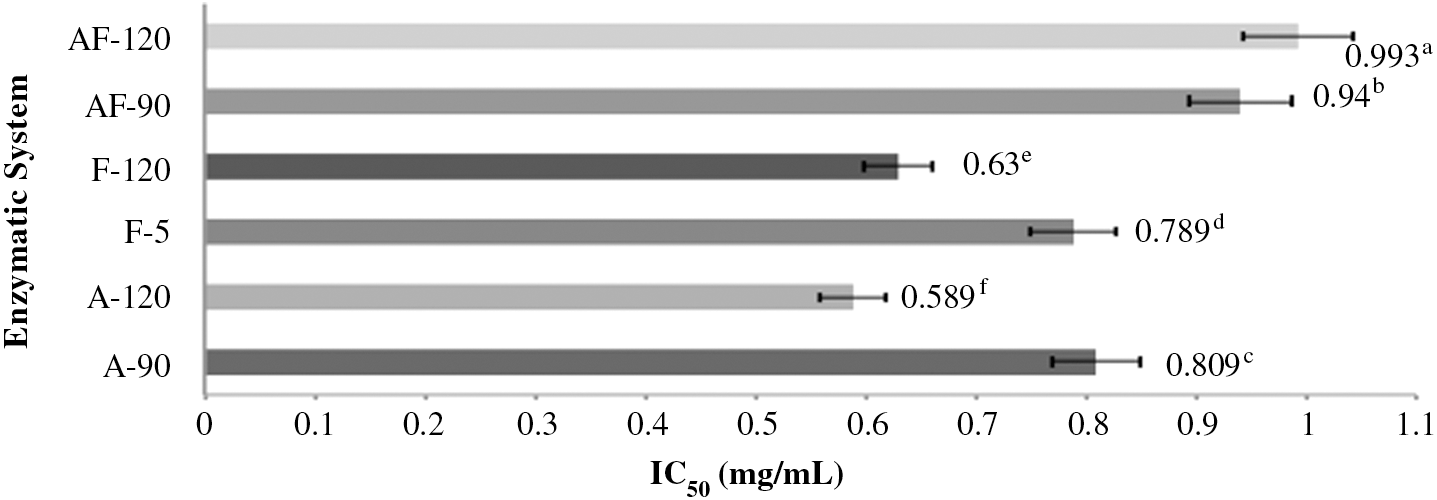
Angiotensin-converting enzyme (ACE-I) inhibitory activity (IC50) of M. pruriens protein hydrolysates. abcdefDifferent letters indicate statistical difference (P < .05).
Hypotensive effect of M. pruriens hydrolysates in experimental animal models
The M. pruriens protein hydrolysates obtained with Alcalase (90 and 120 min), Flavourzyme (5 and 120 min), and the sequential system Alcalase-Flavourzyme (90 and 120 min) were selected to evaluate the hypotensive effect in animal models. In this study, the hypotensive effect of the M. pruriens protein hydrolysates was evaluated using a trial where normotensive rats were administered a single dose of hydrolysates (5, 10, and 15 mg/kg) by IP injection and the tail cuff method was used to measure the blood pressure levels. The peptides in the six analyzed M. pruriens protein hydrolysates exhibited hypotensive effect in experimental animal model excepting Flavourzyme hydrolysate at 5 min administered at the concentration of 5 mg/kg (Fig. 4).
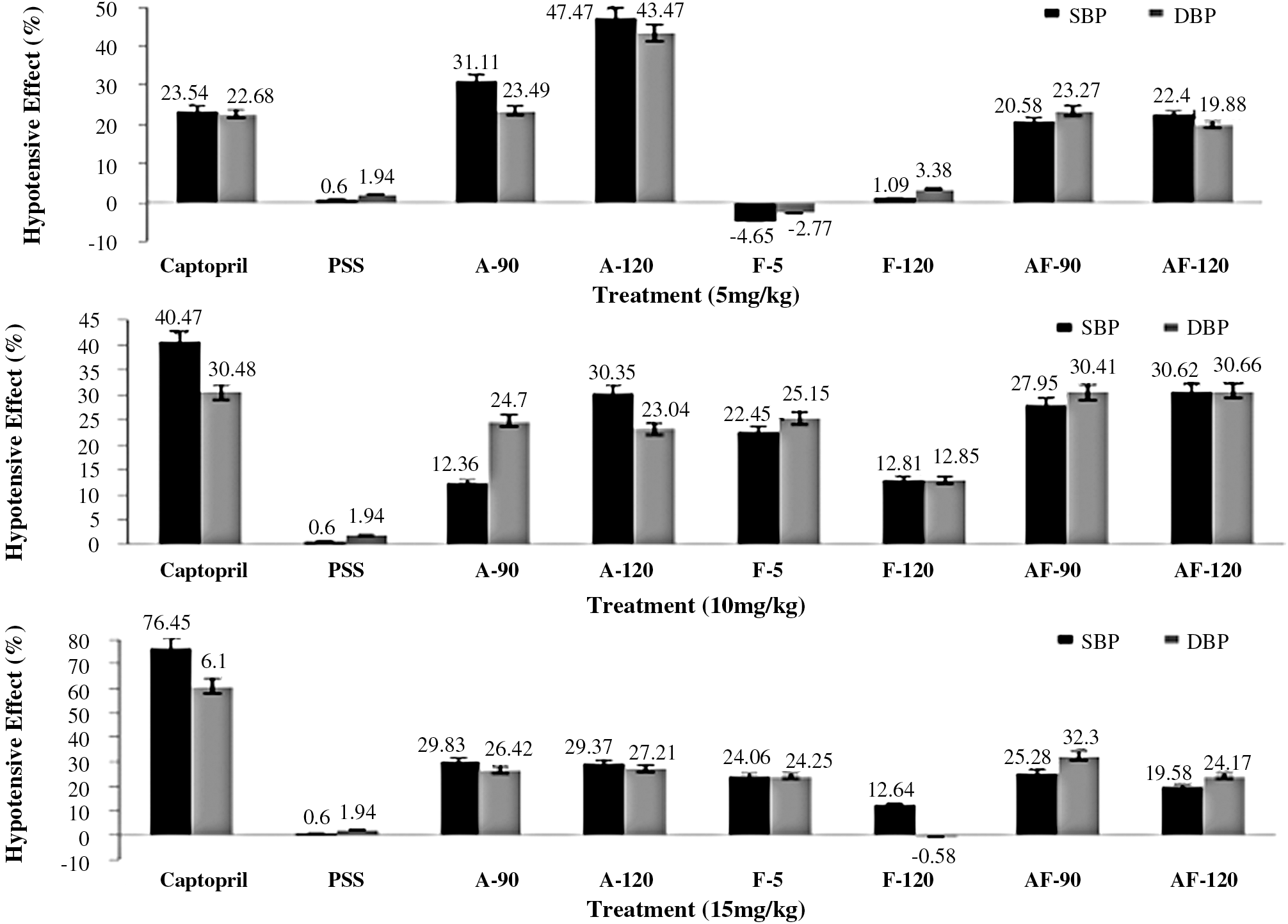
SBP and DBP reduction of captopril, PSS, and the M. pruriens protein hydrolysates administered a single dose (5, 10, and 15 mg/kg) by intraperitoneal injection to normotensive rats. A-90, A-120: Alcalase® at 90 and 120 min; F-5, F-120: Flavourzyme® at 5 and 120 min; AF-90, AF-120: Alcalase-Flavourzyme at 90 and 120 min. DBP, diastolic blood pressure; SBP, systolic blood pressure; PSS, physiological saline solution.
The hydrolysate produced with the Alcalase system at 90 min produced reductions in SBP ranging from 12.36% to 31.11% after 160 min, and a maximum reduction of 26.42% in DBP. The hydrolysate produced with the Alcalase system at 120 min produced reductions ranging from 29.37% to 47.43% in SBP and 23.04% to 43.47% in DBP. When Flavourzyme system at 5 min was injected, a maximum reduction of 24.06% and 25.15% in SBP and DBP was observed.
The hydrolysate produced with the Flavourzyme system at 120 min produced reductions in SBP ranging from 1.09% to 12.81% and a maximum reduction of 12.85% in DBP. When Alcalase-Flavourzyme sequential system at 90 and 120 min was injected, a maximum reduction of 27.95% and 30.62% was produced in SBP and 32.30% and 30.66% in DBP. On the other hand, the results show that the negative control (PSS) registered a nonsignificant hypotensive effect (SBP = 0.6%, DBP = 1.191%), while the positive control (Captopril) was dosage dependent with SBP and DBP reductions ranging from 23.54% to 76.45% and 22.68% to 61%, respectively.
The hypotensive effect of all M. pruriens protein hydrolysates evaluated at 5, 10, and 15 mg/kg registered statistical equality (P > .05), suggesting that the hypotensive effect was in the stable phase of the curve. Therefore, future researches with these hydrolysates should be conducted to lower dosage.
Antihypertensive effect of M. pruriens hydrolysates in experimental animal models
The M. pruriens protein hydrolysates obtained with Alcalase (90 and 120 min), Flavourzyme (5 min), and the sequential system Alcalase-Flavourzyme (90 and 120 min) were selected to evaluate the antihypertensive effect in animal models. Hypertension was induced by oral administration of the nonselective NOS inhibitor
Hypertensive effect by IP administration of the NOS inhibitor
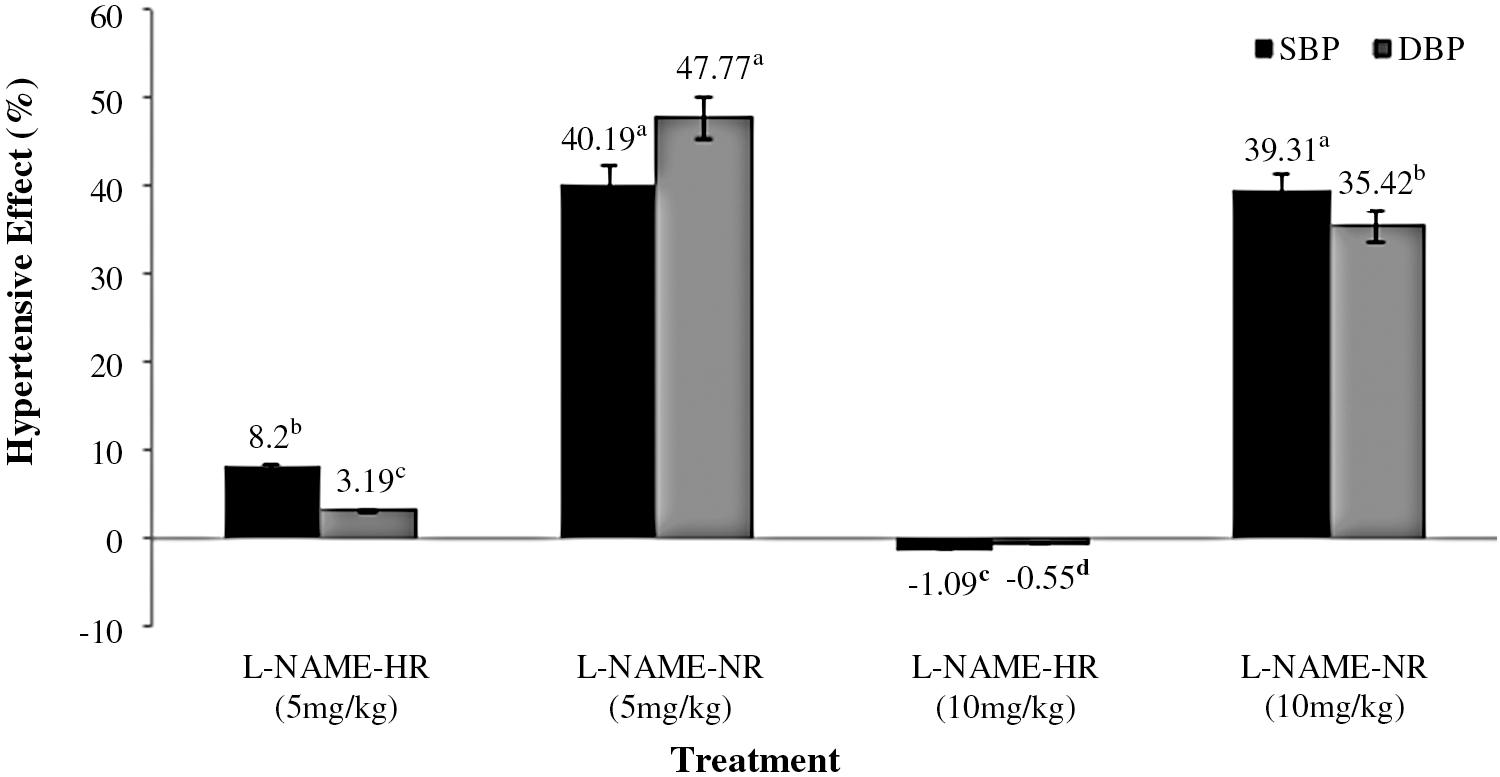
Hypertensive effect by intraperitoneal administration of the NOS inhibitor L-NAME (25 mg/kg/day) to HR and NR. abcdDifferent letters in the same blood pressure indicate statistical difference (P < .05). NOS, nitric oxide synthase;
The experimental models treated and not treated with
(—) Indicates absence of the measured parameter.
The antihypertensive effect of the M. pruriens protein hydrolysates that registered the higher hypotensive effect, at lower doses that were statistically equal (P > .05) corresponding to the same enzyme system, were evaluated using a trial where rats with induced arterial hypertension were administered a single dose of hydrolysates by IP injection (Fig. 6). The Alcalase hydrolysate at 90 and 120 min (5 mg/kg) produced maximum reductions of 25.53% and 27.29% in SBP and of 23.01% and 29.37% in DBP, respectively. These values are similar to those obtained with the lowest captopril dose and was observed dose dependent since the increase to 10 mg had statistically better response (P < .05). These levels were similar to report by Betancur-Ancona et al. 35 for P. lunatus and P. vulgaris peptide fractions obtained by enzymatic hydrolysis.
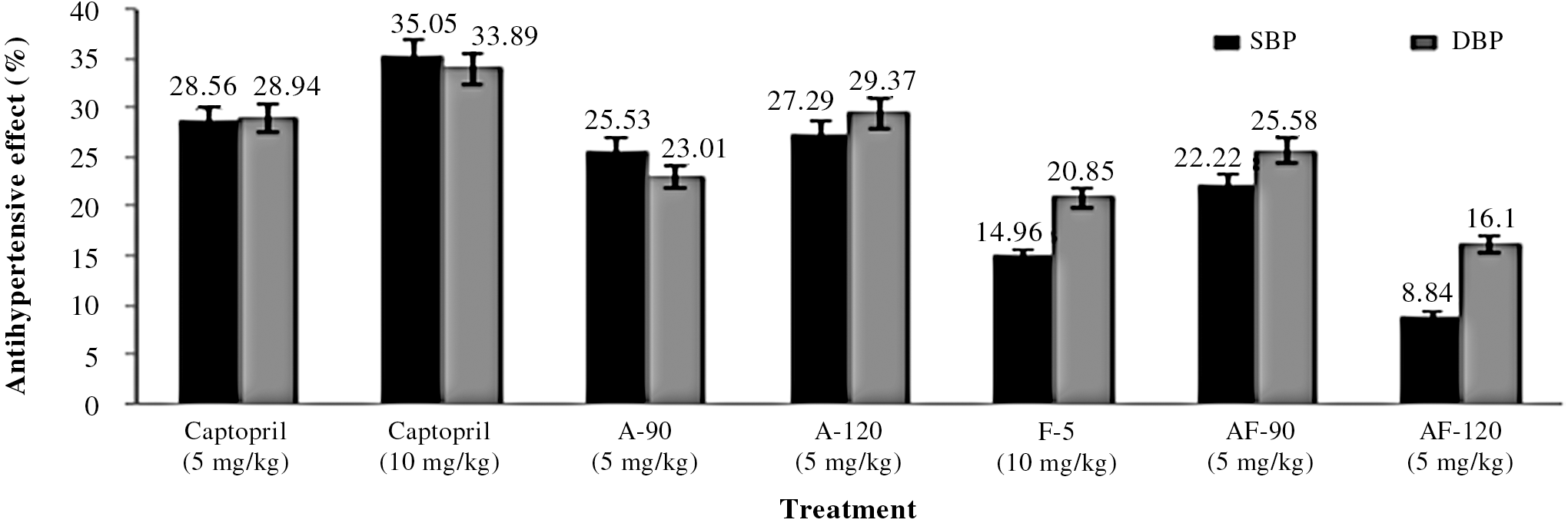
SBP and DBP reduction of captopril and the M. pruriens protein hydrolysates administered a single dose (5 or 10 mg/kg) by intraperitoneal injection to HR. A-90, A-120: Alcalase at 90 and 120 min; F-5: Flavourzyme at 5 min; AF-90, AF-120: Alcalase-Flavourzyme at 90 and 120 min.
The Flavourzyme hydrolysate at 5 min and the Alcalase-Flavourzyme system at 90 and 120 min registered reductions of 14.96%, 22.22%, and 8.84% in SBP and of 20.85%, 25.58%, and 16.10% in DBP, respectively. Antihypertensive peptides from M. pruriens are not as potent as synthetic hypertension drugs (Captopril), but hold promise as safe and natural therapeutic agents free of adverse side effects. This result shows the potential of using M. pruriens protein hydrolysates as an alternative to prevent/control hypertension and related illness.
Conclusions
The IP injection of M. pruriens protein hydrolysates to normotensive and antihypertensive rats produced a hypotensive and antihypertensive effect. By its ACE inhibitory activity in vitro and the in vivo effect, these hydrolysates could be incorporated as functional ingredients with an antihypertensive activity for humans. However, more studies are necessary to clarify the mechanisms responsible for these antihypertensive properties. Before the routine use of these protein hydrolysates, it would be necessary to carry out clinical studies to demonstrate its long-term antihypertensive efficiency in humans.
Footnotes
Acknowledgments
This research was financed by the Consejo Nacional de Ciencia y Tecnología (CONACYT) and Programa de Mejoramiento al Profesorado-PROMEP-SEP (México). The authors thank the “Red Temática de Farmoquímicos del Conacyt-Proyecto 271520” for financial support for this publication.
Author Disclosure Statement
No competing financial interests exist.