




Abstract
Amygdalin is a major component of the seeds of Rosaceae family of plants such as apricots, peaches, cherry, nectarines, apples, plums, and so on, as well as almonds. It is used in alternative medicine for cancer prevention, alleviation of fever, cough suppression, and quenching thirst. The aim of the present study is to determine the mutagenic and recombinogenic effects of amygdalin in a test system Saccharomyces cerevisiae and to evaluate its potential antitumor effect in a yeast cell–based test and colon cancer cell lines. Results obtained show that concentrations 25, 50, and 100 μg/mL did not have any cytotoxic, mutagenic, and carcinogenic effect in yeast cell–based tests. Pretreatment with amygdalin at concentration 100 μg/mL leads to around twofold of the cell survival and decrease of reverse mutation frequency, induced by the alkylating agent methyl methanesulfonate. The frequency of gene conversion and mitotic crossing-over is around threefold lower. The anticarcinogenic potential of amygdalin at the same concentration is presented as around fourfold reduction of Ty1 retrotransposition induced by hexavalent chromium. In summary, data presented in this study provide evidence concerning the inability of amygdalin itself to provoke events related to the initial steps of tumorigenesis. In addition, the observed antimutagenic/antirecombinogenic effect could be activation of error-free and error-prone recombination events. Based on the high selectivity toward normal or tumor cell lines, it could be speculated that amygdalin has higher cytotoxic effect in cell lines with higher proliferative and metabolic activity, which are the majority of fast developing tumors.
Introduction
A
Amygdalin is a major component of the seeds of Rosaceae family of plants such as apricots, peaches, cherry, nectarines, apples, plums, and so on, as well as almonds. 2,7 –9
It is used in alternative medicine for cancer prevention, alleviation of fever, cough suppressant, and quenching thirst. Nowadays, amygdalin is used for prevention and treatment of migraine, hypertonia, chronic inflammation, asthma, bronchitis, emphysema, leprosy, diabetes, colorectal cancer, and vitiligo. 1,10 –12
Contradictory data exist concerning its anticancer effect. In the human body, amygdalin is decomposed to hydrocyanic acid, which is an antitumor compound, and benzaldehyde, with an analgesic effect. Therefore, it is believed that amygdalin can be used for treatment of cancer and to relieve pain 13 –15 . It may induce apoptosis in DU145 and LNCaP cells of prostate cancer by regulating the expression of Bax and of Bcl-2. 14 –17 Another study reported that amygdalin possesses anticancer effect through downregulation of cell cycle–related genes in SNU-C4 human colon cancer cells, 15 as well as inhibition of Bcl2 expression and increase in Bax expression in HeLa cells. 13 On the contrary, Laster and Schabel 18 reported that none of the tested concentrations of amygdalin affected solid osteogenic sarcoma, melanoma, carcinosarcoma, lung cancer tumors, and leukemia in rats and mice. Recent review on randomized controlled trials (RCTs) and quasi-RCTs by Milazzo and Horneber 19 reported that the risk-benefit balance of laetrile or amygdalin as a treatment for cancer is unambiguously negative.
As reported by the National Cancer Institute, the Food and Drug Administration (FDA) has not approved amygdalin for a cancer treatment because of an insufficient clinical evidence of its efficacy and potential toxicity. 10,20 Despite the failure of clinical tests, amygdalin continues to be manufactured and administered as an anticancer therapy in northern Europe and Mexico. 14,21 Although, a lot of data exist concerning the amygdalin mode of action, more detailed information could provide new insights regarding potential antimutagenic and anticarcinogenic application.
The aim of the present study is to determine the mutagenic and recombinogenic effects of amygdalin in a test system Saccharomyces cerevisiae and to evaluate its potential antitumor effect in a yeast cell–based test and colon cancer cell lines.
Materials and Methods
Mutagenicity test
The procedure described by Zimmermann 22,23 was used for detection of spontaneous convertants and revertants with cell cultures of S. cerevisiae diploid strain D7ts1 showing low background. After single treatment or pretreatment with different concentrations of amygdalin for 1 h and subsequent treatment with alkylating agent methyl methanesulfonate, cells were plated to determine survivals and total aberrants, convertants, and revertants.
Carcinogenic effect detection
The Ty1 test is a yeast cell–based test for in vivo detection of carcinogenic effect. 24 The test was used as described by Pesheva et al. 25 using S. cerevisiae strain 551 as a tester strain. Amygdalin (Sigma-Aldrich) dissolved in water was added for 30 min to tester cells; cells were washed with water and the “fold increase of Ty1 transposition” determined. A “fold increase” higher than two compared to the control is considered as a positive response of the Ty1 transposition test.
Cytotoxic/antiproliferative activity of amygdalin
The in vitro cytotoxicity/antiproliferative activity testing was performed on cell cultures from several cancer and normal cell lines using the standard MTT-dye reduction assay, described by Mosmann. 26 Four cell lines were used to confirm the antitumor potential of amygdalin: two tumor—hepatocellular carcinoma (HepG2) and colon carcinoma (HT-29) and two normal—mouse embryonic fibroblasts (BALB/3T3, clone A31) and human fibroblasts (BJ).
Cell line HepG2 is obtained from a patient with hepatocellular carcinoma and it is immortalized. By morphology, the cells are epithelial with 55 chromosomes and are not tumorigenic in mice.
Cell line HT-29 is human colorectal adenocarcinoma. By morphology, the cells are epithelial.
Cell line BJ includes normal cells, obtained from human fibroblasts, which were isolated from healthy reborn skin. The line is with normal karyotype and is with a relatively long life.
Cell line 3T3 is a normal fibroblast, isolated from primary murine embryonic fibroblast cells. The karyotype is with 68 hypertriploid chromosomes, spontaneously immortalized.
A concentration range from 0.075 to 10 mg/mL was applied for 24 and 96 h. All experiments were performed in triplicate. The MTT-formazan absorption was registered using a microplate reader (TECAN; Sunrise TM, Grodig/Salzburg, Austria) at 540 nm.
The relative cell cytotoxicity/viability, expressed as a percentage of the untreated negative controls, was calculated for each concentration.
Statistical analysis
The statistical analysis includes an application of One-way ANOVA with Bonferroni's post hoc test. P < .05 was accepted as the lowest level of statistical significance. Concentrations inducing 50% inhibition of the cell growth (IC50 values) were calculated using nonlinear regression analysis (GraphPad Prism5 Software). At least three independent experiments were performed for each test.
Results
Evaluation of the potential detrimental effect of amygdalin on nuclear DNA
Preliminary results revealed that amygdalin in concentrations of 1 and 10 mg/mL reduces the survival of S. cerevisiae to 72% and 52%, respectively, while concentrations of 25, 50, and 100 μg/mL did not have any cytotoxic effect. The effect on survival of one haploid strain was compared with that of a diploid one. A lack of cell toxicity is observed after treatment with these concentrations for both strains.
After a treatment with amygdalin in concentrations 25, 50, and 100 μg/mL, no statistically significant induction of gene conversion in trp5-locus and also a reversion in ilv1-92 allele was found with Zimmermann's mutagenicity test.
The tested concentrations did not also affect the retrotransposition process in the Ty1 test (data not shown). Thus, a lack of carcinogenic and mutagenic activity was observed for the tested concentrations.
Zimmermann's mutagenicity and Ty1 carcinogenicity tests can be used for evaluation of antimutagenic and anticarcinogenic effects.
Usually, cells are pretreated with the studied substance, washed, and then treated with a mutagenic/carcinogenic substance. Reduction of mutagenic/carcinogenic effect in tests with pretreatment strongly suggests an antimutagenic/anticarcinogenic property of the studied substance.
Evaluation of the potential antimutagenic effect of amygdalin on nuclear DNA
To determine potential antimutagenic effect of amygdalin, the alkylating agent methyl methanesulfonate (MMS) was chosen as a standard mutagen.
Pretreatments with 25, 50, and 100 μg/mL and subsequent treatment with MMS resulted in decrease of the genetic events induced by MMS, as well as an increase in cell survival (Table 1). The most pronounced antimutagenic effect is observed for amygdalin at concentration of 100 μg/mL. Pretreatment with this concentration increased the cell survival and decreased the reverse mutation frequency around twofold. The frequency of gene conversion and mitotic crossing-over was around threefold lower (Table 1).
Values are mean ± SD from at least three independent experiments. The significance of differences between positive control (MMS) and combined treatments, amygdalin and MMS, was calculated by One-way ANOVA with Bonferroni's post hoc test (*** P < .001).
SD, standard deviation.
Statistically significant differences between positive control (16 mM MMS treatment) and combined treatment of amygdalin and MMS are calculated with ANOVA with post hoc test, Dunnett's Multiple Comparison (***P < .001).
Potential anticarcinogenic effect of amygdalin
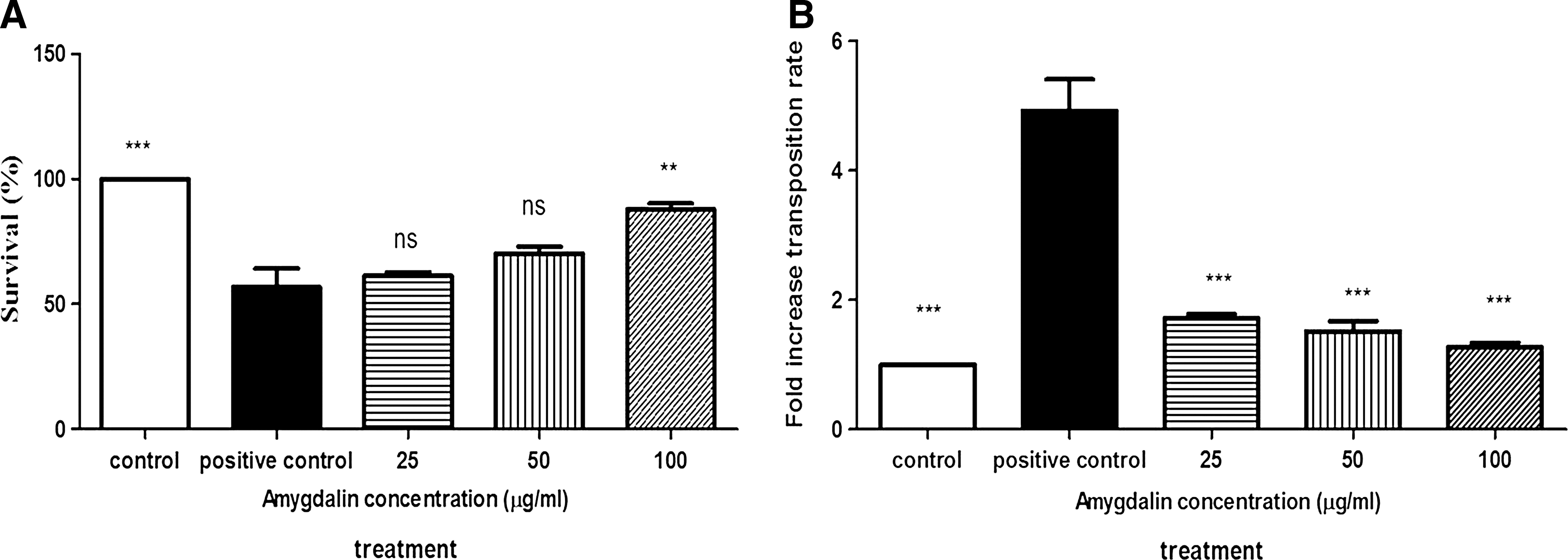
Anticarcinogenic activity of amygdalin was examined toward the standard carcinogen hexavalent chromium (CrVI) (Fig. 1A, B).
Survival rate
Results revealed that CrVI decreases cell survival to around 55% (Fig. 1A).
Experiments related to the potential anticarcinogenic effect of amygdalin revealed that pretreatment with 25 and 50 μg/mL amygdalin and subsequent treatment with 5 mM CrVI does not lead to statistically significant increase in survival rate but at the same time decreases around threefold the transposition rate induced by 5 mM CrVI (Fig. 1B). Pretreatment with 100 μg/mL amygdalin resulted in 1.5-fold higher survival rate (P < .01) (Fig. 1A) and around fourfold lower level of transposition (Fig. 1B).
Cytotoxic and antiproliferative effects of amygdaline in normal cell lines BJ and BALB/3T3
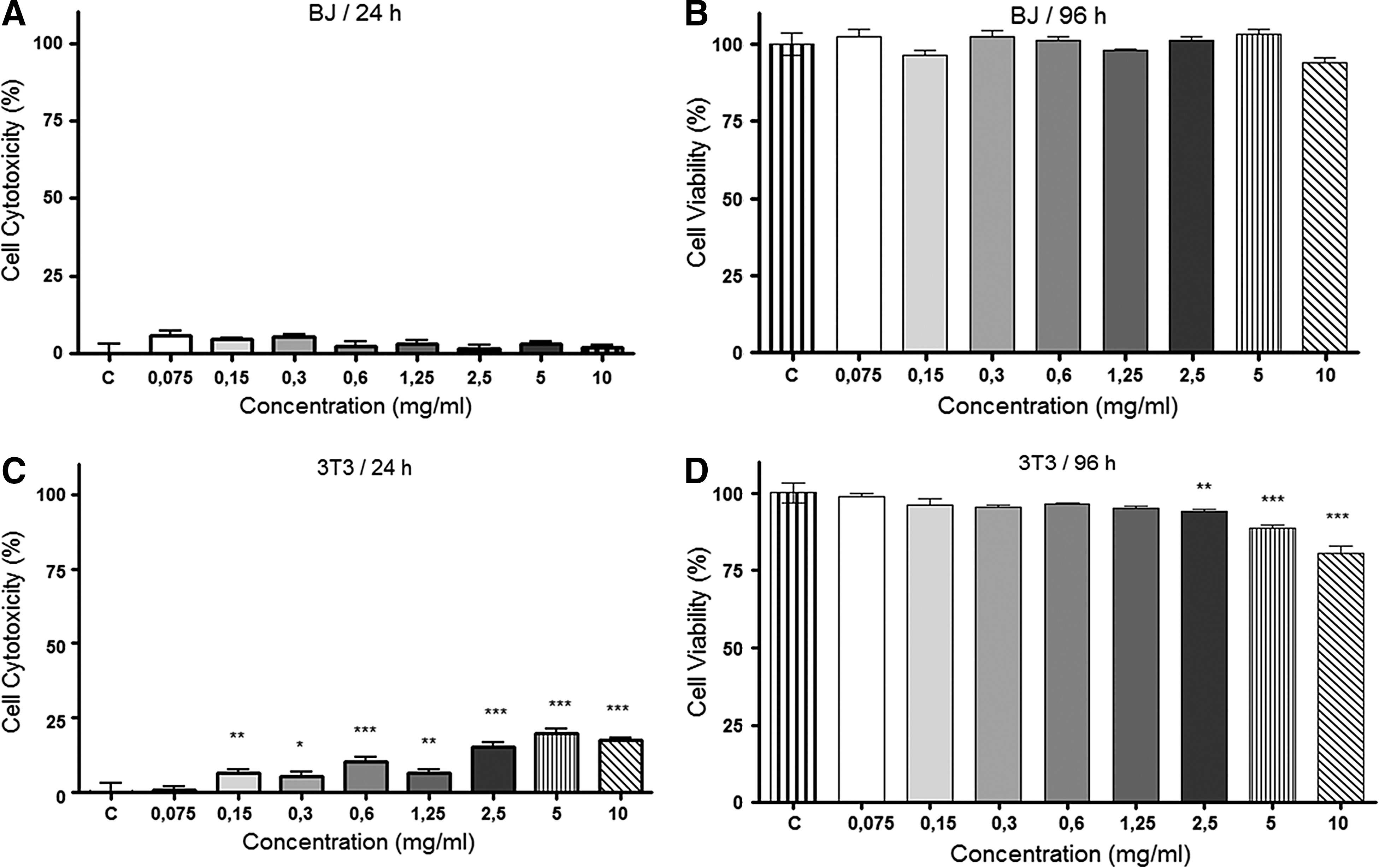
Experiments to define cytotoxic or antiproliferative effects of amygdalin (Fig. 2) were performed in double reduction of the concentrations in a range between 0.075 and 10 mg/mL. To determine the effect of each concentration, the mean value of six consistent repeats was taken into account.
Cytotoxic
Significant differences were observed between both cell lines in means of amygdalin cytotoxicity and antiproliferative effect.
No cytotoxic or antiproliferative effects in presence of amygdalin in the represented concentrations were detected in the normal human cell line BJ (Fig. 2A, B).
Conversely, the mouse embryonic fibroblast cell line BALB/3T3 showed a significantly different result compared to the negative control reaching up to 20% at the highest amygdalin concentrations—2.5, 5, and 10 mg/mL (Fig. 2C, D). The lowest concentration possessing statistically significant cytotoxic effect was 0.15 mg/mL amygdalin (P < .01). An antiproliferative effect was determined after treatment with 2.5 mg/mL amygdalin (P < .01).
Antitumor effect of amygdalin, observed in tumor cell lines HepG2 and HT-29
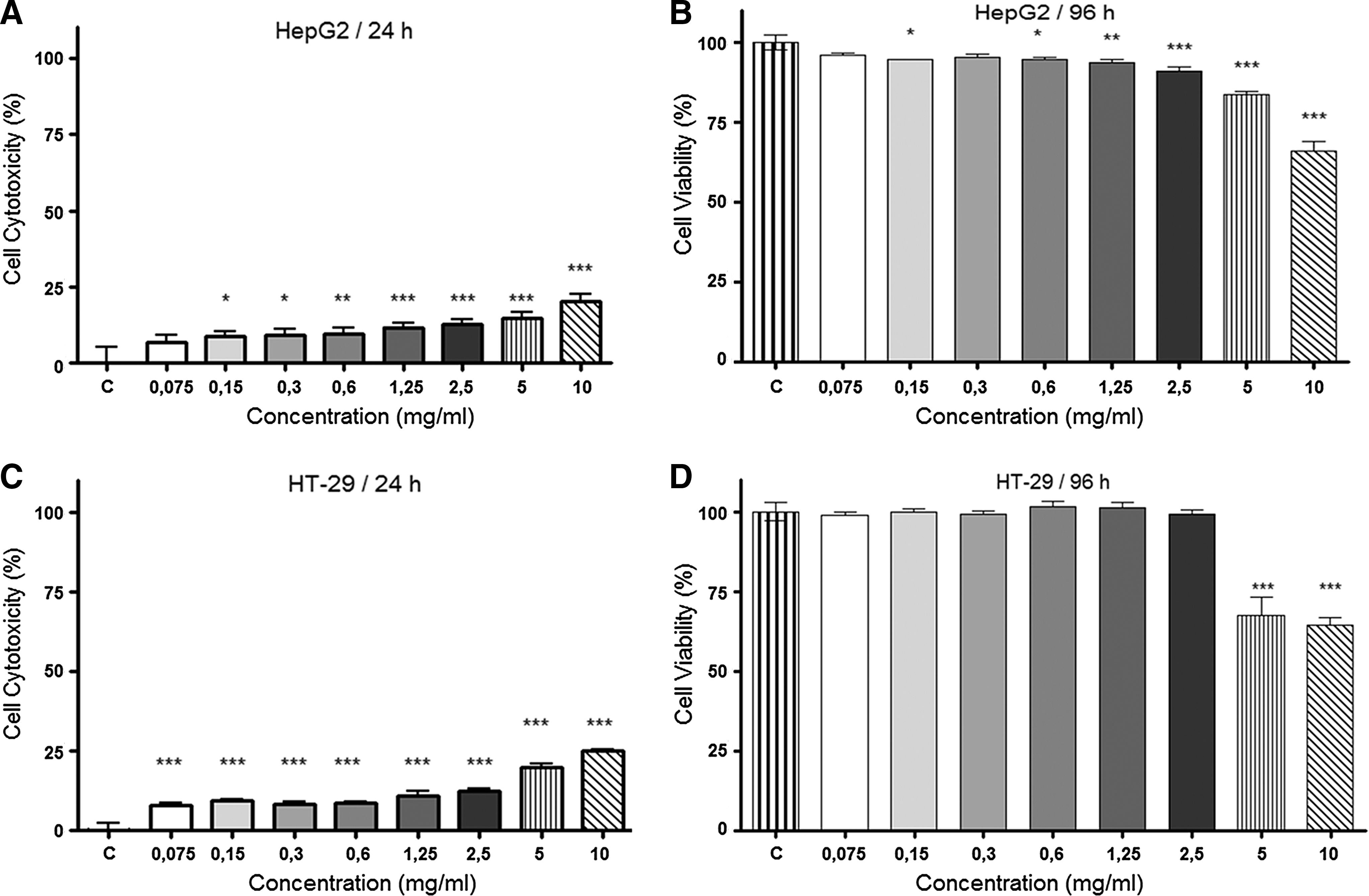
In the range of low concentrations from 0.075 to 0.6 mg/mL, the most sensitive cell line in terms of cytotoxicity was the HT-29 cell line (Fig. 3A, C). The cytotoxic effect of amygdalin on that cell line was observed even at the lowest concentration of 0.075 mg/mL amygdalin (P < .001). Small but statistically significant cytotoxic effect at concentration 0.15 mg/mL amygdalin (P < .05) was determined for HepG2 cell line.
Cytotoxic
The antiproliferative effect (Fig. 3B, D) in presence of amygdalin was highest for the cell line HepG2. The lowest concentration of which a statistically significant antiproliferative effect was measured was 0.6 mg/mL (P < .05). For HT-29 cell line antiproliferative effect of amygdalin was obtained at concentrations 5 and 10 mg/mL (P < .001).
The analysis of results presented in Figures 2 and 3 revealed that amygdalin has no toxic or antiproliferative effects on the normal human BJ cell line in the concentrations used. Higher cytotoxic effect of amygdalin in higher concentrations was detected in the tumor cell lines (Fig. 2A, C) compared to mouse embryonic fibroblasts. These differences although are not statistically significant (P > .05). When comparing the cytotoxic effect of amygdalin on the tumor cell lines BJ, a statistically significant difference of about 25% was observed, whereas in all tumor cell lines significant effects were observed.
Discussion
Contradictory data exist about the action of amygdalin. Although forbidden by FDA, amygdalin is widely applicable in many countries. This would provide serious health concerns. It is of great importance to provide insights into potential mechanisms of action. Data presented in this study provide evidence that low concentrations of amygdalin do not possess mutagenic and recombinogenic activity. In addition, amygdalin does not increase the levels of Ty1 retrotransposition. Such observation is very important because it is known that the major steps in Ty1 replication are analogous to those in retroviral replication, except that Ty1 replication is entirely intracellular. 27
Some of the molecular events linked with tumorigenesis involve loss of heterozygosity of a tumor suppressor gene. 28,29 It could be generated by point mutations, small deletions or inversions, mitotic recombination, or chromosome loss. 30 Recently, a surprising number of tumors have been found to contain long tracts of homozygosity that have arisen from somatic mitotic recombination events. 31 The lack of mutagenic and recombinogenic activity found in our study provide additional evidence for the inability of amygdalin itself to provoke events related to the initial steps of tumorigenesis.
Furthermore, our data clearly demonstrate that amygdalin at low concentrations can reduce the detrimental effect of an alkylating agent such as MMS. It could be suggested that amygdalin concentrations prevent mutations caused by alkylating agents by activating both error-free and error-prone recombination events.
Based on the results presented in this study, it could be speculated that amygdalin is able to reduce the retrotransposition events induced by one strong inducer of oxidative stress such as CrVI.
Data exist in literature that CrVI induces high levels of ROS and induces Ty1 mobility. 32 Important role in the induction of Ty1 transposition plays the superoxide anions.
Lack of toxic effect is observed in normal human BJ cell line, whereas significant toxicity is determined for all the tumor cell lines tested. These results indicate the high selectivity of action of amygdaline toward normal or tumor cell lines. Such observation could be explained with the fact that the treatment of cancer cells with amygdalin results in a chemical reaction in which hydrogen cyanide and benzaldehyde react synergistically and form a poisonous compound that destroys the cells. 33 We suggest that the lower viability of cancer cells is a result of the presence of beta-glycosidase.
Higher cytotoxic and antiproliferative effects of amygdalin in BALB/3T3 mouse embryonic cell line compared to normal human fibroblasts are observed. This could be probably due to the higher proliferative potential and metabolic activity of the mouse cell line. The observed effect is probably a result of the low stability of amygdalin in the biological system proposed.
Based on the results obtained in the present work, it could be speculated that amygdalin may exert higher cytotoxic effect in cell lines with higher proliferative and metabolic activity, which are majority of the fast developing tumors. In normal nonproliferative cells, these effects were not detectable.
The determined cytotoxic effect measured at 24 h postincubation was higher than the antiproliferative effect measured after 96 h. That suggests a possibility that amygdalin is not stable in the biological system used in our experimental conditions or its metabolism into inactive products. These results are in accordance with the results of other research groups. An increase of amygdalin's activity was obtained by β-glycosidase, an enzyme determined in higher amounts in cancerous cells. 11
In combination with nanoparticles or with polymeric structures, the effects of amygdalin might be modulated. Thus, its release into the body could be adjusted for longer periods.
It could be speculated that amygdalin does not affect negatively the mutagenic and recombination processes in cells at the concentrations tested.
It should be taken into consideration that amygdalin breaks down into hydrocyanic acid and benzaldehyde. Thus, these compounds may behave differently than pure amygdalin. Future work may be focused on the investigation of the effect of combination of the two metabolites in a yeast cell–based test and mammalian cell lines.
Conclusion
In summary, data presented in this study provide evidence concerning the inability of amygdalin itself to provoke events related to the initial steps of tumorigenesis such as induction of mitotic gene conversion, reverse mutations, mitotic crossing-over, and Ty1 retrotransposition. In addition, high selectivity of action of amygdalin toward normal or tumor cell lines is found. It could be speculated that amygdalin has higher cytotoxic effect in cell lines with higher proliferative and metabolic activity, which are majority of the fast developing tumors.
Furthermore, amygdalin at concentrations up to 100 μg/mL possesses antimutagenic and anticarcinogenic effect toward the detrimental effect of an alkylating agent such as MMS and the standard carcinogen CrVI. It could be suggested that amygdalin concentrations prevent mutations by activating both error-free and error-prone recombination events.
Footnotes
Acknowledgment
The authors thank Prof. Pencho Venkov for critical reading of the article and for helpful discussions.
Author Disclosure Statement
No competing financial interests exist.