




Abstract
Grape pomace (GP), the residue of grapes after wine making, is rich in dietary polyphenols and fiber, and it has potential to serve as a functional food ingredient to improve health. However, high polyphenol diets have also been reported to inhibit the growth of young animals and cause liver necrosis. This study investigated the effect of diets containing different amounts of GP on the growth performance and blood lipid profile by using a young rat model. Twenty female Sprague–Dawley rats of age 7 weeks were randomly divided into four groups that were fed AIN-93G diets that were modified by substituting 0%, 10%, 20%, and 30% of carbohydrate with GP for 10 weeks (the diets, thus, obtained contained 0%, 6.9%, 13.8%, and 20.7% of GP). The group fed original AIN-93G (0% GP) was used as control. Feed consumption, body weight, length, and height were recorded weekly. Blood samples were taken biweekly to analyze plasma lipid profile. At the end of the feeding period, the rats were fasted overnight and euthanized by exsanguination under anesthesia. Livers, hearts, and kidneys were collected, and their weights were recorded. Results show that the diet containing a maximum of 20.7% of GP did not influence the body weights, lengths, and heights of rats. As the GP content increased, the blood triglyceride and very low-density lipoproteins (VLDL) decreased, the high-density lipoprotein (HDL) and low-density lipoprotein (LDL) increased slightly but were statistically significant, and total cholesterol remained constant. In conclusion, GP in the AIN-93G diet did not influence the growth performance of young rats, but it exhibited both positive and negative effects on the blood lipid profile.
Introduction
G
Polyphenols and dietary fiber play important roles in disease prevention and well-being. Dietary polyphenols possess many biological activities and health-promoting benefits, including prevention of certain types of cancers, prevention of cardiovascular diseases, anti-inflammatory effects, and improvement of neuronal and cognitive functions. 7 Grape seed polyphenols reduce the risk of heart disease by reducing low-density lipoproteins (LDL) and very low-density lipoproteins (VLDL) cholesterol levels and by inhibiting the oxidation of LDL. 8 Some polyphenols have been reported to have potential as weight control agents. For example, tea catechins were found to attenuate the development of obesity and fatty liver in mice fed a high-fat diet, 9 and to boost fat oxidation in humans. 10
A few studies have shown that grape seed polyphenol extract reduced food intake in rats and energy intake in humans. 11 A recent study found that polyphenol extracts of both red and white GP selectively and significantly inhibit intestinal alpha-glucosidase and suppress postprandial hyperglycemia in diabetic mice. 12 Individuals with high intakes of dietary fiber appear to be at a significantly lower risk for developing coronary heart disease, stroke, hypertension, diabetes, obesity, and certain gastrointestinal diseases. 13 The dietary fiber also increases satiety and helps to control weight by increasing intestinal regularity. 14 Grape seed procyanidin extract (GSPE)-corrected dyslipidemia is associated with a high-fat diet (HFD) in rats and represses genes controlling lipogenesis and VLDL assembly in the liver. 15 Low-dose (25 mg per kg body weight per day) GSPE treatment of HFD-fed rats significantly reduced the adiposity index and the weight of all the white adipose tissue depots and reversed the increase in plasma phospholipids induced by the HFD feeding. 16 The results from a randomized, controlled parallel-group trial with 34 non-smoking adults show that consuming 7.5 g/day grape antioxidant dietary fiber for 16 weeks significantly reduced total cholesterol (TC) (9%), LDL cholesterol (9%), and systolic and diastolic blood pressures (6% and 5%, respectively). 17 Therefore, the inclusion of GP in food and feed products could result in the functional foods with beneficial effects of dietary fiber and grape polyphenols.
However, polyphenols are considered a double-edged sword to health. Negative effects of taking high doses of some polyphenols were reported. A considerable amount of evidence is accumulating that supports the hypothesis that high-dose polyphenols can mechanistically cause adverse effects through pro-oxidative action. 18 Laboratory studies with cell culture, rodents, and dogs have supported the fact that the high doses of EGCG, the major polyphenol in green tea, could induce toxicity in the liver, kidneys, and intestine. 19 Diets that are high in polyphenols have been reported to inhibit the activity of digestive enzymes due to protein-polyphenol interaction. In vitro studies found that grape seed and green tea polyphenol extract significantly inhibited α-amylase, pancreatic lipase, lipoprotein lipase, and hormone-sensitive lipase, which are responsible for the fat digestion and metabolism in the human body. 20,21 The addition of polyphenols to the diet has been reported to reduce protein digestibility 22,23 and to be a growth suppressant. 14 The inclusion of GP in the sheep diet to 55% significantly reduced the digestibility of protein. 25
The review of literature shows that the health benefits and toxicity of polyphenols are dose dependent. Although GP is a polyphenol and fiber-rich material and has potential as a health-promoting food ingredient, it is imperative to further evaluate the dosage of GP on growth performance and health in an appropriate animal model to get a basic idea about the proper level of GP that can be included in a diet of regular consumption before the GP can be used in food products for human consumption. The specific objectives are (1) to evaluate the effect of the amount of diet GP content on the growth performance (body weight, length, and height), (2) to evaluate the effect of diet GP content on blood lipid profile (triglyceride [TG], TC, high-density lipoprotein [HDL], LDL, and VLDL), and (3) to evaluate whether GP in the diet causes organ enlargement and other abnormal phenomena.
Materials and Methods
GP and diet formulation
The GP used for this study was the residue of Muscadine Noble grapes and was collected from Benjamin vineyard and winery located in Graham, NC, USA. The fresh pomace was spread into thin layers in plastic trays and dried at room temperature in a well-ventilated room. The dry pomace was then ground into powder that was passed through the 40-mesh sieve for rat diet formulation. The diets were formulated based on AIN-93G (Bio-Serv, Flemington, NJ, USA), the standard diet for growth. For treatment diets, cellulose and a different amount of corn starch were replaced by 10%, 20%, and 30% of GP powder. The resulting treatment diets contained 6.9%, 13.8%, and 20.7% of GP. The nutrient compositions of control and treatment diets are shown in Table 1.
The bold values indicate the significant changes in starch diet contents due to the addition of grape pomace.
Determination of polyphenol and total dietary fiber content in the diets
Polyphenol in the diet samples was extracted by 70% ethanol solution. The total phenolic concentrations (TPC) of the extracts were determined by the Folin-Ciocalteu method 26 and expressed as gallic acid equivalent (GAE) (mg gallic acid/mL extract). The phenolic content of the reformulated diet powder was expressed in mg GAE/per gram feed. The total dietary fiber (TDF) of each diet was determined according to the AOAC official method (991.43) by using a TDF kit purchased from Sigma-Aldrich (St. Louis, MO, USA) and expressed as percentage of total non-digestible. The analyses of TPC and TDF for each formula were conducted in triplicate.
Animal experiment
Experimental design and animal handling
The animal experiment was conducted in accordance with the North Carolina A&T State University IACUC protocol. Sprague–Dawley female rats of age 7 weeks were used. Five rats were randomly assigned to one of the four groups that were fed diets containing 0%, 6.9%, 13.8%, and 20.7% of GP, respectively. The group fed a diet containing 0% of GP served as the control. Each rat was placed in a suspended stainless steel cage and was housed in an animal room with controlled temperature (23°C), humidity (40%), and light cycle (12 h light and 12 h dark). The animals were initially offered 100 g of feed. Feed consumption was recorded every other day. Blood samples were taken biweekly to analyze blood cholesterol profile. At the end of the feeding period, the rats were fasted overnight and euthanized by exsanguinations under anesthesia. The necropsy was done for a gross examination for pathological inspection. The heart, liver, and kidney were weighed and compared with those from the control.
Blood sampling
The animals were placed in an inhalation chamber and anesthetized by inhalation of 1% isoflurane. During the feeding experiment, the blood samples were withdrawn biweekly by using the retro-orbital method and the maximal amount of blood withdrawn from each animal was 1 mL. At the end of the feeding period (week 10), the blood was withdrawn from the heart after the rat was sacrificed. The blood was stored in heparinized micro-hematocrit capillary tubes. After centrifugation, the plasma was collected in labeled micro-centrifuge tubes. An amount of 100 μL of plasma sample was used for lipid profile analysis, and the remaining plasma was stored in a −80°C freezer.
Blood lipid analysis
The lipid profiling of rat blood was performed by utilizing the Abaxis VetScan II Blood Chemistry Analyzer from Abaxis (Union City, CA, USA) and Lipid Panel Reagent Disc from Abaxis. The amount of plasma needed for each individual rat was 100 μL. The items analyzed were TC (mg/dL), HDL (mg/dL), LDL (mg/dL), VLDL (mg/dL), and TGs (mg/dL).
Data analysis
Results were expressed as mean ± standard deviation (n = 5). All data except polyphenol and TDF contents of diet were analyzed statistically by using analysis of variance (ANOVA) and Duncan's multiple-range comparison.
Results
Polyphenol and dietary fiber content of rat feeds
Both polyphenol and TDF in the rat diet increased linearly with the increasing amount of GP added. This is expected, as GP is rich in polyphenol and TDF. The unmodified diet had 6% TDF that was coming from cellulose in the original formula. Replacement of the 10%, 20%, and 30% of total carbohydrate, including cellulose, resulted in diets containing 1.12, 2.69, and 4.47 mg of total polyphenol per gram diet, and 3.95%, 7.9%, and 11.85% of dietary fiber, respectively.
Feed consumption and growth performance as affected by GP content
Feed consumption
We hypothesized that a diet containing high levels of GP should be less preferred by rats, because it has stronger astringent taste, but the experiment data did not support this hypothesis. The statistical analysis of data found that the average feed consumption of rats in the treatment groups fed diets containing 13.8% and 20.7% of GP was not significantly different from that of the control group, but the lowest feed consumption was observed for the rats in the 6.7% GP group during the whole feeding period (Fig. 1A).
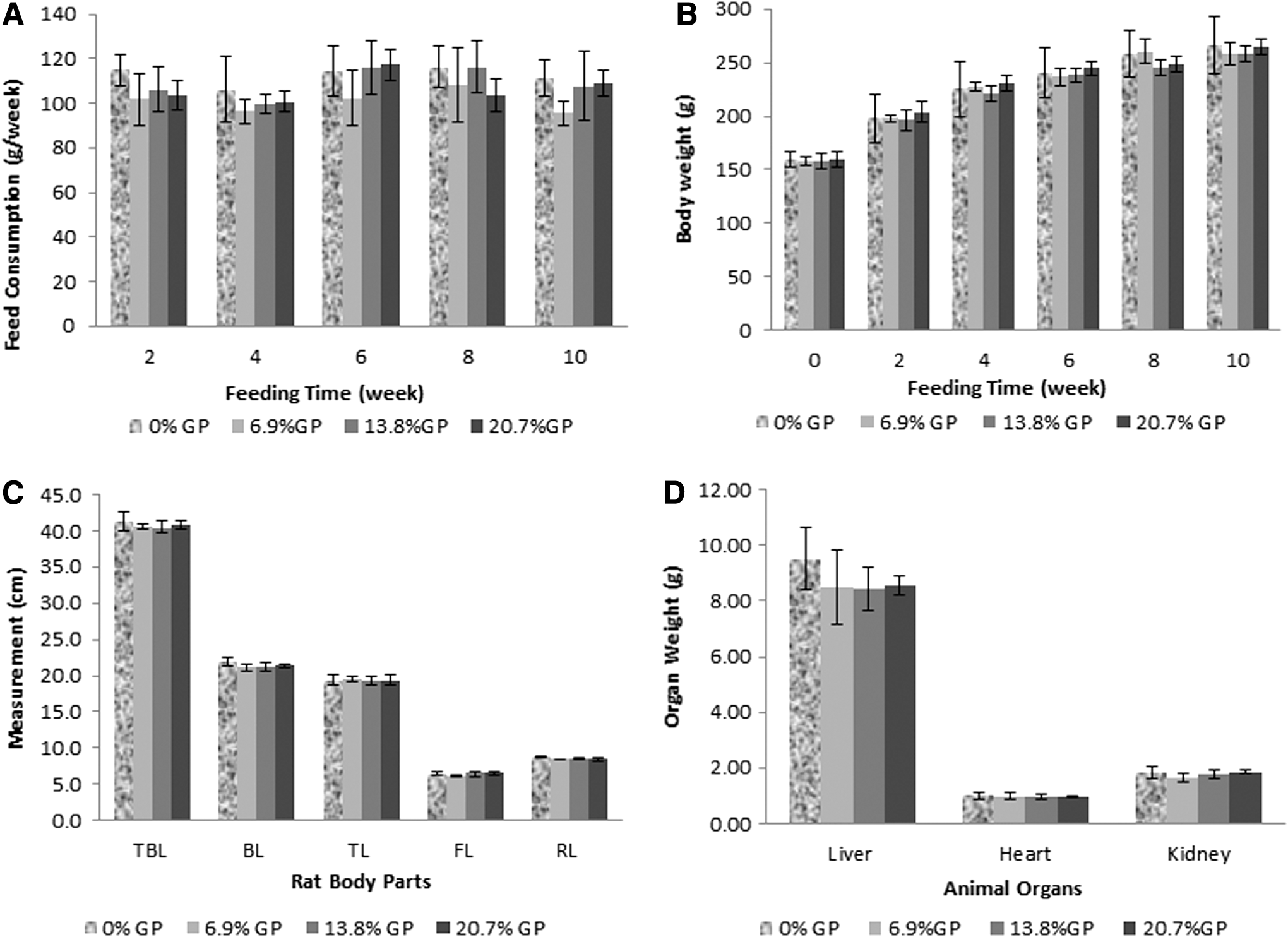
Effects of GP content in diet on
Body weight
Figure 1B shows that feeding time had significant effects on the body weight of rats in all treatment groups (P < .0001). As the treatment time increased, the body weights increased almost linearly until the 8th week. From week 8 to 10, the average body weight of rats in each treatment group remained unchanged, which indicated that the rats reached maturity at week 8. In the first 5 weeks, the average rat body weight was not affected by the GP content of the diet. Starting from week 6, small but statistically significant reduced weight gain was observed in the 13.8% GP and 20.7% GP groups (P < .05).
Body size
The body size of the rat was measured at the end of the 10-week feeding experiment. Figure 1A shows that a diet containing a maximum of 21% of GP did not influence the body size of the rat, as evaluated by total body length (TBL), body length (BL), tail length (TL), front leg length (FL), and rear leg length (RL) (Fig. 1C). This may be explained by the similar feed consumption of all treatment groups during the whole feeding period.
Organ weight
There was no discoloration and enlargement of target organs. No differences were observed in heart and kidney weights between treatment groups and control group. The rats fed a 20.7% GP diet had a significantly smaller liver than the rats in the control group (P < .05) (Fig. 1D). The liver weights of rats in the 6.9% and 13.8% GP diets were obviously smaller but not significantly different from that of the control due to the large standard deviation of data.
Blood lipid profile
Triglyceride
TG is the chemical form of fat that exists in food as well as in the body. TGs are also present in the blood plasma and are associated with blood cholesterol in the form of plasma lipids. Having high TG levels can cause an increased risk for cardiovascular disease. However, there are no apparent consequences for low TG levels. 27 The normal range of TG in rat plasma is 40.4–89.2 mg/dL. 28
Table 2 shows that TG levels of all plasma samples were in the normal range, but the TG level of the control group was significantly higher than those of other groups (P < .001) and close to the high limit (89 mg/dL). At the same treatment time, the TG content of rat plasma decreased with GP in a dose-dependent manner except that at week 10. The reason might be that the blood sample was withdrawn from the heart at week 10 after the rats were sacrificed; whereas during the other weeks, blood samples were withdrawn from the ears when rats were anesthetized by inhalation of 1% isoflurane.
Data with the same superscript in the same row are not statistically different at a 5% significance level.
Total cholesterol
TC is a preventive measure against cardiovascular disease. The more elevated the TC levels are, the higher the risk for plaque to build up on the artery walls and to cause health problems with the cardiovascular system, such as stroke and heart disease.
27
The normal range of TC in rat blood is 40–130 mg/dL (
Data show that treatment time did not have significant impact on the TC of rats, but diet GP content did (Table 3). When diet GP content was 6.9%, the blood TC level of rats was not significantly affected. Only rats on a 13.8% and 20.7% GP diet showed a statistically higher blood TC content at week 6 and 10 (P < .05). The large standard deviations for most of the TC measurements make it difficult to make a conclusion on whether GP inclusion has positive or negative effects on the TC level of rat blood.
Data with the same superscript in the same row are not statistically different at a 5% significance level.
HDL cholesterol
The main function of HDL is to assist with the removal of excess cholesterol from within walls of the blood vessels and then carry it to the liver, where it is broken down and removed from the body in the bile. Low levels of HDL can be an indicator of an increased risk of cardiovascular disease. 29 In humans, the blood HDL normal range is 40–60 mg/dL. In female rats, the normal range of blood HDL is 40–80 mg/dL but it varies with rat age. 28 The GP content in the diet did not show a significant influence on blood HDL level for most of the treatments (Table 4). Higher HDL was observed only at week 6 for rats fed diets containing 13.8% and 20.7% of GP (P < .05). At other treatment times, HDL increased with GP content for most treatments but it was not statistically significant due to large standard deviations. At the same GP content, HDL decreased with treatment time.
Data with the same superscript in the same row are not significantly different at a 95% confidence interval.
Low-density lipoprotein
LDL is measured to determine the risk for cardiovascular disease. When LDL levels are elevated, the risks for cardiovascular disease are increased; when the LDL levels are lower, the risks for cardiovascular diseases are decreased. 30 The normal range for LDL in healthy rats is 17–78 (mg/dL) depending on the age of rats. 28
Table 5 shows that the LDL levels of rat blood samples in all treatment groups were significantly affected by the GP content in the diet. The lowest LDL levels were observed at week 4 for all treatment groups. Although all data in Table 6 were much lower than the upper LDL level of the normal range, rats fed diets containing 13.8% and 20.7% of GP showed significantly higher blood LDL levels (P < .05) than rats in the control group.
Data with the same superscript in the same row are not significantly different at a 95% confidence interval.
Data with the same superscript in the same row are not significantly different at a 95% confidence interval.
Very low-density lipoprotein
VLDL is assembled in the liver from TGs, cholesterol, and apolipoproteins. It functions as the body's internal transport mechanism for lipids, including endogenous TGs, phospholipids, cholesterol, and cholesteryl esters. 28 The normal range of VLDL for female rats is 4–35 mg/dL depending on the age, and it decreases significantly as rats become 20 weeks or older. 28
Table 6 indicates that both GP content in the diet (P < .0001) and treatment time (P < .005) had significant influences on the VLDL level of rat plasma. As the diet GP content increases, the plasma VLDL decreases. The decrease of VLDL seems to correspond to the increase of LDL, because VLDL is converted to LDL in the blood stream. 31
Discussion
This study demonstrates that the inclusion of GP in the AIN-93G diet to 20.7% did not influence the growth performance of young rats (Fig. 1). This is in agreement with a chicken study in which diets containing grape seed extract at levels 0.6, 1.8, and 3.6 g/kg body weight did not affect the growth performance of chickens. 32 A lamb study showed that male lambs fed a diet containing 5% and 10% of dry GP gained more weight than lambs fed a regular diet. 33 However, our study did not show difference in weight gain during a 10-week feeding experiment. In contrast, small but significant weight loss was observed among young rats fed a GP-containing diet at a later stage of feeding treatment. Therefore, long-term consumption of a diet containing a maximum of 20% GP may control weight gain.
Cholesterol is a sterol molecule that is made in the liver and it contains apolipoproteins, lipids, proteins, and TG. 34 The cholesterol profiles are very important, because they are risk indicators of certain cardiovascular diseases such as stroke and heart disease. TC is the summation of HDL, LDL, and VLDL. The present study found that GP exhibited both positive and negative effects on the blood lipid profile.
On the one hand, GP improved the blood lipid profile by reducing TG and VLDL (Tables 2 and 6) and by increasing HDL (although not statistically significant) (Table 4). The decrease in the plasma TG level due to the feeding GP diet is in good agreement with that reported by Pérez-Jiménez et al., 17 where 34 non-smoking adults were supplemented for 16 weeks with 7.5 g/d of grape antioxidant dietary fiber and significant reductions of blood TC, TG, and LDL were observed. The reduced VLDL is similar to that reported by Martin-Carron et al. 35 and Hayes. 36 In the study of Hayes, rats were fed a diet containing 2.5–10% polyphenol-rich peanut skin for 8 weeks and showed significantly reduced blood VLDL. Recent studies have found that VLDL played an important role in the development of cardiovascular diseases. 37,38 Therefore, the VLDL-lowering effect of GP is important in reducing the risk of cardiovascular diseases. On the other hand, blood LDL level increased significantly as diet GP content increased (P < .05), although it was in the normal range (Table 5). This is controversial with the results of Bobek 39 and Martin-Carron et al., 35 who found that feeding high polyphenol diets resulted in a significant decrease in blood LDL levels, but similar to that of Hayes, who found that feeding rats a diet containing peanut skin led to an increase in blood LDL level. 36
It was expected that the rats would have decreased TC- and LDL-cholesterol levels, as the amount of GP in the diet increased as reported by most researchers, but the experimental results of this study did not provide evidence of this. In addition, the results also show significant changes of HDL and VLDL with the feeding time or age of rats. This is because the growing rats were used in the study, and the physiological changes during growth might make the results very different from the expected. Therefore, more animal studies with mature rats and high cholesterol diets are needed to test whether GP has a hypolipidemic effect.
Footnotes
Acknowledgment
This study was financially supported by a Capacity Building Grant (2011-38821-30906) from the National Institute of Food and Agriculture, US Department of Agriculture.
Author Disclosure Statement
No competing financial interests exist.