




Abstract
High blood pressure is one of the major risk factors for various diseases and angiotensin-converting enzyme (ACE) plays a critical role in blood pressure regulation. In our study, the responsive surface methodology was adopted to establish optimal Alcalase-hydrolysis conditions of camellia seed hull against ACE activity. The optimum conditions are hydrolysis temperature of 50.98°C, enzyme/substrate ratio of 2.85%, and hydrolysis pH of 7.12. In an animal feeding study, spontaneously hypertensive rats were treated with either a low or high dose of hydrolyzed Camellia japonica seed cake over 5 weeks. Even though systolic blood pressure was not statistically different, the high dose of C. japonica hydrolysate lowered diastolic blood pressure (106 ± 4.4 mmHg vs. 145 ± 5.9 mmHg) at the 5th week. A similar trend was also observed in serum ACE activity. Considering that this camellia seed hull is a major resource of this plant, our study provides important data to utilize this plant for both academic and industrial applications.
A
Camellia seed oil of Camellia japonica, used as an ornamental plant in Asian culture, 5 has gained increased attention due to high oleic acid content, similar to olive oil. 6 However, there is a paucity of information with regards to C. japonica seed hulls, a residual byproduct from oil processing that accounts for about 60% of the total seed weight. Previously, we demonstrated that (1) C. japonica seed cake possesses biological potency in vitro models and (2) responsive surface methodology (RSM) technique successfully optimizes extraction conditions for maximum potency. 7,8 However, it was not previously investigated whether protein isolates derived from camellia seed hulls elicit antihypertensive activity. In this study, therefore the RSM was adopted to establish optimal hydrolysis conditions of camellia seed hull for obtaining the most potent hydrolysate fraction against ACE activity. In addition, blood pressure-lowering effects of camellia seed hull were examined in spontaneously hypertensive rats (SHRs).
Alcalase-hydrolysis conditions of camellia seed hull were optimized against in vitro ACE activity via RSM. Subsequently, in an animal feeding study, C. japonica hydrolysate lowered diastolic blood pressure (DBP) and ACE activity of SHRs at 5th week. Detailed information for materials and methods is provided in Supplementary Data (Supplementary Data are available online at
To optimize enzymatic hydrolysis conditions of C. japonica for ACE inhibition, a total of 15 sets of variable combinations were examined (Supplementary Table S1). Obtained results were then fitted into a second-order polynomial equation by response surface regression procedure, in which all responses were examined including linear interactions and quadratic terms. Hydrolysis conditions were optimized using the polynomial model (Table 1). The coefficient of the determination (r2 ) for the dependent variable (i.e., ACE inhibition) was 0.91 with a P-value of 0.033. The analysis of variance indicated that the predicted polynomial model is significant at the 5% level and the lack of fit test determined the validity of the model to predict responsible variables (P > .05), indicating that the model is well adapted to the response.
ACE, angiotensin-converting enzyme.
Consequently, the optimum conditions are a hydrolysis temperature of 50.98°C, enzyme to substrate ratio (E/S) of 2.85%, and hydrolysis pH of 7.12 (Table 1). The predicted and experimentally obtained values of ACE inhibition at the conditions are 32.82% and 32.24% ± 1.07%, respectively. As the response surface plots of hydrolysis conditions display potential interactions between each of independent variables on ACE inhibitory potency, both E/S and hydrolysis temperature represented respective threshold levels in regards to ACE inhibitory activity (Fig. 1a). In Figure 1b and c, the maximum inhibitory potency was observed in which pH was 7 or higher and was slightly decreased beyond the certain level. Moreover, following the Alcalase-assisted hydrolysis of C. japonica seed hull at the optimized conditions, two major protein bands (approximate molecular weight 27 and 23 kDa) were degraded with a subsequent release of peptides that had lower molecular weights (Supplementary Fig. S1).
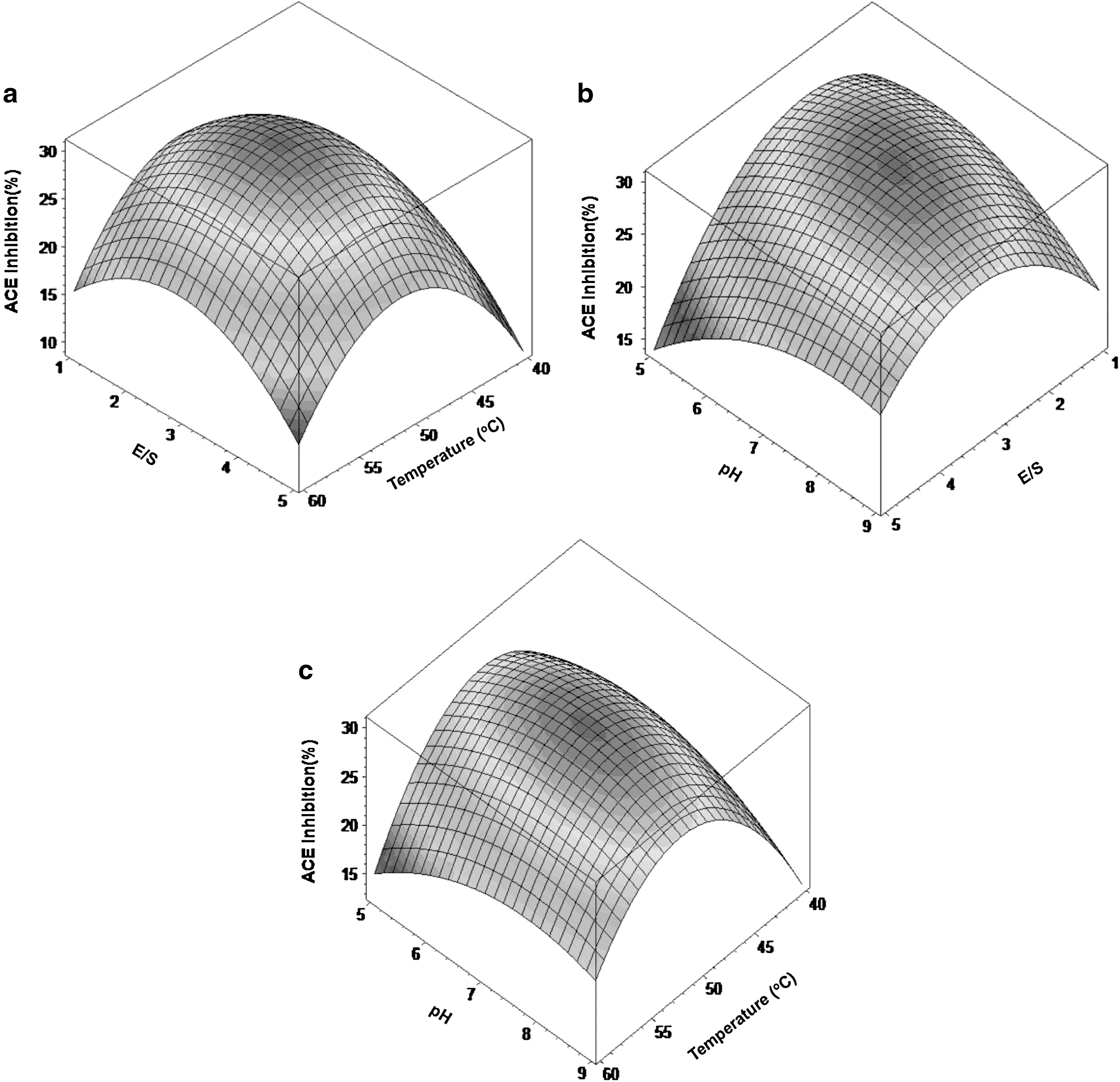
Response surface plot for the effect of hydrolysis temperature, E/S, and pH on the ACE inhibitory activity at the fixed optimum condition of
Enzymatic protein hydrolysis decreases peptide size, thereby modifying functional characteristics of proteins and possibly improving their properties (e.g., soy protein 9 ). Of the multiple enzymes, Alcalase has been widely utilized in the industry owing to its thermo-stability and its wide range of optimal pH. 10 Our current study utilized Alcalase to explore biological functionality of C. japonica seed cake for the first time. Previously, Diniz and Martin utilized the RSM to optimize protein extraction conditions from fish protein using Alcalase, 11 which is similar to our observations, although it is difficult to make a direct comparison between studies due to different sample matrices (e.g., plant seed hull vs. fish protein).
In addition to in vitro ACE activity, blood pressure-lowering effects of Alcalase-hydrolyzed C. japonica seed cake were examined in SHRs (Supplementary Table S2). Our rat feeding study showed that the high dose of C. japonica hydrolysate reduced DBP compared to the negative control group at 5th week (Fig. 2; 106 ± 4.4 mmHg vs. 145 ± 5.9 mmHg); even though it was not statistically significant, systolic blood pressure (SBP) was slightly decreased by 13.0 mmHg in the high dose group. Similarly, same trend of ACE activity reduction was observed in SHRs after 5 weeks of intervention whereas no significant differences in lipid markers were shown among groups (Table 2). Reasons for such marginal effects might be two-fold: (1) high variation in blood pressure measurement (up to 25%) and (2) small sample size (n = 6). Although SBP is a more decisive risk factor, both SBP and DBP are critical independent predictors of cardiovascular diseases. 12 As results, DBP was reduced by C. japonica seed cake hydrolysate with a trend of serum ACE inhibition, thus additional investigations might be warranted with larger sample size to (1) confirm blood pressure-lowering effects of C. japonica and (2) to elucidate further underlying mechanisms responsible therein. 13 Additionally, ACE inhibitory effects of C. japonica in different tissues might be informative given the possibility that an ACE inhibitor may only be active in certain target tissue(s) due to their molecular structures of active moieties, bioavailability, and eventual tissue distribution. 14
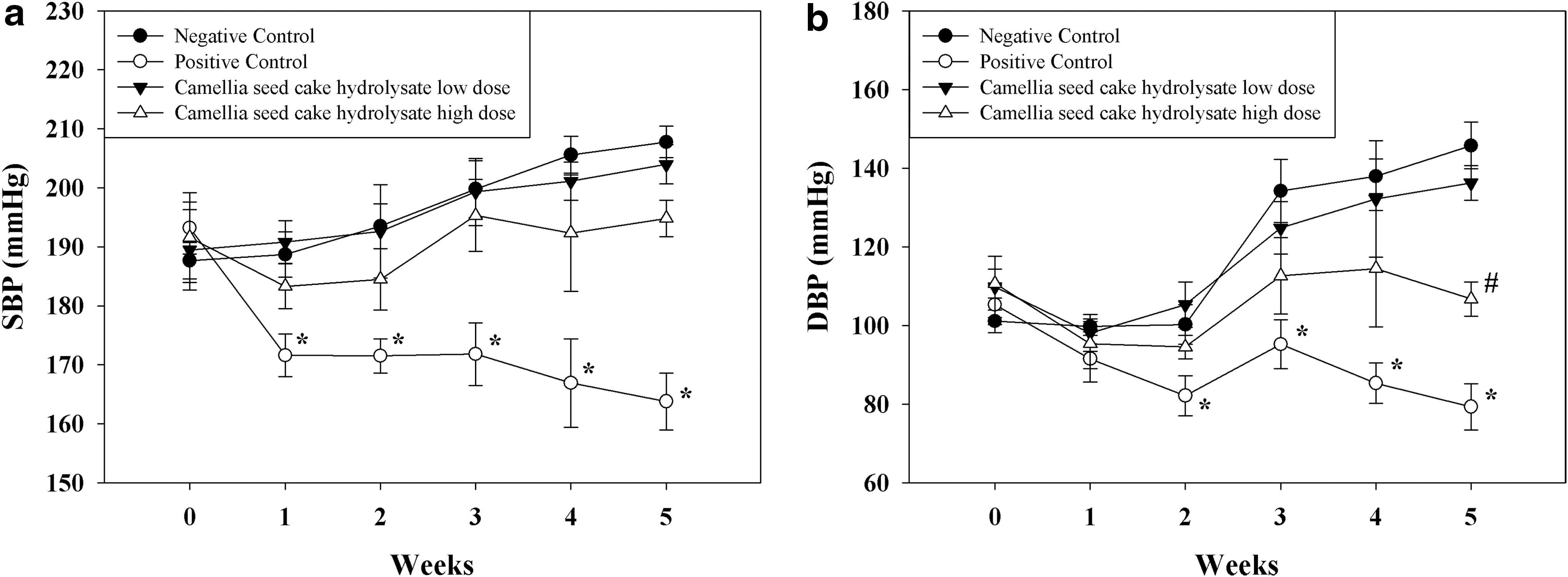
Time course effects of hydrolyzed Camellia japonica seed cake on
All results are expressed as mean ± SEM (n = 6). No significant differences in total cholesterol, HDL cholesterol, and triacylglycerol were found among groups. Different superscripts in the same column represent statistically significant difference (P < .05).
HDL, high-density lipoprotein.
It should be noted that there are a few limitations of this study. First, we visualized the digested hydrolysates of C. japonica seed cake via sodium dodecyl sulfate-polyacrylamide gel electrophoresis, but the active peptide(s) responsible for serum ACE inhibition and blood pressure-lowering effect has not yet been identified. In addition, a certain degree of protein hydrolysis causes the release of bitter taste peptides, thus it is often controlled to limit the degree of hydrolysis to levels lower than 8%. 15 In our study, however, the degree of hydrolysis was not taken into consideration. Lastly, even though Alcalase is often utilized to produce protein hydrolysates in industries, other proteinases (e.g., papain) with different substrate selectivity may result in different peptide profiles with varying biological potency. In this regard, the established hydrolysis conditions might be limited to the Alcalase only and does not necessarily indicate the maximum ACE inhibition activity of C. japonica seed cake hydrolysate that can be achieved.
However, there are a few strengths as well. First, this is the first study to optimize hydrolysis conditions of an industrial by-product of camellia oil; in this, we successfully optimized the Alcalase-assisted hydrolysis conditions using the RSM and confirmed its validity through experimentation. In addition, effects of C. japonica hydrolysate were further examined in SHRs; the high dose of C. japonica hydrolysate reduced DBP after 5 weeks of oral administration and a similar trend was observed in serum ACE inhibitory measurement. Furthermore, considering that this industrial by-product accounts more than 60% of the total weight of C. japonica seeds, our study provides important preliminary data to utilize this plant for both academic and industrial applications.
Footnotes
Acknowledgments
This research was supported by Basic Science Research Program through the National Research Foundation of Korea funded by the Ministry of Education (NRF-2014R1A1A2058119).
Author Disclosure Statement
No competing financial interests exist.
References
Supplementary Material
Please find the following supplemental material available below.
For Open Access articles published under a Creative Commons License, all supplemental material carries the same license as the article it is associated with.
For non-Open Access articles published, all supplemental material carries a non-exclusive license, and permission requests for re-use of supplemental material or any part of supplemental material shall be sent directly to the copyright owner as specified in the copyright notice associated with the article.
