




Abstract
Peroxisome proliferator activated receptor (PPAR) is a nuclear receptor that is one of the transcription factors regulating lipid and glucose metabolism. Fermented ginseng (FG) is a ginseng fermented by Lactobacillus paracasei A221 containing minor ginsenosides and metabolites of fermentation. DNA microarray analysis of rat liver treated with FG indicated that FG affects on lipid metabolism are mediated by PPAR-α. To identify a PPAR-α agonist in FG, PPAR-α transcription reporter assay-guided fractionation was performed. The fraction obtained from the MeOH extract of FG, which showed potent transcription activity of PPAR-α, was fractionated by silica gel column chromatography into 16 subfractions, and further separation and crystallization gave compound
Introduction
T
Ginseng (Panax ginseng, C. A. Meyer, Araliaceae) is one of the most popular herbal medicines in Korea, China, and Japan. Ginseng, as well as its major constituents, including ginsenosides Rb1, Rb2, Rc, Rd, Re, and Rg1, has been shown to possess various biological activities against inflammation, stress, hepatopathy, and metabolic disorders. 9,10,11 Some other contents of ginseng, such as glycans and peptides, also contribute to its wide-ranging benefits. 12 Ginseng and its constituents have demonstrated potential for improving metabolic disorders. In terms of lipid metabolism, ginseng extract containing ginsenosides, proteins, and lipids exerted a hypolipidemic effect in a human study. 13 In addition, the ginsenoside Rf was reported to regulate lipoprotein metabolism through PPAR-α, 14 while an inhibitory effect of ginseng on PPAR-α functions has also been reported. 15 However, supplementation with Korean red ginseng, which is steamed ginseng roots, resulted in no significant changes in metabolic parameters in a clinical study. 16 Thus, the benefits of ginseng for metabolic disorders has been controversial.
Fermented ginseng (FG), which contains metabolites of ginsenosides produced by fermentation or enzymatic techniques, was shown to have a wide variety of pharmacological activities. FG extracts were shown to exert an antihyperglycemic effect in T2DM mice. 17 However, the active constituents of FG for metabolic disorders have not yet been clarified. We previously reported the protective effect of FG against acetaminophen-induced rat liver injury, 12 in which the transcription activity of PPAR-α indicated a tendency to be increased by FG treatment in rats. This observation suggested the presence of a PPAR-α agonist in FG, which prompted us to perform this investigation. As part of our study on the beneficial health effects of FG, we performed a search for a PPAR-α agonist in FG using bioassay-guided fractionation, which resulted in the isolation of its active constituent. We describe herein the isolation and characterization of this compound.
Materials and Methods
General experimental procedure
Optical rotations were measured with a JASCO DIP-370 digital polarimeter (Jasco, Inc., Easton, MD, USA). Mass spectrometry (MS) was obtained on a Waters LCT PREMIER 2695 (Waters, Milford, MA, USA). 1D and 2D NMR spectra were measured on a Bruker AVANCE-500 instrument using tetramethylsilane (0.03%, v/v) as an internal standard. Column chromatography was performed with silica gel 60 N (63–210 μm, Kanto Chemical Co., Inc., Tokyo, Japan), Sephadex LH-20 (25–100 μm; GE Healthcare, Buckinghamshire, United Kingdom), MCI-gel CHP20P (75–150 μm; Mitsubishi Chemical, Japan), and YMC-gel ODS-A (S-50 μm; YMC Co., Ltd., Tokyo, Japan). Preparative HPLC was performed on JASCO apparatus consisting of a PU-980 prep. pump, UV-970 UV/VIS (at a wavelength of 210 nm), and RI-930 with COSMOSIL Cholester (20 mm i.d. × 250 mm; 5 μm; Nacalai Tesque, Inc., Tokyo, Japan).
Preparation of FG
FG was prepared in the same way as described previously. 12 FG was produced by fermentation of a culture medium, including a ginseng (age 5 years) mixture (15%) and Lactobacillus paracasei A221 (2%, 1010 colony-forming units [CFU]/mL) for 10 days at 28°C. The fermented culture was powdered by the spray dry method.
Extraction and isolation
FG (1.0 kg) was extracted with MeOH (2.5 L) at room temperature thrice. After removal of the solvent by evaporation, the MeOH extracts (467 g) were partitioned successively between CHCl3, EtOAc, and H2O. The CHCl3-soluble (28.9 g) and EtOAc-soluble (16.3 g) fractions were mixed together based on the results of the luciferase reporter assay and thin-layer chromatography (TLC) examination and subjected to column chromatography over silica gel (CHCl3: MeOH = 1:0 → 6:4) to give 16 fractions (frs. 1–16). Compound
DNA microarray data analysis
DNA microarray data were obtained from a hepatoprotective study of FG according to the procedure described in our previous report. 12 Rat liver samples of four groups (9 weeks Slc: Wistar, SPF male) were obtained in the animal experiments. Rats (n = 3) with an oral pretreatment of FG (50 mg/kg) for eight consecutive days or without FG pretreatment were administered acetaminophen (APAP: 500 mg/kg) to induce liver injury. The liver samples of these two groups were used for the DNA microarray analysis. Another two groups, vehicle-treated or FG-treated rats both without APAP administration, were also prepared for the microarray analysis. Median values of measured gene expressions in each group were calculated and compared among the four groups; these values were expressed as fold changes relative to the vehicle-treated rat sample. A relative fold change value more than 5-fold was considered to be significant.
Plasmid construction for reporter assay
To measure the transcription activities of PPAR-α and -γ, pcDNA3.1-GAL4-PPAR-α, pcDNA3.1-GAL4-PPAR-γ, and upstream activating sequence (UAS) reporter plasmids were constructed as follows. Full-length rat's PPAR-α or mouse's PPAR-γ was subcloned into the pcDNA3.1 His-V5 vector (Invitrogen, Carlsbad, CA, USA), where the GAL4 gene was inserted. 19 Four copies of the UAS sequence were subcloned into pGL3-luciferase reporter vector (Promega Corporation, Madison, WI, USA). pSV-β-galactosidase expression vector was obtained from Promega Corporation.
Cell culture and transfection
CV-1 cells were maintained in Dulbecco's modified Eagle's medium containing 10% fetal bovine serum, 2 mM
Complex of PPAR-α with coactivator
The binding between PPAR-α and CREB binding protein (CBP) known as a coactivator of PPAR-α was measured using an ELISA method (Fujikura Kasei Co., Ltd., Tokyo, Japan). CBP peptides were coated into 96-well plates for 1 h at room temperature. The recombinant PPAR-α was mixed with each compound
Statistical analysis
For the reporter assay, significant difference was determined by Student's t-test. P < .01 was considered to be statistically significant.
Results
Downregulated gene expressions of APAP-treated rat livers and the effects of FG
DNA microarray analyses were conducted on the APAP-treated livers. Six genes, including Stac3, Bhmt1, Ca3, Fads1, Scd1, and Fmo1, were downregulated more than 5-fold (Table 1). Stac3 gene expression in the APAP-treated rat liver samples was downregulated 15.5-fold compared to that of the control samples. All of the downregulated genes were recovered in the FG-pretreated rat samples, with Stac3 gene expression 9.7-fold higher than in the samples without the FG pretreatment.
The gene expressions in the rat livers were analyzed by DNA microarray. (A) The fold changes were calculated by comparison between gene expressions of vehicle-treated rats and APAP-treated rats. (B) The fold changes were calculated by comparison between gene expressions of vehicle-treated rats and APAP-treated rats pretreated with FG. (C) The fold changes were calculated by comparison between gene expressions of vehicle-treated rats and FG pretreated rats.
FG, fermented ginseng.
PPAR agonist activity of fractions from the MeOH extract of FG
Luciferase reporter assay indicated that the transcription activities of PPAR-α for the CHCl3- and EtOAc-soluble fractions were 1.7- and 1.3-fold higher compared with the vehicle control, respectively (Table 2). In contrast, the H2O-soluble fraction did not show PPAR-α transcription activity (data not shown). TLC examination of the CHCl3- and EtOAc-soluble fractions showed the presence of similar compounds. Therefore, both fractions were mixed together and subjected to silica gel column chromatography to give 16 fractions. Compound
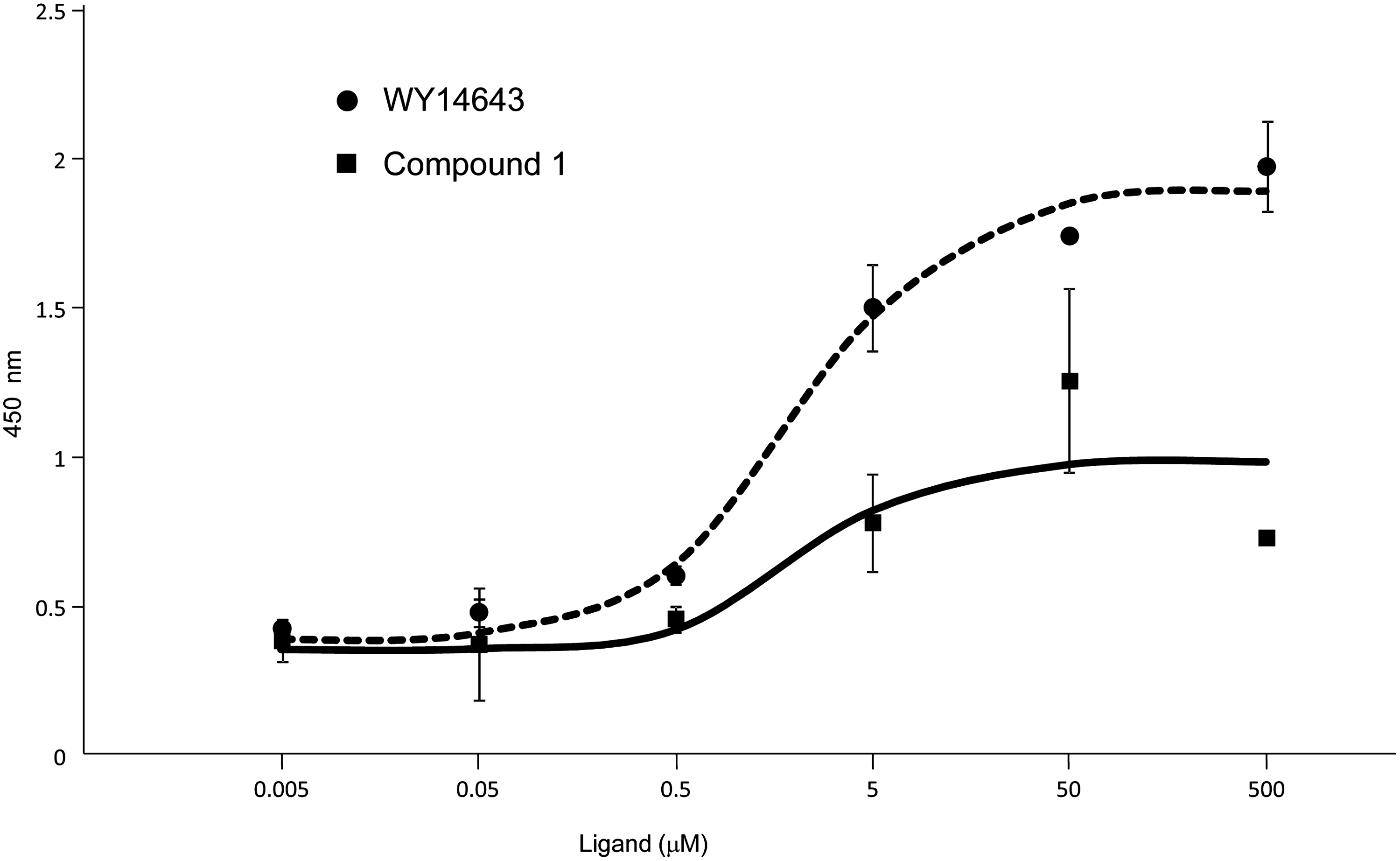
PPAR-α agonist activity for compound
The ratio of luciferase activity was indicated mean value ± SD (n = 3).
P < .01 compared with vehicle controls.
PPAR, peroxisome proliferator activated receptor; SD, standard deviation.
The ratio of luciferase activity was indicated mean value ± SD (n = 3).
P < .01 compared with vehicle controls.
Structural analyses
Compound
Discussion
In the DNA microarray analyses, Stac3 gene expression was drastically downregulated by APAP-induced liver injury, and FG pretreatment attenuated the alteration. In contrast, FG pretreatment without APAP administration did not alter Stac3 expression. Thus, the results implied that FG exerted a beneficial effect on APAP-induced liver injury. The Stac3 gene was reported to be associated with lipid metabolism and to interact with PPAR-α. 20,21 Furthermore, the other altered genes, Fads1, Scd1, and Fmo1, which are listed in Table 1, are also known to regulate lipid metabolisms through PPAR-α activity. 22 –24 Therefore, FG was suggested to contain an active constituent stimulating PPAR-α.
To identify the PPAR agonist in the FG, we attempted to isolate the compound by PPAR-α transcription reporter assay-guided fractionation. The MeOH extract of FG was partitioned successively among CHCl3, EtOAc, and H2O to give CHCl3-, EtOAc-, and H2O-soluble fractions. The transcription activities of PPAR-α of the CHCl3- and EtOAc-soluble fractions were 1.7- and 1.3-fold higher compared with the vehicle control, respectively. Since TLC examination showed the presence of similar compounds in the CHCl3- and EtOAc-soluble fractions, they were mixed together and fractionated by silica gel column chromatography to give 16 fractions. Among these, the highest transcription activity of PPAR-α was found in fr. 2 at the doses of both 5 and 20 μg/mL. Compound
The estimated PPAR agonist activity for the combined CHCl3 and EtOAc fraction based on the isolated amounts was similar to those of the CHCl3 and EtOAc fractions. Thus, compound
The structure of compound
In the present study, we identified 10-hydroxy-octadecanoic acid as an agonist of PPAR-α and -γ in FG. Not only the ginsenoside metabolites produced by L. paracasei A221 fermentation in FG but also the secondary metabolite of L. paracasei A221 contribute to the wide-ranging pharmacological effects of FG.
Footnotes
Author Disclosure Statement
No competing financial interests exist.