




Abstract
The health benefits of raw garlic intake has been extensively studied, but little is known about the biological effects of aged garlic consumption. A randomized, placebo-controlled, parallel-arm, double-blinded trial involving 41 hypercholesterolemic individuals was conducted to simultaneously examine and compare the blood lipid lowering and antioxidant effects after acute and extended exposures to aged and raw garlic supplements (1080 mg daily). Aged and raw garlic did not affect blood lipid concentrations in these hypercholesterolemic participants after acute and 13-week supplementation. The plasma and urinary F2-isoprostanes concentrations were significantly decreased after 13 weeks of aged garlic treatment. Aged garlic supplementation over 13 weeks also significantly decreased serum lipid hydroperoxide concentration and myeloperoxidase activity. Raw garlic treatments did not affect the F2-isoprostanes concentrations in blood plasma and urine, and lipid hydroperoxides in blood sera. Acute effects on the measured parameters were absent for both garlic treatments. In separate in vitro experiments, aqueous methanolic extract of aged garlic inhibited F2-isoprostanes formation and myeloperoxidase activity in freshly isolated human neutrophils to a greater extent than the raw garlic extract and S-allylcysteine at equivalent dosing concentrations. The aged garlic preparation was found to contain significantly higher total phenolic and S-allylcysteine contents than the raw garlic precursor. Our data showed that supplementation with aged garlic, not its raw garlic precursor, reduced oxidative stress and alleviated lipid peroxidation, possibly via the inhibition of myeloperoxidase. The differential antioxidant actions of the aged and raw garlic may be related to their different total phenolic contents and, to a lesser extent, their S-allylcysteine contents.
Introduction
G
Elevated serum cholesterol concentration is an important risk factor for the development of cardiovascular disease. Previous human intervention studies provided inconclusive evidence supporting the hypolipidemic actions of garlic consumption. Garlic capsule treatment (up to 4 g daily) has been shown to significantly reduce blood cholesterol in healthy subjects 4 and hypercholesterolemic subjects. 5 Intervention with aged garlic extract (AGE) significantly decreased serum cholesterol concentrations in mildly hypercholesterolemic men when compared to the placebo treatment. 6
In contrast, 900 mg daily garlic powder intervention did not affect the lipid profiles of patients with lipidemia. 7 –9 Intervention with AGE (3000 mg daily over 3 months) did not affect the blood cholesterols or low-density lipoproteins (LDLs) concentrations in diabetic patients or in patients with mild hypercholesterolemia. 10 It appears that not all garlic preparations are equivalent in their hypocholesterolemic actions.
The concept that lipid peroxidation may be a critical event in the pathogenesis of atherosclerosis 11 and the reported in vitro antioxidant properties of raw and aged garlic 2,12 –15 have led to the proposal that the mechanism for the proposed beneficial properties of raw and aged garlic may involve antioxidant effects. The enhanced antioxidant activity of garlic may be attributed to its high contents of phenolic 3 and organosulfur compounds. 1 Raw and aged garlic may differ in their antioxidant effects as the aging processes would most likely affect the phenolic and organosulfur contents. However, limited data is available on the in vivo antioxidant actions of aged garlic.
There are limited studies that simultaneously examine and compare the antioxidant and hypocholesterolemic actions of raw garlic and its corresponding aged garlic preparations. Our study investigated whether acute and extended exposure to raw garlic and its corresponding aged garlic preparation can significantly lower blood cholesterol concentrations and improve the lipid profiles of hypercholesterolemic individuals. The same study also examined whether the raw and aged garlic supplementations can decrease oxidative stress and alleviate lipid peroxidation in these individuals.
Materials and Methods
Chemicals and materials
Guaiacol, hydrogen peroxide (30% by volume), Folin-Ciocalteu's reagent, sodium carbonate, glucose, gallic acid, concentrated sulfuric acid, hydrochloric acid, sodium hydroxide, and ammonia were purchased from Merck (Bayswater, Australia); Phorbol 12-myristat 13-acetate (PMA), phosphate-buffered saline, and diethylenetriamine penta-acetic acid from Sigma-Aldrich (St. Louis, MO, USA); acetonitrile, ethanol, and methanol were from Tri-Tech Medical (Avon, OH, USA); ficoll-paque was from GE Healthcare (Uppsala, Sweden); Hanks' balanced salt solution (HBSS) and Roswell Park Memorial Institute (RPMI) 1640 were from Gibco Invitrogen (Carlsbad, CA, USA); and dextran 500 was from Amersham Biosciences (Uppsala, Sweden), and arachidonic acid (AA, dissolved in ethanol) were purchased from Cayman Chemical (Ann Arbor, MI, USA).
The aged and raw garlic powders were prepared and encapsulated by Defu Foodstuff Pte Ltd. (Singapore). The aged garlic was prepared by incubating fresh garlic clove at 70°C and 75% humidity for 40 days. 16 The raw and aged garlic clove were slow-heat dried, powdered, and packed into respective capsules.
Study design
A randomized, placebo-controlled, parallel-arm, double-blinded trial was conducted to simultaneously examine and compare the blood lipid lowering and antioxidant effects of aged and raw garlic supplements after acute and prolonged exposures. The study protocol was reviewed and approved by the Institutional Review Board, Nanyang Polytechnic (Singapore; NYP IRB No.: SCL-2013-003). Each subject was provided with written informed consent before his or her study involvement. The procedures followed were in accordance with the ethical standards of the responsible committee on human experimentation (Institutional Review Board) and with the Helsinki Declaration of 1975, as revised in 2008.
Inclusion criteria for study participation include Asian ethnicity, 21–60 years of age, diagnosis of high blood cholesterol level (between 5.2 and 8.0 mmol L−1), and body mass index (BMI) between 20 and 30 kg/m2. Exclusion criteria for recruitment included BMI >30, alcohol consumption >20 g/day (more than two standard drinks per day), cigarette smoking and medical conditions, such as diabetes mellitus, hypertension, and other cardiovascular-related diseases. The participants were randomized to receive one of the following treatments: aged garlic supplements comprised of of 1080 mg organic fermented aged garlic, or raw garlic supplements comprised of 1080 mg raw garlic.
At baseline, each participant was to provide a set of fasting whole blood and spot urine, and had blood pressures assessed. Clinical information (including age, gender, medical history, weight, and height) was collected using structured questionnaires. BMI was derived by dividing weight in kilograms by the square of height in metres. The assigned treatment was consumed over 15 min. A second set of blood and spot urine was taken, and blood pressures reassessed 3 h after treatment. Each participant was asked to consume the assigned garlic supplements daily for 13 weeks. Each participant was also instructed to maintain weight and activity levels alomg with usual garlic consumption habits during the course of the study. At the end of the 13-week exposure, a set of fasting whole blood and urine was collected and blood pressures were also assessed.
Blood and urine biochemistry
Total cholesterol, high-density lipoprotein, LDL, triglycerides, fasting glucose, and high sensitivity C-reactive protein (hsCRP) concentrations were measured in blood plasma/serum using the Cobas c111 Photometric Analyzer (Roche Diagnostic GmbH, Mannheim, Germany). Creatinine and urea concentrations were determined in urine using the same analyzer. F2-isoprostanes concentrations were measured in the blood plasma and urine using stable isotope-labeled gas chromatography-mass spectrometry (GC-MS) as previously described. 17 Plasma F2-isoprostane concentrations were expressed unadjusted, while its urinary concentrations were adjusted for urinary creatinine levels. Plasma concentrations of lipid hydroperoxides were measured using enzyme immunoassay kits (Cayman Chemical). Serum myeloperoxidase enzyme activity was determined using a biochemical assay kit (Cayman Chemical).
Food biochemistry and in vitro experiments
The total phenolic contents of the aged and raw garlic extracts (RGEs) were determined by a modified Folin-Ciocalteu assay. 18 The amounts of S-allylcysteine present in the AGEs and RGEs were measured using a previously published high performance liquid chromatography method. 19 Aqueous methanolic RGE and AGE were prepared by extracting the respective garlic powders (0.5 g) in 50 mL aqueous methanol (50% v/v) in an ultrasonic bath at room temperature for 20 min. Neutrophils were isolated from the neutrophil/erythrocyte pellet after Ficoll Paque gradient centrifugation and dextran sedimentation of red blood cells as previously described. 20 Cell viability was assessed using trypan blue exclusion and was typically >98%. The freshly isolated neutrophils were resuspended in HBSS at a concentration of 5 × 10⁶ cells/mL.
To test the effect of AGE and RGE on myeloperoxidase activity in human neutrophils, freshly isolated human neutrophils (1 × 10⁶ cells/mL in HBSS) were incubated with AGE or RGE (final concentrations of 10, 20, 50, 100, and 200 μg/L) for 5 min at 37°C before the incubate was removed. The neutrophils were resuspended in fresh HBSS and lyzed by sonication. Functional myeloperoxidase activity was determined by measuring its catalytic action on the oxidation of guaiacol in the presence of hydrogen peroxide as described previously. 21
The free radical scavenging abilities of AGE and RGE were examined by measuring the inhibition of F2-isoprostanes formation in peripheral neutrophils. F2-isoprostanes (stable marker of AA oxidation) was quantitated using stable isotope labeled GC-MS as previously described. Briefly, the freshly isolated neutrophils (5 × 10⁶ cells/mL HBSS) were incubated with AGE or RGE (final concentrations of 10, 20, 50, 100, and 200 μg/L) and AA (final concentration, 10 μM) at 37°C for 5 min before stimulation. The garlic extracts and AA were added using HBSS and ethanol as vehicles, respectively. The cells were stimulated with PMA (final concentration, 200 nM) at 37°C for 15 min. AA incubated with PMA-activated cells were used as positive controls, while AA incubated with untreated cells without PMA activation served as negative controls. The supernatant from the cell suspension was collected and stored at −80°C before extraction and analysis of F2-isoprostanes.
Statistical analyses
Statistical analyses were performed using SPSS version 22.0 (SPSS, Inc., Chicago, IL, USA). Mean ± standard deviation was used to describe normally distributed data while median (interquartile range) was used to describe nonparametric data. For normally distributed data, between-groups differences were analyzed using one-way analysis of variance (ANOVA) with Tukey's adjustment. For nonparametric data, between-groups differences were analyzed using nonparametric Krusal Wallis ANOVA. For in vitro data, ANOVA was performed on specific concentration points and on area under the curve. Error bars in all of the figures were presented as standard deviation of means for parametric data and interquartile range for nonparametric data. Statistical significance was considered when P < .05 based on 95% confidence interval.
Results
Human study
The 41 participants were normotensive and normoglycemic (Tables 1 and 2). The participants in the two parallel treatment groups (raw garlic N = 20 and aged garlic N = 21) did not differ in their age, weight, height, BMI, and systolic and diastolic blood pressures before or after the 13-week treatments (Table 1). Acute garlic treatments did not affect the weight, height, BMI, and systolic or diastolic blood pressures (data not shown). Blood glucose and serum hsCRPs concentrations of the participants were not significantly altered throughout the study period (Table 2). The study participants had clinically high concentrations of blood cholesterols, LDLs, and triglycerides (Table 2). Aged and raw garlic did not affect blood lipids concentrations in these hypercholesterolemic participants after acute and 13-week supplementation (Table 2).
Parametric data were presented as mean ± standard deviation.
BMI, body mass index.
Nonparametric data were presented as median (interquartile range).
Parametric data were presented as mean ± standard deviation.
F2-isoprostanes concentrations in blood plasma and urine, and lipid hydroperoxides concentrations in blood sera were significantly decreased after the extended 13-week aged garlic treatment (Figs. 1 and 2a). Aged garlic treatment did not acutely affect the serum lipid hydroperoxides, plasma, and urinary F2-isoprostanes concentrations (Figs. 1 and 2a). Acute and extended treatment with raw garlic did not influence F2-isoprostanes and lipid hydroperoxides concentrations in blood plasma and urine (Figs. 1 and 2a). Serum myeloperoxidase activity was significantly lower after the 13-week aged garlic treatment, but remained unaffected by the raw garlic over the equivalent 13-week treatment (Fig. 2b). Acute aged garlic supplementation did not affect the serum myeloperoxidase activity (Fig. 2b).
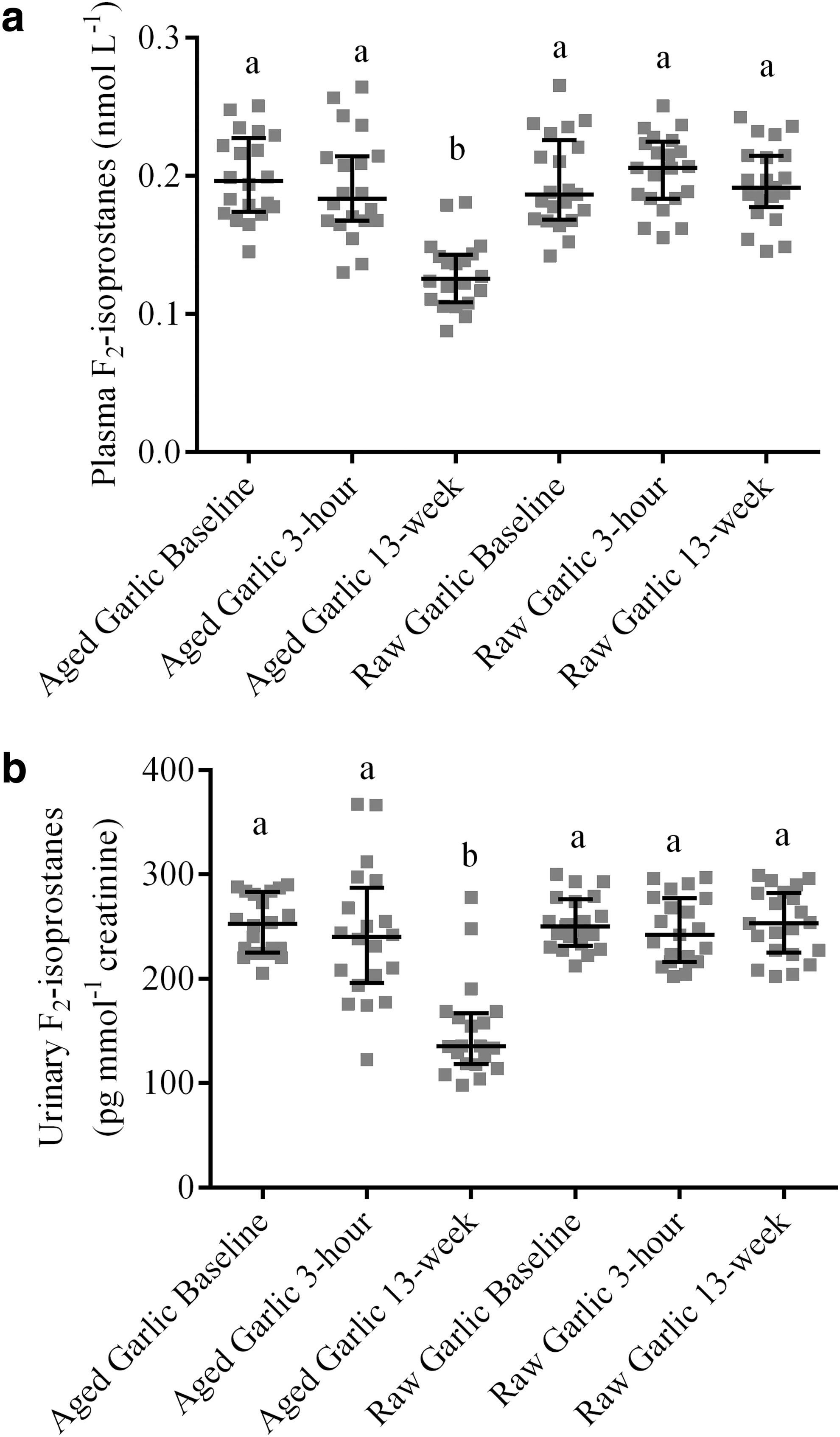
Concentrations of F2-isoprostanes in
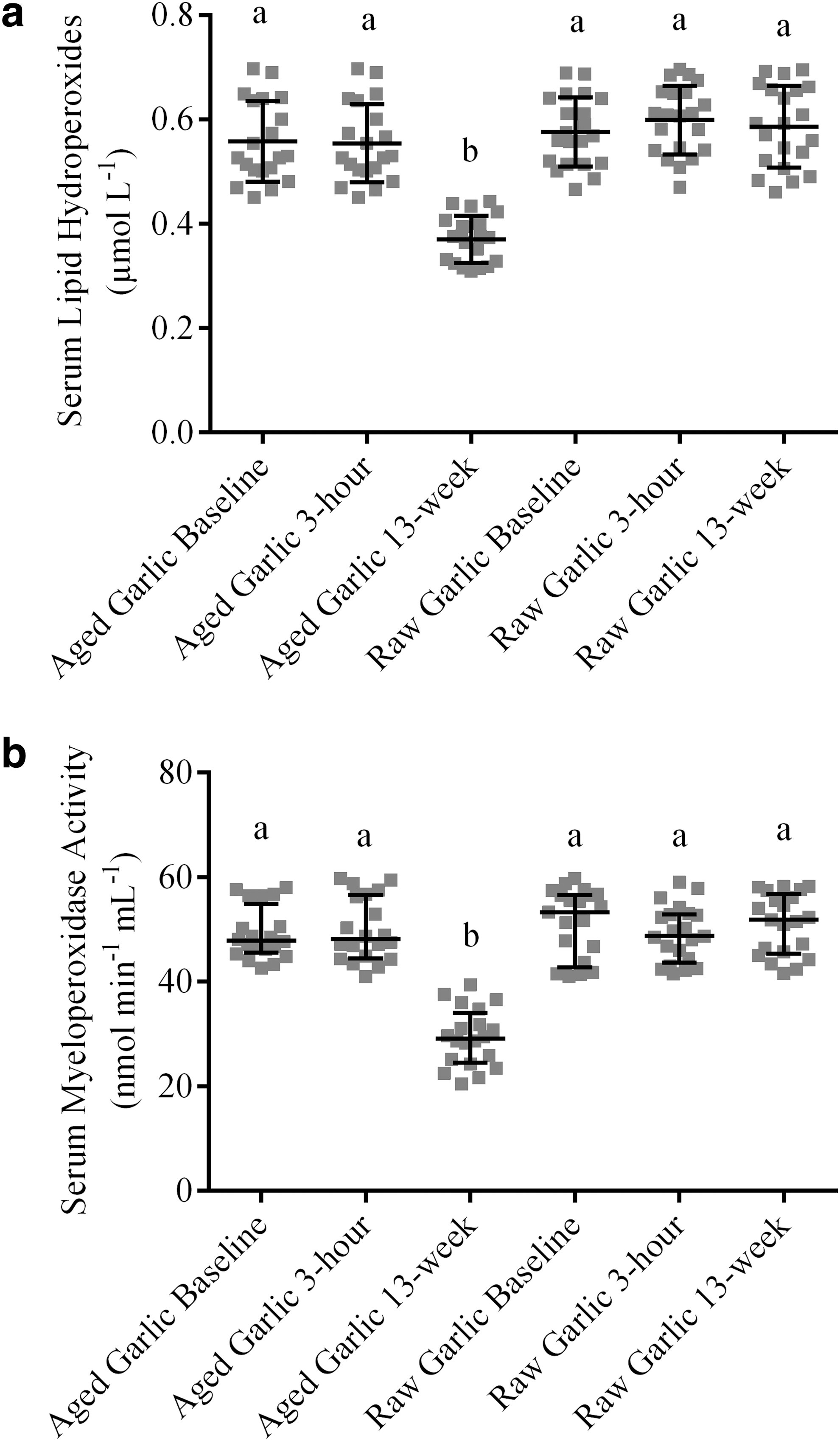
Food chemistry and in vitro experiments
The AGE contained significantly greater amounts of phenolic compounds (N = 5, 6.27 ± 0.36 vs. 1.17 ± 0.18 mg gallic acid equivalent/g) and S-allylcysteine (N = 5, 0.37 ± 0.03 vs. 0.21 ± 0.02 mg/g) than the RGE. S-allylcysteine, AGEs and RGEs dose-dependently decreased F2-isoprostanes production by human neutrophils (Fig. 3a). All three extracts also inhibited the functional myeloperoxidase activity in human neutrophils in a dose-dependent manner (Fig. 3b). AGE altered the F2-isoprostanes production and functional myeloperoxidase activity in human neutrophils to greater extents than the RGE (Fig. 3a, b). S-allylcysteine exhibited significantly lower antioxidant effects than the garlic extracts (Fig. 3a, b).
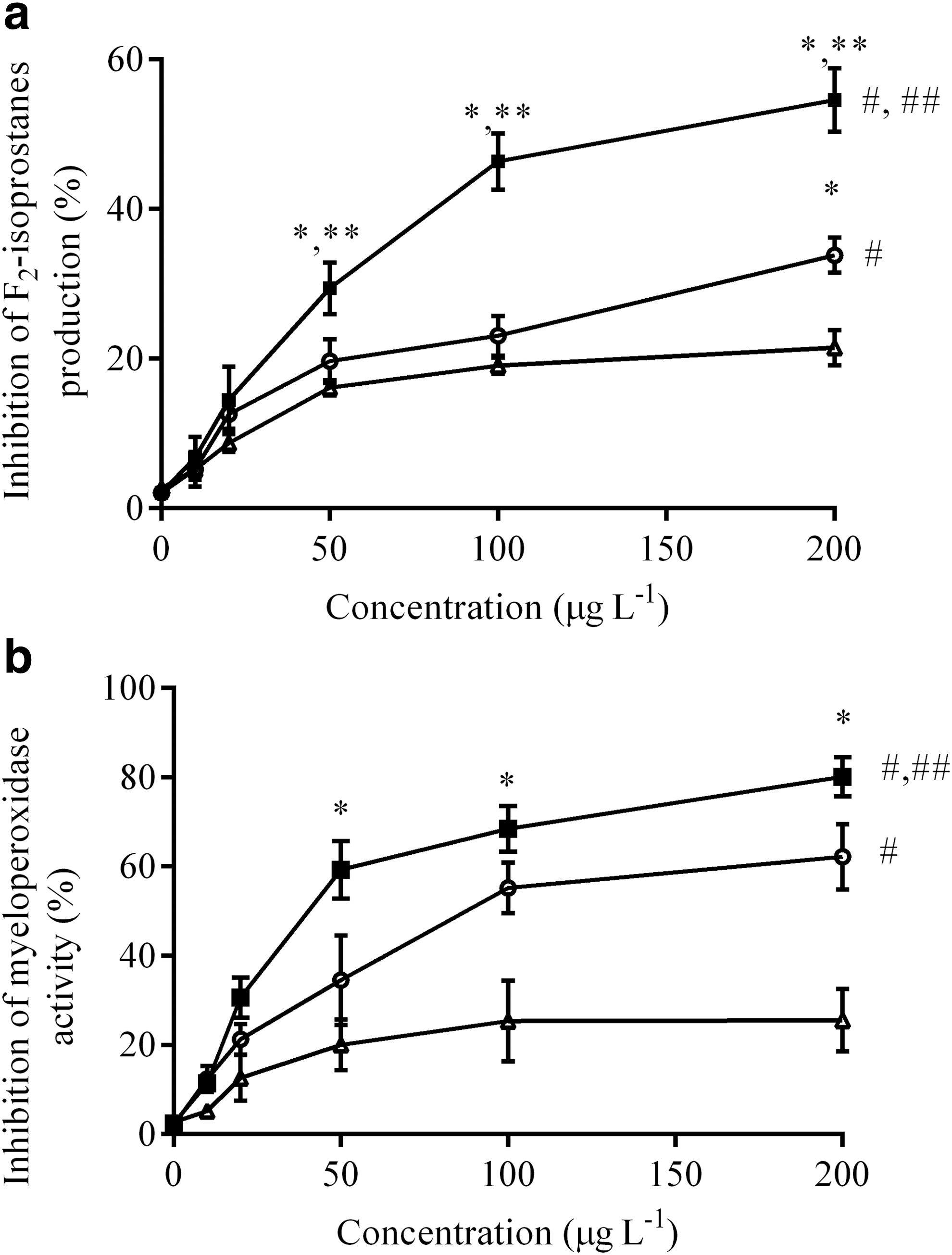
Dose-dependent inhibition of
Discussion
Numerous in vitro and human intervention studies have shown antioxidant effects of garlic preparations, both aged and unaged. Garlic extract has been shown to reduce lipopolysaccharide-induced nuclear factor-κB production in human whole blood. 22 Polar extracts of matured and immature garlic reduced 2,2-diphenyl-1-picrylhydrazyl radical formation and neutralized hydrogen peroxide. 3 Aged red garlic extract reduced lipopolysaccharide-induced nitric oxide production in RAW 264.7 macrophages through heme-oxygenase-1 induction. 23 A chloroform extract of aged garlic attenuated tumor necrosis factor-induced reactive oxygen species production in human umbilical vein endothelial cells. 24 A recent in vitro study comparing the radical scavenging and lipid peroxidation inhibition activities of fresh and aged garlic showed that aging of garlic enhanced its antioxidant capacity. 25 Park et al. reported significantly lower superoxide dismutase inhibition by AGE compared to RGE. 26
Treatment with garlic extract (∼10 g garlic/day) decreased the blood malondialdehyde concentrations in hypercholesterolemic and hypertensive subjects. 27 Ingestion of garlic extract (1 mg/kg body weight daily) led to significantly lowered plasma and erythrocyte malondialdehyde levels in the patients. 27 Dietary supplementation with AGE (∼1500 mg) for 14 days decreased plasma and urine concentrations of 8-iso-prostaglandin-F2α by 29% and 37% in nonsmokers and by 35% and 48% in smokers. 28 These levels returned to the preintervention levels 14 days after cessation of dietary supplementation. 28 None of the reported studies have examined and compared simultaneously the in vivo antioxidant activities of garlic before and after aging. Most of the past studies also failed to elucidate the possible mechanisms by which the studied garlic preparations exert their antioxidant properties.
Our in vivo results demonstrated that 13-week treatment with aged garlic, but not its raw garlic precursor, significantly decreased oxidative stress and alleviated lipid peroxidation in hypercholesterolemic subjects. Previous reports of elevated plasma myeloperoxidase in early adverse cardiac events, 29 in acute coronary syndrome, 30 and after acute myocardial infarction 31 and the association of these conditions to lipid peroxidation provide substantial evidence that myeloperoxidase may contribute to lipid peroxidation in vivo. In our study, participants treated with aged garlic supplement exhibited significantly lower blood myeloperoxidase activities compared to those with raw garlic supplement. Both AGEs and RGEs inhibited myeloperoxidase enzyme activities in vitro, though AGE exhibited significantly higher myeloperoxidase inhibition than RGE. Together, our results suggested that aged garlic supplement protected lipids from oxidative modification via the inhibition of myeloperoxidase.
S-allylcysteine is believed to contribute to the antioxidant actions of garlic preparations. Treatment of endothelial cells with S-allylcysteine (in mM concentrations) attenuated cell death and prevented oxidative damage to cell membranes as measured by lactate dehydrogenase and thiobarbituric acid assays, respectively. 32 S-allylcysteine inhibited Cu2+-mediated oxidation of LDL at an optimal concentration of 1 mM. 33 S-allylcysteine binding with Fe2+ and Fe3+ prevented the redox recycling of iron and thereby inhibited Fe2+-mediated lipid peroxidation. 34 The same molecule also exhibited dose-dependent inhibition of hydrogen peroxide production and NF-κB activation in oxidized LDL-challenged RAW 264.7 macrophages. 33
Findings from these studies may need further consideration, as these studies did not take into account the in vivo concentrations of the tested compounds. S-allylcysteine has been found to be circulating in human blood plasma at concentrations around 100 ppb (100 μg/L). 35 Our in vitro study demonstrated that S-allylcysteine up to 200 μg/L did not protect against AA and lipid peroxidation as effectively as previously reported. It appeared that molecules other than S-allylcysteine were responsible for the observed protection against AA and lipid peroxidation.
Several aged garlic products have shown significantly higher phenolic contents than their unaged counterparts. 26 Processing techniques and aging conditions are important determinants of the changes in total phenolic and organosulfur contents in the final garlic products. 26 The milling and subsequent encapsulation of the final garlic product (into supplement capsule form) can also affect the total phenolic and organosulfur profiles. 26 The complex polyphenolic molecules in raw garlic may be broken down into simpler phenolic molecules by the proprietary aging processes, and thereby result in an increase in the total phenolic content in the final product. Our results suggested that the S-allylcysteine in the garlic extracts may not contribute significantly to their antioxidant activities. The greater antioxidant activity of the aged garlic may be attributed to its comparatively higher phenolic contents. Bozin et al. 3 reported similar observations when differences in phenolic and reported that flavonoid contents could partially account for the difference in antioxidant activities between matured and immature garlic.
The raw garlic supplementation in our study did not significantly affect the blood lipid profiles in hypercholesterolemic subjects, and its subsequent aging process did not improve its hypolipidemic actions. Though various meta-analyses, including a recent one, 36 reported that garlic preparations, aged or unaged, lowered total blood cholesterol concentrations, numerous intervention studies with raw and aged garlic preparations produced similar no-effects on the lipid profile of healthy and hypercholesterolemic individuals. 7 –10 Until the exact garlic components contributing to the potential hypolipidemic effects of aged and unaged garlic have been identified, and the possible mechanisms by which these molecules exert their effects have been elucidated, we cannot explain, in full, the lack of hypolipidemic actions in our two garlic preparations.
Our study was designed to examine and compare the difference in the hypocholesterolemic and antioxidant actions of the raw garlic and its subsequent aged garlic preparation. We did not include a placebo arm in our study design, since the two garlic preparations would act as controls to each other. The aged and raw garlic supplements used in our study were deliberately encapsulated in identical capsules at the original manufacturing site, such that both participants and investigators were blinded to the treatments.
Aged garlic supplementation decreased oxidative stress and alleviated lipid peroxidation, possibly via the inhibition of myeloperoxidase. The enhanced antioxidant actions of aged garlic preparation may be attributable to the upregulated phenolic contents after the aging processes. More studies should be conducted to identify the specific phenolic compounds in the aged garlic responsible for its antioxidative property.
Footnotes
Acknowledgment
The authors of the article would like to thank Defu Foodstuff Pte Ltd. for their invaluable advice and support rendered.
Author Disclosure Statement
No competing financial interests exist.