




Abstract
The hippocampus is an important brain area where abnormal morphological characteristics are often observed in patients with temporal lobe epilepsy (TLE), typically showing the loss of the principal neurons in the CA1 and CA3 areas of the hippocampus. TLE is frequently associated with widening of the granule cell layer of the dentate gyrus (DG), termed granule cell dispersion (GCD), in the hippocampus, suggesting that the control of GCD with protection of hippocampal neurons may be useful for preventing and inhibiting epileptic seizures. We previously reported that eugenol (EUG), which is an essential component of medicinal herbs and has anticonvulsant activity, is beneficial for treating epilepsy through its ability to inhibit GCD via suppression of mammalian target of rapamycin complex 1 (mTORC1) activation in the hippocampal DG in a kainic acid (KA)-treated mouse model of epilepsy in vivo. In addition, we reported that naringin, a bioflavonoid in citrus fruits, could exert beneficial effects, such as antiautophagic stress and antineuroinflammation, in the KA mouse model of epilepsy, even though it was unclear whether naringin might also attenuate the seizure-induced morphological changes of GCD in the DG. Similar to the effects of EUG, we recently observed that naringin treatment significantly reduced KA-induced GCD and mTORC1 activation, which are both involved in epileptic seizures, in the hippocampus of mouse brain. Therefore, these observations suggest that the utilization of natural materials, which have beneficial properties such as inhibition of GCD formation and protection of hippocampal neurons, may be useful in developing a novel therapeutic agent against TLE.
Introduction
E
Antiepileptic drugs (AEDs), which decrease the frequency and/or severity of seizures in people with epilepsy, represent a class of drugs with different pharmacologies and chemistries, but that share the common ability to decrease neuronal excitability. AEDs are mainly used to treat epilepsy, however, some of them can be used for the treatment of neurological diseases such as migraine, neuropathic pain, and hyperkinetic movement disorders, and for the treatment of psychiatric diseases such as anxiety, bipolar disease, and schizophrenia. 7 –12 Although the majority of patients (around 70%) receiving AEDs demonstrate a good control of epilepsy, many AEDs cause some degree of adverse drug reaction, and cause unwanted side effects in some people. 13 –15 Generally, adverse effects of AEDs comprise early onset events such as somnolence, dizziness, gastrointestinal events, or even seizure aggravation, and late onset events such as psychotic episodes, behavioral problems, depression, impaired cognition, osteoporosis, and leucopenia, 13 –15 suggesting that minimizing the adverse effects of treatment while maximizing seizure control should be considered as the therapeutic goal against epilepsy. Therefore, these reports suggest that natural compounds, which have no adverse effects on the body, may be useful as an alternative medicine, and their application, which may have beneficial effects against epileptic seizures, can be used as a novel therapeutic strategy for patients with epilepsy.
In recent years, many studies have reported that various natural compounds such as flavonoids have beneficial properties, through effects such as induction of neurotrophic factors, inhibition of neuroinflammatory responses, and control of reactive oxygen species, against various brain diseases. 16 –20 Although there are not many reports on the beneficial effects or mechanism of action of natural phytochemicals against epilepsy, studies using natural phytochemicals, such as eugenol, naringin, and resveratrol, have shown efficacy against seizure activity in kainic acid (KA)-induced animal models of TLE. 21 –24 Moreover, we recently reported that treatment with the natural compounds, eugenol and naringin inhibited seizure activity via the reduction of morphological changes involved in GCD formation in the DG, in addition to neuroprotection in the KA-treated hippocampus, in vivo. 2,25 Therefore, this evidence suggests that various natural phytochemicals, which have a capacity for inhibiting GCD formation, can be utilized to prevent the epileptogenic process, and the results obtained by their application may be useful in developing a novel therapeutic strategy using alternative medicines for patients with epilepsy.
Tle and Limitation of Aeds
Epileptogenesis is a process in which an injury to the central nervous system can lead to surviving neuronal populations generating abnormal, synchronous, and recurrent epileptiform discharges producing focal or generalized seizures. 1,2,26 TLE is a chronic condition characterized by epileptic seizures originating mainly in temporal lobe areas. 26 The hippocampus is particularly prone to generating seizures and perpetuating focal TLE, which is the most common form of partial or localization-related epilepsy in humans. 2,3 Many studies have sought to develop or improve effective AEDs, which may have a role in controlling cellular mechanisms including modulation of ion channels, neurotransmitters, secondary messengers, and other processes. 27,28 These drugs are certainly helpful in controlling seizures; however, they can also interfere with normal brain functions such as cognition, memory, and emotional behaviors, especially in at-risk groups such as pediatric and elderly patients with epilepsy. 13 –15,27 –30 Moreover, despite the numerous AEDs commercially available, about 30–40% of patients remain with seizures refractory to pharmacological treatment, 31 and it is hard to predict the treatment outcome with the use of current AEDs. 32 In addition, there is no drug with significant efficacy in modifying the epileptogenic process, and there is still a lack of sufficient research looking for novel potential therapeutics to control abnormal cytoarchitecture, such as GCD. These facts suggest that there are multiple obstacles to overcoming the limitations of current AEDs, and that the neurological damage caused by epileptic insults should be considered. Accordingly, natural compounds, which have a capacity for an anti-seizure effect through inhibition of the epileptogenic process with no adverse side effects on the body, may be useful as an alternative medicine for patients with epilepsy.
Mammalian Target of Rapamycin Complex 1 Activation and Gcd in Epilepsy
mTOR kinase exists in two complexes, mammalian target of rapamycin complex 1 (mTORC1) and mTORC2, which play central roles in the integration of cell growth in response to environmental conditions, including growth factors, amino acids, energy substrates, and oxygen. 33,34 mTORC2 activates Akt, also known as protein kinase B (PKB), and is activated in cells exposed to diverse stimuli such as hormones, growth factors, and extracellular matrix components, by Ser473 phosphorylation, whereas mTORC1 is an important mediator of many effects of Akt on cell growth that are induced by growth factors. 33 –35 The activation of mTORC1 can phosphorylate, and activate, ribosomal S6 kinases (S6K1 and S6K2) and inhibit the translational regulator, 4E-BP1. 33 –36 This consequently results in phosphorylation of its downstream effectors that increase mRNA translation involved in cell growth and survival. 35 –37
Dysfunction of the mTORC1 pathway is implicated in the pathophysiology of a number of neurological disorders, and induction of Akt/mTORC1 signaling activation enhances the activity of intracellular cell survival pathways under a variety of conditions such as the withdrawal of trophic factors, ischemic shock, and oxidative stress. 38 –41 In the adult brain, in vivo induction of neuronal mTORC1 activation induces neurotrophic effects resulting in the protection and restoration of dopaminergic neurons in a neurotoxin-induced model of Parkinson's disease. 33 –35,42 Administration of a neurotoxin to induce an animal model of Parkinson's disease decreases Akt phosphorylation resulting in loss of mTORC1 activation. 43 A decreased level of Akt phosphorylation is also observed in the substantia nigra of patients with Parkinson's disease. 43 Moreover, the beneficial effects of neuronal mTORC1 activation, such as neuroprotection and enhanced neuronal activity, were also observed in the hippocampus lesioned by treatment with a neurotoxin, 36 suggesting that activation of mTORC1 is necessary for the survival of adult neurons and functional maintenance of the nervous system against neurodegenerative effects in the adult brain. However, there are many important reports showing that mTORC1 activation is directly involved in epileptic seizures 38,44 –46 and epileptogenesis. 47 –49 Upregulated mTORC1 was observed in the sclerotic hippocampus of patients with TLE, 44 and its inhibition was effective in reducing or eliminating seizures in patients with epilepsy 38,45,46 and showed antiepileptogenic effects such as preventing the development of epilepsy. 38 Thus, these results suggest that the control of mTORC1 activation may have the potential to affect neuronal excitability and exert therapeutic effects against seizures, even though its appropriate activation is necessary for the survival of adult neurons against neurodegeneration in the adult brain.
GCD is commonly found in the hippocampus of TLE patients or experimental animal models, 4,50,51 and this alteration is usually associated with other architectural abnormalities, such as collateral mossy fiber sprouting. 50,51 The clinical observation of GCD-related morphological changes can aid in the prognosis of postsurgical seizure outcomes in TLE patients with DG pathology, 6 and these cytoarchitectural abnormalities are known to be associated with status epilepticus and epileptic progression. 4,6 The morphological features of GCD are mediated by activation of the mTORC1 signaling pathway, with its continuous activation leading to the development of spontaneous recurrent seizure, in dentate granule cells in the hippocampus, 2,25,44,52 suggesting that that the control of GCD may be useful for preventing the epileptogenic process, and that inhibition of the mTORC1 signaling pathway in the dentate granule cells may have a crucial role in preventing GCD formation associated with epilepsy.
Natural Phytochemicals Against Neurodegeneration
There are many beneficial phytochemicals, which can be extracted from natural materials that have antistress, anti-inflammatory, and antioxidant effects, resulting in increases in neuronal activity and induction of neuroprotective effects against age-related neurodegeneration in the adult brain. 53 –58 Fisetin, which is a naturally occurring flavonoid commonly found in strawberries and other fruits and vegetables, has the capacity to inhibit the production of neurotoxic inflammatory cytokines and biomolecules such as tumor necrosis factor-α, interleukin-1β, and free radicals, such as nitric oxide and superoxide anion, consequently resulting in neuroprotection. 58 Moreover, oral administration of fisetin attenuated cognitive impairments through inhibition of astrogliosis, neuroinflammation, and altered eicosanoid metabolism observed in an animal model of Alzheimer's disease. 54 Epigallocatechin-3-gallate, a major polyphenol isolated from green tea, exerts neuroprotective effects against various disease conditions by suppressing inflammatory and oxidative stresses in the brain. 53 Resveratrol, a natural polyphenol extracted from grapes in the processing of red wine, is well known as an inducer of sirtuin (silent mating type information regulation 2 homolog) 1, and its administration induces neuroprotective effects through antiaging, anti-inflammatory, and antioxidant properties in ischemic stroke and Alzheimer's disease. 56,57 In the animal models of Parkinson's disease, treatment with natural flavonoids such as nobiletin, silibinin, naringin, and a standardized safflower flavonoid extract, showed beneficial properties for inhibiting neurodegeneration via direct/indirect neuroprotective mechanism in animal models of Parkinson's disease, 16,17,19,20,55 suggesting that many natural phytochemicals are potentially protective against neurodegeneration in the adult brain. Moreover, antiepileptic progression through changes in functional phenotypes such as inhibition of autophagic and oxidative stress, and antineuroinflammation following treatment with certain phytochemicals, such as naringin, epigallocatechin-3-gallate, and resveratrol, has been recently reported. 22,24,59 –61 Although the detailed mechanisms that exert significant structural alterations such as GCD-related morphological changes is still unclear, these reports suggest that various natural compounds may also be useful as an alternative medicine against epileptic seizures, and its administration can be utilized as a novel therapeutic strategy for patients with epilepsy.
Eugenol and Naringin As Potential Neuroprotective Agents in the Adult Brain
Eugenol, a naturally occurring phenol extracted from cloves, has been used for its antiseptic and analgesic effects in dental care. 2,62 Eugenol has various beneficial effects such as antioxidant, anti-inflammatory, anticancer, and antinociceptive activities in various models of diseases. 2,62,63 In the adult brain, its administration could protect hippocampal neurons from ischemic, excitotoxic, and oxidative injury in vivo and in vitro, 64 and also protect dopaminergic neurons from oxidative stress in a neurotoxin-treated animal model of Parkinson's disease. 65 Similar to the beneficial effects of eugenol in the adult brain, treatment with methyleugenol, which can be derived from eugenol and has structural similarity, reduced cerebral ischemic injury by suppression of oxidative injury and neuroinflammation in vivo. 66 Moreover, eugenol has potential anticonvulsant activity against maximal electroshock- and pentylenetetrazole-induced seizure models of epilepsy in vivo 67,68 and an inhibitory role against epileptiform activity in hippocampal slices in vitro, 23 suggesting that it may be a potential therapeutic agent for TLE.
Among the many flavonoids, naringin, a major flavonone glycoside in grapefruits and citrus fruits, is considered as a potential therapeutic agent against neurodegenerative diseases because it can induce not only anti-inflammatory effects but also neuroprotective effects through the induction of neurotrophic factors such as brain-derived neurotrophic factor and glia-derived neurotrophic factor, and by the activation of antiapoptotic pathways. 19,20 In an animal model of Alzheimer's disease, treatment with naringin induced various beneficial effects such as lessening learning and memory deficits, improving locomotor activity, reducing scattered senile plaques, and ameliorating disturbances in brain energy metabolism in vivo. 69 Similar to the effects in the Alzheimer's disease model, its neuroprotective effects were also observed in animal models of ischemic stroke 70 and Parkinson's disease. 19,20 These reports suggest that naringin induces protective efficacy against neurodegeneration in the adult brain. Moreover, we recently reported that naringin treatment prevented KA-induced hippocampal cell death via inhibition of neuroinflammation and autophagic stress, and reduced KA-induced seizure activities. 22 Therefore, these reports suggest that the administration of eugenol and naringin may have a potential therapeutic role in the treatment of TLE with their beneficial neuroprotective effects against neurotoxicity.
Effects of Eugenol and Naringin On Gcd Formation in a Mouse Model of Tle
Although the clinical observation of GCD-related morphological changes, which are associated with status epilepticus and epileptic progression, can aid in the prognosis of postsurgical seizure outcomes in TLE patients with DG pathology, 4,6 suggesting that the control of GCD may be a useful strategy to prevent the epileptogenic process, it was largely unknown whether administration of natural phytochemicals against epilepsy could contribute to the alleviation of morphological abnormalities in the epileptic hippocampal GCL. We recently reported that treatment with eugenol 2 and naringin 25 significantly increased the seizure threshold, resulting in a delayed onset of seizures and reduced GCD in the KA-treated model of epilepsy. Moreover, the treatments significantly reduced mTORC1 activation, which is an important regulator involved in the development of GCD, in the hippocampus of the adult mouse brain in vivo. 2,25 As supporting evidence for naringin-induced inhibitory effects on GCD formation in the KA-treated model of epilepsy, 25 analysis of Nissl-stained brain slices demonstrated that naringin treatment with a daily intraperitoneal injection could alleviate GCD at 1 week following KA injection (Fig. 1A), and western blotting showed that the levels of p-4E-BP1, a phosphorylated form of the mTORC1 substrate, 4E-BP1, were significantly increased 1 day after KA treatment compared with controls (Fig. 1B; P < .001 vs. CON). However, p-4E-BP1 levels were significantly decreased by naringin treatment (Fig. 1B; P < .001 vs. KA), suggesting that naringin could mitigate KA-induced GCD by inhibiting activation of mTORC1. Taken together, these results suggest that eugenol and naringin may be beneficial for preventing epileptic events through the inhibition of GCD by inhibiting mTORC1 activation with neuroprotective effects such as anti-neuroinflammation and anti-autophagic stress in the hippocampus in vivo (Fig. 2).
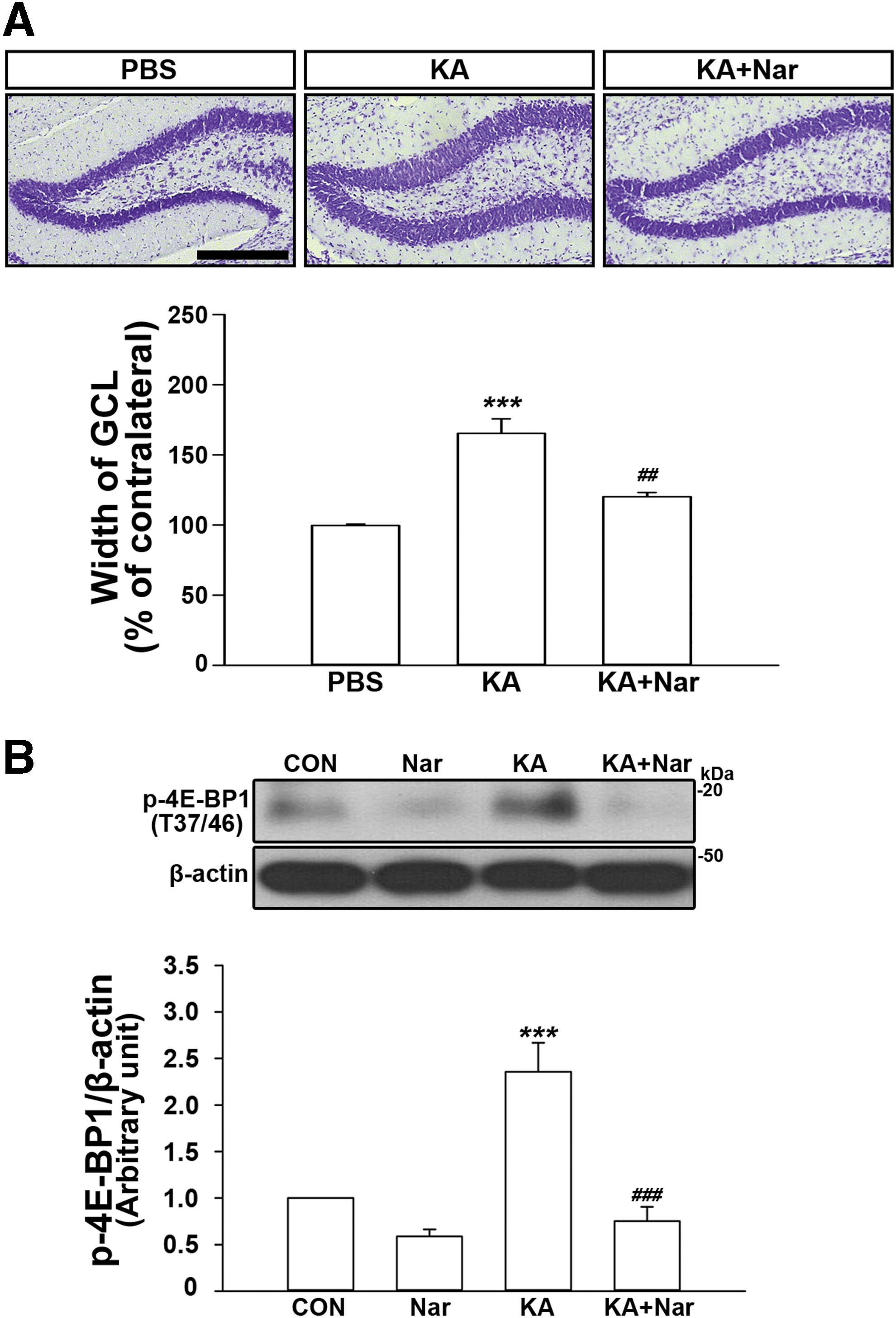
Effect of naringin on KA-induced GCD in the hippocampal DG.

Natural phytochemicals such as naringin and eugenol may have beneficial effects in preventing epileptic events through inhibition of GCD, neuronal cell death, and neuroinflammation in the hippocampus in vivo, suggesting that various natural phytochemicals, which have neuroprotective effects through the inhibition of GCD formation, can be utilized as alternative medicines in preventing the epileptogenic process in patients with epilepsy. Color images available online at
Conclusions
Many kinds of phytochemicals may have beneficial effects as therapeutic natural materials against the activation of neurotoxic signaling pathways involved in neurodegeneration, even though the phytochemical-mediated bio-availability must be continually examined in detail. Moreover, some phytochemicals, such as eugenol, naringin, epigallocatechin-3-gallate, and resveratrol, have a capacity to reduce seizure activity in animal models of TLE. In particular, the administration of eugenol and naringin shows inhibitory effects on GCD formation through the suppression of mTORC1 activation in the hippocampal DG in vivo. Although there is lack of evidence for the beneficial effects of phytochemicals in clinical trials, and it is unclear whether post-treatment with effective phytochemicals exert long-term neuroprotective effects against epileptic progression, the evidence suggests that various natural phytochemicals, such as eugenol and naringin, which have a capacity for inhibiting GCD formation, have potential as alternative medicines to prevent the epileptogenic process in patients with epilepsy.
Footnotes
Acknowledgments
This research was supported by the National Research Foundation of Korea (NRF) grant funded by the Korean government (No. 2014R1A1A2056508), and also by grants from the Korea Healthcare Technology R&D Project, Ministry of Health & Welfare (HI15C1928).
Author Disclosure Statement
No competing financial interests exist.