




Abstract
The extraction yield, total phenols, caffeic acid derivatives (CAD), and antioxidant properties of 50% ethanolic Echinacea purpurea flower extract were determined. The in vitro inhibitory effects of 50% ethanolic extract and CAD on α-amylase, α-glucosidase, and angiotensin-converting enzyme (ACE) linked with type 2 diabetes were also investigated. The extraction yield, total phenols, and total CAD of the extract were 27.04%, 195.69 mg CAE/g and 78.42 mg/g, respectively. Cichoric acid (56.03 mg/g) was the predominant CAD compound in the extract. The extract exhibited good antioxidant properties. The extract and CAD inhibited α-amylase, α-glucosidase, and ACE activities in a concentration-dependent manner. Among the tested samples, chlorogenic acid, and caffeic acid (IC50 of 1.71–1.81 mg/mL) had the highest α-amylase inhibitory activity, cichoric acid (IC50 of 0.28 mg/mL) showed higher α-glucosidase inhibitory activity. Both chlorogenic acid and caffeic acid (IC50 of 0.11–0.14 mg/mL) demonstrated higher ACE-inhibitory activity. The in vitro results suggest that E. purpurea extract and CAD have good potential for managing hyperglycemia and hypertension. Overall, the data suggest it is a choice for developing antihyperglycemia and antihypertension compounds from field-grown E. purpurea.
Introduction
C
Hypertension is not only one of complications of diabetes but also a major risk factor for cardiovascular disease development. 6 There are a number of therapeutic options for treating hypertension, such as diuretics, β-blockers, calcium channel blockers, and angiotensin II receptor blockers. 7 The inhibition of angiotensin-converting enzyme (ACE) activity is the most common treatment. ACE cleaves inactive angiotensin I into a powerful angiotensin II (vasoconstrictor), and also inhibits bradykinin (a vasodilator). 6 Consequently, the inhibition of ACE activity is considered one of the more useful therapeutic approach for hypertensive patients. 4 –7 The ACE inhibitors have been widely developed for the management of hypertension, 8 but the synthetic ACE inhibitors are designed as pharmaceutics, and are accompanied with side effects such as dry cough and angioneuroticedema. 9 Therefore, developing potential ACE inhibitors with no or little side effects from different natural resources is very important.
Hypertension is a major global public health problem, and the importance of dietary habits as a means of reducing the incidence of hypertension was emphasized by the World Health Organization. 10 Excessive free radical generation will induce oxidative stress, which is one of the risk factors in hypertension and other cardiovascular diseases. To reduce oxidative stress, consumption of antioxidant-rich foods, such as polyphenol-rich foods, could help achieve this goal. 11 Many studies have reported that several plant extracts, mainly those rich in polyphenols, have ACE-inhibitory effects against hypertension. 2,4,6,9,12
Echinacea purpurea products are frequently used to stimulate the immune system. The immunostimulating properties of Echinacea products are mainly attributed to its bioactive phytochemicals, especially cichoric acid. Cichoric acid is frequently used as a quality index of Echinacea products and it has many bioactive functions, such as high free radical scavenging, protection of collagen from free radical-induced degradation, promoting phagocyte activity in vitro and in vivo, antihyaluronidase activity, antiviral activity, inhibition of human immunodeficiency virus type 1 integrase and replication, and inhibition of human colon cancer cell growth. 13 –17
E. purpurea has been introduced into Taiwan and grows well for years, and its whole plant was permitted for use as a food material by Taiwan Food and Drug Administration. A previous study showed that the total phenols and caffeic acid derivative (CAD) contents of the different parts of E. purpurea were in the descending order as follows: flower > leaf > stem > root. 18 The optimal extraction method for the flower uses 50% aqueous ethanol at 65°C, and the resulting ethanolic extract exhibited good antioxidant, antimutagenic, and anticancer activities. 17,19,20 However, little information is available regarding the inhibition of α-amylase, α-glucosidase, and ACE activities of E. purpurea flower extract and individual CAD. Thus, the purposes of this study were to determine the extraction yield, content of total phenols and individual CAD, and antioxidant properties of 50% ethanolic extract from freeze-dried E. purpurea flowers. Furthermore, the inhibitory effects of the 50% ethanolic extract and individual CAD on α-amylase, α-glucosidase, and ACE linked with type 2 diabetes were investigated using an in vitro model.
Materials and Methods
Materials and chemicals
The freeze-dried flowers of E. purpurea (L.) Moench variety CLS-P2 (6-month-old plants), including petal and torus, were kindly donated by Echili Biotechnology (Dali, Taichung, Taiwan). The freeze-dried flowers were ground in a mill, and the particle size distribution of powders was >1.680 mm (0.01%), 0.840–1.680 mm (1.74%), 0.149–0.840 mm (75.31%), 0.074–0.149 mm (13.74%), and <0.074 mm (9.20%). The dried flower powders were sealed in a PET/Al/PE bag and then kept at −20°C before use.
Methanol, acetonitrile, and phosphoric acid were purchased from Mallinckrodt Baker, Inc. (NJ, USA). Echinacoside was purchased from ChromaDex, Inc. (Santa Ana, CA, USA). Caftaric acid, chlorogenic acid, cichoric acid, caffeic acid, Folin-Ciocalteu's phenol reagent, 1,1-diphenyl-2-picrylhydrazyl (DPPH), trichloroacetic acid, potassium ferricyanide, ferrous chloride, ferrozine, ascorbic acid, α-tocopherol, butylated hydroxyanisole (BHA), ethylene diamine tetraacetic acid (EDTA), 3,5-dinitrosalicylic acid, starch, acarbose, porcine pancreatic α-amylase (EC 3.2.1.1), p-nitrophenyl-α-D-glucopyranoside, α-glucosidase (from Saccharomyces cerevisiae) (EC 3.2.1.20), rabbit lung ACE (EC 3.4.15.1), hippuryl-l-histidyl-l-leucine, hippuric acid, and captopril were purchased from Sigma-Aldrich Chemical Co. (St. Louis, MO, USA). Trifluoroacetic acid was purchased from Alfa Aesar (Ward Hill, MA, USA). Anhydrous sodium carbonate was purchased from Shimakyu's Pure Chemicals (Osaka, Japan). Ferric chloride was purchased from Wako Pure Chemical Industries Co. (Osaka, Japan). Sodium phosphate was purchased from Union Chemical Work Ltd. (Hsinchu, Taiwan). Ethanol (95%) was purchased from Taiwan Tobacco & Liquor Co. (Tainan, Taiwan).
Ethanolic extract preparation
The ethanolic extract was obtained according to the methods of Tsai et al. with some modifications. 20 The freeze-dried flower powders (1.5 kg) were poured into a filter bag, were extracted with 15 L of 50% aqueous ethanol using a low temperature extraction and concentration machine (GV-800AS; Amos Instruments Co., Taipei, Taiwan) for 30 min under 65°C conditions, and then centrifuged in a stainless steel centrifugal separator (TF-16, Tung Fu Machinery Co., Ltd.), filtered through Mini Jet Filter (Buon Vino Manufacturing, Inc., Ontario, Canada) with filter pads No.1 (5–7 μm). The residue was reextracted with 15 L of 50% aqueous ethanol. The combined ethanolic extract was evaporated at 40°C in the low temperature extraction and concentration machine and then freeze-dried with vacuum. The resultant dry extracts were stored at −20°C before use. All experiments were done in triplicate.
Determination of total phenols and CAD of extract
Total phenols and total CAD of the extract were analyzed following the method described by Chen et al. 19 The content of total phenols was calculated on the basis of the calibration curve of chlorogenic acid (the equation of standard curve: absorbance at 760 nm = 0.005 Cchlorogenic acid [μg/mL] −0.0040, R 2 = 0.9998). Result was expressed as milligram of chlorogenic acid equivalents (CAE) per gram of dry extract. The contents of various CAD were calculated on the basis of the calibration curves of caftaric acid, chlorogenic acid, caffeic acid, echinacoside, and cichoric acid. Each analysis was carried out in triplicate.
Determination of antioxidant properties of extract
The scavenging ability of extract (0–150 μg/mL) on DPPH radicals, reducing power of extract (0–500 μg/mL), and chelating ability of extract (0–2500 μg/mL) on ferrous ions were determined according to the method of Chen et al. 19 The EC50 values were the effective concentration (μg/mL) at which DPPH radicals were scavenged by 50%, the absorbance was 0.5 for reducing power, and the ferrous ions were chelated by 50%. Each antioxidant attribute of ethanolic extracts from E. purpurea flower was averaged from three replications. EC50 value was obtained by interpolation from linear regression analysis. The ascorbic acid, BHA, α-tocopherol, and EDTA were used for comparison.
α-Amylase inhibition assay
The α-amylase inhibitory activity of the extract and CAD was determined according to the methods of Pinto et al. with minor modifications. 4 Briefly, a total of 200 μL of extract (0–50 mg/mL) or various CAD (0–50 mg/mL) solutions and 200 μL of 0.02 M sodium phosphate buffer (pH 6.9 with 0.006 M NaCl) containing α-amylase solution (10 U/mL) were incubated in a shaking bath (37°C) (SB302; Kansin Instruments Co., Kaohsiung, Taiwan) at 100 rpm for 45 min. After preincubation, 400 μL of a 0.5% starch solution was added to each tube and incubated in a shaking bath (37°C) for 10 min. The reaction was stopped with 1.0 mL of dinitrosalicylic acid color reagent. The test tubes were incubated in a boiling water bath for 10 min and cooled to room temperature. The reaction mixture was then diluted after adding 3 mL of distilled water, and the absorbance was measured at 540 nm using a spectrophotometer. The readings were compared with the controls, containing buffer instead of sample extract. The results were expressed as percentage α-amylase inhibition, and the IC50 value (mg/mL) was the concentration at which the enzyme activity was inhibited by 50%. Acarbose was used for comparison.
α-Glucosidase inhibition assay
The inhibition properties of extract (0–50 mg/mL) and various CAD (0–5 mg/mL) solutions against α-glucosidase were assayed according to the procedure described by Chiang et al. with some modifications.
3
Briefly, a 100 μL of extract or various CAD solutions and 100 μL of α-glucosidase solution (1 U/mL) in a 0.1 M phosphate buffer (pH 6.9) were incubated at 25°C for 10 min. Then, 50 μL of 5 mM p-nitrophenyl-α-
ACE inhibition assay
The ACE-inhibitory activities of the extract and CAD were determined according to the methods of Actis-Goretta et al. with some modifications.
12
A mixture of 100 μL of ACE solution (2.5 mU/mL) and 100 μL of extract (0–50 mg/mL), or various CAD (0–5 mg/mL) or captopril (1–10 ng/mL) solutions was preincubated for 30 min at 37°C. The above mixture was added with 100 μL of 3 mM hippuryl-
Statistical analysis
All measurements were carried out in triplicate. All data were subjected to analysis of variance using SAS software (SAS Institute, Cary, NC, USA). When a significant difference was found among treatments, Duncan's multiple range tests were performed to determine the differences among the mean values at the level of α = 0.05.
Results and Discussion
Extraction yield, total phenols and CAD
The freeze-dried extract weight from 1.5 kg dried E. purpurea flowers prepared by a two-step sequential extraction was 405.57 g. The extraction yield was 27.04% (Table 1), which was lower compared with 33.75% and 37.4% in previous studies. 19,20 In this study, the aerial part of the plants, including petal and torus, with particle size of <6 mm, and only two sequential extractions without shaking were used. However, the aerial part of raw material is only petal (10 g), its particle size is less than 0.5 mm, and three sequential extractions with shaking (100 rpm) were used in the study of Tsai et al. 20 The particle size of raw material (petal and torus, 15 g) was less than 2 mm, and three sequential extractions with shaking (100 rpm) were used in the study of Chen et al. 19 The extraction yield of only two sequential extractions was 30.85% in the study of Chen et al. 19 Thus, the extraction yield was affected by the aerial parts that were used, particle size of raw material, and extraction times and shaking.
Each value is expressed as mean ± standard deviation (n = 3).
The content of total phenols and total CAD of the extract were 195.69 mg CAE/g and 78.42 mg/g, respectively (Table 1). The results are similar to the results (180.06 mg CAE/g and 90.40 mg/g) in the previous study of Chen et al. 19 with three sequential extractions. However, our data are lower than the results (473.34 mg CAE/g and 302.20 mg/g, respectively) reported by Tsai et al. 20 These results are not surprising because the total phenols (94.11 mg caffeic acid equivalent/g) and total CAD (39.20 mg/g) of petals are higher than seeds (14.58 mg caffeic acid equivalent/g and 4.92 mg/g, respectively), and torus contain large amount of seeds. 22 In addition, the particle size of raw material, extraction times, and shaking may affect the extraction yield to some extent. When the extraction yield was taken into consideration, the calculated total phenolic content of freeze-dried E. purpurea flower was 52.91 mg/g, which was the same as the result (55.65 mg/g, two sequential extractions) in previous studies. 19 Besides, the highest portion of CAD is cichoric acid (71.45%), followed by caftaric acid (23.25%), chlorogenic acid (3.20%), echinacoside (1.45%), and caffeic acid (0.65%) (Table 1). The portion of individual CAD in the extract is in agreement with the report of previous studies. 19,20
Antioxidant properties
The progression of several human diseases, such as diabetes mellitus and atherosclerosis, is reported to be associated with free radicals. 23 Naturally occurring antioxidants are reported to retard the progress of many chronic human diseases by scavenging free radicals. 24 In this study, the DPPH radical scavenging ability dose-dependently increased with the increase of flower extract and reference (ascorbic acid, α-tocopherol, and BHA) concentrations (Fig. 1A). The DPPH radical scavenging ability of the flower extract is lower compared with references at the same concentrations. At a dose of 30 μg/mL, the scavenging ability of flower extract and references were in the descending order of ascorbic acid (96.87%) > α-tocopherol (94.79%) > BHA (92.93%) > flower extract (29.32%). At the level of 120 μg/mL, the scavenging ability of flower extract reached 90%. The estimated EC50 values of ascorbic acid, α-tocopherol, BHA, and flower extract for DPPH radical scavenging ability were 15.49, 15.83, 16.15 μg/mL, and 50.66 μg extract/mL (9.91 μg total phenols/mL), respectively (Table 2). The DPPH radical scavenging ability depends on the number and substitution positions of hydroxyl groups. Several studies reported that CAD, especially the phenolic rings with two adjacent hydroxyl groups of cichoric acid, showed a higher radical scavenging ability. 13,16 The cichoric acid is the dominant component of CAD in flower extract. Consequently, the DPPH radical scavenging ability of flower extract could be attributed to CAD, especially cichoric acid (Table 1).
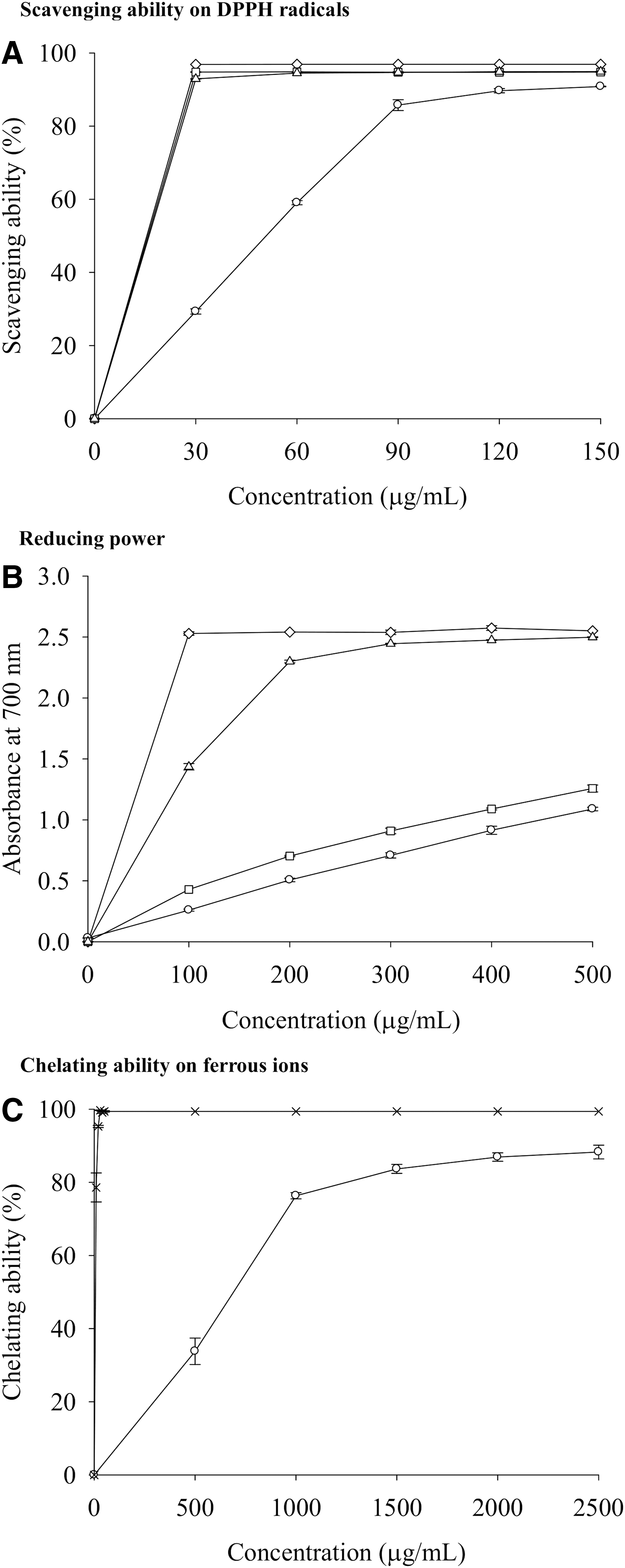
Antioxidant properties of references and freeze-dried extract from freeze-dried Echinacea purpurea flower. Each value is expressed as mean ± standard deviation (n = 3).
Each value is expressed as mean ± standard deviation (n = 3). Each value on the right of means within the same row bearing different small letters is significantly different (P < .05).
BHA, butylated hydroxyanisole; EDTA, ethylene diamine tetraacetic acid; –, not detected.
The reducing power of flower extract and references also showed dose-dependent responses (Fig. 1B). At a dose of 100 μg/mL, the reducing power of samples were in the descending order of ascorbic acid (2.529 AU) > BHA (1.436 AU) > α-tocopherol (0.429 AU) > flower extract (0.260 AU). At the level of 400 μg/mL, the reducing power of flower extract was 0.910 AU, which is lower compared with the result (2.301 AU) of Tsai et al. 20 The result should be attributed to the polyphenolic content of flower extract. The estimated EC50 values of ascorbic acid, BHA, α-tocopherol, and flower extract for reducing power were 19.92, 34.85, 116.16 μg/mL, and 208.56 μg extract/mL (40.81 μg total phenols/mL), respectively (Table 2).
Ferrous ions are also frequently used as an antioxidant assessment index, because they are the most effective prooxidants in food systems. 25,26 The ferrous ions chelating ability of flower extract exhibited dose-dependent responses, whereas ascorbic acid, BHA and α-tocopherol were not detectable in this study (Fig. 1C). At doses of 0.5, 1.0, and 1.5–2.5 mg/mL, the ferrous ions chelating ability of flower extract is 33.80%, 76.34%, and 83.68–88.30%, respectively. At the level of 1.5–2.5 mg/mL, the ferrous ions chelating ability of flower extract was not enlarged, which indicates that a saturating state was almost attained at 1.5 mg/mL of flower extract. The estimated EC50 values of EDTA and flower extract are 6.38 μg/mL and 659.46 μg extract/mL (129.05 μg total phenols/mL), respectively (Table 2), which indicate that EDTA was more potent than the flower extract for ferrous ion chelating ability. The adjacent hydroxyl and carbonyl groups in the molecule or hydroxyl groups among molecules could chelate ferrous ions to form a complex. 27 Thus, the ferrous ion chelating ability of flower extract may be attributed to the specific functional groups in its polyphenolic structure.
α-Amylase and α-glucosidase inhibition assay
Several studies have shown that many foods and herbs have potential beneficial effects on diabetic glycemic control by inhibiting the α-amylase and α-glucosidase activity. 28 –31 Therefore, the flower extract and individual CAD against the activities of α-amylase and α-glucosidase were determined by using in vitro assays, in this study. Acarbose is commonly used as an α-amylase and α-glucosidase inhibitor for type-2 diabetes. 32 However, it is reported to cause some side effects, such as abdominal discomfort and flatulence, which were due to excessive α-amylase inhibition and will lead to the abnormal bacterial fermentation of undigested carbohydrates in the colon. 33 Therefore, in this study, acarbose was used as a positive control for comparison. The structure of porcine pancreatic α-amylase is similar to human α-amylase and it has often been used to simulate the human α-amylase. 34 The inhibitory effects of flower extract, individual CAD, and acarbose against porcine pancreatic α-amylase were shown in Figure 2. The flower extract, individual CAD, and acarbose inhibited the α-amylase activity in a concentration-dependent manner. At a dose of 15 mg/mL, the α-amylase activity inhibitory ability of flower extract, cichoric acid, and caftaric acid was 93.87%, 89.09%, and 98.52%, respectively (Fig. 2A). At a dose of 2.5 mg/mL, the α-amylase activity inhibitory ability of chlorogenic acid, caffeic acid, and acarbose was 95.10%, 85.23%, and 76.86%, respectively (Fig. 2B). However, the inhibitory effect of acarbose on α-amylase activity was higher compared with chlorogenic acid and caffeic acid at lower doses (0.5–1.5 mg/mL) (Fig. 2B). At 0.5–1.0 mg/mL doses, chlorogenic acid and caffeic acid had no or little inhibitory ability against the α-amylase activity. The α-amylase activity inhibitory ability (IC50) of flower extract and individual CAD and acarbose was in the descending order of acarbose (0.50 mg/mL) > chlorogenic acid (1.71 mg/mL) > caffeic acid (1.81 mg/mL) > caftaric acid (6.54 mg/mL) > flower extract (8.99 mg/mL) > cichoric acid (12.29 mg/mL) (Table 3).
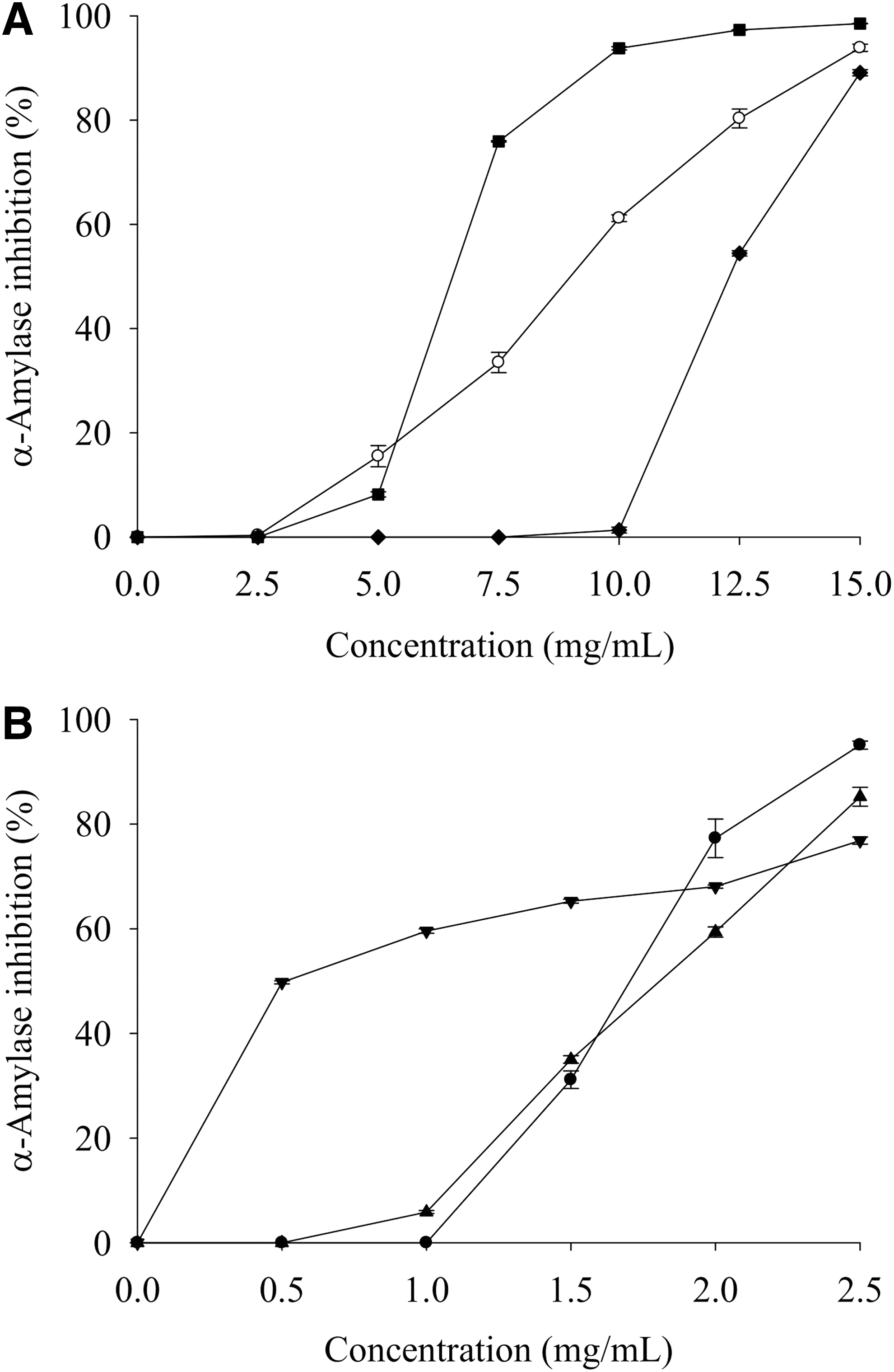
The inhibitory effects of freeze-dried extract, various caffeic acid derivatives, and acarbose against α-amylase. Each value is expressed as mean ± standard deviation (n = 3).
IC50 values, the enzyme activity was inhibited by 50%. The IC50 values of samples were obtained by interpolation from linear regression analysis, except the IC50 values of caftaric acid against ACE were obtained by extrapolation from linear regression analysis.
Each value is expressed as mean ± standard deviation (n = 3). Means with different capital letters within a column are significantly different (P < .05).
ACE, angiotensin-converting enzyme.
The dietary carbohydrates were rapidly digested and absorbed, which resulted in a sharp increase in the postprandial blood glucose level. 3 Thus, to reduce glucose absorption and postprandial hyperglycemia, the inhibition of intestinal α-glucosidase is one of the beneficial therapies. 5 The striking structure and function of α-glucosidase purified from yeast are similar with those from human cells. 35 Thus, the inhibitory effects of flower extract, individual CAD, and acarbose against commercially available yeast α-glucosidase were investigated and compared. The inhibitory abilities of flower extract, individual CAD, and acarbose against α-glucosidase activity were also concentration dependent (Fig. 3). At 4 and 20 mg/mL, the α-glucosidase activity inhibitory ability of flower extracts was 42.38% and 95.03%, respectively (Fig. 3A). At the level of 0.4 mg/mL, the α-glucosidase activity inhibitory ability of caftaric acid, chlorogenic acid, caffeic acid, cichoric acid, and acarbose was 10.62%, 30.90%, 41.59%, 71.78%, and 44.87%, respectively (Fig. 3B). The α-glucosidase activity inhibitory ability (IC50) of flower extract, individual CAD, and acarbose was in the descending order of cichoric acid (0.28 mg/mL) > caffeic acid (0.52 mg/mL) > acarbose (0.62 mg/mL) > chlorogenic acid (0.90 mg/mL) > caftaric acid (1.15 mg/mL) > flower extract (5.72 mg/mL) (Table 3). It is worth noting that cichoric acid had the highest inhibitory effect on α-glucosidase activity among tested samples, especially the positive control, acarbose.
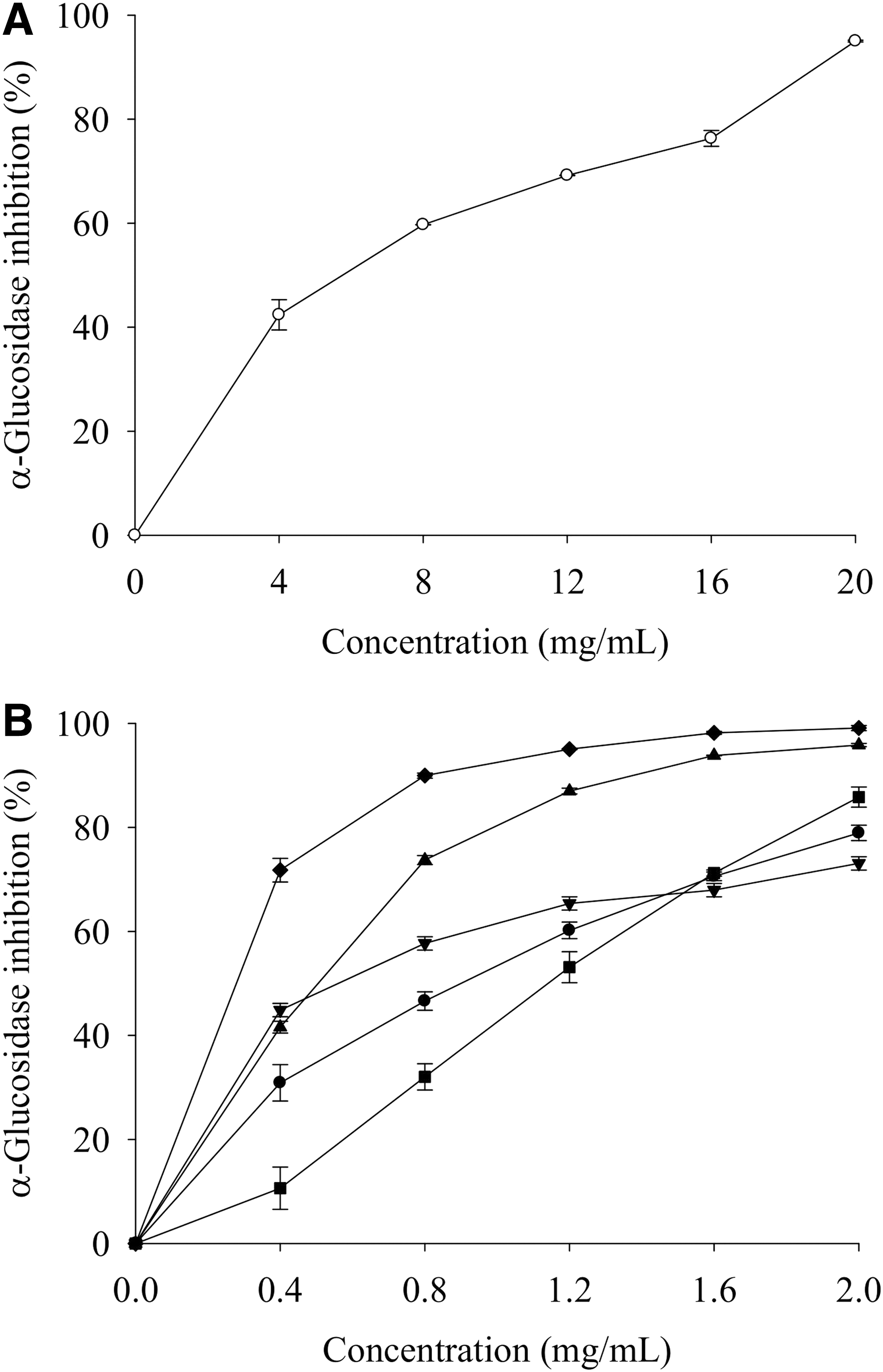
The inhibitory effects of freeze-dried extract, various caffeic acid derivatives and acarbose against α-glucosidase. Each value is expressed as mean ± standard deviation (n = 3).
The observed inhibitory effect of flower extract and individual CAD against α-amylase and α-glucosidase in vitro revealed that their inhibition could significantly suppress the postprandial increase in blood glucose. The result could be attributed to their phenolic acid contents. 2,3 That the flower extract and individual CAD significantly inhibited α-glucosidase more than α-amylase is of therapeutic importance at preventing the unpleasant side effects associated with acarbose. The result is in agreement with several studies. 2,3
ACE inhibition assay
In this study, the inhibitory effects of the flower extract, individual CAD, and captopril against ACE were also determined. The result showed that flower extract, individual CAD, and captopril inhibited the ACE activity in a concentration-dependent manner (Fig. 4). At 3.3 mg/mL, the ACE-inhibitory ability of flower extract was 53.62% (Fig. 4A). The ACE activity inhibitory ability of flower extract reached 100% when flower extract concentration increased to 13.3 mg/mL. At a dose of 167 μg/mL, chlorogenic acid and caffeic acid inhibited the ACE activity by 87.75% and 63.49%, respectively (Fig. 4B). At a dose of 1.67 mg/mL, the ACE activity inhibitory ability of cichoric acid and caftaric acid was 76.79% and 39.76%, respectively (Fig. 4C). At doses of 0.33 and 3.33 ng/mL, the ACE activity inhibitory abilities of captopril were 39.57% and 91.44%, respectively (Fig. 4D). The ACE-inhibitory ability (IC50) of flower extract, individual CAD, and captopril was in the descending order of captopril (0.49 ng/mL) > chlorogenic acid (0.11 mg/mL) > caffeic acid (0.14 mg/mL) > cichoric acid (1.27 mg/mL) > caftaric acid (1.78 mg/mL) > flower extract (3.21 mg/mL). The content of chlorogenic acid and caffeic acid in the extract was lowest (Table 1), but their inhibitory abilities against the ACE activity were higher than those of cichoric acid and caftaric acid. Oboh et al. reported that jute leaf (Corchorus olitorius) possess antihypertension ability, which could be attributed to caffeic acid, chlorogenic acid, and isorhamnetin. 36 Captopril had the highest ACE activity inhibitory ability compared to the flower extract and individual CAD, but it has side effects, such as dry cough and angioneuroticedema. 9
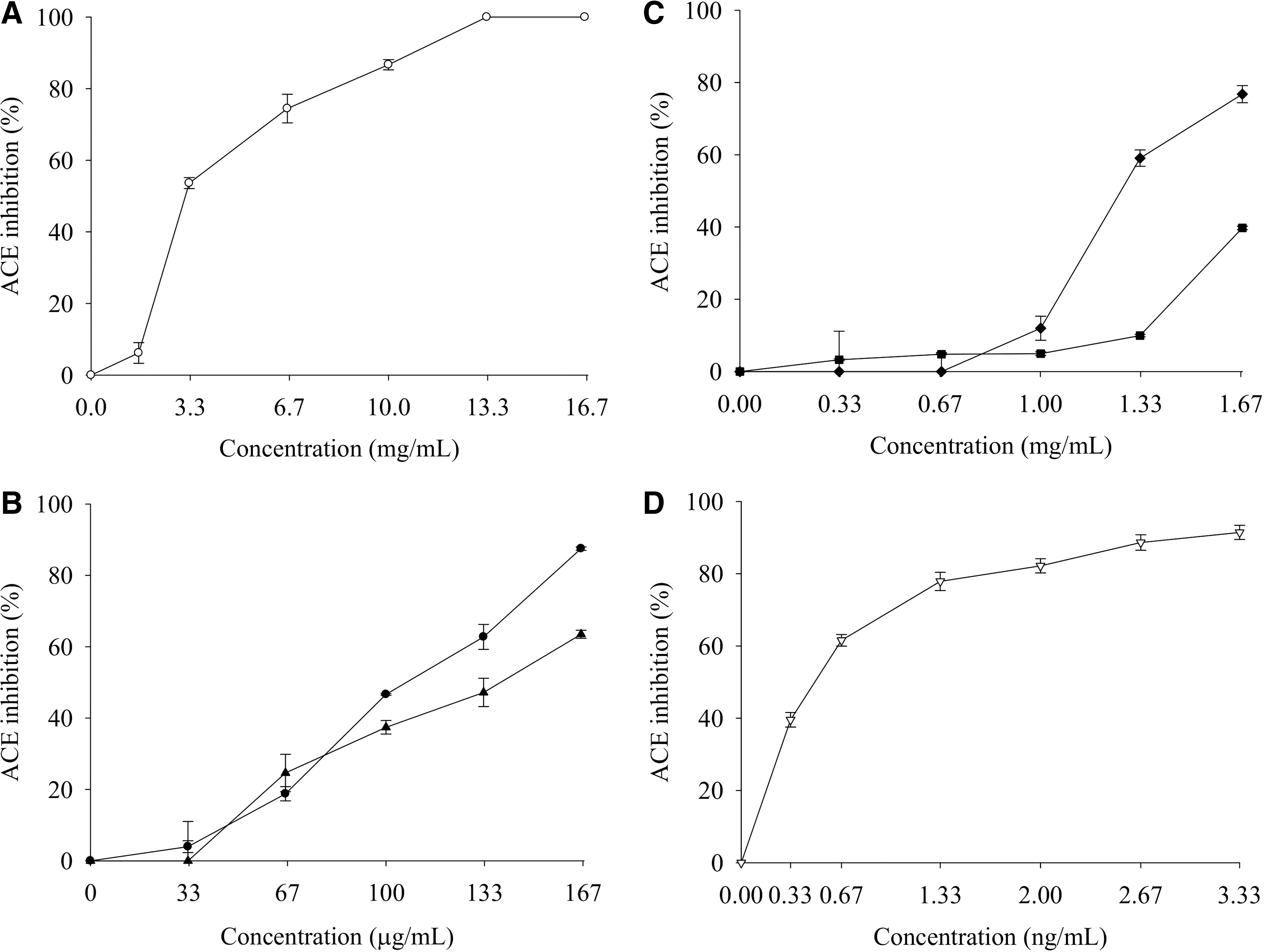
The inhibitory effects of freeze-dried extract, various caffeic acid derivatives, and captopril against angiotensin-converting enzyme. Each value is expressed as mean ± standard deviation (n = 3).
In this study, a positive correlation between total CAD content and the ACE-inhibitory effect was found. The phenolics are reported to inhibit the ACE activity. 2,30,36 Umamaheswari et al. proposed a structure–function relationship in inhibiting the ACE activity by chelating the active site zinc ion or inducing the formation of hydrogen bridges between the active site amino acid residues and the polyphenolics. 37 Thus, E. purpurea flower extract could be as an alternative to synthetic drugs such as captopril, but with few or no side effects.
In conclusion, the 50% ethanolic extract of freeze-dried E. purpurea flower contained total phenols and CAD, and showed a good antioxidant ability in this study. Furthermore, flower extract and individual CAD were able to inhibit key enzymes relevant to type 2 diabetes mellitus (α-amylase and α-glucosidase) and hypertension (ACE) in vitro. The results suggested that flower extract and individual CAD have good potential for the prevention and management of postprandial hyperglycemia and hypertension. Consequently, flower extract and individual CAD seem to be suitable to use as an alternative for retarding carbohydrate digestion and absorption, thereby suppressing postprandial hyperglycemia and hypertension. Further studies with animal and human models reflecting potential in vivo benefits are needed in the future.
Footnotes
Acknowledgments
The authors would like to thank Ministry of Science and Technology, Taiwan, for financially supporting this research under Grant No. NSC 102-2221-E241-009.
Author Disclosure Statement
No competing financial interests exist.