




Abstract
Luteolin was gamma irradiated at doses of 0, 15, 30, 50, 70, and 100 kGy. We observed that the luteolin peak decreased simultaneously with the appearance of new radiolytic peaks, using high-performance liquid chromatography (HPLC). The highest new radiolytic peak (GLM) of radiolytic product in gamma-irradiated luteolin was observed at a dose of 70 kGy, and the GLM was identified by nuclear magnetic resonance and high-performance-liquid-chromatography-quadrupole-time-of-flight (HPLC-Q-TOF) mass spectrometry. We examined whether 70 kGy gamma-irradiated luteolin has more effective anti-melanogenic effects than intact luteolin. Seventy kilograys of gamma-irradiated luteolin inhibited melanin synthesis and intracellular tyrosinase activity without cytotoxicity, whereas the intact luteolin-treated group did not show anti-melanogenic activity in 3-isobutyl-1-methylxanthine-stimulated B16BL6 melanoma cells. The expression of melanogenic enzymes, such as tyrosinase, tyrosinase-related protein (TRP)-1, and TRP-2, was decreased by 70 kGy gamma-irradiated luteolin treatment, owing to the suppression of microphthalamia-associated transcription factor and 3′,5′-cyclic adenosine monophosphate (cAMP) response element binding protein. In addition, gamma-irradiated luteolin decreased the phosphorylation of phosphoinositide 3-kinase (PI3K)/Akt and extracellular regulated kinase (ERK). The anti-melanogenic effects of 70 kGy gamma-irradiated luteolin were attenuated by the treatment of two specific inhibitors (PD98059 and LY294002), and these results indicate that the anti-melanogenic effects were mediated by ERK and PI3K signaling pathways. Therefore, our findings suggest that gamma-irradiated luteolin can be a potential cosmeceutical agent for skin whitening.
M
It has been reported that phenolic compounds obtained from various plants have anti-melanogenic effects and anti-oxidative activities. 11,12 For example, previous studies have shown that luteolin (3′4′,5,7-tetrahydroxyflavone), belonging to the flavone group, has various biological functions, 13 –15 and these biological functions are due to the functional groups of flavones, including hydroxyl, carbonyl, and conjugated double bonds. 16 The backbone of flavone is 2-phenylchromen-4-one, and it has two phenyl rings and a heterocyclic ring. 17 Luteolin is found in common fruits and vegetables from our daily diet. 18
Recent studies have shown that gamma irradiation can induce an improvement of physiological functions of organic compounds, such as polysaccharides and polyphenols, by modifying their intrinsic structure. 19 We have reported that gamma-irradiated β-glucan showed lower molecular weight through depolymerization, with an increase in the anti-cancer activity. 20 In addition, it was reported that gamma-irradiated resveratrol showed new radiolytic peaks, and they suggested an anti-inflammatory effect as well as lessened cytotoxicity. 21 These previous reports have demonstrated that some gamma-irradiated molecules have stronger physiological activities than intact molecules; as a result, gamma irradiation can be a useful technology for developing new health benefit products. Therefore, the aim of this study was to improve the physiological properties of luteolin with respect to anti-melanogenic activity by using gamma irradiation, and to examine the potential of gamma-irradiated luteolin for developing a new cosmeceutical ingredient.
Luteolin was dissolved in methanol at a concentration of 1 mg/mL (w/v). The luteolin solution was then irradiated at doses of 0, 15, 30, 50, 70, and 100 kGy by a cobalt-60 irradiator (MDS Nordion International Co. Ltd., Ottawa, Canada) in the Advanced Radiation Technology Institute, a branch of the Korea Atomic Energy Research Institute (Jeoung-Eup, Korea).
The structure of gamma-irradiated luteolin was analyzed by using an Agilent HPLC system 1260 (Agilent Technologies, Inc., Santa Clara, CA) with a diode array detector. The radiolysis product was identified by the hydrogen-nuclear magnetic resonance ( 1 H NMR) and high-resolution Q-TOF Mass Spectrometry System (Bruker, Rheinstetten, Germany) at the Korea Basic Science Institute (Seoul, Korea). B16BL6 melanoma cells were maintained in Dulbecco's modified eagle's medium (Gibco BRL, Carlsbad, CA) supplemented with 10% fetal bovine serum and 100 U/mL of penicillin/streptomycin (Gibco BRL). Noncytotoxic doses of gamma-irradiated luteolin were determined through a 3-(4,5-dimethylthiazol-2-yl)-2,5-diphenyltetrazolium bromide (MTT) assay. The melanin contents were measured by using a modified method by Park et al. 22 The cells were stimulated with 3-isobutyl-1-methylxanthine (IBMX), and they were treated with 0- or 70-kGy gamma-irradiated luteolin for 72 h. The cells were dissolved in 1 N NaOH and measured at 405 nm. The intracellular tyrosinase activity was measured by using a previously published protocol. 9 For a Western blot analysis, the cells were lysed with an NP-40 lysis buffer (Invitrogen, Carlsland, CA) containing 1 mM phenylmethylsulfonylfluoride. The cell lysates were separated by 10% sodium dodecyl sulfate-polyacrylamide gel electrophoresis, and they were electrotransferred to a polyvinylidene difluoride (PVDF) membrane. The PVDF membrane was blocked with 5% skim milk, incubated overnight at 4°C with several primary antibodies, and finally incubated with horseradish peroxidase-conjugated anti-rabbit IgG antibodies (Calbiochem, San Diego, CA). The proteins were visualized by using an ECL advance kit (GE Healthcare, Little Chalfont, United Kingdom). All experiments were repeated ≥3 times, producing consistent results. All statistical analyses were calculated by using GraphPad Prism version 5 (Graphpad Prism Software, San Diego, CA).
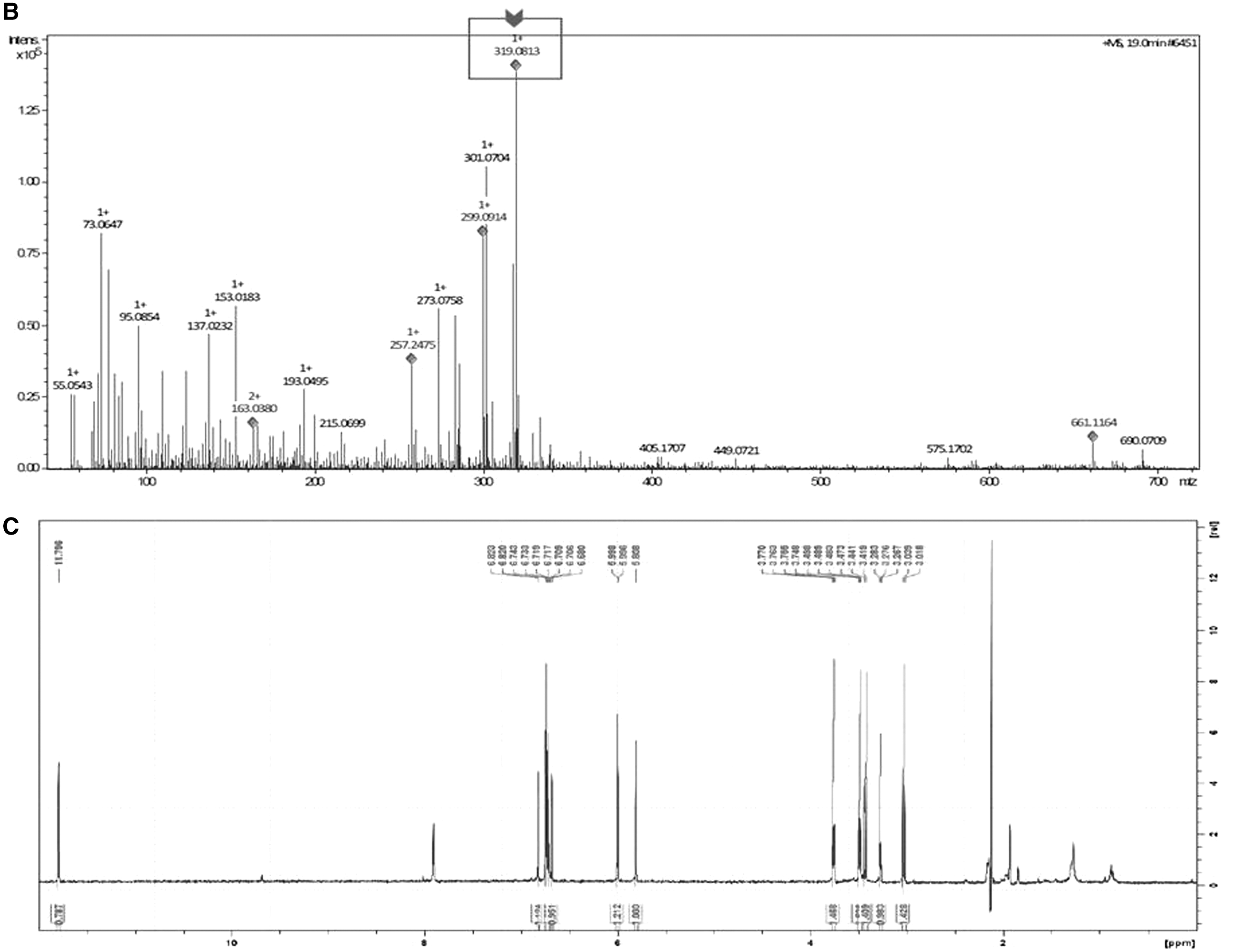
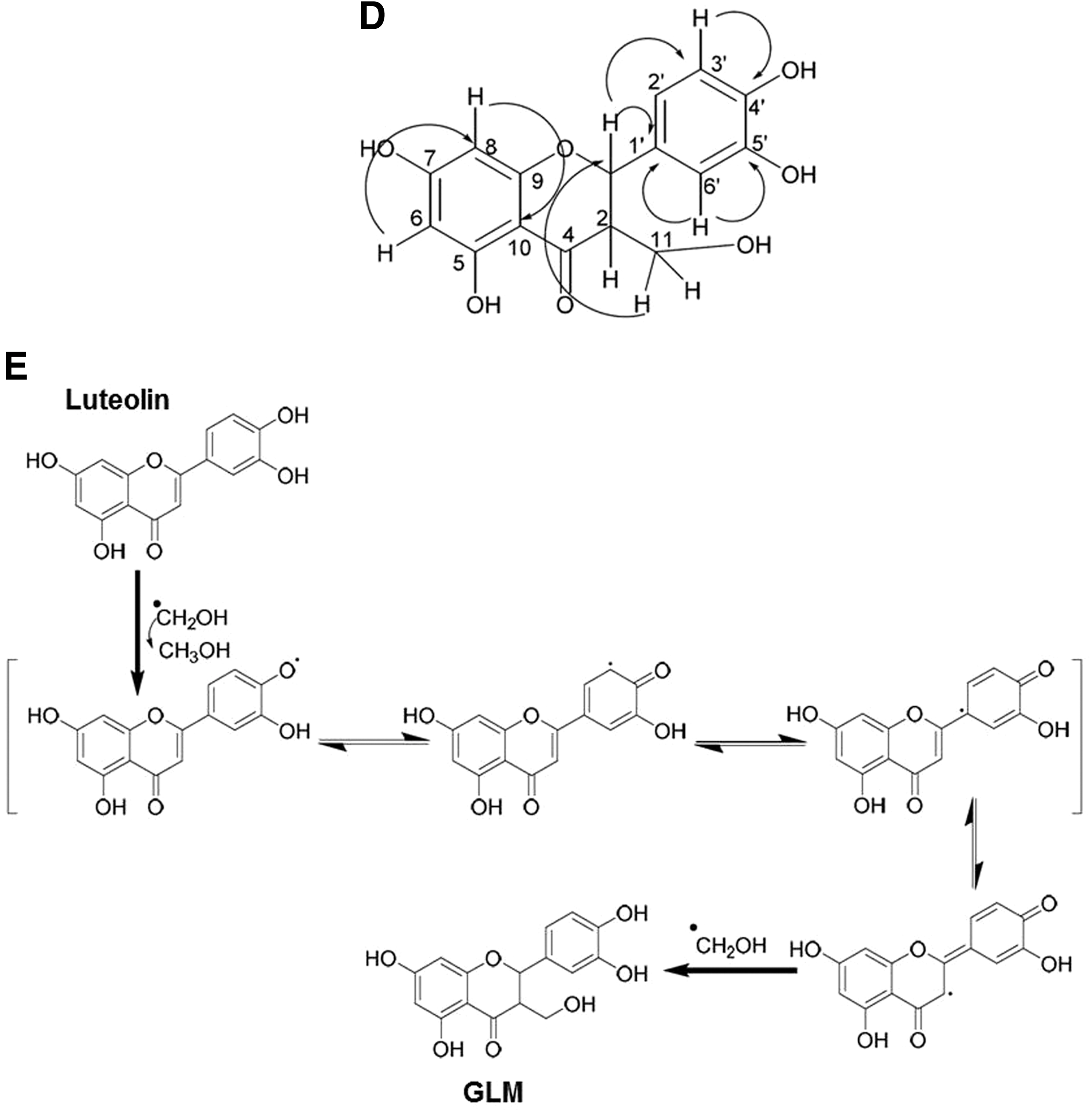
As shown in Figure 1A, the main peak of luteolin was steadily decreased whereas several new radiolytic peaks appeared after gamma irradiation. These new radiolytic peaks can hypothetically indicate the changes in physiological effects of luteolin. Among them, the maximum radiolytic peak (GLM) was observed at a dose of 70 kGy. The identification of GLM: Amorphous white powder, HR-EIMS [M+] found m/z 319.0794 (Calculated for C16H14O7, 318.0704; Fig. 1B); 1 H NMR (900 MHz, Methanol-d4): 11.796 (1H, s), 9.79 (1H, s), 7.77 (1H, s), 6.8 (1H, s), 6.71 (2H, d, J = 8.6 Hz), 6.70 (2H, d, J = 8.6 Hz), 6.8 (1H, s), 5.90 (1H, d, J = 2.1 Hz), 5.86 (1H, d, J = 2.1 Hz), 3.7 (1H, m, H-2), 3.47 (1H, m, H-2), 3.41 (1H, d, J = 8.6 Hz), 3.2 (1H, t, J = 8.9 Hz), and 3.0 (1H, d, J = 8.9 Hz; Fig. 1C). The mechanism of proton shift is proposed in Figure 1D, and the mechanism of GLM is proposed in Figure 1E.

HPLC chromatograms of gamma-irradiated luteolin
We investigated the anti-melanogenic effects of 70 kGy gamma-irradiated luteolin in B16BL6 melanoma cells to compare them with 0 kGy luteolin. Neither 0- nor 70-kGy gamma-irradiated luteolin was found to induce cytotoxicity at concentration ranges of 1.25–5 μM (Fig. 2A). Seventy kilograys of gamma-irradiated luteolin significantly reduced the melanin synthesis (Fig. 2B, C) and intracellular tyrosinase activity (Fig. 2D) in IBMX-stimulated B16BL6 melanoma cells.
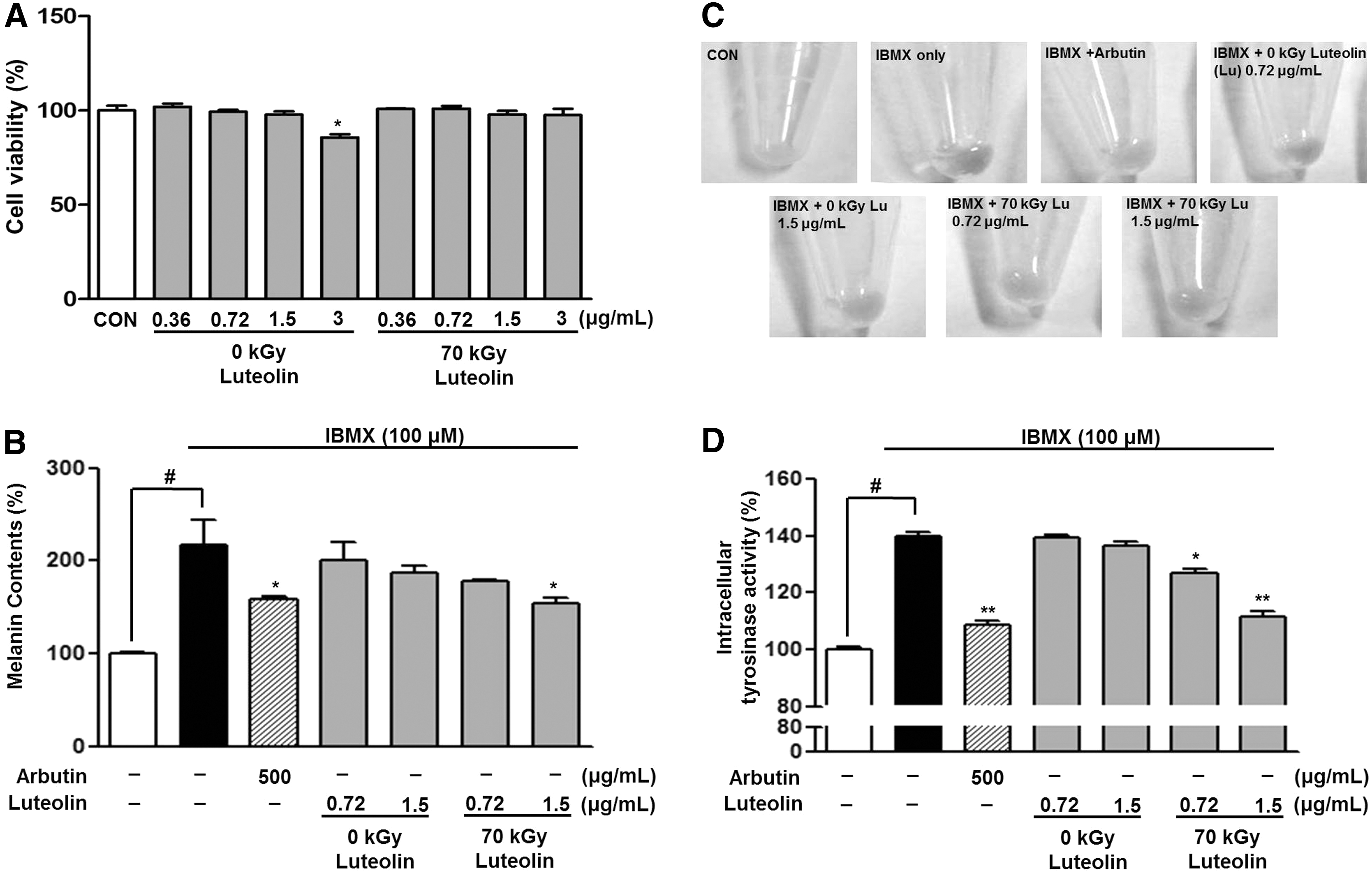
Effects of gamma-irradiated luteolin on melanin synthesis and tyrosinase activity without cytotoxicity. Seventy kilograys of gamma-irradiated luteolin reduced IBMX-induced melanin production and tyrosinase expression without cytotoxicity in B16BL6 melanoma cells. Cell viability was determined through an MTT assay
The treatment of 70 kGy gamma-irradiated luteolin decreased the protein expression of phosphor-3′,5′-cyclic adenosine monophosphate (cAMP) response element binding (CREB), microphthalamia-associated transcription factor (MITF), and melanogenic enzymes. The phosphorylation of PI3K, Akt, and extracellular regulated kinase (ERK) was also attenuated by the treatment of 70 kGy gamma-irradiated luteolin (Fig. 3A). As shown in Figure 3B, IBMX-induced melanin synthesis was decreased by 70 kGy gamma-irradiated luteolin, which was attenuated by the treatment of specific ERK (PD98059) or PI3K/Akt (LY294002) inhibitors. These results indicate that the inhibitory effects of gamma-irradiated luteolin on IBMX-induced melanogenesis are importantly regulated by the ERK and PI3K/Akt pathways.

Effects of gamma-irradiated luteolin on IBMX-induced melanogenic enzymes expression and their upstream signaling molecules
In a previous study, as illustrated by Buscà et al., the determined IBMX elevated the cellular level of cAMP, which plays an important role in the regulation of melanogenesis. 23 The phosphorylation of CREB protein leads to the activation of the MITF level. 24 MITF directly binds to a tyrosinase gene promoter, and it subsequently promotes the expression of tyrosinase. 25 The expression of tyrosinase leads to an increase in the levels of TRP-1 and TRP-2, and as a result, these melanogenic enzymes produce two types of melanins: black–brown eumelanin and yellow–red phaeomelanins. 26 Recent studies demonstrated that the ERK and PI3K/Akt signaling pathways are closely related to the regulation of melanogenesis process. 27,28 There have been some reports that MITF expression is promoted by phosphorylating PI3K/Akt and ERK signaling pathways in melanogenesis processes. 29,30 In this study, we observed that 70 kGy gamma-irradiated luteolin inhibited the activation of CREB, MITF, and melanogenic enzymes (tyrosinase, TRP-1, TRP-2). The treatment of gamma-irradiated luteolin significantly reduced the phosphorylation of ERK and PI3K/Akt in IBMX-stimulated B16BL6 melanoma cells. These results indicate that the anti-melanogenic effect of gamma-irradiated luteolin is caused by inhibiting melanogenic enzymes expression through the regulation of CREB/MITF, and these results are related to inactivation of the PI3K/Akt and ERK pathways (Fig. 3C).
In conclusion, we observed that gamma irradiation modified the luteolin structure. The gamma-irradiated luteolin had higher anti-melanogenic effects than intact luteolin through the suppression of CREB/MITF, PI3K/Akt, and ERK signaling pathways. These effects might be related to the formation of new radiolytic peaks induced by gamma irradiation in luteolin. These findings suggest that gamma-irradiated luteolin can be used as a whitening agent for the treatment of various hyperpigmentation disorders. However, further studies are needed to investigate the anti-melanogenic effect of gamma-irradiated luteolin in animal models.
Footnotes
Acknowledgment
This study was supported by the Nuclear Research & Development Program of the National Research Foundation (NRF-2012M2A2A6011335; 2012M2B2B1055245) grant funded by the Government of the Republic of Korea; a National Research Foundation of Korea grant funded by the Ministry of Education, Science and Technology (NRF-2012R1A1A2009507); and a research grant from the Kongju National University in 2015.
Author Disclosure Statement
No competing financial interests exist.