




Abstract
The aim of this study was to evaluate the antiulcerative and antinociceptive activities of milk proteins using the induced gastric ulcer with ethanol rat model and the acetic acid-induced writhing mouse model. Casein (CN), (100, 300, and 1000 mg kg−1) doses presented antiulcerative activity on a dose-dependent manner with values of 30.8%, 41.4%, and 57.0% of inhibition measured using the ulcerative lesions index (ULI), respectively. Whey protein concentrate (WPC), (100, 300, and 1000 mg kg−1) doses presented antiulcerative activity on a dose-dependent manner with values of 48.9%, 65.5%, and 68.22% of ULI inhibition, respectively. CN, casein hydrolysates (CNH), WPC, and whey protein hydrolysates (WPH), (3, 10, and 30 mg kg−1) doses presented antinociceptive activity using the acetic acid-induced writhing in the mouse model. CN (30 mg kg−1) presented a value of 40% of inhibition writhing, and CNH (30 mg kg−1) presented antinociceptive activity with a value up to 46% of writhing inhibition. WPC (30 mg kg−1) presented a value of 52.50%, and WPH (30 mg kg−1) presented antinociceptive activity with a value up to 88.00% of writhing inhibition. In conclusion, CN and WPC demonstrated in vivo antiulcerative properties and represent a promising alternative to be used as protectors of the gastric mucosa. CNH and WPH demonstrated in vivo antiulcerative properties and represent a promising alternative to be used as natural analgesic.
Introduction
M
Milk is also a known food source of potent bioactive peptides with various activities such as antihypertensive, antimicrobial, antioxidant, opioid, and antiviral. 4 Whey protein concentrate (WPC) is described presenting antitumor and antimicrobial activities. 5 –7 The biological activities of lactoferrin milk described include antibacterial, antitumor, antiviral, antifungal, and antiparasitic activities. 8 –15
Matsumoto et al. have reported antiulcerative activities of WPC and bovine α-lactalbumin. 16 The protective effect exhibited by WPCs and derivates has been predominantly linked to their content of α-lactoalbumin (alpha-La). Further studies have confirmed the ulcer inhibitory properties of this WP. Matsumoto et al. found a significant inhibition of ulcer formation mediated by the ingestion of a whey protein isolate (WPI), followed by the evaluation of the activities of individual components at representative concentrations, showing that only α-La emulated the observed effect. 16 Tavares et al. reported a WPC hydrolyzed with extracts of Cynara cardunculus, which has demonstrated a protective effect against ulcerative lesions induced by ethanol in rats. The fraction below 3 kDa was the most active. 17
Brantl et al. reported for the first-time analgesic activity/opioid activity of an identified peptide of bovine β–CN, which was named β-casomorphin 7. 18 Then, β-casomorphin peptides from 4 to 13 have been described in the literature as peptides with opioid activity, that is, agonist. Then, other 26 agonist peptides have been described: (8 from β-CN, 8 from α-S1CN, 3 from k-CN, 1 from β-Lg, and 1 from lactoferrin [Lf]). Among the 26 agonist peptides, 21 were identified from cow's milk, and the other 5 were identified from human milk. Furthermore, only eight additional antagonist peptides have been described in cow's milk. 19 –21
Carrillo et al. reported antinociceptive activity of hen egg-white lysozyme in its native and denatured form and its hydrolysates obtained with pepsin. The activity was evaluated in a classic acetic acid-induced abdominal writhing tests in mice. 22 The hydrolyzed native lysozyme, presented 48% of inhibition of abdominal writhing in mice. The aim of this study was to evaluate the antiulcerative and antinociceptive activities of milk proteins and hydrolysates using the rat model of induced gastric ulcer with ethanol and the mouse acetic acid-induced writhing model.
Materials and Methods
Milk proteins
Bovine CN was obtained by isoelectric precipitation using whole cow's milk by adding 2 M HCl (pH 4.6). CN was recovered by centrifugation at 5000 g for 20 min. The CN precipitate was washed three times with acidulated water (pH 4.6), and the remaining fat in the CN precipitate was removed by washing with dichloromethane acidulated water (1:1, v/v). The supernatant (WPC) was retired and lyophilized until its use. This product is referred to as total WPC. The final bovine CN precipitate was then lyophilized. This product is referred to as total CN. 23
Production of milk protein hydrolysates
Both CN and WPC rich in β-lactoglobulin (β-Lg) hydrolysates were prepared using the company Innaves S.A. (Porriño, Pontevedra, Spain). Hydrolysis with food-grade pepsin (Biocatalyst, Cardiff, United Kingdom) of commercial CN (Promilk 85, Arras Cedex, France) was carried out to obtain the CNH (LowPept®) according to Sánchez et al. 24 In brief, CN at 0.06% (W/W) was digested at 37°C at a pH 2.0 acid with pepsin at a ratio of 1:50 (w/w) (enzyme:substrate), with the addition of the enzyme at the beginning of hydrolysis and after 3 h. Hydrolysis was then inactivated by increasing pH up to 7.0. The supernatant after clarification was collected and spray dried.
The protein content of this hydrolysate determined by the Kjeldahl method was 71.33% ± 1.55% (w/w), as previously assessed. 25 To produce the β-Lg hydrolysate, a WPC rich in β-Lg (Friesland Campina Domo, Zwolle, The Netherlands), containing at least 99.0% of β-Lg of protein content, was hydrolyzed with food-grade trypsin (Biocatalyst), as reported by Anadón et al. 26 In brief, WPC was suspended at 5% (w/v) and heated at 90°C for 10 min. After addition of trypsin at a ratio 1:20, hydrolysis was performed at pH 8.0 and 37°C for 3 h and stopped by heat inactivation of trypsin at 95°C for 15 min. The hydrolysate was clarified and spray dried. The protein content for this hydrolysate was 74.07% ± 0.19%.
Animals
Wistar male rats, 250–350 g body weight (bw) and 8-week-old male Swiss and BALB/c mice of 25–35 g bw, were obtained from the Experimental Animal Center (CEMIB) of Campinas University (São Paulo, Brazil).
Before the experiments, animals were kept for at least 7 days at 20°C and under alternative light/dark cycles of 12 h, receiving a commercial standard diet (Nuvital Nutrients, Curitiba, Brazil) and water ad libitum. Animals fasted for 12 h before the experiments.
The studies were carried out in accordance with current guidelines for the veterinary care of laboratory animals and were performed under the consent and surveillance of Unicamp Institute of Biology Ethics Committee for Animal Research (number 2206-2).
Ethanol-induced gastric ulcer model
The protective effect on rat stomach mucosa was studied using the absolute ethanol ulcerogenesis model. 27 The Ethics Committee for Animal Research of Campinas University approved the experimental protocol in agreement with the ethical principles of The International Association for the Study of Pain (IASP). Animals were divided in groups of five rats, a group per treatment. Sodium chloride solution (0.9% w/v) at 10 mL kg−1 bw (negative control) and an antiulcerative drug, carbenoxolone (Sigma, St. Louis, MO, USA), at 200 mg kg−1 bw (positive control) were used as negative and positive controls.
Samples were administrated at three different concentrations (100, 300, and 1000 mg kg−1 bw) in a single dose by gastric intubation. One hour after the administration of the sample or the controls, 1 mL of absolute ethanol was provided to each rat. One hour later, animals were sacrificed and their stomachs were extracted and washed with a saline solution for ulcerative lesions analysis.
Ulcerative lesion analysis
The ulcerative lesions were evaluated by visual inspection of rat gastric mucosa. According to Gamberini et al., the ulcerative lesions index (ULI) of each animal was determined by summing the scores associated to several parameters: loss of normal morphology (1 point), mucosa discoloration (1 point), edema (1 point), hemorrhage (1 point), petechial points until 9 mm (2 points), petechial points larger than 10 mm (3 points), ulcers up to 1 mm (n × 2 points), ulcers larger than 1 mm (n × 3 points), and perforated ulcers (n × 4 points), where n is the number of ulcers found. 28
Percent decrease of the ULI score was calculated by the Equation (1):
The effective dose (ED50), defined as the sample concentration that achieves a decrease of 50% ULI, was estimated by using a logarithmic regression equation for ULI values obtained from 100, 300, and 1000 mg kg−1 treatments.
Antinociceptive activity of CN, WPC, and hydrolysates
The writhing test in mice was carried out using the method of Spindola et al. 29 The mice were divided into four groups (n = 6). The writhes were induced by intraperitoneal injection of 0.8% acetic acid (v/v). One dose of native or modified CN, CNH, WPC, and whey protein hydrolysates (WPH) (3, 10, and 30 mg kg−1 bw) was administered by oral gavage to groups of six animals each, 30 min before chemical stimulus (acetic acid). Sodium chloride 0.9% (10 mL kg−1) was used as negative control and indomethacin (30 mg kg−1) as positive control. The number of muscular contractions was counted over a period of 20 min after acetic acid injection. Contraction of the abdominal muscle concomitant with a stretching of the hind limbs in response to an intraperitoneal injection of acetic acid 0.8% (10 mL kg−1) was measured.
The percentage of protection against acetic acid-induced writhing was calculated using the following equation: percentage of protection = (Wc − Wt)/Wc) × 100. The effective dose (ED50), defined as the sample concentration that achieves a decrease of 50% writhing, was estimated by using a logarithmic regression equation for writhing values obtained from 3, 10, and 30 mg kg−1 treatments.
Statistical analysis
Experimental results were analyzed using a one-way ANOVA method, followed by Tukey's test. GraphPad Prism 4 software was used. Different letters indicate significant differences among dose groups (P < .05). *(P < .05), **(P < .01) and ***(P < .001) express statistical differences between samples and saline control.
Results and Discussion
Antiulcerative activity
Peptic ulcer is a disease with a major health risk in terms of morbidity and mortality. Globally, more than 14 million people are diagnosed with gastric ulcer annually, and about 4 million people would die from related complications. 30,31 This disease is one of the most common disruptions of the mucosal integrity of the stomach (gastric ulcer) and small intestine (duodenal ulcer). In this disease, there is an imbalance between offensive factors versus defensive factors, producing a break in the gastrointestinal tract bathed by acid/pepsin, alcohol, tobacco and caffeine, Helicobacter pylori infection, anti-inflammatory no steroids (NSAID), mucus secretion, bicarbonate production, mucosal blood flow, cellular repair mechanisms, prostaglandin E, and growth factors. 32 –34
In this study, absolute ethanol was used to produce gastric lesions in rats. Ethanol-induced gastric lesion formation may be due to stasis in gastric blood flow, which contributes to the development of the hemorrhage and necrotic aspects of tissue injury. Alcohol rapidly penetrates the gastric mucosa apparently causing cell and plasma membrane damage leading to increased intracellular membrane permeability to sodium and water. The massive intracellular accumulation of calcium represents a major step in the pathogenesis of gastric mucosal injury. 35,36
Many classes of synthetic antiulcer drugs have been used for its treatment, but these drugs present adverse effects and increased incidence of relapses during ulcer therapy. Therefore, search for new antiulcer drug continues and can be extended to proteins and hydrolysates from food proteins for their easy availability, high protection, low cost, and low cytotoxicity.
The CN and WPC antiulcerative activities were studied in a model of ulcer induced by absolute ethanol in rats. The lesions of rat gastric mucosa were analyzed with macroscopic observation. The group treated with saline solution (negative control) presented a high number of lesions with red bands with inflammation. The group treated with carbenoxolone (positive control) presented an absence of inflammation signs. Carbenoxolone is a drug used to prevent and treat gastric ulcers.
The group treated with CN (1000 mg kg−1) and WPC (1000 mg kg−1) presented a few lesions induced by absolute ethanol. This fact indicates that the sample was effective to prevent the lesions induced by absolute ethanol (Fig. 1). On the contrary, the percentage of decrease of ULI was calculated with the [Eq. (1)]. We found that the saline solution presented an absence of antiulcerative effect compared with the carbenoxolone (positive control). Carbenoxolone presented a 92.7% of ULI inhibition. CN (100, 300, and 1000 mg kg−1) samples presented antiulcerative effect on a dose-dependent manner with values of 30.8%, 41.4%, and 57.0% of ULI inhibition, respectively (Fig. 2). WPC (100, 300, and 1000 mg kg−1) samples presented antiulcerative effect on a dose-dependent manner with values of 48.9%, 65.5%, and 68.22% of ULI inhibition, respectively (Fig. 2). WPC samples were more active than CN samples. CN and WPC samples presented statistical differences (P < .05). The values of ED50 obtained were of 177 mg kg−1 for CNH and 729 mg kg−1 for WPH. The ED50 to WPC is very low compared with CN samples.
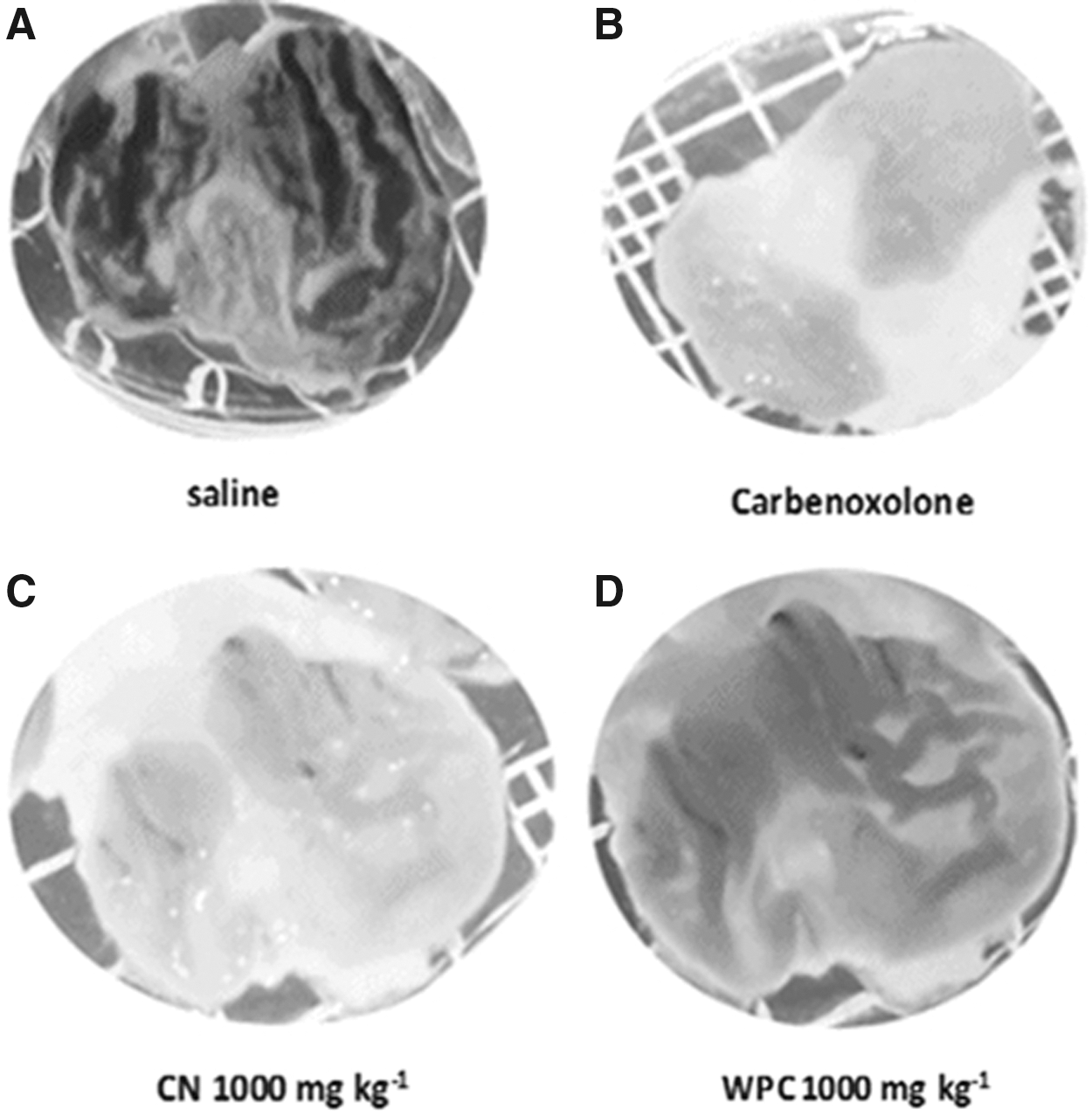
Images of ethanol-induced ulcers in rat stomachs with caseins and whey protein treatments: saline solution 10 mL kg−1 bw
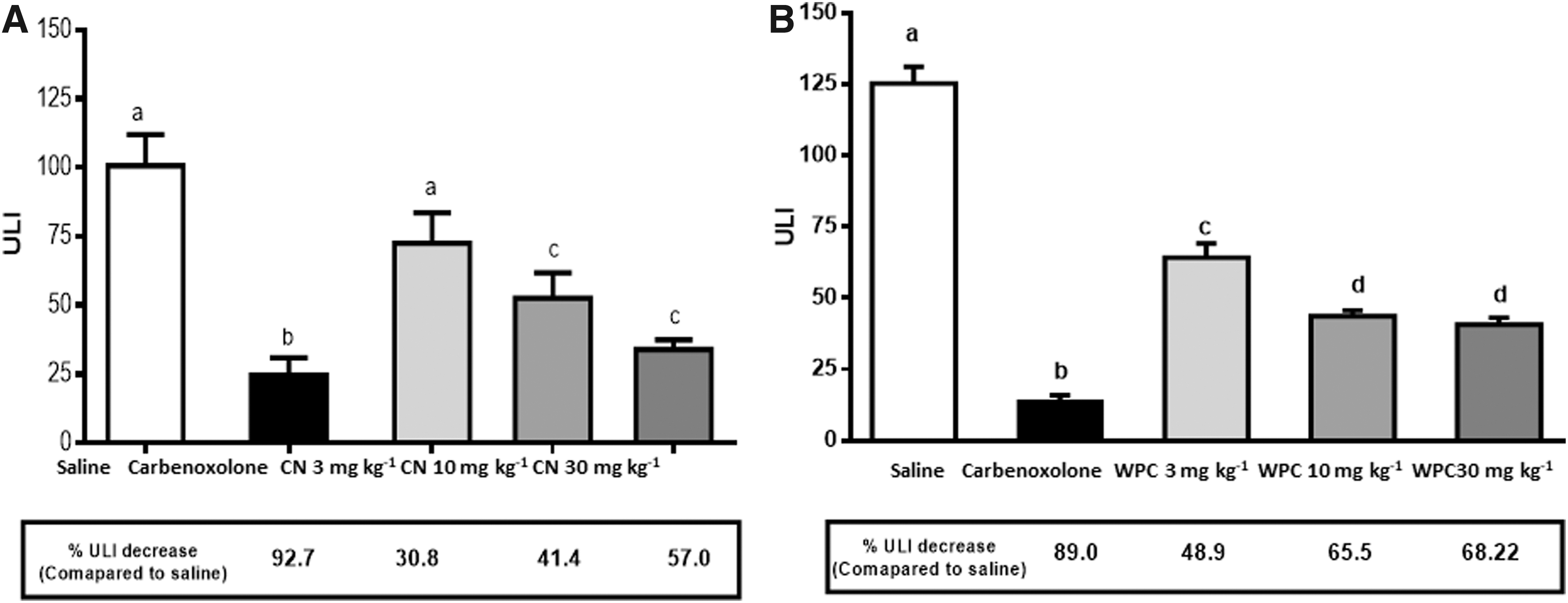
Antiulcerative activities of caseins and whey protein. Effect of single dose of casein (CN)
Mezzaroba et al. 37 reported antiulcerative activity of commercial α-lactalbumin with a value of 44% of ULI inhibition and α-lactalbumin obtained in laboratory with a value of 12% of ULI inhibition. Matsumoto et al. 16 reported antiulcerative activity of WPI (200 mg kg−1) with a value of 47% of ULI inhibition, while CN only presented a value of 9% of ULI inhibition. Furthermore, α-La (5, 10, 200, and 1000 mg kg−1) presented 27%, 47%, 82%, and 98% of ULI inhibition, respectively. They found that the protect effect of WPI is due to the presence of α-lactalbumin.
The WPC used in this study has a content of 99% of β-lactoglobulin, which indicates that the antiulcerative activity is due to the presence of this protein in the WPC. 16 We are reporting antiulcerogenic activity of bovine α-lactalbumin with a highest value of 68.22% of ULI inhibition at a concentration of 1000 mg kg−1. We are also reporting antiulcerative activity of bovine caseins with values ranging from 30.8% to 57% of ULI inhibition. In the assays of Matsumoto et al., 16 the samples were incubated for 30 min; in this study, samples were incubated for 60 min. Matsumoto et al. 16 induced the ulcers with 60% ethanol with HCL; in this study, the ulcers were induced with absolute ethanol.
Furthermore, antiulcerative activity of hydrolysates from milk proteins has also been reported. For example, Tavares et al. 17 reported antiulcerative activity of hydrolysate (fraction below of 3 kDa) obtained of WPC in the ulcer induced for ethanol model. Pacheco et al. reported antiulcerative activity of hydrolysate obtained of WPC with pancreatin enzyme with a value of 65.5% of ULI inhibition at a concentration of 1000 mg kg−1. 38
Antinociceptive activity
Nonsteroidal anti-inflammatory drugs (NSAIDs) are among the most frequently prescribed medicines such as ibuprophen, naproxen, and diclofenac. It is known, that NSAIDs act by inhibiting cyclooxygenases (COX-1 and COX-2) blocking the biosynthesis of proinflammatory prostaglandins, which contribute to pain and inflammation. 39,40 However, these prostaglandins also serve to protect the gastric mucosa and kidney function. Prolonged consumption of NSAIDs is associated to gastrointestinal damage and renal toxicity. For this reason, much research has been done to find new molecules with analgesic capacity that can protect the gastric mucosa with mechanisms of protection different to conventional analgesics. 41 In this context, proteins and their hydrolysates may play a promising role as new drugs with antiulcerogenic and antinociceptive activity.
The acetic acid-induced writhing response is a sensitive test used for screening analgesic activity, regardless of the central or peripheral causes. Acetic acid is an irritant which causes the synthesis and release of proinflammatory mediators such as prostaglandins (PGE and PGF2) and sympathetic nervous system mediators that provoke pain nerve endings. 42 In this study, acetic-induced writhing in mice was used to evaluate the antinociceptive activity of milk proteins and their hydrolysates.
The antinociceptive activity of CN and CNH is shown in Figure 3. The mice treated with indomethacin showed a decrease of 67% in the number of writhes, which was significantly higher than the ones obtained with mice treated with CN and CNH on a dose-dependent manner. CN only presented antinociceptive activity at a concentration of 30 mg kg−1 with a value of 40% of inhibition of writhes (Fig. 3A).
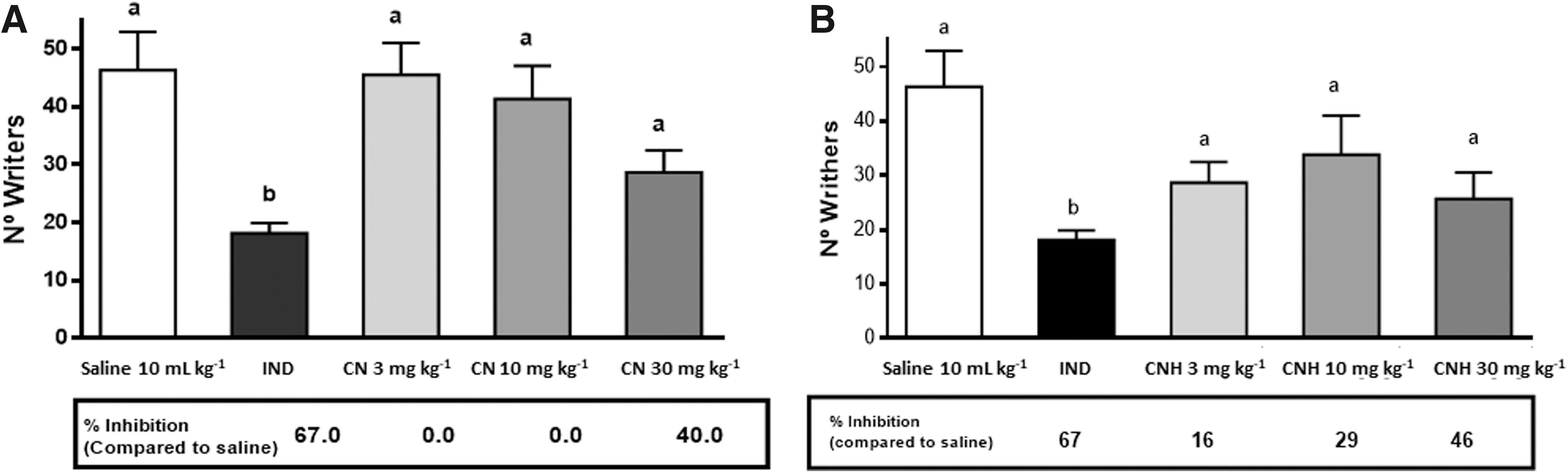
Analgesic effects of the CN (caseins) and CNH (hydrolysate of caseins).
No significant differences were found between the antinociceptive activity of CNH at 3, 10, and 30 mg kg−1. CNH at 3, 10, and 30 mg kg−1 presented antinociceptive activity with values of 16%, 29%, and 46%, respectively (Fig. 3B).
WPC at 3, 10, and 30 mg kg−1 presented high antinociceptive activity with an effect dependent on doses, with values of 13.66%, 30.93% and 52.50%, respectively (Fig. 4A). WHP at 3, 10, and 30 mg kg−1 presented high antinociceptive activity with an effect dependent on doses, with values of 38%, 42%, and 88%, respectively (Fig. 4B). WPH at 30 mg kg−1 presented a higher antinociceptive activity compared to indomethacin used as positive control. A high number of peptides from milk proteins with opiod activity have been described so far. The values of ED50 obtained for WPC were of 27.30 mg kg−1 and for WPH, 11.14 mg kg−1.
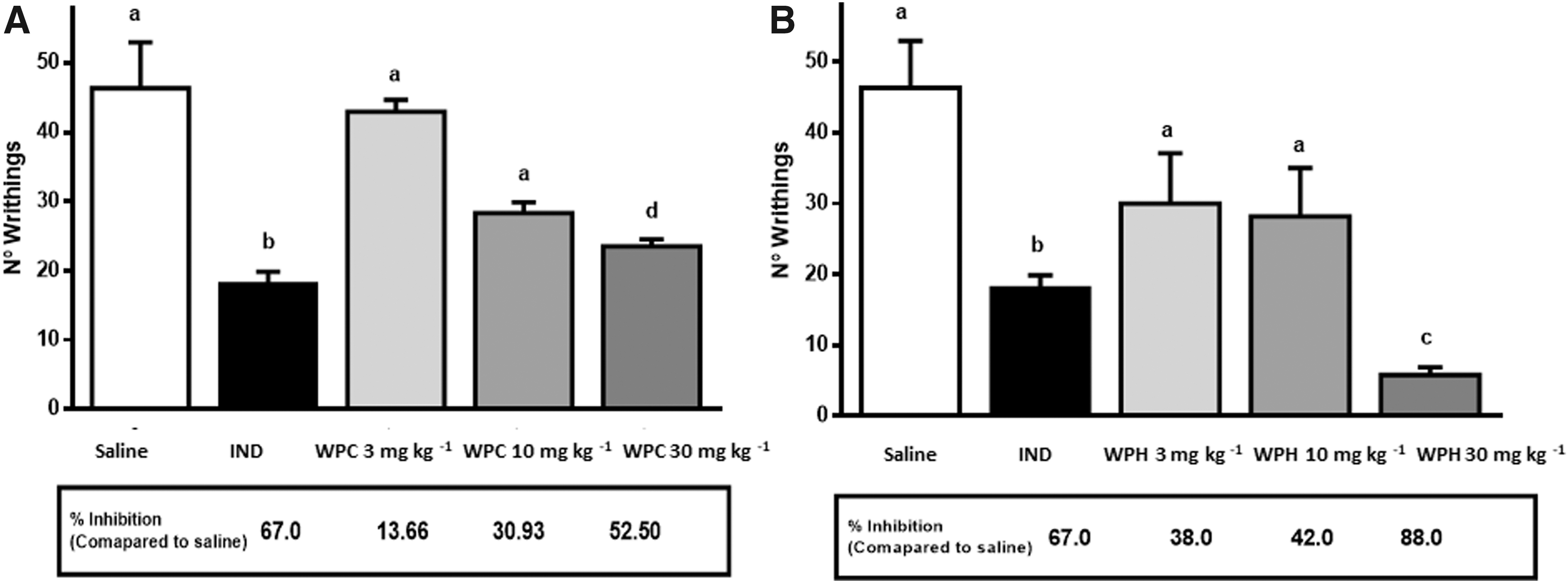
Analgesic effects of the WPC and WPH.
The ED50 to WPH is very low compared to the WPC sample. The value of ED50 for CNH was of 18.70 mg kg−1. For the CN sample, it was impossible to calculate the ED50, as this sample only presented activity for the 1000 mg kg−1 dose. WPH presented a value of ED50 lower than CNH.
Yamaguchi et al. reported that orally administered α-LA protein showed an inhibition of writhing induced by acetic acid in the mice model. The suppression of nociception and inflammation in rat footpads was caused by the carrageenan in the rats. 43 Hayashida et al. 44 reported a reduction of nociception in various pain models, as shown by the formalin test, hot plate test, and acetic acid writhing test in rats. Intraperitoneal (i.p.) administration of bovine lactoferrin significantly inhibited nociception in these pain models. WPC contents α-La and Lf proteins, described with antinociception activity in different pain models. For this reason, our results are in accordance to the bibliography. Sasaki et al. described that bovine lactoferrin (100 mg kg−1) presented antinociceptive effects in a rat lumbar disc herniation model with a permanent effect continuing during the 21 days of the experiment. 45
Bovine caseins are precursors of a significant number of opioid peptides described as β-casomorphins. These opioids peptides have been evaluated in different animal and human models, demonstrating their efficacy against pain. 46 When β-casomorphins are injected in the blood stream, they induce an analgesic and sedative effect due to their action on the central nervous system. 47 β-Casomorphin-4, β-casomorphin-5, and β-casomorphin-6 cause analgesia for up to 45 min, whereas β-casomorphin-7 causes analgesia for more than 90 min. 48
Tani et al. reported the opiod peptide named β-Lactorphin f(102–105) Tyr-Leu-Leu-Phe with an agonist effect. This peptide was isolated from bovine β-lactoglobulin. This group also reported the opioid peptides named Lactoferroxin A f(318–323) Tyr-Leu-Gly-Ser-Gly-Tyr, Lactoferroxin B f(536–540) Arg-Tyr-Tyr-Gly-Tyr, and Lactoferroxin C f(673–679) Lys-Tyr-Leu-Gly-Pro-Gln-Tyr with antagonist effects. These peptides were obtained from the human lactoferrin protein. 49 We suggest that WPH can content peptides with opioid ability to protect against pain. Future research can identify the sequence of the peptides with antinociceptive activity in the mouse model.
With the results obtained in this study, we can conclude that CN and WPC can be used as a natural protection of the gastric mucosa and can be used to elaborate functional ingredients to prevent gastric ulcers. CNH and WPH present a high antinociceptive activity in acetic acid-induced writhing in the mouse model. These peptides bioactive can be used to elaborate natural analgesics with the ability to protect the gastric mucosa. Future research can be developed to identify the sequences with antinociceptive activity and its potential pharmaceutical and medical uses.
Footnotes
Acknowledgments
This work has received financial support from the projects CYTED110AC0386 (IBEROFUN), AGL2011-24643, FEDER-INNTERCONECTA-GALICIA (ENVELLEFUN), FP7-SME-2012-315349 (FOFIND), and CNPq (Brazil). The authors are participants in the FA1005 COST Action INFOGEST on food digestion. The English edition has been reviewed by Emilio Labrador.
Author Disclosure Statement
No competing financial interests exist.