




Abstract
The aim of this study was to determine the effect of feeding high gamma-aminobutyric acid (GABA)-containing black sticky rice giant embryo (BSRGE, Oryza sativa L.) on anxiety-related behavior of C57BL/6 mice. Experimental feedstuff (BSRGE with high GABA+AIN-76A) and control (AIN-76A) were provided to C57BL/6 mouse for 10 days. Antianxiety effects of BSRGE with high GABA were measured using an elevated plus maze. On day 8, the number of open arm entries by GABA and control groups were 1.10 ± 1.60 (mean ± SD) and 0.00 ± 0.00 (P = .030). On day 10, the number of open arm entries by the GABA group was 2.00 ± 1.89, which was significantly (P = .025) higher than that in the control group (0.40 ± 0.84). On day 8, the time the mice spent in open arm in the GABA group and control group was 3.60 ± 7.06 and 0.00 ± 0.00 sec (P = .068), respectively. On day 10, the time the mice in the GABA and control groups spent in open arm was 6.20 ± 5.35 sec and 1.80 ± 3.82 sec (P = .042), respectively. In repeated analysis of variance for the number of entries into open arm and time spent in open arm, significant differences were found between the two groups. Therefore, BSRGE with high GABA content might have an antianxiety effect. This study can serve as a preliminary study so that further antianxiety effects of BSRGE can be determined in more extended animal or clinical research studies in the future.
Introduction
A
Most work on the neurobiology of anxiety has been focused on monoamines such as serotonin, noradrenaline, and gamma-aminobutyric acid (GABA)-benzodiazepine receptor complex. They are known to be linked with provocation and prevention of anxiety. 5 Among them, GABA is a four-carbon amino acid that functions as one of the important inhibitory neurotransmitters in the central nervous system. 6 GABA is an essential point setting for the anxiety state. 7 In both human and animal research studies, positive modulators of GABA receptors commonly have anxiolytic effects, whereas negative modulators show anxiogenic-like activity. 8 Benzodiazepines and other drugs such as alcohol and barbiturates that operate at the GABA receptor have effective and quick anxiolytic action, although coincidentally, it also has a history of abuse in anxiety disorder. 5 Despite currently changing treatment guidelines, benzodiazepine that works at the GABA receptor is still considered a good treatment option for both acute and chronic phases of anxiety disorders by many psychiatrists, partially because of their fast onset of action and effectiveness with a favorable adverse effect profile, and also because of the incomplete treatment responses of some alternative medications. 9 In addition, several GABA analogs and agents influencing transmitter metabolism and increasing GABAergic tone (e.g., valproate, vigabatrin, and tiagabine) have shown antianxiety effects. 8 Taken together, these results suggest that dysfunction of the GABA system is associated with anxiety spectrum disorders.
Black sticky rice with giant embryo (BSRGE; “Nunkeunheugchal”) containing high level of GABA was developed by the Rice Breeding Team of National Institute of Crop Science of Rural Development Administration (Korea) in 2012. Embryonal weight of “Nunkeunheugchal” is 1.46 mg. It is thrice heavier than general rice “Josaengheugchal.” Its GABA content in the embryo is 34 mg/100 g, which is seven times more than that in “Josaengheugchal.” GABA content in germinated rice of “Nunkeunheugchal” is 88 mg/100 g, which is 1.7 times more compared with “Josaengheugchal.” 10 Because the effect of alcohol is closely linked to the GABA receptor, some studies have already determined the association between alcohol intake and alcohol-related indices to clarify the effect of BSRGE. An animal study with BSRGE has shown a change in alcohol intake. Kim et al. 11 have described that feeding BSRGE freely to C57BL/6 mice has a meaningful suppression on 2-h alcohol intake compared to the control group. They have suggested that the alteration on 2-h alcohol intake is induced by higher GABA level in BSRGE than in general brown rice. 11 Jung et al. have reported that alcohol in combination with GABA extract in social drinkers can affect alcohol-related indices after acute alcohol intake with gender-related differences in sedation at least. 12 Based on the results of these two studies, GABA content of BSRGE might influence the effect of alcohol.
Because GABAergic tone is clearly associated with anxiety and alcohol effects, the effect of BSRGE, including GABA content on anxiety-related behavior, needs to be studied. Therefore, the aim of this study was to investigate the effect of feeding BSRGE with high GABA on anxiety-related behavior of C57BL/6 mice.
Materials and Methods
Animals for research
Four-week-old C57BL/6 male mice were used for this study. The number of BSRGE and control group is ten, respectively. First, these mice were adapted to laboratory atmosphere. They were provided free access to assorted feed and water for the first 7 days. After the first 7 days, one mouse was then assigned to each individual cage. They were provided free access to water and feed. Experimental diets (containing BSRGE with high GABA+AIN-76A) or control (AIN-76A) were provided to mice for 10 days. The animals were housed in a controlled environment maintained at 21 ± 2°C, controlled lighting with a dark cycle from 10 pm to 10 am, and with semispecific pathogen-free conditions. This study was approved by the Animal Study Ethics committee of Pusan National University.
Feedstuff
Feedstuff for this study was made from AIN-76A combined with BSRGE containing high GABA content (so called “Nunkeunheukchal”). The control group mice were supplied AIN-76A. Detailed contents of each feedstuff are shown in Table 1 and Figure 1.

All components are in units of g/100 g feeds.
GABA content of rice bran in embryo is 190 mg/100 g.
GABA, gamma-aminobutyric acid.
Behavior test for anxiety: elevated plus maze
Antianxiety effect of BSRGE containing high GABA content was measured by using an elevated plus maze (EPM). The EPM was made of black acryl and plus (+)-shaped maze. It was set up 50 cm above the base. Among the four passages, two opposite passages (length, 30 cm; width, 5 cm) were open, and the other two passages with the same size comprised two 20 cm walls (Fig. 2). The width and height of the central platform were both 5 cm. A video camera (intensity of light and 20 lux) was installed to the central roof of the maze for recording animal behavior. At the beginning of the study, the mouse was laid on the central area of the maze toward the outside and permitted to explore freely. The behavior of the mouse was observed for 5 min. The number of entries into the open arm and time spent in the open arm were observed using EthoVision program (Noldus Information Technology, Wageningen, Netherlands) to check anxiety-related behavior. The entire entry of four feet into each open arm was defined as “one entry.” The time spent on each open arm after the entire entry was checked to determine the sum of total time spent in the open arm. After each trial, 70% EtOH was used to remove traces of other mice to avoid influencing the next trial. The closed arm had a wall representing a less anxious environment compared to the open arm. Therefore, the more anxious mouse was, the more it would enter the closed arm and spend time there.
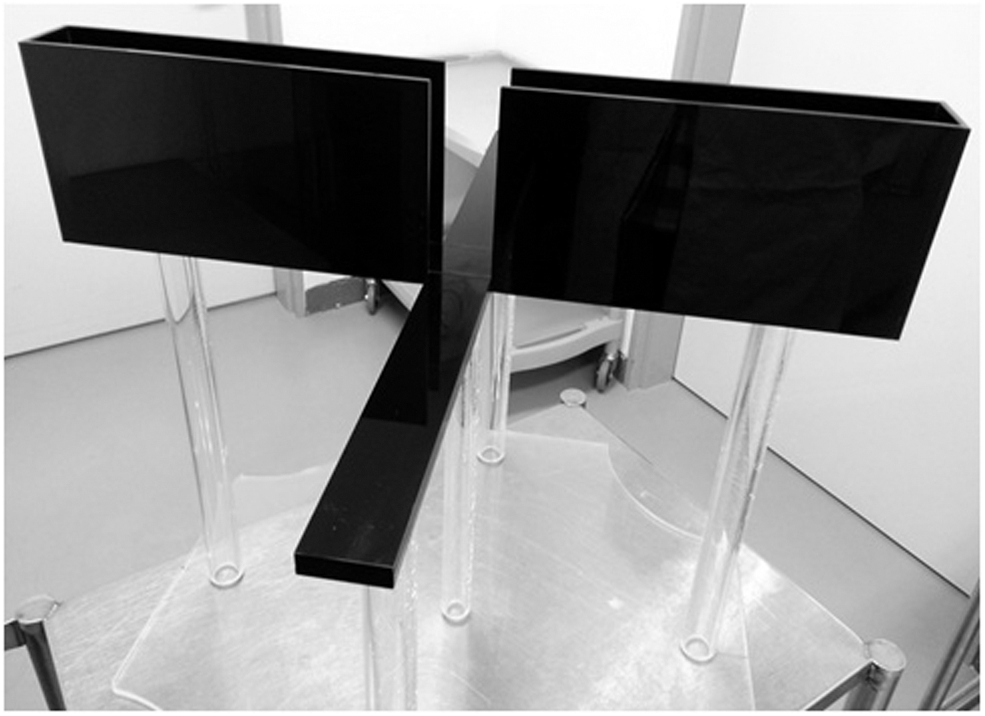
The elevated plus maze used for anxiety-related behavior test.
Statistics
Categorical variables were expressed in frequencies and percentages, while continuous variables were expressed in means and standard deviations. The Mann–Whitney U test was performed to determine the difference in behavior between GABA and control groups. Repeated-measures analysis of variance (ANOVA) was carried out to test differences between the two groups considering all observation days. Statistical significance was considered when P-value was <.05. SPSS version 21.0 was used for all statistical analyses.
Results
The number of entries into the open arm
On day 8, the number of entries into the open arm by the GABA and control groups was 1.10 ± 1.60 and 0.00 ± 0.00 (Mann–Whitney U test, P = .030), respectively. On day 10, the number of entries into open arm by mice in the GABA group was 2.00 ± 1.89, which was significantly (Mann–Whitney U test, P = .025) higher compared with the control group (0.40 ± 0.84) (Table 2).
SD, standard deviation.
In repeated-measures ANOVA, the number of entries into the open arm also showed significant (P = .01) differences between the two groups. The change in number of entries into the open arm according to observation day was also significant (P = .001). The number of entries into the open arm was significantly increased on day 10 compared to that on days 2, 4, or 6 in the GABA group. However, the control group did not have any significant difference in the number of entries into the open arm among all observation days. The trend of changes according to the observation day was also significantly different between the two groups (P = .03; Table 3; Fig. 3).
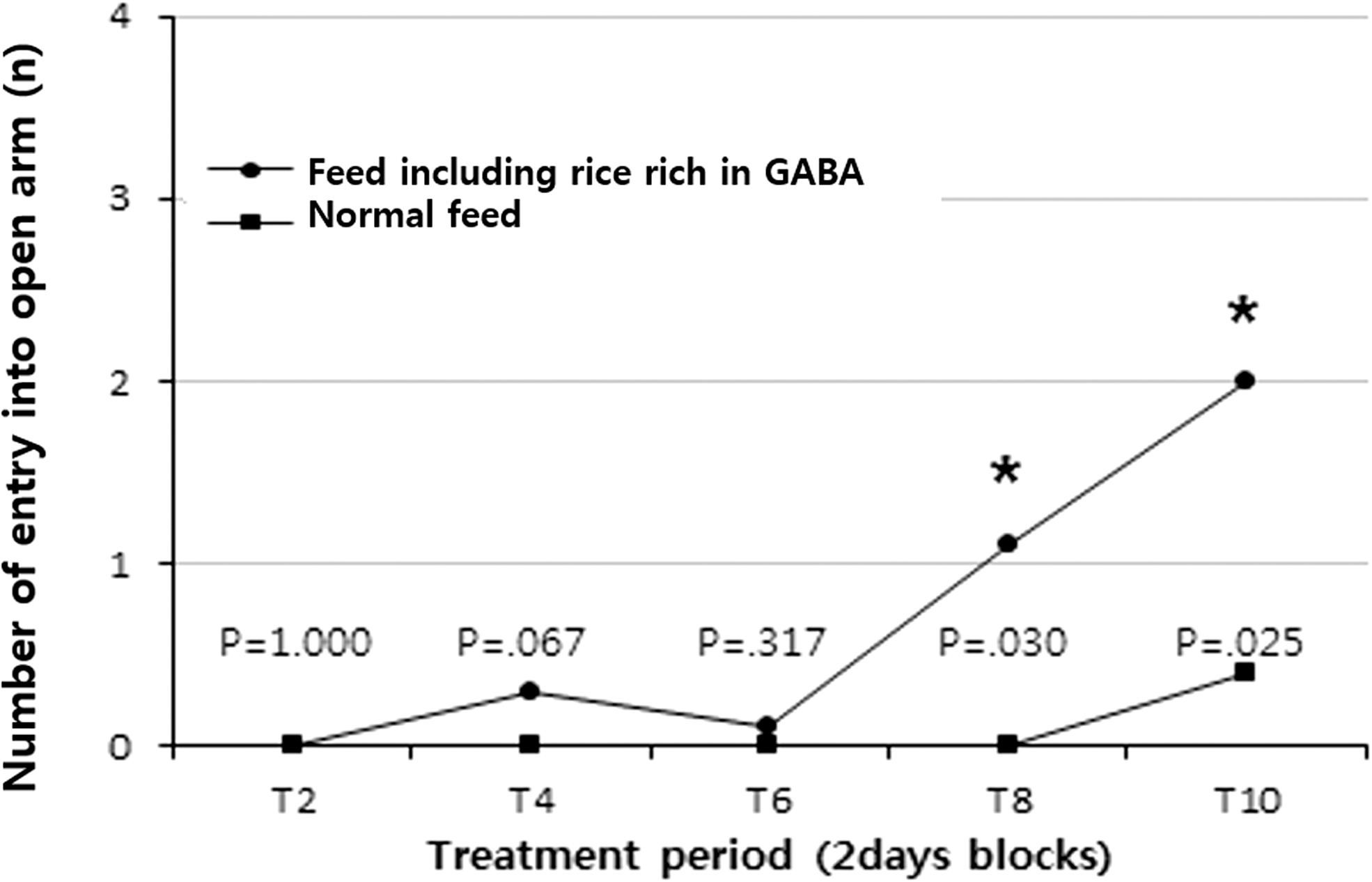
Comparison of the number of entries into the open arm between the two groups. P-values are derived from Mann–Whitney U test. GABA, gamma-aminobutyric acid. *P<.05.
Values are mean ± SD. Bonferroni's post hoc test was used for multiple comparisons among the five time points. Means with different scripts are different from each other (P < .05).
P-values are derived from between-group effect.
ANOVA with repeated measures. Greenhouse-Geisser correction was used when sphericity was not assumed.
ANOVA, analysis of variance.
Time spent in the open arm
The time that mice spent in the open arm also tended to be different between the GABA and control groups from day 8. The time that mice in the GABA and control groups spent in the open arm on day 8 were 3.60 ± 7.06 and 0.00 ± 0.00 (seconds) (P = .068, Mann–Whitney U test), respectively. The time that mice in the GABA and control groups spent in the open arm on day 10 were 6.20 ± 5.35 and 1.80 ± 3.82 (seconds) (P = .042, Mann–Whitney U test), respectively (Table 2).
In repeated ANOVA for the time spent in the open arm, a significant (P = .029) difference was found between the two groups. The changes in time according to the observation day were also significant (P = .003). The time of mice in the GABA group spent in the open arm was significantly increased on day 10 compared to that on days 2, 4, 6, or 8. However, mice in the control group did not show any significant difference in time spent in the open arm among all observation days. The trend of change according to the observation day did not show any significant difference between the two groups (P = .091; Table 4; Fig. 4).

Comparison of time spent in the open arm between the two groups. P-values are derived from Mann–Whitney U test. *P<.05.
Values are the mean ± SD. Bonferroni's post hoc test was used for multiple comparisons among the five time points. Means with different scripts are different from each other (P < .05).
P-values are derived from between-group effect.
ANOVA with repeated measures. Greenhouse-Geisser correction was used when sphericity was not assumed.
Discussion
This study investigated the effect of feeding BSRGE containing high GABA on anxiety-related behavior of mice using an EPM. The GABA group mice showed an increase in the number of entries into the open arm and the time spent in the open arm compared to those in the control group on observation days 8 and 10. The number of entries into the open arm and the time spent in the open arm increased on day 10 compared to those on previous experimental days in the GABA group. However, mice in the control group failed to show any significant difference in the number of entries into the open arm or the time spent in the open arm on all observation days.
Because an increase in the open arm activity (duration and/or entry) can indicate antianxiety behavior, the anxiolytic effect of pharmacological agents can be evaluated using the EPM test. 13 Rago et al. 14 reported that mice treated with benzodiazepine inverse agonist, DMCM, would spend significantly less time in the open arm with reduced number of open arm entries. After administration of diazepam (benzodiazepine combined with GABA receptor), an increase in time spent in the open arm and higher numbers of open arm entries were reported. 14 Based on the results of this study, the high doses of GABA in the Giant Embryo Black Sticky Rice might have an antianxiety effect.
Although several effective and relatively tolerable antianxiety medications such as selective serotonin reuptake inhibitors, tricyclic antidepressant, benzodiazepine, and buspirone are available, 15 many clinicians have reported some important adverse effects, stigma about psychotropics, and noncompliance by patients. In fact, benzodiazepine combined with GABA receptor has some clinical issues such as dependence, memory impairment, falling, serious overdose potential, and withdrawal reactions. 16,17
For these reasons, several previous studies have studied natural compounds and found that some of them have antianxiety properties. For example, Kim et al. have reported that mice in a group that took a beverage mixed with Gastrodia elata Blume extract for 2 weeks showed increases in the numbers of entries into the open arm and the time spent in the open arm. 18 Kang et al. have also reported the anxiolytic effect of Cnidium officinale using the EPM test. 19 More recently, Choi and Jung have reported that administration of Scrophularia buergeriana can significantly enhance the percentage of time spent in the open arm and the number of entries into the open arm of EPM compared to saline-treated control group. Furthermore, the antianxiety effect of S. buergeriana can be antagonized by flumazenil (a GABA A antagonist), but not by WAY-100635 (a 5-HT1A antagonist). 20
In fact, GABA is considered to be a “food constituent” and a “dietary supplement” in Europe and the United States, respectively. GABA food supplements can be bought online through several websites. Hundreds of purchasers have reported that these supplements have helped them reduce anxiety and/or improve sleep quality. Both anxiety and sleep quality is known to be associated with GABA effects. 21 However, both animal studies and clinical research studies are merited to verify the antianxiety effect of food supplement containing GABA.
This study has several limitations. First, a small number of experimental mice were used in this study. Second, a much longer duration of feeding BSRGE is needed to observe the maintenance of antianxiety effects. Nonetheless, this study clearly demonstrated that rich GABA content in a specific rice had a suppressive effect on the anxiety behavior of mice. As studies assessing the effect of BSRGE are still in their early stages, some considerations should be made when planning the next study. First, a comparative analysis with other control feedstuff (such as general rice “Josaengheugchal”+AIN-76A) that has a much lower GABA content than experimental feed stuff (BSRGE with high GABA+AIN-76A) needs to be performed. Second, although the EPM is widely used to measure the anxiety level, additional behavioral test procedures, including general locomotion, thigmotaxis, or light–dark box test, would help confirm the antianxiety effect and strengthen the conclusion of this study. Third, general data including weight gain and amount of food consumption between the comparison groups need to be included in the experimental data. Therefore, this study can serve as a preliminary study, so that, further antianxiety effect of BSRGE could be determined in more extended animal or clinical research studies in the future.
Footnotes
Acknowledgment
This study was supported by Research Institute for Convergence of Biomedical Science and Technology Grant (30-2014-016), Pusan National University Yangsan Hospital.
Author Disclosure Statement
No competing financial interests exist.