




Abstract
Lactobacillus gasseri BNR17 is a probiotic strain isolated from human breast milk. Animal studies reported that BNR17 inhibited increases in body weight and adipose tissue weights. The purpose of this study was to evaluate the antiobesity effects of BNR17 in humans. In a randomized, double-blind, placebo-controlled trial, 90 volunteers aged 20–75 years with body mass index (BMI) from 25 to 35 kg/m2 were randomized to receive a placebo, low-dose BNR (BNR-L, 109 CFU/day), or high-dose BNR (BNR-H, 1010 CFU/day) for 12 weeks. Body weight, BMI, waist and hip circumferences, waist-to-hip ratio, abdominal adipose tissue areas, body fat mass, lean body mass, and biochemical parameters were assessed at the beginning and end of the trial. Visceral adipose tissue (VAT) was significantly decreased in the BNR-H group compared with the placebo group (P = .038). Difference of VAT areas of the BNR-H group compared with the placebo group after 12-week consumption of BNR17 was significant (−21.6 cm2, P = .012). Waist circumferences were significantly decreased in both the BNR-L and BNL-H groups (P = .045 and .012, respectively) compared with the baseline values, but not in the placebo group. Biochemical parameters were not significantly different among the groups. These findings suggest that daily consumption of BNR17 may contribute to reduced visceral fat mass in obese adults.
Introduction
O
Microbiota is regarded as one of the critical factors related to obesity and metabolic disorders. 4,5 The potential role of gut microbiota in the development of obesity led several groups to investigate the effects of probiotic consumption on weight management. Probiotics, which are bacteria known to confer health benefits on the host, modulate the gut microbiota and therefore may affect the energy balance and metabolism of the host. The administration of specific strains of Lactobacillus or Bifidobacterium has shown to prevent weight gain in mouse models of obesity. 6 There is some evidence to demonstrate the effects of probiotic consumption on weight management in humans. Kadooka et al. 7 reported that a supplementation of fermented milk with Lactobacillus gasseri SBT2055 for 12 weeks induces significant weight loss and a decrease in abdominal visceral and subcutaneous fat mass in overweight adults under ad libitum conditions. Omar et al. 8 demonstrated that the consumption of two yogurts per day supplemented with Lactobacillus amylovorus leads to a decrease in total body fat mass in a placebo-controlled, double-blind, crossover clinical study. Ilmonen et al. 9 showed that nutritional counseling combined with probiotic treatment (Lactobacillus rhamnosus GG and Bifidobacterium lactis Bb12) in pregnant women can reduce the risk of central adiposity at 6 months postpartum. Sanchez et al. 10 demonstrated the effect of an L. rhamnosus CGMCC1.3724 supplementation on weight loss and maintenance in obese women during the moderate energy restriction period for the first 12 weeks followed by 12 weeks of weight maintenance, in a double-blind, placebo-controlled, randomized trial.
L. gasseri BNR17 is a probiotic strain isolated from human breast milk. Previous studies have demonstrated that L. gasseri BNR17 suppressed body weight and fat weight gain in the high-sucrose diet-fed rat and transgenic db/db mouse. 11 –13 Also, the antiobesity effect of L. gasseri BNR17 was attributed to elevated expression of fatty acid oxidation-related genes. In a previous human study of L. gasseri BNR17 in which daily energy intake and expenditure were not surveyed and controlled, L. gasseri BNR17 supplementation showed no significant differences compared with the placebo group. 14 However, after a 12-week supplementation, body weight tended to be decreased and waist and hip circumferences were significantly decreased only in the BNR17 group but not in the placebo group.
In the present study, we investigated the effect of L. gasseri BNR17 on alleviating adiposity in obese adults with mild energy intake restriction by performing a 12-week, randomized, double-blind, placebo-controlled trial. For this, we assessed total and regional body fats using dual-energy X-ray absorptiometry (DEXA) and computed tomography (CT), anthropometric measures, biochemical parameters, and daily energy intake and expenditure.
Materials and Methods
Test materials
L. gasseri BNR17 was kindly provided by Bioneer Corporation (Daejeon, Korea). It was isolated from the human breast milk and contained approximately ≥109 CFU live probiotic cells per gram. This was mixed with maltodextrin, crystalline cellulose, and magnesium stearate to make a daily dose of 109 CFU (low dose) and 1010 CFU (high dose) of L. gasseri BNR17 test materials. The placebo was composed of maltodextrin, crystalline cellulose, and magnesium stearate. Test materials were provided in capsules and final products had identical shape, texture, and appearance.
Subjects and study design
Subjects aged 20–75 years with a body mass index (BMI) between 25 and 35 kg/m2 were recruited from the general public by poster advertisements. At the screening visit, all subjects received a medical history review, physical examination, and routine battery of blood and urine tests. Exclusion criteria for subjects were the current use of dietary supplements or medications affecting body weight, probiotic consumption within 2 weeks before the screening visit, history of gastric surgery for weight control, hypertension, diabetes, hepatic failure, renal failure, hyperthyroidism or hypothyroidism, Cushing syndrome, malignant tumor, or any other disease affecting the results of the study, participation in another clinical trial within 4 weeks before the study, and pregnancy or lactation.
On completion of the 2-week run-in period, subjects were randomly assigned to the placebo group, the low dose of L. gasseri BNR17 (BNR-L) group, or the high dose of L. gasseri BNR17 (BNR-H) group for a 12-week intervention period. Randomization was performed using computer-generated random numbers by the study coordinator who had not participated in this study. Group allocation was blinded for both investigators and participants. The clinical research center was given a single-sealed, opaque envelope for each subject that contained the treatment code and was to be opened only in a medical emergency. Treatment assignment was thus concealed and masking was successfully achieved during the study since no sealed envelope was opened voluntarily or accidentally or was tampered with during the study.
During the 12-week intervention period, subjects were asked to take two capsules (400 mg/capsule) of low dose or high dose of L. gasseri BNR17 or a placebo twice a day preferably after breakfast and dinner. Test materials were dispensed by the investigator every 6 weeks, and compliance for the consumption of the test materials was assessed by counting the returned capsules and checking the diary written by the subjects. Subjects were instructed to reduce 200 kcal per day from their energy intake and increase 100 kcal per day in their physical activity during the intervention period. These instructions were provided by a dietitian at each visit. The lifestyle changes of the subjects regarding diet and physical activity were monitored using a 3-day dietary record and a physical activity record for 2 weekdays and 1 weekend. The dietary record was analyzed using a computer-aided nutritional analysis program (Can-Pro 3.0; the Korean Nutrition Society, Seoul, Korea), and physical activity was analyzed using the energy conversion factor for physical activity. 15
Written informed consent for participation was obtained from all subjects. The study protocol was approved by the Institutional Review Board of Seoul National University Hospital and complied with the Helsinki Declaration. This trial was registered in the International Clinical Trials Registry Platform of the WHO with the following identification number: KCT0000756.
Outcome measures
Body weight and height were measured while the subject was fasting and wearing only undergarments. BMI was calculated as body weight divided by the square of the height. Waist circumference was measured between the lowest rib margin and the iliac crest while the subject was in a standing position to the nearest 0.1 cm. Hip circumference was measured at the widest point of the hip to the nearest 0.1 cm.
Visceral adipose tissue (VAT) area and subcutaneous adipose tissue (SAT) area were measured at the fourth and fifth lumbar spine (L4–L5) level using a 16-slice CT scanner (SOMATOM Definition Flash; Siemens AG, Erlangen, Germany). Body compositions, including body fat mass, lean body mass, and percent body fat, were assessed using a DEXA (Lunar Prodigy Advance; GE, Wisconsin, USA).
Fasting blood samples were analyzed for total cholesterol, high-density lipoprotein cholesterol, low-density lipoprotein cholesterol, triglycerides, glucose, insulin, HbA1c, leptin, tumor necrosis factor alpha, C-reactive protein, adiponectin, and monocyte chemoattractant protein-1 by using routine laboratory methods at Seoul National University Hospital. HOMA-IR was calculated as follows: fasting blood glucose (mg/dL)/18 × fasting blood insulin (μIU/mL)/22.5. For safety assessments, vital sign measurements (blood pressure, pulse beat, and body temperature), routine battery of blood and urine tests, and adverse event monitoring were conducted.
Statistical analysis
A power calculation based on a previous study 7 predicted that with 30 subjects at each group assuming a 20% dropout rate, there was an 80% chance of detecting a difference in adipose tissue area among the three groups with a two-sided alpha of 0.05. Analysis of outcome measures was conducted for all subjects who were enrolled in the study. Last observation carried forward method was used for analysis of all outcome measures in subjects who did not complete the study. A Shapiro–Wilk W test was used to assess the normality of each variable and log transformation was performed on skewed variables. Differences in the baseline characteristics among the three groups were tested with chi-squared or Fisher's exact test for categorical variables and analysis of variance (ANOVA) for continuous variables. Daily energy intake and daily energy expenditure from physical activity were tested with repeated-measures ANOVA. For all outcome measures, least squares mean (LSmean) values were estimated using one-way analysis of covariance (ANCOVA) adjusting for gender and waist circumference, which were significantly different at baseline (P < .05). Within-group comparisons of anthropometric measures were assessed using the paired t-test. P < .05 was considered significant. SAS program package version 9.3 (SAS Institute, Cary, NC, USA) was used for all statistical evaluations.
Results
Baseline characteristics
One hundred ten subjects were recruited and 90 eligible subjects were enrolled and randomized into three groups. Thirteen subjects were withdrawn throughout the intervention period: five in the placebo group because of private reasons (n = 3) and not feeling the effect (n = 2), four in the BNR-L group because of private reasons (n = 2), pregnancy (n = 1), and intake of oriental medicine (n = 1), and four in the BNR-H group because of private reasons (n = 3) and lost to follow-up (n = 1) (Fig. 1). No significant adverse events were reported by any participant. The compliance was excellent (mean compliance ratio for all subjects = 94.0%).
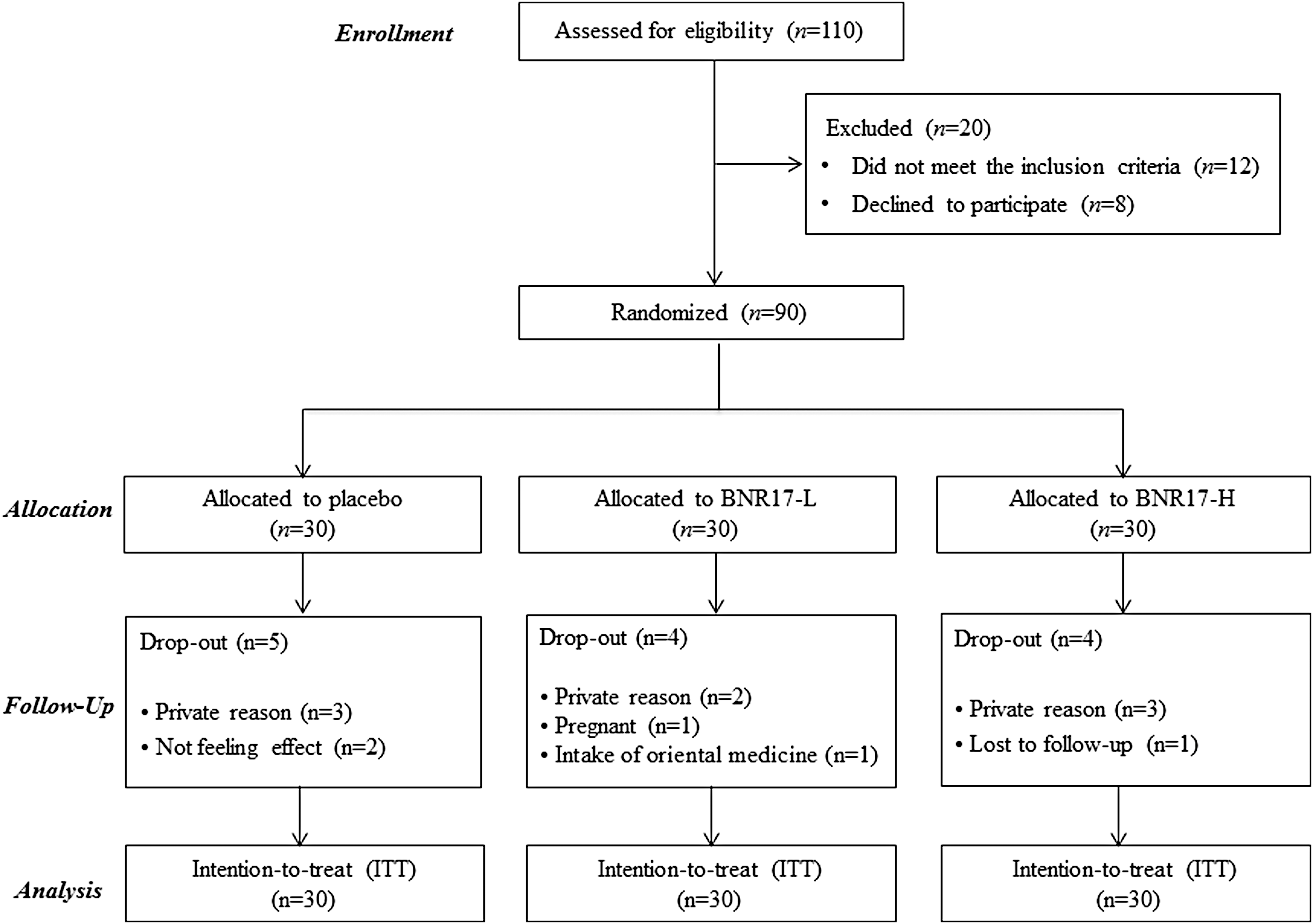
Flow chart of the trial.
The baseline characteristics of the subjects are shown in Table 1. The three groups were well matched for age, body weight, hip circumference, adipose tissue areas, body composition, and biochemical variables. However, gender, waist circumference, and waist-to-hip ratio were significantly different among the three groups.
The values are mean (95% CIs).
Differences among the three groups were evaluated by chi-squared test or Fisher's exact test for categorical variables and ANOVA for continuous variables.
ANOVA, analysis of variance; BMI, body mass index; BNR-L, low-dose BNR; BNR-H, high-dose BNR; CRP, C-reactive protein; HDL-C, high-density lipoprotein cholesterol; LDL-C, low-density lipoprotein cholesterol; MCP, monocyte chemoattractant protein; SAT, subcutaneous adipose tissue; TC, total cholesterol; TG, triglycerides; TNF-α, tumor necrosis factor alpha; VAT, visceral adipose tissue.
Daily energy intake and daily energy expenditure from physical activity
Daily energy intake and daily energy expenditure from physical activity were not significantly different among the three groups (Table 2).
The values are mean (95% CIs).
Differences among the three groups, times, and group × time interactions were evaluated by repeated-measures ANOVA.
Anthropometric measures
Anthropometric measures are shown in Table 3. LSmeans of body weight at week 0 and 12 and waist circumference at week 0 were significantly different among the three groups. BMI, hip circumferences, and waist-to-hip ratio were not significantly different among the three groups at week 0, 6, and 12. For the within-group comparisons, changes of mean values from week 0 (adjusted to zero) to week 12 are shown in Figure 2. Waist circumferences in BNR-L and BNR-H groups and hip circumferences in the BNR-L group decreased significantly after the 12-week consumption of BNR17 within each group (P = .045, .012, and .033, respectively), while the placebo group did not changed significantly.
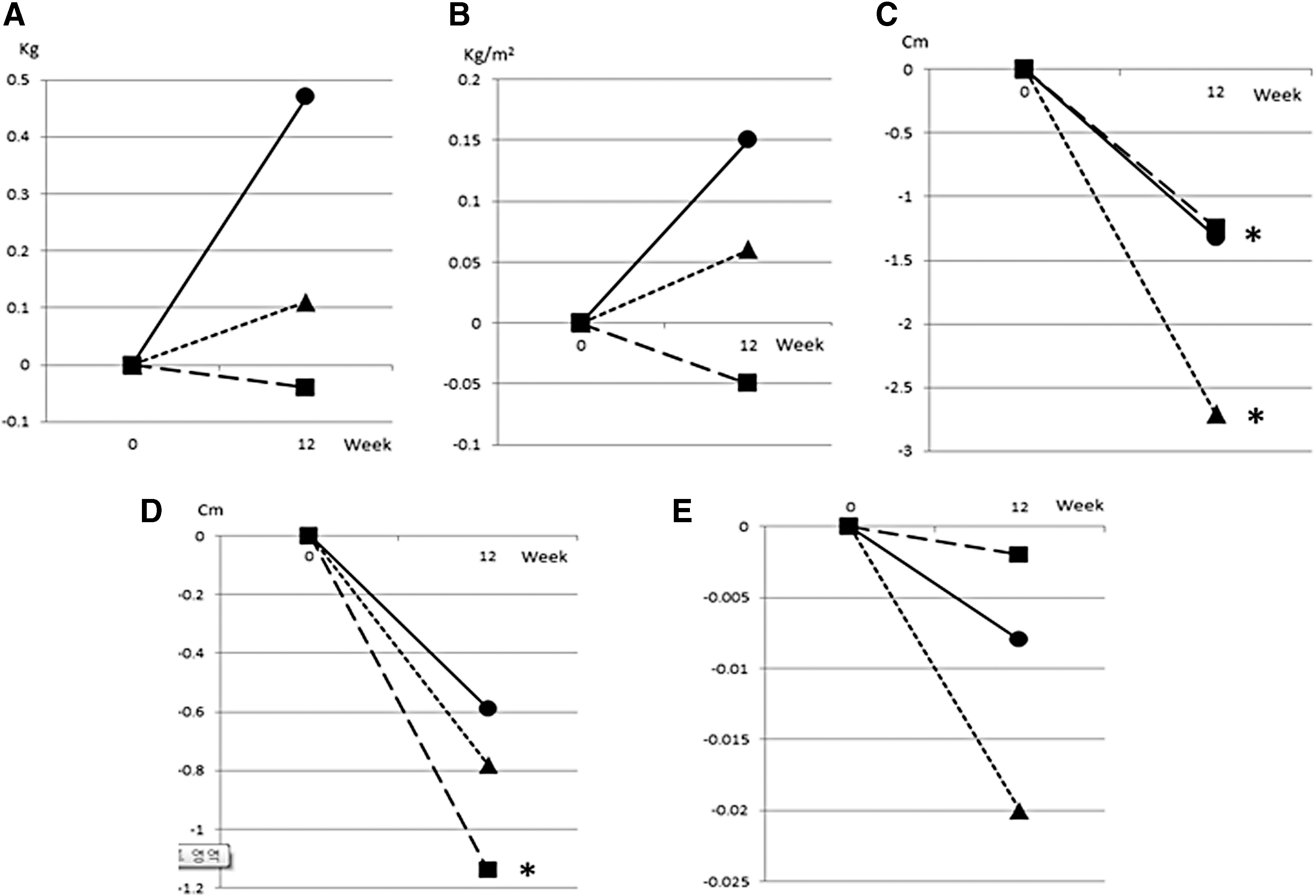
Changes of anthropometric measures from baseline value (adjusted to zero) to week 12.
The values are LSmean (95% CIs).
Different superscript letters are significantly different among the groups (P < .05).
Differences among the three groups were evaluated by ANCOVA.
ANCOVA, analysis of covariance; LSmean, least squares mean.
Abdominal adipose tissue area and body composition
Abdominal adipose tissue area and body composition are shown in Table 4. All variables were not significantly different among the three groups at week 0. VAT areas after the 12-week consumption of BNR17 were significantly different among the three groups (P = .038) and that of the BNR-H group was significantly less than that of the placebo group. Difference of VAT areas of the BNR-H group compared with the placebo group after the 12-week consumption of BNR17 was significant (−21.6 cm2, P = .012). SAT and total adipose tissue areas and %fat, lean body mass, and body fat mass were not significantly different among the three groups.
The values are LSmean (95% CIs).
Different superscript letters are significantly different among the groups (P < .05).
Differences among the three groups were evaluated by ANCOVA.
Biochemical variables in blood
Biochemical variables in blood are shown in Table 5. All variables were not significantly different among the three groups.
The values are LSmean (95% CIs).
Differences among the three groups were evaluated by ANCOVA.
Safety assessment
No significant differences in vital signs, the routine battery of blood and urine tests examined, and no adverse events were reported by any participant (data not shown).
Discussion
The hypothesis that L. gasseri BNR17 supplementation may alleviate the adiposity in obese subjects was supported by recent in vivo studies of Kang et al. 11 –13 In the preliminary study in rats fed a high-sucrose diet, 13 L. gasseri BNR17 significantly inhibited increases in body weight and adipocyte tissue weight after the 12-week administration compared with the control group. In the animal study that provided a high-sucrose diet containing BNR17 (109 or 1010 CFU/day) for 10 weeks, the administration of BNR17 significantly reduced body weight and white adipose tissue weight regardless of the dose of BNR17 compared with the high-sucrose diet group. In BNR17-fed groups, mRNA levels of genes related with fatty acid oxidation, including acyl CoA oxidase (ACO), carnitine palmitoyl-transferase 1 (CPT1), and peroxisome proliferator-activated receptor α and δ (PPAR-α and δ), were significantly higher and those related with fatty acid synthesis, including sterol regulatory element-binding protein-1c (SREBP-1c) and acetyl-CoA carboxylase (ACC), tended to be lower compared with the high-sucrose diet group. ACO and CPT1 are key enzymes in fatty acid oxidation and target genes of PPARs, which play important roles in energy homeostasis and adipogenesis. The expressions of these genes are increased by the activation of PPAR-α and PPAR-δ and result in antiobesity effects. SREBP-1c, a transcription factor involved in adipogenesis, controls the expression of lipogenic genes such as fatty acid synthase and ACC. Therefore, the increased expression of genes related with fatty acid metabolism rather than reduced fatty acid synthesis is responsible for the antiobesity effect of BNR17. 12 In a study of transgenic db/db mouse, BNR17 did not lead to an excessive increase in body weight, while the rosiglitazone group, which was a positive control for blood glucose-lowering effect and known to have a serious side effect of excessive increase in body weight, showed continuous increases in body weight over the experimental period. 13 In the previous human study, 14 L. gasseri BNR17 supplementation without diet control, especially energy intake, and physical activity reduced BMI and waist and hip circumferences, but this reduction failed to reach a significant difference compared with the placebo group. In our study, with a mild modification of energy intake and expenditure, L. gasseri BNR17 supplementation significantly decreased VAT in obese adults. In humans, fat is organized into subcutaneous and visceral compartments. Numerous studies have shown that the regional distribution of body fat is a more important variable than the magnitude of generalized obesity in the relationship between obesity, metabolism, and health, 1 showing that VAT was more strongly associated with an adverse metabolic risk profile than SAT. Therefore, a decrease in VAT may have a positive effect on metabolic risk factors. 16 –19
Recent studies suggested that gut microbiota plays an important role in energy metabolism. The composition of gut microbiota has been shown to differ in lean and obese humans and change in response to dietary factors. Also, differences in intestinal microflora composition between humans seem to represent a key factor affecting energy homeostasis. 20 In particular, gut microbiota is believed to contribute to metabolic diseases such as obesity and type 2 diabetes via stimulation of low-grade inflammation. 21 However, we did not evaluate the changes of gut microbiota in this study. Also, there was no significant change in biochemical variables, including inflammatory biomarkers, lipid profiles, and blood glucose level, in our study. These results seemed to be due to the fact that the inclusion and exclusion criteria of this study did not focus on the recruitment of subjects with an unhealthy metabolic profile. Therefore, further studies are needed to evaluate the correlation between the antiobese effect of BNR17 and the changes of gut microbiota, and to investigate the changes of biochemical variables in subjects with unhealthy metabolic profiles.
In conclusion, the present study demonstrated that L. gasseri BNR17 supplementation has an antiobese effect by reducing the VAT in obese adults. The findings in this study are in agreement with those of previous animal studies. Together with those of previous studies, the results suggest that BNR17 may exert beneficial effects on adiposity in obese adults.
Footnotes
Acknowledgments
We are grateful to the participants in this study. This study was supported by the “Food Functionality Evaluation Program” under the Ministry of Food, Agriculture, Forestry and Fisheries and was partially supported by the Korea Food Research Institute and Bioneer Corporation. It was also supported by the Ministry of Science, ICT & Future Planning (NRF 2012 M3A9C4048761). The funding sources had no involvement in the design, collection, analysis, and interpretation of the data; the writing of this report; or the decision to submit this article for publication.
Author Disclosure Statement
The authors declare that no competing financial interests exist.