




Abstract
Allium hookeri has been widely cultivated and used as a vegetable and medicine in Asia, but its anti-obesity effects have not been previously reported. In this study, the effects of a leaf extract of A. hookeri on obesity were investigated by administering a high-fat diet (HFD) to mice. Male Institute of Cancer Research mice (n = 32; 5 weeks old) were randomly divided into four groups: normal-diet group, HFD group, HFD containing 200 mg/kg/day A. hookeri leaf extract (HFD-A1), and HFD containing 400 mg/kg/day A. hookeri leaf extract (HFD-A2). A. hookeri leaf extract was orally administered daily for 4 weeks. We found that the body weight gain and organ tissue weights of mice in the HFD-A1 and HFD-A2 groups were significantly lower compared with those of mice in the HFD group. Administration of A. hookeri leaf extract also significantly decreased the size of the epididymal adipose tissue (AT). Serum levels of triglyceride (TG), total cholesterol, low-density lipoprotein cholesterol, and the atherogenic index were significantly lower in the HFD-A1 and HFD-A2 groups than in the HFD group. The TG and total cholesterol levels in the hepatic, epididymal, and mesenteric ATs of the HFD-A2 group were significantly lower than the levels in the HFD group. In addition, mRNA levels of liver fatty acid synthase and lipoprotein lipase were decreased in the A. hookeri leaf extract groups compared with those of the HFD group. These results demonstrate that intake of A. hookeri leaf may have beneficial effects for suppressing obesity-related disease.
Introduction
O
Natural products have received increasing attention as potential obesity treatments that have relatively low costs and minimal side effects. 9 Increasing evidence has revealed that plant extracts, including phytochemicals, are potential anti-obesity agents. Allium hookeri belongs to the Amaryllidaceae family. It is a traditional herb and vegetable in Asia and has been used as a food additive in China. 10 Recently, this plant was cultivated in the southern region of South Korea. 11 The Allium species, including garlic and onion, possess many sulfur-containing active compounds, including allicin, its precursor, alliin, and other thiosulfinates. 12 A. hookeri root, which contains allicin and its derivative compounds, showed anti-obesity effects in obese mice. 13 A. hookeri has also been reported to have anti-inflammatory, antimicrobial, and antioxidant activities, and it has been shown to increase bone formation. 14 –16 Recently, we found that A. hookeri root extract decreased body weights and improved lipid profiles in rats fed a high-fat diet (HFD). 17 However, no studies have investigated the anti-obesity-related mechanisms of A. hookeri leaf extract in mice. Particularly, A. hookeri leaf extract contains phytochemicals such as alkaloids, saponins, glycoside, carbohydrates, tannins, flavonoids, and steroids. 18 The health benefits of A. hookeri leaf are not well known, but there are a few studies of anti-diabetic effects in diabetic rats and the treatment of ulcer and stomach ailments in humans. 18,19 Therefore, we evaluated the effects of A. hookeri leaf extract on obesity-associated changes in body weight, tissue weight, blood lipids, and mRNA levels.
Materials and Methods
Preparation of A. hookeri leaf extract
A. hookeri was purchased from a local market in Gwangju, Korea. The rinsed leaves of A. hookeri were freeze-dried for 72 h. One hundred grams of freeze-dried sample were extracted with 300 mL distilled water, 1.5 L 80% ethanol, or 1.2 L ethanol for 3 h, and the extract was filtered with Whatman filter paper. The A. hookeri leaf extract was concentrated with a rotary evaporator, and the dried extract was stored at −80°C until use.
Animals and experimental diets
The 5-week-old male Institute of Cancer Research mice were purchased from Orient, Korea, and were housed under conventional conditions with a 12-h light/dark cycle at 21°C ± 2°C and 50% ± 5% humidity. All mice were fed a commercial diet and water ad libitum for 1 week before the initiation of experiments. For the HFD-induced obese group, mice were fed with an HFD containing 45% of its total caloric content derived from fat (D12451; Research Diet, Inc., New Brunswick, NJ, USA). The 32 mice were randomly divided into four groups (n = 8 mice/group): normal diet (ND), HFD, HFD supplemented with oral administration of A. hookeri leaf extract (200 mg/kg/day) (HFD-A1), and HFD supplemented with oral administration of A. hookeri leaf extract (400 mg/kg/day) (HFD-A2). During the 4-week feeding period, food intake and body weight of the mice were recorded every 2 days. Animal care and research protocols were approved by the Animal Care and Use Committee of Chosun University, Korea (CIACUC2016-S0016).
Sample collection and storage
At the end of the experiment, the mice were fasted and then anesthetized with ether. Blood samples were collected and centrifuged at 2000 rpm on an Eppendorf Centrifuge 5810 R (Eppendorf AG, Hamburg, Germany) for 20 min at 4°C. The liver and AT (mesenteric, epididymal, and retroperitoneal depots) were harvested, weighed immediately, and stored at −80°C until use.
Biochemical analyses
Serum levels of triglyceride (TG), total cholesterol (TC), and high-density lipoprotein cholesterol (HDL-c) were enzymatically analyzed with a commercial kit (Asan Pharmaceutical, Seoul, Korea). Low-density lipoprotein cholesterol (LDL-c) was calculated by using the Friedewald formula, 20 and the atherogenic index (AI) was calculated by the Rosenfeld formula. 21 Aspartate transaminase (AST) and alanine transaminase (ALT) were determined by using an automatic analyzer (Hitachi, Japan). Tissue lipids were extracted by using a chloroform/methanol mixture according to the method of Folch. 22 TG and TC contents in liver and epididymal AT were measured by the methods of Wease et al. and Zlatkis and Zak, respectively. 23,24
Histological analyses
The epididymal AT was fixed in 10% formalin, and paraffin-embedded tissue sections were stained with hematoxylin and eosin for histopathological examination (100 × magnification). The areas of randomly selected adipocytes were measured by using ImageJ 1.42 software (Bethesda, Maryland, USA).
RNA extraction and reverse transcription polymerase chain reaction
Total RNA from frozen liver tissue was isolated by using an RNeasy kit (Qiagen, Valencia, CA, USA). RNA (1 μg) was reverse transcribed by using Oligo-dT primers and SuperScript III Reverse Transcriptase (Invitrogen, USA). The sequences of the primers are shown in Table 1. The cDNA fragment was polymerase chain reaction (PCR) amplified with primers specific for each gene. The reaction conditions were as follows: for liver FAS, C/EBP-α, LPL, and β-actin, 30 cycles of 95°C for 15 sec, 60°C for 60 sec, and 72°C for 30 sec. PCR amplification employed β-actin as an internal control. PCR products were separated on a 2.0% agarose gel and visualized by ethidium bromide staining and UV transillumination.
FAS, fatty acid synthase; LPL, lipoprotein lipase; C/EBP-α, CCAAT/enhancer binding protein-α.
Statistical analyses
All data are expressed as means ± standard deviations. All results were compared by one-way ANOVA with Tukey post hoc analysis, using Prism GraphPad 5.01 software (San Diego, CA, USA). Group means were considered significantly different at P < .05.
Results
Effect of A. hookeri leaf extract diet on body weight, food intake, and food efficiency ratio
Diet composition is detailed in Table 2. Table 3 showed the changes in body weight, body weight gain, food intake, and food efficiency ratio (FER) of the mice fed the HFD with oral administration of A. hookeri leaf extract after 4 weeks of treatment. The final body weight in the HFD group (40.56 ± 0.98 g) was significantly higher than that in the ND group (36.63 ± 1.55 g). The body weight gain of mice fed HFD with A1 or A2 was significantly decreased compared with that of mice fed HFD alone for 4 weeks. However, food intake was not different among the groups. The FER was significantly increased in the HFD group compared with that of the ND group. The FERs of HFD-A1 and HFD-A2 groups were lower than that of the HFD group, but the difference was not statistically significant.
Prepared by Research Diet, Inc., New Brunswick, NJ, USA.
AIN-93G (D10012G) for ND group.
HFD (D12451) for HFD group.
HFD (D12451) and different doses of Allium hookeri leaf-supplemented groups. HFD group was daily given by oral administration of A. hookeri leaf extract (200 or 400 mg/kg/day).
Mineral and vitamin mixture.
As recommended by the AIN-93M rodent diet.
HFD, high-fat diet; ND, normal diet.
Mice (n = 8) were treated with ND, HFD, 200 mg/kg/day leaf of A. hookeri (HFD-A1), and 400 mg/kg/day leaf of A. hookeri (HFD-A2) by daily oral administration with concurrent feeding of HFD for 4 weeks. All experimental data were Mean ± SD. Different letters indicate statistical differences among all the groups (P < .05).
FER = total body weight gain/total food intake × 100.
FER, food efficiency ratio; SD, standard deviation.
Effect of A. hookeri leaf extract diet on weights of liver and AT
The effect of A. hookeri leaf extract on AT weights of mice is shown in Table 4 Visceral fat, which is located inside the abdominal cavity, is composed of retroperitoneal, mesenteric, and epididymal white AT. 25 Retroperitoneal AT in mice lies in the paravertebral position between the spine and the posterior abdominal region. 25 Abdominal subcutaneous AT may contribute to the metabolic syndrome. 25 The HFD treatment significantly increased the weights of ATs, including liver, retroperitoneal, mesenteric, and epididymal ATs, compared with ND treatment. The liver, mesenteric, and epididymal AT weights were significantly decreased in the HFD-A2 group compared with those in the HFD group. The retroperitoneal AT in the HFD group was significantly lower than that in the HFD-A1 and HFD-A2 groups.
At the end of the experiment, liver and visceral tissues (retroperitoneal, mesenteric, and epididymal adipose tissue) from mice were excised immediately, rinsed with phosphate buffer saline, and weighed. All experimental data were Mean ± SD. Different letters indicate significant differences among all the groups (P < .05).
Effect of A. hookeri leaf extract diet on serum metabolic parameters
Table 5 shows the serum lipid profiles of the mice fed HFD with oral treatment of A. hookeri leaf extract. HFD feeding significantly increased TG levels, but the HFD-A1 and HFD-A2 groups exhibited suppressed TG levels by 12.7 and 27.5%, respectively, compared with the HFD group. The level of TC was significantly lower in the HFD-A1 and HFD-A2 groups than in the HFD group. The HFD-A1 and HFD-A2 groups exhibited significantly decreased levels of LDL-c (by 59.4% and 69.6%, respectively) compared with the HFD group. The HDL-c level was significantly decreased after HFD feeding compared with that of the ND group. However, the oral treatment with A. hookeri leaf extract at 200 or 400 mg/kg/day significantly increased the HDL-c level compared with that of the HFD mice. The AI has been indicated as a predictor of cardiovascular risk. 26 AI was significantly increased after HFD diet. However, there was a significant decrease in AI in the HFD-A1 and HFD-A2 groups compared with that of the HFD group. HFD increased the levels of ALT and AST, but the HFD-A1 and HFD-A2 groups did not show significant differences in ALT and AST activities compared with those of the HFD group.
Mice (n = 8) were treated with ND, HFD, 200 mg/kg/day leaf of A. hookeri (HFD-A1), and 400 mg/kg/day leaf of A. hookeri (HFD-A2) by daily oral administration with concurrent feeding of HFD for 4 weeks. All experimental data were Mean ± SD. Different letters indicate significant differences among all the groups (P < .05).
AI = total cholesterol−HDL cholesterol/HDL cholesterol.
ALT, alanine transaminase; AST, aspartate transaminase; LDL, low-density lipoprotein; AI, atherogenic index; HDL, high-density lipoprotein.
Effect of A. hookeri leaf extract diet on tissue lipid content
Table 6 shows the effect of oral treatment of leaf extract of A. hookeri on tissue lipid content. Hepatic TG levels in the HFD-A1 and HFD-A2 groups were suppressed by 17.0% and 25.5%, respectively, compared with those of the HFD group. The level of hepatic TC was significantly decreased in mice fed A. hookeri leaf extract at 400 mg/kg/day. The level of epididymal TG was significantly decreased in HFD-A2 mice. The increased levels of TC in epididymal lipids in the HFD group were significantly attenuated by administration of 200 and 400 mg/kg/day A. hookeri leaf extract. Mesenteric TG and TC levels were decreased in the HFD-A1 and HFD-A2 groups compared with the levels in the HFD group.
Total lipid contents (triglyceride, total cholesterol) in liver and visceral tissues (retroperitoneal, mesenteric, and epididymal adipose tissue) were extracted and measured by using the method as described. All experimental data were Mean ± SD. Difference letters indicate significant differences among all the groups (P < .05).
Effect of A. hookeri leaf extract diet on hepatic mRNA expression
We performed reverse transcription polymerase chain reaction (RT-PCR) analysis, using hepatic mRNA from ND, HFD, HFD-A1, and HFD-A2 groups, to examine the effect on lipid metabolism. The mRNA level of C/EBP-α in liver did not show any differences among the groups. Liver FAS mRNA expression was significantly increased in the HFD group compared with expression in the ND group. However, the mRNA levels of FAS in the HFD-A1 and HFD-A2 groups were significantly lower than those in the HFD group (Fig. 1A, B). RNA expression of LPL was significantly increased in the HFD group compared with the ND group. Feeding HFD mice leaf extract of A. hookeri (400 mg/kg/day) lowered hepatic mRNA levels of LPL.
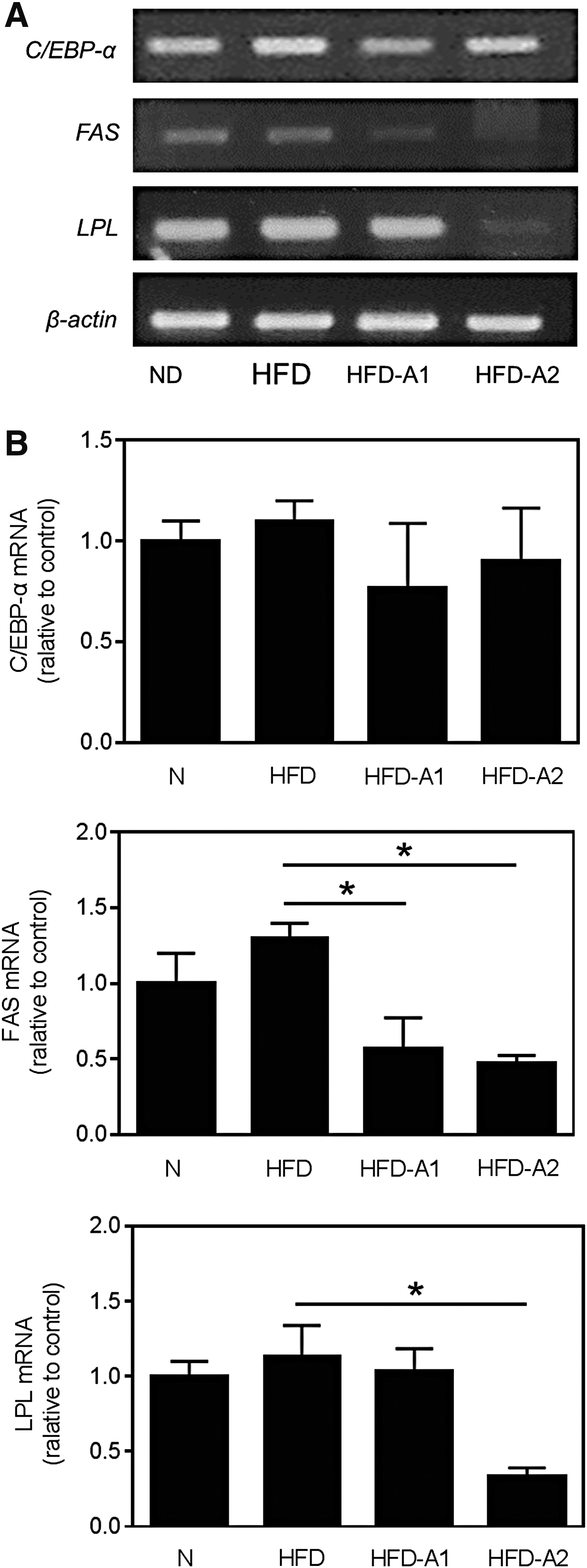
Effects of Allium hookeri leaf extract on mRNA expression of C/EBP-α, FAS, and LPL. Representative images for the reverse transcription polymerase chain reaction analysis
Effect of A. hookeri leaf extract diet on histological analysis
Figure 2 shows the histological analysis of epididymal AT in the ND and HFD groups with A. hookeri leaf extract. Adipocytes were larger in the HFD group than in the ND group. The adipocyte sizes in the HFD-A1 and HFD-A2 groups were significantly decreased compared with those in the HFD group (Fig. 2A, B).
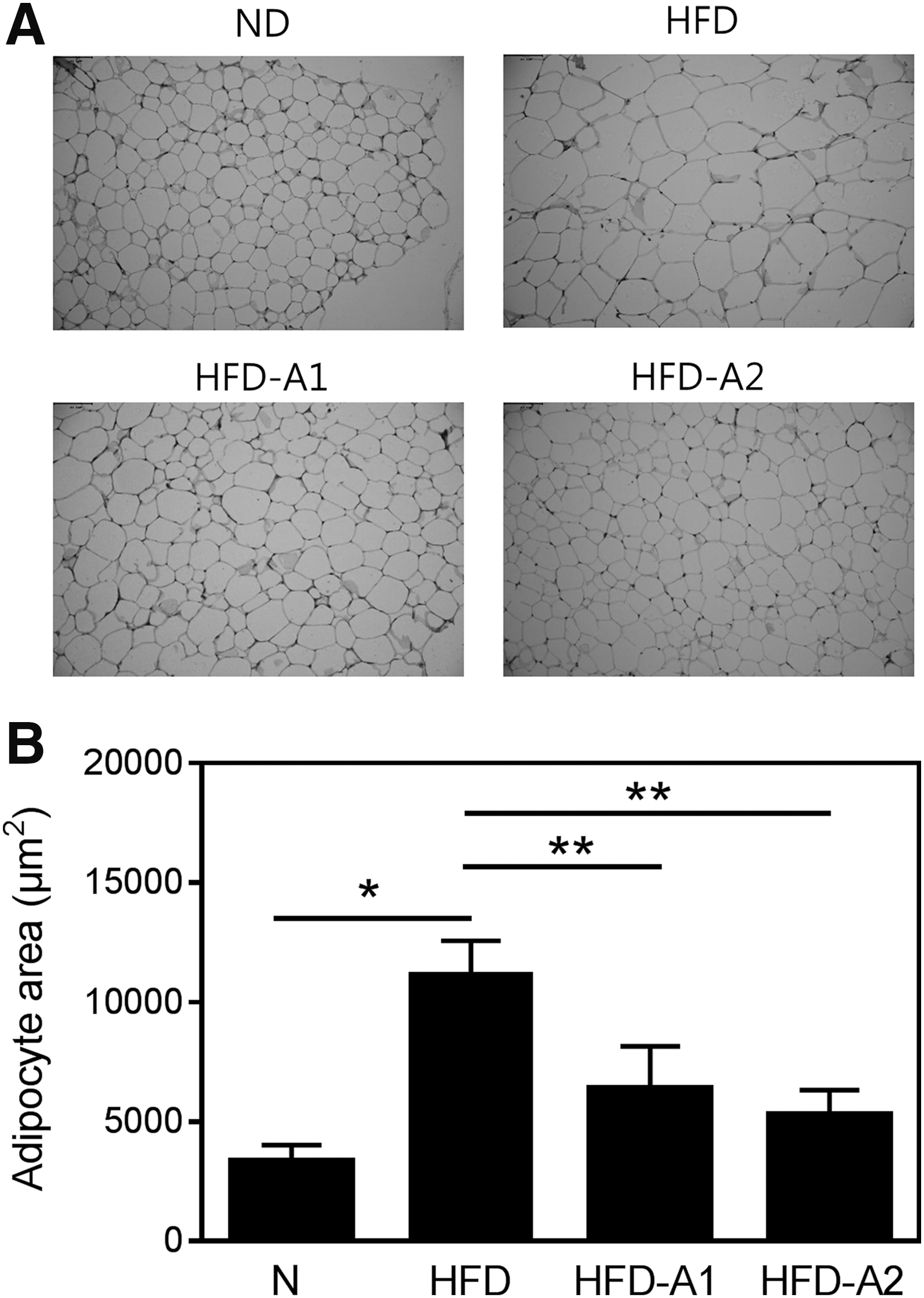
Histological analysis of epididymal adipose tissue. Microscopic images of hematoxylin and eosin-stained epididymal adipose tissues from mice maintained on ND or HFD with A. hookeri leaf extract for 4 weeks (100 × magnification)
Discussion
A. hookeri is consumed as a traditional herb and dietary medicine in some areas. 27 Various studies, including our previous study, revealed the biological activities of A. hookeri root extract. 17 However, this study investigated, for the first time, the effect of oral administration of A. hookeri leaf extract on obesity and lipid profiles in mice fed an HFD containing 45% fat for 4 weeks. The administration dose of A. hookeri leaf extract (200 mg/kg/day or 400 mg/kg/day) was determined based on a previous study, 13,18 and it was shown to be safe dosage for experiments.
According to our results, the HFD group exhibited a significantly higher body weight gain than did the ND group, which indicated that obesity was induced. The HFD-fed mice treated with A. hookeri leaf extract had decreased body weight and AT weight; however, food intake and FER were not different over 4 weeks. These observations indicate that the decrease in body weight with A. hookeri leaf extract treatment was not caused by reduced intake.
Visceral obesity represents the main risk factor for inappropriate storage of TG in adipocytes, and this fat accumulation plays a crucial role in the development of obesity-related disorders such as type 2 diabetes, hyperlipidemia, hypertension, and metabolic syndrome. 28 Fat accumulation in the liver also causes insulin resistance and dyslipidemia. 29 This study showed that HFD-induced body fat, including liver and intra-abdominal fat (mesenteric and epididymal tissue), was markedly reduced by A. hookeri leaf extract supplementation. Therefore, our results suggested that A. hookeri leaf extract administration with an HFD inhibits lipid absorption and has an anti-adipogenic effect.
In this study, oral treatment with A. hookeri leaf extract significantly ameliorated the serum TG, TC, and LDL-cholesterol levels observed in animals administered the HFD. The Allium genus includes plants such as garlic, onions, and shallots that are rich in sulfur compounds, steroidal saponins, and flavonoids, which have antioxidants and lower blood lipids and blood glucose. 30 A. hookeri contains allicin, the major flavor compound of garlic (A. sativum), and other organic sulfur compounds, which have been shown to reduce TG and TC levels in hyperinsulinemic hyperlipidemic hypertensive rats. 11,31 A. hookeri root contained thiosulfinates, including allicin, 13,32 and its leaf consisted of isoalliin (0.21 ± 0.01 mg/g of dry weight), methiin (5.17 ± 0.51 mg/g of dry weight), and cycloalliin (11.62 ± 1.26 mg/g of dry weight). In addition, we also showed the physicochemical properties by using A. hookeri extract. 33 The leaf of A. hookeri had a high total polyphenol (60.75 ± 3.22 mg/g extract) and flavonoid (131.82 ± 1.76 mg/g extract) content. 33 Dietary polyphenols were reported to have protective effects against AT growth by suppressing adipocyte differentiation and TG accumulation. 34 Flavonoids could decrease lipid absorption by inhibiting the activity and gastrointestinal level of pancreatic lipase. 35,36 A previous study from our laboratory has also shown hypolipidemic effects for 3% and 5% A. hookeri root extract in rats fed an HFD. 17 A. hookeri leaf extract is a rich source of phytochemicals and bioactive compounds; therefore, the anti-obesity effect using A. hookeri leaf extract might be attributable to those compounds, but further studies are needed to confirm their effects.
We also found that the size of epididymal AT in animals administered an HFD was significantly lowered by supplementation with A. hookeri leaf extract in a dose-dependent manner. The traditional role of AT in lipid homeostasis is to store extra fat and release fatty acids and glycerol during fasting and continued food deprivation. 37 However, recent reports have described the regulation of adipocyte metabolism by secretion of AT-derived factors, including adipokines and chemokines. 38 In addition, adipocyte hypertrophy, hypoxia, autophagy, and inflammation in AT are associated with AT dysfunction, and they can be early abnormalities in the development of obesity. 38,39 Anti-inflammatory effects of A. hookeri root extract have been revealed in studies using lipopolysaccharide-induced RAW264.7 cells. 40 Roh et al. also reported the ameliorating effects of A. hookeri on oxidative stress-induced inflammatory response. 41 Further, enlarged fat cells show modified metabolic capacities and could affect the metabolic complications of obesity at the whole-body level. 42 Weight reduction is accompanied by a dramatic decrease in the size of adipocytes. 43 A study by Yang, et al. showed that A. hookeri was shown to decrease differentiation and lipid accumulation in 3T3-L1 adipocytes. 44 Hence, the findings suggest that decreasing adipose size with A. hookeri leaf extract will, at least partly, have an inhibitory effect on obesity-related diseases.
PPAR-γ and C/EBP-α are the major transcription factors that regulate adipogenesis. 45,46 C/EBP-α in combination with PPARγ induces the differentiation of pre-adipocytes into mature adipocytes. 45 Activation of these transcription factors leads to the differentiation of adipocytes by enhancing adipogenic markers, such as FAS and LPL. 47 A. hookeri leaf supplementation suppressed the mRNA expression of C/EBP-α, but the differences were not significant among groups. LPL is secreted by mature adipocytes and plays an essential role in controlling lipid accumulation via fatty acid uptake. 48 The mRNA expression of LPL and FAS was downregulated as a result of A. hookeri leaf extract treatment. These findings indicate that A. hookeri leaf extract may partially inhibit adipogenesis and lipogenesis by regulating the earlier described factors during HFD feeding.
In conclusion, we found that A. hookeri leaf extract has potent anti-obesity effects, including decreasing body weight and AT weight gains, reducing blood lipid profiles, and modulating obesity-related mRNA expression levels in mice fed an HFD.
Footnotes
Acknowledgment
This study was supported by research funds provided by Chosun University in 2013.
Author Disclosure Statement
No competing financial interests exist.