




Abstract
β-site amyloid precursor protein cleaving enzyme 1 (BACE1) plays a role in generating amyloid β (Aβ), thus playing a major part early in the pathogenesis of Alzheimer's disease (AD). BACE1 has emerged as a crucial therapeutic target for decreasing the Aβ concentration in the AD brain. To explore natural BACE1 inhibitors, the present study concentrated on isoflavones, including genistein, formononetin, glycitein, daidzein, and puerarin. In this study, in vitro anti-AD activities were assessed using BACE1 inhibition assays, as well as enzyme kinetic predictions. Molecular docking analysis was applied to design potential BACE1 inhibitors. Among the major isoflavones, genistein exerted a notable BACE1 inhibition through reversible noncompetitive mechanism, while other compounds were less potent against BACE1. The docking study revealed that genistein had negative binding energy (−8.5 kcal/mol) and was stably positioned in the allosteric domains of BACE1 residues. It interacted with important amino acid residues in BACE1, such as ASN37, GLN73, and TRP76, through hydrogen bonding. The results suggested that genistein may be beneficial for preventing and/or treating AD. Furthermore, it may provide potential guidelines for the design of new BACE1 inhibitors.
T
Recent research indicated that one of the most important risk factors for the onset of AD is estrogen-deficient postmenopause. 4 Compared with postmenopausal women who were not administered estrogen replacement therapy, epidemiological studies demonstrated that those who were administered estrogen replacement therapy had a significantly lower risk for the onset of AD. Estrogen is neuroprotective against various toxic insults, such as oxidative stress, Aβ, lipopolysaccharide, and tunicamycin. 5 –7
Isoflavones are characterized by a common 3-phenylchromen-4-one core structure. The substituents on the primary structure, such as methoxy, hydroxyl, and glycoside moieties, however differ between isoflavones. Given its structural similarity to estrogen, the health benefits of isoflavones have been evaluated in age-related and hormone-dependent diseases such as cancer, osteoporosis, and coronary heart disease. 8,9 Furthermore, several studies provided evidence that an isoflavone-enriched diet is neuroprotective. Hsieh et al. reported that the administration of soy isoflavones reduced oxidative stress and AD related parameters in C57BL/6J mice treated with D-galactose. 10 A preclinical study indicated that a soy-enriched diet, administered for 10 weeks, substantially improved short- and long-term memory. 11
In the present study, the BACE1 inhibitory properties of three abundant soybean isoflavones (i.e., genistein, daidzein, and glycitein), and a major isoflavone in red clover (i.e., formononetin) and its glucoside (puerarin), were evaluated. In the present study, BACE1 inhibitory potency and kinetic analysis of isoflavones was performed to seek putative anti-AD candidates. In addition, a molecular docking analysis and 3D visualization were performed to ascertain how the inhibitor interacted with BACE1.
Samples (i.e., daidzein, formononetin, genistein, glycitein, and puerarin ≥98%) and resveratrol (≥99%) were obtained from Sigma-Aldrich (St. Louis, MO, USA). Puerarin (≥98%) was purchased from Tokyo Chemical Industry (Tokyo, Japan). Biological evaluation and kinetic analysis of BACE1 were performed as described previously. 12 BACE1 inhibitory activity was measured by the cleavage of the fluorescence resonance energy transfer method using Rh-EVNLDAEFK-Quencher as the substrate. Dixon and Lineweaver–Burk plots were used to determine the type of inhibition. Graphical representations were made using SigmaPlot software (Version 12.3; Systat Software, Inc., San Jose, CA, USA). A molecular docking study was performed as described previously. 13 The crystal structure (PDB ID: 2WJO) used for BACE1 and its inhibitor, in the current study, was prepared from the PubChem database (CID 5280961 for genistein). Data were analyzed with Duncan's multiple range tests using Statistical Analysis System (SAS) version 9.3 (SAS Institute, Cary, NC, USA).
As shown in Figure 1A, genistein significantly inhibited BACE1, in a dose-dependent manner, from 10 to 100 μM, with an IC50 value of 6.3 × 10⁻⁵ M. Although the other tested aglycones, including daidzein, formononetin, and glycitein, also exhibited dose-dependent BACE1 inhibitory properties, these effects were not significant. Puerarin, which possesses a glucoside moiety in B ring, did not show any repressive effect against BACE1 activity (>100 μM). These results clearly demonstrated that structural requirements for BACE1 inhibition include the presence of a hydroxyl group at C-5 on the A ring (such as in genistein). The present result corroborated with a previous study that demonstrated that the C-5 hydroxy group in A ring, including genistein and biochanin A, is crucial for neuroprotective activity in PC12 cells against Aβ-induced toxicity. 14 In addition, our previous study showed that biochanin A suppressed recombinant human BACE1 activity. 12 Based on the results of BACE1 inhibition, we selected and focused on genistein for further experimental study.
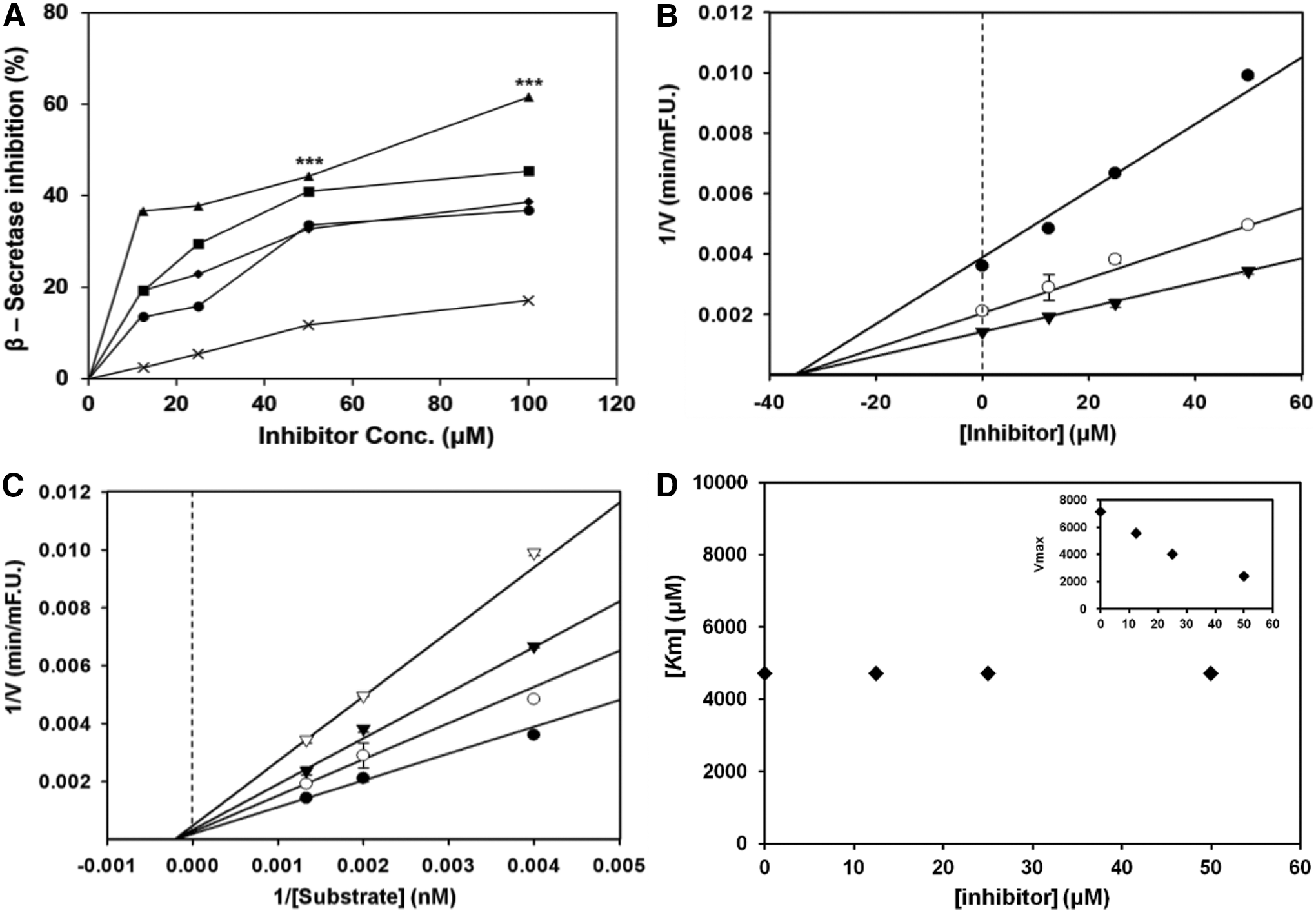
As shown in Figure 1B, genistein exhibited noncompetitive inhibition with a respective Ki value of 3.5 × 10⁻⁵ M in the Dixon plot. Furthermore, according to the Lineweaver–Burk plot analysis, the Km and Vmax value of genistein were 4.7 × 10⁻⁴ M and 5.1 mM/min/mg, respectively (Fig. 1C, D). For each mode of inhibition, one can calculate a dissociation constant, Ki, for the inhibitor that reflects the strength of the interaction between the enzyme and the inhibitor. Ki for an inhibitor is analogous to Km for a substrate; a small Ki value reflects tight binding of an inhibitor to an enzyme, whereas a larger Ki value reflects weaker binding.
Molecular docking, which is often used in the discovery process of anti-AD drugs, is a computational method that can be used to rapidly determine the binding modes of ligands to their receptors. 13 In the present study, the docking analysis was used to investigate the interactions between compound and the pocket site of BACE1. BACE1 and genistein formed four hydrogen bonds involving allosteric site residues, such as ASN37, GLA73, and TRP76 residues, without active BACE1 catalytic centers (Asp32 and Asp228) (Fig. 2B, left). Interestingly, the hydroxyl moiety of genistein acted simultaneously as a hydrogen donor and acceptor. Detailed graphical interaction is shown in (Fig. 2B, right) and Table 1. The oxygen atoms of C-5 and C-7 in the A ring of genistein were donated to the ASN37 residue of BACE1 (distance: 4.55 and 2.96 Å, respectively) and oxygen atom of C-4′ in the B ring offered to GLN73 (distance: 4.81 Å). In contrast, the oxygen atom of genistein accepted a hydrogen from the nitrogen atom of TRP76 in BACE1 (distance: 3.20 Å). In addition, the binding affinity of the most proposed complexes of genistein with BACE1 was −8.5 kcal/mol. A noncompetitive inhibitor usually binds somewhere other than the active site, but is able to change the conformation of the active site in such a way that the substrate is not able to efficiently catalyze the reaction. The inhibition level is dependent on the concentration of the inhibitor but is not reduced by increasing concentrations of substrate. Because of this, Vmax is reduced, but Km is unaffected. In the present study, genistein decreased the Vmax values without affecting the affinity of BACE1 toward the Km, which demonstrated that genistein exhibited noncompetitive inhibition against BACE1. These in vitro kinetic results were concordant with docking analysis.

Representative docking interaction between BACE1 and genistein.
O, oxygen atom; Lig, ligand; N, nitrogen atom.
Genistein inhibited Aβ-induced cell death in several cortical neural cell lines, such as SHSY5Y, C6, and human neuroblastoma cell lines. 15 –17 In addition, genistein also alleviated neuronal apoptosis induced by Aβ in rats. 18 The compound also acted on the estrogen receptor to promote the regeneration of neurons and improve the memory in intrahippocampal Aβ 1–40-injected rats. 18,19 Furthermore, genistein is still pharmacologically safe, even at the high dose of 500 mg/kg/day in rats. 20
To be successful as anti-AD therapies, BACE1 inhibitors must cross the blood–brain barrier (BBB) and maintain effective drug concentrations in the brain. However, only a limited class of lipophilic compounds, with low molecular weights of less than 400–500 kDa, can successfully cross the BBB. Genistein has been reported to cross the BBB in vitro and in vivo. Tsai reported that the administration of genistein (30 mg/kg, i.v.) penetrated the BBB (0.3 μM) independently from P-gp function. 21 Furthermore, gavage administration of genistein increased its concentration in the rat brain tissue 2 h later. 22 Its ability to cross the BBB and its neuroprotective action, with no toxicity, highlighted the importance of further characterizing genistein's protective mechanisms of action against AD.
The present study demonstrated that genistein exhibited a significant inhibition of BACE1. On a molecular level, genistein interacted with BACE1 through strong hydrogen bonding at the allosteric site of BACE1. The current study provided important information for identifying and characterizing isoflavones for the treatment and/or prevention of AD.
Footnotes
Acknowledgment
This research was supported by Dong-A University.
Author Disclosure Statement
No competing financial interests exist.