




Abstract
In this pilot study, we investigated the effect of spatone, a naturally occurring mineral water supplement, on endurance capacity and inflammatory cytokines in wrestlers undergoing a rapid weight control program. Nine amateur university wrestlers participated and were randomly divided into placebo- and spatone-treated groups. The study used a crossover design, including a 4-week washout period. The rapid weight control program was focused on body weight loss, while maintaining their athletic performance (muscular strength and cardiovascular endurance). The initial body weight was 87.19 ± 2.45 kg in the spatone-treated group and 86.60 ± 3.01 kg in the placebo group. After the rapid weight control program, the body weight decreased to 83.56 ± 2.71 kg (4.21% decrease) in the spatone-treated group and 82.95 ± 2.97 kg (4.16% decrease) in the placebo group. However, there were no significant differences in body weight or body composition between placebo- and spatone-treated groups. Endurance capacity improved significantly in terms of VO2max and lactate accumulation after spatone supplement. The interleukin (IL)-10, tumor necrosis factor (TNF)-alpha, and IL-6 concentrations were not altered with spatone treatment or placebo in the rapid weight-loss condition; however, a positive relationship (R = 0.643, P = .023) was observed between the change in IL-6 and VO2max. Thus, our results are consistent with prior studies in that spatone supplementation could protect against iron loss induced by intense training, considering that spatone affects the modulation of inflammatory cytokines and exercise capacity. These preliminary results serve to facilitate the planning for the nutritional application of spatone with their exercise program for wrestlers.
Introduction
R
A previous study on weight loss by wrestlers found dehydration and skeletal muscle damage in elite wrestlers participating in weight-loss programs. 5 Excessive dehydration following weight reduction induces a loss of trace minerals and blood ions, including zinc and iron, through sweat during prolonged exercise. 6 Among various blood ions, iron is a functional component of hemoglobin and myoglobin that facilitates the delivery of oxygen to the body's tissues. Furthermore, iron plays a key role in the electron transport chain since mitochondrial enzymes and cytochromes are heme-containing proteins. 7 Thus, a deficiency in iron may lead to a decline in general health and athletic performance. 8,9 For elite athletes, the excessive loss of blood ions, including iron, after intense training has been considered to be a major negative consequence of rapid weight reduction. Physiological changes induced by intense training can mimic iron deficiency and decrease hemoglobin and ferritin concentration in blood. 10
Spatone is a naturally occurring mineral water from Trefriw Wells Spa in Gwynedd (Wales, United Kingdom) and it contains ∼0.3 mg/mL of iron in the form of ferrous sulfate. 11 Burnett and colleagues estimated the iron absorption from natural mineral water (spatone) and reported that spatone provides iron in a highly bioavailable form. 11 Although tonics and food supplements containing iron are widely available and have been used for centuries, there are no reports on the effect that spatone supplements have on exercise capacity, especially in athletes engaging in weight loss. To this end, we investigated the effect that spatone supplementation has on endurance capacity and inflammatory cytokines in wrestlers undergoing rapid weight control program. These preliminary results serve to generate further hypotheses and facilitate the planning for the use of spatone in the nutritional protocol combined with their exercise program for wrestlers.
Materials and Methods
Subjects
The subjects were nine Korean, healthy, male amateur wrestlers from Yongin University. All subjects provided written informed consent after all experimental procedures, potential risks, and the aim of the study were fully explained and before their participation. If the subjects felt symptoms of pain or fatigue during the experimental period, they could cease to participate. This research protocol was designed in accordance with the Declaration of Helsinki and was approved by the Research Ethics Committee of the Yongin University (2-1040966-AB-N-01-201512-HMR-038-2). The physical characteristics of the subjects are shown in Table 1.
Percent daily values are based on a 2000 kcal diet.
Experimental design (crossover design)
The study consisted of two experiments with crossover design, including a 4-week washout period, labeled Trial 1 and Trial 2. Trial 1 consisted of a pretest (baseline values) on the first day (body composition, blood sampling, and maximal incremental running test) followed by weight loss of 5% over 7 days. In the spatone-treated group, the participants were instructed to drink spatone water containing 5 mg of iron in orange juice at 06:00 and 20:00, respectively (2 pouches per day), for 1 week of weight-loss period (nutritional composition of spatone is described in Table 1). Trial 2 consisted of a pretest (body composition, blood sampling, and maximal incremental running test), followed by weight loss of about 7% over 7 days without taking a natural iron supplement. A posttest (body composition, blood sampling, and maximal incremental running test) was conducted on day 7 at 0600 h for each of the trials. During the weight-loss period, the subjects completed the training protocol twice or thrice per day, and the training session consisted of 30 h a week of exercise, 5 h each day (Fig. 1).
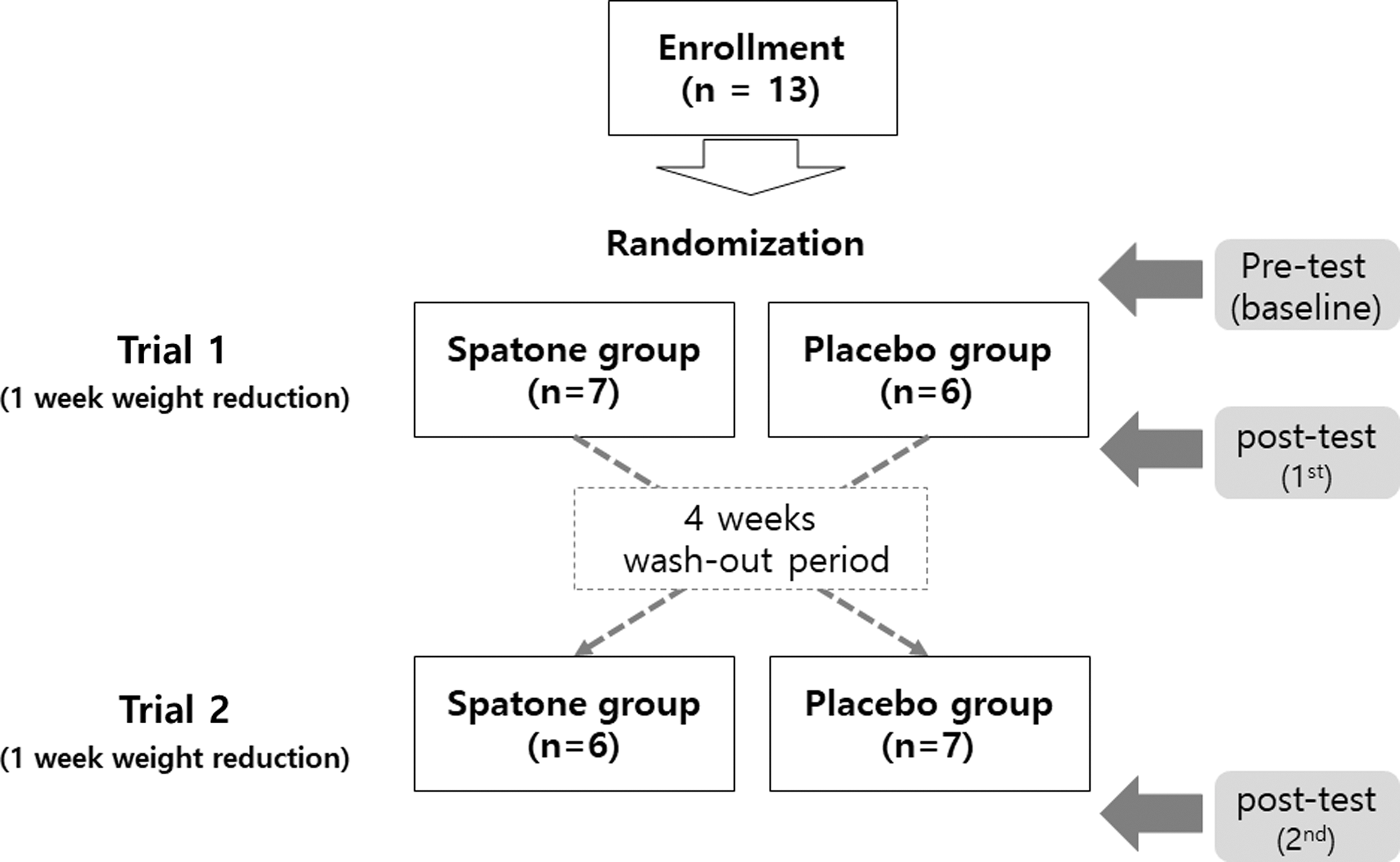
Flowchart for the experimental design.
Weight reduction method
For the experiment, it was important to develop the training program to reduce the body weight since we focused only on exercise intensity without dietary regulation. As such, the core strategies for the training program were for the wrestlers to lose body weight and maintain their athletic performance. Therefore, the types of included exercises were intended to achieve explosive strength, muscle strength, muscle endurance, and cardiovascular endurance.
For the morning session, the main training consisted of running and dashing to increase cardiovascular endurance and muscle endurance. The dash training for explosive strength was performed on a plain, a hill, and a stair on Monday, Wednesday, and Thursday. The interval training and fartlek training were performed for cardiovascular endurance and muscle endurance on Tuesday and Friday. To reinforce insufficient training, subtraining was completed after each main training session. For the afternoon session, mat training was conducted targeting physical fitness, skill training, sparring, and ground sparring to improve game strategy. For the evening session, the subjects performed weight training to maintain their strength on Tuesday and Thursday, but took a rest to recover on Monday, Wednesday, and Friday. The weight training program consisted of a power clean, dead lift, squat, and sit-ups to exercise the power zone, including the lower back, abdominal region, and thighs (Table 2).
Blood sampling and analysis
Blood samples were collected from branchial vein four times (∼Trial 1 before and after, Trial 2 before and after) in a 5 mL vacuum tube (Vacutainer, serum tube 1) using a 22-gauge needle. After centrifugation, plasma aliquots were stored in a freezer at −80°C for subsequent analysis. All eight types of blood corpuscles, including leukocytes and inflammatory cytokines, were analyzed by the Green-Cross Clinical Laboratory Center.
Maximal incremental running test
In this study, the subjects participated in a maximal incremental running test using a treadmill and the Bruce protocol. The subjects arrived 1 h before the start of the experiment, and we measured the respiration rate, ventilation volume, and respiratory exchange ratio. After warm-up at a self-selected treadmill speed, the maximal incremental test commenced, beginning with a 2-min stage at the current treadmill speed. During the test, the subjects were monitored using an ECG monitor, and the test was stopped when they appeared to have continuous ventricular tachycardia, a decrease of 1 mm more of the ST segment at lead without diagnostic Q-wave, and volitional exhaustion despite encouragement by the researcher. During the experiment, the respiration variance was measured at each 30 sec with temperature (22–23°C) and humidity (40–60%).
Blood lactate analysis
After the participants received information on the purpose and procedures for this study, they took a rest for 30 min. Then, we evaluated the blood lactate concentrations at rest, immediately after exercise, after recovery for 10 min, and after recovery for 30 min. The blood samples were collected from the fingertips into heparinized capillary tubes. The lactate concentration was analyzed by an electro-enzymatic method with a lactate analyzer (YSI 1500, YSI Life Science, USA).
Statistical analysis
The statistical analyses were conducted using SPSS 18.0 for Windows. All data were presented as mean ± SD. Two-way repeated measure ANOVA was then applied to determine the difference in the blood variance between the intake of a natural iron supplement pretest and posttest. The level of significance was set at P < .05.
Results
Table 3 shows the participants' basic characteristics and their changes following spatone supplementation, including age, height, body weight, and body composition. The initial body weight was 87.19 ± 2.45 kg in the spatone-treated group and 86.60 ± 3.01 kg in the placebo group. After the rapid weight control program, the body weight decreased to 83.56 ± 2.71 kg (4.21% decrease) in the spatone-treated group and 82.95 ± 2.97 kg (4.16% decrease) in the placebo group (Table 3). There were no significant difference in body weight between the first trial and second trial with a 4-week wash-out period, and this result indicates that our weight-loss program was properly carried out in both trials. In addition, the body composition, including skeletal muscle mass, body fat, and body mass index, did not significantly change when using the spatone supplement (Table 3).
Endurance capacity improved significantly in terms of VO2max and lactate accumulation after taking the spatone supplement. VO2max decreased (10.96%, P < .05) after rapid weight loss in the placebo group (Fig. 2B). However, there was no significant decrease in the spatone-treated group. In addition, the accumulation of blood lactate decreased in the early phase after exhaustive exercise in the spatone-treated group relative to the placebo group (Fig. 2C, D). The maximal heart rate did not change significantly with the spatone treatment after exhaustive exercise (Fig. 2A).

Effect of spatone on the exercise capacity.
The concentration of calcium, magnesium, and iron in blood were measured in the spatone- and placebo-treated groups before and after the rapid weight control program. There were no significant alternations in blood calcium and magnesium concentrations between the spatone and placebo groups (Table 4). The blood iron concentrations increased in both the spatone (48.89% increase) and placebo (33.51% increase) groups, with no significant group × time interaction. In addition, eight of the variables related to blood cells (RBC, Hb, Hct, mean corpuscular volume (MCV), platelet, while cell volume (WCV), mean corpuscular hemoglobin (MCH), and mean corpuscular hemoglobin concentration (MCHC)) were measured in the spatone- and placebo-treated groups after the rapid weight-loss program. In this study, the spatone treatment showed no effect according to blood cell types and in terms of blood-related factors during rapid weight control program (Table 4).
Proinflammatory cytokines (including interleukin [IL]-10, tumor necrosis factor [TNF]-alpha, and IL-6) were measured in the plasma. The IL-10, TNF-alpha, and IL-6 concentrations were not altered with spatone treatment or placebo during the rapid weight loss (Fig. 3). In addition, we found a large standard deviation in the IL-6 level with spatone treatment. Therefore, an additional analysis was performed for the individual correlation between the changes in inflammatory cytokines and VO2max. Figure 3D shows a positive relationship (R = 0.643, P = .023) between the change in IL-6 and VO2max, while a significant correlation was not found with IL-10 and TNF-alpha.
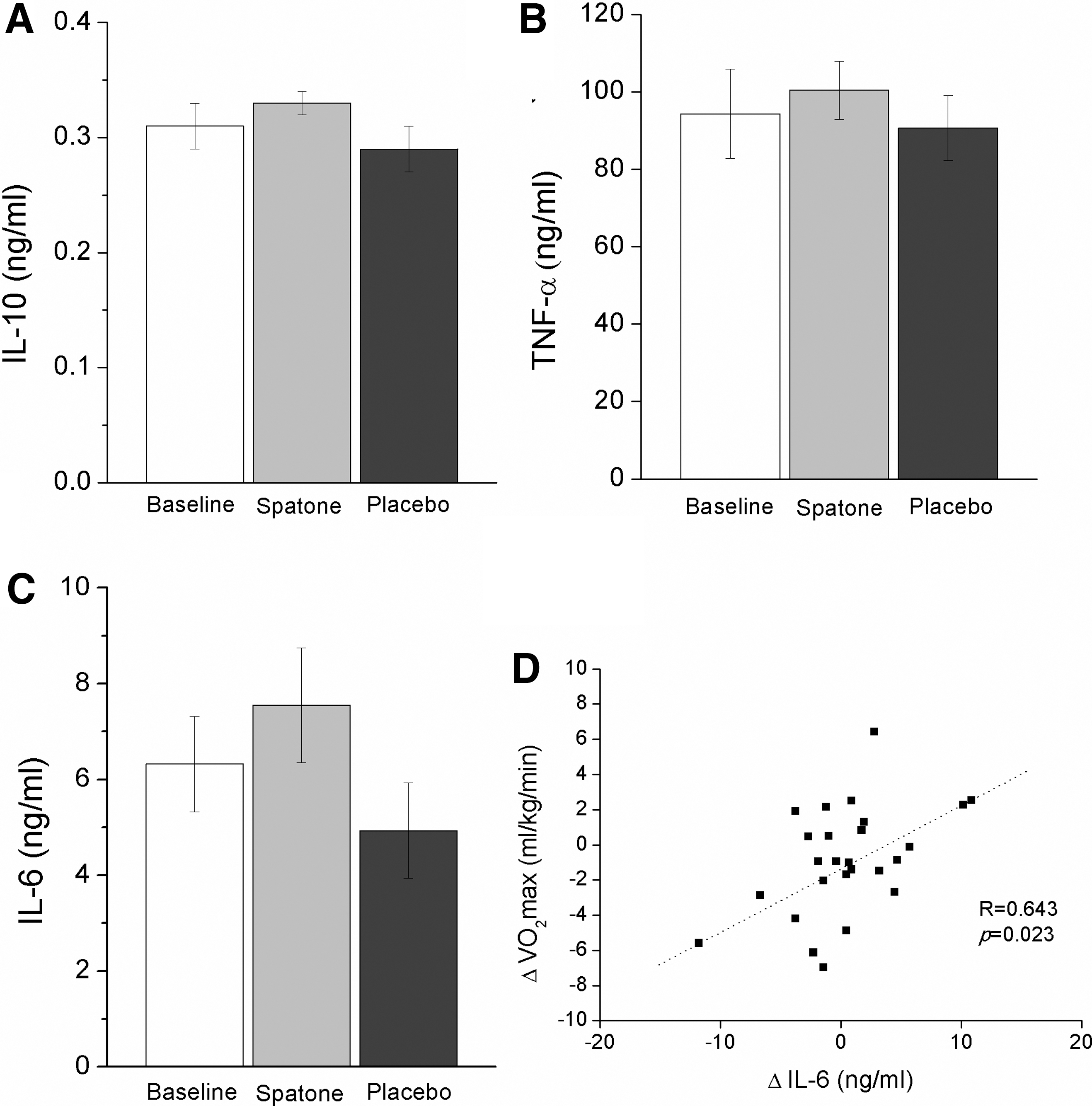
Effect of spatone on inflammatory cytokines.
Discussion
In this pilot study, we found that spatone supplementation prevents a reduction in the endurance capacity (VO2max) and attenuates lactate accumulation in university wrestlers during the recovery phase of the rapid weight control program. Although there were no significant differences in inflammatory cytokines between the placebo- and spatone-treated groups, the change in the IL-6 concentration was correlated with a decrease in VO2max. A relationship between prolonged intense exercise and iron deficiency has previously been reported in athletes. According to a review article from Peeling et al., 12 exercise-induced iron deficiency is related to inflammation, cytokines, and hormones. Another report revealed dehydration and inflammation before competitions among elite wrestlers. 5 Although the relationship between iron deficiency and rapid weight loss was thought to be an important consideration, there were no reports investigating the effect of iron supplementation during the rapid weight loss in elite wrestlers. 5 In this study, as in previous studies, our results indicate that spatone supplementation can be helpful in maintaining endurance capacity and inflammatory status during a rapid weight control program. In addition, we confirmed the safety and feasibility to apply spatone supplementation for the wresters with rapid weight control program.
After the rapid weight control program, the participants exhibited a significant decrease in body weight (4.21% decrease in spatone-treated group and 4.16% decrease in placebo group) without a loss of skeletal muscle mass. In addition, we investigated and confirmed the safety and feasibility using a questionnaire regarding their body condition and exercise performance. Considering our weight-loss program, high-intensity exercise-induced dehydration was observed following the rapid weight control program. Even though we did not measure the loss of minerals through sweat in this study, previous studies have shown a loss in trace minerals, such as iron and zinc, concomitant with dehydration during high-intensity, prolonged exercise. 13 After the weight-loss program in this study, these alterations were accompanied by changes in physical performance, including endurance, lactate accumulation, and inflammatory cytokines. Taken together, rapid weight control program with iron-rich water supplementation could be applied to wresters preparing for competition.
Previous articles have shown that iron deficiency can affect (1) the ability for iron storage in bone marrow and the liver, (2) erythropoiesis and erythroid marrow, and (3) hemoglobin production and anemia. 12,14 According to previous reports, the manifestations of depletion of essential body iron have profound effects on skeletal muscle, with a significant decrease in mitochondrial iron-sulfur content, 15 mitochondrial cytochrome content, 16 –18 and total mitochondrial oxidative capacity. In addition, iron-containing enzymes in skeletal muscle and liver are altered in iron deficiency to promote an increased rate of lactate production in muscle and use by liver. 19,20 However, the effect that low-grade iron deficiency in exercise physiology without anemia has on performance and capacity following weight loss or prolonged exercise training is not well known, and a debate is ongoing as to whether tissue iron deficiency without anemia actually affects performance. 12
For amateur wrestlers, intense training during rapid weight loss promotes sweating to assist thermoregulation, and this process leads to a loss of iron. The average iron concentration in sweat during a cycling exercise for 1 h at 50% of VO2max was 0.22 mL/L, and the secretion of iron in sweat is gradually reduced. 21 Based on previous studies, it is possible for iron loss to occur in sweat (0.14 mg/L), and this amount of loss might not be sufficient to induce iron deficiency in an athlete. However, when athletes perform an exercise for prolonged periods of time over multiple training sessions, especially in hot conditions, dehydration may incur a cumulative debt, which could ultimately impact their body iron status. 12 We offered iron-rich water to amateur wrestlers participating in a rapid weight-loss program, and a loss of iron due to sweat was not observed after intense exercise. Our result shows that the concentration of circulating iron increased after the weight-loss program compared to baseline values since the blood volume decreased significantly due to sweat-induced loss. This study has an experimental limitation in that we did not measure the amount of iron loss in sweat and the replenishment of iron levels following spatone treatment.
There are several possible mechanisms that could explain the effect of iron deficiency on the immune system. Inflammatory cytokines such as TNF, IL-1, and interferon-delta all work as effectors of iron movement. These cytokines reduce the size of the intracellular labile iron pool affected by transferrin receptor. 19 Regarding the mechanism for iron-related cytokines and inflammation, hepcidin could be a potential regulator of the iron mechanism related to exercise performance and recovery following training. 22 The inflammatory increase in hepcidin ultimately results in a rapid decrease in plasma iron levels. In addition, the primary mediator of the upregulation of hepcidin is inflammatory cytokine IL-6. 23 Our results show no significant alteration in inflammatory cytokines (IL-6, IL-10, and TNF-alpha) from spatone supplementation, and only a correlation between changes in IL-6 and VO2max could be found after spatone supplementation. For future study, an in-depth investigation is needed into optimal methods for the training protocol and nutritional supplementation to evaluate the relationships among iron metabolism, inflammatory cytokine, and exercise capacity of athletes.
Current practices of iron supplementation in elite athletes appear to be largely uncontrolled, and it is very difficult to identify athletes who will benefit from iron supplementation. 10 Most prior studies have shown that iron supplementation has no beneficial effects on an athlete's performance and low serum iron-related parameters immediately after competition, indicating no correlation with performance. 24 –26 Furthermore, therapeutic iron supplementation remains questionable for athletes with iron deficiency without anemia. There was no evidence elucidating the effect that iron supplementation has during rapid weight loss with dehydration on physical performance and inflammatory response. Considering that intense exercise during a rapid weight control program induces iron loss though sweat and increases lactate accumulation and inflammatory response, our positive results in preventing a decrease in endurance capacity and lactate clearance might be important evidence of potential strategies to maintain physical performance during rapid weight control program.
The results from a recent study on the impact of iron consumption from groundwater add complexity to the challenge of defining how to address iron replacement, especially for children and pregnant women. An association was observed between the consumption of water naturally rich in iron and health outcomes in Bangladeshi children. 27 The supplementation of spatone with roughly 200 mg/L of ferrous sulfate was found to provide a highly bioavailable source of iron for pregnant women. 28 In addition, there was significant improvement in hemoglobin, iron status, and growth in a Brazilian population treated with water fortified with iron and ascorbic acid. 29 Taken together, the evidence suggests that groundwater can provide an inexpensive, sustainable source of bioavailable iron. However, there was no investigation of the effect that spatone supplementation has on recovery from repeat or prolonged training for athletes. Thus, our results are consistent with prior studies in that spatone supplementation could protect against iron loss induced by intense training and spatone affects the modulation of inflammatory cytokines and exercise capacity.
Footnotes
Acknowledgment
This research has been conducted by the Research Grant of Kwangwoon University in 2016.
Author Disclosure Statement
No competing financial interests exist.