




Abstract
We investigated the preventive effects of Ramyeon made from brown rice–sorghum noodles and doenjang–bamboo salt soup (BS+DB) on colitis induced by dextran sulfate sodium (DSS) in C57BL/6 mice. Noodles were prepared with 10% brown rice and 10% sorghum powders added to wheat flour and potato powder, and soup was made using starter fermented (SF) doenjang powder (32%) and bamboo salt (13.5%). The experimental animals were divided into five groups: Normal, Control, BS (brown rice and sorghum noodles)+DB (doenjang and bamboo salt soup) (BS+DB Ramyeon), W (white flour noodles, commercial one)+DB, W+dC (W+doenjang commercial soup), and W + D (W+SF doenjang powder [100%]). The BS+DB and W + D groups showed significant reduction of DSS-induced colitis symptoms (P < .05). Doenjang soup (100%) (W+D) also showed a strong anticolitic effect even though the noodles were prepared with W. Histological observation of the colon revealed that BS+DB Ramyeon markedly alleviated colitis development in mice. Serum protein and mRNA levels of proinflammatory cytokines (TNF-α, IL-1β, and IL-6) were significantly suppressed in colon tissue of the BS+DB group compared with those of the W+DB and W+dC groups. BS+DB Ramyeon also reduced colon mRNA levels of inducible nitric oxide synthase and cyclooxygenase-2 compared with those of other groups (P < .05). Our results show that modification of noodle ingredients using brown rice and sorghum as well as alteration of soup composition using doenjang and bamboo salt improved the health benefits of Ramyeon.
R
To develop a healthy functional Ramyeon, we prepared functional Ramyeon noodles based on a mixture of brown rice and sorghum powders to wheat flour. Brown rice contains high levels of dietary fiber and enriched protein, lipids, calcium, phosphate, and iron 2 and shows preventive effects against cell mutation. 3 Sorghum has antioxidants and anti-mutagenic effects 4 as well as anticancer effects. 5 Ramyeon soup is mainly prepared with starter fermented (SF) doenjang and bamboo salt. SF doenjang can be produced more quickly than traditional doenjang and has health functional properties and a lower price. 6 Bamboo salt also has stronger anticancer and antioxidative effects compared with other salts. 7
Noodles were prepared by Saelom Food Industry (Wanju, Jeollabuk-do, South Korea). BS noodles consisted of 10% brown rice powder, 10% sorghum powder, 10% gluten, 25% potato powder, 55% wheat flour, and 2 g of bamboo salt baked three times. W (wheat) noodles (S Co., Korea), composed of wheat and potato flours, were purchased from a local market. DB (doenjang–bamboo salt) composed of 32% SF doenjang powder fermented with Aspergillus oryzae, Bacillus subtilis-SKm, and Lactococcus lactis-Gam, 6 13.5% bamboo salt baked three times (9.3% bamboo salt in doenjang +4.2% bamboo salt), and artificial flavors were prepared at Myungsung Food Co. (Yangsan, Gyungsangnam-do, South Korea). dC (commercial doenjang soup from S Co.) soup consisted of 9% commercial doenjang, 25% purified salt, other commercial ingredients, and various artificial additives. D (doenjang) soup contained only SF doenjang powder (100%), which was provided by Sambou Food Industry (Gochang, Jeollabuk-do, South Korea). Each Ramyeon sample was cooked, freeze dried, and used to make dry-type samples.
C57BL/6 mice (male, 6 weeks; Samtako, Osan, Gyeonggi-do, South Korea) were randomly divided into six groups (n = 10): no treatment plus standard diet (Normal), dextran sulfate sodium (DSS)-treated plus standard diet (Control), DSS-treated plus BS+DB diet (BS+DB), DSS-treated plus W+DB diet (W+DB), DSS-treated plus W+dC diet (W+dC), and DSS-treated plus W + D diet (W+D). Experimental diets were a mixture of 60% standard diet (Harlan 2018S rodent diet; Samtako) and 40% different dry types of freeze-dried Ramyeon. Colitis was induced in mice by administration of 2.5% (w/v) DSS to drinking water for 1 week. 8 Before sacrifice, the animal study protocol used in this study was reviewed by the Pusan National University Institutional Animal Care and Use Committee (PNU-2013-0479). After sacrifice, colon tissues (from the ileocecal junction to the anal verge) and blood were collected. Colon length was measured and colon segments prepared for histological analysis. Serum made from the blood collected from the vena cava was transferred to test tubes and centrifuged (3000 g, 10 min, 4°C). Serum levels of TNF-α, IL-1β, and IL-6 were determined using commercial ELISA Assay Kits (ELISA MAX; BioLegend, San Diego, CA, USA) according to the manufacturer's protocol. mRNA expression levels of TNF-α, IL-1β, IL-6, inducible nitric oxide synthase (iNOS), and cyclooxygenase-2 (COX-2) in colon tissue were measured with an RT-PCR assay. 6
Colon length of the Control group (4.8 ± 0.4 cm) was significantly shorter than that of the Normal group (8.3 ± 0.9 cm) (Table 1). Colon length was 6.3 ± 0.6 cm in the BS+DB group (43% recovery) and 6.0 ± 0.5 cm in the W+DB group (34% recovery), whereas the W+dC group had a colon length of 5.5 ± 0.2 cm (20% recovery) after 2 weeks. Soup consisting of 100% doenjang with W noodles resulted in a colon length of 6.2 ± 0.0 cm (40% recovery), similar to that of the BS+DB group. Colon tissues were analyzed histologically to assess DSS-induced intestinal injury (Fig. 1). Control treatment induced discontinuous lesions that exhibited cellular infiltration throughout the colon tissue. Following treatment with various Ramyeon samples, the BS+DB and W + D groups demonstrated partial resolution of epithelial damage, near absence of inflammatory infiltration, and almost normal smooth muscle appearance compared with the W+DB and W+dC groups. Brown rice is associated with immunity enhancement and anticancer activities. 9,10 Sorghum contains phenolic compounds and shows antioxidant activity 11 and anti-inflammatory effects in colitis. 12 Therefore, brown rice and sorghum (BS) may have more anticolitic effects than W in mice.

Histological microphotograph of colonic tissue in Ramyeon-treated DSS-induced colitis mice (H&E staining ×40). Abbreviations are same as shown in Table 1. DSS, dextran sulfate sodium.
Values are mean ± SD.
The values in parenthesis indicates recovery rate (%).
Mean with the different letters in the same columns are significantly different (P < .05) by Duncan's multiple range test.
Normal: Group received chow diet without DSS; Control: Group received chow diet and induced colitis by 2.5% DSS; BS+DB: deep fried noodles with brown rice flour and sorghum flour, starter doenjang soup and bamboo salt(3×), 2.5% DSS; W+DB: deep fried noodles with wheat flour and starter doenjang soup and bamboo salt(3×), 2.5% DSS; W+dC: deep fried noodles with wheat flour and commercially available doenjang Ramyeon soup, and 2.5% DSS; W+D: deep fried noodles with wheat flour and starter doenjang powder, and 2.5% dextran DSS.
DSS, dextran sulfate sodium; NS, not significantly different.
Control mice treated with DSS showed significantly increased serum levels of proinflammatory cytokines compared with Normal mice (Fig. 2). All Ramyeon treatments reduced DSS-induced production of proinflammatory cytokines (TNF-α, IL-1β, and IL-6) in serum, whereas BS+DB and W + D treatments significantly reduced the serum cytokine levels (P < .05). Colon mRNA expression levels of TNF-α, IL-1β, and IL-6 were elevated in Control mice treated with DSS (Fig. 3). However, BS+DB and W + D treatments significantly reduced mRNA expression levels of these proinflammatory cytokines (P < 0.05). Colon mRNA expression levels of iNOS and COX-2 are shown in Figure 4. The mRNA levels of iNOS and COX-2 were markedly increased in DSS-induced mice, whereas levels were significantly reduced in BS+DB and W + D mice compared with the Control (P < .05). Furthermore, BS+DB and W + D mice showed greater reduction of iNOS and COX-2 mRNA levels than W+DB and W+dC mice.
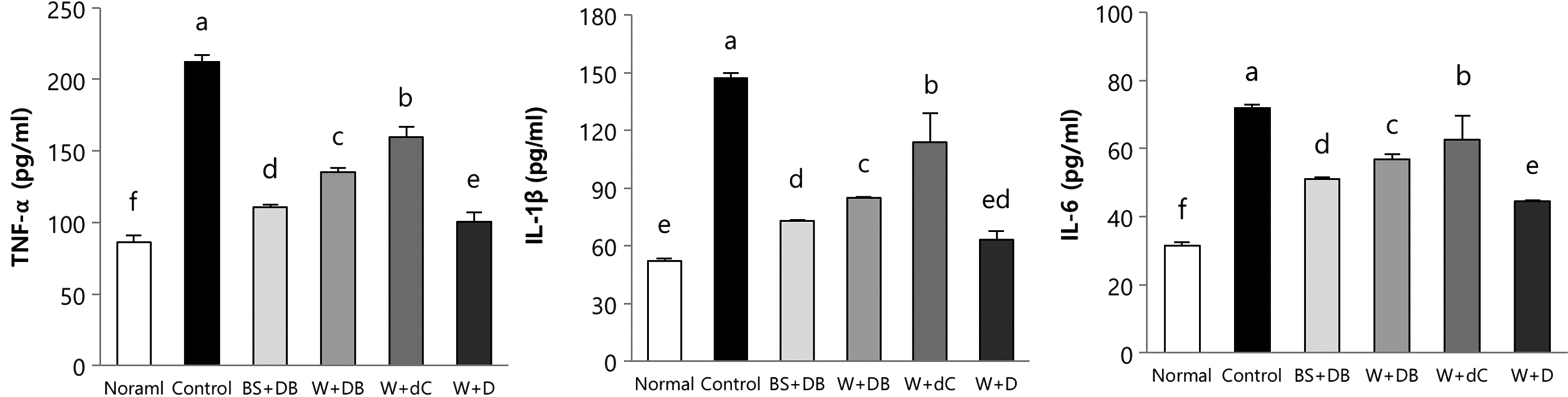
Serum proinflammatory cytokines level of TNF-α, IL-1β, IL-6 in Ramyeon-treated DSS-induced colitis mice. Normal: Group received chow diet without DSS; Control: Group received chow diet and induced colitis by 2.5% DSS; BS+DB: deep fried noodles with brown rice flour and sorghum flour, starter doenjang soup and bamboo salt(3×), 2.5% DSS; W+DB: deep fried noodles with wheat flour and starter doenjang soup and bamboo salt(3×), 2.5% DSS; W+dC: deep fried noodles with wheat flour and commercially available doenjang Ramyeon soup, and 2.5% DSS; W+D: deep fried noodles with wheat flour and starter doenjang powder, and 2.5% dextran DSS. a–fMean with the different letters on the bars are significantly different (P < .05) by Duncan's multiple range test.

Effects of Ramyeon on mRNA expression of TNF-α, IL-1β, and IL-6 in DSS-treated colitis mice. Abbreviations are same as shown in Table 1. Fold ratio: Gene expression/GAPDH × control numerical value (Control fold ratio = 1). a–eMean with the different letters on the bars are significantly different (P < .05) by Duncan's multiple range test. Result is presented as mean ± SD.

Effects of Ramyeon on mRNA expression of iNOS and COX-2 in DSS-treated mice. Abbreviations are same as shown in Table 1. Fold ratio: Gene expression/GAPDH × control numerical value (Control fold ratio = 1). a–eMean with the different letters on the bars are significantly different (P < .05) by Duncan's multiple range test. Result is presented as mean ± SD. COX-2, cyclooxygenase-2; iNOS, inducible nitric oxide synthase.
Commercial doenjang soup (dC) is composed of 9% commercial doenjang, although it still contains artificial additives and purified salt as main components. Thus, we modulated the soup composition to be 32% SF doenjang and bamboo salt as well as substituted artificial additives with natural ones (BD). Doenjang has abundant fermented isoflavones, such as genistein and daidzein, 13 and has been shown to control inflammation. 14 Genistein and daidzein were shown to reduce iNOS expression in LPS-induced murine J774 macrophagocytes. 15 Additionally, genistein was found to reduce the expression of COX-2 in vitro. 16 In addition, SF doenjang possesses more antioxidant effects than commercial doenjang 17 as well as shows reduced levels of IL-1β, IL-6, COX-2, and iNOS (P < .05). 6
SF doenjang is cheap and safe and tastes better than traditional doenjang due to its simple production process and probiotic microorganisms. Bamboo salt contains abundant amounts of natural minerals, such as calcium, iron, and magnesium 18 and has health-beneficial effects for treatment of digestive diseases 19 and cancer prevention. 7,20 In accordance with these results, soup containing SF doenjang and bamboo salt prevented colitis symptoms compared with mice fed dC soup. Furthermore, W + D treatment had almost the same effects as BS+DB treatment.
These results suggest that the composition of soup is more important for colitis prevention than the composition of noodles in mice fed Ramyeon. According to our results, addition of SF doenjang and replacement of purified salt with bamboo salt can produce Ramyeon with improved taste and health functionality at low cost. When functional grains were added to noodles, colitis was more suppressed compared with wheat flour noodles.
In conclusion, Ramyeon with altered noodle ingredients and especially soup composition may have good health function (anticolitic effects). As shown in this study, Ramyeon prepared with mixed grain noodles, and soup containing SF doenjang and bamboo salt instead of purified salt suppressed colitis symptoms in mice and may have other health-beneficial effects.
Footnotes
Acknowledgment
This study was supported by grant 20130290 to the Solar Salt Research Center of Mokpo, National University, from the Ministry of Oceans and Fisheries, Korea.
Author Disclosure Statement
No competing financial interests exist.