




Abstract
Black-fruited chokeberries (Aronia melanocarpa), growing mainly in the Central and Eastern European countries, have health benefits due to the high concentrations of polyphenolic compounds. However, a strong bitter taste of chokeberries limits its usage as functional food. We hypothesized that the fermented A. melanocarpa with a reduced bitter taste would improve insulin sensitivity and/or ameliorate weight gain induced by high-fat diet (HFD) in male C57BL/6J mice. The mice were administered with HFD together with the 100 mg/kg of natural A. melanocarpa (T1) or the fermented A. melanocarpa (T2) for 8 weeks. The treatment with T2 (100 mg/kg body weight, p.o.) markedly attenuated the weight gain and the increase in serum triglyceride level induced by HFD. The T2-treated group had better glucose tolerance and higher insulin sensitivity as measured by oral glucose tolerance test and intraperitoneal insulin tolerance test in comparison to the T1-treated group. Phytochemical analysis revealed that the main constituents of T2 were cyanidin-3-xyloside and 1-(3′,4′-dihydroxycinnamoyl)cyclopenta-2,3-diol, and the content of cyanidin glycosides (3-glucoside, 3-xyloside) was significantly reduced during the fermentation process. From the above results, we postulated that antiobesity effect of black chokeberry was not closely correlated with the cyanidin content. Fermented chokeberry might be a viable dietary supplement rich in bioactive compounds useful in preventing obesity.
Introduction
T
Black chokeberry (Aronia melanocarpa [Michx.] Elliot, Rosaceae) is mainly distributed in eastern North America and East Canada. 9,10 Health benefits of A. melanocarpa fruits are well-known since it is rich source of polyphenols such as anthocyanins and cyanidin glycosides. 10,11 Current knowledge presents black chokeberry as a medicinal plant with diverse biological activities such as anti-inflammatory, gastroprotective, and hepatoprotective properties. 12 –14 Aronia plants have been routinely and traditionally used for the treatment of metabolic diseases and Aronia fruit juice has recently been of interest for their hypolipidemic effects. 9,15 Nevertheless, there is little scientific research to discover the beneficial effects of fermented Aronia berries in the treatment of obesity.
In this study, we performed a comparative study on dietary effects of fermented and unfermented A. melanocarpa on obesity in a mouse model of obesity and hyperlipidemia. Aronia samples were prepared under two different operations, namely compressed fluid extraction, being extracted from fresh fruits through screw compression without adding water, and fermentation, which amplifies flavor and reduces the bitter taste of fresh Aronia. In vivo antiobesity effects of A. melanocarpa extracts were evaluated by measuring weight gain in high-fat diet (HFD)-induced C57BL/6J obese mice. Oral glucose tolerance test (OGTT) and intraperitoneal insulin tolerance test (IPITT) were also measured to evaluate the effects on glucose tolerance and insulin resistance. The hypolipidemic properties of A. melanocarpa extracts were investigated by measuring the levels of triglyceride (TG), total cholesterol (TC), low-density lipoprotein cholesterol (LDLC), and high-density lipoprotein cholesterol (HDLC). Phytochemical analysis also has been performed using high-performance liquid chromatography (HPLC) to reveal chemical composition of fermented Aronia berry extract.
Materials and Methods
Plant material and sample preparation
Aronia berries were obtained from Samheung Agricultural Corp. (Geochang, South Korea) and identified by Prof. Yang (College of Pharmacy, Pusan National University). A voucher specimen (GNP-77) has been deposited in the laboratory of pharmacognosy, Gyeongnam National University of Science and Technology.
Fermentation procedures and sample preparation
The fresh A. melanocarpa fruits were washed and extracted through screw compression (Dongnam Co., Ltd., Yangsan, Korea) with extraction yield of 56.81 ± 3.05% (T1). For the fermentation of A. melanocarpa, a two-step process, alcohol fermentation and subsequent acetic acid fermentation, was been carried out. Saccharomyces kluyveri DJ 97 KCTC 8842P and Acetobacter sp. HJK 9-1 were provided from Samheung Agricultural Corp. (Geochang, South Korea) and used as the inoculum. First, the soluble solids (24° Brix) of Aronia extract (T1) were incubated with S. kluyveri at 25°C for 48 h, of which the alcohol content was 5%. Next, the extract was further incubated with Acetobacter sp. at 30°C for 7 days until the acidity was pH 4 and was designated as T2.
Animals
Male C57BL/6J mice (3 weeks old) were obtained from Central Lab. Animal, Inc. (Seoul, Korea). Mice were housed in the 20 ± 2°C constant temperature and 50 ± 5% humidity under a 12-h light:12-h dark cycle, with water and food freely available. All animal experimental procedures conformed to the guidelines of The Gyeongnam Department of Environment and Toxicology, Korea Institute of Toxicology on the Care and Use of Laboratory Animals (Certification No. KIT-1603-0004).
Treatments
Male C57BL/6J mice were randomly divided into five groups (n = 12): a normal diet (ND) group (0.5% carboxymethyl cellulose [CMC] and normal diet containing 10% kcal fat), a vehicle control (VC) group (0.5% CMC and HFD containing 60% kcal fat), a positive control (PC) group (15 mg/kg body weight/rat Orlistat and HFD), a T1 group (100 mg/kg body weight/rat natural A. melanocarpa extract and HFD), and a T2 group (fermented A. melanocarpa extract and HFD). Body weight change and food intake were monitored weekly. A. melanocarpa extracts were dissolved in 0.5% CMC and orally administered once a day for 8 weeks. The HFD mice received either Orlistat (Zenical®; Roche Pharm Ltd., Reinach, Switzerland) or 0.5% CMC as a positive or negative control.
OGTT and IPITT
OGTT and IPITT were carried out according to the recommended protocols of previous publication 16 a week before sacrifice. Briefly, for OGTT test, 2g/kg glucose was orally administered after 6 h of fasting. For IPITT test, 1 IU/kg insulin was injected intraperitoneally after 4 h of fasting. Blood glucose level was checked by ACCU-CHEK ACTIVE (Roche) at 0, 15, 30, 60, and 120 min right after the glucose or insulin treatment.
Adipose tissue weight and biochemical measurements
After 8 weeks of treatment, mice were sacrificed and both epididymal and perirenal white adipose tissue were prepared and weighed. Blood samples were collected from the abdominal aorta and centrifuged at 3000 rpm for 15 min (Eppendorf 5424R). Total serum TG, TC, LDLC, and HDLC levels were measured using Automatic Plasma Analyzer (Seoul, Korea).
Phytochemical analysis of Aronia extracts by HPLC
For the phytochemical analysis of Aronia extracts, HPLC was performed using an DIONEX Ultimate 3000 equipped with WPS-3000TSL autosampler and HPG-3200SD pump. Chromatographic separation was conducted under a condition of Phenomenex gemini-RP18 (4.6 × 250 mm) column, gradient elution with acetonitrile–water with 0.1% trifluoroacetic acid (TFA) (Table 1). The eluent was detected by DAD (diode array detector).
Solvent Gradient Conditions for High-Performance Liquid Chromatography-Diode Array Detector
TFA, trifluoroacetic acid.
Statistical analysis
Each data value was expressed as the mean ± standard deviation. Biochemical parameters and body weight data were analyzed by one-way and two-way analysis of variance, respectively. If the P-value was < .05, the data were considered significant statistically.
Results
Effects of Aronia berry extracts on weight gain in HFD-induced obese mice
As depicted in Figure 1, the body weights of C57BL/6J mice fed an HFD were significantly higher than those of mice fed an ND. A 2.4-fold increase in weight gain was detected in the VC group compared with the ND group. However, T2 administration to HFD-fed mice markedly prevented this weight gain. T2 treatment showed better hypolipidemic effects than T1 for decreasing weight gain and adipocity in HFD-induced animal model. In addition, T2 administration to obese mice reduced the cumulative fat mass, including perigonadal and perirenal fat (Fig. 2). The adipose tissue weight of VC group was estimated as the sixfold value of ND group. T2-treated mice had 18% lower adipose tissue than HFD-treated mice.
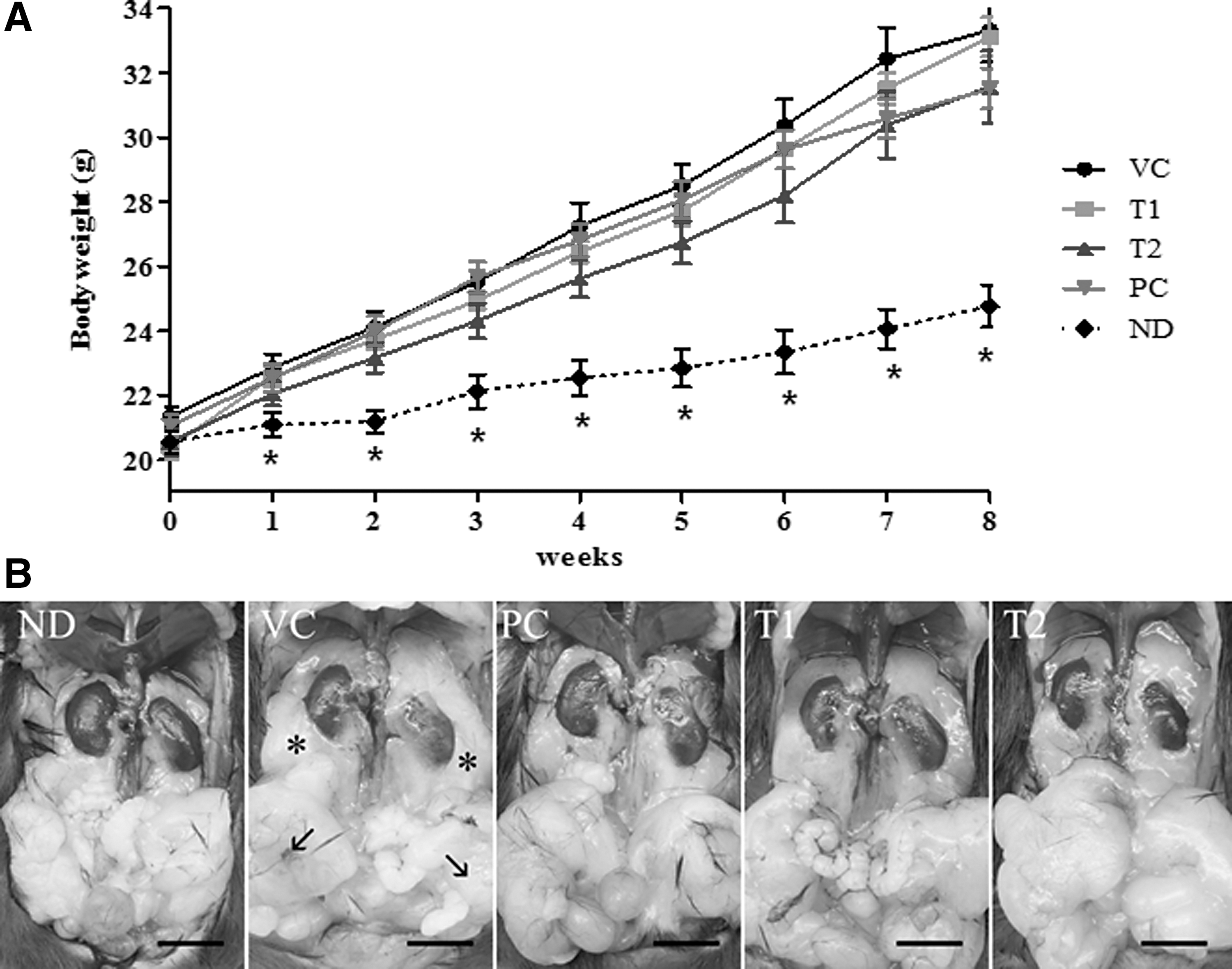
Effect of Aronia berry extracts on body weight of obese mice.

Effect of Aronia berry extracts on adipose tissue weights in HFD-induced obese mice. Values were expressed as mean ± SD (n = 12); ***P < .001 compared to ND group; **P < .01 compared to VC group. ND, normal diet group; VC, HFD group; PC, Orlistat-treated group; T1, unfermented A. melanocarpa-treated group (100 mg/kg body weight/rat, p.o.); T2, fermented A. melanocarpa-treated group (100 mg/kg body weight/rat, p.o.).
Effect of Aronia berry extracts on serum lipid levels
HFD feeding increased in the serum levels of TG (2-fold of control), TC (1.5-fold of control), HDL (1.3-fold of control), and LDL (1.6-fold of control) group compared to the ND group. T1 and T2 administrations significantly reduced the elevation of TG by 65% and 100%, respectively, compared to the VC group (Fig. 3B). However, serum TC, HDLC, and LDLC levels did not change significantly (Fig. 3A,C,D).
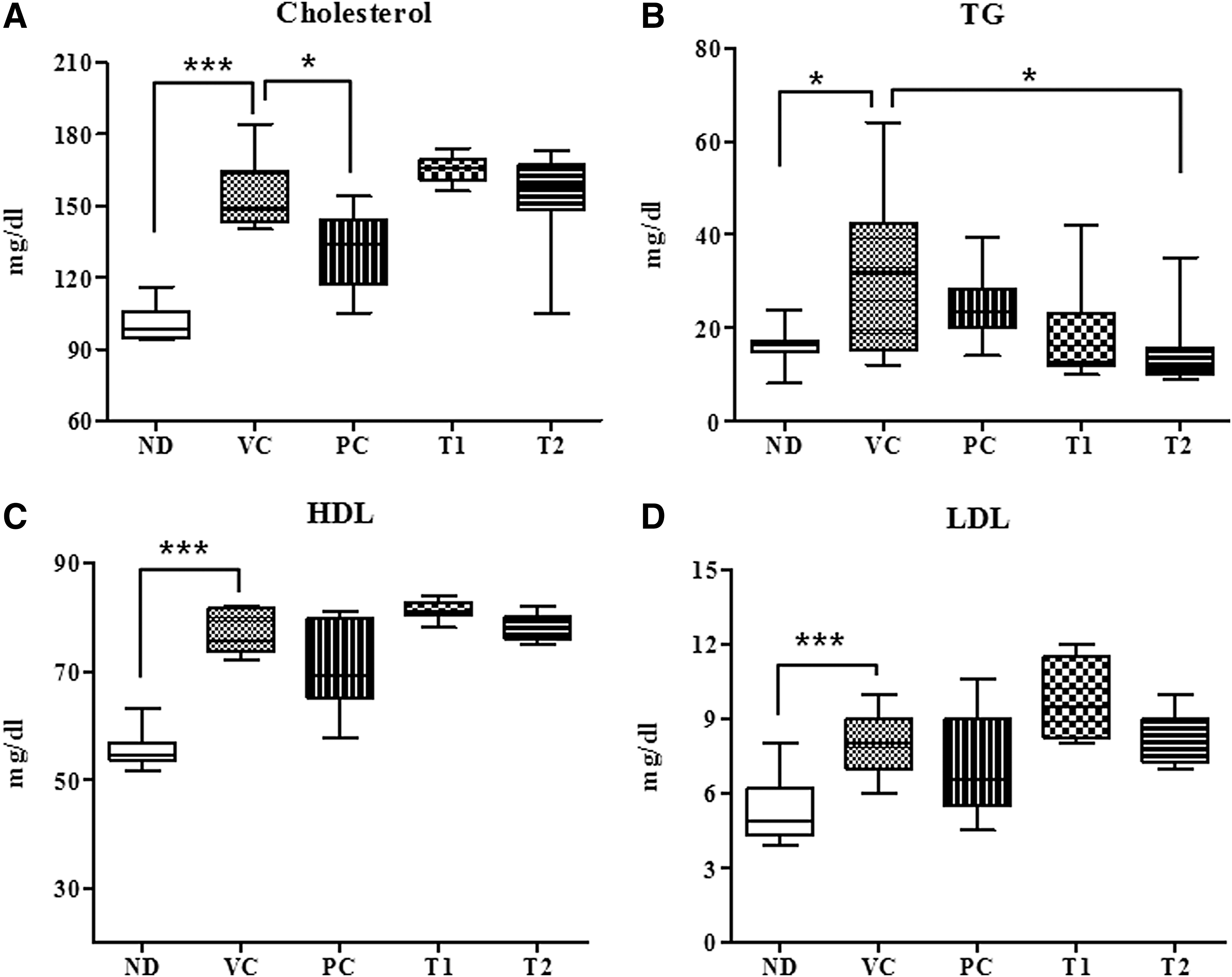
Effect of Aronia berry extracts on serum lipid levels of cholesterol
Effects of Aronia berry on glucose intolerance and insulin resistance
Feeding an HFD for 8 weeks resulted in severe glucose intolerance and insulin resistance as shown in Figure 4. Blood glucose concentrations of HFD-fed mice increased to 417 mg/dL after 15 min from a baseline value of 221 mg/dL. Corresponding area under the curve (AUC)-OGTT of the VC group was shown to be increased compared to the value of the ND group (Fig. 4A). T1- and T2-treated mice displayed a slight decrease in the postglucose challenge AUC-OGTT with no statistical significance. In IPITT, mice treated with HFD also showed severe insulin resistance as shown in Figure 5B. In mice treated with T1 and T2 following i.p. insulin load, blood glucose levels decreased to 122 and 112 mg/dL, respectively, in 60 min from baseline values of 219 and 193 mg/dL in 15 min (Fig. 4B).

Effect of Aronia berry extracts on OGTT

HPLC chromatogram of T2 at the wavelength of 254 nm.
Phytochemical analysis of fermented A. melanocarpa extract
We optimized a chromatographic condition for the simultaneous identification of main components of Aronia extract samples (T1 and T2). The mixture of acetonitrile and water containing 0.1% TFA was found to improve the peak resolution. The wavelength for detection was set at 220, 254, 280, and 365 nm in DAD, and the absorption of peaks and S/N (signal-to-noise ratio) were compared. The wavelength of 280 nm showed the high absorption of overall peaks, as detected with the improved S/N. The retention times of five compounds,
Discussion
Fermentation has been widely used as a method to preserve perishable food and beverage items. Fermentation is a widely practiced and ancient technology. 17,18 Food fermentation contributes to increased shelf-life and microbiological safety. 18 In addition, fermentation processing enhances the nutritional value of food by increasing digestibility and bioavailability. 19,20 In regard to the natural product research, fermentation process affects the development of compounds responsible for bioactivity in medicinal plants. 21 –23 Furthermore, it is well known that fermentation can result in increased yields of natural microbial products and has exerted a profound influence on microorganism-based drug discovery. 20,24 For this reason, fermentation methodologies have attracted continuous interest due to its potential applications in natural product drug development. 25
Previous studies with black chokeberry (A. melanocarpa) revealed that its crude extracts possess pancreatic lipase inhibition and antiobesity properties in obese mice. 26,27 However, there has been no systematic attempt to describe changes in biological activities of A. melanocarpa against obesity depending on fermentation. Therefore, we attempted a comparative study on antiobesity effects of fermented and unfermented Aronia berry extracts using HFD-induced obese mice. Aronia extract samples (T1 and T2) were prepared by different processes (with or without fermentation) and used for in vivo experiments. Repeated oral administrations of T1 (unfermented) and T2 (fermented) Aronia extracts significantly improved characteristic symptoms of obesity in C57BL/6J mice. Especially, weight gain was apparently reduced in T2 group in comparison to the T1 group when obese mice were exposed to Aronia samples for 8 weeks. As a result, the process of fermentation might give rise to synergistic and enhanced antiobesity effects of Aronia products.
The chemical composition of the chokeberries is dependent on cultivar, harvest date or region, storage condition (fertilization and temperature), and maturation of berries. 28,29 Besides these external environmental factors, a broad spectrum of analytical methods and conditions has been used for the analysis of polyphenols contained in chokeberries. It has been demonstrated that the freshly pressed Aronia juice can be distinguished by their high contents of bioactive polyphenols. 30 –32 The total phenolic content of chokeberries has been reported to range from 3440 mg/100 g to 7849 mg/100 g dry weight. The content of total procyanin, one of main polyphenols in chokeberries, ranges from 3992 to 5185 mg/100 g dry weight; total anthocyanins range from 641 to 1959 mg/100g dry weight. 10
In our recent study, five phenolics, 1-(3′,4′-dihydroxycinnamoyl)cyclopenta-2,3-diol
Anthocyanins in fruits of A. melanocarpa exist as a mixture of four cyanidin glycosides such as 3-galactoside, 3-glucoside, 3-arabinoside, and 3-xyloside. 34 It has been already reported that cyanidin 3-O-β-glucoside (C3G) ameliorates hyperlipidemia and insulin resistance. C3G exerted insulin-like activities by increasing adipocyte glucose uptake and GLUT4 membrane translocation. 35 Also, C3G inhibited lipolysis in adipocytes by regulating FoxO1-mediated transcription of adipose TG lipase, suggesting its potential to improve diabetes-associated hyperlipidemia. 36,37 Interestingly, despite that the content of C3G was found to be in significantly higher abundance in T1 (1.36 ± 0.87 mg/mL) compared to T2 (0.04 ± 0.00 mg/mL), T2 showed the better activity for decreasing body weight gain and improving insulin resistance in the HFD-induced animal model.
This study provides direct evidence for the beneficial effects of fermented Aronia berries on HFD-induced obesity in mice. Comparison of the body weight between T1 and T2 groups showed that increased body weight and adiposity were definitely weakened in T2. T2 had much better blood TG level, OGTT, and IPITT than T1 in the HFD mice. Further study with fermented Aronia extract is warranted to confirm its antiobesity effects in human.
Footnotes
Acknowledgments
This work was supported by grants from Korea Institute of Planning and Evaluation for Technology in Food, Agriculture, Forestry and Fisheries (IPET) through High Value-Added Food Technology Development Program (116016-3), funded by Ministry of Agriculture, Food and Rural Affairs (MAFRA).
Author Disclosure Statement
No competing financial interests exist