




Abstract
Acetaldehyde, the major cytotoxin formed by the metabolism of alcohol, is responsible for liver injury, extracellular matrix alterations, inflammation, and hangover in heavy drinkers. This study aimed to demonstrate the efficacy of a standardized polyphenolic extract of clove buds (Clovinol) in ameliorating the oxidative stress and inflammation caused by the accumulation of acetaldehyde after binge drinking. We used a randomized, double-blinded crossover study with 16 male social drinkers. The subjects were randomized into two groups of eight subjects and received either placebo or Clovinol in a single hard shell gelatin capsule (250 mg × 1) per day. The dosage of alcohol was 1 g/kg body weight/day. After 2 weeks of washout period, the treatment regime was reversed. Blood samples were drawn at 0, 0.5, 2, 4, and 12 h after treatment with either placebo or Clovinol, and biochemical parameters were analyzed. Hangover severity score was determined by using a validated questionnaire as reported earlier. Results showed faster elimination of blood acetaldehyde with significant decreases in oxidative stress, lipid peroxidation, C-reactive protein, interleukin-6, and significant enhancement in glutathione and superoxide dismutase as compared with placebo along with an overall reduction of 55.34% in hangover severity in Clovinol-treated subjects. This study demonstrated the efficacy of clove bud polyphenols for alleviating alcohol-related side effects among social drinkers at the studied dose.
Introduction
O
Acetaldehyde, a metabolite of alcohol formed by the action of alcohol dehydrogenase, has been identified as the primary component responsible for the development of alcohol-mediated liver injury, extracellular matrix alterations, and inflammation. 6,7 Acetaldehyde can hinder the cellular functions and gene expressions by forming adducts with proteins and DNA, and can induce oxidative stress and lipid peroxidation, key factors in the development of arteriosclerosis. 8 Acetaldehyde may be further converted to acetate and acetyl-CoA by the action of aldehyde dehydrogenase, which were reported to enhance histone acetylation, a critical pathway of inflammation to regulate the synthesis of macrophage inflammatory cytokines. 9 The recent understanding is that the blood levels of acetaldehyde, acetate, metabolites of acetaldehyde, and prostaglandin synthesis also play a key role in mediating alcohol-related side effects, including hangover. 10 Hangover has been considered as the presence of any of the two symptoms, which include headache, poor sense of overall well-being, diarrhea, anorexia, fatigue, and nausea upon complete metabolization of an intoxicating amount of alcohol. 5
In this study, clove bud polyphenol (hereinafter named as “Clovinol”) was investigated for its efficacy in changing the blood acetaldehyde/alcohol levels along with its capacity to modulate the endogenous antioxidants and inflammatory status as compared with placebo. Clove buds (Syzygium aromaticum L.), a popular kitchen spice, have been identified as one of the richest sources of antioxidant polyphenols among the various fruits, vegetables, and edible herbs. 11 Preclinical studies on Clovinol have already demonstrated its anti-inflammatory effects and anti-ulcerogenic potential with a significant enhancement in antioxidant defense enzymes and gastric mucous levels. 12,13 Clovinol was also shown to be safe upon repeated dose acute (28 days), chronic (90 days), and genotoxicity studies. 14
Materials and Methods
Preparation and characterization of Clovinol
Dried clove buds were identified by an authenticated botanist, and a voucher specimen (AK-CLV-011) was deposited at the Herbarium of M/s. Akay Flavours and Aromatics Ltd. (Cochin, India). A representative sample of “Clovinol” produced by hydro-ethanolic extraction followed by purification, emulsification, and spray drying (Lot No. 01/13 B2 dated July 2013) was used for this study. The total polyphenols were expressed as gallic acid equivalents by the standard Folin–Ciocalteu test. 15 Characterization of the polyphenols was achieved through a 1290 infinity Ultra performance liquid chromatography system coupled with an Agilent 6530 QTOF instrument having a Jet-Stream source (Agilent India Pvt Ltd., Bangalore, India) as previously described. 13
Study subjects
Healthy adult human volunteers (16 male subjects; aged between 25 and 55 years), who were not using any medications or dietary supplements were selected for the study. The trial participants were social drinkers who had the previous history of hangover when alcohol was consumed at the dose of 1.5–3 g/kg body weight. The subjects underwent a standard clinical assessment comprising structured diagnostic interview on demographic characteristics, health conditions, hematology/biochemical parameters, blood sugar, and blood pressure at M/S DDRC (Cochin, India) (Table 1). Those who were found to have any abnormalities in the assessments were excluded from the study. The subjects were instructed to avoid foods that are known to affect the alcohol metabolism for 3 days before the study day. The study was carried out in accordance with the clinical research guidelines established by the Government of India, and protocol was approved by an independent ethical committee (Clinical trial Reg. No. ECR/64/Indt/KA/2013). Written consent from all individuals was obtained before the study, and the subjects were assigned three-digit, unique randomization codes.
Characteristics of Study Subjects
Data expressed as mean ± SD, where P > .05 when the values of Clovinol compared with placebo and at baseline.
BMI, body mass index; BP, blood pressure; Hb, hemoglobin; RBS, random blood sugar; SGOT, glutamate oxaloacetate transaminase; SGPT, glutamate pyruvate transaminase; ALP, alkaline phosphatase; HDL, high-density lipoprotein; LDL, low-density lipoprotein; SD, standard deviation.
Study design and protocol
The study was conducted with a randomized, double-blinded, crossover design as shown in Figure 1. Participants were randomized into placebo and test groups in a 1:1 ratio to receive alcohol along with either the placebo containing microcrystalline cellulose or Clovinol as a single hard shell two-piece gelatin capsule (250 mg × 1) of identical color and appearance. In the typical protocol, each volunteer was instructed to make two visits at 2 week intervals after visit 1. During visit 2 and visit 3, the volunteers reported at the study center by 5 p.m. without taking any food, except drinking water, for the past 4 h. They were allowed to rest for 30 min, and 6 mL of blood corresponding to 0 time was withdrawn.
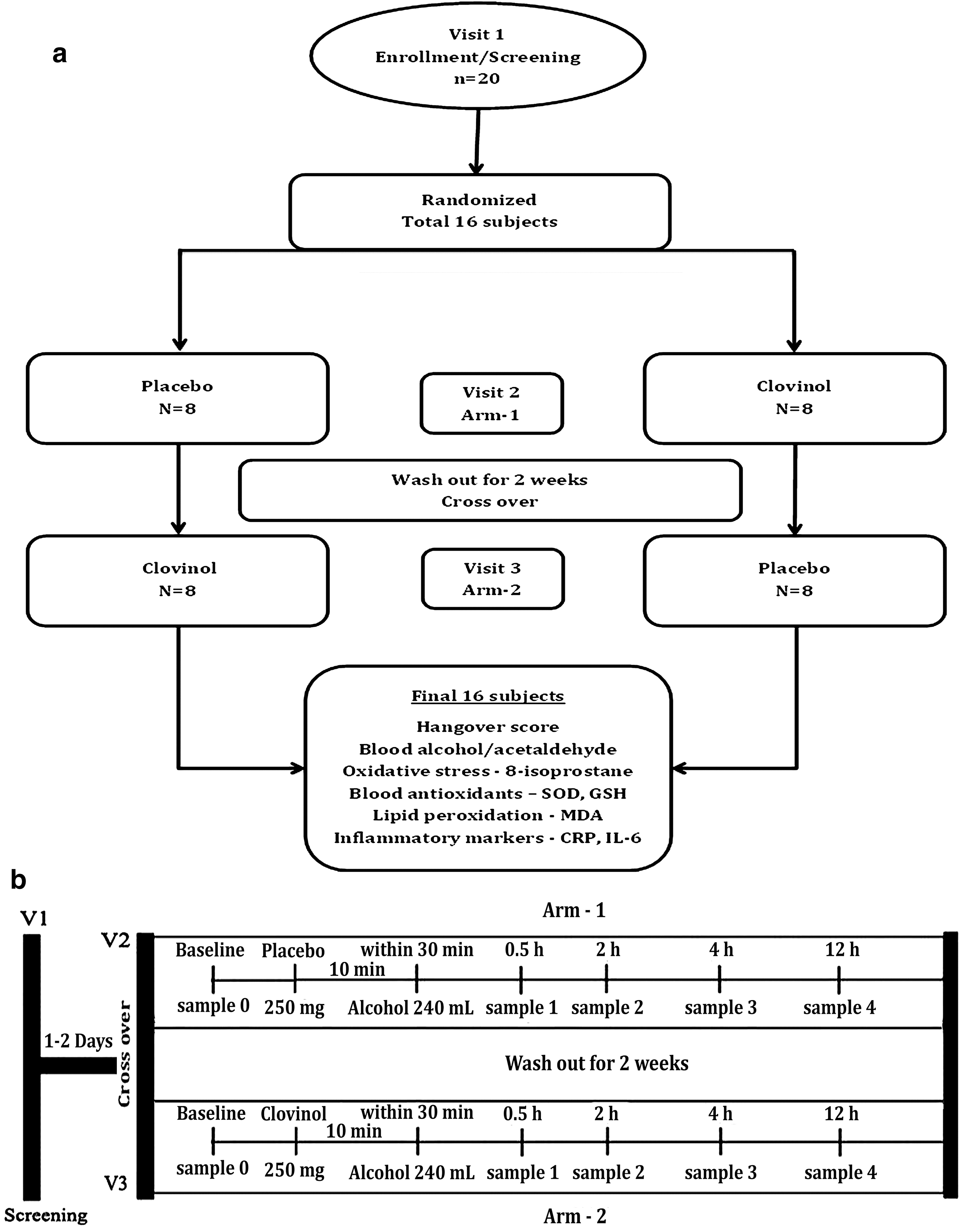
Subsequently, randomized treatment with a single capsule of either placebo or Clovinol followed by 240 mL of 42.8% alcohol (McDowell's V.S.O.P. Brandy; United Spirits Limited, Bangalore, India) and a piece of cheese was provided to both groups within a duration of 30 min, with 750 mL of drinking water. All subjects were then provided with a standardized dinner consisting of wheat bread, one piece of chicken breast, a cup of leafy vegetables and water. All subjects were allowed to have 7 h sleep after 4 h of alcohol consumption. Blood samples (6 mL) were taken after 0.5, 2, 4, and 12 h after alcohol consumption with either placebo or Clovinol employing an indwelling venous cannula, and collected into ethylene diamine tetra acetate (EDTA)-coated and non-EDTA vials. A basic checkup of blood sugar, blood pressure, and heart beat was also performed at 0 and 12 h postconsumption time under fasting conditions. Subjects were also asked to complete the questionnaire regarding their feelings on various hangover symptoms and over all severity. All the subjects followed the same protocol during visit 3, and the treatment between placebo/Clovinol was crossed over. Each treatment was performed in duplicate with a minimum 2 weeks of washout period, and the average values were considered.
Hematological/biochemical parameters
Red blood cell count, total and differential white blood cell count, platelet levels, and hemoglobin content were determined using a hematology analyzer (Model-Diatron, Wein, Austria). Plasma was separated by centrifugation at 11,950 g for 10 min at 4°C and stored for a maximum of 2 days at −20°C for biochemical analysis. Biochemical parameters such as total cholesterol, low-density lipoprotein, high-density lipoprotein, triglycerides, glutamate oxaloacetate transaminase, glutamate pyruvate transaminase, and alkaline phosphatase levels were analyzed by following the kit analysis procedures provided by M/s Agappe Diagnostics Pvt. Ltd. (Bangalore, India).
Blood ethanol concentration was estimated using headspace gas chromatography (Agilent Technologies, Wilmington, DE, USA; 6890N, Model G1540N, SeriaUS1020514) equipped with flame-ionization detector and Agilent DB-624 column (30 m × 0.530 mm), following the method of Tiscione et al. 16 Blood acetaldehyde levels were also determined with the same headspace gas chromatograph following the method of Schlatter et al. 17 Antioxidant status and lipid peroxidation of the blood at each time point (0, 0.5, 2, 4, and 12 h), after the consumption of alcohol with either placebo or Clovinol, were measured by estimating plasma levels of superoxide dismutase (SOD) activity by the method of McCord and Fridovich, 18 glutathione (GSH) activity by the method of Rahman et al., 19 and lipid peroxidation was analyzed by the method of Ohkawa et al. 20 8-Isoprostane concentration in plasma at various intervals after alcohol consumption was measured using an enzyme-linked immunosorbent assay (ELISA) kit (Cayman Chemical, Ann Arbor, MI, USA). Samples were collected in a sterile vacuum blood collection tube (Insepack; Sekisui Medical Co., Ltd., Tokyo, Japan) containing no EDTA and allowed to stand for 30 min. The samples were then centrifuged at 3000 g (R-24; Remi House, Mumbai, India), and serum was collected and stored at −80°C until assayed. Quantitative detection of serum interleukin-6 (IL-6) and C-reactive protein (CRP) was performed using human-specific ELISA kits (Invitrogen™ Novex™ from Life Technologies, Carlsbad, CA, USA) following the manufacturer's instruction manual. Values were measured in duplicate, and the average value was reported.
Alcohol hangover severity scale
The alcohol hangover severity experienced by subjects in the Clovinol and placebo groups was determined by a survey adapted from previous hangover assessment tools. 21,22
Statistical analysis
Statistical analyses were performed using Graph Pad InStatV-3.06.To test normal distribution of biochemical marker data comparing placebo and Clovinol treatments, we performed the Kolmogorov–Smirnov normality test. Considering normality, the results were compared using paired t-test. The results were expressed as mean ± standard deviation and were considered significant if “P” < .05.
Results
Preparation and characterization of Clovinol
The hydroethanolic extract of clove buds (Clovinol) used in this study was a brownish water-soluble powder with a polyphenol content of 28.6% gallic acid equivalent, and was described in greater detail in earlier studies. 13
Study protocol and participant demographics
Due to the lack of females willing to participate, only male subjects were enrolled in this study. Among the 20 volunteers screened for eligibility to participate (visit 1), 16 volunteers were found to meet the inclusion criteria. The volunteers were then randomly allocated to receive either Clovinol or placebo treatment before the alcohol ingestion during visit 2, and the treatments were then crossed over during the next visit (visit 3). All 16 subjects completed the study successfully without any dropouts. The baseline biochemical/hematological characteristics, blood sugar, blood pressure, and heart rate of the participants were within the normal range, indicating that the subjects were healthy (Table 1). Demographic and anthropometric measurements of the subjects showed a healthy range of body mass index with an average value of 24.22 ± 2.37 kg/m2 (Table 1). No adverse events or significant alterations in the biochemical and/or hematological characteristics were observed after the alcohol ingestion either with placebo or with Clovinol (Table 1). When the body weight was considered, the actual quantity of alcohol consumed in this study (i.e., 240 mL of 42.8% ethanol) was found to be in the range of 1.5–3 g/kg body weight depending on the individuals who consumed to their satisfaction.
Blood alcohol and acetaldehyde concentrations
It was found that the blood alcohol concentrations in the Clovinol group at various postalcohol consumption time intervals were lower than those in the placebo group with an average reduction of 9.95% upon Clovinol treatment (Fig. 2a). A similar time-course analysis for blood acetaldehyde levels revealed a significant decrease for the Clovinol group as compared with the placebo with an average reduction of 65.10% upon Clovinol treatment.

Effect of Clovinol (250 mg) and placebo preadministration on the blood levels of
At the 12 h postadministration time point, the acetaldehyde levels were below the detection limit (Fig. 2b). From these time-course analyses, the pharmacokinetic parameters, comprising area under the concentration–time curve (AUC)0–12h, C max, T max and T 1/2 and C 12h for both blood alcohol and acetaldehyde were calculated (Table 2). From the AUC, the percentage decrease in the blood acetaldehyde concentrations upon Clovinol treatment, as compared with control, was shown to be significant, with a faster clearance of acetaldehyde (≥2.5-fold), as compared with the decrease in blood alcohol concentrations, which was not significantly different between the Clovinol and control groups.
Pharmacokinetic Parameters of Blood Alcohol and Acetaldehyde after Alcohol Consumption
The values are given as mean ± SD (N = 16). T max and T 1/2 were calculated from the analysis of blood samples collected after 0.5–12 h of alcohol consumption. About 0.5 h has been given to all subjects to consume 240 mL of 42.8% alcohol with enough water.
#P > .05 and * P < .05, when values of Clovinol group compared with placebo.
AUC, area under the concentration–time curve; C max, maximum blood concentration; T max, time to reach C max; and T 1/2, half-life; ND, not detected.
Antioxidant status and lipid peroxidation
Alcohol consumption was found to cause significant depletion in the primary antioxidant enzyme levels during the 12 h of postconsumption. In this study, both SOD and GSH showed a significant decrease after 2, 4, and 12 h of alcohol consumption. Maximum decrease was found after 4 h and remained at almost the same level even after 12 h. SOD levels in the placebo-treated group showed 35% reduction after 12 h, as compared with the baseline. But Clovinol administration was found to maintain the baseline level of SOD with significant inhibition (92.5%; P < .001) in SOD depletion as compared with placebo (Fig. 3a). A similar decrease in glutathione levels was also observed in the placebo group. Clovinol administration was found to inhibit the depletion with an average enhancement of 34.5% (P < .001) as compared with placebo (Fig. 3b).
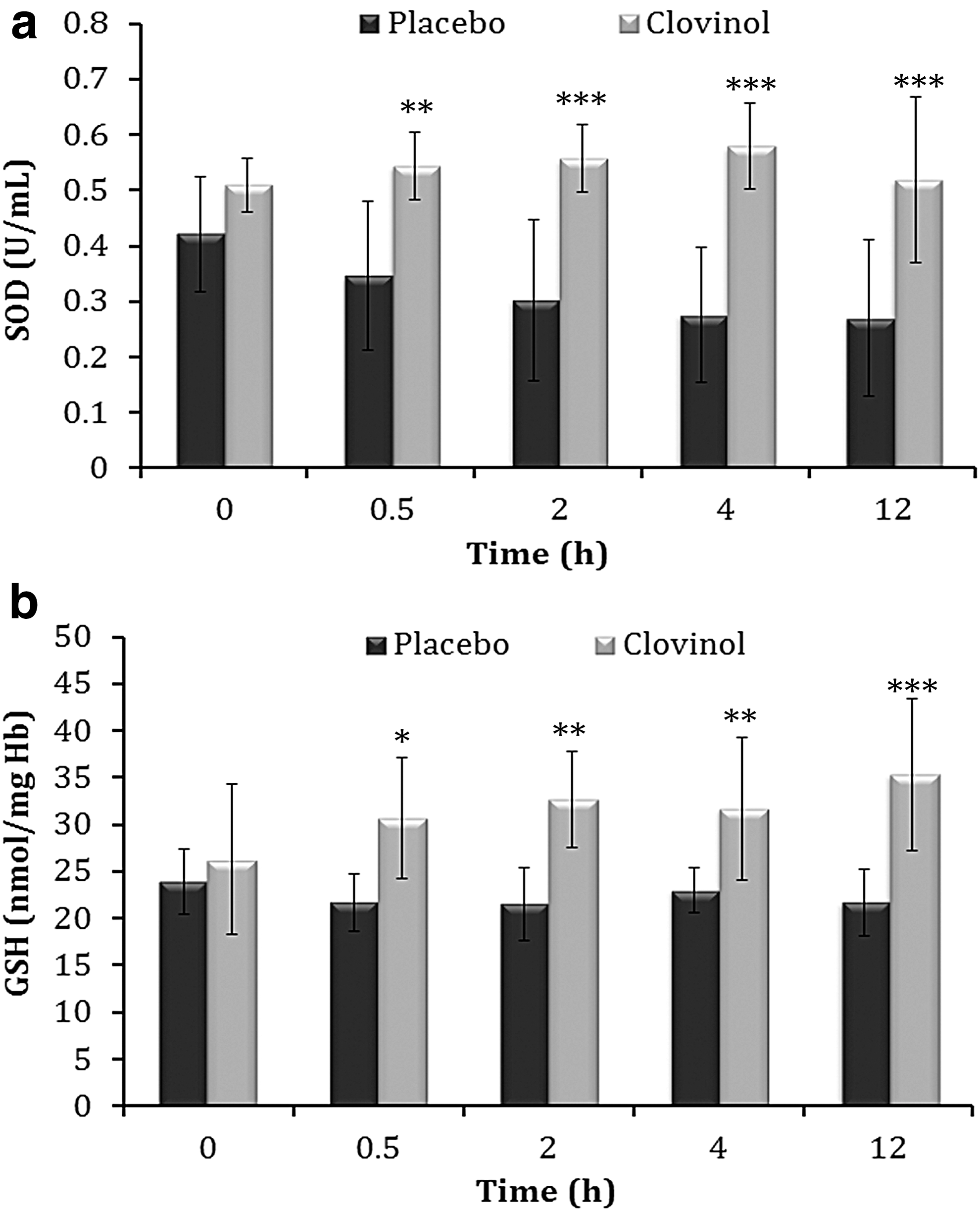
Effect of Clovinol (250 mg) and placebo preadministration on alcohol-induced alteration in endogenous antioxidants of human subjects intoxicated with 240 mL alcohol;
The placebo group showed maximum thiobarbituric acid reactive substances (TBARS) concentrations at 4 h, and remained 28% higher by the end of 12 h postadministration time point. However, Clovinol administration reduced the extent of lipid peroxidation by 25%, and helped it to remain in the normal range at all times after alcohol ingestion (Fig. 4). Area under curve for TBARS levels was 717 nmol/dL · h for Clovinol group and 1114 nmol/dL · h for the placebo, indicating an average reduction of 35.64% in lipid peroxidation.

Effect of Clovinol (250 mg) and placebo preadministration on alcohol-induced alteration in lipid peroxidation levels of human subjects intoxicated with 240 mL alcohol. Data show MDA levels in blood at different time intervals (0–12 h) after binge drinking and expressed as mean ± SD, where *P < .05 and ***P < .001. MDA, malondialdehyde.
Measurement of 8-isoprostane
Alcohol consumption was found to increase the oxidative stress as evident from the generation of 8-isoprostane in plasma. Plasma concentration of 8-isoprostane was found to be significantly elevated among the subjects in placebo group. While a significant (P < .05) increase was observed among 65% of the subjects in the placebo group, Clovinol administration was found to maintain the baseline 8-isoprostane levels (Fig. 5).

Effect of Clovinol (250 mg) and placebo preadministration on alcohol-induced alteration in oxidative stress marker, 8-isoprostane levels in the plasma of human subjects intoxicated with 240 mL alcohol at different time intervals (0–12 h) after binge drinking. Data expressed as mean ± SD, where *P < .05 and ***P < .001.
Measurement of CRP and IL-6
A significant increase in the inflammatory markers, CRP and IL-6, was observed among the placebo treatment group after heavy consumption of alcohol. The CRP levels were found to be elevated among the placebo group, while the Clovinol administration was found to inhibit the increase in the CRP levels significantly (P < .001) (Fig. 6a).

Effect of Clovinol (250 mg) and placebo pre-administration on alcohol-induced alteration in inflammatory markers,
IL-6 elevation was not significant among three subjects, while all others showed significantly higher levels upon heavy consumption of alcohol. The observed elevation was maximum among people who had severe hangover symptoms. However, the Clovinol supplementation significantly inhibited the alcohol-induced elevation in IL-6, although it tended to be somewhat elevated in the control group as well (Fig. 6b).
Survey of hangover severity
With the help of a hangover severity score sheet consisting of 15 hangover symptoms, the effectiveness of Clovinol against the placebo was evaluated by comparing each of the symptoms and overall hangover severity (Table 3). All subjects completed the questionnaire 14 h after consumption of alcohol, including a minimum of 7 h night sleep. The symptoms in the Clovinol group were found to be reduced when compared with placebo group under the same conditions (Table 3).
Alcohol Hangover Symptom Severity and Overall Symptom Score of Subjects After Study
Data expressed as mean ± SD, and the differences found to be significant if P < .05.
CI, confidence interval.
The mean overall hangover severity score for the Clovinol group was significantly lower than that for the placebo group with a reduction of 55.34% (Fig. 7). Among the various symptoms monitored, dizziness, headache, thirst, nausea, sweating, gastrointestinal discomforts, and general fatigue showed high significance in the Clovinol group. More than 80% of the subjects in the Clovinol group reported a good night sleep without waking for drinking water and indicated a significant reduction in thirst during the next morning. Similarly, 74% of the subjects were hungry in the morning, and reported no blotting or fullness of the stomach unlike in the placebo group. However, two of the subjects reported slight constipation.

Mean hangover score expressed as the sum average of the total 15 hangover symptoms. and ***P < .001, when the score of Clovinol administered group compared with that of placebo at baseline and after trial.
Discussion
Clove buds are reported to be rich in water-soluble hydrolyzable tannins as esters of ellagic acids. 13 Time-of-flight tandem mass spectrometry (TOF-MSn) and high-performance liquid chromatography were employed in this study to characterize and quantify various polyphenols in Clovinol. 12 The identified compounds were mostly flavonoids and their glycosides, polyphenolic acids and their derivatives and catechins. Upon mass spectrometric analysis, the glycosidic linkages in flavonoid glycosides were found to cleave with H-rearrangement leading to the elimination of hexoses such as glucose (162 amu), deoxyhexose such as rhamnose (146 amu), and pentoses such as arabinose (132 amu). 12 Collision-induced dissociation of deprotonated phenolic acids produces a typical fragmentation pattern characterized by the loss of a CO2 from their carboxylic acid group. 12 Chlorogenic acid was confirmed from its molecular ion at m/z 353 [M-H]− and the product ions of m/z 191, 179, and 173, as observed with the fragmentation of the reference standard. In addition, the molecular ion peaks of eugenol m/z 163.9 [M]+ were observed in Clovinol.
The rationale behind this study was the earlier reports that the standardized polyphenolic extract of clove buds (Clovinol) exhibits significant antioxidant, anti-inflammatory, and anti-ulcerogenic effects by elevating the detoxifying enzymes, enhancing the integrity of the gastric mucosa, and minimizing inflammation. 12 Both animal and human studies have demonstrated the ability of Clovinol to alleviate oxidative stress by significantly enhancing the endogenous antioxidant enzymes such as GSH, SOD, and catalase. 13 Moreover, Clovinol exhibited no adverse events or toxicity in repeated dose subchronic and genotoxicity studies, indicating its suitability for further human intervention studies. 14 Clovinol has also been shown to be safe in human volunteers when supplemented at 250 mg/day dose for 30 days. 13
The results of this study demonstrated that maximum blood concentrations of both alcohol and acetaldehyde were observed after half an hour of alcohol consumption, followed by a gradual decrease during the following 12 h postconsumption time period. The significant reduction in AUC, C max, T max, and T 1/2 in blood acetaldehyde levels upon Clovinol treatment, as compared with the placebo, indicated the potential detoxification ability of Clovinol by accelerating the elimination of the toxic acetaldehyde metabolites. The enhanced rate of elimination by Clovinol treatment assumes great significance, since pathology of alcohol hangover has been mainly attributed to the alterations in acetaldehyde levels, rather than inter- and intraindividual variability. 10
The generation of reactive oxygen species and their attack on lipids, proteins, and DNA leading to cellular damage and lipid peroxidation were identified as the leading causes of alcohol toxicity. 23,24 8-Isoprostane, 8-hydroxydeoxyguanosine, and malondialdehyde have been identified as reliable markers for oxidative stress and lipid peroxidation. 25 By monitoring the levels of 8-isoprostane in biological fluids, we observed that alcohol ingestion can enhance the plasma 8-isoprostane levels within a relatively short time after the consumption of alcohol, and can significantly increase within 24 h, and may return to its original level after a day. Alcohol intake was also found to increase the generation of reactive oxygen intermediates and acetaldehyde through induction of the cytochrome P450 type 2E1 (CYP2E1) isozyme, which catalyzes lipid peroxidation. 26 Our results are consistent with this, indicating the development of significant oxidative stress. However, Clovinol treatment was found to maintain plasma 8-isoprostane levels in the normal range, indicating its potential antioxidant efficacy. Extent of lipid peroxidation in Clovinol-treated group was also found to be minimized when compared with placebo, indicating the protective effect of Clovinol before alcohol consumption.
Another important factor, the endogenous defense enzymes, GSH and SOD, were identified as the key factors in the oxidative and nonoxidative mechanisms involved in the pathogenesis of hangover and alcohol-mediated diseases. A significant depletion of these enzymes was observed in placebo groups upon alcohol ingestion. However, their maintenance at the normal level with only a minor enhancement was observed among subjects in the Clovinol group, demonstrating the ability of Clovinol to counteract the oxidative deterioration in primary detoxification antioxidants. An earlier study in healthy human subjects has also reported a significant enhancement in GSH and SOD upon repeated administration of Clovinol at the 250 mg dose for 28 days. 13 Thus, the strong in vivo antioxidant efficacy of Clovinol can be attributed to the protective mechanism of Clovinol against alcohol toxicity and hangover.
Heavy consumption of alcohol was also shown to cause significant enhancement in inflammatory markers such as CRP and cytokines in plasma, suggesting that inflammation may play a key role in the pathogenesis of hangover. 4 When the relative changes in CRP and IL-6 during 12 h of postconsumption time period after the alcohol ingestion were monitored, all subjects in the placebo group showed a significant enhancement in CRP levels and 81% showed increases in IL-6 levels. AUC for the time-course analysis of both CRP and IL-6 also showed significant enhancement in the placebo group as compared with the Clovinol group indicating its strong anti-inflammatory effect. Anti-inflammatory effects of Clovinol have already been reported in a carrageenan-induced paw edema model of rats. 12
The mechanistic work was well supported by the findings of the alcohol hangover severity scale, which showed an overall reduction of 55.34% in the Clovinol-treated group compared with the control group (Table 3). Alcohol hangover develops when blood alcohol level returns to 0 and may take 12–24 h after alcohol consumption. More than 75% of the occasional drinkers were reported to experience hangover after heavy consumption of alcohol. 5,21 Blood acetaldehyde concentration buildup on the other hand has been correlated with the pathology of hangover. 7,12 Thus, this study revealed a significant reduction in acetaldehyde levels in comparison with placebo.
In conclusion, this study confirmed the efficacy of clove bud polyphenols in alleviating both short-term and long-term effects of alcohol-derived acetaldehyde among social drinkers through its antioxidant, anti-inflammatory, and gastroprotective potential. However the lack of data on alcohol dehydrogenase and acetaldehyde dehydrogenase activities/expressions remains as a limitation of this study and needs to be addressed in the future studies.
Conclusions
This study demonstrated significant increases in plasma acetaldehyde levels, inflammatory markers, lipid peroxidation, and oxidative stress along with depletion in endogenous antioxidant defenses after occasional heavy dose consumption of alcohol. Treatment with Clovinol (250 mg × 1) before alcohol consumption was found to be beneficial for maintaining the inflammation, lipid peroxidation, and antioxidant levels by faster elimination of acetaldehyde, one of the major toxic metabolites of alcohol. Thus, these results support the use of Clovinol as a safe and effective natural medicine for the treatment of alcohol-induced toxicity and for reduction of hangover severity.
Footnotes
Acknowledgments
The authors would like to thank Dr. Ramadassan Kuttan, Director of research, Amala Cancer Research Centre, Kerala, India for the toxicity studies of Clovinol and advises for the design of the protocol of this study. The authors also thank M/s. Akay Flavours and Aromatics Pvt Ltd., Cochin, India, for providing an authentic sample of Clovinol manufactured in their Good Manufacturing Practice (GMP) plant.
Ethical Approval
All human studies have been monitored and controlled by M/S SMO Connect Research Services Pvt Ltd., in accordance with the clinical research guidelines established by the Government of India (Clinical trial Reg. No. ECR/64/Indt/KA/2013).
Author Disclosure Statement
Four of the authors (R.R.M., N.M.J. B.M., I.M.K.) are members of Akay Flavours and Aromatics Pvt. Ltd. M.R. has no conflict of interest. ‘Clovinol’ is the registered trademark of the patent pending Clove bud extract of M/s. Akay Flavours and Aromatics Pvt Ltd.