




Abstract
Medicinal plants are widely used for the relief of disease symptoms or as dietary supplements. In recent decades, purple coneflower has become extremely well known. An infusion or tincture of purple coneflower can be prepared by anyone simply, inexpensively, and ecologically safely. Three plant parts of purple coneflower were used in the study: extracts from roots, flowers, and leaves were obtained using three different solvents (100% and 40% ethanol and water). High-performance liquid chromatography-mass spectrophotometer identified and quantified 23 individual phenolics. Pure (100%) ethanol gave the lowest yield of all the investigated phenolic compounds in all herb parts. Chicoric and caftaric acids were the major phenolic compounds in coneflower. Caftaric acid, with health promoting properties, was extracted best in a water solution from purple coneflower leaves (2673.31 mg/100 g dry weight [DW]) and chicoric acid, also with a beneficial effect on human health, yielded the highest levels in 40% ethanol solution from flowers (1571.79 mg/100 g DW) and roots (1396.27 mg/100 g DW).
Introduction
Echinacea purpurea (L.) Moench, known as purple coneflower or eastern purple coneflower is a widely known flowering plant, belonging to the Asteraceae family. It is native to open wooded areas in eastern North America. Botanically, it is a perennial herb with erect, stoutly branched, and glabrous growth. The leaves are oval to lanceolate, with an acute apex and serrated margins. The upper surface of the leaves is often dark green with sparse white uniseriate trichomes. The flowers are inflorescences with hemispherical ending on long stalks. The central flower cone (achene) is similar to a sea urchin, with a brownish-purple color. The ray florets, around the achene are long and droop downward, with light pink to pale purple color. 1,2 They not only have a decorative function but also contain compounds that stimulate the human immune system. These compounds are accumulated in all plant parts (leaf, seed, flower, stalk, and root). 3,4 There are nine different species of Echinacea, but only three of them are used as medicinal herbs (E. purpurea; Echinacea pallida; and Echinacea angustifolia). Purple coneflower has been used for centuries in both traditional and folk medicine. 5,6 In the last decade, it has been one of the most widely used medicinal plants in German and there are more than 800 products on the market made from Echinacea. 7 The most extensively used products made from purple coneflower are teas, liquid extracts, syrup, pastilles, capsules, and pills. 8,9 It is one of the top 10 selling medicinal herbs in the United States and Europe. 10 It has been proved that purple coneflower contains bioactive compounds with immune-stimulating, antimicrobial, antivirus, anti-inflammatory, antitumor, and antioxidant properties. 3,4,9,11 –13 The compounds are mainly used for the prevention and treatment of colds. 9,14
A medicinal plant mainly consists of caffeic acid derivatives, essential oils, polysaccharides, and glycoproteins, such as echinacin or echinacoside and nitrogen compounds, such as alkylamides, and smaller amounts of alkaloids. 4,9,12 The pharmacological effect is achieved by the synergistic effect of selected compounds present in different plant parts. 4 Alcohol solvents, such as ethanol at different concentrations in water, are extensively used for the extraction of active components from medicinal plants. 10,11 Classical extraction with various solvents has been used over many years to obtain different nutritional compounds from many medicinal plants. It is important to preserve the composition of substances during extraction. 5,15 However, the use of purple coneflower can potentially have adverse effects, such as gastrointestinal disorders or skin sensitivities. As with all immunostimulants, its use is not recommended for people with tuberculosis, multiple sclerosis, AIDS, HIV infections, and other immune diseases. It can cause allergic responses in people with asthma problems. 6,9,16
Extraction is one of the main steps in the recovery of particular bioactive compounds from herbs. Drying plant material extends the shelf-life of herb, and teas or tinctures can be made at any time, regardless of the season. Most people use various home-prepared tinctures and tea products, which are simple, inexpensive, and ecologically safe. We therefore prepared three different extracts (infusion and two tinctures; water, 40% ethanol, and 100% ethanol) from dried purple coneflower roots, leaves, and flowers. It is important for consumers, who prepare different immunosuppressive products on their own, to know which extraction solvents are suitable for which parts of the herb and which plant part contains the highest levels of health promoting compounds.
Materials and Methods
Plant material
Adventitious roots, flowers, and leaves were taken from cultivated purple coneflower (E. purpurea). Plants were harvested from a 4-year-old plantation in Forme by Škofja Loka (46°11′28.28′′N; 14°19′27.74′′E; 369.8 m altitude; Slovenia) on 28th July 2016. For purple coneflower, it is recommended to harvest them at the time of full flowering, when they contain the most of the beneficial compounds. They were harvested in mid-day when the plants were dry. Plant organs were cleaned of all contaminants and dried at 40°C for 78 h in air oven. Müller and Heindl 17 reported that the best temperature for drying herbs is between 30°C and 50°C. Higher temperature causes more rapid decrease in content of some secondary metabolites, and in opposite, lower temperatures increases energy consumption. The moisture content after drying was 5.61% for flowers, 4.80% for roots, and 4.06% for leaves.
Extraction of different plant organs from purple cornflower
Extraction was carried out in 100 and 200 mL round-bottomed flasks. For preparing the water infusion, 100 mL of boiling water was separately poured over one gram of dried roots, flowers, or leaves. For preparing alcohol tinctures, 50 mL of 40% ethanol or a 100% ethanol solution was poured over half a gram of each purple coneflower plant part. The samples were extracted in pure water and 40% ethanol solution for 45 min at room temperature in light. Hundred percent ethanol was used as control, and the samples were extracted in ultrasonic bath. All solutions were afterward filtered through a Chromafil AO-20/25 polyamide filter (Macherey-Nagel, Düren, Germany) and transferred into vials for further high-performance liquid chromatography (HPLC) and mass spectrophotometer (MS) analyses. Each sample was independently extracted seven times for each solvent.
Determination of phenolic contents
Phenolic compounds were identified by MS using a LCQ Deca XP MAX (Thermo Finnigan, San Jose, CA) instrument with electrospray ionization, operating in negative and positive ion modes. The instruments used were a Gemini C18 (150 × 4.6 mm 3 μm; Phenomenex, Torrance) column, operated at 25°C, protected with a Phenomenex security guard column. Operating conditions are as follows: capillary temperature of 250°C; sheath gas and auxiliary gas were 60 and 15 U, respectively; the source voltage was 3 kV; and collision energy was between 20% and 35%. Spectral data were elaborated using Excalibur software (Thermo Scientific, San Jose, CA). The injection volume was 20 μL, and the flow rate was maintained at 0.6 mL/min. Mobile phase A was 0.1% formic acid with 3% acetonitrile in double-distilled water (v/v/v) and mobile phase B 0.1% formic acid with 3% bidistilled water in Acetonitrile (v/v/v). Samples were eluted according to a linear gradient described in the study of Wang et al. 18
Individual phenolics were quantified on the Accela HPLC System (Thermo Scientific) with a diode array detector, controlled by CromQuest 4.0 chromatography workstation software. Column and chromatographic conditions were identical to those used for the MS analysis. Compounds were identified by fragmentation, comparison of retention times, and spectral UV-vis spectra from 200 to 550 nm, as well as by adding a standard solution to the sample. The areas under each phenolic peak in our plant extracts were compared with the area of the standards. Calibration curves were prepared from all standards, and the concentrations of individual phenolics were then calculated. The contents were expressed in mg/100 g of dry weight.
Chemicals
Standards used for the determination of phenolic compounds were as follows: chlorogenic acid (5-caffeoylquinic acid), chicoric and caftaric acid, naringenin, quercetin-3-O-galactoside, and cyanidin-3-O-glucoside, purchased from Sigma-Aldrich Chemie (Steinheim, Germany). Methanol for phenolics extraction and chemicals for the mobile phases (formic acid and acetonitrile) were also obtained from Sigma-Aldrich Chemie. Water for extraction and the mobile phase was double distilled and was purified by the Milli-Q system (Millipore, Bedford, MA).
Statistical analysis
Statistical analysis involved the use of the statistical program R commander. Analysis of variance was performed by one-way ANOVA. Significant differences between means were determined by the Least Significant Difference statistical test, and P values of less than .05 were considered to be statistically significant.
Results
Twenty-three individual phenolics were identified in purple coneflower and are presented in Table 1, together with their fragmentation ions. Eighteen different phenolics were analyzed in flowers, 13 in leaves, and 9 in roots. Individual phenolics were grouped into the following four groups: hydroxycinnamic acids (HCAs), flavanones, flavonols, and anthocyanins. Chicoric and caftaric acids from the HCAs are separately presented in Table 2; as they had the highest amounts of all the analyzed phenolics, it has been suggested that they have the highest health properties. 3,4,11 Their share together represent from 58% to 92% of total analyzed phenolics in leaves, from 45% to 78% in flower, and from 76% to 95% in root. Chicoric acid reached the highest peak on the chromatogram in our study. The peak has pseudomolecular ion at m/z 473 and by MS2 fragmentation produce ion m/z 311 (loss of 162 amu, caffeoyl moiety) and by fragmentation MS3 ions m/z 179 [caffeic acid–H−], 149 [tartaric acid–H−], 293 [caffeoyltartaric acid–H2O–H−], and 131 [tartaric acid–H2O–H−], (Table 1). The second highest peak was produced [M–H]− at m/z 311 and three MS2 ions at m/z 179 [caffeic acid-H]−, 149 [tartaric acid-H]−, and 135 [caffeic acid–CO2–H−], suggesting that it was caffeoyltartaric acid (caftaric acid), which was also confirmed by the addition of an external standard of caftaric acid. Two different isomers, each of both caftaric and chicoric acids, were found in purple coneflower. We suggest that both phenolic acids are present as cis and trans isomers. Two major peaks of HCAs in Echinacea samples were present in trans form, as was previously reported by Abdelmohsen et al. 19 In general, the different solvents produced different amounts and composition of selected analyzed phenolics in plant extract. There were significant differences among phenolic profiles of extracts regarding plant organ and extraction solvent, with significant interaction. Exception was only chicoric acid, for which there was a weak statistical difference among different herb parts (P = .002), and there was no significant interaction (P = .206).
High-Performance Liquid Chromatography-Mass Spectrophotometer Identification of Phenolic Compounds in Purple Coneflower Plant Parts in Negative and Positive Ionization Mode
[M+H]+ (m/z) anthocyanins were obtained in the positive ion mode.
HCA, hydroxycinnamic acid; MS, mass spectrophotometer.
Contents of Individual Phenolics (mg/100 g of Dry Weight) in Three Purple Coneflower Parts (Leaves, Flowers, and Roots) Prepared with Different Solvents and Interactions Between Them
Different letters (a–f) in rows denote statistically significant differences in individual and total analyzed phenolic levels in purple coneflower leaf, flower, and root along with different extraction solvents, with the LSD range test (P < .05).
Statistically significant differences at P value <.001.
Statistically significant differences at P value <.0001.
LSD, least significant difference statistical test.
Comparison of different solvents for extraction of phenolics
In our study, 100% ethanol was the poorest solution for extraction of all studied phenolic compounds (Table 2) (Fig. 1). Forty percent ethanol was found to be the best solvent for the extraction of chicoric acid from all purple coneflower parts: leaves (1260.72 mg/100 g), flowers (1665.21 mg/100 g), and roots (1466.67 mg/100 g) (Table 2). Flowers and roots diluted in 40% ethanol showed the highest levels of caftaric acid (415.16 mg/100 g, 406.31 mg/100 g) and flavonols (407.95 mg/100 g, 11.40 mg/100 g) for flowers and roots, respectively. Anthocyanins, present only in flowers, had the highest values in 40% ethanol solution (11.21 mg/100 g), being 15 times higher than in pure ethanol and 40 times higher than in water extract. Naringenin hexoside, from the group of flavanones, also had the highest levels in 40% ethanol solvent in all purple coneflower parts. Water was the best extraction solution for caftaric acid (2786.44 mg/100 g), total HCAs (392.15 mg/100 g), flavanones (55.26 mg/100 g), and flavonols (355.45 mg/100 g) in purple coneflower leaves (Table 2) (Fig. 1). The total sum of analyzed phenolics in the different solvents showed the same trend as for individual phenolics. Total analyzed phenolics showed the highest levels in water for coneflower leaves, while there was better extraction of total analyzed phenolics from flowers and roots in 40% ethanol (Fig. 1).
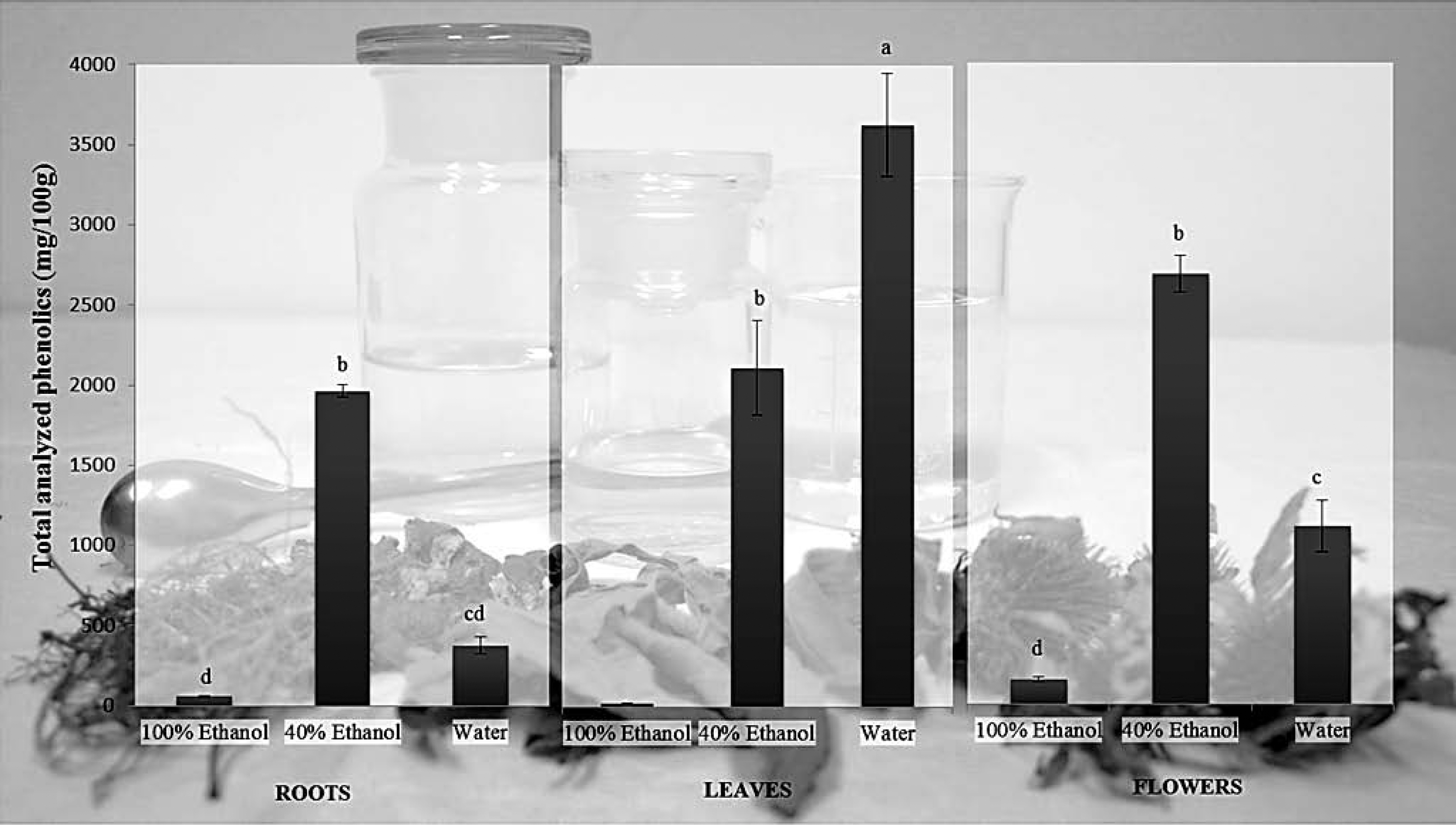
Contents of total analyzed phenolics in leaves, flowers, and roots of purple coneflower in three different type of solvent. a–ddenotes statistically significant differences in total analyzed phenolics in purple coneflower roots, leaves and flowers in three different type of solvent.
Comparison of phenolic compounds in different plant organs
The highest contents of caftaric acid were found in the leaves of purple coneflower (2786.44 mg/100 g), while chicoric acid, the second most abundant caffeic acid derivative in E. purpurea, was the most abundant in flowers (1665.21 mg/100 g) and roots (1466.67 mg/100 g) (Table 2). Purple coneflower roots contained the lowest content of both total (Fig. 1) and individual analyzed phenolics (Table 2). Anthocyanins were present only in purple coneflower flowers. Purple coneflower leaves had the highest flavanones content (55.26 mg/100 g), followed by roots (21.80 mg/100 g) and flowers (1.89 mg/100 g). Total flavonols contents were lowest in roots of purple coneflower (11.40 mg/100 g) (Table 2). Of total analyzed phenolics, purple coneflower leaves had the highest values (3629.54 mg/100 g), 1.35 times higher than in flowers (2685.49 mg/100 g) and almost twice as high as in roots (1964.23 mg/100 g) (Table 2).
Discussion
Phenolics from purple coneflower are known to have a positive effect on human health. 20 Their contents have been shown to differ among various phenolic compounds in different plant parts, 3,6 which is in accordance with our study. Moreover, Mølgaard et al. 21 and Thomsen et al. 22 reported that plant part (root, stems, leaves, and flowers), age of plant, its growth location, method of extraction, drying, and storage greatly influence the phenolic composition in plant. In addition, different phenolics (HCAs, flavanols and flavonols) are located in different cell parts (vacuole and nuclei) and their accumulations are dependent on the season of growth. 23 Higher levels of some phenolics have been determinated in the growing season (May, June, and July). This may be a reason for lower studied compounds in roots than in above ground plant parts (flowers and leaves). Their levels were probably higher in the winter season, the time of plant hibernation.
The predominant phenolic compounds in purple coneflower are caffeic acid derivatives, 5 such as caftaric and chicoric acids, which are the most important potentially active compounds in purple coneflower. 24 This is in agreement with our study, in which caftaric and chicoric acids exhibited the highest peaks in all studied plant parts and solution types. In general, most biologically active compounds that enhance different phenolic groups are polar or water-soluble compounds. Some of such compounds are poorly soluble due to large molecular sizes or poor lipid solubility. 25 Both caftaric and chicoric acids, the highest contributors to total analyzed phenolics in our study, are considered to be more water-soluble compounds. 12 Caftaric acid on average contributes from 9% to 77% of total analyzed phenolics and chicoric acid from 1% to 75%. Caftaric acid transfers more quickly across a membrane into the final product than chicoric acid. 5 In addition, caftaric acid is extracted better in a higher proportion of water than alcohol. 5 In our study, therefore, the highest levels of caftaric acid were found with pure water or 40% alcohol. After caftaric acid, chicoric acid was the second most predominant and major contributor to total analyzed phenolics in purple coneflower. Chicoric acid is often used as a marker for determination of the drug activity of various medicines made from purple coneflower. 26 Its molecular structure contains several hydroxyl groups, rendering a polar character for extraction and requiring an alcohol-water mixture for this. 10 In our study, the highest chicoric acid contents were thus obtained for leaves, flowers, and roots in 40% ethanol. It has been reported that the extraction yield of chicoric acid increases with the ethanol percentage in the solvent, up to 60%. Higher than 60% alcohol means a lower concentration of selected phenolic compounds. 24,27 Wu et al. 24 reported that when the alcohol concentration is above 60%, proteins can coagulate, which causes greater diffusion resistance. Accordingly, all phenolic compounds yielded the lowest contents in 100% ethanol extraction solvent in all investigated purple coneflower parts. Rezaei and Abedi 10 also reported low yields of chicoric acid extracted in pure and less polar solvents. Pure water is the most polar solvent and its polarity makes it unsuitable for extraction of chicoric acid, which was reflected in the lower yield of chicoric acid in all plant parts in our study. Most phenolics, including chicoric acid, can be degraded by polyphenol oxidase and oxidative processes. The presence of ethanol can inhibit enzymatic degradation and purple coneflower products, therefore contain higher concentrations of chicoric acid. 28 The absence of chicoric acid in various products also depends on the synergism between alkylamides and chicoric acid. 26 Chicoric and caftaric acid belong to the HCA group. In general, total HCAs showed the highest amount in extracts when water was used as the solvent. This is in agreement with the following studies: Reis et al. 29 ; Senica et al. 30 ; and Mikulic-Petkovsek et al., 31 in which pure water or a high percentage of water in the solvent showed higher HCA levels. Similar extractability was also shown in our study by the group of flavanones, which was in contrast to the results of Wilcox et al. 32 ; Mikulic-Petkovsek et al. 31 ; and Senica et al., 30 in which flavanones extracted better in organic solvents.
The group of flavonols formed 12 different quercetin derivatives and kaempferol glycosides in our study. Batabura et al. 33 reported that the best solvent for kaempferol and quercetin extraction is a combination of alcohol and water (85:15), whereby quercetin showed a higher concentration than kaempferol with this kind of solvent. In our study, leaves of purple coneflower contain higher levels of quercetin derivatives, the contents of which were higher in water solvent (data not shown), while flowers contained higher levels of kaempferol derivatives, which were better extracted in the presence of alcohol. The higher levels of flavonols in purple coneflower leaves with water solvent and in flowers extracted with 40% ethanol were therefore attributed to different contents and proportions of kaempferol and quercetin glycosides in different purple coneflower parts.
Anthocyanins, present only in flowers, gave the highest levels with 40% ethanol extraction solvent. Their extraction is better performed in organic solvents with the presence of water than in pure alcohol or water. 30,34 It has been found that the ethanol concentration increased the diffusivity of anthocyanins under 60% of ethanol, but with increasing of the percent of organic solvent up to 60%, anthocyanin contents decreased. 27
In conclusion, the distribution of the selected phenolic compounds in different coneflower parts and their varied solubility in different solvents leads to differences in their composition in different purple coneflower products. If leaves from purple coneflower are used, then it is better to prepare a water extract or infusion, whereby the highest levels of caftaric acid and other phenolics present in the plant material are obtained. If purple coneflower tincture is required, then 40% ethanol is recommended for extraction from roots and flowers, whereby the best extraction of both individual and total analyzed phenolics is achieved. Alcohol tincture from flowers additionally contains anthocyanins, which also has an antioxidative function in human health.
Footnotes
Acknowledgment
The research is part of Horticulture Program No. P4-0013-0481, funded by the Slovenian Research Agency (ARRS).
Author Disclosure Statement
No competing financial interests exist.