




Abstract
Nopal is used in Mexico as both food and traditional medicine for metabolic diseases. Our aim was to analyze the effect of the chronic administration of mucilage fiber extracted from nopal (Opuntia ficus indica; 500 mg/kg body weight per day) on male Wistar rats on a high-fructose diet (HFD). After which three groups were administered one of the following for 30 days: whole-fresh nopal mixed in water, mucilage, and control. Metabolic and hemodynamic parameters (triglycerides, cholesterol, fasting glucose, oral glucose tolerance test, blood pressure, and abdominal circumference) were determined. Rats administered nopal and mucilage had lower levels of triglycerides and diastolic arterial pressure than control, but only nopal had significant differences. Furthermore, systolic and diastolic pressure were higher in the control group. Thus, whole nopal and mucilage improve metabolic parameters in rats fed a HFD.
Nopal (Opuntia ficus indica) is a domestic species of the Cactaceae family in Mexico that causes metabolic effects due to its high fiber content,
1
both soluble and insoluble.
2
The soluble fiber has effects on metabolism that can improve metabolic syndrome parameters. Mucilage is a high proportion of the soluble fiber in nopal
1,2
; its complex structure has highly ramified carbohydrates, such as
Metabolic syndrome has been related to obesity, increased lipids, cholesterol, glucose, arterial pressure, and glucose intolerance, resulting in the development of a chronic degenerative disease. 4 The aim of this study was to evaluate the chronic effect of mucilage from nopal on the metabolic parameters of rats fed a high-fructose diet (HFD).
Male Wistar rats (Harlan Laboratories, Inc., USA) aged ∼2 months and weighing 250–350 g each were housed under standard conditions with a 12-h photoperiod (12-h light/12-h dark), temperature 23°C ± 2°C, and humidity 40% with the laboratory animals of the University of Colima, México. The plant material in this study was fresh young nopal (O. ficus indica) cladodes collected in Zacualpan, Colima, Mexico at latitude 28.7583, longitude −106.9583 from April to May. Mucilage was extracted from nopal by Sepulveda's method, with 95% ethanol 1:4, 4 h drying, and mechanical pulverization. 5 A total of 21 rats were used in this study. The sample size was calculated under criteria NC3R (n = 7 per group). 6
After 3 weeks on the HFD, the rats were randomized into three treatment groups. The diet was discontinued and treatment started: the first group received mucilage at a dose of 500 mg/kg body weight (bw) per day diluted in water, 7 the nopal group received 4.36 g/kg bw per day of whole fresh liquefied nopal cladodes prepared daily, 8 and the third was administered only water (2 mL per rat). All substances were administered orally in the morning (9–10 am) for 30 days. At the beginning and end of experimental treatments, the rats were tested for fasting glucose, oral glucose tolerance test [OGTT], arterial pressure, cholesterol total, triglycerides, and abdominal circumference. Diet was administered in water with fructose at 20% (Sigma Aldrich) for 8 weeks with standard aliment (ENVIGO 2018S) ad libitum. 9
All biochemical parameters (triglycerides, cholesterol total, and fasting glucose) were measured with 12 h overnight fasting and the blood samples collected from the distal tail. 10 For the OGTT, rats were administered 2 g glucose/kg bw by oral gavage and blood samples drawn after 0, 30, 60, and 120 min. OGTT data were expressed as the area under the curve (AUC). Triglyceride and cholesterol were analyzed using Accutrend (Roche) and glucose with an Accuchek glucometer.
For determination of the abdominal circumference, the animal was placed on the millimeter tape measure in the dorsal decubitus position with the legs slightly separated from the body, and then the middle part of the abdomen (anterior part of the leg) identified. 11 Blood pressure was measured by a noninvasive method using PANLAB5002 (Panlab Harvard Apparatus, C/Energia, Cornellá, Barcelona, Spain).
We used descriptive statistical analyses. The expressed variables were reported as means with standard error and P values (≤.05) were considered significant. SPSS (version 22; SPSS Corp. LP, USA) was used to perform analyses. Paired Student's t-tests were used to assess differences in mean values at the beginning and end of each intervention. The Student's t-test for independent samples was used to assess differences in the mean values between the groups. To analyze OGTT data, we calculated the AUC using the mathematical Tai model. 12
At the beginning of the study, we did not observe significant differences in the plasma glucose level or the AUC of OGTT between groups after fasting. After administration of a HFD, triglyceride levels, fasting glucose, the AUC of OGTT, abdominal circumference, and systolic arterial pressure increased in all rats, but only the fasting glucose levels, AUC of OGTT, and abdominal circumference were significant (P < .05).
Compared with the levels obtained after HFD, the mucilage-treated rats had significantly decreased levels of triglycerides (168.28 ± 12.96 vs. 97.42 ± 10.50, P < .05), cholesterol (162.85 ± 3.01 vs. 152.71 ± 2.27, P < .05), and AUC of OGTT (17,005.71 ± 754.53 vs. 14,498.57 ± 463.78, P < .05), whereas the group treated with complete nopal had significantly decreased levels of triglycerides (145.14 ± 12.30 vs. 82.14 ± 8.82, P < .05). The differences with tendencies to reduce levels were also observed in the control group, but only in the AUC of OGTT (16,695 ± 798.16 vs. 13,875 ± 428.39, P < .05). When the HFD was suspended in this group without treatment, it presented a significant increase in systolic pressure (137.02 ± 11.98 vs. 172.71 ± 11.98, P < .05) and diastolic pressure (98.48 ± 2.38 vs. 131.54 ± 8.01, P < .05). We compare the effects between groups at the end of the treatments, finding no significant differences in fasting glucose or the AUC of the OGTT.
With respect to lipids, the nopal group and mucilage group presented with lower levels of triglycerides than the control group (Fig. 1), with a significant difference in the group treated with nopal (P < .05). Differences were not observed at the end of the treatments in regard to the levels of cholesterol or the abdominal circumference. Although no differences were observed in the levels of systolic pressure, a tendency existed in the effect that could be observed at the end of the experiment and significant differences were found in diastolic pressure with lower levels in nopal group, with respect to control group (Fig. 2a, b).
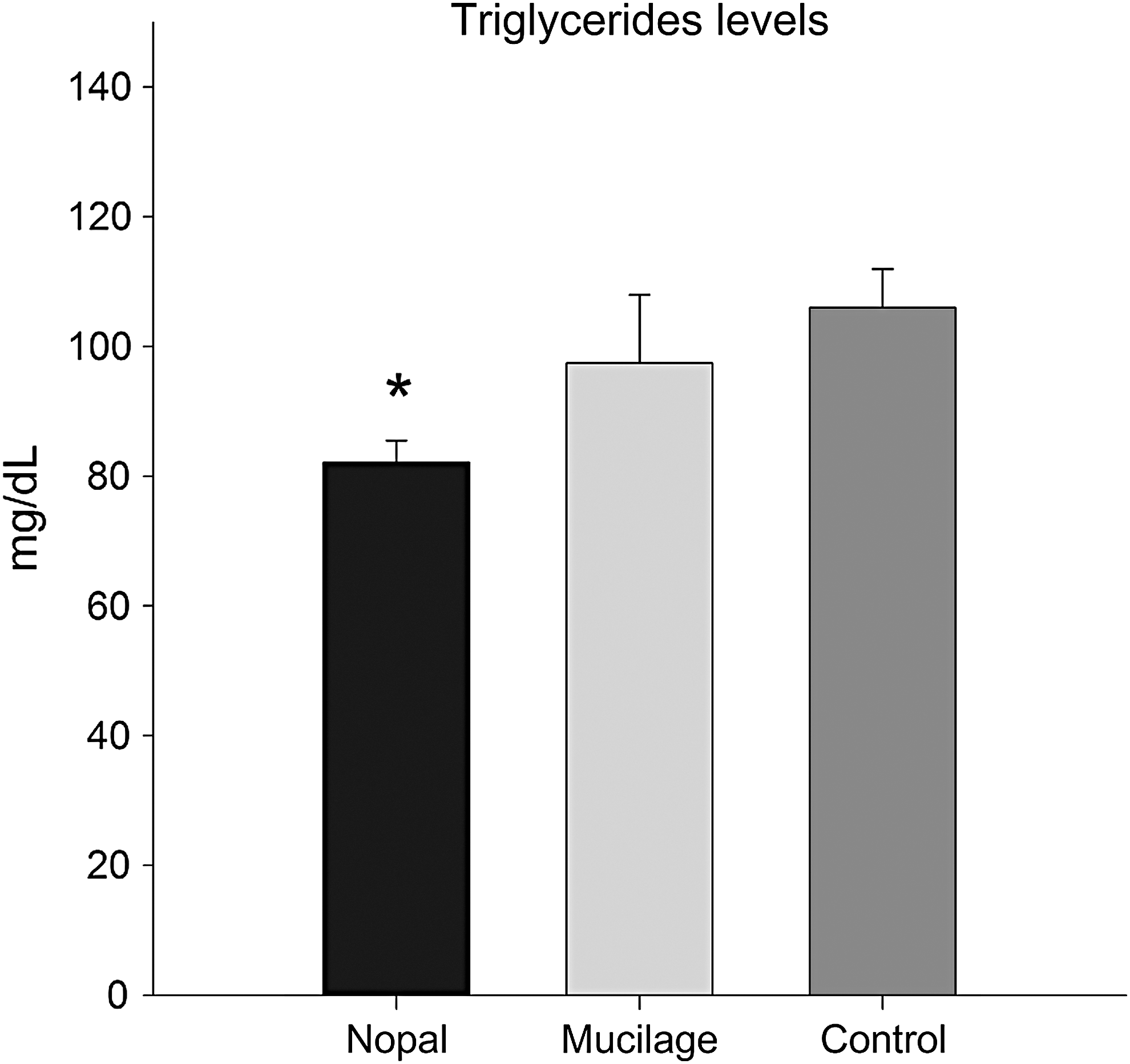
Effect of nopal and mucilage on the levels of triglycerides in rats fed a high-fructose diet. Rats were treated with nopal (4.36 g/kg bw per day) or mucilage (500 mg/kg bw per day) for 8 weeks. Data are presented as media ± standard error. *Significant differences (P < .05 Student's t-test) compared with control. bw, body weight.
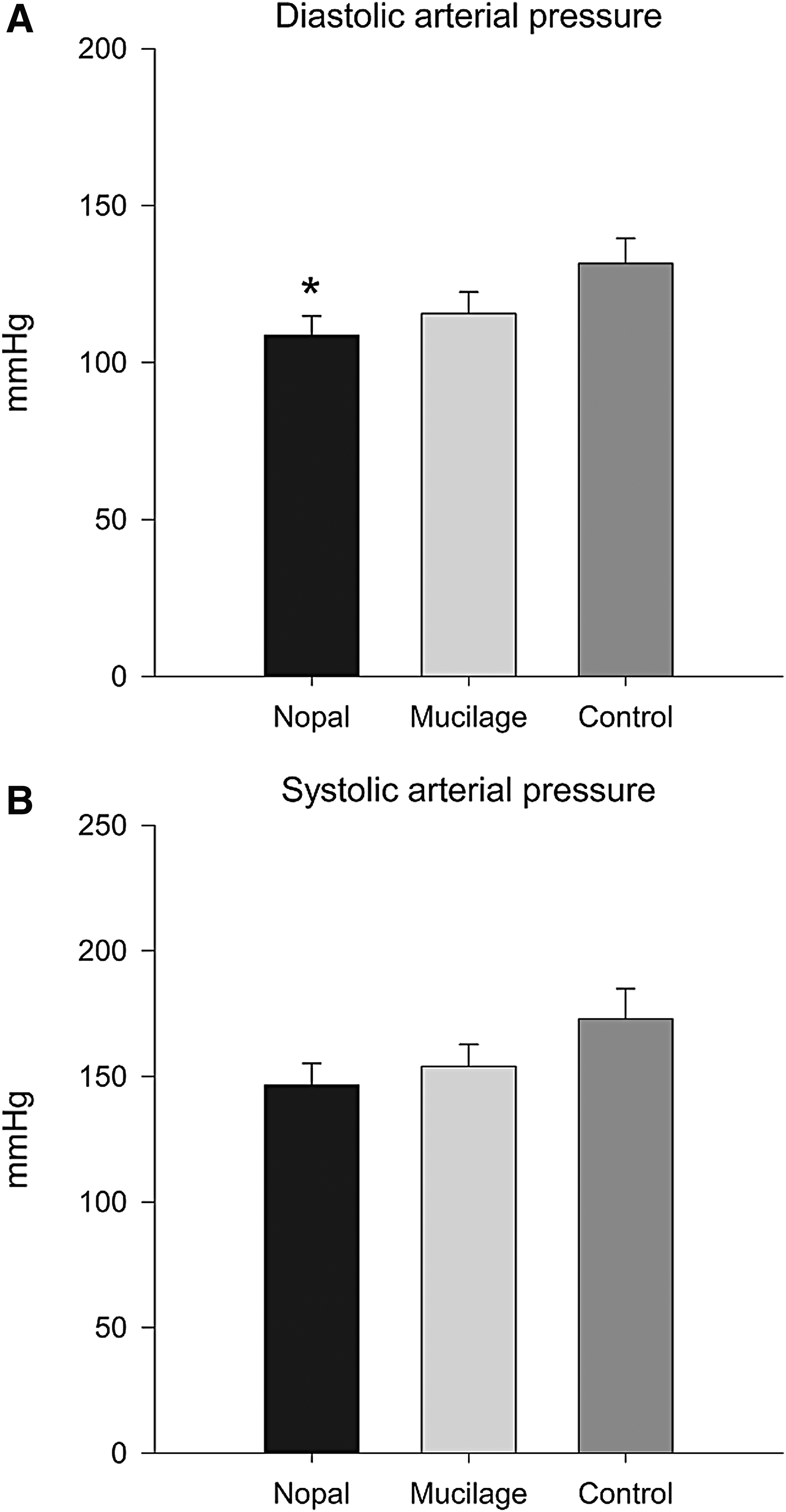
Effect of nopal and mucilage on the levels of diastolic
These results indicate that the nopal group of rats had improved triglycerides after HFD, and the mucilage diet tended to have this same effect; the synergism of other components of nopal with mucilage apparently increase their metabolic effects. In addition, rats that did not receive nopal or mucilage for 8 weeks had significantly higher systolic and diastolic arterial pressure. Several mechanisms have been postulated for the action of nopal on triglycerides, including the adiponectin pathway and participation of nopal fibers. In this study, we showed that mucilage-treated rats present with lower levels of triglycerides, which has been related to some fibers decreasing intestinal lipid absorption. 13,14 A mechanism that explains the decrease in the absorption of nutrients, including lipids, is the viscosity of the fiber due to an increase in the aqueous layer in the resting intestine, called unstirred water layer (UWL), and the viscosity of mucilage cushioning intestinal motility contraction, increasing the thickness of the UWL and making it difficult for apical intestinal cells to absorb the lipids. 15,16 In addition, components of the dietary fiber can modify the intestinal architecture, and it could be related to altered functional characteristics. 17 Soluble fiber viscosity makes the reabsorption of bile salts in the small intestine into the enterohepatic circulation difficult, causing increased excretion in feces; consequently, bile salts decrease and recover in concentration, with cholesterol catabolized by hepatocytes. In addition, increased membrane receptors for low density lipoproteins-cholesterol improves cholesterol capture from circulation and decrease cholesterol in the blood. 16 Soluble fibers also diminish lipid emulsification and increases the short chain fatty acids (SCFAs) through fermentation of fibers in the colon. Thus, the colonic pH decreases and modifies the colonic microbiota, which redundantly increases the synthesis of SCFAs such as propionate, acetate, and butyrate, that have been associated with reduced synthesis of cholesterol. These effects could vary depending on the dietetic fiber viscosity, dose, time of consumption, diet, and microbiota. 16,18
An important effect rarely addressed in the studies related to dietary fibers is the effect on arterial pressure. Obata et al. 19 observed a diminution in the arterial pressure in hypertense rats after treatment with psyllium, which has a high mucilage content, and these similar effects have been reported in obese and diabetic rats. 20,21 The effects on arterial pressure could also be associated with an improvement in insulin resistance. In our experimental animal model, this effect appears not to be related to this mechanism; however, we need more research to understand how the dietary fibers reduce arterial pressure. Our results provide evidence of the effect of nopal on metabolic parameters, and mucilage could be in part responsible for these effects, but studies are necessary to establish the optimal doses and possible mechanism of action to determine the pharmacological interactions that occur in a clinical context in which patients with metabolic syndrome often need to receive various drugs.
Footnotes
Acknowledgment
M.L. and J.B.B. were in receipt of a CONACyT scholarship.
Author Disclosure Statement
No competing financial interests exist.