




Abstract
Multiple studies have examined the impacts of various nuts on appetitive and metabolic effects; however, fewer studies have addressed the impacts of mixed nuts. The objective was to examine the acute effects of consumption of an isocaloric (253 kcal) snack of mixed nuts or pretzels on appetite hormones, glucose and insulin responses, and subjective appetite ratings in overweight and obese adults. In a two-arm randomized controlled trial, overweight and obese adults consumed either mixed nuts (n = 27) or pretzels (n = 27) with 16 men and 11 women per group. After an overnight fast, blood glucose, insulin, and appetite hormone were measured at baseline and 60 min post snack consumption. Appetite/satiety questionnaires were completed at baseline and 20, 40, 60, 90, 120 min after snack consumption. Both snacks increased satiety and reduced hunger over time. The pretzels group exhibited higher subjective satiety and lower hunger (P < .001) following consumption than the mixed nuts group. Pretzel consumption increased glucose and insulin (P < .001), while no elevation was detected in the mixed nuts at 60 min post snack consumption. Leptin and ghrelin concentrations were significantly lower for the mixed nuts group at 60 min compared with baseline (P < .05). Mixed nuts promote satiety in overweight and obese adults while maintaining stable blood glucose and insulin levels. These results suggest that mixed nuts snack may be beneficial for those who are overweight or obese. Future mixed nuts studies are warranted to examine long-term effects.
Introduction
Approximately one-third of adults in the United States are obese. 1 Obesity increases the risk of insulin resistance, inflammation, and metabolic disorders such as type 2 diabetes. 2 Snacking has been implicated in the obesity epidemic, 3 but recent studies have demonstrated that snacks that are high in fiber and protein may increase overall satiety, which may cause weight loss. 4,5
Nuts can serve as a healthy snack that is usually rich in protein, unsaturated fat, and fiber 6,7 and that may promote satiety 8 in obese individuals. 9,10 In recent studies, the effects of single types of nuts on appetite have been examined. These studies suggest that nuts may promote postprandial satiety in a variety of populations. 11 –16 One 18-week study suggests that consumption of walnut oil might increase leptin levels in adults with diabetes. 17 A few studies suggested that walnuts and Korean pine nuts have no effect on postprandial ghrelin, while another showed a decrease in ghrelin levels following pistachio consumption. 11,18 Adiponectin levels were increased in adults following long-term consumption of pistachios and mixed nuts, 18,19 but no short-term effects were seen in these studies. Postprandial levels of cholecystokinin (CCK) were increased in adults following the consumption of Korean pine nuts and walnuts. 12,14 Acute studies of Korean pine nuts and peanuts revealed increased postprandial peptide YY (PYY) levels in adults.
Several studies suggested that nut consumption might improve postprandial glucose and insulin 11,20 –22 ; some studies showed a reduction in postprandial glucose and an increase in postprandial insulin. 13,14 Some single nut studies have also examined the long- and short-term effects on glucose and insulin levels with conflicting outcomes. 11 –14,16,18,20,21 Some studies showed an improvement in postprandial glucose and insulin with no long-term effects noted.
Although some research suggested an improvement in glucose, insulin, and satiety hormones, 11,13,15,17,18,21,22 there is little evidence to substantiate the effects of mixed nuts on these indicators. Moreover, studies have shown that mixed nuts might promote satiety in healthy individuals, while their effects on overweight and obese individuals are still unclear. 19,22 Therefore, the purpose of this study was to examine the acute effects of isocaloric snacks of mixed nuts or pretzels on appetite-related hormones (i.e., leptin, ghrelin, adiponectin, CCK, PYY), glucose and insulin responses, and subjective appetite in overweight and obese adults.
Materials and Methods
Subjects
In a two-arm randomized controlled trial, overweight and obese adults recruited from southern California consumed either mixed nuts (n = 27) or pretzels (n = 27) with 16 men and 11 women per group between January and December 2017. Based on a related study of nuts, 11 power calculations indicated that 26 individuals are necessary to detect difference in satiety at 80% power and an alpha-level of P < .05. Participants were randomly assigned by study investigators to one of two groups in random order and equal allocation in blocks of five. Inclusion criteria included ages 18–55 years and a body mass index (BMI) between 27 and 40 kg/m2. Exclusion criteria included smoking, pregnancy, taking dietary supplements for medical condition, allergies to nuts or wheat, and known medical conditions that might result in chronic inflammation or metabolic disorders. Female participants initiated the study during days 3–11 of their menstrual cycle to control for fluctuations in metabolism. Study protocol was approved by the San Diego State University Institutional Review Board and informed consent was given by all participants (ClinicalTrials.gov, NCT03375866).
The mean age of participants in the pretzels group was 29.4 ± 1.9 years and in the mixed nuts group was 30.0 ± 1.9 years (Table 1). Mean BMI of the pretzels group was 31.9 ± 0.6 kg/m2 and of the mixed nuts group was 31.1 ± 0.6 kg/m2, indicating obesity. Mean systolic blood pressure of the pretzels group was 125.9 ± 2.7 mmHg and of the mixed nuts group was 127.3 ± 2.4 mmHg. Mean diastolic blood pressure of the pretzels group was 80.2 ± 1.6 mmHg and of the mixed nuts group was 84.3 ± 1.6 mmHg. Ethnic breakdown of the pretzels group was 15 Caucasians, 6 Asians, 5 Hispanics, and 1 other, and of the mixed nuts group was 16 Caucasians, 6 Asians, and 5 Hispanics. There were no significant differences between groups at baseline for age, height (cm), weight (kg), BMI, systolic, or diastolic blood pressure.
Demographics of Overweight/Obese Adults Participating in Isocaloric Snack Trial
Data are presented as means ± SE.
BMI, body mass index.
Study design
Participants were instructed to fast overnight before coming into the laboratory for testing. They were also instructed to refrain from alcohol and vigorous physical activity for 24 h before the exercise testing trial. All participants arrived between 08:00 and 10:00 AM for blood collection on testing day following an overnight fast. On the trial day, after resting for 10 min, participant's blood pressure, height, and weight were measured. Fasting blood was collected to determine baseline characteristics. Following the baseline blood draw, subjects were instructed to consume the snack of 42 g of mixed nuts (253 kcal, 9 g carbohydrate, 7 g protein, 21 g fat, 163 mg Na) or 69 g of Snyder's mini unsalted pretzels (253 kcal, 56.5 g carbohydrate, 6.8 g protein, 0 g fat, 173 mg Na) along with 16 oz of water within 5 min. Blood was collected 1 h after consumption of the snacks. Samples were centrifuged at 1200 g for 10 min at 4°C to separate serum, which was stored at −80°C for later use. Two 24-h recalls were filled out for the 2 days leading up to the testing period.
Satiety questionnaire
A series of Visual Analog Scale appetite questionnaires was used to determine subjective appetite. Participants completed the questionnaires before consumption of the snack and water, then again 20, 40, 60, 90, and 120 min after consumption of the snack. The appetite questionnaires consisted of five questions: How hungry are you? How full are you? How strong is your desire to eat? How much do you think you could eat? and How thirsty are you? Participants recorded their answers by making a mark on a 10-cm line. The left side indicated not at all hungry, not at all full, not at all, nothing, and not at all thirsty. The right side indicated totally hungry, totally full, extremely, a large amount, and totally thirsty.
Glucose and insulin
Serum glucose levels were analyzed using Glucose LiquiColor kits (Stanbio Laboratory, Boerne, TX, USA). Glucose oxidase was used to oxidize glucose in samples. A reaction was catalyzed by the formation of hydrogen peroxidase and elicited a red-violet quinone complex. Absorbance was measured at 500 nm.
Serum insulin levels were analyzed using Ultrasensitive Insulin ELISA kits (ALPCO, Salem, NH, USA). Samples were added to wells coated in an insulin-specific antibody along with detection antibody. Then, 3,3′,5,5′-tetramethylbenzidine (TMB) substrate was added followed by a stop solution to generate a color response. Absorbance was measured at 450 nm. Investigator who analyzed the samples was blinded.
Leptin, ghrelin, adiponectin, CCK, and PPY
Leptin, total ghrelin, adiponectin, and PPY serum levels analyzed using ELISA kits, and CCK serum levels were determined using an EIA kit (RayBiotech, Norcross, GA, USA). Samples were added to wells coated with a specific antibody and then incubated with biotinylated secondary antibody followed by horseradish peroxidase streptavidin. Color was generated with TMB substrate, and absorbance was read at 450 nm using iMark microplate reader (Biorad, Hercules, CA, USA).
Statistical analysis
Statistical analyses were conducted using IBM SPSS version 24 (IBM, Armonk, NY, USA). A mixed-design analysis of variance was conducted to examine differences between groups and over time. Follow-up t-tests were conducted to compare group means of glucose, insulin, and satiety hormones at baseline and 60 min after. The alpha-level was set at P < .05 for significance.
Results
Appetite questionnaires
There were no significant differences between groups for any of the satiety or thirst questions at baseline (Fig. 1). Results revealed significantly decreased hunger following the consumption of both snacks (P < .001), but the pretzels group reported significantly lower hunger responses than did the mixed nuts group (P < .05) (Fig. 1A). Following the consumption of both snacks, significantly increased fullness responses were reported, with the pretzels group indicating a significantly lower hunger response than the mixed nuts group (P < .05) (Fig. 1B). Desire to eat significantly decreased following the consumption of both snacks, but the pretzels group reported a significantly lower desire to eat than did the mixed nuts group (P < .05) (Fig. 1C). Both groups reported a significant reduction in the size of food they thought they could eat following snack consumption, with the pretzels group signifying a significantly lower amount than the mixed nuts group (P < .05) (Fig. 1D). A significant decrease in thirst after snack consumption was reported by both groups (P < .001) with no difference in thirst observed between the groups (Fig. 1E).
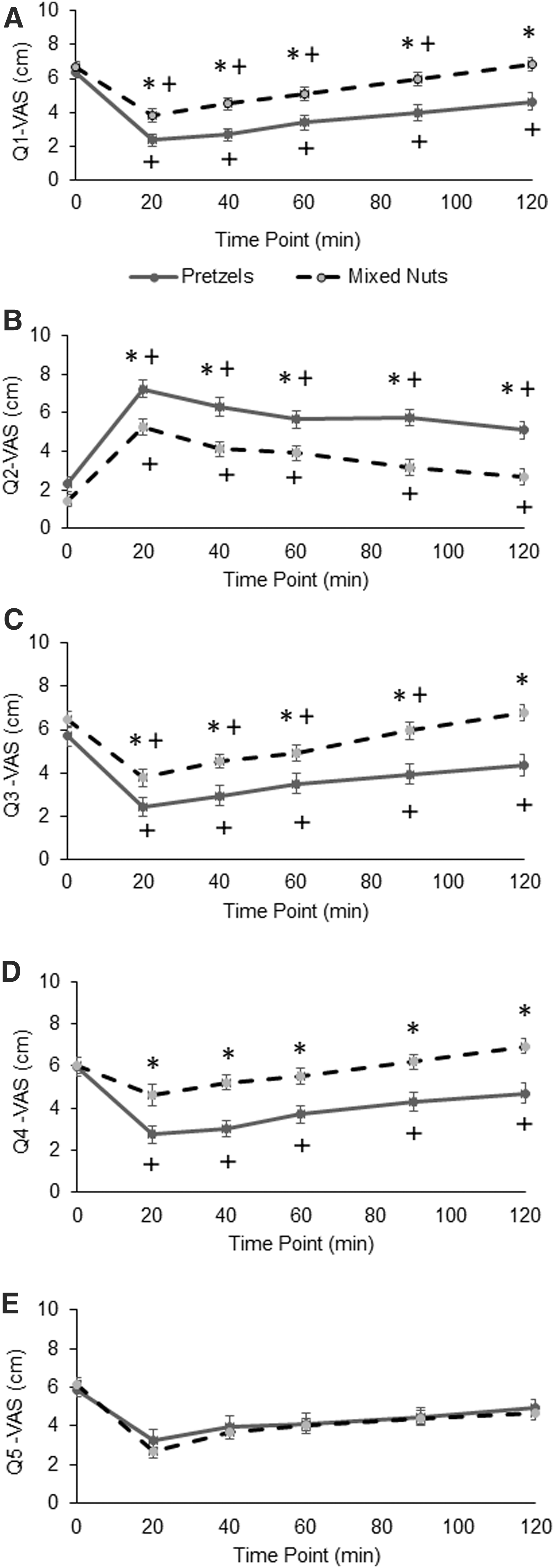
Satiety response of overweight/obese adults between pretzels versus mixed nuts at baseline, 20, 40, 60, 90, and 120 min post snack consumption as measured on a 10-cm VAS.
24-h recalls
Average intake was 1911 ± 95 kcal/day by the pretzels group and 2122 ± 111 kcal/day by the mixed nuts group. There were no differences in intakes of kcal, protein, fat, cholesterol, sugar or calcium, potassium, sodium, iron, phosphate, zinc, vitamins A, B1, B2, B6, B12, C, D, E, K, and folate between the two groups.
Glucose and insulin
The pretzels group demonstrated significantly higher blood glucose levels at 60 min post consumption than at baseline (P < .001) (Fig. 2A). For the mixed nuts group, no significant differences were seen from baseline to 60 min post consumption. The pretzels group demonstrated significantly higher blood glucose levels at 60 min post consumption (P < .001) than the mixed nuts group.
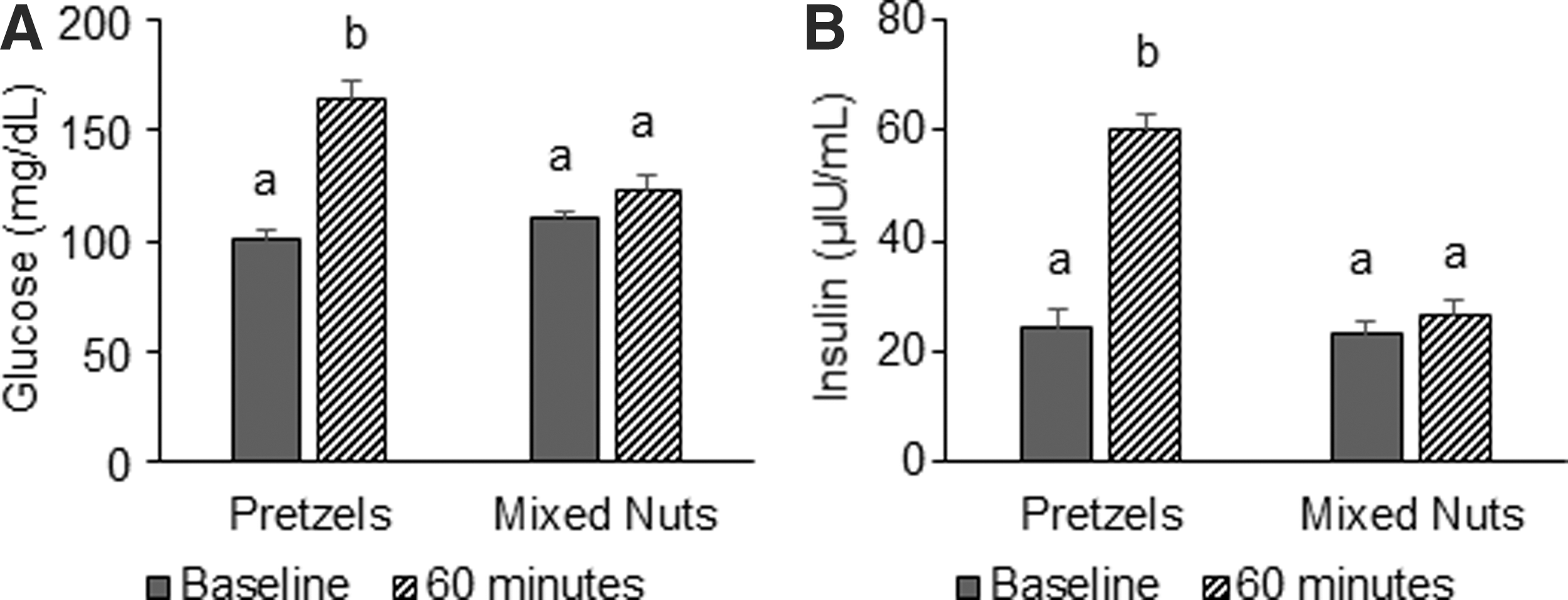
Glucose
Similarly, the pretzels group demonstrated significantly higher insulin levels at 60 min post consumption than at baseline (P < .001), while no significant effects were seen in the mixed nuts group (Fig. 2B). The pretzels group demonstrated significantly higher insulin levels at 60 min post consumption (P < .001) than the mixed nuts group.
Appetite hormones
The mixed nuts group exhibited significantly lower leptin levels at 60 min post consumption (P = .01) than the pretzels group (Table 2). Similarly, the mixed nuts group demonstrated significantly lower total ghrelin levels at 60 min post consumption (P = .03) than the pretzels group. A trend was observed in the mixed nuts group with CCK concentration being higher at 60 min post consumption (P = .08) than the pretzels group. No significant differences were observed for adiponectin, CCK, or PYY concentration in the mixed nuts or pretzels groups. There were no significant differences between groups at baseline.
Satiety Hormone Concentrations of Overweight/Obese Adults for Each Snack at Baseline and 60 Min Post Consumption (Pretzel n = 27; Mixed Nuts n = 27)
Data are presented as means ± SE.
Different from mixed nuts baseline at P < .05.
Discussion
This study was conducted to examine the acute effects of mixed nuts consumption on glucose, insulin, and appetite. Both mixed nuts and pretzels consumption promoted responses related to satiety, but the pretzels group exhibited significantly greater responses than did the mixed nuts group. This might have been due to the volume consumed. A study on young men suggested that the volume of food or beverage affects ratings of hunger and fullness. 23 The pretzel snack consumed was 69 g (2.5 oz), while the isocaloric amount of mixed nuts snack was 42 g (1.5 oz). Greater volume with stomach extension may contribute to greater satiety and lower hungry feeling in the pretzels group. Another possible explanation for higher subjective satiety in the pretzels group is the higher glycemic response. Participants in the pretzels group experienced significantly higher glucose and insulin levels at the 60-min time point than did the mixed nuts group. This again may be due to the macronutrient profiles of the two snacks. Pretzels are mostly carbohydrate (56.5 vs. 9 g in mixed nuts), while mixed nuts are composed of primarily protein (9 vs. 6.8 g in pretzels) and fat (21 vs. 0 g in pretzels) with very little carbohydrate content. Research has shown that appetite may be affected by hyperglycemia, which might explain greater satiety ratings after pretzel consumption. 24,25 Mixed nuts did promote satiety among participants, which is consistent with other studies that suggested that nuts might promote subjective ratings of satiety. 14,15,22 This suggests that mixed nuts help maintain relatively stable blood glucose and insulin levels, 11,13,14,18,20 –22,26 qualifying them as a healthful snacking alternative.
Leptin levels at the 60-min time point were significantly lower in the mixed nuts group than in the pretzels group. Recent meta-analysis suggested that nut consumption decreases leptin. 27 Leptin is often impaired in obesity, as many obese individuals are resistant to leptin. 28 The results of this study suggest that mixed nuts may improve leptin sensitivity by decreasing the amount of circulating leptin in the body. However, a study of healthy adults showed that an intake of a walnut-enriched meal has no effect on postprandial leptin. 29 Lasa et al. 19 also reported that a daily consumption of 30 g almonds, hazelnuts, and walnuts for 1 year did not affect leptin levels.
The concentrations of total ghrelin significantly decreased at the 60-min time point in the mixed nuts group compared with the pretzels group. It has been shown that ghrelin works through a specific pathway in the hypothalamus to stimulate feeding and that blocking this pathway eliminates the feeding response of ghrelin. 30 This finding suggests that mixed nuts may be effective at decreasing the levels of ghrelin, which could be a mechanism through which mixed nuts reduce hunger. Similarly, Kendall et al. 11 examined the effects of pistachios in adults with metabolic syndrome and found a decrease in postprandial ghrelin concentrations. Conversely, others have detected no effect on ghrelin after intake of walnut and Korean pine nuts by overweight and obese adults. 12,17 Active (acyl ghrelin) and inactive (des-acyl ghrelin) isoforms of ghrelin have been identified. 31 Acylated ghrelin binds to its receptor, the growth hormone secretagogue receptor (GHS-R), and the activation of GHS-R is associated with an increase in food intake. Further investigation is warranted to examine the role of active form of ghrelin as well as total form, and GHR-R as a function or mixed nuts consumption.
Adiponectin levels were not affected by either snack in the present study. Brennan et al. 15 showed that walnut consumption over 4 days increased satiety by day 3 but did not change adiponectin level. In contrast, a study on healthy adults revealed improved postprandial adiponectin levels following acute consumption of a walnut-enriched meal. 29 Gulati et al. 18 found an increase in adiponectin following 6 months of pistachio nut consumption in adults with metabolic syndrome.
CCK is involved in the promotion of satiety and insulin secretion. Despite lower production of satiety responses, there was a trend (P = .08) for higher CCK levels in the mixed nuts group compared with the pretzels group. An elevation in this hormone is seen about 20 min after consumption of food, but slowly decreases over the next few hours. 32 CCK has been examined in several single-nut studies. Studies involving Korean pine nuts, peanut butter, and walnuts suggested a postprandial increase of CCK, 21 –23 while one study of walnuts demonstrated no effects. 17
There were no significant differences in the levels of PYY between the two snacks. Reis et al. 13 suggested that levels of PYY increase in the 0–240 min following consumption of 42 g of whole peanuts or peanut butter, while walnut consumption showed no effect on postprandial PYY. 15,17
Overall, the effect of nut consumption on satiety hormone secretion is mixed, and underlying mechanisms for the appetitive effects of nut consumption are not well understood due to a paucity of studies on the issue. More studies are needed to elucidate the physiologic role of mixed nuts on gut satiety hormone response.
Many studies have examined the effects of certain types of nuts, but there is limited research if the beneficial effects can be extended by the consumption of a nut mixture, which is more practically relevant. In addition, testing was done in a real-life setting, which suggested that the changes seen are applicable outside of the laboratory. The human subject research is limited to effects that occur while the subjects consume their various basal diets. However, we aimed to determine the effects of mixed nuts on top of real diets.
Since blood samples were collected at a single postprandial time point, it is possible that we missed satiety hormone changes earlier in the time course after consumption. It is suggested that blood levels should be examined more frequently to conclusively determine the effect of mixed nuts on satiety hormone levels. This study examined the acute effects of mixed nuts consumption. Intervention studies investigating chronic effects of mixed nuts should also be conducted to determine if a decrease in food consumption may attenuate body weight as a possible outcome. The participants of this study were relatively healthy overweight and obese adults. Future studies should recruit participants with chronic illnesses such as type 2 diabetes and cardiovascular disease to determine if mixed nuts may be beneficial for these populations.
In conclusion, mixed nuts do promote satiety in overweight and obese adults while maintaining stable blood glucose and insulin levels; however, it is important to note that pretzels promote an even greater satiety response, which deserves further examination. These results suggest that mixed nuts as well as pretzels should be studied as a potential useful snack for overweight and obese individuals and potentially other special populations.
Footnotes
Acknowledgment
This study was funded by the American Heart Association (16GRNT31360007). The study is registered at
Author Disclosure Statement
No competing financial interests exist.