




Abstract
Neuropathic pain (NP) is associated with chronic hyperglycemia and emotional disorders such as depression in diabetic patients, complicating the course of treatment. Drugs currently used to treat NP have undesirable side effects, so research on other natural sources has been required. β-caryophyllene (BCP), a natural sesquiterpene found in some food condiments and considered an agonist to cannabinoid receptor type 2, could have potential therapeutic effects to treat conditions such as NP and emotional disorders. For this reason, we assessed whether BCP modulates nociception, anxiety, and depressive-like behavior in streptozotocin (STZ)-induced experimental diabetic BALB/c female mice. BCP was orally chronic administrated (10 mg/kg/60 μL). Pain developed with STZ was evaluated with von Frey filament test, SMALGO®, and hot plate test. Anxiety and depression-like behavior were assessed by marbles test, forced swim test, and tail suspension test. BCP significantly reduced glycemia in experimental diabetic mice. The pain was also mitigated by BCP administration. Depression-like behavior assessed with tail suspension test was attenuated with orally chronic BCP administration. Substance P and cytokines such as interleukin-1β (IL-1β), tumor necrosis factor α (TNF-α), and interleukin-6 (IL-6) were also attenuated with BCP administration. NP was positively correlated with substance P and IL-6 and IL-1β release. Our data using an orally chronic BCP administration in the STZ challenged mice to suggest that glycemia, diabetes-related NP, and depressive-like behavior could be prevented/reduced by dietary BCP.
Introduction
Neuropathic pain (NP) is considered a diabetes consequence 1,2 that is present among 40–60% of patients with this condition. 3,4 High glucose concentrations activate the polyol pathway and also promote advanced glycation end products release, damaging nerve terminals, 5 evoking pain, and increasing production of substance P and cytokines such as interleukin-1β (IL-1β), tumor necrosis factor α (TNF-α), and interleukin-6 (IL-6), which has a role in NP development and permanence. 6
Patients with NP experience a variety of pain conditions such as hyperalgesia (highly painful perception to low pain stimuli) and allodynia (painful perception to non-painful stimuli). 4 –6 Importantly, NP affects lifestyle patients, causing mood swings, 7,8 increasing anxiety, and promoting depression, which could be characterized by changes in glutamate metabolism, substance P, and also proinflammatory cytokines release. 6
Currently, there are drugs to treat NP that have undesirable side effects, modest efficacy and their use may be specific only for some patients. 7 For this reason, it is considered a need for novel functional substances of food origin with effects against these diseases, and it can also be incorporated on a regular basis into the diet of any person.
β-caryophyllene (BCP) is a natural sesquiterpene and is an agonist to cannabinoid receptor type 2 (CB2R), 9,10 which is found in essential oils of cloves (Syzygium aromaticum), cinnamon (Cinnamomum spp.), black pepper (Piper nigrum L.), and rosemary (Rosmarinus officinalis L). 11,12 BCP use in foods has been approved by the U.S. Food and Drug Administration due to its low toxicity. 13 Some studies show that cannabimimetic drugs such as CB2R ligands might have therapeutic potential effects, including antioxidant, anti-inflammatory, neuroprotective, 11 anxiolytics, 14 antidepressive, and analgesic. 12 Therefore, the aim of this study was to evaluate the possible polypharmacological effect of BCP on NP and depressive-like behavior in experimental diabetic mice.
Materials and Methods
Animals and ethical considerations
Experiments were carried out by using 60 BALB/c female mice (20–25 g body weight). Mice were maintained in room temperature 25°C ± 1.0°C and a 12-h light/12-h dark cycle with food and water ad libitum. Mice were handled according to NOM-062-ZOO-1999 (Mexican Ministry of Health), which is in accordance with the Code of Ethics of the Directive 2010/63/EU.
Drugs
BCP (95% pure) was donated from Jürg Gertsch, Institute of Biochemistry and Molecular Medicine, University of Bern, Switzerland. Streptozotocin (STZ) was purchased from Sigma-Aldrich Chemicals, St. Louis, MO, USA.
Experimental diabetes induction
Groups: Basal (beginning of experimentation); vehicle control (VC), BCP, STZ, and streptozotocin plus β-caryophyllene (STZ+BCP). Before induction, a protective dose of BCP of 10 mg/kg body weight was orally administered (v.o.) by gavage-fed at a volume of 60 μL to BCP and STZ+BCP group mice. Mice were fasted 16 h before STZ administration via intraperitoneal (IP) infusion. First induction (week 1): STZ and STZ+BCP groups were IP administered with 100 μL of STZ (40 mg/kg body weight). Second induction (week 3): STZ and STZ+BCP groups were IP administered with 100 μL of STZ (120 mg/kg body weight) dissolved in physiological saline solution. 15 Body weight and basal glucose were monitored every week. Glucose concentration was measured by using a digital glucometer, Contour® TS (Bayer HealthCare LLC, Mishawaka, IN, USA) in blood samples collected from the tail vein. At the end of the third week, diabetic mice were considered those who had basal glucose levels >250 mg/dL (Fig. 1). BCP (10 mg/kg/60 μL per dose v.o.) was administered by gavage-fed for 45 days to BCP and STZ+BCP groups.

General experimental diagram. Female BALB/c mice (n = 15). Basal and final analysis of metabolic tests (OGTT), anxiety or depressive behavior, and pain. Groups: VC, BCP, STZ, and STZ+BCP. Twenty-four hours before the first induction, a protective oral administration of BCP (10 mg/kg) was performed and there was a previous fasting trial of 16 h. Week 1: first induction (sensitization): 100 μL IP of STZ at 40 mg/kg. Week 3: second induction (reinforcement): 100 μL via IP of STZ at 120 mg/kg. Day 45: obtaining serum to subsequently perform insulin, substance P, and proinflammatory cytokines quantification. ♀, female; BCP, β-caryophyllene; IP, intraperitoneal; OGTT, oral glucose tolerance test; PSS, physiological saline solution; STZ, streptozotocin; STZ+BCP, streptozotocin plus β-caryophyllene; VC, vehicle control.
Oral glucose tolerance test and insulin evaluation
Oral glucose tolerance test (OGTT) was conducted at the beginning (basal) and at the end of the 45 days of experimentation. Mice fasted for 3.5 h and glucose were measured to rule out biases in glucose concentration due to stress generated by mice manipulation during measurement. After 4 h of fasting, it was considered zero time and glucose was measured again, in addition to subsequently administering 150 μL of a glucose solution (2 g of glucose/kg of mouse v.o.); and glucose was monitored at 15, 30, 45, 60, 90, and 120 min. At the end of the experimental period, mice were euthanized and the blood was collected (two aliquots of 60 μL serum). Insulin quantification was determined by Enzyme-Linked Immuno Sorbent Assay (ELISA) using the kit: MILLIPEX® MAP Mouse Metabolic Magnetic Bead Panel Kit (Cat. No.: MMHMAG-44K; Kit Lot No.: 2968854; Billerica, MA, USA) in accordance with the manufacturer's instructions.
Anxiety and depression tests
Anxiety evaluation: marbles test was carried out in a clean cage of 17 × 13.5 × 26.5 cm with a bed of 5–10 cm of compressed sawdust, in which nine glass marbles with an equidistant distribution of 4–5 cm were placed. These were cleaned with ethanol to eliminate olfactory signals. During 10 min of the experimental period, the number of marbles touched by mice was registered. Depressive evaluation: The forced swim test was done in accordance with Can et al. 16 Animals were placed in a transparent cylinder filled with water. The animal movement was recorded for 6 min. Each video was analyzed, visually recording the time (sec) that the mouse remained immobile passively floating and only making the necessary movements to keep its head above the water, expressing this time as a percentage of immobility. Tail suspension test was performed in accordance with Can et al. 17 Animals were suspended by the tail for 6 min and their movements were recorded. The videos were analyzed visually, recording the time (sec) in which the mouse remained totally immobile, expressing it as a percentage of immobility.
Nociception tests, substance P, and proinflammatory cytokines
Von Frey filaments test was evaluated with the method described by Gong et al. 2 by using nylon filaments from Bioseb-VF-M, Chaville, France. Mice were placed in a transparent acrylic cylinder on a metal mesh. Filaments used were 0.16, 0.40, 0.60, 1.00, 1.40, and 2.00 g applied in ascending and perpendicular order for ∼2 sec, until a curvature occurred on the right rear plantar surface. It was observed as a positive response that the animal withdrew, shook, or licked the paw stimulated. The SMall animal ALGOmeter (SMALGO®) test-BIOSEB, Pinellas Park, FL, USA: Animals were carefully immobilized in the experimenter's hand and pressure was exerted on the plantar surface of the left rear leg, resting it against the flat base of the pressure transducer, with a linearly increasing force (g) until observing a response. Hot plate test was done in accordance with Kaur et al. 18 ; substance P quantification was determined by using blood serum by ELISA substance P kit ALPCO® (Cat. No.: 74-SUPHU-E01, Kit Lot No.: 3749561, Keewaydin Drive, Salem, NH, USA). IL-1β, TNF-α, and IL-6 quantification was determined by ELISA using the kit: R&D Systems® (Cat. No.: LXSAMSM-03; Kit Lot No.: L125455; Minneapolis, MN, USA) in accordance with the manufacturer's instructions.
Statistical analyses
Data were expressed as the mean ± standard deviation (n = 15). Statistical analysis was carried out with one-way analysis of variance followed by a Tukey post hoc test or a nonparametric Kruskal-Wallis test with Dunn's post hoc evaluation (P ≤ .05). For this analysis, GraphPad Prism® 6 software (GraphPad Software, Inc., La Jolla, CA, USA) was used. The association between Thermal Threshold versus depressive-like behavior, Substance P versus Thermal Threshold, and Substance P versus proinflammatory cytokines was performed by using a Pearson's correlation. Statistical significance was accepted for *P < .05.
Results
Weekly glucose and body weight monitoring, OGTT, and insulin evaluation
Figure 2A shows body weight (g) and deltas (Fig. 2B) of mice and the area under the curve (AUC), respectively, without observing any significant difference between groups evaluated. In Figure 2C, it was observed that glucose levels did not vary in any of the groups within the first 14 days after the STZ administration (40 mg/kg). In the STZ group, a high average glucose concentration was observed up to the 15th day (after second administration) of 406.0 mg/dL, unlike the VC group whose average glucose value was 74.0 mg/dL. In the weekly glucose curve (Fig. 2D), the STZ+BCP and control group (VC) showed similar non-significant values of 473.1 ± 165.0 and 424.0 ± 150.0 mg/dL/120 min, respectively. In Figure 2E, OGTT evaluated at the end of the experiment is shown. In this, it was possible to observe that glucose concentration in the STZ group ranged between 540.0 mg/dL in the first 15 min and 558.0 mg/dL of glucose at 30 min, these being the maximum points in the curve. Overall, 83.0% postprandial decrease was observed. The other groups evaluated in this curve showed low glucose concentrations compared with the STZ group described earlier. The STZ+BCP group, after 15 min of dextrose administration, showed concentrations of 272.0 mg/dL; at 30 min, its concentration was 229.0 mg/dL, and it had postprandial glucose of 104.0 mg/dL similar to the control group and the BCP group. The AUC (Fig. 2F) showed a significant concentration of 55,198 mg/dL/120 min glucose units for the STZ group, compared with the STZ+BCP group, which was 22,210 mg/dL/120 min; whereas VC values were 18,372 mg/dL/120 min. Insulin results are shown in Figure 2G. After 45 experimentation days, the STZ group had 261.4 ± 93.4 pg/mL, showing a significant decrease (P < .01) in insulin concentration with respect to the VC group (882.9 ± 216.4 pg/mL). The STZ+BCP group showed 707.7 ± 171.5 pg/mL (P < .01) in insulin quantification without a significant difference (P < .5) from the VC group.
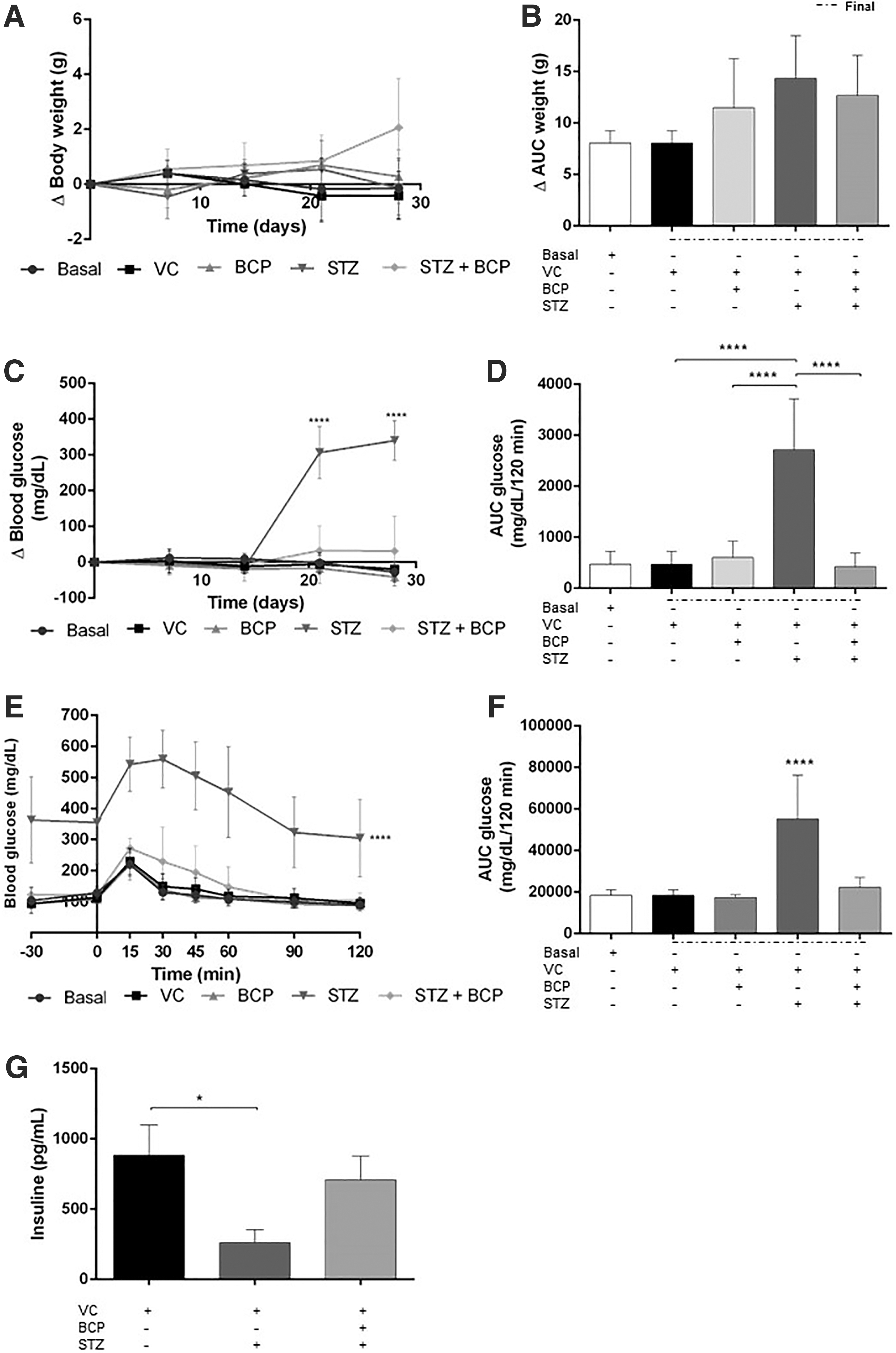
BCP effect on glucose metabolism.
Anxiety and depression test
Figure 3A shows marbles test results; the STZ group presented nine touches, being higher than values presented by the basal group (6.3 touches) and the VC group (6.4 touches), without significant difference. A significant increase (P < .01) of 53.0% occurred when comparing the BCP group with the STZ group. BCP administration to the STZ+BCP group showed a tendency to decrease the number of touches, without significance. The VC and STZ groups, in the forced swim test (Fig. 3B), did not present a significant difference. However, there was an increase in the immobility of 31.0% between the BCP group and the STZ group. BCP administration (10 mg/kg) showed a 16.0% decrease by the STZ+BCP group compared with the STZ group, without significant difference. Tail suspension test (Fig. 3C) turns out to be more conclusive to verify depression behavior. Statistically (P < .05), BCP administration (10 mg/kg) shows a decrease of 28.0% of immobility with respect to VC. As was also observed in the forced swim test, in the evaluation of the suspension of the tail, there was a statistically different increase (P < .001) in the immobility time of 42.0% between the BCP and STZ groups. The anxiogenic effect observed by the STZ group was reversed significantly (P < .01) by 23.0% after 10 mg/kg BCP chronic administration.
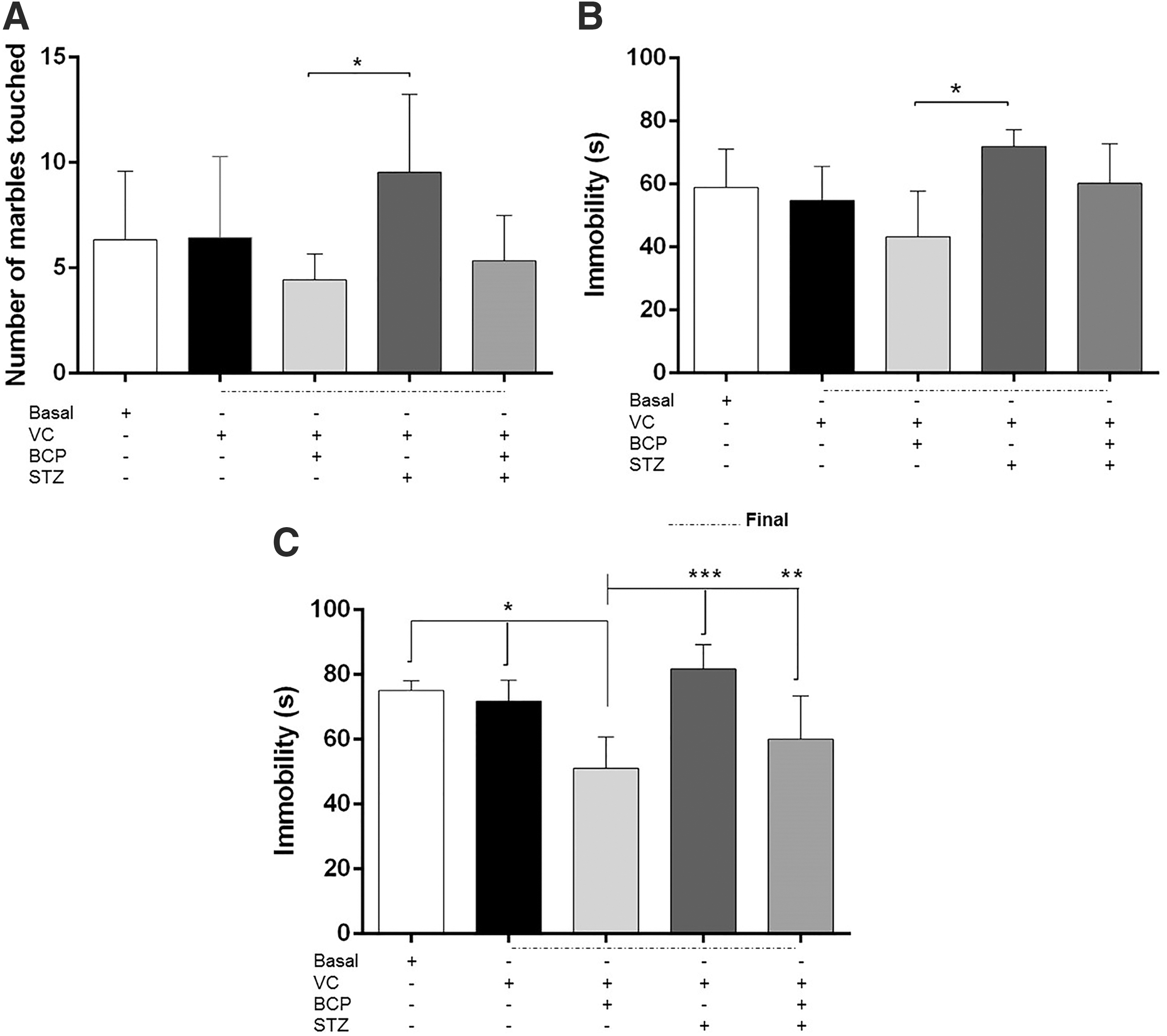
Anxiety and depression tests.
Nociception tests, substance P, and proinflammatory cytokines
In von Frey filament test (Fig. 4A), the STZ group presented a significant increase (P < .001) in the pain threshold of 53.0% compared with the basal group. In Figure 4A, a significant reversal (P < .001) of 94.0% can be observed in the STZ group administered orally with 10 mg/kg of BCP with respect to the STZ group. In the deltas chart (Fig. 4B), it was observed that intolerance to a painful stimulus was registered by the STZ group compared with the other groups. SMALGO test showed a similar trend to the von Frey filaments test. Statistically significant differences (P < .0001) existed between STZ and the other research groups (Fig. 4C). In Figure 4D, it can be seen that the highest delta value was presented by the STZ group compared with the basal group, so this group presented a greater perception of pain. Mice belonging to the STZ group evaluated by hot plate test (Fig. 4E) showed a significant decrease (P < .0001) of 43.0% with respect to the basal group in pain tolerance, that is, they presented a high threshold before the stimulus. Deltas in Figure 4F showed a greater decrease in VC and STZ groups. Values obtained for substance P are shown in Figure 5A. The STZ group showed a high concentration of substance P (405.9%) compared with control group concentration. After 45 days of treatment of STZ+BCP, there was a significant decrease in the amount of substance P (176.8%). Proinflammatory cytokines such as IL-1β (Fig. 5B), TNF-α (Fig. 5C), and IL-6 (Fig. 5D) are related to the development and establishment of NP. 6 IL-1β values of the STZ group were 471.7%, whereas a significant decrease in the STZ+BCP group was observed when 10 mg/kg BCP was administered. The STZ group showed high values of TNF-α (868.0%) compared with the VC group (121.1%), whereas the STZ+BCP group showed a significant decrease (P < .0001). This same behavior was presented by the other cytokines. Serum concentration of IL-6 in the mice of the STZ group was 435.9%, and it was much higher than the VC group concentration (134.5%). Pearson's correlation is shown in Figure 6. The relationship between nociceptive and depression tests shows a negative significant correlation (Fig. 6A) between hot plate test and tail suspension test (r = −0.9367; P < .0189). A higher concentration of substance P is related to a low tolerance for pain (Fig. 6B). High correlations were obtained between substance P and cytokines IL-6 (Fig. 6C) (r = 0.7436; P < .0001) and IL-1β (Fig. 6D) (r = 0.8078; P < .0001). TNF-α presented low correlation with respect to substance P (Fig. 6E).

Mechanical and thermal nociception tests:
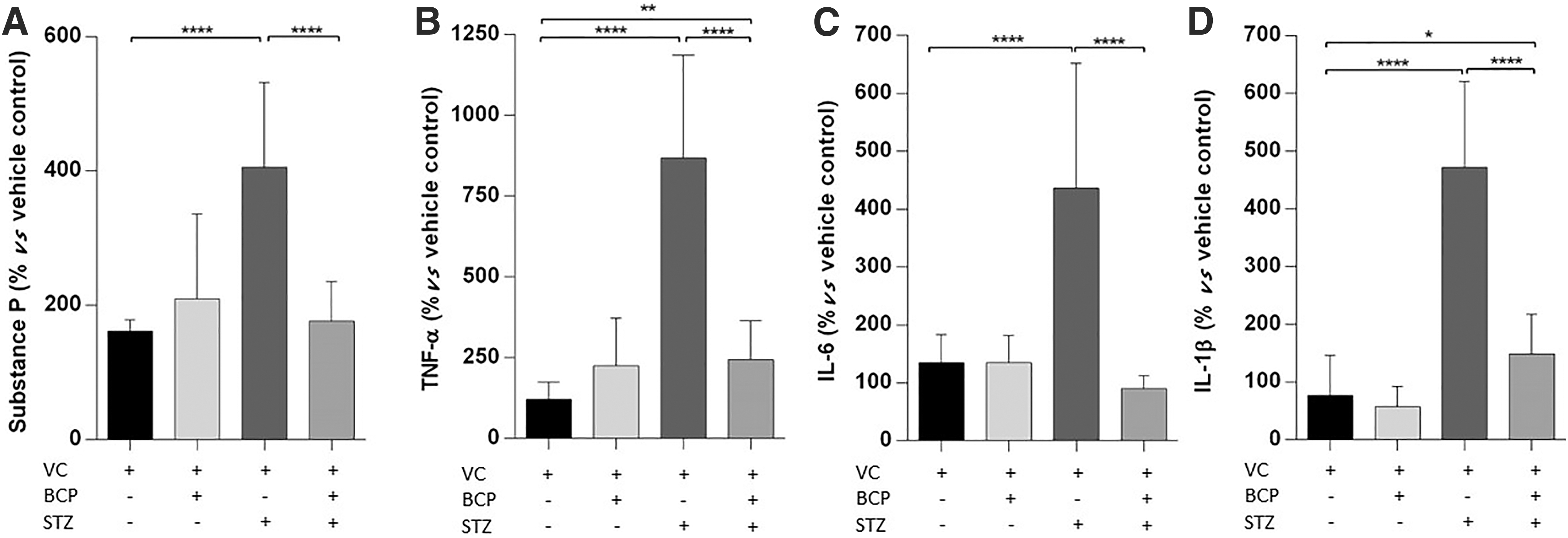
Chronic administration effect of BCP on substance P
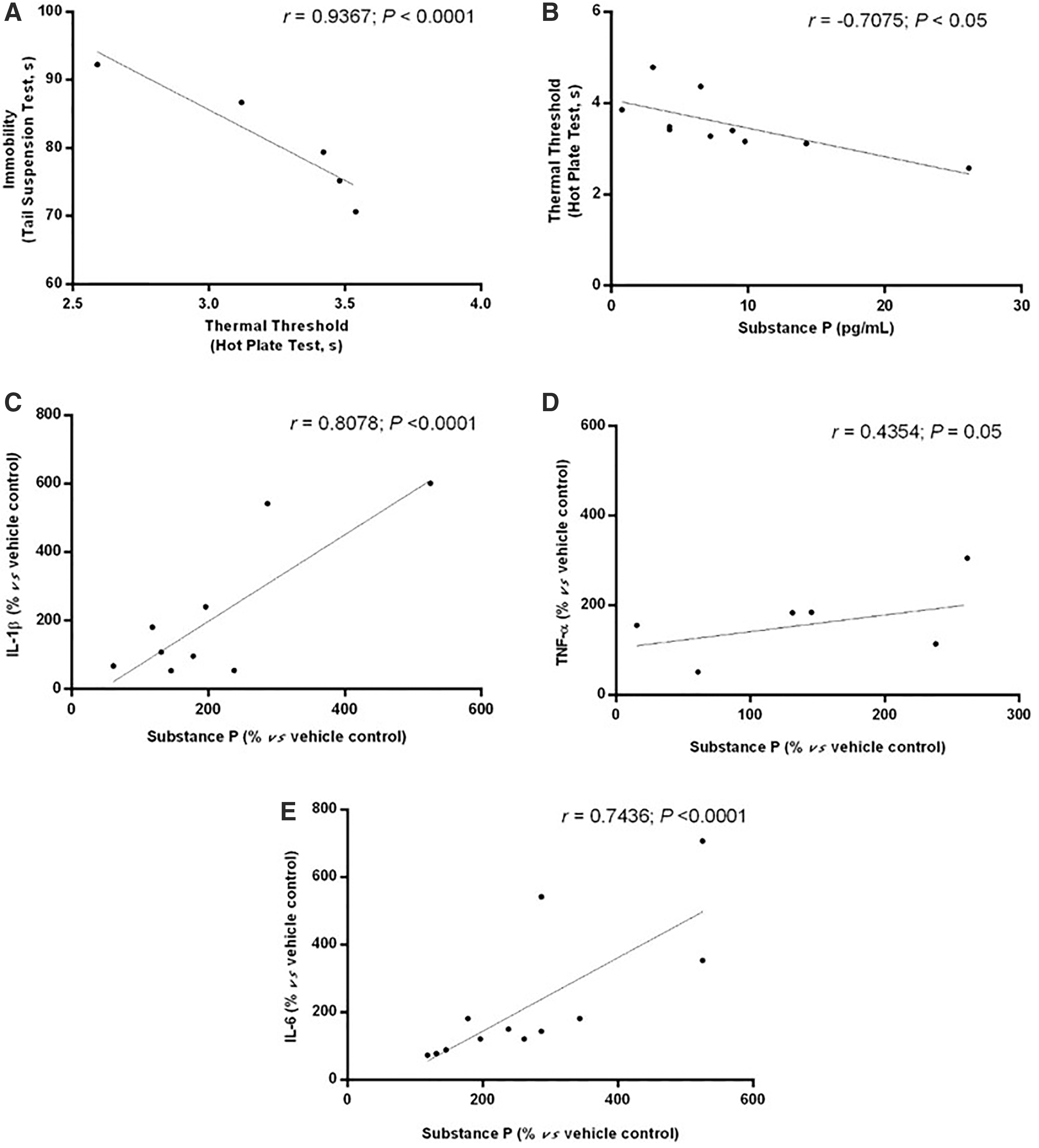
Pearson's correlation test.
Discussion
The STZ chemical structure is constituted by a portion similar to the glucose structure; this is why it can interact with glucose transporter type-2 (GLUT-2) glucose receptors of the pancreatic membrane and go inside the cell promoting oxidative stress that releases reactive oxygen and nitrogen species that damage genetic material and promote cellular apoptosis and insulin release decrease. 19 Insulin insufficiency promotes hyperglycemic stages and diabetes development. High blood glucose levels generate a metabolic imbalance by releasing polyols through the aldose reductase pathway. 5 In this work, it was observed that BCP administration decreased blood glucose levels and increased insulin levels in animals with hyperglycemia. The decrease is mainly due to insulin secretion by BCP administration, an agonist to CB2R. It has been determined that CB2R is present in pancreatic β cells and the use of an agonist to it, as is the case of BCP, calcium channel regulates insulin secretion. 20 –23 BCP effect could reduce oxidative stress and inflammation, those responsible for β cell damage presented in STZ-induced diabetic rats, which improved quality of these cells and insulin secretion. 22 The administration of this phytopharmaceutical (BCP) turns out to be a proposal to mitigate the effects promoted by diabetes and mainly in the development of NP. NP development produced by diabetes is due to neuronal dysfunction, high excitability in the spinal horn, and a low function of inhibitory neurons. 8 NP greatly impacts the patient's quality of life, displaying painful thermal, electrical, and sharp sensations. 24 In our work, mice administered with STZ developed mechanical allodynia. Dogrul et al. 25 also reported the development of mechanical allodynia at the end of 45 days after experimental diabetes with 200 mg/kg of STZ via IP in BALB/c female mice. Regarding thermal sensitivity in diabetic animals, results can be variable, since some researchers report thermal hyperalgesia, 26 whereas others report no changes in thermal sensitivity beyond 8 weeks of diabetes 27 or even report hypoalgesia. 8 Endocannabinoids, phytocannabinoids, and CB2R agonist have been shown to have an antinociceptive effect in animals with acute, inflammatory, and NP. 28,29 BCP does not have side effects and has been shown to have anti-inflammatory effects in some pain models. 30,31 BCP (10 mg/kg) administration in our study showed a decrease in pain threshold. BCP characteristics enable it to have important advantages against usual treatments for NP treatment such as gabapentin and tricyclic antidepressants. It is well established that CB2R is present in immune cells and it has neuroimmune, anti-inflammatory, analgesic, and neuroprotective effects in experimental models of neuropathy. 32 Its activation in glial cells allows the release of inflammatory mediators such as IL-1β, TNF-α, and IL-6, which sensitize peripheral and central neurons and performance of persistent pain. 6,31 –33 The microglia present in CB2R can be activated by ligands related to these such as the BCP, modulating inflammation and secretion of proinflammatory cytokines 12 ; substance P is a pain-related neuromodulator released into sciatic nerve, dorsal root ganglion, and spinal cord. 34 The decrease of this substance when administering BCP promoted analgesia. The association between NP and development of emotional disorders has been established in rodents, 6,8 making it more complicated to treat the comorbidity of NP and depression alone. 35 An investigation group showed that immobility time (forced swim test) was correlated with the mechanical sensitivity; for this reason, they concluded that the depressive-like behavior of the animals was related to the development of pain due to diabetes. 6,8 According to our results in the depressive-like behavior test, pain test, and glycemic test, BCP could be considered in the treatment of neuropathy and depression development in patients with diabetes.
Footnotes
Acknowledgments
This research work was supported by Immunopharmacology Laboratory, Guadalajara University; Postgraduate in Sciences in Biotechnological Processes, Guadalajara University; and National Council for Science and Technology (CONACYT 239231).
Author Disclosure Statement
No competing financial interests exist.