




Abstract
We developed low temperature-aged garlic (LTAG) to remove its unique and spicy flavor and evaluated the anti-fatigue properties of LTAG against exercise-induced fatigue in mice. In the results, the treadmill running time to exhaustion in the mice fed LTAG was prolonged compared with the control. There was significant difference in blood parameters of glucose, lactate, lactate dehydrogenase (LDH), and free fatty acid (FFA) concentration between the LTAG-fed mice and the control. In addition, LTAG effectively increased the content of glycogen and creatine kinase and the activity of antioxidant enzymes in the muscle. The mechanism underlying the anti-fatigue activity of LTAG is hypothesized to involve increase in postexercise tissue glycogen accumulation to improve the aerobic and anaerobic exercise capacity. LTAG may have an ergogenic effect on endurance exercise while decreasing the levels of FFA, LDH, and lactate, which are associated with the anti-fatigue effect. Thus, LTAG has potential as a pharmacological anti-fatigue agent.
Introduction
Fatigue is tiredness resulting from a physical or mental exertion wherein the physical and mental capacities are reduced; this is classified as physical and mental fatigue. Physical fatigue, such as that caused by exercise, is the feeling of lethargy owing to the accumulation of a variety of substances in the blood. 1,2 Mental fatigue, such as that caused by extended cognitive activity, emotional conflict, anxiety, or malaise, refers to a transient state of lethargy, somnolence, or decreased attention. 3,4 Such fatigue deteriorates the performance of the body and can lead to illnesses such as liver dysfunction, diabetes, and gastrointestinal diseases. 5,6
There are various theories regarding the mechanisms underlying physical fatigue, including exhaustion, clogging, and the radical theory, among others. The exhaustion and radical theories have attracted the most interest. The exhaustion theory refers to the exhaustion of various energy sources, including glucose and glycogen, during exercise, resulting in physical fatigue. 7 The radical theory proposes that intense exercise can lead to an imbalance between the body's oxidative and antioxidative systems; it has previously been demonstrated that oxidative stress is one of the factors leading to fatigue. 8 High levels of oxidative stress lead to the excessive generation of reactive oxygen species (ROS), which are highly reactive molecules that cause lipid peroxidation in membrane structures and damage cellular structures. The release of ROS could result in lipid peroxidation in the mitochondrial membrane. Damaged mitochondria were observed to reduce cellular respiration and adenosine triphosphate (ATP) generation, and are suggested to be a primary cause of fatigue. 9 Several studies have demonstrated that exogenous antioxidants can reduce the contribution of exercise-induced oxidative stress. 10,11 Recently, researchers have been seeking natural components that improve athletic ability and accelerate the elimination of fatigue. 12 –14
Garlic (Allium sativum L.) is one of the most popular vegetables worldwide; it is often used as a spice in Asian and Mediterranean foods and has long been used in traditional medicine because of its diverse health benefits, including antibacterial, 15 anticancer, 16 antioxidant, 17,18 and hypotensive 19 properties. Garlic has also been the subject of study because of its endurance and stamina-enhancing effects. 20 The major components involved in garlic's stamina-enhancing effect are scordinin and allicin. 21 Allithiamine, the combination of allicin and vitamin B1, breaks down carbohydrates to produce energy, stimulates metabolism, is effective in alleviating fatigue, 22 and has a stronger effect than natural vitamin B1. 23 Hence, if we take water-soluble vitamins and garlic together after exercise, they will have a great effect in reducing fatigue. 21 However, because of the strong aroma and pungent taste of raw garlic, it gives a sense of rejection when consumed. To overcome these factors, research methods have been developed to remove or conceal the strong flavor and spicy taste while maintaining the physiological activity of garlic. The typical method is heat treatment or modifying the aging period. 24 –26 Several studies have reported that aged garlic extract protects against fatigue. 27,28 Morihara et al. 27 reported the ameliorating effect of aged garlic extract on physical fatigue through the turnover of aerobic glucose metabolism, attenuate oxidative stress, and increase oxygen supply based on vasodilation. Ushijima et al. 28 compared anti-fatigue effect of raw garlic juice, heated garlic juice, processed garlic powder, and aged garlic extract. Although several studies have evaluated the anti-fatigue effect of aged garlic, there have been few studies on the anti-fatigue effects of low temperature-aged garlic (LTAG) extract and the anti-fatigue mechanism of LTAG extract remain unclear. Therefore, this study aimed to evaluate the anti-fatigue properties of LTAG extract on exercise and endurance capacity in mice.
Materials and Methods
Preparation of LTAG extract
Garlic was purchased from Uiseong-Gun, Gyeongsangbuk-do, Korea. It was stored in a sealed container and the aging treatment was performed under the following conditions: the aged garlic at 60°C for 60 days was peeled and lyophilized, then pulverized with a Philips mini blender (HR 2860; Yahorng Electronic Co., China) for 10 min. Subsequently, 5 g LTAG powder was added to 200 mL of 70% EtOH and ultrasonic extraction was performed for 30 min. After standing at room temperature for 1 h, the supernatant was recovered. This was repeated three times and then filtered (Whatman No. 2 filter paper). The 70% EtOH extract of LTAG was concentrated under vacuum at 45°C (EYELA N-1000; Tokyo Rikakikai Co., Ltd., Tokyo, Japan), and then the concentration lyophilized with a Bondiro Lyophpride freeze dryer (Ilshin Lab Co. Ltd., Yangju, Korea) at −70°C under reduced pressure (<20 Pa). The dry residue was stored at −70°C. For the raw garlic extract, the same process was used except for the aging process using the same batch of garlic.
Reagents
Assay kits used for the determination of blood glucose, lactate dehydrogenase (LDH), lactate, free fatty acid (FFA), glycogen, and creatine kinase (CK) were purchased from Abcam (Cambridge, United Kingdom). All other reagents used in this study were of analytical grade.
Animals and treatment
The 6-week-old male ICR mice were purchased from Orient Bio, Inc. (Seongnam, Korea). All animal experiments were approved according to the guidelines of the Institutional Animal Care and Use Committee of the National Institute of Agricultural Sciences (NIAS201602), and all procedures were conducted in accordance with the Animal Experiments Guidelines of the National Institute of Agricultural Sciences. The mice were housed under a controlled temperature (23°C ± 3°C) with a relative humidity of 40–60% and 12 h light/dark cycles. Food (rodent diet 5L79; Orient Bio, Inc.) and water were provided ad libitum.
After 1 week of acclimation, the animals were divided randomly into six groups (n = 10) as follows: (a) normal group (administered phosphate-buffered saline [PBS] with no exercise); (b) control group (administered PBS with exercise); (c) low-dose raw garlic extract (200 mg/kg)-treated group with exercise (raw 200); (d) high-dose raw garlic extract (500 mg/kg)-treated group with exercise (raw 500); (e) low-dose LTAG extract (200 mg/kg)-treated group with exercise (LTAG 200); and (f) high-dose LTAG extract (500 mg/kg)-treated group with exercise (LTAG 500). The mice in each group were orally administered with the extract or PBS for 28 days.
The mice in each group were forced to run on the treadmill for 4 weeks. The pattern of loaded exercise consisted of forced running as follows: During the first week, 20 m/min for 5 min, 25 m/min for 5 min, and 30 m/min for 5 min; during the second week, 20 m/min for 5 min, 25 m/min for 10 min, and 30 m/min for 5 min; during the third week, 20 m/min for 5 min, 25 m/min for 15 min, and 30 m/min for 15 min; during the fourth and final week, the speeds used for determination of the exhaustion were 30 m/min during the 50 min.
Exhaustive treadmill test
The exhaustive treadmill test evaluated the effects of LTAG extract on exercise durability in mice. After 28 days of treatment, 5 mice from each group were subjected to the exhaustive treadmill capacity test. At 30 min after the final treatment, the mice were placed individually onto treadmills. The exhaustive treadmill capacity test increased the treadmill speed from 15 to 40 m/min every 3 min, and the running time was monitored until the mouse failed to follow the speed increase on three consecutive occasions and lag occurred, at which point the total running time was immediately recorded. 29
Analysis of the biochemical parameters of blood and gastrocnemius muscle
The effect of LTAG on the levels of glucose, FFA, LDH, and lactate in the blood was evaluated immediately after exercise. At 1 h after the last oral administration with the extract or PBS, the mice underwent a 60-min treadmill exercise. After the treadmill exercise, the mice were killed with CO2. Blood samples were collected from the abdominal aorta with heparinized syringes. Immediately after blood collection, the gastrocnemius muscle was isolated and rapidly frozen in liquid nitrogen, then stored at −70°C before tissue analysis. The plasma was prepared by centrifugation at 850 g at 4°C for 15 min (GZ-1730MR; Gyrozen Co. Ltd., Daejeon, Korea). The concentration of blood glucose, FFA, lactate, and LDH activity in plasma and glycogen and CK in muscle were determined by detection kits according to the instructions.
Quantitative real-time polymerase chain reaction and analyses of antioxidant gene expression
The total RNA was isolated from muscle tissue using an RNA extraction kit (Qiagen, Valencia, CA, USA) according to the manufacturer's instructions. cDNA was synthesized from 500 ng of total RNA using M-MLV Reverse Transcriptase (Promega, Madison, WI, USA). The real-time polymerase chain reaction (RT-PCR) reaction was performed using 2 × SYBR® Green Master mix (Qiagen) and specific primers for the indicated antioxidant enzyme-related genes: superoxide dismutase (SOD) and glutathione peroxidase (GPx). All results were normalized to those of housekeeping gene, glyceraldehyde 3-phosphate dehydrogenase.
Statistical analysis
Statistical analyses were performed using the SPSS v12.0 software (SPSS, Inc., Chicago, IL, USA). Data are represented as the mean ± standard error of the mean from three independent experiments, unless stated otherwise. Differences between groups were analyzed by one-way analysis of variance test followed by Tukey's post hoc least significant difference test and P < .05 was considered to indicate a significant difference.
Results
Effect of LTAG treatment on body weight and food intake
We evaluated the general characteristics of the mice by LTAG extract treatment, with body weight, observing behavior, and food intake. As presented in Figure 1, body weight was unaltered in all groups over the duration of 4 weeks. In addition, daily intake of diet did not differ in the normal, control, and garlic treatment groups, and no noticeable side effects were observed.
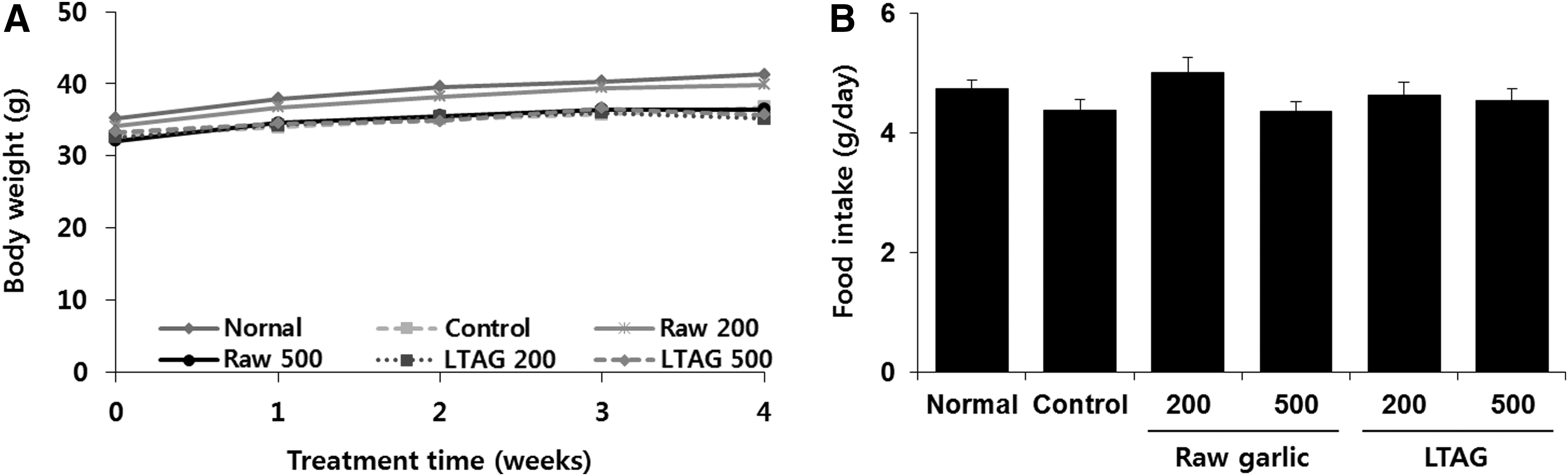
Effect of LTAG extract on
Effect of LTAG treatment on the exhaustive treadmill test
We selected an exhaustive running test to assess the degree of physical fatigue, wherein the length of the exhaustive running time indicates the degree of fatigue. The effects of raw garlic and LTAG extract on the running time of mice are presented in Figure 2. The groups treated with LTAG showed a significant increase in their running time compared with the control group. The running time of 200 and 500 mg/kg LTAG groups increased by 65.4% and 104.1%, respectively. The results indicated that the LTAG extracts intake could increase exercise endurance in mice and that LTAG extracts had anti-fatigue effects.
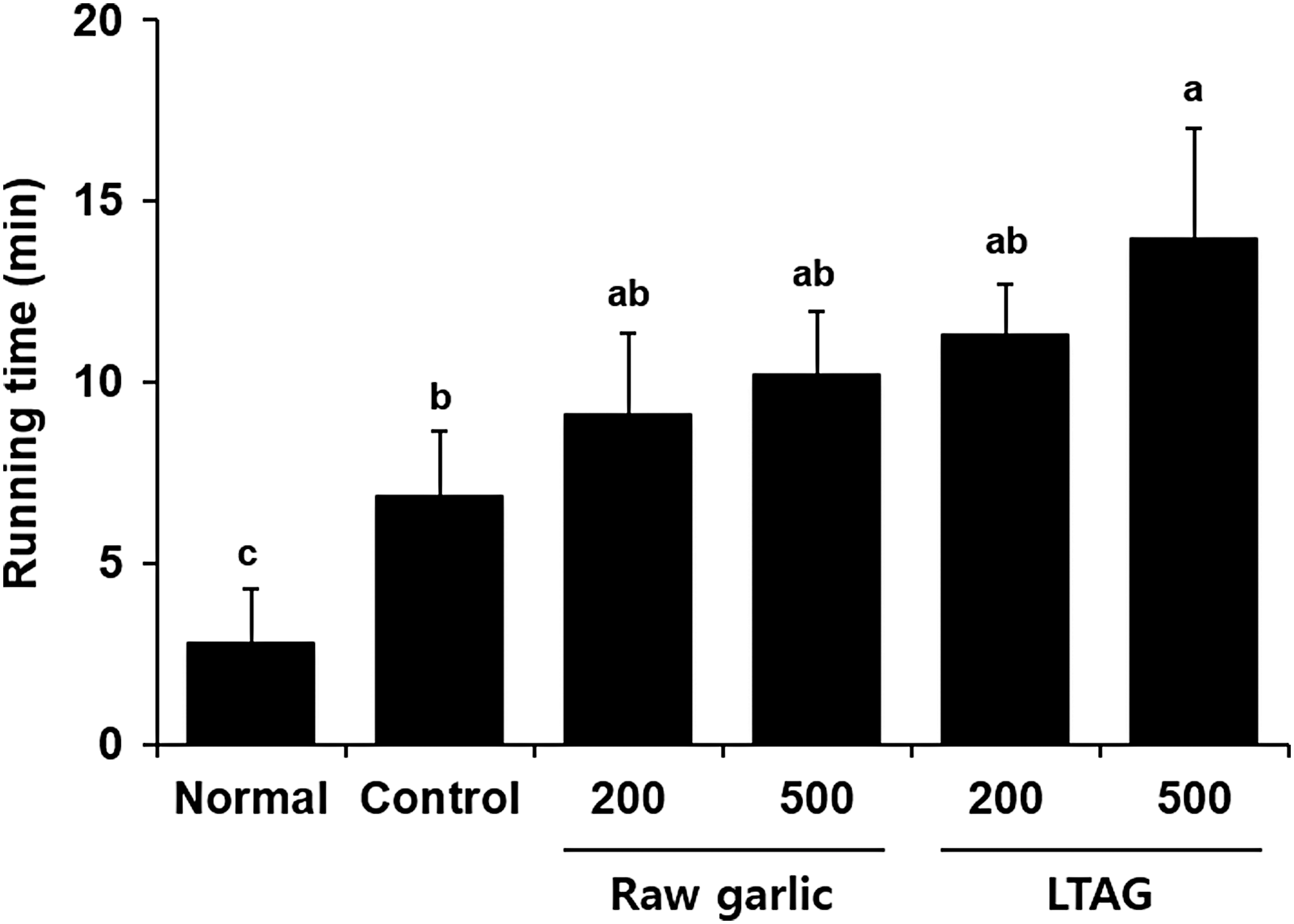
Effect of LTAG extract on exhaustive treadmill test performance in mice. Data are expressed as mean ± SEM (n = 5). Different letters (a–c) above the bars indicate significant differences at P < .05.
Effect of LTAG treatment on plasma biochemistry
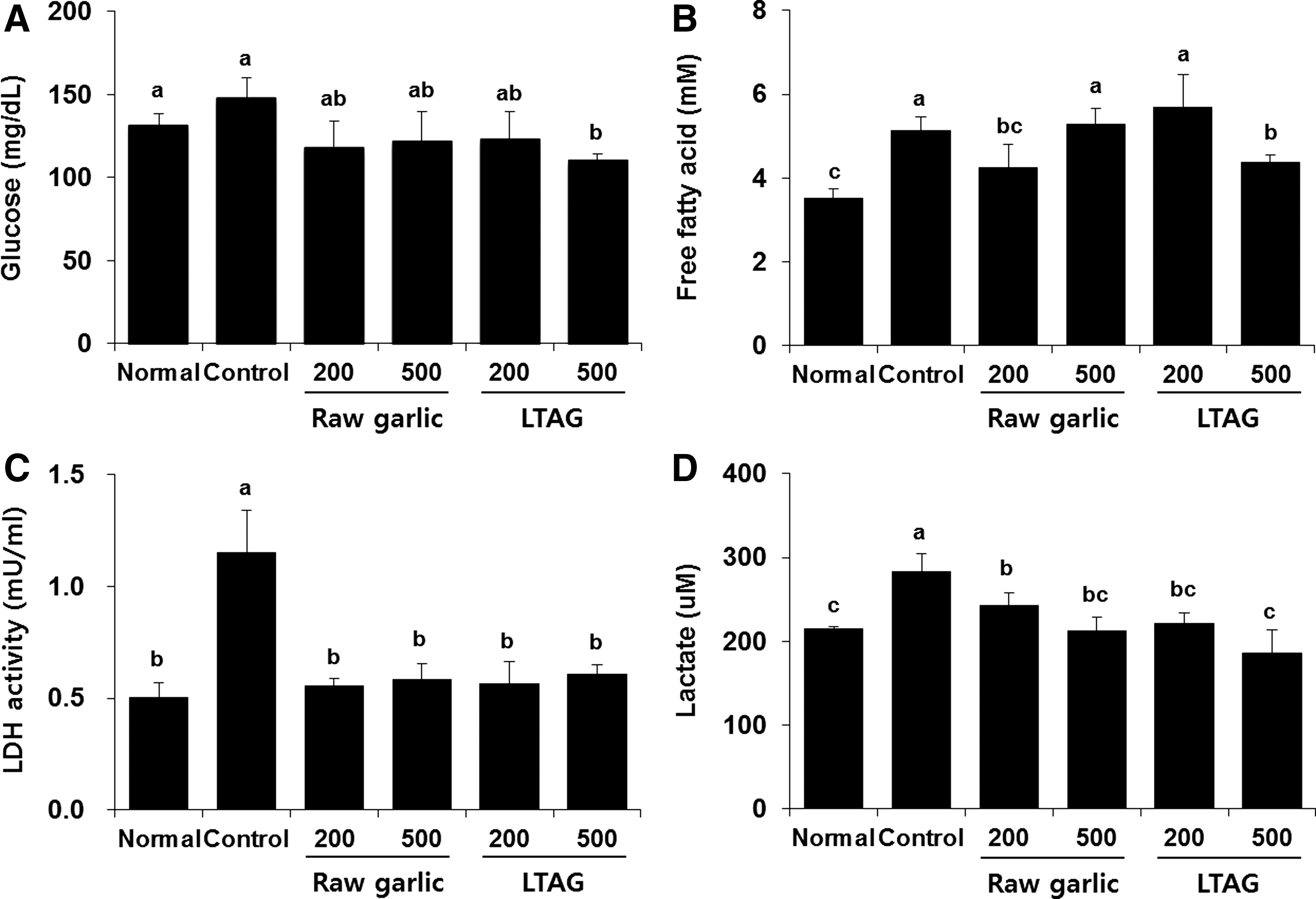
Biochemical analysis results of the plasma from each group are presented in Figure 3. The plasma glucose levels were lower in the 500 mg/kg LTAG-treated group than in the control group. The plasma glucose levels in the raw garlic and 200 mg/kg LTAG-treated groups tended to be slightly lower than those in the control group; however, no statistically significant differences were observed (Fig. 3A).
Effect of LTAG extract on
There was no significant difference in the plasma FFA level between the raw garlic or LTAG-treated groups and the control group, with the exception of the 500 mg/kg LTAG group, which exhibited significantly lower FFA levels than those in the control group (Fig. 3B).
During periods of extended and vigorous exercise, excess lactate accumulates in the body. Lactate can be used as an indicator of intense exercise and fatigue. 30 The effects of raw garlic and LTAG extract on the LDH activity and lactate content after running are giving in Figure 3C and D. Raw garlic and LTAG extract significantly decreased the LDH activity and lactate content. We found that plasma LDH activity was reduced by 51.6% and 49.3%, 50.9% and 47.3%, in the 200 and 500 mg/kg raw garlic, 200 and 500 mg/kg LTAG groups, respectively, as compared with that in the control group (Fig. 3C). Plasma lactate levels were reduced by 14.1%, 24.9%, 21.9%, and 34.1%, in the 200 and 500 mg/kg raw garlic, 200 and 500 mg/kg LTAG groups, respectively. Raw garlic and LTAG extract treatment reduced lactate levels in a dose-dependent manner (Fig. 3D).
Effect of LTAG treatment on gastrocnemius muscle parameters
The importance of muscle glycogen levels in endurance exercise has previously been verified, and the depletion of muscle glycogen is a factor in fatigue and exhaustion. 31
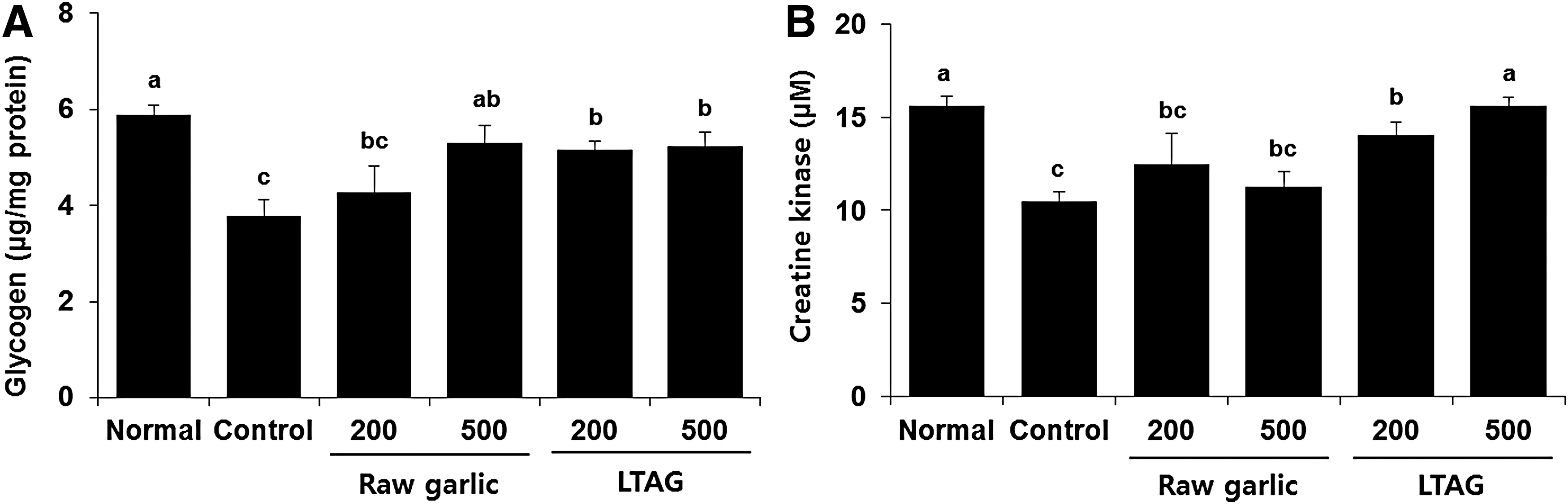
As given in Figure 4A, after vigorous exercise, the muscle tissue glycogen content in the LTAG-treated groups was higher than that in the control group. Muscle glycogen levels significantly increased by ∼1.4-fold upon LTAG treatment.
Effect of LTAG extract on gastrocnemius muscle
Muscle CK is known to be an accurate indicator of muscle damage. 32 As given in Figure 4B, the CK levels in mice significantly increased in the LTAG extract-treated mice compared with that in the control mice. There were no significant changes in the CK levels for the raw garlic extract-treated groups.
Effect of LTAG treatment on antioxidant enzyme expression in muscle
ROS are produced during normal metabolism and perform a variety of physiological functions; however, excessive oxygen production through intense exercise can cause peroxidation of the membrane lipids and lead to intracellular tissue and DNA damage. 33
We assessed whether increased exercise endurance by LTAG treatment were associated with antioxidant enzymes such as SOD and GPx using RT-PCR and western blot. As indicated in Figure 5 and Supplementary Figure S1, raw garlic and LTAG treatment significantly increased SOD and GPx expression compared with the control group. Both LTAG 200 and 500 mg/kg groups were significantly different from control group, and there was no significant difference between the two concentrations.

Effect of LTAG extract on the mRNA expression the antioxidant enzymes
Discussion
In this study, the effects of LTAG extract on exercise performance and fatigue were investigated in mice. To confirm the anti-fatigue effects of LTAG extract and its mechanisms, the mice were subjected to an exhaustive running test and biochemical parameters related to fatigue, including glucose, FFA, LDH activity, lactate, tissue glycogen, CK, SOD, and GPx were determined.
The length of the exhaustive running time indicates the degree of fatigue. 29,34 As a result of the exhaustive running test, we confirmed that mice treated with LTAG extract had longer exhaustive running times than the control mice.
The occurrence of fatigue during intense exercise is closely associated with the depletion of glycogen, both in the liver and muscle. 35 Glycogen storage is an important energy source, particularly during exercise, and serves a central role in maintaining glucose homeostasis by supplementing the blood glucose. 36 Fatigue occurs when the stored glycogen is almost exhausted. Thus, glycogen is used as an accurate marker for fatigue, and increased glycogen is closely associated with improved endurance and anti-fatigue effects. 37 In this study, the muscle glycogen concentrations in the mice of the LTAG-treated groups significantly increased compared with those of the control group (Fig. 4A).
Various biochemical parameters, including lactate, ammonia, glucose, and CK, are important markers of muscle fatigue during exercise. 38 Lactate is an endogenous metabolite of the anaerobic reaction produced by the reduction of pyruvate, and its concentration in body fluids increases during intense exercise. 39 Conversely, human tissues perform optimally within a narrow pH range; thus, if the pH is lowered because of increased lactate in the muscle and blood, and acidification occurs, mitochondrial function is disturbed and the muscle energy production capacity is inhibited. Consequently, muscle contraction becomes difficult, and thus muscular strength is weakened. After the administration of LTAG extract, plasma lactate levels were significantly decreased compared with that of the control group (Fig. 3D). Therefore, LTAG extract decreased glycogen utilization and lactate production in mice during exercise, suggesting that the anti-fatigue effect of LTAG extract is associated with improvements in energy metabolism activation.
In addition, LDH regulates lactate formation and conversion through reducing pyruvate during anaerobic metabolic processes in muscle. LDH is a specific enzyme in the blood used as an index to evaluate the energy metabolic pathways mobilized during exercise. It allows evaluation of metabolic function adaptation during energy metabolism, exercise intensity, exercise duration, muscle rigidity, fatigue recovery, and excessive training, and is used to evaluate histological damage in muscle tissue and assess physical fitness. 40 In this study, we confirmed that the LTAG extracts decreased blood lactate levels by decreasing blood LDH activity, which is increased by exercise (Fig. 3C, D). Through this mechanism, it is considered that LTAG extracts prevent the depletion of energy sources required for exercise, thereby reducing the excessive accumulation of fatigue substances such as lactate and alleviating muscle fatigue.
CK is known to be an accurate indicator of muscle damage. The function of CK is to add a phosphate group to creatine and convert it into the high-energy molecule phosphocreatine, which is then burned as a fast energy source by the cells. 32 However, the normal function of CK is not associated with what happens to CK in the event of muscle damage. During muscle degeneration, muscle cells are dissolved and their contents enter the bloodstream. Most of the body's CK is present in muscle. When the muscle damage has occurred or is occurring, 41 muscle CK comes out into blood. Therefore, muscle CK is decreased and blood CK is increased in muscle damage status. As given in Figure 4B, the muscle CK levels in mice were significantly decreased compared with the control, whereas the blood CK levels were significantly increased (Supplementary Fig. S2). There were no significant differences between the high and low LTAG treatment groups for these two biochemical parameters. Combined, these data suggest that the administration of LTAG extract can alleviate fatigue in mice during exercise.
ROS serve a role in exercise-induced protein oxidation and contribute to muscle fatigue. 8 Muscle cells contain two main classes of endogenous cellular defense mechanisms to eliminate ROS. The primary antioxidant enzymes include SOD and GPx. SOD helps the superoxide radicals break down into H2O2 and O2. 42 GPx reduces H2O2 or organic hydroperoxides to water and alcohol, respectively. 43 These antioxidant defense mechanisms are attenuated in chronic fatigue and other disease states. 44 Therefore, enhancement of these defense mechanisms could assist in overcoming fatigue. As presented in Figure 5, SOD and GPx expression levels in the muscle tissue of the LTAG-treated group were higher than those in the control group. The results support the hypothesis that LTAG can promote the activity of these antioxidant enzymes and exert an anti-fatigue effect.
The mitochondrion plays an important role in oxidative stress. 45 Decreased SOD and GPx activity leads to mitochondrial DNA (mtDNA) damage. 46,47 The mtDNA copy number is thought to be a representative marker of mitochondrial function. 48 Mitochondrial transcription factor A (TFAM) is a key transcription factor for the regulation of mitochondrial gene transcription and a direct regulator of mtDNA duplication. 49 Nuclear respiratory factor 1 (NRF-1) initiates the synthesis of mitochondrial proteins, such as mitochondrial import proteins, heme biosynthesis proteins, components of the electron transport chain complexes, cytochrome c, and TFAM as a positive regulator of transcription. 50 Thus, mitochondrial function in muscles contributes to exercise-induced fatigue. To evaluate mitochondrial function, we confirmed mtDNA copy number, mRNA expression of TFAM and NRF-1 were measured. In this study, we found LTAG could improve mitochondrial function by restoring the mtDNA content and increasing the mRNA expression of NRF-1 and TFAM (Supplementary Fig. S3), thereby suppressing oxidative stress and generating more ATP for energy supplement. This might be a potential mechanism of the anti-fatigue effects of LTAG.
According to Moreno et al., 51 the amadori compound obtained in the first step of the Maillard reaction of the aged garlic extract has antioxidant activity. And also, Cardelle-Cobas et al. 52 have also reported that amadori compounds produced from the browning reaction of garlic and onion have antioxidant properties. In this respect, functionalities have been reported on the components of garlic during the aging process, and they are thought to affect the anti-fatigue effect through oxidative stress inhibition. However, it is necessary to carry out an in-depth study on the aged garlic compounds that exert the anti-fatigue effect in the future.
In conclusion, this study confirmed that LTAG extract exhibits anti-fatigue effects by reducing plasma LDH activity, lactate concentration, and muscle glycogen utilization, and that it also enhances exercise performance in mice. The bioactive compounds of the extract and the mechanism underlying the anti-fatigue effects are yet to be elucidated, but this study provided evidence to support the anti-fatigue effect of LTAG. Thus, LTAG could be a useful anti-fatigue agent and an ergogenic aid.
Footnotes
Acknowledgments
This study was supported by the “Research Program for Agricultural Science & Technology Development (Project No. PJ01094202),” National Institute of Agricultural Sciences, Rural Development Administration, Republic of Korea.
Author Disclosure Statement
No competing financial interests exist.
References
Supplementary Material
Please find the following supplemental material available below.
For Open Access articles published under a Creative Commons License, all supplemental material carries the same license as the article it is associated with.
For non-Open Access articles published, all supplemental material carries a non-exclusive license, and permission requests for re-use of supplemental material or any part of supplemental material shall be sent directly to the copyright owner as specified in the copyright notice associated with the article.
