




Abstract
This study was designed to determine whether the ethanol extract of Artemisia princeps could inhibit the cariogenic activity of Streptococcus mutans. The increase in acid production and biofilm formation by S. mutans were evaluated. The expression levels of virulence factor genes were determined by performing the real-time polymerase chain reaction (PCR). The bactericidal effect was tested by confocal laser scanning microscopy. The A. princeps extract was observed to inhibit the growth of S. mutans at concentrations >0.05 mg/mL (P < .05). After using the safranin staining method, we found that the A. princeps extract had an inhibitory effect against biofilm formation at a concentration of >0.05 mg/mL. These experimental results were similar to that observed with the scanning electron microscopy. The results of the confocal microscopy revealed that the A. princeps extract at high concentrations of 0.4–3.2 mg/mL showed a bactericidal effect in a concentration-dependent manner. According to the results of the real-time PCR analysis, it was observed that the A. princeps extract inhibited the expression of virulence factor genes. These results suggest that A. princeps may inhibit the cariogenic activity of S. mutans, and may be useful as an anticariogenic agent.
Introduction
Despite today's advanced development of dentistry technology, the prevalence rate of dental diseases is on the rise, and still many people are not free from the pain of oral diseases. The dental caries is one of the most common dental diseases.
Streptococcus mutans is a gram-positive bacteria that has a spherical form, and is regarded as the most important pathogenic bacteria related to the occurrence of dental plaque and dental caries. 1 S. mutans adheres to the surface of teeth, colonizes, and aggregates with other oral bacteria to form dental plaque, which is a type of biofilm. 2 The glucosyltransferases (GTFases) of S. mutans are responsible for the synthesis of water-insoluble glucan, which is a bacterial extracellular polysaccharide synthesized from sucrose. 3 The water-insoluble glucan accelerates the maturation of dental plaque. S. mutans, if present inside the dental plaque, metabolizes carbohydrates remaining on the tooth surface to produce acid, leading to the dissolution of teeth. 4,5
A number of different methods are used to prevent the dental caries. The most representative methods that have been developed so far to prevent dental caries are the fluoride method, plaque control method, and dietary control method. Also, several antiplaque agents are being used to prevent dental caries, 6 but the fact that the dental caries remain one of the major causes of tooth loss indicates that none of these are effective enough to inhibit the occurrence of dental caries. Therefore, it is necessary to develop a new and effective method to prevent dental caries. Many studies are being carried out on medicinal plants that can inhibit the formation of dental plaque and prevent dental caries. 7
Mugwort is a perennial plant that belongs to the Compositae family. It is widely distributed across South Korea. In China, the northeast region of China is famous for mugwart. Mugwort was squeezed into a juice, which was drunk for the treatment of diarrhea, and the mugwort leaf was crushed and applied to the affected area of insect bite and injury in the past. Modern medical science has demonstrated that Artemisia princeps inhibits the growth and proliferation of bacteria. 8,9 A. princeps has been reported to have the effect of inhibiting bacteria, including not only Escherichia coli but also Bacillus subtilis and Bacillus thuringiensis. 10,11 It has been reported that the A. princeps extract has an outstanding antibacterial effect against Staphyloccocus aureus. 12,13
However, there have yet to be enough studies on the inhibitory effect of the A. princeps extract against cariogenic activity. This study evaluated the anticariogenic efficacy or A. princeps extract by measuring the influence of A. princeps on S. mutans' growth, acid production, biofilm formation, bactericidal effect, and the expression of virulence factor genes.
Materials and Methods
Materials
The leaves of A. princeps were purchased from a local drug store, Dae Hak Yak Kuk, in Jeonbuk province of Korea. The identity of the plant was confirmed by Young-Hoi Kim at the College of Environmental and Bioresource Sciences, Chonbuk National University (Jeonju, South Korea). A voucher specimen (no.: 5-22-12) has been stored in the Herbarium of the Department of Oral Biochemistry, School of Dentistry, in Wonkwang University. The dried leaves of A. princeps (300 g) were extracted with 3000 mL of 70% ethanol for 72 h at room temperature, filtered, and evaporated. The yield of ethanol extraction was 13.86 g (4.62%). The ethanol extract was dissolved in dimethyl sulfoxide (DMSO) and diluted to perform the experiment. The final concentration of DMSO (Sigma Aldrich Co., St Louis, MO, USA) was adjusted to 0.1% (v/v). The dose for the negative control group was adjusted to 0.1% DMSO alone.
Bacterial growth and acid production
Bacterial culture was performed by using a modified method of a previous study. 14,15 The growth of S. mutans ATCC 25175 was determined at 37°C in 0.95 mL of brain heart infusion (BHI) broth (Difco Laboratories, Detroit, MI, USA) containing several concentrations of A. princeps extract. In these tubes, 0.05 mL of bacteria was inoculated [final: 5 × 10⁵ colony-forming units (CFU)/mL] and incubated at 37°C for 24 h. Absorbance was determined spectrophotometrically at 550 nm. The pH of the cultures was also estimated by a pH meter (Corning, Inc., Corning, NY, USA). As a positive control, NaF (0.1%) was used. Each concentration of the test extract was measured for three replicates.
Biofilm assay
The biofilm assay was performed according to the method described by a previous study. 16 Various concentrations of A. princeps extracts were added to BHI broth, which contains 1% glucose, in the 35 mm polystyrene dishes or the 24-well plates (Nunc, Copenhagen, Denmark), and then S. mutans (final: 5 × 10⁵ CFU/mL) was inoculated into the culture. After 24 h incubation, the bacterial suspension was removed, and the dishes or the resin teeth in 24-well plates were washed with distilled water. The biofilm formation on the surface of dishes was observed by staining with 0.1% safranin. The bound safranin at the bottom of dishes was released by 30% acetic acid, and the optical density of the solution was determined at 530 nm. The biofilms on the surface of the resin teeth were also stained with 0.1% safranin and observed.
Scanning electron microscopy
Scanning electron microscopic observation was performed by modification of a previously described method. 17 The biofilms that formed on the 35 mm polystyrene dishes were washed with distilled water. The biofilms were fixed with 2.5% glutaraldehyde in 0.1 M sodium cacodylate buffer (pH 7.2) at 4°C for 24 h. The samples were freeze-dried after gradual dehydration with ethyl alcohol gradient series (60%, 70%, 80%, 90%, 95%, and 100%). The biofilms were sputter coated with gold (108A sputter coater; Cressington Scientific Instruments, Inc., Watford, England, United Kingdom) and observed by scanning electron microscopy (SEM) (JSM-6360; JEOL, Tokyo, Japan).
Confocal laser scanning microscopy
To determine the bactericidal effect of A. princeps extracts on S. mutans, live and dead cell staining was performed and observed by confocal laser scanning microscopy. S. mutans was diluted to 1 × 10⁷ CFU/mL and treated with high concentrations (0.4–3.2 mg/mL) of A. princeps extracts. The bacteria were washed with phosphate-buffered saline after 30 min of incubation. According to the manufacturer's instructions, the bacteria were stained with LIVE/DEAD BacLight Bacterial Viability Kit (Molecular Probes, Eugene, OR, USA) for 15 min. Two kinds of fluorescent dyes were contained in the LIVE/DEAD BacLight Bacterial Viability Kit. One is propidium iodide, which penetrates only bacteria with damaged membranes, and the other is SYTO 9, which labels live bacteria. The bacteria stained with fluorescent dyes were observed using confocal laser scanning microscopy (LSM 510, Zeiss, Germany).
Real-time polymerase chain reaction analysis
Real-time polymerase chain reaction (PCR) assay was performed to determine the effect of A. princeps extract on gene expression. S. mutans was cultured under the subminimal inhibitory concentration (sub-MIC; 0.05–0.2 mg/mL) of A. princeps extracts for 24 h. According to the manufacturer's instructions, total RNAs of cultured S. mutans were isolated by using Trizol (Gibco-BRL, Grand Island, NY, USA). The cDNAs were synthesized using Superscript (Gibco-BRL). The primer pairs were synthesized according to the method described by a previous report. 18 –20 The primer pairs are also listed in Table 1. 16S rRNA was used as an internal control. The target cDNAs were amplified with ABI-Prism 7000 Sequence Detection System with Absolute QPCR SYBR Green Mixes (Applied Bio Systems, Inc., Foster City, CA, USA).
Nucleotide Sequences of Primer Used for Real-Time Polymerase Chain Reaction
Phytochemical screening
Phytochemical tests of the extracts were performed as previously described. 21 Mayer's reagent was used for alkaloids, Molish test for glycosides, Liebermann–Buchard reagent for steroids, ferric chloride reagent for phenolics, Mg–HCl reagent for flavonoids, Biuret reagent for peptides, and silver nitrate reagent for organic acids.
Statistical analysis
Statistical evaluation was performed using the Statistical Package for Social Sciences (SPSS, Chicago, IL, USA). All values are expressed as the mean ± standard deviations. All of the experiments were performed in triplicate. The significant differences between the means of the experimental and control groups were evaluated by Student's t-test. Statistical significance was defined as P < .05.
Results
Inhibitory effect of A. princeps extract on S. mutans' growth
After producing the ethanol extract from A. princeps, this study tested its antibacterial effect against S. mutants, and the results are shown in Figure 1. After injecting S. mutans at concentrations of 0.05, 0.1, 0.2, and 0.4 mg/mL into the A. princeps extract, it was found that the A. princeps extract had a bactericidal activity against S. mutans in a concentration-dependent manner. The A. princeps extract significantly inhibited the growth of S. mutans compared with the control group. The strongest inhibitory activity was observed at an extract concentration of 0.4 mg/mL. The positive control group used by this study was 0.1% NaF, which completely inhibited the growth of S. mutans. The mentioned experimental results indicate that the A. princeps extract has an antibacterial activity.

Inhibitory effect of A. princeps extract on S. mutans growth. The bacteria were treated with ethanol extract of A. princeps for 24 h at 37°C. The absorbance was determined by using a spectrophotometer. Values are expressed as mean ± standard deviation. *P < .05.
Inhibitory effect of A. princeps extract on S. mutans' acid production
S. mutans produces organic acid from carbohydrates as a fermentative metabolic product. To conduct an experiment on whether the A. princeps extract inhibits the production of organic acid, this study observed the changes in pH after inserting the S. mutans culture solution to the A. princeps extract. According to the experiment results, the pH level of the culture solution was measured at ∼7.24 before bacteria cultivation, but the pH level of the control group decreased to ∼5.33 after S. mutans cultivation. However, the experimental groups with injected A. princeps extract at concentrations from 0.05 to 0.4 mg/mL inhibited the pH decrease. The positive control group with 0.1% NaF also inhibited the pH decrease (Table 2). The mentioned experiment results indicate that A. princeps inhibits the production of organic acid.
Inhibitory Effect of A. princeps Extract on Acid Production by S. mutans
Negative control (bacteria +0.1% DMSO).
Values (pH) are expressed as mean ± standard deviation.
Positive control (bacteria +0.1% NaF).
P < .05 compared with the control group after incubation.
DMSO, dimethyl sulfoxide.
A. princeps extract inhibits S. mutans' biofilm formation
The results of observing the A. princeps extract's inhibitory effect against S. mutans' biofilm formation are shown in Figure 2. In the control group that was not injected with the A. princeps extract, a distinctive formation of biofilm by S. mutans was observed. In contrast, the experimental groups showed that the formation of biofilm by S. mutans was more strongly inhibited by a higher concentration of the A. princeps extract. Especially, the experimental groups with concentration of 0.2 mg/mL or higher exhibited a similar level of inhibitory effect against biofilm formation as the positive control group (0.1% NaF). These experiment results were similar to those observed with the SEM method. As shown in the SEM images in Figure 3, a higher concentration of the A. princeps extract showed a stronger inhibitory effect against S. mutans' biofilm formation; the suppression of biofilm formation was also observed in the positive control group. Furthermore, we also discovered the inhibitory effect of the A. princeps extract against S. mutans' biofilm formation on the surface of resin teeth. As shown in Figure 4, the A. princeps extract showed an inhibitory effect against the formation of biofilm on the surface of resin teeth by S. mutans. Especially, the experimental groups at a concentration of 0.2 mg/mL or higher displayed a stronger inhibitory effect against S. mutans' biofilm formation.
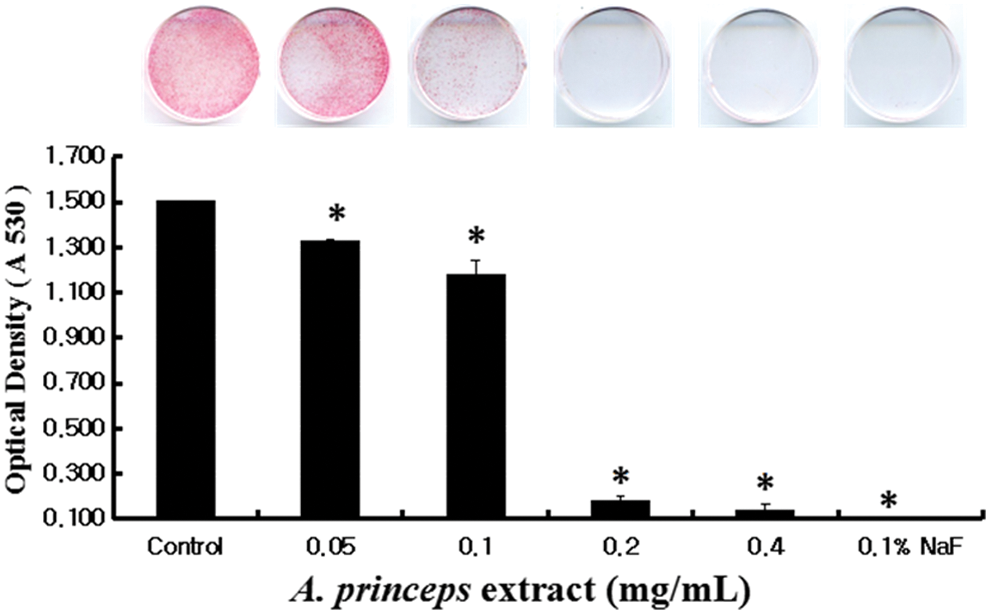
Inhibitory effect of A. princeps extract on biofilm formation of S. mutans. The bacteria were cultured on polystyrene dishes in the media of biofilm formation. The biofilms on the dish surface were determined with safranin staining. Values are expressed as mean ± standard deviation. *P < .05. Color images are available online.

Scanning electron microscopy of biofilms. The bacteria were treated with ethanol extract of A. princeps in the media preferring biofilm formation.
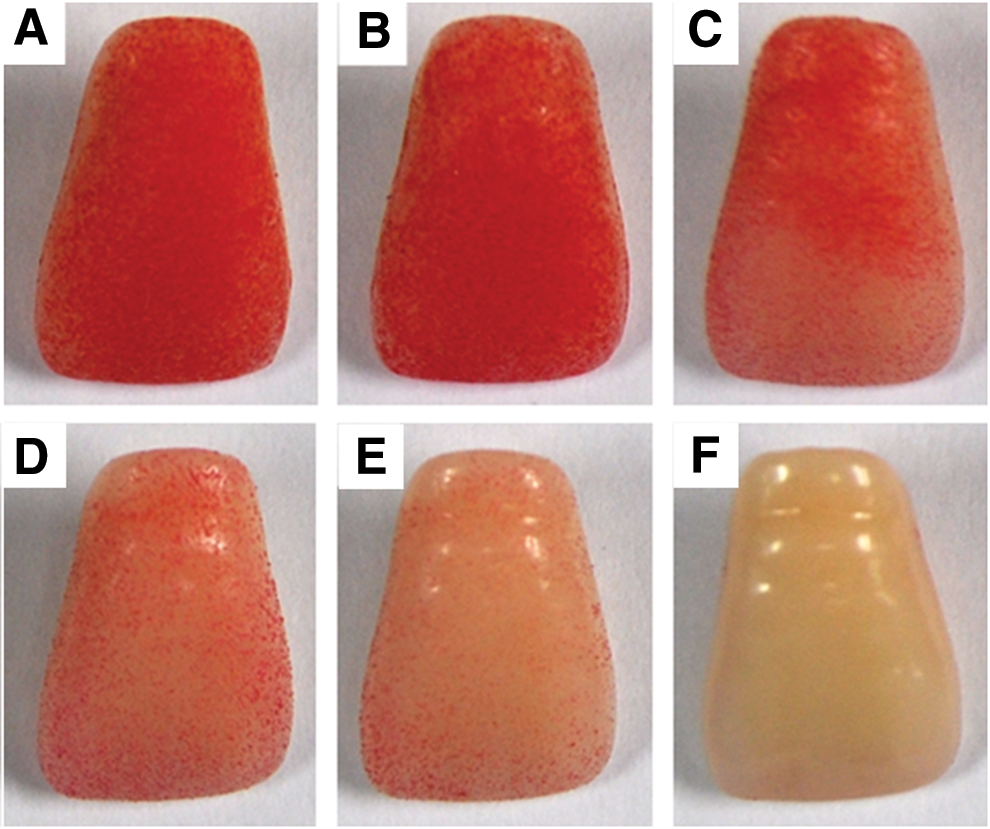
S. mutans biofilms on resin tooth surface. The bacteria were treated with ethanol extract of A. princeps in the media preferring biofilm formation.
Bactericidal effect of A. princeps
After injecting high concentrations (0.4–3.2 mg/mL) of the A. princeps extract into the S. mutans culture, we observed the bactericidal effect using confocal laser scanning microscopy. As the concentration of the A. princeps extract was getting higher, the ratio of the dead bacteria (red fluorescence labeled cell stained by PI) against the living bacteria was observed to increase, which confirms the bactericidal effect of the A. princeps extract. At a concentration of 3.2 mg/mL or higher, nearly all bacteria were observed to be dead (Fig. 5).

Scanning confocal laser microscopy of S. mutans. The bacteria were treated with the high concentration (0.4–3.2 mg/mL) of A. princeps ethanol extract.
A. princeps extract inhibits the expression of virulence factor
After injecting the A. princeps extract at subminimal inhibitory concentrations (sub-MIC) of 0.05–0.2 mg/mL, the expression of virulence factor genes of S. mutans was observed using the real-time PCR. The gtfs are responsible for the synthesis of GTFases in S. mutans. The expression levels of gtfB and gtfD were reduced at concentration >0.1 mg/mL. The expression levels of gtfC were reduced at concentration of 0.2 mg/mL. The gbpB and spaP of S. mutans are necessary for attachment to the teeth surface. The expression levels of gbpB and spaP were decreased at concentrations >0.05 mg/mL (Fig. 6). The expression of brpA, which is related to the regulation of the glucose phosphotransferase system (PTS), was decreased at concentrations >0.05 mg/mL, whereas the expression of relA, which is involved in acid tolerance, was decreased at the concentration >0.1 mg/mL. The expression of vicR, which regulates the expression of gbpB, gtfB, gtfC, and gtfD, was also reduced at the concentration of 0.2 mg/mL.

Real-time PCR analysis of biofilm-related genes of S. mutans. The bacteria were treated with A. princeps extract and real-time PCR analyses were performed as described in the Materials and Methods section. Data are shown as the mean ± SD. *P < .05. PCR, polymerase chain reaction; SD, standard deviation.
Phytochemical tests
The result of the phytochemical test of the A. princeps extract is given in Table 3. A strong intensity reaction of organic acid was observed in the ethanol extract of A. princeps, whereas a moderate intensity of glycosides and a weak intensity of phenolics were discovered.
Phytochemical Tests of the Ethanol Extract of A. princeps
+++, strong; ++, moderate; +, weak intensity reaction; —, nondetected.
Discussion
A. princeps has been used as a digestive medicine, fever reducer, vermifuge, and antihemorrhagic, and is also known to have medicinal effects on women's diseases and stomach disorders. Also, the aromatic ingredients and essence oil of A. princeps are known to have various physiological activities, such as insecticidal, bactericidal, and antitumor activities. 22 In this study, we measured the effect of the A. princeps extract on S. mutans' growth, biofilm formation, bactericidal activity, and expression of virulence factor genes, and conducted phytochemical testing. S. mutans are a type of bacteria that are generally found in the human dental plaque, most of which accumulate on the tooth enamel, causing dental caries. 1
This experiment observed that the A. princeps extract inhibited growth of S. mutans. As S. mutans is generally known to form dental plaque and is regarded as a pathogenic bacterium that causes dental caries, 2 the fact that A. princeps extract had an inhibitory effect against S. mutans' growth will support the scientific rationale that native inhabitants used the A. princeps extract as a treatment for dental diseases. S. mutans metabolizes dietary sugars to produce organic acids, including lactic acid, acetic acid, pyruvic acid, formic acid, and butyric acid. These organic acids lower the pH of dental plaque, demineralize tooth enamel, and cause dental caries. 4 This study found that the A. princeps extract suppressed the pH decrease induced by S. mutans. These results suggested that the A. princeps extract could inhibit the production of organic acid by S. mutans.
Dental plaque is a type of biofilm that builds up on the surface of teeth. The biofilm is a community of bacteria that grow on the surface of a living organism or an inanimate object. A biofilm is surrounded by an extracellular matrix consisting of polysaccharide and proteins. The dental biofilm may cause dental caries and periodontitis. The adhesion and colonization of S. mutans on an acquired pellicle-coated tooth surface are the initial step of the dental biofilm formation. As the formed biofilm increases, the bacteria increase the bacterial resistance against the host's immune system and boost the bacterial defense against antibiotics; the bacteria are not easily killed even by the administration of antibiotics. GTFase plays an important role in the maturation of biofilm. 18 After measuring the formation of biofilm by S. mutans using the safranin staining method, this study found that the A. princeps extract with concentrations from 0.05 to 0.4 mg/mL showed the inhibitory effect against the biofilm formation by S. mutans. The SEM data obtained after the observation of the formation of biofilm by S. mutans were similar to the data from the safranin staining method. The A. princeps extract was observed to inhibit the formation of biofilm on the surface of resin teeth. According to the results of the observation with the confocal laser scanning microscopy, the A. princeps extract displayed a bactericidal effect in a concentration-dependent manner. The living bacteria were stained with the SYTO 9 to emit green fluorescence, whereas the dead bacteria exhibited red fluorescence. These results suggested that the use of A. princeps extract was effective in preventing the formation of dental plaque.
Real-time PCR was performed to measure the influence of the A. princeps extract on the expression of virulence factor genes. The gene expression levels of gtfB, gtfC, and gtfD encode GTFases B, C, and D. These GTFases synthesize from sucrose structurally different α-glucans, and these biopolymers form the matrix of dental plaque. 23 In this study, the A. princeps extract at subminimal inhibitory concentrations (0.25–0.2 mg/mL) inhibited the expression levels of gtfB, gtfC, and gtfD. The synthesized glucans provide a binding site for bacterial adhesion. gbpB encodes the glucan binding protein B expression, and the glucan binding proteins exist in the cell membrane of S. mutans and are essential elements in the adherence of dental bacteria to glucan molecules. 24 S. mutans has the spaP gene, which encodes the cell surface antigen SpaP. SpaP is also known as Ag I/II, Pac, AgB, etc., and forms a type of surface fibrillar adhesion by attaching to salivary agglutinin glycoprotein and proline-rich proteins present in the acquired pellicle formed on the tooth surface. 25 This study observed that the A. princeps extract significantly inhibited the expression of gbp B and spaP. When S. mutans was treated with the A. princeps extract, the expression levels of brpA and relA were significantly decreased, and the expression of vicR showed a declining tendency. The relA encodes GTP pyrophosphokinase that is known to regulate the biofilm formation and to contribute to quorum sensing. The relA is also known to participate in the regulation of glucose PTS, which is the glucose uptake system of S. mutans, and also to acid tolerance. 26 The brpA is also known to contribute to the regulation of biofilm formation and to acid tolerance. 27 The vicR gene is a regulatory gene that controls the expression of virulence factor genes such as gbpB, gtfB, gtfC, and gtfD. 23
According to previous studies, Artemisia has been reported to contain many ingredients with potent antioxidant effects, including vanillin, caffeic acid, protocatechuic acid, catechol, umbelliferone, and ferulic acid.
28
Magnolia officinalis
In conclusion, A. princeps extract inhibits S. mutans' growth, acid production, and biofilm formation, in addition to its bactericidal activity. The A. princeps extract was observed to inhibit the expression of S. mutans' virulence factor genes such as gtfB, gtfC, gbpB, spaP, brpA, relA, and vicR. The results of the phytochemical test of the A. princeps extract indicated that organic acids and glycosides would be the major ingredients. These results suggest that A. princeps may inhibit the cariogenic properties of S. mutans, so the A. princeps extract may be expected to be useful as an anticariogenic agent.
Footnotes
Acknowledgments
This research was supported by Basic Science Research Program through the National Research Foundation of Korea (NRF) funded by the Ministry of Education, Science and Technology (Grant No. 2017R1D1A3B03032656).
Author Disclosure Statement
No competing financial interests exist.