




Abstract
MicroRNAs (miRNAs) are small molecules of 19–23 nucleotides of RNA that act as regulators of the expression of proteins in eukaryotic cells. Currently, the participation of miRNAs in the development of different types of cancer has been observed. To evaluate the inhibitory effect of kaempferol-3-O-glycoside on the expression of oncological biomarkers, miR31 and miR92a in a colon cancer cell line (RKO) were analyzed. Cells were cultured and treated with 1 mM kaempferol-3-O-glycoside isolated from black bean. Expression levels of miR31 and miR92a were evaluated by real-time PCR using TaqMan probes; in addition, two oncogenes (KRAS and c-MYC) and two tumor suppressors (AMP-activated protein kinase [AMPK] and adenomatous tumors of polyposis coli [APC]) were quantified to validate the biological effects; normalization of expression levels were carried out by 2−ΔΔCt. Results were analyzed by one-way ANOVA. The expression levels of miR31, miR92a, KRAS oncogene, and the c-MYC transcription factor were subexpressed upon 72 h post-treatment with kaempferol-3-O-glycoside compared with the control without treatment (P < .05); in contrast, the tumor suppressor genes AMPK (∼4.85, P = .005) and APC (∼2.71, P = .066) tumor suppressors genes were overexpressed. Our results showed the inhibitory effect of isolated black bean flavonoid kaempferol-3-O-glycoside on cancer biomarkers: miR31 and miR92a; based on our results, this flavonoid may have interesting nutritional, therapeutic, and/or prophylactic applications to combat colon cancer.
Introduction
At the international level, colon cancer represents the second cause of malignant tumors. In Mexico, colon cancer is also an important public health problem, since according to the latest INEGI report of 2017, 1 ∼5.2% of deaths recorded in our country were associated with gastrointestinal cancer.
The microRNA (miRNA) are small molecules of 19–23 ribonucleotides that act as regulators of the expression of proteins in eukaryotic cells by arresting translation and degradation of messenger RNA as well as being potent drivers of differentiation and development. Typically, the generation of miRNA occurs in the nucleus with the transcription of a 1000 nt fragment called primary miRNA, this fragment has single or double-stranded hairpins with 5′ and 3′ single-stranded ends and with distal loops every 10 nt. 2
Turchinovich et al. demonstrated that the miRNA remains stable in the extracellular space for at least 1 month, suggesting that the extracellular miRNAs can be used as a biomarker for cancer, damage of tissues or organs, or viral infections. 3
The flavonoids are of great interest in the biomedical field, mainly because of their antioxidant function and their ability to reduce the accumulation of free radicals by their chelating action; various research groups have demonstrated the activity of flavonoids to combat bacterial infections, viral, degenerative, cardiovascular, cancer, and other diseases. 4
Kaempferol (3,4′,5,7-tetrahydroxyflavone) is one of the most common flavonoids in the diet, commonly found in tea, broccoli, grapefruit, and other different plant sources; it is known to exert antioxidant and anti-inflammatory properties. 5 The presence of this relevant flavonoid has been described in Mexican black beans. 6
Kaempferol has been reported to inhibit estrogen alpha receptor expression in breast cancer cells and also to induce apoptosis in glioblastoma and lung cells by the activation of MEK-MAPK. 7 Colorectal cancers develop through a series of well-characterized histopathological changes resulting from mutations in selected oncogenes and tumor suppressor genes. The KRAS oncogene, as well as the suppressor genes of adenomatous tumors of polyposis coli (APC), SMAD4 and TP53, are the main targets of these genetic changes. Mutations in APC lead to stabilization of β-catenin and, consequently, to deregulation of the Wnt pathway by activation of TCF/LEF target genes such as c-MYC. 8
The role of some miRNA can vary between the different cancer histotypes. In particular, miR96 can act as a miRNA that is associated with cancer or tumor suppressors depending on the cell context: for instance, its expression has increased in lung, prostate, bladder, colorectal, and breast cancer; in contrast, the expression of miR96 is strongly downregulated in pancreatic cancer, demonstrated that miR96 can affect cell proliferation, migration, and apoptosis in pancreatic cancer cells by binding the 3′UTR of KRAS mRNA. 9
Therefore, our objective was to evaluate the inhibitory effect of kaempferol-3-O-glycoside isolated from black bean, on the regulation of expression levels of miR31 and miR92a in RKO colon cancer cells, p53 positive.
Materials and Methods
Cell culture and treatment with black bean flavonoids
RKO cells were cultured using ADMEM (Gibco-BRL, Grand Island, NY, USA) supplemented with 2% fetal bovine serum (Gibco-BRL) and 1% glutamine at 37°C and 5% CO2 until their treatment for 24, 48, or 72 h with kaempferol-3-O-glycoside previously isolated from black bean or kaempferol aglycone at a concentration of 1 μM (Sigma, St. Louis, MO, USA); cell viability was assessed using alamar blue; RKO cells were treated with 0.01, 0.1, and 1 μM for 24, 48, and 72 h with kaempferol-3-O-glycoside and kaempferol aglycone.
Black bean kaempferol-3-O-glycoside isolation
A black bean methanolic extract (BBME) was obtained from the seed coats using 80% methanol (DEQ Monterrey, México) in a 1:10 (w/v) ratio. The mixture was stirred in a shaking incubator (New Brunswick Scientific, Edison, NJ, USA) at 25°C and 45 g for 3 h. The solution was filtered and then concentrated with a rotary evaporator (Büchi Laboratories, Switzerland) at 60°C and finally freeze-dried (VirTis SP Scientific, Warminster, PA, USA) and stored at −20°C until further use.
Five grams of BBME was mixed with 250 mL of butanol and 250 mL water and stirred at 25°C, 56 g for 15 min, and left 1 h to separate. After 1 h, three phases were visible: upper butanolic phase (BUP), interphase (IP), and lower or aqueous phase (ALP). The BUP was then dried in a Genevac Rocket evaporator system (SP Scientific, PA, USA) and the powder was recollected. IP and ALP were reprocessed with other 500 mL of butanol–water solvent for two more times. The black bean-enriched extract was resuspended in butanol and injected into a centrifugal partition chromatograph (CPC, Kromatron, France).
The CPC system flow was set at 10 mL/min in the ascending mode. Rotation was set at 112 g, reaching a pressure of 50 bar. A mixture of ethyl acetate (AcE), butanol (But), and H2O (3/6/91; v/v/v) was used as stationary phase. Mobile phase A had AcE/But/H2O 77/16/7 (v/v/v), whereas phase B had a 47/40/13 ratio. Gradient maintained 100% of A during 30 min and changed to 100% B in 35 min, giving a total run time of 65 min. Fractions of 10 mL were obtained from the CPC and those containing flavonoid glycosides were further purified in a HPLC preparative system (Agilent Technologies, Santa Clara, CA, USA). A Zorbax SB-C18 Semi-preparative 9.4 × 250 mm 5 μM column (Agilent Technologies) was used for separation. The solvents were (A) 100% H2O and (B) 100% methanol. A flow of 1 mL/min flow was used with a gradient that started with 60% of B increasing to 90% at 20 min, maintaining it until 25 min and decreasing to 60% at 30 min and the following sample was injected after 5 min equilibrium. The purified compound was dried completely with nitrogen. 10
miRNAs isolation
The samples were subjected to a standard extraction of phenol:chloroform (Ambion, Austin, TX, USA). The supernatant was recovered and precipitated with 1.25 volumes of absolute ethanol. Then, samples were purified by passing through glass fiber columns (Ambion) and eluted with 0.1 mM EDTA, pH 8. The total RNA was stored at −20°C.
Real-time PCR for miRNAs
After retrotranscription (RT) using TaqMan Advanced miRNA Assays and the quantification of each miRNA with nanodrop, real-time PCR was carried out using a fluorescent probe to miR31 (UGC UAU GCC AAC AUA UUG CCA U), miR92a (UAU UGC ACU UGU CCC GGC CUG U), and the housekeeping miR191 (CAA CGG AAU CCC AAA AGC AGC UG) (Applied Biosystems, Foster City, CA, USA); the results were analyzed by 2−ΔΔCt. Each experiment was performed in triplicate. Cells without treatment were used as negative control.
Real-time PCR (qPCR) for targeted genes
The reaction was performed in a final volume of 20 μL: 1 × SybrGreen (Invitrogen, USA), 7 μL of diethyl pyrocarbonate (DEPC) water, 1 μL of KRAS, forward: 5′ GGGGAGGGCTTTCTTTGTGTA 3′ and reverse: 5′ GTCCTGAGCCTGTTTTGTGTC 3'; APC, forward: 5′ TTATGGAAGCCGGGAAGGA 3′ and reverse: 5′ TGGAAATGAACCCATAGGAACAG 3′; c-MYC, forward: 5′ TCAAGAGGCGAACACACAAC 3′ and reverse: 5′ GGCCTTTTCATTGTTTTCCA 3′; AMP-activated protein kinase (AMPK), forward: 5′ GACTGCTACTCCACAGAGATCG 3′ and reverse: 5′ TCAGCATCTGAATCACTCCTTT 3′), 1 μL of the reverse primer (40 mM KRAS, APC, c-MYC or AMPK), and 1 μL of 10 ng/μL cDNA. Note: for the GAPDH primers, forward: 5′ AGGGCTGCTTTTAACTCTGGT 3′ and reverse: 5′ CCCCACTTGATTTTGGAGGGA 3′, 1 μL of 5 mM (instead of 40 mM) was used for both the forward and reverse primers (Invitrogen). The reaction conditions were as follows: 50°C/2 min, 95°C/10 min, then 45 cycles of 95°C/15 sec and 60°C/min.
Statistical analysis
The real-time PCR results normalized with a constitutive miRNA 191 were evaluated by one-way ANOVA with SPSS for Windows, v.20 (IBM Corp., Armonk, NY, USA). Differences were considered statistically significant with a value of P ≤ .05.
Results
miR31 and miR92a post-treatment with black bean kaempferol-3-O-glycoside and kaempferol aglycone
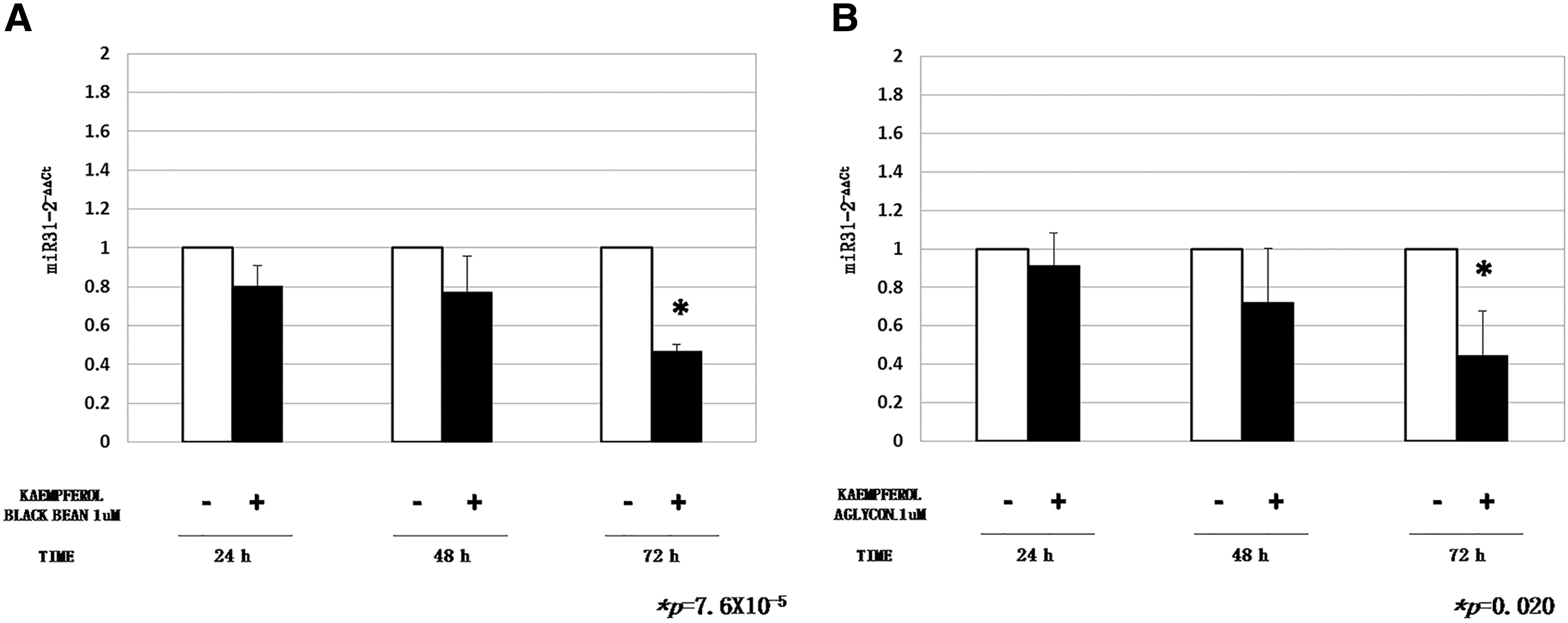
The expression levels of miR31 and miR92a were quantified by real-time PCR and normalized with miR191, showing a downregulation at 72 h upon treatment with kaempferol-3-O-glycoside, as follows: miR31 ∼ 54%, P = 7.6 × 10⁻⁵ and with kaempferol aglycone ∼77%, P = .020 (Fig. 1), whereas miR92a ∼64%, P = .005 and with kaempferol aglycone ∼83%, P = .007 (Fig. 2).

Cancer biomarkers post-treatment with black bean kaempferol-3-O-glycoside
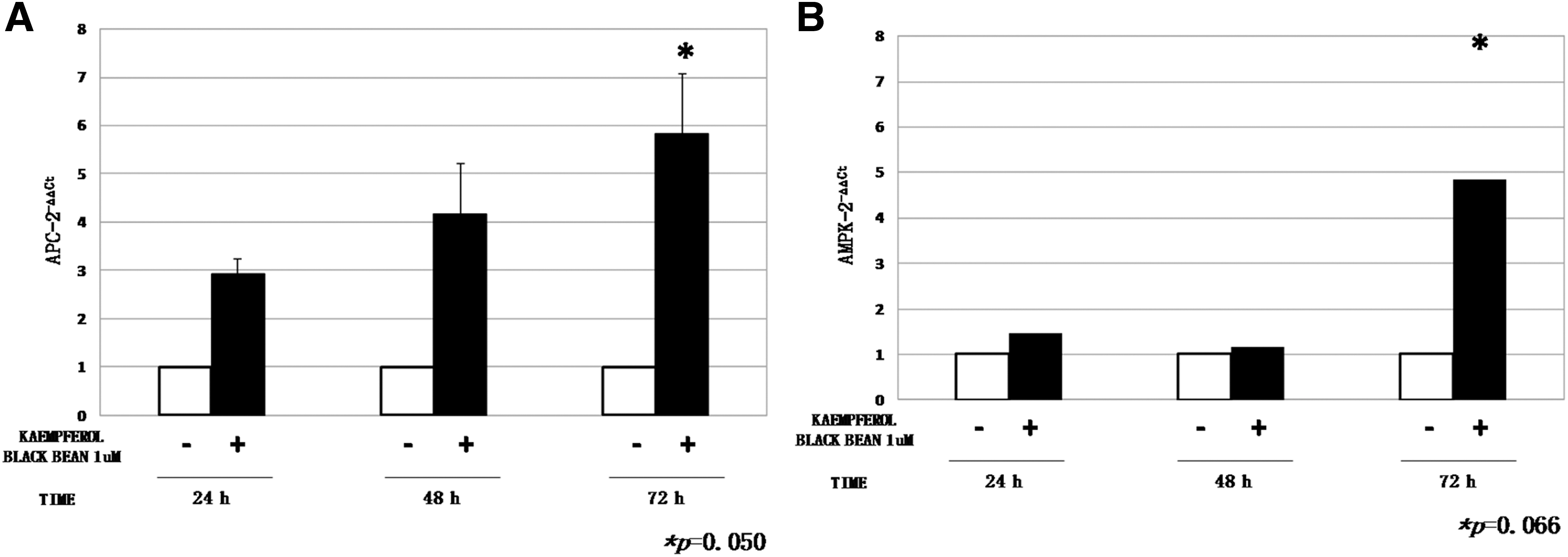
The mRNA levels decreased for both oncogenes KRAS (∼76%, P < .001) and c-MYC (∼65%, P < .001) (Fig. 3); for tumor suppressors, an overexpression was observed, which we reported number of times, as follows: AMPK (∼4.85, P = .005) and APC (∼2.71, P = .066) (Fig. 4).

Discussion
In human HCT116 colon cancer cells, kaempferol induces p53-dependent growth inhibition and apoptosis. In fact, this flavonoid has recently been reported to induce halting of the G1 and G2/M phases of the HT-29 cell cycle by inhibition of cyclin CDK2, CDK4, and CDC2 dependent kinase activity. 11,12
Flavonoids are secondary metabolites mainly of plant origin and phenolic in nature; its chemical structure is formed by polyphenolic groups with skeletons of ∼15 carbons of benzopyrone structure, which is formed by two benzene rings attached by a heterocyclic pyran ring, generating the basic structure of this compound. 4 Several studies report that common bean is a food with a content of bioactive compounds such as flavonol glycosides, anthocyanins, and condensed tannins that also confer color to the seed 13 ; recently, we described antitumor properties of flavonoid compounds in xenografting model of lymphoma. 14 We analyzed the activity of kaempferol-3-O-glycoside using 1 μM in RKO colon cancer cells at 24, 48, and 72 h as treatment.
Kaempferol is a common natural flavonoid abundant in many plant-derived foods; it has been reported that this compound has antioxidant, anti-inflammatory, anticancer, antimicrobial, neuroprotective, antidiabetic, analgesic, and antiallergic activities. 15
Circulating miRNAs in blood and cell cultures are excellent biomarkers because they have high extracellular stability with Ago2 protein association. The miRNA-Ago2 complexes can remain in the extracellular space for up to a month, converting them into appropriate biomarkers for the diagnosis of diseases such as cancer. 3 It is known that miRNAs expressed differently depending on the stage of development of a disease and the types of mutations present. Thus, current research focuses on determining the role of miRNAs as biomarkers for the timely diagnosis of colon cancer. Diagnosis at early stages and adequate treatment prescription increase survival success without invasive or costly procedures. 16
The inhibitory effect of polyphenols on miRNA function has been previously studied 17 and being explored as cancer as cancer therapy. 18 In colon cancer, the elevation of miR31 19 and miR92a 20 has been shown. In this study, we analyzed miR31 and miR92a because they offer great potential in the diagnosis of colon cancer. 21 As for miR31 it has been observed its expression is frequently altered in a large variety of cancers where it can hold both tumor suppressive and oncogenic roles in different tumor types. 22 Moreover, alterations in normal levels of miR92a promoted cell proliferation cells by promoting cell cycle progression through the regulation of p21 expression 23 to promoting tumorigenesis since it may trigger endothelial cell angiogenesis. 24
Our results show the inhibitory effect of isolated black bean kaempferol-3-O-glycoside (flavonoid) on cancer biomarkers: miR31 and miR92a present in RKO cells. In addition, we quantified the effect of kaempferol-3-O-glycoside isolated from black beans on the mRNA levels of the KRAS and c-MYC oncogenes and the tumor suppressors AMPK and APC; the aforementioned, to corroborate the antitumor effect of kaempferol-3-O-glycoside in our study model. We observed a decrease in mRNA expression levels of oncogenes and an increase in mRNA of tumor suppressors upon treatment. Based on our results, this flavonoid can be tested as new therapeutic and/or prophylactic strategy to combat colon cancer.
Footnotes
Authors' Contributions
C.P.R.I., J.A.G.U., and S.R.O.S.S. conceived and designed the study. C.P.R.I. and M.S.S. interpreted the results of the experiments and analyzed the data. C.P.R.I., J.A.G.U., M.S.S., S.R.O.S.S., and A.M.R.E. drafted, edited, and revised the article. C.P.R.I., J.A.G.U., and D.S.G. performed the experiments. C.P.R.I., M.S.S., and A.M.R.E. prepared the figures. C.P.R.I., J.A.G.U., M.S.S., D.S.G., S.R.O.S.S., and A.M.R.E. approved the final version of the article to be published.
Author Disclosure Statement
The authors declare that they have no competing interests.