




Abstract
Adaptogen-based plant formulations play an important role in traditional medicine and have been used in medical practice to increase the resistance of individuals. Rhodiola rosea (RR) and Panax ginseng (PG) exhibit adaptogenic properties and are related to the recovery of homeostasis and strengthen systems impaired by stress. This study aimed to evaluate the effects of RR and PG on metabolic profile and muscle damage parameters in Wistar rats submitted to swimming. Animals were divided according to the following: G1: control group; G2: group that was submitted to swimming; G3: group treated with PG; G4: group treated with PG and submitted to swimming; G5: treated with RR; and G6: treated with RR and submitted to swimming. At the end of the experimental protocol, groups G2, G4, and G6 practiced swimming for a period five times longer than during the previous 30 days. Anthropometric and biochemical parameters were investigated, and no significant results were found in the groups. Nevertheless, animals treated with PG and RR reduced the levels of creatine phosphokinase (CPK) and lactic dehydrogenase (LDH). Our findings demonstrate that both PG and RR produced a significant reduction in the levels of CPK and LDH after physical stress, suggesting that they can be used to improve physical performance. For these reasons, we may say that these plants may be used to minimize the stress promoted by the practice of physical exercises.
Introduction
The use of the word adaptogen was created in Russia to classify plants and other substances able to increase resistance to a variety of physical, chemical, and biological factors. Known as a supplement for disposal, adaptogen-based plant formulations play an important role in traditional medicine and have been used in medical practice to increase the resistance of individuals and to reduce oxidative stress. Rhodiola rosea (RR) and Panax ginseng (PG) are plants that stand out because they have adaptogenic properties and are related to the recovery of homeostasis and strengthen systems impaired by stress. 1,2
RR belongs to the Crassulaceae family and grows in the mountainous Arctic regions of North America, Europe, and Asia. Its main active compounds include p-tyrosol, salidroside, rosin, rosavin, and rosarine. The roots present antioxidant, anticarcinogenic, antibacterial, antidiabetic, and antihepatotoxic properties. Extracts produced with the roots and rhizomes may augment the resistance of the body to stress, exhaustion, and fatigue. 3 –6
Another root commonly used is PG that belongs to the Araliaceae family. Its medicinal properties have been used for more than 2000 years in China, Japan, and Korea. The pharmacological effects of ginseng extract are due to various ginsenosides and their metabolites that are effective in the treatment of stress, fatigue, obesity, diabetes mellitus, ischemic myocardial injury, and other diseases. 7 –10
In view of the above, this study aimed to evaluate the effects of RR and PG on the metabolic profile and muscle damage parameters in Wistar rats submitted to swimming.
Materials and Methods
Preparation of plant material
The dried extracts of RR and PG were purchased from a commercial establishment in the city of Marília—São Paulo, Brazil. For administration (via gavage), the extracts were prediluted in propylene glycol (75 mg/mL) and diluted in water to obtain a concentration of 0.75 mg/mL. Each animal received a daily dose of 1.5 mg/kg for 30 days (animals from control group received only the vehicle).
Group of animals
After approval by the Ethics Committee from the University of Marilia–UNIMAR–São Paulo State, Brazil, we used 48 male Wistar rats weighing 200–250 g, which were kept in boxes (5 animals per box) at the university vivarium, under a 12-h dark cycle, ambient temperature of 22 ± 2°C, and relative humidity of air of 60% ± 5%. The animals were randomly divided into six experimental groups (n = 8) and then underwent a period of acclimatization to the laboratory conditions of 7 days and a period of adaptation to swimming: first day 2 cm of water and second day 3 cm of water.
All animals received water and commercial rat food ad libitum during the experimental protocol. The experimental groups were treated with the plant extract 5 times a week for 30 consecutive days according to the following: G1: control group; G2: group that was submitted to swimming; G3: group treated with PG; G4: group treated with PG and submitted to swimming; G5: treated with RR; and G6: treated with RR and submitted to swimming.
The groups G2, G4, and G6 were submitted to swimming, according to the model of Porsolt et al. 11 with modifications. The animals were submitted to swimming three times a week for 15 minutes in a temperature-controlled tank (37°C) for 30 days.
At the end of the experimental protocol, groups G2, G4, and G6 practiced swimming for a period five times longer than animals were submitted to swim during the previous 30 days. 12,13
Anthropometric and biochemical parameters
The animals suffered euthanasia with an intraperitoneal injection of thiopental (200 mg/kg). After death, body weight and muzzle-anus length were assessed to determine the Lee index. Also, waist circumference and chest circumference were measured, and visceral fat was weighed. Blood was collected from the inferior vena cava for evaluation of the biochemical profile (glycemia [mg/dL], triglycerides [mg/dL], total cholesterol [mg/dL], HDL-c [mg/dL], creatine phosphokinase [CPK] [U/L], and lactic dehydrogenase [LDH] [U/L]).
Variance analysis and Kruskal–Wallis were used for statistical analysis, and the variables were presented as mean and standard deviation, with a significance level of 5% (P < .05).
Results
No significant differences were found for the anthropometric and biochemical parameters (Tables 1 and 2).
Results for the Anthropometric Parameters of the Control Groups and the Groups Treated with Panax ginseng and Rhodiola rosea
WG, weight gain; TC, thoracic circumference; AB, abdominal circumference; VF, visceral fat. P < .05. G1: control group; G2: group that was submitted to swimming; G3: group treated with PG; G4: group treated with PG and submitted to swimming; G5: treated with RR; and G6: treated with RR and submitted to swimming. RR, Rhodiola rosea; PG, Panax ginseng.
Results for the Biochemical Parameters (mg/dL) of the Control Groups and the Groups Treated with Panax ginseng and Rhodiola rosea
HDL-c, high-density lipoprotein. P < .05. G1: control group; G2: group that was submitted to swimming; G3: group treated with PG; G4: group treated with PG and submitted to swimming; G5: treated with RR; and G6: treated with RR and submitted to swimming.
Figures 1 and 2 show the results for the evaluation of CPK and LDH in the animals treated, respectively, with PG and RR.

Results for the evaluation of CPK (UI) and DHL (UI) in the animals treated with PG. G1: control group; G2: group that was submitted to swimming; G3: group treated with PG; G4: group treated with PG and submitted to swimming; G5: treated with RR; and G6: treated with RR and submitted to swimming. *P < .05; **P < .01; ***P < .0001; ns, nonsignificant. RR, Rhodiola rosea; PG, Panax ginseng; CPK, creatine phosphokinase.
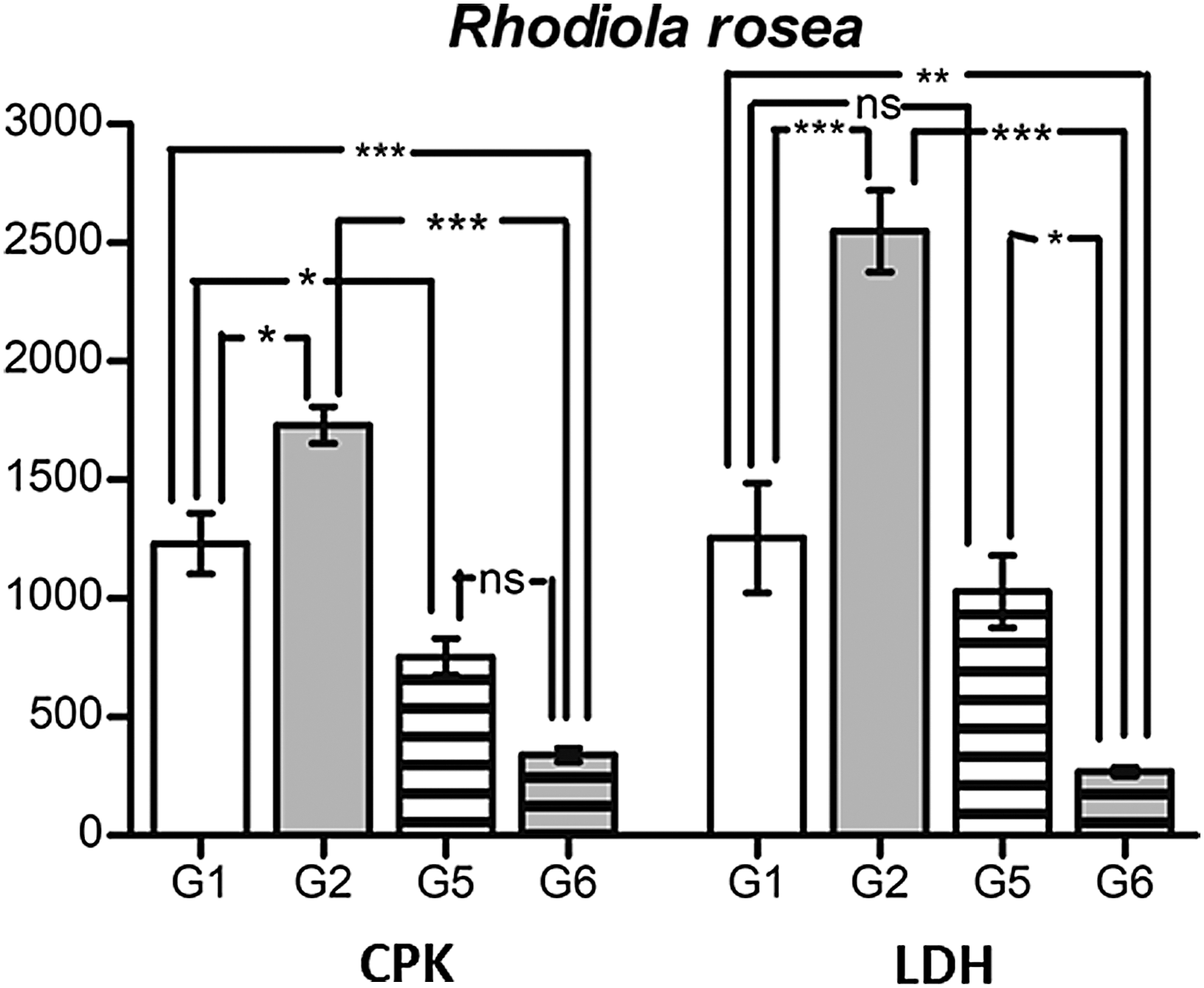
Results for the evaluation of CPK (UI) and DHL (UI) in the animals treated with RR. G1: control group; G2: group that was submitted to swimming; G3: group treated with PG; G4: group treated with PG and submitted to swimming; G5: treated with RR; and G6: treated with RR and submitted to swimming. *P < .05; **P < .01; ***P < .0001; ns, nonsignificant.
Discussion
Although our results showed that there were no significant differences in relation to the metabolic parameters with the use of PG and RR, some authors showed that both plants might promote cardioprotective effects. 14,15
Ayaz, Alnahdi 16 investigated the effects of the ingestion of PG (150 mg/Kg) daily for 42 days for animals intoxicated with ethanol and showed modulation in the lipid profile and attenuation in the increase of LDH and CPK compared with the control groups.
Bao et al. 17 studied the effects of oligopeptides extracted from PG as antifatigue actions. After 30 days of treatment, they observed that these compounds significantly augmented the forced swimming time and enhanced LDH activity, suggesting that they may exert antifatigue effects probably due to the improvement of mitochondrial function and reduction of oxidative stress and could work as a natural agent for relieving the fatigue promoted by the exercise.
In another study, Yang et al. 8 evaluated the effects of the ginsenoside Rg3 in a postoperative fatigue syndrome model and found that this compound extracted from PG upregulated the levels of total cholesterol, triglycerides, and LDH, as well as antioxidant enzymes improving the exercise performance and resistance to fatigue.
Other authors investigated the effects of PG in a rat model of myocardial ischemia/reperfusion and in a neonatal rat cardiomyocyte model of anoxia/reoxygenation injury and found that ginsenoside Rg3 produced significant improvement in rat cardiac function and decreased the levels of LDH and CPK, as well as improvement in the size of the myocardial infarct. 18
As we see in Figure 2, there was a significant reduction in CPK and LDH levels (P < .05) in the animals of G5 and G6 when compared with G2. When compared with G1, it was observed that the isolated use of RR reduced the levels of the markers and its adaptogen effects were potentiated under physical stress (as shown by the comparison of G5 and G6). These findings corroborate other studies showing that chronic supplementation with the extract of RR allows the reduction of LDH levels and damage to muscle fibers after an exhaustive physical exercise session. 4,19,20 The CPK and LDH enzymes, respectively, evaluate nonspecific tissue damage and muscle damage, and surprisingly, comparing the G3 group with G1, there was an increase in CPK and LDH. This suggests that the adaptogenic effect of PG occurs only through the presence of stressors. 7,16,21
Panossian et al. 22 evaluated the levels of stress markers such as cortisol in animals under immobilization stress and showed that the levels of these markers were highly increased in the placebo group.
Abidov et al. 23 showed that rats treated with the extract of RR significantly elongated duration of exhaustive swimming and stimulated the (re)synthesis of ATP in mitochondria obtained from skeletal muscle.
Shanely et al. 24 measured the influence of the use of RR on muscle damage induced by exercises in experienced runners in a marathon. The individuals received placebo or 600 mg/day of RR extract for 30 days before, the day of, and 7 days after performing the marathon. Blood samples were analyzed to the evaluation of several parameters and authors observed an increase in CPK. The authors also observed an increase in other parameters such as aspartate transaminase, alanine transaminase, interleukin-6, IL-8, C reactive protein, and other parameters and concluded that the ingestion of RR for 30 days before a marathon did not minimize the reduction in muscle function or increases in the muscle damage.
As pointed before, the extract obtained from the roots and rhizomes of RR produces effects that lead to augmentation in the resistance to stress and fatigue. The presence of a plethora of pharmacological and biochemical stress reducing occurs to its unique mechanism of action that leads to normalization in the release of stress hormones and, simultaneously, increases the ATP synthesis in mitochondria. 3,4,6,8,25
Some researchers have tested the use of both PG and RR in individuals undergoing mild and chronic stress and observed protective effects. PG exerts these effects due to its antioxidant potential and RR due to its ability to reduce the production of tumor necrosis factor-alpha. 26,27
Elongated intense endurance exercise may lead to profound stress and damage to skeletal muscle, production of inflammatory markers and stress hormones, and result in oxidative stress. The improvement of this scenario through nutritional compounds is of substantial interest. 24 PG and RR are plants with the potential to be used as adjuvants in the management of stress produced during physical training.
Conclusion
Our findings demonstrate that both PG and RR did not modify the biochemical and anthropometric parameters, but produced a significant reduction in the levels of CPK and LDH after physical stress, suggesting that they can be used to improve physical performance. The adaptogenic effects of RR are more impressive than those promoted by PG. For these reasons, we may say that these plants may be used to minimize the stress promoted by the practice of physical exercises.
Footnotes
Author Disclosure Statement
No competing financial interests exist.