




Abstract
Echinacea purpurea is a common herbal remedy used to treat a variety of illnesses, though its health benefits and effects on the immune system have not been fully elucidated. In this study, we investigated the effect of E. purpurea root extract on the survival of concanavalin A (ConA)-activated murine splenocytes and the production of the cytokines interferon-gamma (IFN-γ), interleukin-2 (IL-2), and tumor necrosis factor (TNF) by these cells. We found that E. purpurea root extract did not affect splenocyte survival or IL-2 production and increased IFN-γ cytokine levels only modestly. However, TNF cytokine production by ConA-activated splenocytes increased in response to E. purpurea root extract treatment in a dose-dependent manner, suggesting that E. purpurea root extract does have immunomodulatory effects.
Introduction
E chinacea purpurea (purple coneflower) is a plant native to North America, commonly used as an herbal remedy for diseases such as the common cold and influenza. 1 Despite its widespread use, its efficacy in disease treatment and full range of effects on the immune system remain unclear. 2 While data from in vivo mouse and in vitro immune cell studies suggest that E. purpurea root extract has immunomodulatory properties, results from clinical studies on its effects on the common cold show little to no curative effects. Analysis of clinical data is complicated by the various types of Echinacea treatments used across studies, including the difference in species, plant parts, and extraction methods, and the presence of other herbal components in the treatments. A review and meta-analysis by Karsch-Völk et al. 3 analyzed 24 randomized controlled clinical trials, including studies that investigated the efficacy of Echinacea in both preventing and treating the common cold. The prevention studies that were analyzed did not show a significant difference in the number of patients with at least one cold when comparing groups treated with placebo versus groups treated with Echinacea, although a pooled meta-analysis revealed a small reduction in relative risk in the Echinacea group.
Studies on E. purpurea often measure cytokine production as a proxy for effects on the immune system as a whole. Effects of E. purpurea treatments have been inconsistent across studies, likely because of the great variation in experimental variables, including immune cells studied, mitogens used to activate immune cells, methods of E. purpurea extraction and plant parts used, and treatment (in vivo vs. in vitro). In phorbol 12-myristate 13-acetate (PMA)-stimulated human Jurkat T cells, treatment with neutral and weak acid E. purpurea extract from aerial parts resulted in the upregulation of both interferon-gamma (IFN-γ) and interleukin-2 (IL-2). 4 In contrast, IL-2 production was inhibited in a similar study using E. purpurea ethanolic extracts from aerial parts with phytohemagglutinin/PMA-stimulated Jurkat T cells. 5 In contrast with studies using the aerial portion of the plant, when using E. purpurea root extract for an in vivo treatment in mice, IFN-γ levels were upregulated, but there was no effect on IL-2 levels. 6 An E. purpurea extract of roots, seeds, and leaves had no influence on the production of IL-2 or IFN-γ by mouse splenocytes. 7
Tumor necrosis factor-alpha (TNF-α) is another important immunostimulatory cytokine that is both produced by and acts on T cells, though it is also produced by macrophages, neutrophils, and B cells. It is one of the earliest cytokines transcribed in response to a diverse set of stimuli. 8 While TNF plays a critical role in the immune response, dysregulation of TNF production results in disease states, including chronic inflammation and autoimmune disorders. TNF inhibitors have been successfully used to treat these disorders. 9 Research on the effect of E. purpurea on TNF production is limited, though there is evidence for both inhibitory and stimulatory effects. In both Pam3CysSerLys4-induced human monocytic THP-1 cells and lipopolysaccharide (LPS)-stimulated RAW 264.7 macrophages, E. purpurea root extract inhibited TNF production. 10,11 However, in human blood macrophages, E. purpurea juice enhanced TNF protein production. 12 Additionally, in LPS-stimulated macrophages and monocytes, E. purpurea alkylamide treatment induced TNF messenger RNA transcription but not protein synthesis. 13 Hwang et al. 7 demonstrated that E. purpurea extract (a combination of root, seed, and leaf extracts) enhanced the production on TNF by mouse splenocytes.
In this study, we used concanavalin A (ConA)-stimulated murine splenocytes to investigate the effect of in vitro E. purpurea root extract treatment on cell survival and production of TNF, IFN-γ, and IL-2. Splenocytes were stimulated with either a full dose of ConA or a suboptimal dose of ConA, a widely used mitogen that stimulates T cell proliferation. 14 The cells were also exposed to varying doses of E. purpurea root extract and harvested within 24 or 48 h for analysis.
Materials and Methods
Mice
C57BL/6J wild-type mice were purchased from Jackson Laboratories. Studies were conducted in accordance with the National Institutes of Health guidelines for the proper use of animals in research and with local Institutional Animal Care and Use Committee approval.
In vitro splenocyte stimulation
The spleens of wild-type mice were harvested at 6–12 weeks of age. The cells were plated in 24-well plates at 5 × 10⁶ cells/mL and activated with ConA (L7647; Sigma-Aldrich; 5 μg/mL for full dose, 5 × 10⁻³ μg/mL for suboptimal dose) for 24 or 48 h in complete media [RPMI 1640 medium with
Cell counts
Live cells were counted by Trypan blue (Millipore) exclusion using a hemocytometer. To calculate cell survival, the number of cells harvested at 24 or 48 h was divided by the number of cells initially cultured for each condition.
Enzyme-linked immunosorbent assay
Mouse TNF, IFN-γ, and IL-2 ELISA (enzyme-linked immunosorbent assay) MAX Kits were purchased from BioLegend and performed according to the manufacturer's protocol. Plates were read at 450 nm using an ELx808IU plate reader.
Statistical analysis
A two-sided paired Student's t-test was used to assess statistical differences in experimental groups. A P-value ≤.05 was considered statistically significant.
Results
To investigate the influence of E. purpurea root extract on ConA-activated splenocytes, we first determined whether or not cell survival of ConA-activated splenocytes was affected by E. purpurea root extract. Splenocytes were cultured at a concentration of 5 × 10⁶ cells/mL with varying doses of ConA (suboptimal dose of 5 × 10⁻³ μg/mL or full dose of 5 μg/mL) with varying doses of E. purpurea root extract (0, 0.1, 1, and 10 mg/mL). Cells were harvested for analysis after 24 and 48 h of culturing. We used Trypan blue to count live cells that were harvested and found that the dose of E. purpurea root extract included in the splenocyte culture had no impact on the number of cells that were harvested at either 24 or 48 h (Fig. 1). This finding indicates that differences in cytokine production by the splenocytes cannot be attributed to differences in cell numbers in the cultures.
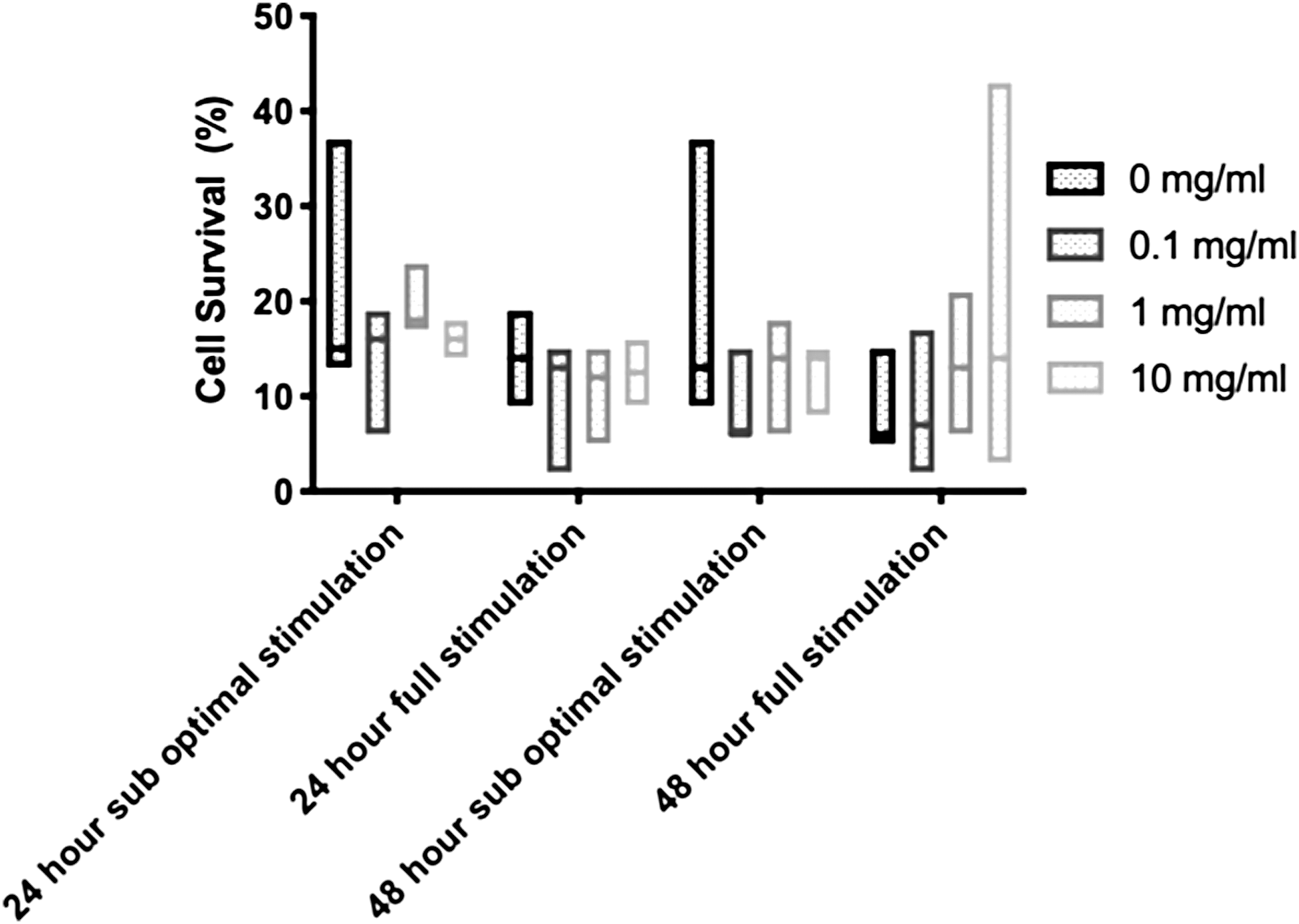
Echinacea purpurea root extract does not influence the survival of ConA-activated splenocytes. Splenocytes were cultured with ConA and varying amounts of E. purpurea root extract as indicated. Cultures were harvested at 24 and 48 h. Cell survival was calculated as follows: number of cells harvested/number of cells cultured × 100. Data from three trials are graphed as box plots, with the median point marked with a line and the minimum and maximum points as the lower and upper limits of the box. ConA, concanavalin A.
We went on to determine the levels of IFN-γ, IL-2, and TNF in culture supernatants using ELISA. When comparing splenocytes cultured with only ConA to those cultured with ConA and varying amounts of E. purpurea root extract, we did not find any impact of E. purpurea root extract on IL-2 levels (Fig. 2). There was a slight upward trend in IFN-γ levels as the dose of E. purpurea root extract increased for splenocytes cultured with a suboptimal dose of ConA; however, these differences were not statistically significant (Fig. 2). Interestingly, we found that the production of TNF by ConA-activated splenocytes was enhanced by E. purpurea root extract. For all culture conditions, there was an upward trend in TNF production as the dose of E. purpurea root extract increased. For splenocytes cultured with a suboptimal dose of ConA, at 24 h the production of TNF by cells cultured with 10 mg/mL of E. purpurea root extract was significantly higher than that of the cells cultured with no E. purpurea root extract. For splenocytes cultured with a full dose of ConA, at both 24 and 48 h, the production of TNF by cells cultured with 10 mg/mL of E. purpurea root extract was significantly higher than that of the cells cultured with no E. purpurea root extract. Additionally, the TNF level was significantly higher at 48 h for cells cultured with full ConA stimulation and 1 mg/mL of E. purpurea root extract compared with the TNF levels of cells cultured with full ConA stimulation and no E. purpurea root extract.

Echinacea purpurea root extract influences the production of TNF, but not IFN-γ or IL-2, by ConA-activated splenocytes. Splenocytes were cultured with ConA and varying amounts of E. purpurea root extract as indicated. Cultures were harvested at 24 and 48 h. Culture supernatants were analyzed for IFN-γ, IL-2, and TNF cytokine levels by enzyme-linked immunosorbent assay. Data from three trials are graphed as box plots, with the median point marked with a line and the minimum and maximum points as the lower and upper limits of the box. *P ≤ .05. IFN-γ, interferon-gamma; IL-2, interleukin-2; TNF, tumor necrosis factor.
Discussion
E. purpurea extract is widely used as a medicinal herb, and while several groups have published on the influence of E. purpurea extract on immune cells, there is not yet a complete knowledge on this topic. Using an in vitro system in which mouse splenocytes were cultured with ConA and varying doses of E. purpurea root extract, we demonstrated that E. purpurea root extract has no impact on the survival of ConA-activated splenocytes (Fig. 1). Although others have reported that E. purpurea root extract enhances the production of IFN-γ and IL-2, 4 in our splenocyte culture system, E. purpurea root extract had no impact on IL-2 cytokine levels and only modest effects on IFN-γ cytokine levels (Fig. 2). Our results corroborate those of Hwang et al., 7 who exposed mouse splenocytes (not ConA-stimulated as in our study) to E. purpurea extract (an extract of roots, seeds, and leaves) and found no increase in the production of either IL-2 or IFN-γ.
Interestingly, we found that E. purpurea root extract increased TNF cytokine levels produced by ConA-activated splenocytes (Fig. 2). This finding supports the use of E. purpurea extracts for the treatment of common cold and influenza infections. TNF is produced by the immune cells in response to rhinovirus and influenza infections and has direct antiviral effects as well as inducing the expression of other antiviral cytokines. 15 –18 So E. purpurea root extract, through its ability to enhance TNF production, can boost an antiviral immune response.
Our finding that E. purpurea root extract increases TNF production by activated mouse splenocytes is also in line with Hwang et al., 7 who demonstrated an increase in TNF production upon the exposure of mouse splenocytes to E. purpurea extract. Studies have shown that TNF induces proliferation in naive T cells but induces apoptosis of highly activated effector T cells. 19 Thus, the uniform splenocyte survival rates between control and E. purpurea treatment groups that we found may have resulted from the expansion of one group of T cells and the contraction of another, without a change in total group survival.
We used splenocytes in our experiments, so it was not possible to definitively conclude that the cytokines detected in culture supernatants were derived from T cells. However, since we used ConA to stimulate splenocytes, the main cell population to be activated and producing cytokines would have been T cells. 14 In models of autoimmune liver diseases, ConA stimulation resulted in increased TNF production by liver macrophages. 20 Though liver cells were not used in this study, it is plausible that ConA activation of spleen macrophages contributed to the overall TNF production. Going forward, we will continue to investigate the influence of E. purpurea root extract on TNF production by T cells using pure T cell cultures. It is important to seek a complete understanding of how E. purpurea root extract influences immune cell functions to better integrate this potent herbal remedy into conventional therapies that are designed to boost immune cell functions.
Footnotes
Acknowledgments
This work was supported by the University of Minnesota Undergraduate Research Opportunity Program and the Office of the Vice President for Research of the University of Minnesota (UMM Faculty Enhancement Research Fund).
Author Disclosure Statement
The authors declare that no competing financial interests exist.