




Abstract
Peptides from protein hydrolysate of a mixture of chicken combs and wattles (CCWs) were obtained through enzymatic hydrolysis, and their anticoagulant and inhibitory effects on angiotensin I-converting enzyme (ACE) were investigated. The protein hydrolysate exhibited anticoagulant capacity by the intrinsic pathway (activated partial thromboplastin time) and potent ACE-inhibitory activity. The peptides were sequenced by LC-MS to identify those with higher inhibitory potential. From the pool of sequenced peptides, the following three peptides were selected and synthesized based on their low molecular weight and the presence of amino acids with ACE-inhibitory potential at the C-terminus: peptide I (APGLPGPR), peptide II (Piro-GPPGPT), and peptide III (FPGPPGP). Peptide III (FPGPPGP) showed the highest ACE-inhibitory capacity among the peptides selected. In conclusion, a peptide (FPGPPGP) of unknown sequence was identified as having potent ACE-inhibitory capacity. This peptide originated from unconventional hydrolysates from poultry slaughter waste, including combs and wattles.
Introduction
The knowledge on the role of proteins in the diet as a source of physiologically active peptides has been increasing. An important step in the production of bioactive peptides from proteins is the hydrolysis process. In a review, Xie et al. 1 described the enzymatic hydrolysis processes of food proteins that result in active peptides and exert regulatory functions in humans beyond normal and adequate nutrition.
In the literature the use of by-products of the animal industry to obtain bioactive peptides with biological and technological properties is described. Among the by-products, the derivatives of collagenous proteins stand out. Peptides derived from collagen degradation from different sources may exhibit antihypertensive, anticoagulant, antioxidant, and mineral-chelating activities, improving the absorption/bioavailability of these minerals in addition to antiulcerative, healing, and osteoprotective properties. 2 –4
Hypertension is a disease of modern civilization and a risk factor for chronic degenerative diseases, such as arteriosclerosis, myocardial infarction, and stroke. 5 One of the metabolic pathways responsible for reduced blood pressure is the inhibition of angiotensin I-converting enzyme (ACE). This enzyme plays a role in the renin/angiotensin system, catalyzing the conversion of angiotensin I (decapeptide) to angiotensin II (octapeptide), a potent vasoconstrictor. 6 Angiotensin II can also catalyze the degradation of bradykinin (vasodilator). This mechanism of action (ACE inhibition) is used in some drugs indicated for the treatment of hypertension. 7
In addition to hypertension, the thrombotic effect can also potentiate the abovementioned diseases. The thrombotic effect is directly related to the blood coagulation system and is the second step of hemostasis and is triggered in response to endothelial rupture. The coagulation system involves a series of enzymatic reactions in intrinsic and extrinsic pathways. The last step of the coagulation process is the conversion of soluble fibrinogen into fibrin filaments. Coagulation is of extreme importance as imbalance in this system can lead to excessive bleeding or thrombus formation. 8
The ACE-inhibitory and anticoagulant effects of peptides have been demonstrated in studies with different food matrices, such as poultry, fish, pork, and cattle. 6 –9 Nevertheless, peptides from chicken combs and wattles (CCWs) have not been studied for their biological activity beyond their nutritional value. Moreover, hydrolysis of these peptides using enzymes to obtain extracts with bioactive properties of high added value has also not been studied. In this context, the analysis of the bioactivities of peptides derived from chicken slaughter by-products, which are a source of collagenous protein, becomes relevant.
The aim of this work was to assess the ACE-inhibitory and anticoagulant potentials of peptides from protein hydrolysate of a mixture of CCWs to identify and synthesize the most promising ones as well as confirm their activity based on the proposed sequences.
Materials and Methods
Materials
The CCWs were acquired from a slaughterhouse located in the state of Paraíba (Brazil). The microbial enzyme alcalase (Bacillus licheniformis) was supplied by Novozymes Latino Americana Ltda. (Paraná, Brazil). The reagents used for the analyses were obtained from laboratory suppliers (Sigma-Aldrich Chemie GmbH, Steinheim, Germany).
Production of protein hydrolysate from a mixture of chicken CCWs (1:1 w/w)
The CCW raw material, at a ratio of 1:1 (w/w), was ground and homogenized, aiming to obtain a homogeneous paste for the hydrolysis process. This mixture was transferred to a beaker in a preheated, temperature-controlled water bath. Ultrapure water was added to the mixture to weight percent 33% (w/w) with constant stirring. The temperature and pH were controlled in the hydrolysis process according to the optimal performance values of added enzyme (alcalase). The enzyme to substrate ratio (5%) and the total hydrolysis time (240 min) were determined using a Full Factorial Experimental Plan.
The pH was kept stable during the reaction (0.5 M NaOH). After 240 min of hydrolysis, the enzyme was inactivated at 90°C for 15 min. The hydrolysate was centrifuged (12,000 g for 30 min). The lipid was removed from the upper layer and the supernatant was filtered and lyophilized to obtain a hydrolysate powder. Through this process, the hydrolysate (referred to as CWPH) used in the present study was obtained.
Hydrophobicity profile of the CCW and CWPH protein hydrolysates
The CCW mixture (1:1 w/w) and the CWPH were diluted in ultrapure water and homogenized in an Ultra-Turrax tube disperser (Ika, Staufen, Germany) for 10 min at 7258 g. The solution was centrifuged at 2060 g for 10 min and filtered using filter paper and transferred to a syringe containing a filter with pores measuring 0.45 μm in diameter.
The hydrophobicity profile was separated using a Nova-Pak C18 column (4.6 m × 250 mm, 4 μm; Cartcombs, Waters, Ireland) connected to a high efficiency liquid chromatograph (Waters 2690; Varian, CA, USA). The injection volume of the soluble extract (0.2 g/mL) was 20 μL. The mobile phase consisted of eluent A (0.1% trifluoroacetic acid [TFA] in ultrapure water) and eluent B (0.1% TFA in ACN). A linear gradient of eluents A and B was applied for 60 min at a flow rate of 1 mL/min. Detection was performed at 218 nm.
Coagulation assays
Human blood
Blood samples were collected by venipuncture from nonmedicated apparently healthy donors in polypropylene tubes containing 3.8% sodium citrate solution (1:9 anticoagulant:blood ratio). The platelet-poor plasma was collected after centrifugation at 1572 g for 10 min at 25°C and stored at −80°C. 10
Determination of prothrombin time and activated partial thromboplastin time
Using a semiautomated BFT II coagulometer (Dade Behring), prothrombin time (PT) and activated partial thromboplastin time (aPTT) were determined in human plasma according to the procedure described by Salu et al. 11 For the aPTT determination, plasma (50 μL) was incubated with 50 μL of actin-activated cephaloplastin and 50 μL of 0.15 M NaCl and unfractionated heparin (UFH) (0.1 UFH/mL) or different concentrations of CWPH at a final volume of 250 μL for 120 sec at 37°C. After incubation, the reaction was activated by the addition of 50 μL of calcium chloride (0.025 M), and the time was immediately monitored. For the PT determination, 50 μL of plasma was incubated with 50 μL of increasing concentrations of CWPH (0.075–0.4 mg), 0.15 M NaCl or heparin (5 × 10⁻³ UFH) for 60 sec followed by the addition of 100 μL of lyophilized rabbit brain thromboplastin. All anticoagulant activities were defined based on the concentration required to prolong human plasma clotting up to two times the control time.
ACE inhibition assay
ACE inhibition experiments were performed using ACE from rabbit lung. ACE activity on 10 μM Abz-FRK(Dnp)P-OH was continuously measured at 37°C in a Shimadzu RF-1501 PC spectrofluorimeter adjusted to λ ex = 320 nm and λ em = 420 nm. The assays were performed in 0.1 M Tris-HCl buffer (pH 7.0) containing 50 mM NaCl and 10 μM ZnCl2. Inhibition assays were performed under the same conditions after a 1-min preincubation of enzymes with increasing concentrations of peptides. 12 Fluorescence emission was continuously measured, and the half maximal inhibitory concentration (IC50) values were obtained using the following equation: y = 100%/1 + (x/IC50) S ; where S is a slope factor. This equation assumes that y falls with increasing x. The IC50 values for the ACE inhibitor were calculated by the tight-binding titration data analysis GraFit program. 13
Mass spectrometry analysis
Proteomic sample preparation
For solid-phase extraction, 10 mg of each lyophilized sample containing peptides obtained from protein hydrolysis of CCWs with different hydrolysis conditions were dissolved in 1 mL of 0.1% TFA, filtered using a 0.22 μm-nylon filter and fractionated using C18 ZipTip (Millipore, Billerica, USA) pipette tips previously conditioned with methanol and 0.1% TFA (Waters, Milford, MA, USA). Sample was loaded by pipetting 50 μL two times followed by aspirating/refilling of eluate 10 times. After loading the peptides, the cartridges were washed with 50 μL of 0.1% TFA 10 times, and the peptides were eluted with 50 μL of 0.1% TFA in H2O/ACN (10:90 v/v) 6 times. The eluate was freeze dried in a SpeedVac concentrator (ThermoSavant, Holbrook, NY, USA) and stored at −20°C for further analysis.
Identification of peptide sequences by LC-ESI-MS/MS
The dried samples were resuspended in 50 μL of 2% ACN/0.1% formic acid solution. The peptide mixtures were subjected to nLC-ESI-MS/MS analysis performed on a Dionex Ultimate 3000 NanoLC System (Thermo Fisher Scientific) coupled with a Substitute: Impact II mass spectrometer (BrukerDaltonics). Samples (2 μL) were loaded on an Acclaim PepMap nano-trap column (Dionex-C18, 100 Å, 75 μm × 2 cm), and the trapped peptide mixture was separated online using an Acclaim PepMap RSLC analytical column (Dionex-C18, 100 Å, 75 μm × 15 cm) under gradient elution from 5% to 40% (v/v) ACN with 0.1% formic acid during 120 min and a flow rate of 250 nL/min. Mass spectra were acquired in the positive-ion mode with MS precursors, and MS/MS products were acquired at 2 Hz in the 50–3000 m/z mass range. The ramped collision-induced dissociation energy parameters ranged from 7 to 70 eV.
The raw MS data (.d file) containing MS/MS spectra were imported into PEAKS Studio 8.5 software (Bioinformatics Solution, Inc., Waterloo, Canada) for de novo analysis and database searches.
14
De novo analysis was performed with precursor mass tolerance of 10 ppm, fragment mass tolerance of 0.025 Da, and no specific enzyme cleavage. The following variable modifications were set: oxidation on Met (+15.99 Da); dihydroxylation on Tyr, Trp, Phe, Arg, Lys, Pro, and Cys (+31.98 Da); oxidation or hydroxylation on Arg, Tyr, Pro, Asn, Lys, and Asp (+15.99 Da); and deamidation on Asn and Gln (+0.98 Da). De novo sequenced peptides with average local confidence scores ≥50% were selected and submitted to database searches using SPIDER tools against the Gallus gallus database from UniprotKB/Swiss-Prot (2287 sequences downloaded on November 10, 2017 from
Synthetic peptides
To confirm the ACE-inhibitory activity of the most interesting sequences, peptides were synthesized. All peptides were obtained by the solid-phase peptide synthesis strategy previously described using the Fmoc procedure in an automated bench-top simultaneous multiple solid-phase peptide synthesizer (PSSM 8 system; Shimadzu, Tokyo, Japan). 15 Peptides were synthesized in TGAresin (loading 0.2 mmol/g) using HBTU/HOBT as the coupling reagent, and the cleavage of peptide resin was accomplished with TFA:anisol:EDT:H2O (85:5:3:7). The final deprotected peptides were purified by semipreparative HPLC on an Econosil C18 column (22.5 × 250 mm) using a two-solvent system as follows: (A) TFA:H2O (1:1000, v/v) and (B) TFA:ACN:H2O (1:900:100, by vol.).
The column was eluted at a flow rate of 5 mL/min with a 10–50% or 30–60% gradient of solvent B over 30 or 45 min. Analytical HPLC was performed using a binary HPLC system from Shimadzu with a SPD-10AV Shimadzu UV-Vis detector coupled to an Ultrasphere C-18 column (5 μL, 4.6 × 150 mm), which was eluted with solvent systems A1 (H3PO4:H2O at 1:1000) and B1 (ACN:H2O:H3PO4 at 900:100:1) at a flow rate of 1.0 mL/min and a 10–80% gradient of B1 over 20 min. The HPLC column eluates were monitored by their absorbance at 220 nm. The molecular weight and purity of synthesized peptides were verified by MALDI-TOF mass spectrometry (Bruker Daltons) or electron spray LC/MS-2010 (Shimadzu).
Statistical analysis
Statistically significant differences were determined using ANOVA tests complemented by Tukey's test considering significance at 5% (P < .05). Statistical summary data are graphically presented using box plots. All analyses were performed using SPSS 20 (SPSS, Inc., Chicago, IL, USA).
Results and Discussion
Hydrophobicity profile of CCW and CWPH
Hydrolysis results in the cleavage of protein peptide bonds and the release of peptides with different molecular masses. Depending on the specificity of the proteolytic enzyme, the selected breakage region results in peptides with different hydrophobicity profiles. 16 –18
Separation of peptides was performed using a linear gradient (100–0%) of water for 60 min. The peptides eluted between 0 and 30 min exhibited greater hydrophilicity, whereas the peptides eluted from 30 to 60 min exhibited greater hydrophobicity. The chromatogram for the CCW (Fig. 1) showed a few peaks concentrated in small areas, indicating low amounts of peptides in the sample. In comparison, the CWPH chromatogram showed greater quantities of peaks in larger areas, indicating the proteolytic action of alcalase. A higher degree of hydrolysis results in the release of larger amounts of peptides from the protein chain. Zhang et al. 19 reported this same behavior when hydrolyzing bovine collagen.

Hydrophobicity profile at 218 nm. CCW, chicken combs and wattles; HCCW, protein hydrolysate.
The CCW raw material exhibited high concentrations of collagen (45.78% dry base), according to previous studies (data unpublished). However, after enzymatic hydrolysis and regardless of the degree of hydrolysis, the released peptides exhibited a greater hydrophilic character due to the exposure of polar functional groups at the end of the chain. The cleavages may have exposed the aromatic groups that were originally located within the protein chain; the aromatic groups have higher absorption at a wavelength of near 218 nm.
The hydrophilic and hydrophobic peptide production (Fig. 1) indicated appropriate enzymatic hydrolysis in the present study. When inserted in the protein chain, these peptides did not exhibit bioactivity because the structural sequences were inactive. Once released from the main structure, however, these peptides can act as signals and may play specific roles due to their bioactive characteristics. 20
Determination of PT and aPTT
The anticoagulant effects of CWPH were evaluated in vitro. aPTT and PT assays were used to evaluate the intrinsic and extrinsic pathways of blood clotting factors. Both aPTT and PT assays were determined in the absence and presence of peptide solution for the CWPH samples.
Four concentrations of CWPH were used in the aPTT assays (Fig. 2). All concentrations (0.075 to 0.5 mg) significantly prolonged aPTT using 50 μL compared with a NaCl solution (0.15 M). The maximum prolonged time was approximately doubled (2.2-fold) compared with the NaCl group, indicating that CWPH contains peptides with an anticoagulant effect that are capable of inhibiting the specific clotting factor involved in the intrinsic pathway. Nasri et al. 21 emphasized that the anticoagulant effects on protein hydrolysates are enhanced in the presence of low-molecular-weight peptides and are influenced both by the composition of the amino acids and by the sequence in which they are arranged.. CWPH peptides are derived from collagen and elastin sources as the by-products (CCW) exhibit high protein concentrations of these components. According to Kawecki et al., peptides derived from elastin and collagen have anticoagulant effects. 22
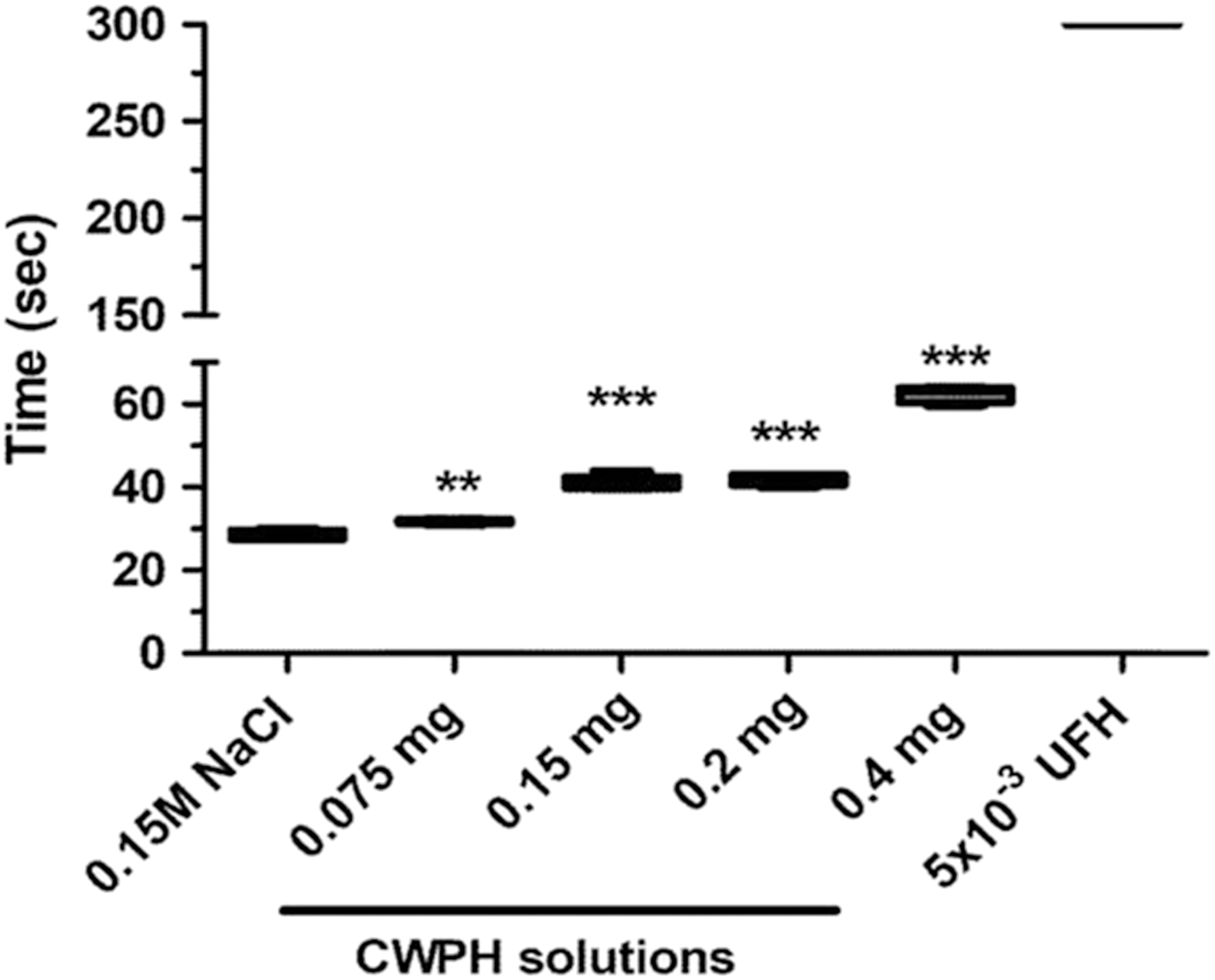
Effect CWPH on aPTT. Increased concentration of CWPH were compared with the 0.15 M NaCl as control. ***P < .0001, **P < 0.001 were considered indicative of significance. aPTT, activated partial thromboplastin time; CWPH, protein hydrolysates of chicken combs and wattles.
The PT is a test to evaluate the extrinsic and common pathways, that is, factors VII, X, V, and II. Figure 3 shows that CWPH did not prolong PT, indicating that the pathway of action of CWPH involves factors from the extrinsic pathway. Other studies involving the interaction of peptides with various clotting factors are necessary to understand all mechanisms involved in prolonging clotting time. Indumathi and Mehta 8 found similar results when studying a peptide isolated from algae. The peptide was able to prolong the aPTT but not the PT, indicating that it effectively inhibited the clotting factors involved in the intrinsic coagulation pathway.

Avaliation of CWPH effect on PT. CWPH (0.4 mg) compared with the control 0.15 M NaCl and UFH. PT, prothrombin time; UFH, unfractionated heparin.
ACE inhibition assay
The antihypertensive effect of CWPH was assessed through inhibition of ACE (IC50). CWPH had an IC50 value of 134.21 μg/mL, which was considered satisfactory (Fig. 4). The ACE-inhibitory capacity of the protein hydrolysate under study was considered superior to that found by Herregods et al. 23 in bovine gelatin hydrolysate (IC50 = 800 μg/mL).
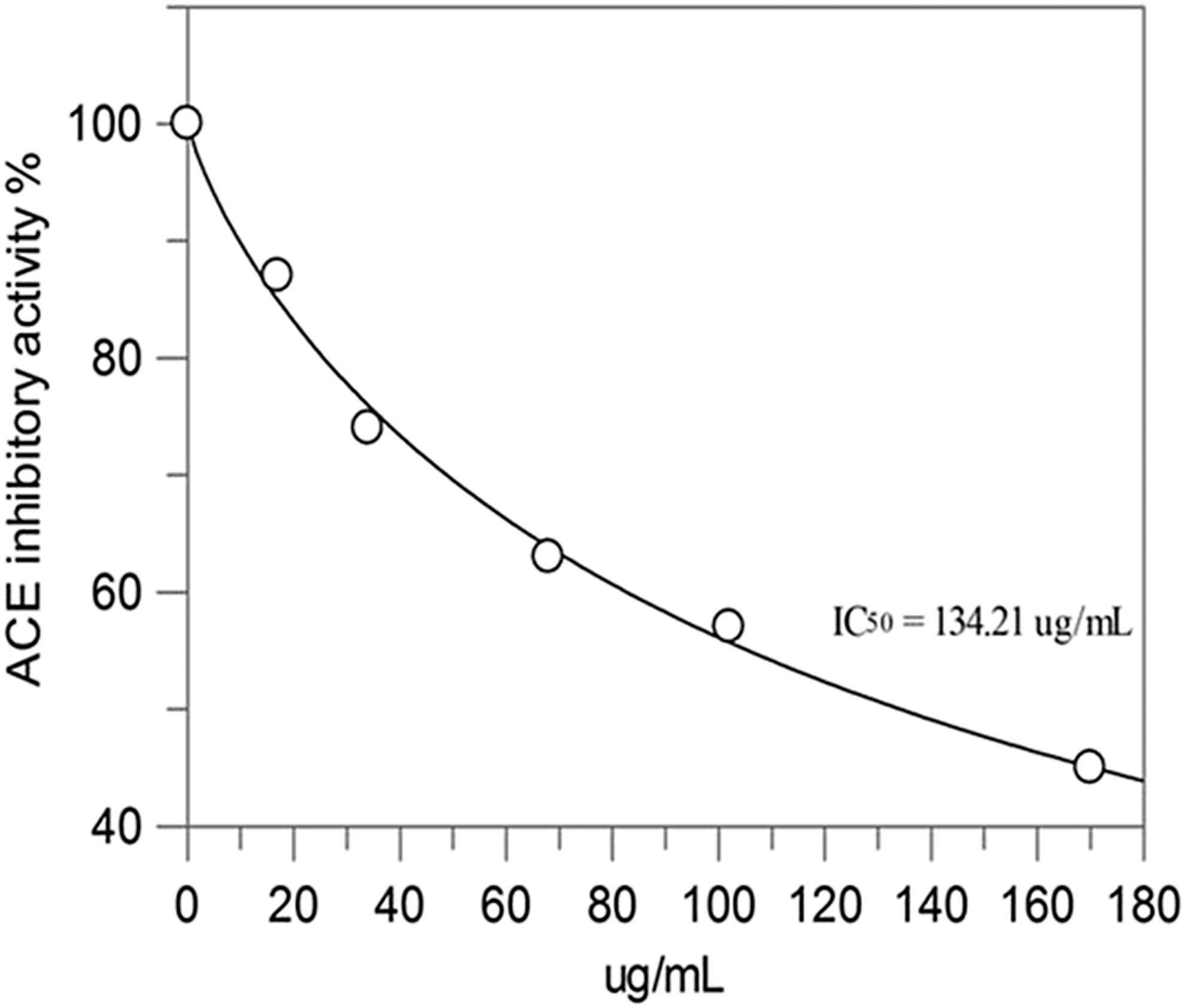
ACE inhibition assay of CWPH. ACE, angiotensin I-converting enzyme; IC50, concentration (μg/mL) required for inhibiting 50% of ACE activity.
Inhibition of the enzyme occurs through the action of peptides from collagen and elastin molecules. According to García-Moreno et al., 7 peptides derived from collagen have excellent antihypertensive capacity due to the action of amino acid residues at the ends of the sequence, such as proline and hydroxyproline at the C-terminus. Another important factor responsible for the inhibitory action of the converting enzyme is the reduction and, thus, release of low-molecular-weight peptides caused by proteolytic enzymatic systems, such as alcalase.
Identification of peptide sequences by LC-ESI-MS/MS
In the hydrolysate under study, the most intense peak ions eluted in retention time of 20–30 min, corresponding to the ACN gradient at 7–12%, which revealed a hydrophilic profile of the peptides. However, the mapping of the ion distribution showed that most of the peptides from the hydrolysate had a m/z ≤400, indicating the profuse production of low mass peptides.
The MSMS spectra analyzed resulted in 697 peptide sequences (486–3057 Da atomic mass) from 14 proteins. Most of the peptides had a calculated atomic mass <2000 Da. The CWPH peptides were derived from structural proteins of the cartilage matrix, such as collagen alpha-2 (I), collagen alpha-1 (I), collagen alpha-1 (III), and elastin, which mainly present Gly, Pro, Val, and Ala amino acids (in descending order), and a large number of their sequences had Arg, Lys, Glu, Gln, Phe, and Pro at the C-terminus.
With regard to the CCWH peptides, a high number of Pro residues was found with hydroxylation modification (hydroxyproline—Pro +15.99 Da), and some peptides had Gly-Pro-Hyp-like sequences, namely GLP(+15.99)GPIGP(+15.99)P(+15.99)GPR and GPP(+15.99), as well as GDIGGP(+15.99)GFP(+15.99)GPK (Fig. 5). Protein hydrolysates produced from collagen-rich materials, such as skin gelatin, have been reported with antioxidant activity and sequences similar to CCW-derived peptides with repeating Gly-Pro-Hyp sequences in their structures. 24,25
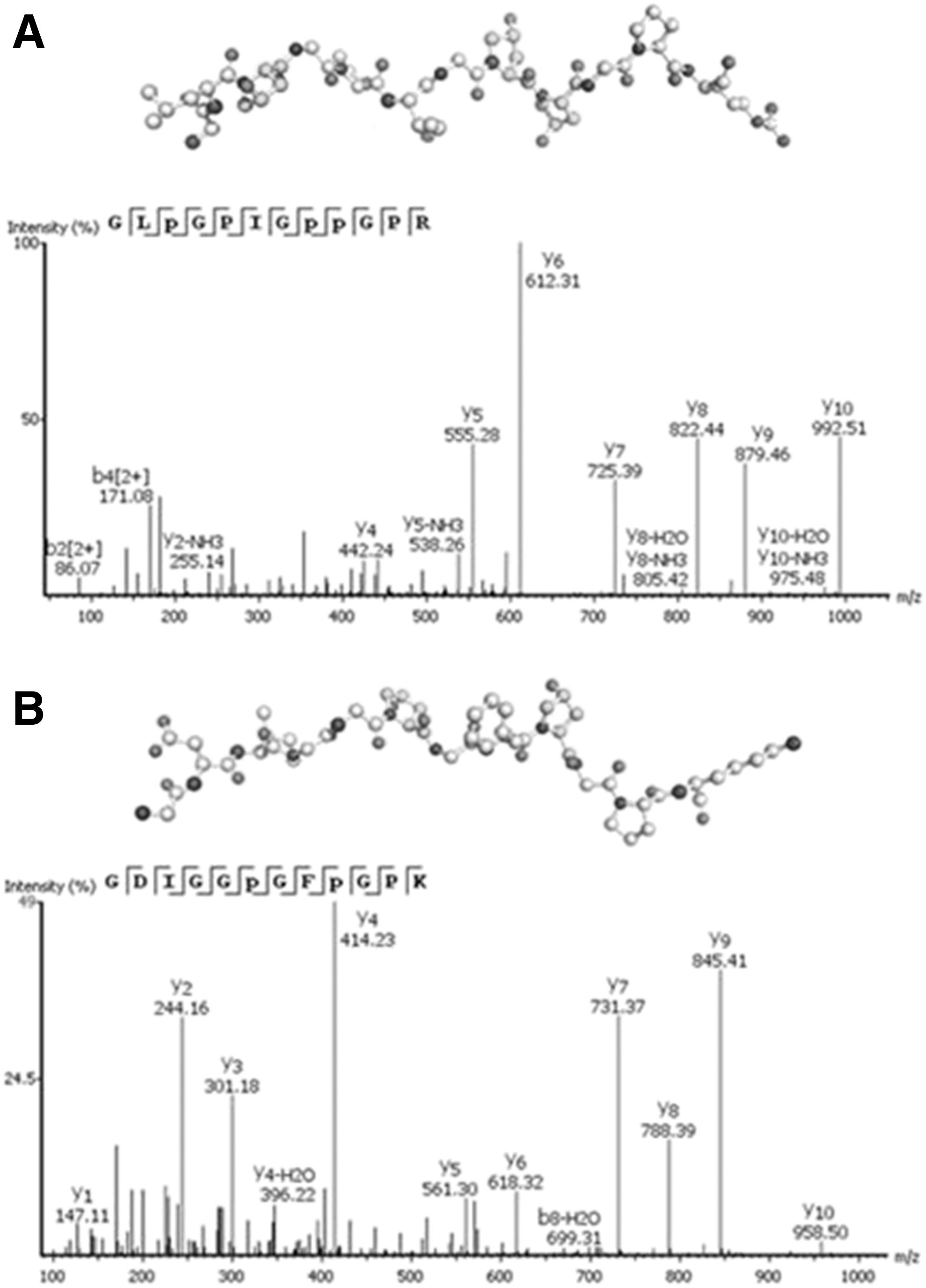
Structural insight of identified peptides with Pro-Arg/Lys in C-terminal from precursor proteins in high-degree hydrolysis.
ACE-inhibitory capacity of synthetic peptides
After evaluating the CCWH peptide sequences, three peptides with potential ACE-inhibitory activity were selected and synthesized. The peptides were selected based on their size and terminal amino acids, which are factors used to infer ACE-inhibitory property. The following synthetic peptides were used: peptide I (APGLPGPR), peptide II (Piro-GPPGPT), and peptide III (FPGPPGP). The peptides were tested for their ACE-inhibitory capacity. The IC50 values for the synthesized peptides are shown in Figure 6.

ACE inhibition assay of synthetic peptides.
Evaluation of the IC50 of the synthesized peptides showed that peptide III (FPGPPGP) had a greater potential to inhibit the converting enzyme (38 μM) compared with the other synthesized peptides. ACE-inhibitory activity is potentiated by the presence of hydrophobic amino acids at the C-terminus, mainly Pro residues. 19 Thus, peptide III had the following three amino acids at the end of the sequence: Gly-Pro-Pro.
The synthesized peptides were derived from collagen and elastin protein sequences based on the original matrix (CCW). According to Bhat et al., 26 peptides originating from collagen protein have high ACE-inhibitory potential. The ACE-inhibitory capacity of the synthesized peptides was similar to that obtained by Saiga et al., 27 who synthesized peptides from chicken meat extract (IC50 = 29 to 42 μg/mL).
Summary
The present study revealed the anticoagulant potential of peptides from the total hydrolysate of CCW and the mechanism of action of the intrinsic pathway. The total hydrolysate showed inhibition of ACE, which can act by inhibiting contraction of blood vessels and consequently elevation of blood pressure, thus it may help reduce blood pressure. The chemical synthesis of peptides copying the amino acid sequence of natural peptides from the protein hydrolysate confirmed the high ACE-inhibitory capacity of a new peptide sequence (FPGPPGP).
Footnotes
Author Disclosure Statement
The authors declare no conflicts of interest.
Funding Information
This work was supported by Fundação de Amparo à Pesquisa do Estado de São Paulo (FAPESP—Projects 12/50191-4 and 18/13588-0) and Coordenação de Aperfeiçoamento de Pessoal de Nível Superior (CAPES).