




Abstract
High-protein diets (HPDs) are widely used for health and performance. However, the combination of whey protein and natural foods (i.e., fruits) is still unclear. Thus, we evaluated the role of supplemental HPD with Bocaiuva (Acrocomia sp.) in metabolic and body composition parameters of rats submitted to resistance training (RT). Wistar rats (203.3 ± 30 g) were randomly allocated to five groups: normoproteic control (CON, n = 5), sedentary high-protein (SH, n = 5), RT + H (trained high-protein [TH], n = 5), sedentary+Bocaiuva (SH+B, n = 4), and RT+Bocaiuva (TH+B, n = 4) diet groups. After 12 weeks of RT, the maximal strength increased in both trained groups (P < .05). The TH + B group had lower values of adiposity index (AI) (3.8 ± 0.7% vs. 6.8 ± 1.3%) and visceral fat (0.038 ± 0.004 g/g vs. 0.067 ± 0.012 g/g) compared with the SH group, respectively (P < .05). The other groups did not show differences in values of AI (CON, 5.4 ± 1.6%, TH, 5.4 ± 1.3%, and SH+B, 5.5 ± 1.2%). In addition, the fasting glucose of trained groups (TH, 106.0 ± 4.5, and TH+B, 100.4 ± 13.5 dL/mg) was significantly lower when compared with controls (SH, 120.0 ± 14.4, and SH+B, 119 ± 6.4 dL/mg) (P < .05). Bocaiuva combined with an HPD reduced visceral fat and AI in addition to improving glucose tolerance of rats submitted to RT.
Introduction
In recent years, there has been an increase in the number of studies linking high-protein diets (HPDs) to health and performance benefits. 1,2 Thus, some potential health and ergogenic effects of these diets are related to body weight reduction, lean mass maintenance, muscular hypertrophy, and recovery improvements. Overall, recommendations for human protein intake based on nitrogen techniques range from 0.8 to 1.6 g(kg·d); however, many factors, including age, exercise level, training volume, body composition goals, and total energy intake, can increase these values up to two to four times. 3,4
To meet these daily protein requirements, physically active individuals and athletes should intake high-quality sources across the day, which can be obtained from a combination of foods and dietary supplements. 5 In this sense, whey protein (WP) is one of the most consumed and studied supplements in sport. It is a protein derived from milk serum, rich in branched-chain amino acids, with higher digestibility and absorption kinetics compared with many other protein sources. 6 WP supplementation is commonly associated with RT 7,8 due to its effects on strength gains, hypertrophy, and abdominal fat loss. 9 Haraguchi et al. 8 used WP as a protein source in rats submitted to exercise (8-week protocol) and showed a significant increase in mammalian target of rapamycin (mTOR) expression when compared with the standard dietary protein (casein) of rodent diet (AIN93). However, WP is commonly provided as an isolated protein source or added to a carbohydrate solution, 10,11 but little is known about the combination of WP with natural foods, mainly fruits and vegetables.
In the last years, natural foods have been the target of numerous investigations in sports nutrition. 12 –14 From the standpoint of global sustainability and local development, plant-based foods incur lower production costs compared with animal products and could be used as a complement in supplements with ergogenic and health benefit properties. In this sense, we highlight biomes with high biodiversity, such as the Brazilian savanna, which presents numerous species. It is the second largest biome in Brazil and its native fruits have high nutritional content and are commonly used in local cuisine. 15
Among several fruits stands the Bocaiuva, one of the fruits of the palm tree Acrocomia aculeata (Jacq) Lodd. Ex. Mart widely distributed in Central and South America, which is commonly used in different culinary preparations and as medicine due to its high nutritional value. It is distinguished from other tropical fruits by the high concentration of starch and oleic acid (70%) and high bioavailability of β-carotene, vitamin C, calcium, magnesium, zinc, and copper. 16
However, no study has investigated the effects of Bocaiuva fruit associated with exercise training. Therefore, the present study aimed to verify the role of an HPD supplemented with Bocaiuva (Acrocomia sp.) on metabolic and body composition parameters in rats submitted to chronic resistance training (RT).
Materials and Methods
Animals
Twenty-three male Wistar rats (Rattus norvegicus) (45 days, 203.3 ± 30 g) from the Central Vivarium of Federal University of Mato Grosso do Sul were housed in collective cages (2–3 animals) in a thermo-controlled environment with a 12-h light–12-h dark cycle. The animals had ad libitum access to food and water. All procedures were approved by the animal ethics committee (protocol number 854/2017) and followed international animal model research requirements.
Experimental design: diets
Diets were prepared in accordance with the American Institute of Nutrition for adult rodents (AIN-93M) to guarantee the nutritional requirements for rodents. 17 However, the casein content was replaced by 80% concentrated purified WP. The diets contained Bocaiuva (Acrocomia sp.) and were supplemented with 6% of lyophilized fruit pulp. Adaptations were made in the proportions of the diet's ingredients (cornstarch and soybean oil) to ensure the same energy content. The macronutrient composition of the diets is shown in Table 1.
Macronutrient Composition and Energy Density of Experimental Diets (Dry Weight g/kg)
Estimated value by realizing the difference of the total nutrients (moisture, carbohydrates, proteins, fat, and ashes) in 100 g.
The estimate of total energy value was based on standard physiological fuel values for carbohydrates, proteins, and fat of 4, 4, and 9, respectively.
Vitamin Mix AIN-93-VX.
Mineral Mix AIN-93M-MX.
Mature Bocaiuva fruits (Acrocomia sp.) were obtained between October and December of 2015. The coordinates were defined by Global Positioning System (GPS) (latitude—21°28′49″ longitude—56°08′17″ W). Fruits were selected, sanitized, weighted, and depleted and later lyophilized and stored in metalized vacuum packages and kept in a freezer at −20°C until preparation of the experimental diets.
Experimental design: exercise protocol
The animals were randomly allocated according to the sequentially numbered, opaque sealed envelope method into five different groups: normoproteic control (CON, n = 5), sedentary high-protein (SH, n = 5), trained high-protein (TH, n = 5), sedentary high-protein with Bocaiuva 6% (SH+B, n = 4), and trained high-protein with Bocaiuva (6%) (TH+B, n = 4) diet groups. The experiment lasted 12 weeks. Body mass (BM) and muscle strength and dietary intake were evaluated weekly.
The familiarization period consisted of a climbing vertical ladder (1.1 m, 2.0 cm between steps, and 80° slope) with weights attached to the animals' tails. 18 Thereafter, the animals were submitted to an incremental test to determine the maximal carrying capacity (MCC), which consisted of climbing the ladder with a load of 75% of the animal BM. After the first climb, 120 sec of recovery was given between each climb and 30 g was added to the carrying load. The procedure was repeated until the animal was no longer able to perform a completely new climb and MCC was determined by the sum of loads added to 75% of the BM. 19
The RT protocol was performed three times a week, with animals performing climbs with progressive loads, starting with 50%, 75%, 90%, and 100% of the MCC and 120-s intervals between climbs. 18,19 After climbing with 100% MCC, subsequent loads of 30 g were added to the apparatus attached to the tail until the animal stopped rising the ladder. At the end of the 12-week experiment, the animals were evaluated again (incremental test), and 48 h after the last session, the animals were euthanized (xylazine 0.06 mL/100 g and ketamine 0.03 mL/100 g) by exsanguination.
Body composition analysis
BM and body length (nose-to-anus length) assessments were made weekly. The BM and body length were used to determine the body–mass index (BMI) (body weight [g]/length 2 [cm2]). The mesenteric, epididymal, omental, perirenal, and retroperitoneal fat tissues were removed and measured individually and used to calculate the adiposity index (AI) (AI% = fat mass sites/BM × 100). 20 These measurements were made in anesthetized rats.
Intraperitoneal glucose tolerance test
The intraperitoneal glucose tolerance test (iGTT) was performed at the end of the experiment, 24 h after the last training session. The animals were fasted for 6 h, without water restriction. After the first measurement, a 50% glucose infusion (2 g/kg) was performed and monitored at different times (15, 30, 60, and 120 min) using a portable blood glucose monitoring system (Accu-Chek Advantage/Roche®).
Statistical analysis
Data are expressed as mean and standard deviation. The Kolmogorov–Smirnov test was used to verify normality of data. After normality test verification, the data were tested by one-way (body weight change, AI, visceral fat, glucose area under the curve (AUC), skeletal muscle mass, and fasting glucose) or two-way (body weight, BMI, food intake, iGTT, and MCC) analysis of variance. The Bonferroni multiple comparison test was used in all situations. A significance level of 5% was adopted. All data were treated and analyzed by Prism 8 for Mac (GraphPad Prism, v 8.0.1). G × Power, v3.1, was used to calculate the power of the study (critical F 3.238, effect size >1.13), which (1—β) was 0.90 for α 0.05 with a proper sample size using four animals per group.
Results
After 12 weeks of training, the body weight was significantly lower (P < .05) in the trained groups (TH, 378.4 ± 33.9 g, and TH+B, 379.2 ± 43.3 g) when compared with the SH group (446.8 ± 28.9 g) (Fig. 1A). Regarding BMI, as expected, all groups presented an increase compared with the beginning of the experiment. At the end of 12 weeks, the TH group presented lower BMI than their sedentary control. In addition, the group supplemented with Bocaiuva showed lower BMI when compared with the control hyperproteic groups (Fig. 1B; P < .05). In addition, the sedentary group (SH) presented a significant elevated body weight change (229.6 ± 16.4 g) compared with the TH (164.6 ± 28.3 g) and TH + B (174.1 ± 29.1 g) (Fig. 1C) groups. It was observed that the TH group had a lower body weight change (164.6 ± 28.3 g) when compared with the SH + B group (216.9 ± 13.6 g) (Fig. 1C).
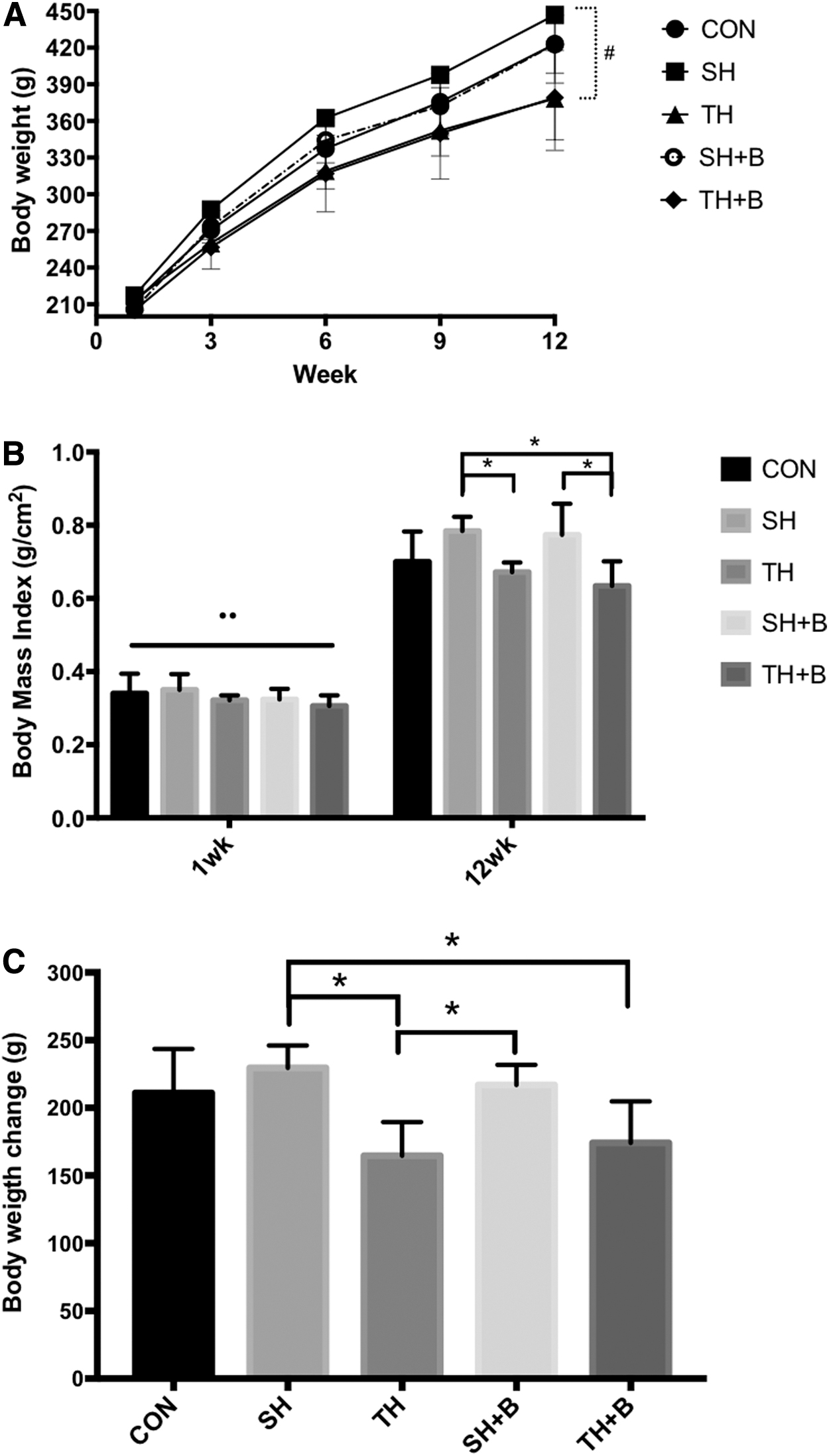
Body weight time course
In relation to the AI, the TH + B group presented lower AI (3.80 ± 0.65%) when compared with SH (6.80 ± 1.25%) (P < .05; Fig. 2A). Regarding visceral fat corrected for body weight, only the TH + B group had lower values (0.038 ± 0.004 g/g) when compared with the nonexercise group (SH) (0.067 ± 0.012 g/g) (P < .01; Fig. 2B).
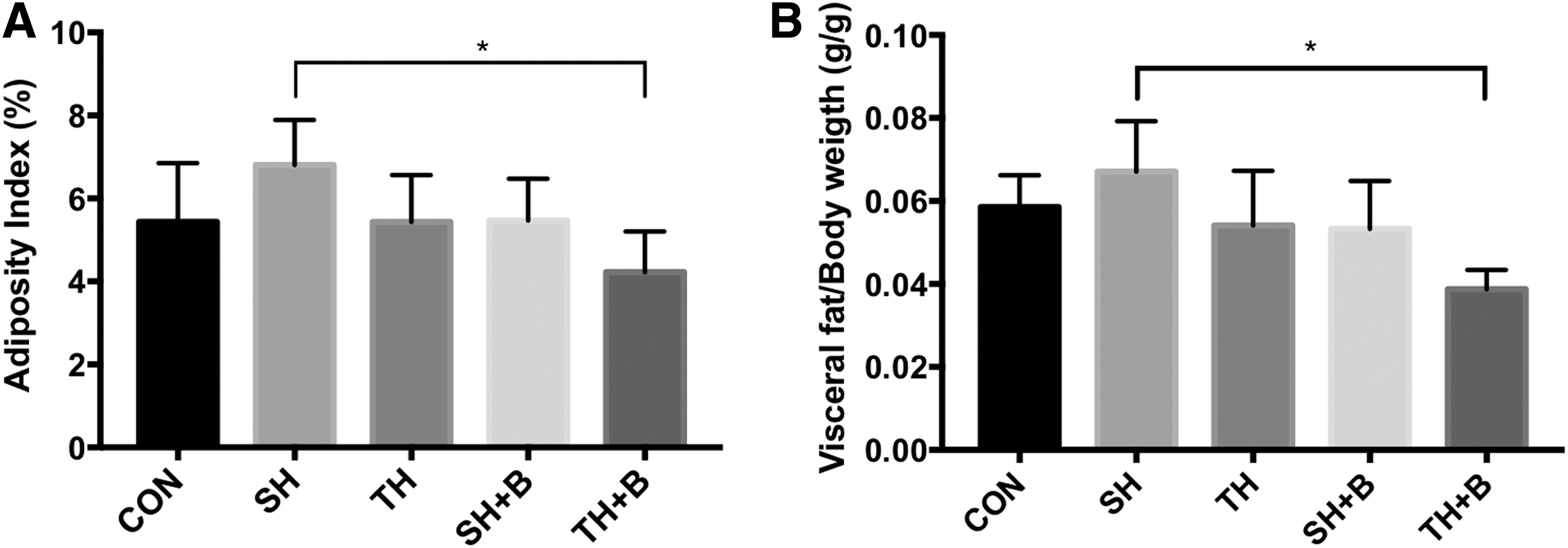
Adiposity index
Food consumption (g) was calculated during the 12-week experiment (per animal/day). Figure 3 shows the kinetics of the average consumption of groups every 3 weeks. Thus, only the TH group showed lower food consumption (17.0 ± 0.7 g) when compared with all untrained groups (week 12) (CON, 20.2 ± 0.3 g, SH, 19.9 ± 0.6 g, and SH+B, 19.9 ± 1.2 g; P < .05; Fig. 3).
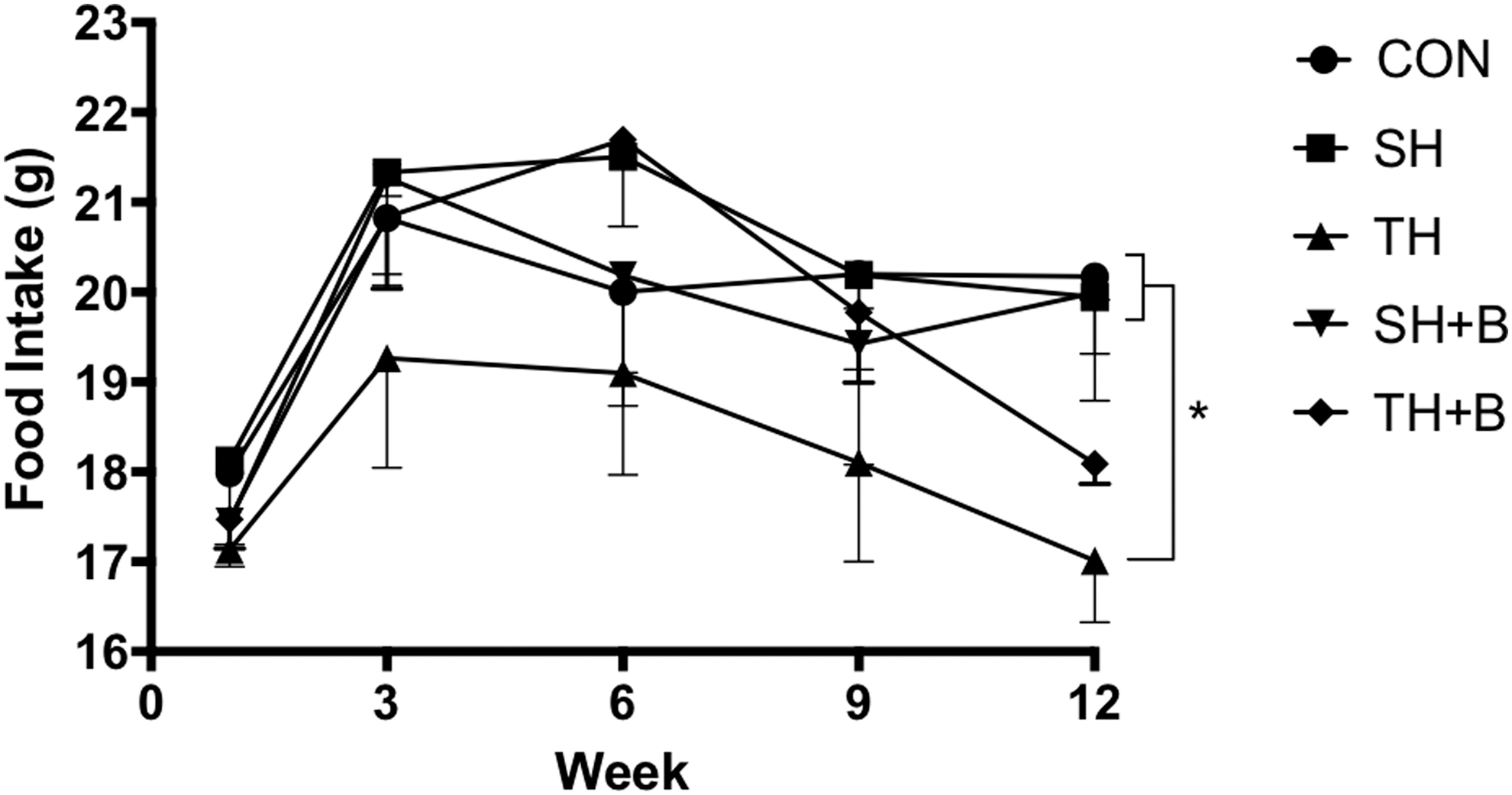
Food consumption time course (per rat/day) in CON, SH, TH, SH+B, and TH + B groups. *Indicates differences between the respective markings.
The glucose kinetics after the iGTT showed no significant differences (interaction, P = .61) among groups (Fig. 4A). However, the TH + B group showed a lower AUC compared with the other high-protein groups (Fig. 4B). At the end of 12 weeks, fasting blood glucose levels of TH and TH + B groups (106.0 ± 4.5 and 100.4 ± 13.5 dL/mg, respectively) were significantly lower when compared with their respective SH and SH + B controls (120.0 ± 14.4 and 119.0 ± 6.4 dL/mg) and absolute control (CON, 114.0 ± 9.4 dL/mg).

Blood glucose tolerance test
Finally, statistically significant differences regarding the weight of the gastrocnemius muscle corrected by body weight were not observed between the experimental groups (Fig. 5A). Regarding the MCC test, after 12 weeks, both trained groups (TH and TH+B) showed a significant increase compared with their respective baseline carrying capacity (Fig. 5B). No statistical differences were found between groups through the training period.

Skeletal muscle weight—gastrocnemius
Discussion
The present study evaluated the chronic effects of the HPD supplemented with Bocaiuva (Acrocomia sp.) in rats submitted to 12 weeks of RT. To the best of our knowledge, this is the first study to investigate the effects of Bocaiuva on the response to exercise training. The main findings show that 12 weeks of RT were effective in reducing visceral fat, increasing muscle strength, and improving the glycemic profile, mainly in animals supplemented with Bocaiuva (Acrocomia sp.).
HPD is commonly used as a strategy for improving body composition, 2 mainly when associated with exercise training. 5 Thus, the use of nutritional strategies with high-protein intake in short periods seems to improve glucose metabolism. 21 However, in the long term, the high consumption of protein and cholesterol was associated with glucose intolerance in Canadian Inuits 22 as well as increased risk for type 2 diabetes. 23 However, the chronic effects of HP supplementation have not yet been fully elucidated, and even less the Bocaiuva (Acrocomia sp.) administration effects. Interestingly, when associated with RT, rats supplemented with 6% Bocaiuva showed lower values of AI, visceral fat, and BMI at the end of 12 weeks compared with SH groups.
Fruits and vegetables play an important role in human health since they are essential nutrient sources of minerals, which are necessary for neuromuscular function. 24 In this sense, it was identified that the Bocaiuva pulp (Acrocomia sp.) presents a high concentration of potassium, calcium, copper, and phosphorus, as well as an ideal amount of β-carotene, which can be a vital source of vitamin A. 25 In this sense, Petiz et al. observed that oral vitamin A supplementation associated with swimming was able to reduce inflammatory biomarkers. 26
In this study, Bocaiuva (Acrocomia sp.) supplementation, as well as HP, seems to be effective in reducing the visceral fat in rats submitted to RT. Differently, de Sousa Neto et al. 27 verified an increase in fat in rats fed a standard diet and subjected to the same RT protocol used in the present study. Besides, de Sousa Neto et al. verified a decrease in the matrix metalloproteinase-2 activity, which plays a vital role in development and organization of adipose tissue 28 and is associated with the adipogenesis process. 29 Therefore, studies investigating Bocaiuva supplementation in metalloproteinase activity are necessary to further elucidate its mechanisms, especially in adipose tissue metabolism.
The RT protocol proposed by Hornberger and Farrar 18 has been widely used by several studies 19,27 where the animal can perform the movement (climbing ladder) voluntarily. In the present study, no ergogenic potential of Bocaiuva was observed when strength parameters were evaluated once the MCC values of the trained groups after 12 weeks showed no statistical differences. Taking into consideration that these data were not statistically different, further studies could aim for a more in-depth investigation regarding longer or different types of RT programs and how previously cited, possible anti-inflammatory factors of Bocaiuva could play a role in strength exercises and recovery between sessions. In addition, Lescano et al. 30 verified the anti-inflammatory activity of Bocaiuva oil in Wistar rats, which may indicate a potential use of this fruit as a food resource.
The nonexercised high-protein groups (SH and SH+B) presented higher fasting glycemia when compared with trained animals and the CON group at the end of 12 weeks. Thus, glycemic control is an essential factor to be taken into account, especially in sedentary conditions. Thus, Miranda et al. verified the effects of pomegranate seed oil (Punica granatum) on the metabolism of rats given an obesogenic diet (150 g/kg of fat). However, no changes were observed in glycemic control. 31 Besides, the use of fruits can be an essential tool in metabolic control under different conditions. Thus, Esmaeilinezhad et al. 32 carried out a randomized, controlled, and blind study using the combination of pomegranate juice and symbiotics in glycemic control, sex hormones, and anthropometric indexes of women with polycystic ovarian syndrome. The analyzed outcomes disclose significant improvements in insulin resistance, hormonal, and anthropometric profiles. Liao et al. demonstrated that administration of a mixture of amino acids (Ile: 3%, Leu: 1%, Val: 0.2%, and Arg: 0.3%) for 9 weeks in rats given advanced glycation end products resulted in better glycemic responses when compared with groups without amino acid supplementation. 33
HPD containing high levels of branched-chain amino acids may be beneficial in glycemic control, 25 mainly in pathological models such as type 2 diabetes mellitus. 26 In this sense, leucine appears to be involved in regulating glycemic control 34 because it increases muscle glucose oxidation. 35 In addition, it is known that RT can improve muscle glucose uptake by increasing both GLUT4 translocation and the expression of IGF-1, as well as other signaling pathways. 36
Although the present study did not analyze the expression of GLUT4 or other signaling pathways, the exercised groups had lower fasting glycemia after 12 weeks of RT. Moreover, the TH + B group demonstrated a smaller AUC, which may be associated with an improvement in the muscle glucose uptake function. These findings corroborate other studies that verified the hypoglycemic effects of palm fruits, such as Bocaiuva (Acrocomia sp.). 37 Additionally, a recent study performed by da Silva et al. 38 demonstrated antioxidant activity and reduction in glucose levels of eutrophic and experimental diabetic rats supplemented with oat pulp oil (without cytotoxicity signs). Furthermore, Nunes et al. demonstrated that experimental diabetic animals presented a reduction of glycemic levels when treated with Bocaiuva (Acrocomia sp.) oil, 39 which corroborates our results.
Conclusion
In summary, Bocaiuva (Acrocomia sp.) supplementation when combined with an HPD was efficient in reducing intake, visceral fat, and AI and improving glycemic control in rats submitted to 12 weeks of RT. Finally, new studies using different exercise training protocols as well as the use of fruits of the Brazilian Cerrado are encouraged.
Authors' Contributions
J.A.A. carried out all experimental procedures, performed statistical analysis, and wrote, drafted, and revised the article; H.A.P.S. was involved in design, writing, data interpretation, reviewing, and editing; D.M.-S. was involved in writing, formal analysis, data interpretation, reviewing, and editing; M.E.N. was involved in writing, conceptualization, data acquisition, and original draft preparation; K.K.S.S. carried out all experimental procedures and drafted the article; C.S.M. carried out all experimental procedures and study design; H.M. drafted the article, study design, and revised the article; C.C.F.R. wrote, drafted, and revised the article; F.A.V. was involved in writing, revising all experimental procedures, and revising the article; and R.C.A.G. conceived the study, carried out experimental procedures, and drafted and revised the article. All authors read and approved the final article.
Footnotes
Author Disclosure Statement
The authors declare no conflicts of interest.
Funding Information
This study was supported by Conselho Nacional de Desenvolvimento Científico e Tecnológico (CNPq, Universal, 408534/2016-8), Coordenação de Aperfeiçoamento de Pessoal de Nível Superior (CAPES), and Mix Nutri Inovação Nutricional.