




Abstract
The highest causes of worldwide morbidity and mortality are cardiovascular diseases (CVD) that pose a major health concern affecting patients' quality of life. Pomegranate fruit contains unique compounds with various bioactivities and has been used as a powerful medicinal food in various illnesses, including CVD. Several trials confirmed the therapeutic impacts of its edible portion, but trials on pomegranate peel's impacts are fewer. Our aim was to evaluate the anti-inflammatory and antiatherogenic in vivo effects of pomegranate peel powder (PPP) in rats fed a high-fat diet (HFD). Twenty-eight albino rats were distributed among four groups: I (control), II (on HFD), III (on HFD and PPP 0.5 g/kg BW), and IV (on HFD and 1 g/kg BW). Blood samples were tested for interleukin-6 (IL-6), C-reactive protein (CRP), serum amyloid-A (SAA), total cholesterol (TC), high density lipoprotein cholesterol (HDL), and some primary biochemical parameters. HFD induced significant elevations in cholesterol and inflammatory markers as compared with controls. Nevertheless, HDL, alanine aminotransferase, creatinine, and albumin showed no change in all rats. In both PPP treatment groups, CRP and SAA levels were reduced significantly with significant decrease in TC. Samples of thoracic aorta from treatment groups showed a normal appearance and amelioration of subclinical atherosclerotic changes found in HFD group. PPP exhibited anti-inflammatory and antiatherogenic effects in comparison to HFD controls.
Introduction
The world's leading cause of mortality is cardiovascular disease (CVD), with its multifactorial etiologies, and underlying atherosclerotic pathophysiology. Recent trials have demonstrated that vascular inflammation is the earliest known incident in the initial stage of atherosclerosis, when monocytes mount tightly on the endothelial layer to migrate to the intima of the artery and transform into macrophages. This migration is triggered by chemoattractant molecules and proinflammatory cytokines. 1–2
Increased thickness in the intima and media is linked with an increasingly diseased artery. Because there is a relation between intima media thickness (IMT) and cardiovascular events, IMT is an important test for detecting disease in its earliest phase, when interventions such as diet, lifestyle, and drug treatment can have the greatest impact. 3
Cardiac and anti-inflammatory medications are currently the world's most widely used classes of treatments, and while pharmacological products are of great importance, CVD are consuming therapeutic assets and substantially influencing global and national health budgets. 4 Lifestyle-related factors, including healthy eating are considered key variables in the progression of CVD. Increased proinflammatory and oxidative stress in obesity-related metabolic problems mandates that more emphasis is placed on designing therapeutic products to prevent inflammations and oxidative stress. 5
Functional foods, such as fruit polyphenols, provide considerable capacity for improving health and preventing certain illnesses by their antioxidant and anti-inflammatory characteristics, with a main focus on modifiable risk factors, including metabolic syndrome, hyperlipidemia, diabetes, obesity, and raised inflammatory biomarkers. This is crucial nutritionally as they contain substances that operate synergistically to decrease the risk of CVD. 6–7
The species (Punica granatum L) of pomegranate has lately been of major importance to pharmaceutical, nutritional, and pharmacological researchers and to current medicinal products because of its unique compounds and various bioactivities like antioxidants, antiviral, antineoplastic, antibacterial, and antidiabetic. Tannins and phenolics are abundant in pomegranate and have proved responsible for their antioxidant activities. While the demand for pomegranate processing is increasing worldwide, higher quantities of waste are generated as the peel represents 50% of the weight of the fruit. 8
Pomegranate peel and juice have considerable quantities of phytonutrient substances, such as ellagic acid, ellagic tannins, anthocyanines, catechin, flavonols, procyanidins, and gallic acid. Polyphenolic compounds exist in a greater quantity in pomegranate peel powder (PPP) than in pomegranate juices, and thus PPP is more potent biologically. In spite of this fact, the peel is frequently thrown as waste. This is why it is regarded as a considerable and inexpensive source of natural antioxidants by many researchers. 9
Several trials have shown that the antioxidant capability of the peel powder extract is significantly greater than the pomegranate juice extract, e.g., in hydroxyl and peroxyl radicals and superoxide scavenging capacity. The peel has demonstrated a wide array of other biological actions, including anticancer, antimicrobial, and anti-inflammatory activity. 10
The association of obesity with immune dysfunction and chronic low-grade inflammation has been frequently specified. Pomegranate extract was demonstrated to have antiobesity impacts and to re-establish obesity-induced harm. 11
Acute-phase proteins particularly C-reactive protein (CRP) and serum amyloid-A (SAA)—in some robust epidemiological studies—are reliable indicators of CVD. SAA is at the crossroads of inflammation, dyslipidemia, and metabolic syndrome through its impacts on high density lipoprotein cholesterol (HDL) metabolism, obesity, and insulin resistance. 12 For those with acute coronary artery disease (CAD), high SAA is frequently a sign of poor prognosis. SAA unfavorably affect CV system by disturbing reverse cholesterol transport, increasing endothelial dysfunction, promoting clotting, and turning on various inflammatory triggers. Reducing SAA level is now believed to help acute CAD patients. 13
Recent research shows that nutritional polyphenols are significantly interfering with pathophysiological processes and the development of arterial rigidity. 14 Studying the therapeutic impacts of pomegranate on chronic inflammation and conditions associated with inflammatory diseases was specially focused on fruit-derived juice or extracts. 15 They have been mainly studied for their capacity to treat prostate cancer, diabetes, and atherosclerosis. Numerous articles are now accessible 16 –18 regarding pomegranate juice and different extracts' antimicrobial, antioxidant, anti-inflammatory, and anticancer properties. Other biological characteristics also indicate protective impacts on hepatic function or glucose and lipid metabolism. Yet the peel extract has been mainly studied for its antioxidant and anti-inflammatory activities, liver protection, and antimicrobial potentials. 19 –25 On the other hand, the endothelial-protecting ability of PPP is still new.
Therefore the aim of the present study was to evaluate in-vivo anti-inflammatory and antiatherogenic properties of PPP on rats fed a high-fat diet (HFD).
Materials and Methods
Collection of material and preparation of pomegranate peel powder sample
Preparation of PPP aqueous suspension: (milling, stirring, and centrifugation)
Pomegranate fruits were washed then peeled and their eatable portions were carefully separated. The peels were air dried for 1 day, then roasted in a medium heat oven for 1 h, and ground into powder using a Grain Mill Chef Attachments KAX941PL (Kenwood), sieved (with a 60 μm mesh), and kept in an air-tight container.
A 12.5 and 25 g PPP (respectively) and 50 mL purified water were stirred for 20 min using the Dlab Hot Plate Magnetic Stirrer (DLAB Scientific Co., Ltd., Beijing, China) at 22°C to be mixed, then totaled by adding purified water to 100 mL, and stirred for 1 h at 80°C, then spinning at 900 rpm/min for 1 h in a centrifuge (India & Desktop H3-18K High Speed Centrifuge; Hunan Kecheng Instrument and Equipment Co., Ltd.) to increase homogeneity. Finally two concentrations were obtained, 0.5 g/kg (1 mL of 12.5% sol) and 1 g/kg (1 mL of 25% sol).
Proximate analysis and antioxidant content of PPP
Total antioxidant capacity, total phenols, and total flavonoids were measured by Spectrophotometer UV–VIS Analytikjena Spectro D250 Germany, results were expressed as milligram gallic acid equivalent/100 g date seeds; selenium, and zinc were measured by Inductively coupled plasma (ICP MS/MS 8800 Triple Quad) Agilent Technologies in the Central National Laboratory of Food & Feed, Cairo, Egypt.
Animals and treatment
A total of 28 albino rats (150–180 g) were obtained from the animal house of the faculty of pharmacy and drug manufacturing, Pharos University, Alexandria, Egypt. The rats were acclimatized for 3 days before starting the experiment. All animals were housed in standard cages (seven rats/cage), in air-conditioned rooms at 21–23°C and 60–65% of relative humidity, and kept on a 12-h light/12-h dark cycle. The animals received humane care in accordance with the research ethics for use of animals, issued by the Scientific Research Ethics Committee of Pharos University and fed with standard laboratory diet and tap water ad libitum.
Ingredients of diet
Standard laboratory chow: 6% of calories from fat.
HFD: (46% of calories from fat) (plant margarine rich in saturated fatty acids from palm oil, and lard) added to chow.
Experimental groups and protocol
Four groups of seven rats each (n = 28) were approved for the study. Group I: −ve control, Group II: +ve control, Group III: PPP (0.5 g/kg BW), and Group IV: PPP (1 g/kg BW).
Group I: Rats fed on standard laboratory diet without any additives for 8 weeks and served as a negative control group.
Group II: Rats fed on HFD for 8 weeks; i.e., positive control.
Group III: Rats fed on HFD for 4 weeks, and then PPP1 by oral gavage in addition to HFD for 4 weeks.
Group IV: Rats fed on HFD for 4 weeks, and then PPP2 by oral gavage in addition to HFD for 4 weeks.
Body weights of all groups under investigation were measured twice weekly. At the end of the experiment, the animals (the control and experimental animals) were sacrificed under pentobarbital anesthesia. Blood samples were collected from the aorta for biochemical analysis.
Biochemical tests
Samples were tested for interlukin-6 (IL-6), CRP, SAA, total cholesterol (TC), HDL, total protein, albumin, urea, creatinine, creatine kinase, aspartate aminotransferase (AST), alanine aminotransferase (ALT), alkaline phosphatase (ALP), and gamma-glutamyl transpeptidase on Roche/Hitachi Cobas c systems (Integra 400 Plus), Germany, by using enzymatic colorimetric methods.
Histopathology
The heart and aorta were retrieved; the samples were kept in formalin solution for preparing paraffin sections. Sections were stained with Hematoxylin and Eosin to study the histological structure of the wall of the thoracic aorta. After slides' preparation, a photo session was performed using a Moticam 3 attachable digital C-mount camera with Live resolution: 3.0 MP (2048 × 1536), and saving images with either a (magnification × 40), (magnification × 80), or (magnification × 100).
Statistical analysis
Analysis was done using IBM SPSS software package version 20.0. (IBM Corp., Armonk, NY). The Kolmogorov–Smirnov test was used to verify the normality of distribution. Quantitative data were described using range (minimum and maximum), mean ± SD and median. Significance of the obtained results was judged at the 5% level.
F-test (ANOVA) was used for normally distributed quantitative variables, to compare more than two groups, and post hoc test, Tukey–Kramer multiple comparison test for pair-wise comparisons
Results
Proximate analysis and antioxidant content of PPP are shown in Table 1.
Nutrient Content
PPP, pomegranate peel powder.
Table 2, discloses that HFD-induced significant elevations in total serum cholesterol and inflammatory markers, IL-6, CRP, and SAA levels, as compared with the control group; whereas HDL, ALT, ALP, creatinine, and albumin showed no change in all rats.
Comparison Between the Different Studied Groups According to Biochemical Tests
Pair-wise comparison between each two groups post hoc test (Tukey).
Statistically significant difference between the negative control group and other groups.
Statistically significant difference between the positive control group and other groups.
ALP, alkaline phosphatase; ALT, alanine aminotransferase; AST, aspartate aminotransferase; CRP, C-reactive protein; HDL, high density lipoprotein cholesterol; IL-6, interleukin-6; SAA, serum amyloid-A; TC, total cholesterol.
HFD led to significant increase in TC in comparison to negative control (176.5 ± 11.21) and (77.02 ± 15.23), respectively, with P-value <.001. In both PPP treatment groups, TC levels were reduced significantly compared with the positive control group. Whereas, HDL levels were almost the same in all groups.
AST was significantly higher in positive controls (170.2 ± 40.43) when compared with negative controls (118.0 ± 10.12), P a = .030. Yet its level in both PPP treatment groups did not show any significant difference from negative controls.
There were no significant differences between all groups in other primary biochemical parameters listed in the methods section (Data not displayed).
IL-6, CRP, and SAA showed significant elevations in positive control than negative control P a = .015. In PPP treatment groups, CRP and SAA showed significant decrease than positive controls P b = <.001 and < .001, respectively.
In Table 3, adding HFD led to significant increase in body weight gain of positive control compared with their negative control rats, P a = .017 (Tukey). With a % change in weight: ↑35.39 ± 9.74, ↑44.78 ± 10.61, ↑40.94 ± 8.17, and ↑36.38 ± 6.67 for all groups, respectively.
Comparison Between the Different Studied Groups According to Weight Change, Weight Gain, and Feed Intake
Pair-wise comparison between each two groups post hoc test (Tukey).
Statistically significant difference between the negative control group and other groups.
Histopathology
Positive controls—HFD—showed that there were patchy thickenings in lamina media with degenerative changes alternating with areas of normal thickness in aorta (Fig. 1B) with the straight black line indicating the thickened media. (magnification × 80)
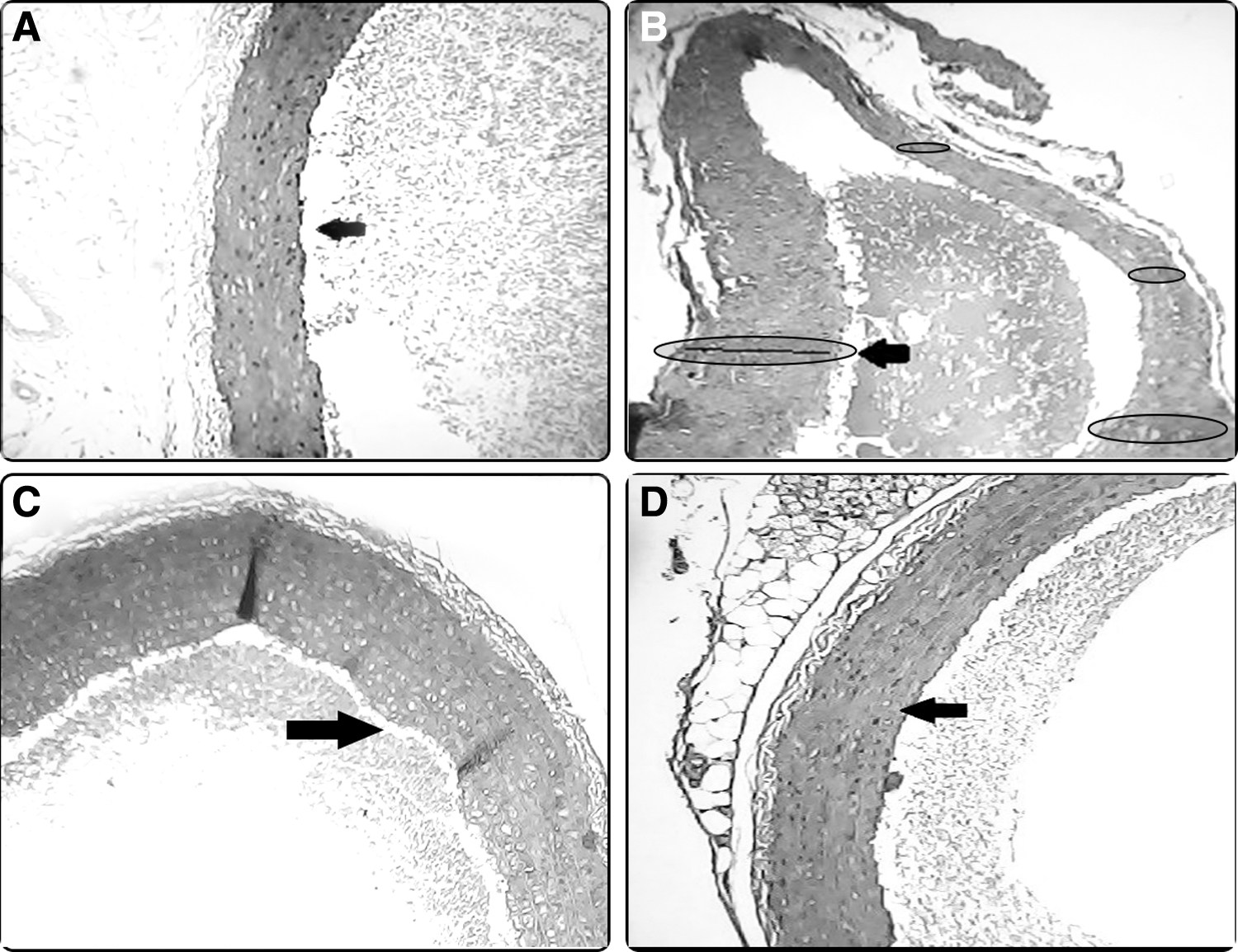
Photomicrographs of rats' thoracic aortas (arrows are pointing to intima/media).
Samples of negative control rats (Fig. 1A) (magnification × 80) and rats from treatment groups (Fig. 1C, D) (magnification × 100) showed a normal appearance of the intima and media. No changes related to ischemia (IMT) were detected in all treated groups. These observations confirm the protective effects related to the oral consumption of PPP by rats on HFD.
Discussion
The consumers' choice of natural products as well as side effects of synthetic pharmaceuticals had led to an increasing interest in the public quest and use of natural phytonutrients in fruit and vegetables. Thus, in a way to investigate more into PPP anti-inflammatory and antiatherogenic properties; we supplemented rats fed a HFD—to induce low-grade inflammation, atherogenesis, and obesity—with two concentrations of aqueous suspension of very finely ground PPP.
Total phenols in our sample as shown in Table 1, were 4892 mg/100 g gallic acid equivalent, total antioxidant capacity was 3757.5 mg/100 g ascorbic acid equivalent and total flavonoids were 529.5 mg/100 g quercetin equivalent.
There were no significant changes in serum albumin, creatinine, as well as ALT and ALP with the use of PPP as shown in Table 2, and since there was no change in the primary biochemical parameters following consumption, the use of PPP could be considered safe for rats. Moreover the rise in AST by HFD (which is an indicator of tissue injury, more specific to the heart) was ameliorated by the use of PPP.
PPP-treated groups showed significantly lower TC levels compared with the positive control group and as HDL levels did not change in all groups; this means that the cholesterol-lowering effect was mainly demonstrated on LDL levels. Corresponding studies' findings indicate that PPP help to reduce TC and LDL levels in rats and many studies have supported our findings and highlighted the hypolipidemic impacts of using PPP. 26
Body weight gain that occurred in HFD-positive control did not occur in the 1 g/kg (1 mL of 25% sol) treatment (Group IV), and % weight gain in this group was the same as negative control—shown in Table 3. This implies that higher concentrations of PPP may be needed to prevent weight gain resulting from HFD.
In a previous research, an 8 weeks pomegranate extract (300 mg/kg) reduced the levels of HFD-induced rise in IL-6 levels in rats in one study. 27 Our current results showed a significant increase in IL-6 in HFD control group; (21.1 ± 5.02a) in contrast to (15.45 ± 0.12) in negative controls (P a = .018). PPP use attenuated the elevated levels of IL-6 to baseline in both treatment groups as in Table 2.
Researchers discovered that when pomegranate extract was added to high-cholesterol diet-fed mice, they encountered cardiac protective effects, including decreased arteriosclerotic plaque size, and lower level of proinflammatory biomarkers. 15 SAA and CRP showed significant decrease than positive controls in both treatment groups in the current study.
In this research, the aorta of rats fed on HFD has shown structural alterations; increased width of the tunica media was the most drastic, with patchy thickenings and degenerative changes alternating with areas of attenuated thickness in aorta (Fig.1B). This was not found in either PPP treatment groups. In agreement with our findings, Sakr 28 found that the histopathological changes in rat groups fed orally with pomegranate juice yogurt and peel extract yogurt showed marked improvement than positive controls, i.e., normal histopathological structure comparable to the negative control group.
Although different trials have shown that pomegranate and its components have cardiovascular protective impacts, studies on the potential of PPP on IMT and organs other than the liver are scarce. Furthermore, some extracts could not be normally consumed by humans with a normal diet. This stresses the significance of the current research and its prospective application. Coffee substitution beverages with elevated antioxidant content combined with low consumption of caffeine are of public interest because of the increasing awareness of health benefits of phytochemicals. This is both feasible and socially acceptable. We addressed the core factors in atherogenesis and the impacts of a natural ingredient, PPP, in treating that serious disease. This wasted residue can be used to prepare warm drink infusions by drying, toasting, and milling.
Rats fed on HFD supplemented with PPP (0.5 g and 1 g/kg BW) for 4 weeks showed a potential atheroprotective effects compared with HFD control group. Both concentrations that succeeded to restore the biochemical parameters showed good anti-inflammatory and antiatherogenic properties and improved the histological alteration of the thoracic aorta. Furthermore, the findings support a lack of harm related to PPP use in rats. PPP intake did not alter the primary biochemical indicators. These results can help in the development of complementary therapeutic approaches for atherosclerosis associated with obesity.
Limitations and future directions
Soluble vascular cell adhesion molecule-1 levels and oxidative stress biomarkers were not determined. Further studies concerning sensory evaluation of PPP in humans as well as molecular biology and mechanisms should be undertaken to fully utilize the health-promoting potential of PPP as a medicinal food.
Footnotes
Authors' Contributions
A.A.S. and N.M.E. jointly formulated the major concepts of this article and provided overall supervision of the experimental part, analyzed the data, revised the final version critically, approved it, and provided information and references for this article. A.A.S. interpreted the laboratory findings and wrote and edited versions of the article. N.M.E. provided supervision of the animal follow-up and data collection. M.B. performed and interpreted the histopathological study, revised the final version critically and approved it, and provided information and references for this article.
Acknowledgment
The authors are grateful to Senior Nutrition Students at PUA for their valuable contribution in data collection.
Author Disclosure Statement
No competing financial interests exist.
Funding Information
No funding was received for this study.