




Abstract
This study investigated the antihypertensive effects of an antioxidant peptide, Leu-Trp-His-Thr-His (LWHTH), purified from Styela clava peptic hydrolysate, to assess the bioactivity of the peptide and verify the value of S. clava as a health-promoting food. Also, the study presented structural evidence for the effects of LWHTH. The inhibitory effect of LWHTH on angiotensin I-converting enzyme (ACE) was assessed using enzyme reaction methods and the simulation methods in computational space. LWHTH inhibited ACE with an IC50 value of 16.42 ± 0.45 μM. The LWHTH structure was stable, and its ACE inhibitory effect was retained under simulated gastrointestinal conditions. In silico simulations revealed that LWHTH binds the active site of ACE, with residues LW making the ACE–LWHTH complex stable and residues HTH making the complex strong. Furthermore, LWHTH significantly reduced blood pressure in spontaneously hypertensive rats. These results demonstrate that LWHTH has the potential to be a healthy functional food with antihypertensive effects. Therefore, S. clava consumption may be beneficial for human health.
Introduction
The marine invertebrate, Styela clava, is a tunicate native to the northwest Pacific coast, including Taiwan, Japan, Korea, northeast China, and Russian Federation. They are also widely distributed in northwestern Europe, North America, Australia, and New Zealand. 1 The Food and Agriculture Organization (FAO) has reported the aquaculture of Styela sp. in the Republic of Korea. S. clava is called mideodeok in Korea, and is used in local seafood such as steamed dishes and soup. 2 S. clava is a valuable protein source with flesh tissue containing 67% protein. 3 In our previous study, the antioxidant peptide Leu-Trp-His-Thr-His (LWHTH) was purified from S. clava through peptic hydrolysis and sequential isolation (Fig. 1). LWHTH possessed the peroxyl radicals scavenging effect with an IC50 value of 39.4 μM. 3

LWHTH crystal structure. The structure was drawn by CDOCKER tool in Accelrys Discovery Studio (DS) 3.0 (Accelrys, Inc.,): carbon—gray sphere, hydrogen—white sphere, nitrogen—blue sphere, and oxygen—red sphere. LWHTH, Leu-Trp-His-Thr-His.
Angiotensin II, a vasoconstrictor produced by the action of angiotensin I-converting enzyme (ACE), amplifies oxidative stress by inducing the formation of intracellular reactive oxygen species. 4,5 Thus, ACE inhibition intensifies the antioxidant defense system in animals and humans. Therefore, antioxidant compounds might also possess antihypertensive activity. Several bioactive peptides have been reported to possess both antioxidant and antihypertensive effects, such as Thr-Gly-Gly-Gly-Asn-Val (TGGGNV) from Pacific cod skin gelatin 6 and Met-Val-Gly-Ser-Ala-Pro-Gly-Val-Leu (MVGSAPGVL) from skate skin gelatin. 7
Efficiency of bioactive peptides in the human body is important for their use as functional food materials. The in vitro effects of bioactive peptides can be destroyed in vivo during metabolic processes such as digestion and absorption. In other words, the physiological effects of peptides are valid when the peptides reach target sites in their intact form. Peptide stability is dictated by molecular characteristics such as molecular weight, hydrophilicity, and resistance to aggregation or degradation by gastrointestinal peptidase. 8
In this study, the structural evidence for the antihypertensive effect of an antioxidant peptide purified from S. clava peptic hydrolysate was presented, and the value of S. clava as a health-promoting food was verified by assessing its potential as a multiple bioactive peptide.
Materials and Methods
Experimental materials
LWHTH peptide was synthesized by Peptron, Inc., (Daejeon, Korea) based on its amino acid sequence. The gastrointestinal enzymes pepsin, trypsin, and α-chymotrypsin were purchased from Sigma Chemical Co. (St. Louis, MO, USA). Other experimental materials used were of analytical grade.
ACE inhibition effect
ACE inhibition effects of peptides were measured by using an ACE kit (Dojindo Molecular Technologies, Inc., Kumamoto, Japan) following the instruction in the enclosed user manuals. The principle is a colorimetric method determining the absorbance of the reactant produced by the action of ACE.
Stability against gastrointestinal enzymes
Stability of the peptide was assessed by a modified method described in the previous paper. 9 The peptide was dissolved in the gastrointestinal enzyme solutions (0.5 mg/mL), and the mixtures were incubated at 37°C for 4 h. After the termination of reaction by boiling at 100°C for 15 min, these mixtures were centrifuged at 10,000 g for 25 min. ACE inhibition by the supernatants was measured by using an ACE kit-WST. Supernatant stability was analyzed using liquid chromatography-tandem mass spectrometry (LCQ-Fleet, Waltham, MA, USA) on an Atlantis T3 column (3.0 μm, 3.0 × 150 mm; Waters, Milford, MA, USA). A gradient flow consisting of acetonitrile:water was used as the mobile phase (0–30 min: 0:100–30:70, 30–40 min: 50:50, and 40–60 min: 100:0).
In silico docking to ACE
In silico docking studies were performed by a modified method described in the previous paper. 10 –12 The structural prediction of ACE–peptide complex was determined using CDOCKER tool in Discovery Studio 3.0 (Accelrys, Inc., CA, USA).
Blood pressure regulation in spontaneously hypertensive rats
An animal experiment study on blood pressure regulation effects was performed by a modified method described in the previous paper. 12 Spontaneously hypertensive rats (SHRs) (10 weeks, Male, specific pathogen free) were purchased from SLC, Inc., (Shizuoka, Japan). SHRs with tail systolic blood pressure (SBP) >180 mmHg were randomly separated into three experimental groups (n = 5 per group). After single oral administration of the peptide dissolved in saline (40 mg/kg body weight), the tail blood pressures were measured by using a CODA program (Kent Scientific Corp., Torrington, CT, USA) at a regular time. The control group and positive control group were administered with the saline and captopril, respectively. The experimental protocol was approved by the Animal Care and Use Committee of Jeju National University.
Statistical analysis
All data were presented as the mean ± standard deviation of three determinations. Statistical comparison of the mean values was performed through a one-way analysis of variance followed by Duncan's multiple range test. Statistical significance was considered at P < .05, P < .01, and P < .001.
Results
ACE inhibition effect of LWHTH
As shown in Figure 2, LWHTH (6 − 24 μM) strongly inhibited ACE in a concentration-dependent manner, and its IC50 value was calculated to be 16.42 ± 0.45 μM (Fig. 2A, B). The chromatograms of the reactants resulting from the reaction between LWHTH and pepsin, trypsin, and α-chymotrypsin are shown in Figure 2B. The main peak of LWHTH remained after the gastrointestinal enzymatic reactions, and their ACE inhibitory effects were maintained with IC50 values of 22.31, 19.62, and 21.25 μM, respectively. These results show that LWHTH is highly stable and is not greatly affected by gastrointestinal enzymes.
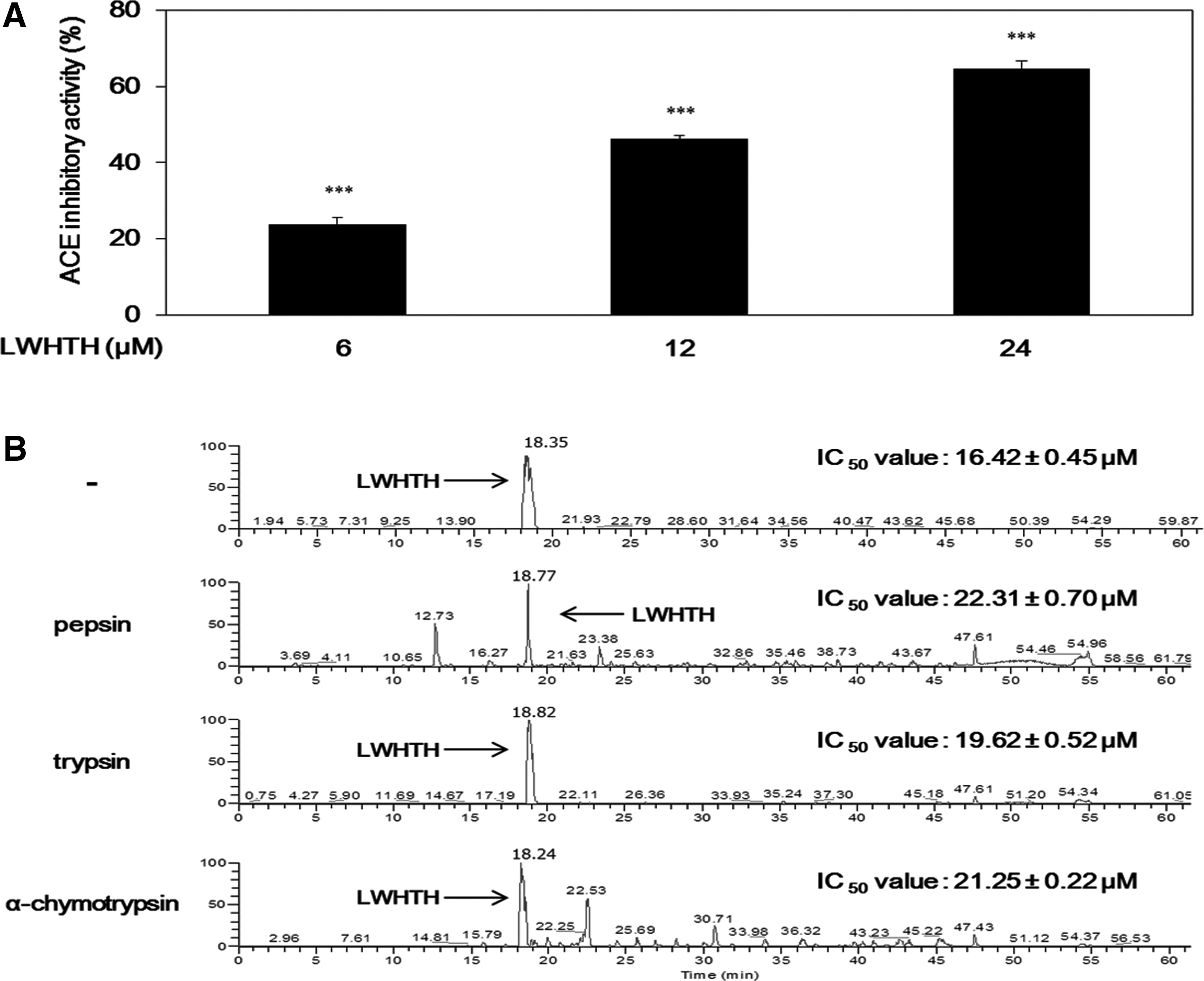
ACE inhibition by LWHTH.
Molecular docking analysis of LWHTH and ACE
Bioactive peptides possess multifunctional activities based on their structural characteristics such as hydrophobicity, charge, and microelement binding activity. LWHTH-mediated ACE inhibition was predicted by simulating the interaction between ACE and LWHTH in computational space. CDOCKER tool, a molecular docking module, finds favorable docking pose between small molecules and active sites of enzymes using in silico computational simulation. 10 ACE structure was determined using PDB (PDB ID: 1O86) and modified according to a previously described method. 12
Molecular dockings of LWHTH to ACE were performed by tightly interacting LWHTH with the active site of the enzyme. The docking pose of the ACE–LWHTH complex is shown in Figure 3. In the figure, ACE was displayed as the red ribbon structure, and the active site of ACE was shown in yellow. LWHTH was indicated as a gray and red stick structure (Figs. 1 and 2), and the binding surface of ACE was expressed in two forms: hydrogen bonds (Fig. 3A) and hydrophobicity (Fig. 3B). In Figure 3B, the part of the α-helix from Arg124 to Leu140 was deleted because it was hiding the binding surface.

Computational prediction of the ACE structure (PDB ID: 1O86) and the predicted 3D structure of the ACE–LWHTH complex. LWHTH is shown as a gray and red stick model. ACE is shown as the red ribbon model, and the active site of ACE is shown in yellow.
As shown in Figure 4A, the binding position of the ACE–LWHTH complex was predicted by the 2D diagram. The docking pose formed a network of hydrogen bonds and a pi bond between the following amino acids: Arg522 (hydrogen bond), Glu403 (hydrogen bond), and Lys118 (pi bond). Arg522 in the ACE active site combined with two oxygen molecules of tryptophan and threonine. In addition, two hydrogen molecules adjacent to the nitrogen of the leucine combined with Glu403. Besides, the benzene ring of the tryptophan and Lys118 was more strongly combined with a pi bond. Thus, the ACE–LWHTH complex displayed a favorable hydrogen bond with the pink section as a donor and the green section as an acceptor (Fig. 3A).

Predicted 2D diagram of the ACE–LWHTH complex and its docking energy.
The hydrophobicity of the ACE–LWHTH complex is shown in Figure 3B. The tripeptide HTH was fitted to the dished surface of the active site, and this surface was expressed in blue because the tripeptide is hydrophilic. However, leucine and tryptophan were placed on the outside of the dished surface, and the surface was expressed in white because these amino acid residues are hydrophobic.
The stability of the ACE–LWHTH complex was verified with low binding energy values (CDOCKER interaction energy: −102.566 kcal/mol, total binding energy: −372.069 kcal/mol) (Fig. 4B).
Antihypertensive effect of LWHTH in SHRs
The changes in blood pressure after the single oral administration of LWHTH (40 mg/kg of body weight) are shown in Figure 5. The blood pressure reduction effect of LWHTH was compared with the effects of captopril, a commercially available ACE inhibitor used to treat hypertension. As shown in Figure 5A, after the administration of both LWHTH and captopril, SBP decreased and was maintained until 9 h. The maximum reduction of SBP in the LWHTH-treated group was 89.4% at 3 h (The initial blood pressure was 207.6 ± 10.3 mmHg, the lowest blood pressure was 185.4 ± 6.8 mmHg at 3 h), and the clear difference compared with control group was observed at 9 h (P < .01, the final blood pressure was 194.5 ± 15.6 mmHg at 9 h in LWHTH-treated group). Diastolic blood pressure (DBP) reduction showed a trend similar to that observed for SBP. The maximum reduction of DBP in the LWHTH-treated group was 83.8% at 3 h, and the clear difference compared with control group was observed at 9 h (P < .05) (Fig. 5B).
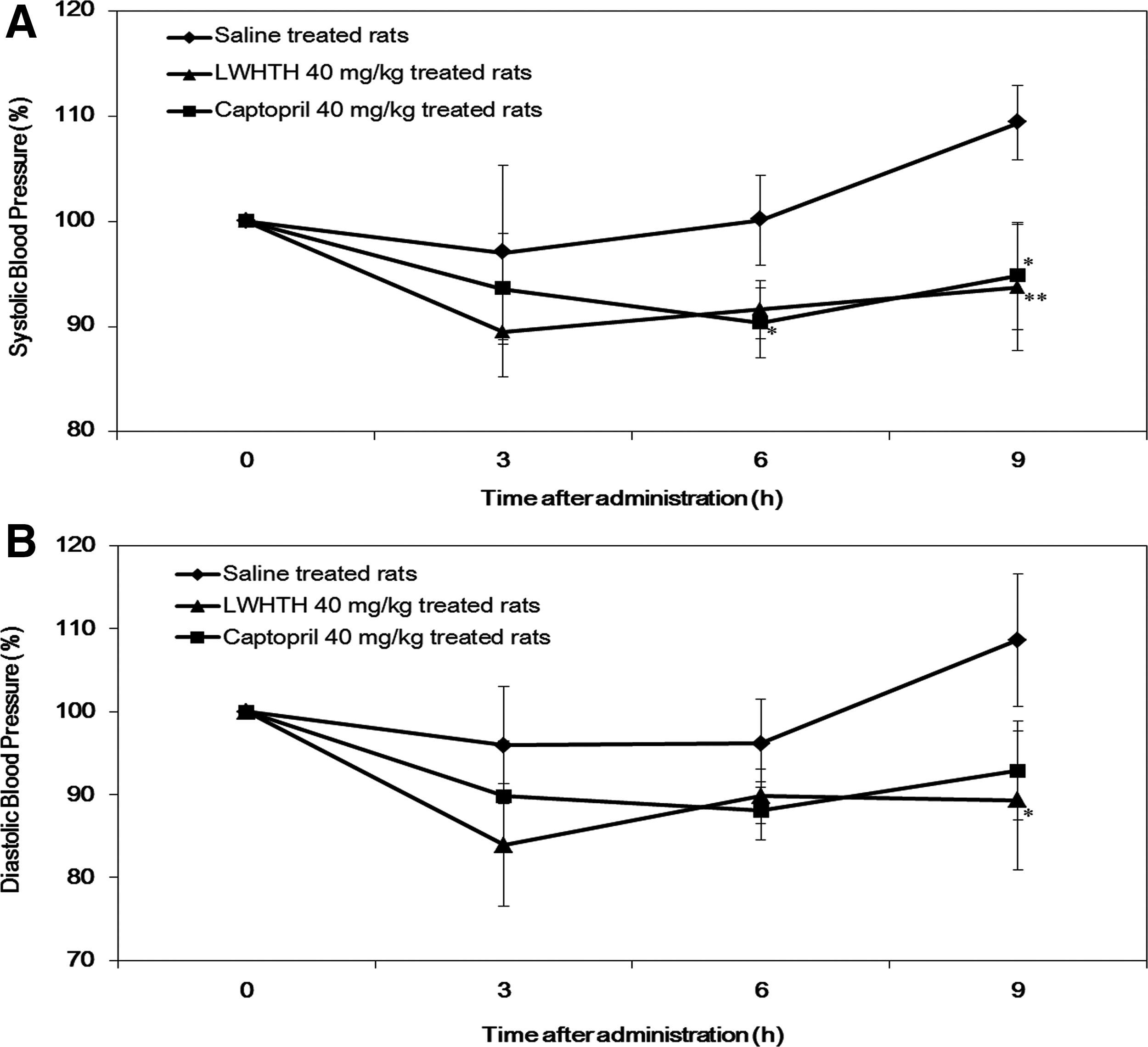
Change in SBP
Discussion
Efficiency of bioactive peptides in the human body is a critically important property for their use as functional food ingredients because in vitro bioactivities can be lost during metabolic processes such as digestion and absorption in vivo.
Peptides are produced from parent proteins through fermentation, hydrolysis, and digestion. 6 Within the body, potent bioactive peptides are naturally released from food proteins through the action of gastrointestinal enzymes such as pepsin and trypsin. 13 LWHTH and hydrolysate fractions containing LWHTH were isolated from the peptic hydrolysate of S. clava flesh tissue, thus LWHTH can be obtained by consuming S. clava as a food. According to the previous study, the yields of the peptic hydrolysate and the hydrolysate fraction (gel filtration chromatography-Fr.3) were 52.33% and ∼25%, respectively. It indicated that the hydrolysate fraction containing LWHTH constitutes ∼10% of S. clava flesh tissues. 3
In previous studies, diverse bioactive peptides such as FGASTRGA (Alaska Pollock), VECYGPNRPQF (microalgae), and YNKL (Wakame) were purified using peptic hydrolysis. These peptides possess ACE inhibitory effects with IC50 values similar to those of LWHTH, such as FGASTRGA, 14.7 μM; VECYGPNRPQF, 29.6 μM; and YNKL, 21 μM. 14,15
Degradation or modification of bioactive peptide sequences might result in loss of bioactivity. Thus, stability against gastrointestinal enzymes is crucial for these peptides to function as ligands to enzymes in the body. 16,17 Peptide degradation can occur by the action of gastrointestinal enzymes such as pepsin in the stomach, and trypsin and chymotrypsin in the small intestine. 18 Therefore, valuable bioactive peptides are stable despite exposure to these gastrointestinal enzymes. LWHTH was stable against the gastrointestinal enzymes pepsin, trypsin, and α-chymotrypsin in this study (Fig. 2).
Peptide absorption occurs in the small intestine through distinct routes such as paracellular transport and passive diffusion. The small intestine absorbs some materials more rapidly than others. In addition, bioactive peptides consist of 3 − 6 amino acids with a low molecular weight for favorable absorption. 19 LWHTH is a pentapeptide with a molecular weight of 692.2 Da. Moreover, essential amino acids are absorbed more rapidly than nonessential amino acids. 20 All of the amino acids of LWHTH—leucine, tryptophan, histidine, and threonine—are essential amino acids. LWHTH treatment resulted in a reduction in blood pressure within 3 h after the treatment in SHRs; hence, it can be considered that LWHTH was quickly absorbed into the vascular system and exerted its effect in the body. This effect might be due to the molecular characteristics of LWHTH such as material form, number of amino acids, molecular weight, and amino acid type.
ACE inhibitors have been extensively used for the prevention and the treatment of hypertension. 9,21 –23 Captopril, a synthetic ACE inhibitor modified structurally, strongly inhibits ACE with an IC50 value of 2.3 nM in in vitro ACE tests. However, the administration of captopril causes diverse side effects such as headache, insomnia, and fever. 9,21,22 LWHTH is a natural bioactive peptide obtained by hydrolysis using pepsin, a gastrointestinal enzyme, and S. clava is an edible marine organism. Therefore, LWHTH could be used as a safe antihypertensive agent.
Once the active site of ACE is blocked, ACE cannot interact with its substrates such as angiotensin I and bradykinin. LWHTH easily interacted and forcefully combined with ACE through strong electrostatic interactions.
Predominantly, the binding of peptides to enzymes takes place through the carboxy-terminal tripeptide residues. 24 Thus, the tripeptide sequence is very important for the inhibitory effects of peptides. Histidine on tripeptides actively binds the active sites of enzymes because the imidazole group of histidine can serve as both an electron donor and an acceptor. As shown in Figure 4A, the C-terminal histidine of LWHTH blocked the amino acids of the active site, including a zinc atom, which plays a vital role in ACE activity. The histidine placed at the last amino acid position surrounded the active site, and the nitrogen of the imidazole was close to the amino acids such as Glu 411 and Tyr 523 in the ACE active site.
Hydrophobic amino acids and charged side groups affect its inhibitory potential by enhancing enzyme accessibility. 25,26 As shown in Figure 3B, the tripeptide HTH fit into the dished surface of the active site, whereas leucine and tryptophan were placed in the outside of the dished surface. Leucine, a branched-chain aliphatic amino acid, at N-terminal of peptides is suitable for binding to ACE as a competitive inhibitor. 6 It can be interpreted that leucine and tryptophan influence the binding to ACE, and the C-terminal tripeptide substantially binds the active site.
The bonds from leucine and tryptophan stabilized the ACE–LWHTH complex with the CDOCKER interaction energy of −102.566 kcal/mol, and the interaction with the tripeptide including histidine strengthened the complex with a binding energy of −372.069 kcal/mol. Therefore, LWHTH strongly inhibits the biological function of ACE.
In this study, we determined that LWHTH, an antioxidant peptide isolated from S. clava, possesses an antihypertensive effect. LWHTH exerted strong ACE inhibition, and this effect persisted in simulated gastrointestinal conditions. The amino acids of the peptide were predicted to play roles in interacting with the ACE active site as shown in silico. Moreover, LWHTH exerted an antihypertensive effect by regulating blood pressure in SHRs. In conclusion, S. clava hydrolysates or oligopeptides containing LWHTH might be useful as a healthy functional food. The results of this study and other similar studies indicate that Styela sp. is a beneficial nutraceutical food containing many bioactive peptides.
Footnotes
Author Disclosure Statement
No competing financial interests exist.
Funding Information
This research was supported by Basic Science Research Program through the National Research Foundation of Korea (NRF) funded by the Ministry of Education (2019R1A6A1A03033553).