




Abstract
Hordei Fructus Germinatus (HFG) has been used as a traditional medicine to treat functional dyspepsia (FD) in China. Stir fried HFG (F-HFG) containing Maillard reaction products (MRPs) is used more widely than the raw HFG (R-HFG). However, the exact mechanisms in its functionality remain unclear. This article investigated the effect of R-HFG, F-HFG, and MRPs on brain-gut peptides, gut microbiota, and digestive enzymes using an FD animal mode. After administration of R-HFG, F-HFG, and MRPs, higher mRNA expression level of gastrin (GAS) and lower mRNA expression level of vasoactive intestinal peptide (VIP) were exhibited in F-HFG and MRPs rats than R-HFG rats (P < .05). Furthermore, compared with the R-HFG group, the contents of motilin (MTL) and GAS showed an upward tendency, whereas the contents of VIP and chokcystokinin (CCK) showed a downward tendency in the F-HFG group. In addition, bacterial communities in the control, F-HFG, and MRPs groups clustered closely to one another, and bacterial communities in the model and recovery groups clustered together, whereas the bacterial communities in the R-HFG group were clustered into a category. Moreover, there were no apparent differences in brain-gut peptides and gut microbiota between the F-HFG and MRPs groups. However, after the oral administration of R-HFG, F-HFG, and MRPs, the level of digestive enzyme did not show a significant change as compared with the recovery group. These results indicated that the stronger effect of F-HFG could be attributed to the MRPs produced during stir frying, and MRPs possessed the effect of regulating brain-gut peptides and gut microbiota.
Introduction
Hordei Fructus Germinatus (HFG), also called Maiya in Chinese, is obtained by drying the germinated ripe fruits of barley (Hordeum vulgare L.). It is generally known that HFG is the main raw material for brewing beer, at the same time, HFG has been used as a traditional medicine for centuries. The medicinal application of HFG was first documented in Yaoxinglun. Now HFG has been listed in the Chinese Pharmacopoeia. HFG is widely used for the treatment of functional dyspepsia (FD) in China and frequently prescribed either alone or in combination with other herbs, such as Shanzha (Fructus Crataegi) and Shenqu (Massa Medicata Fermentata). 1,2
Under the theory of Traditional Chinese Medicine (TCM), crude herbs should be appropriately processed before medicinal use because it improves the therapeutic effect and reduces the toxicity and/or side effects. 3 The common processing methods include stir frying, calcining, steaming, and boiling. 4 In China the popular processing methods for raw HFG (R-HFG) is stir frying to prepare stir fried HFG (F-HFG), named as Chao-Maiya. F-HFG is more widely used in TCM than R-HFG. According to the standardized prescriptions of Chinese medicine, there are 15 Chinese patent drugs containing F-HFG, such as Xiaoer-Huazhi-San, Baikou-Tiaozhong-Wan, and Baohe-Pian. However, there are only seven Chinese patent drugs containing R-HFG, such as Shenqu-Cha. It is unclear what advantages F-HFG have over R-HFG for the treatment of FD and what mechanisms might be responsible for those advantages.
In the quality control of TCM research, digestive enzyme (e.g., amylase) and flavonoids (e.g., quercetin, tricine, kaempferol, and catechin) are regarded as the main maker compounds for quality control of R-HFG and F-HFG. 5 Therefore, it is worth exploring whether the enhancement of digestive function of F-HFG is related to the digestive enzyme and flavonoids. On the one hand, it is widely accepted that the enzyme has an optimal temperature range and its activity will decrease under high temperature. That is to say, the content and activity of digestive enzyme in F-HFG will decrease in comparison with that in R-HFG. On the basis of that analysis, R-HFG should be selected to compose prescription for FD. On the other hand, our previous research had demonstrated that the content of total flavonoids did not change significantly during the stir frying process. 6 In other words, there were no significant differences in the content of total flavonoids between R-HFG and F-HFG. Therefore, if only digestive enzyme and flavonoids are important for functionality, it cannot be explained scientifically why the F-HFG is more widely accepted than R-HFG in clinical prescriptions.
In recent years, the Maillard reaction, which occurs mainly between amino acids, peptides, or proteins with reducing sugars during heating, has received much attention of researchers on TCM. 7 Our previous research demonstrated that the contents of amino acids and reducing sugars in R-HFG change significantly during the stir frying process, implying that the Maillard reaction has occurred. 6 This reaction forms Maillard reaction products (MRPs) that contribute to aroma and an attractive appearance. 8 Recently, many studies have focused on the activities of MRPs. Some investigations revealed that MRPs could result in multifarious chronic diseases, such as diabetic complications and atherosclerosis. 9,10 On the contrary, there were also other studies that showed that MRPs had multiple pharmacological actions, including antioxidant activities, anti-inflammatory effects, and antibacterial activities. 11 –13 Furthermore, TCM argues that aroma substances produced during the stir frying process can improve digestive capability. 14 Since the main components of MRPs contain aroma substances, we preliminarily speculate that MRPs can also improve digestive capability.
FD, a common chronic gastrointestinal disease, is characterized by upper abdominal discomfort, sensation of fullness, and so on. 15,16 Although the exact pathogenesis of FD is unknown, previous studies have shown that gastrointestinal dysmotility, visceral hypersensitivity, and psychological anxiety factors are closely related to FD. 17 –19 In recent years, many studies have demonstrated that brain-gut peptides are deeply involved in the regulation of gastrointestinal motility. 20,21 It has also been suggested that gut microbiota can affect feeding and emotions. 22,23 Furthermore, digestive enzymes have been used to treat FD. Therefore, we can consider that FD may be closely related to brain-gut peptides, gut microbiota, and digestive enzyme to a certain extent, and further speculate that MRPs produced during stir frying process can regulate brain-gut peptides, gut microbiota, and digestive enzyme. Moreover, the reason why F-HFG is more widely used than R-HFG may be due to MRPs.
The purpose of this research is to compare the effects of R-HFG and F-HFG on the digestive function. Furthermore, the effect of MRPs on brain-gut peptides, gut microbiota, and digestive enzymes was also studied. To the best of our knowledge, few endeavors were made to investigate the mechanism of R-HFG and F-HFG on digestive function from the Maillard reaction perspective. Moreover, the effects of MRPs on brain-gut peptides, gut microbiota, and digestive enzyme were also seldom reported. This research may be useful for clarifying the mechanism of stir frying process from the Maillard reaction perspective, which will lay the foundation for the clinical application of R-HFG and F-HFG.
Materials and Methods
Materials
R-HFG and F-HFG were purchased from a local pharmacy (Nanchang, China), and identified by Professor Shouwen Zhang from Jiangxi University of Traditional Chinese Medicine. 5-Hydroxymethyl furfural (purity ≥98%) was obtained from the National Institute for Food and Drug Control (Beijing, China). Methanol was of high-performance liquid chromatography (HPLC) grade and obtained from E. Merck (Darmstadt, Germany). Ultrapure water was prepared through a Milli-Q system (Millipore, Bedford, MA) and used for all analyses. Glucose, maltose, fructose, glycine, histidine, arginine, γ-aminobutyric acid, threonine, alanine, proline, tyrosine, valine, methionine, isoleucine, leucine, phenylalanine, tryptophan, and lysine were purchased from Shanghai Aladdin Bio-Chem Technology Co., Ltd (Shanghai, China). All other chemicals used were analytical grade and commercially available.
Comparative analysis of F-HFG by HPLC fingerprint
R-HFG as well as F-HFG is included in the Chinese Pharmacopoeia (2015 edition). F-HFG can be obtained from local markets or by processing using R-HFG according to the procedure recorded in the Chinese Pharmacopoeia. To assess the similarity and the differences between the marketed F-HFG and self-made F-HFG, a fingerprint by using HPLC was established (Fig. 1).
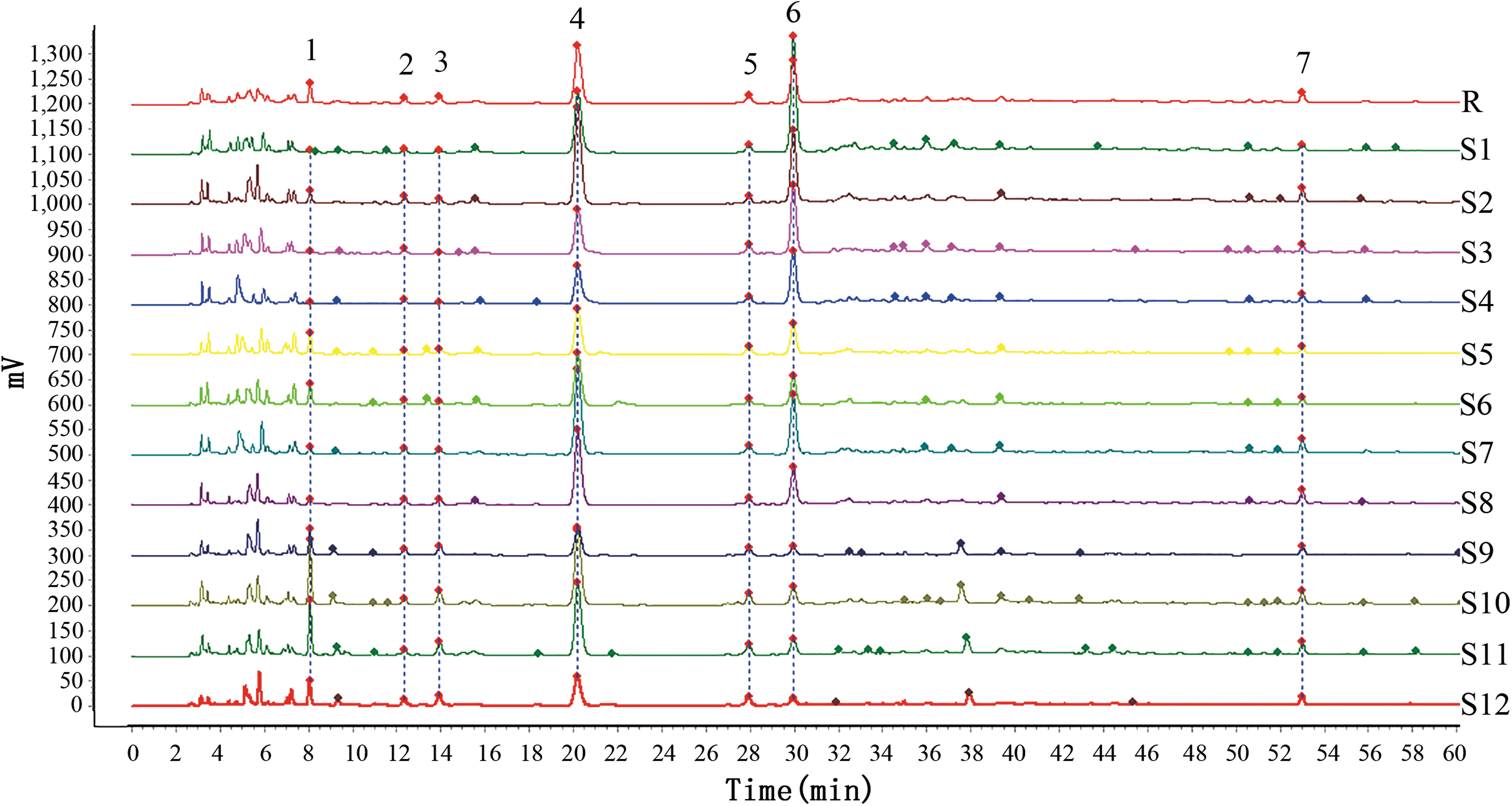
HPLC fingerprints of marketed F-HFG and self-made F-HFG. Separation was carried out on a kromasil C18 column (4.6 × 250 mm, 5 μm). Detection wavelength: 283 nm; mobile phase A: water containing 0.1% acetic acid, mobile phase B: methanol; gradient program: 2% B (0–20 min), 2–35% B (20–60 min); flow rate: 0.8 mL/min; temperature: 30°C; injection volume: 20 μL. Seven common peaks monitored with DAD at 283 nm were 1, 2, 3, 4, 5, 6, and 7. S1–S6: marketed F-HFG; S7–S12: self-made F-HFG; R: reference chromatogram. DAD, diode array detector; F-HFG, fried Hordei Fructus Germinatus; HPLC, high-performance liquid chromatography.
As shown in Figure 1, seven common peaks were found in the 12 different batches of samples (6 batches of marketed F-HFG and 6 batches of self-made F-HFG). The peak 6 was chosen as the reference peak. The similarities between the marketed F-HFG and self-made F-HFG were analyzed by the Similarity Evaluation System for Chromatographic Fingerprint of Traditional Chinese Medicine (Version 2012; National Committee of Pharmacopoeia, China). The results are shown in Table 1. As shown in Table 1, all the correlation coefficients between the reference chromatogram and S1, S2, S3, S4, S5, S6, S7, S8, S9, S10, S11, and S12 were >0.8. Furthermore, the minimum value of correlation coefficients was observed between S4 and S12 (0.656). The results indicated that the marketed F-HFG and self-made F-HFG showed a certain similarity. Moreover, TCM clinics mostly purchased F-HFG from the markets. Therefore, F-HFG, which was short for the commercial F-HFG, was selected as the experimental drug.
Similarities of Marketed Fried Hordei Fructus Germinatus and Self-Made Fried Hordei Fructus Germinatus
Preparation of the extracts of R-HFG and F-HFG
The R-HFG and F-HFG are shown in Figure 2a and b, respectively. The same weight of R-HFG and F-HFG, pulverized to a coarse powder, were, respectively, refluxed with water two times (0.1 g/mL crude drug), 1.5 h for each time, and the extraction solutions were combined and then filtered. The aqueous solution obtained was condensed to 0.5 g/mL crude drug under reduced pressure.
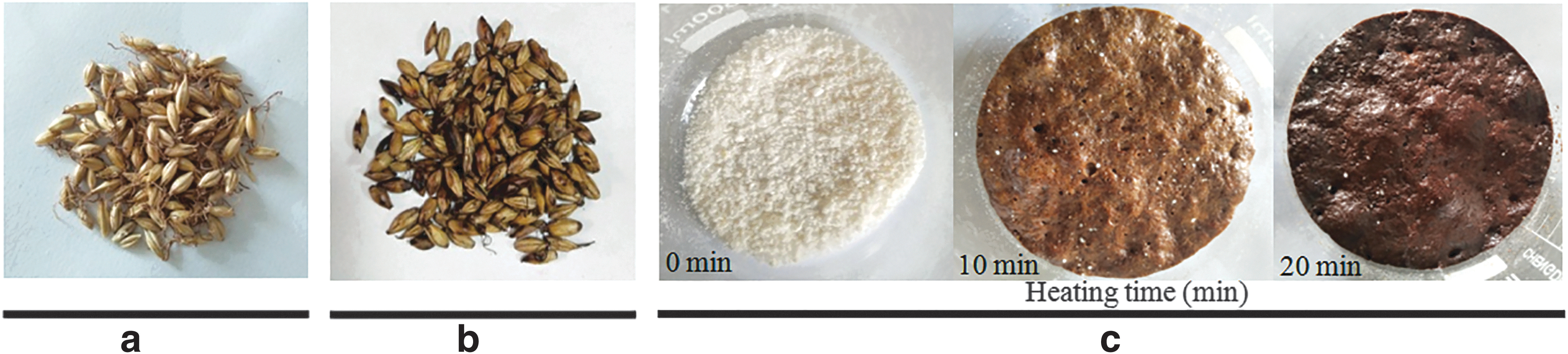
Photographs of R-HFG
Preparation of MRPs
Our previous experiments showed that the contents of glucose, maltose, fructose, glycine, histidine, arginine, γ-aminobutyric acid, threonine, alanine, proline, tyrosine, valine, methionine, isoleucine, leucine, phenylalanine, tryptophan, and lysine were 18,691, 15,969, 9872, 159.41, 131.22, 469.89, 157.79, 192.18, 481.60, 1186.45, 408.77, 468.81, 32.14, 286.47, 527.84, 387.85, 54.46, and 256.63 μg/g in R-HFG, respectively. 24,25 According to the aforementioned ratio, 3 kinds of reducing sugar and 15 types of amino acids were weighed and mixed uniformity in the weighing bottle, heated for 20 min at 180°C in an oven to form MRPs (Fig. 2c).Then MRPs were dissolved in distilled water at a concentration of 0.025 g/mL and administered to rats.
FD model construction and drug administration
Sprague-Dawley rats (100–120 g, male and female) of specific pathogen free-grade were provided by the Experimental Animal Center of Jiangxi University of Traditional Chinese Medicine, Jiangxi, SCXK20110001. The animal experiments performed here were based on the institutional guidelines for Care and Use of Laboratory Animals and approved by the Committee of Jiangxi University of Traditional Chinese Medicine. All animals were housed under controlled conditions (relative humidity 50% ± 5%, 25°C ± 2°C) and fed with standard diet pellets. They were fasted for 12 h before experiments with free access to tap water.
The rats were randomly divided into six groups (n = 6): control group, model group, recovery group, R-HFG group, F-HFG group, and MRPs group. The FD model was established by clamping the rats' tails and semistarvation as previously described with slight modification to all animals except those in the control group. 26,27 On the 15th day, the animals in the model group were anesthetized, and then the duodenum, hypothalamus, and fresh feces were collected. The blood samples were collected from the abdominal aorta. The whole blood samples were allowed to stand at room temperature for 1.5 h and centrifuged at 3000 g for 15 min at 4°C to get the serum sample.
The rats in the R-HFG, F-HFG, and MRPs groups were orally administrated with R-HFG (7.8 g/kg per day), F-HFG (7.8 g/kg per day), and MRPs (0.39 g/kg per day, equivalent to ∼7.8 g F-HFG/kg per day) for 14 days, respectively. The animal dose of F-HFG used in this study was converted from a human dose. In the meantime, the rats in the control group and the recovery group were administrated with the same volume of normal saline. After 2 weeks administration, all the rats were sacrificed. And as described in the model group, duodenum, hypothalamus, serum sample, and fresh feces were collected for the following analysis. The serum samples were prepared for determining the levels of pepsin (PP), trypsin (TRY), pancreaticamylase (PAMY), pancrelipases (PL), motilin (MTL), gastrin (GAS), vasoactive intestinal peptide (VIP), and chokcystokinin (CCK). Duodenum and hypothalamus were used for investigating the mRNA expression levels of MTL, GAS, VIP, and CCK. The feces were used for analysis of gut microbiota.
ELISA
The contents of digestive enzymes (PP, TRY, PAMY, and PL) and brain-gut peptides (MTL, GAS, VIP, and CCK) in the serum were measured by ELISA kit (Nanjing Jiancheng Bioengineering Institute Co., Ltd, Nanjing, China). The experiment was performed strictly in accordance with the manufacturer's instructions and run in triplicate. The optical density of each plate was determined using a microplate reader (Perlong Medical, Beijing, China) at 450 nm, and the standard curve was applied to calculate the concentrations of MTL, GAS, VIP, and CCK.
Reverse transcription-polymerase chain reaction
The mRNA expression levels of MTL, GAS, VIP, and CCK were investigated by RT-polymerase chain reaction (PCR). The total RNA was isolated from duodenum and hypothalamus using an Eastep® Super Total RNA Extraction kit (Promega, WI) following the manufacturer's instructions. The purity of the RNA was determined by electrophoresis and the RNA concentration was measured using a Varioskan Flash (Thermo Scientific, Waltham, MA). Isolated total RNA was then reverse transcribed to generate cDNA using GoScript™ Reverse Transcription System (Promega).
The PCR was performed using the GoTaq® Green Master Mix (Promega) with a thermal cycler (Hangzhou LongGene Scientific Instruments Co., Ltd, Hangzhou, China). Each reaction was performed for 30 cycles in a total volume of 25 μL (3 μL cDNA, 12.5 μL of 2 × GoTap Green Master Mix, 1 μL forward primer, 1 μL reverse primer, 7.5 μL Nuclease-Free Water). The primers were designed according to the cDNA sequences and synthesized commercially (Sangon Biotechniques, Shanghai,
Primer Sequences for Reverse Transcriptase-Polymerase Chain Reaction
CCK, chokcystokinin; GAS, gastrin; MTL, motilin; VIP, vasoactive intestinal peptide.
The resulting PCR products were further analyzed by 2% agarose gel electrophoresis. Then gels were photographed using a Molecular Imager® Gel Doc™ XR+ Imaging System (Bio-Rad, Hercules, CA). Band intensities were quantified by densitometry, and each value was normalized against that of β-actin.
PCR-denaturing gradient gel electrophoresis analysis
The fecal microbial genomic DNA was extracted using the TIANamp Stool DNA Kit (TIANGEN Biotech CO., Ltd, Beijing, China) following the manufacturer's procedures. The V3 region of the bacterial 16S rDNA was amplified using the primers GC-338F (CGCCCGCCGCGCGCGGCGGGCGGGGCGGGGGCACGGGGGGCCTACGGGAGGCAGCAG) and 518R (ATTACCGCGGCTGCTGG). 28 PCR was carried out in a thermal cycler (Hangzhou LongGene Scientific Instruments Co., Ltd) using the following parameters: predenaturation at 95°C for 2 min, 30 cycles of amplification (95°C for 30 s, 56°C for 30 s, and 72°C for 30 s) and a final extension at 72°C for 10 min.
Denaturing gradient gel electrophoresis (DGGE) was carried out using a DCode™ Universal Mutation Detection System (Bio-Rad) as described previously.
29
Gels were stained with SYBR Green I nucleic acid gel stain (Solarbio, Beijing, China) and subsequently were photographed using a Molecular Imager Gel Doc XR+ Imaging System (
Several predominant bands in the DGGE gel were excised. Then the DNA eluted from the excised bands was reamplified for sequencing using the primers 338F (without GC clamp) and 518R with the same PCR program. These amplified PCR products were sent to commercial sequencing companies (Shanghai Sangon Biotech, Inc., Shanghai, China) to sequence. The obtained sequences were compared with those in the GenBank database using BLAST program to determinate species.
HPLC analyses
HPLC method was used to investigate the differences of the main components in R-HFG, F-HFG, and MRPs. Analyses were performed on an Agilent Series 1260 liquid chromatograph (Agilent Technologies, Palo Alto, CA), equipped with a diode array detector. The separation was carried out on a kromasil C18 column (5 μm particle size, 4.6 × 250 mm) from AKZO NOBEL company at a column temperature of 25°C. The mobile phase consisted of solvent A (0.1% acetic acid solution) and solvent B (methanol) at a flow rate of 0.8 mL/min. The gradient elution profile was 0–20 min, 2% B; 20–60 min, 2–35% B. The detector wavelength was 283 nm.
Statistical analysis
Experimental data were calculated and presented as mean ± standard deviation (mean ± SD). Statistical analysis was performed using analysis of variance and the Student's t-test with SPSS 13.0 (SPSS, Inc.). A value of P < .05 was regarded as statistically significant.
Results
The effect of R-HFG, F-HFG, and MRPs on the content of brain-gut peptides in serum
As illustrated in Table 3, the model group showed lower values of MTL and GAS and higher values of VIP and CCK than the control group, implying that the brain-gut peptides played an essential role in FD as compared with the control group. After the treatment of FD rats with F-HFG and MRPs, the levels of MTL and GAS increased significantly, and the levels of VIP and CCK decreased remarkably as compared with the recovery group (P < .05). Meanwhile, the levels of MTL in R-HFG increased significantly (P < .05), whereas no significant changes in the levels of GAS, CCK, and VIP were observed as compared with the recovery group. Moreover, the F-HFG group showed the higher values of MTL and GAS as well as the lower of VIP and CCK than the R-HFG group, suggesting F-HFG was more potent than R-HFG in regulating brain-gut peptides. At the same time, there were no obvious differences in the level of brain-gut peptides between the F-HFG and MRPs groups (P > .05), indicating that MRPs, produced during stir frying process, possess the effect to regulate brain-gut peptides.
The Effect of Raw Hordei Fructus Germinatus, Fried Hordei Fructus Germinatus, and Maillard Reaction Products on the Contents of Motilin, Gastrin, Vasoactive Intestinal Peptide, and Chokcystokinin
Mean ± SD, n = 6. Compared with control group,* P < .05; compared with recovery group, ** P < .05.
F-HFG, fried Hordei Fructus Germinatus; MRPs, Maillard reaction products; R-HFG, raw Hordei Fructus Germinatus.
The effect of R-HFG, F-HFG, and MRPs on the mRNA expression of MTL, GAS, VIP, and CCK in the duodenum and hypothalamus
Because of the effects of R-HFG, F-HFG, and MRPs on the content of brain-gut peptides in serum, the mRNA expression levels of brain-gut peptides in the duodenum and hypothalamus were further explored. As shown in Figure 3, the result was basically consistent with that of the effect of R-HFG, F-HFG, and MRPs on the content of brain-gut peptides in serum, suggesting that the content changes of MTL, GAS, VIP, and CCK were associated with regulation of the relevant mRNA expression. Especially, higher mRNA expression level of GAS and lower mRNA expression level of VIP was exhibited in the duodenum and hypothalamus of F-HFG rats than R-HFG rats (P < .05). Similarly, in comparison with the R-HFG group, treatment with MRPs increased markedly the mRNA expression levels of MTL and GAS, decreased the VIP mRNA expression level (P < .05), implying that F-HFG and MRPs showed a stronger regulatory effect on the mRNA expressions of MTL, GAS, and VIP, than R-HFG.
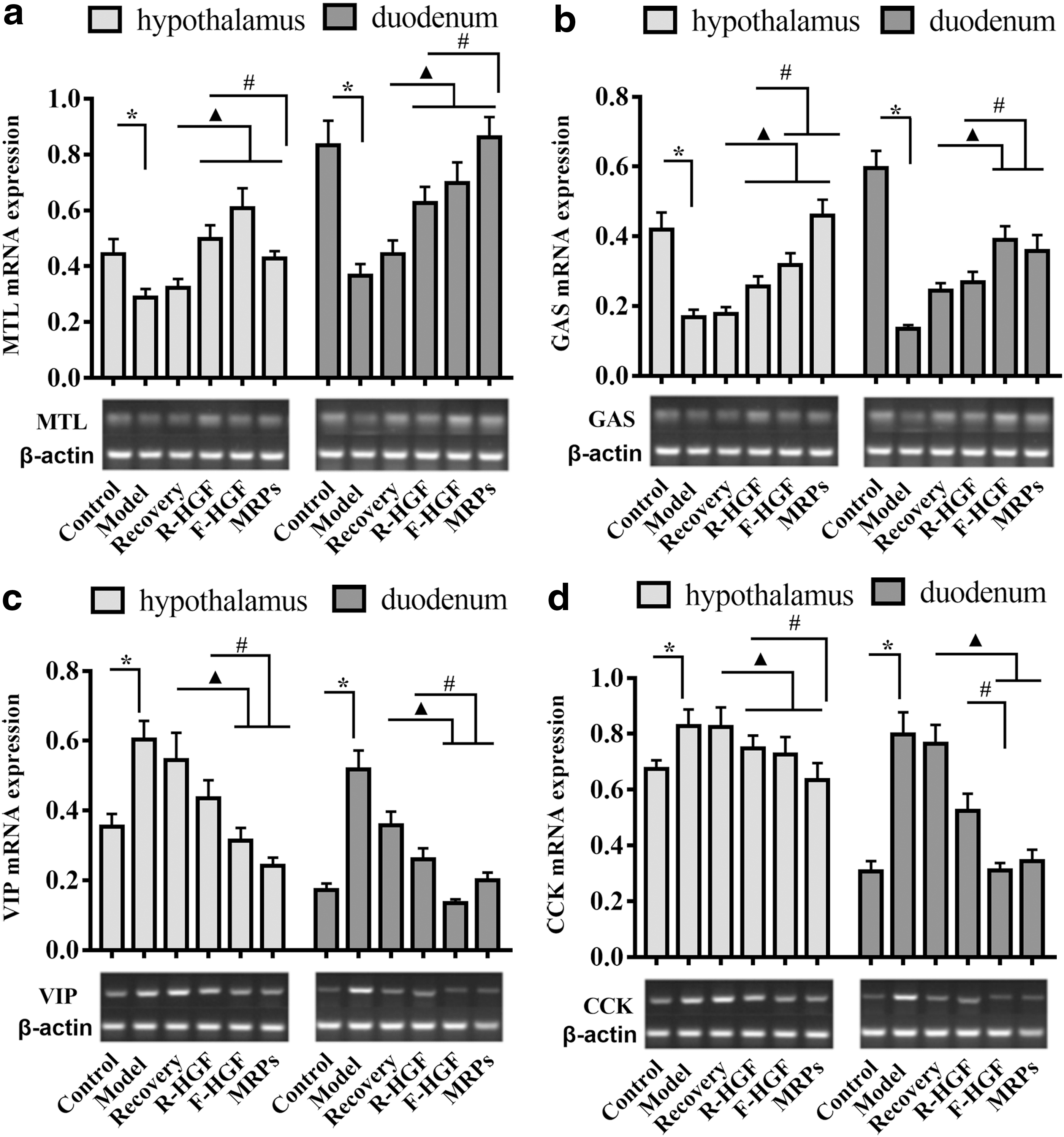
The effect of R-HFG, F-HFG, and MRPs on the mRNA expression of MTL
Analysis of DGGE fingerprint profiles
PCR-DGGE is widely used to investigate the gut microbiota. As shown in Table 4, compared with the control group, SDI and SRI in the model group decreased significantly (P < .05), revealing that changes of gut microbiota in FD rats could be observed. After the administration of F-HFG and MRPs, SDI and SRI increased significantly as compared with the recovery group (P < .05). Especially, compared with the R-HFG group, SDI and SRI in the F-HFG and MRPs groups increased significantly (P < .05). These results suggested that F-HFG and MRPs had a vital influence on gut microbiota. Meanwhile, there were no significant differences in the SDI and SRI between the F-HFG and MRPs treatment groups, implying that both F-HFG and MRPs played an importance role in regulating the gut microbiota.
Shannon Diversity Index and Species Richness Index of All the Six Groups
Mean ± SD, n = 6. Compared with control group, * P < .05; compared with recovery group, ** P < .05; compared with R-HFG group, *** P < .05.
SDI, Shannon diversity index; SRI, species richness index.
Cluster analysis was applied to analyze the similarity of the gut microbiota in the six groups. The result is shown in Figure 4. The gut microbiota in the control, F-HFG, and MRPs groups clustered closely to one another, those in the model and recovery groups clustered together, whereas the gut microbiota in the R-HFG group was clustered into a category. According to the results of cluster analysis, there were obvious differences in the gut microbiota between the F-HFG and R-HFG treatment groups, whereas no obvious differences were found in the gut microbiota between the F-HFG and MRPs treatment groups. This indicated further that F-HFG and MRPs can regulate gut microbiota.

DGGE analysis of 16S rDNA fragments of total bacterial populations from rat feces.
Polymerase Chain Reaction-Denaturing Gradient Gel Electrophoresis Fingerprinting of 16S rRibonucleic Acid V3 Region Major Band Gene Sequence Analysis Results
To identify the identities of the most prominent bacteria, 10 most distinct bands were excised, cloned, and sequenced. The closest relatives to the excised bands are summarized in Table 5. Compared with the control group, the relative abundance of Bacteroides, Ruminococci, Anaerostipes, and Lachnospira in FD model decreased, and the relative abundance of Clostridium, Prevotella, and Porphyromonas increased. After administration of F-HFG and MRPs, the relative abundance of Bacteroides, Ruminococci, and Eubacterium increased, and the relative abundance of Clostridium and Prevotella decreased obviously.
The effect of R-HFG, F-HFG, and MRPs on the content of digestive enzyme in serum
R-HFG and F-HFG contain digestive enzyme, which contribute to digesting the food in the stomach; the content of digestive enzyme in serum was determined. The results are shown in Table 6. Compared with the control group, no obvious differences were found in the levels of PP, TRY, PAMY, and PL in the model group (P > .05), which showed that the levels of digestive enzymes may be maintained at normal level in animal with FD. And after the oral administration of R-HFG, F-HFG, and MRPs, the levels of PP, TRY, PAMY, and PL did not show obvious change in the treatment group compared with the recovery group (P > .05), indicating that the digestive enzymes could not explain properly why the F-HFG was more widely used than R-HFG for the treatment of FD.
Effect of Raw Hordei Fructus Germinatus, Fried Hordei Fructus Germinatus, and Maillard Reaction Products on the Contents of Pepsin, Trypsin, Pancreaticamylase, and Pancrelipases
PAMY, pancreaticamylase; PL, pancrelipases; PP, pepsin; TRY, trypsin.
Analyses of R-HFG, F-HFG, and MRPs by HPLC
The pharmacological effects of Chinese medicines are closely related to their chemical composition. Therefore, it is very important to examine the changes of chemical components during processing. As shown in Figure 5, peaks 1 and 2 were new chemical compounds that appeared in F-HFG. Meanwhile, peaks 1 and 2 appeared also in the chromatograms of MRPs, among which peaks 1 was determined to be 5-hydroxymethyl furfural based on retention time matching. These findings suggested that the new chemical components in F-HFG, produced during stir frying process, were mainly MRPs.

Constituent analysis of R-HFG, F-HFG, and MRPs by HPLC: (a) standard (5-hydroxymethyl furfural), (b) MRPs, (c) R-HFG, and (d) F-HFG.
Discussion
In this article, we focused on the potential differences between how R-HFG and F-HFG affect brain-gut peptides, gut microbiota, and digestive enzymes. The results revealed that there were significant differences in brain-gut peptides and gut microbiota between R-HFG and F-HFG, whereas no significant differences were found between F-HFG and MRPs. Therefore, the stronger effect of F-HFG was suggested to be mediated by the roles of MRPs. Since previous studies have mainly focused on the antioxidant and anti-inflammation activity of MRPs, it is suggested that this research is the first to focus on its effect of regulating brain-gut peptides and gut microbiota.
In TCM theory, FD is usually attributable to spleen deficiency (pixu) and liver depression (ganyu). The function of the spleen is mainly reflected in promoting digestion and absorption. The function of liver is related to storing the soul and controlling dispersion, which means that the liver has the effect of regulating emotional activities. 32,33 In our experiment, the FD model was established by clamping the tails of rats on a restricted diet. After being establishing the model, the rats appeared exhausted, sluggish, uncomfortable, irritable, and tense. These symptoms matched with the same description of FD with liver-depression and spleen-deficiency syndrome. 34,35
Brain-gut peptides, which play an important role in functional gastrointestinal disorders, have attracted considerable attention from researchers in recent years. MTL, GAS, VIP, and CCK are the most common brain-gut peptides clinically applied to judge the occurrence and recovery from FD. Studies have shown that MTL can promote gastrointestinal motility, and GAS has the effects of stimulating gastric acid secretion. 36,37 Meanwhile, many investigations have shown that VIP and CCK are also closely related to digestive function. VIP, which is an inhibitory neurotransmitter in the gut, can inhibit gastrointestinal motility by relaxing the gastrointestinal smooth muscle. 38,39 CCK can also inhibit gastric motility and slow gastric emptying. 40 In our study, the contents of MTL and GAS decreased remarkably, and the contents of VIP and CCK increased markedly in the model group. The results suggested that rats with FD had an obvious para secretion of brain-gut peptides, implying that the FD model was successfully established. Compared with the recovery group, F-HFG and MRPs were more potent than R-HFG in regulating the brain-gut peptides. Therefore, the reason why F-HFG was more widely used than R-HFG was that the MRPs possessed the effect of regulating brain-gut peptides.
In recent years, increasing numbers of researchers have begun to focus on gut microbiota. A number of scientific studies have suggested that the gut microbiota plays a principal role in the regulation of intestinal homeostasis, maintaining immune system and acting as a barrier to gut pathogens. 41,42 Moreover, many studies have also shown that the gut microbiota played a vital role in food digestion. 43 This study was carried out to investigate the effect of R-HFG, F-HFG, and MRPs on the gut microbiota in a rat model of FD. The result of cluster analysis suggested that the F-HFG, MRPs, and the control groups showed high similarity in the gut microbiota, implying that both F-HFG and MRPs had a regulatory effect on gut microbiota. However, R-HFG did not have obvious effect on gut microbiota.
On the basis of cluster analysis, the most prominent bacteria was sequenced and further analyzed by comparing band intensities. And the identified Bacteria are included in Bacteroides, Eubacterium, Prevotella, and Clostridium. To some extent, Bacteroides, as well as Eubacterium, may contribute to host health. The Bacteroidetes are major constituents of gut microbiota related with digestion and can establish stable long-term associations with their hosts for helping maintain a healthy gut. 44,45 The Eubacterium can produce short chain fatty acids, which play a critical role in the prevention and treatment of colorectal cancers and ulcerative colitis. 46 –48 But in contrast, overgrowth of Prevotella and Clostridium will likely lead to a potential threat to the health of the host. Emerging studies have linked increased abundance of Prevotella to inflammatory bowel disease. 49,50 Clostridium is also the most commonly isolated proinflammatory pathogen associated with inflammatory bowel diseases. 51,52 In this study, the FD model showed a lower proportion of Bacteroides, Ruminococci, Anaerostipes, and Lachnospira, and a higher proportion of Clostridium, Prevotella, and Porphyromonas than the control group. Administration of F-HFG and MRPs not only significantly suppressed the growth and expansion of Clostridium and Prevotella but also increased the amount of Bacteroidetes and Eubacterium. Consequently, the reason why F-HFG was more widely used than R-HFG was that the MRP possessed the effect of regulating gut microbiota.
It is generally recognized that the secretion of digestive enzymes is a direct response to the function of the digestive system. Moreover, the secretion of digestive enzymes is mainly controlled by the autonomic nervous system and regulated by brain-gut peptides. 53 As a result, studies on digestive enzymes will help explain the efficacy differences between R-HFG and F-HFG. In this experiment, there was no significant difference in the contents of digestive enzymes in serum among all groups, suggesting that regulating digestive enzyme secretion is not a mechanism of action of R-HFG and F-HFG. According to Rome criteria, dyspepsia can be divided into two classes: organic dyspepsia (OD) and FD. 54 The clinical investigation of OD may be identified by an underlying organic disease, which is characterized by damage to the intestinal microvilli and inhibition of digestive enzyme secretion. Therefore, the digestive enzymes could not explain properly why the F-HFG was more widely used than R-HFG for the treatment of FD.
In this study, the MRPs were found to be closely related to promoting digestion of F-HFG. Therefore, the MRPs, which are all regarded as ineffective components from the traditional view, should be regarded as the active ingredients for quality control of F-HFG. In other words, the roles of ineffective components should not be ignored in the research on the processing mechanism and pharmacodynamics. Furthermore, in this study, the MRPs were found to possess the effects of improving digestive capability by regulating brain-gut peptides and gut microbiota. Thus, the appropriate administration of MRPs may decrease the severity of FD. In brief, the research results provide a method of quality control of F-HFG, and provided direct experimental evidence to support the traditional use of MRPs in the treatment of FD. However, further studies regarding the pharmacological effect and action mechanism of MRPs in the treatment of FD are needed.
Footnotes
Author Disclosure Statement
No competing financial interests exist.
Funding Information
The authors sincerely appreciate the financial support from National Natural Science Foundation of China (nos. 81560659 and 81760722), and the Science and Technology Plan Projects of Jiangxi Provincial Education Department (no. GJJ150836).