




Abstract
High-fat diet (HFD)-induced obesity is related to cognitive and memory dysfunction. Much attention was focused on functional foods as a therapeutic strategy to treat cognitive decline by obesity. In the present study, we confirmed the protective effect of Vigna angularis (VA) on cognitive and memory impairment in an obese mouse model. For 16 weeks, mice were fed HFD and VA extract was administered during 4 weeks at 100 and 200 mg/kg. The cognitive abilities of HFD-induced mice were evaluated using behavioral tests. Compared with the control group, VA groups were improved spatial and recognition ability. In T-maze and novel object recognition tests, VA 100 and VA 200 groups showed increased ratios of exploration of a novel object/route compared to a familiar object/route. Moreover, VA 100 and VA 200 groups reached the platform faster than the control group in a Morris water maze test. Therefore, VA extract may protect against HFD-induced cognitive impairment and memory dysfunction. (PNU-IACUC; approval no. PNU-2019-2166).
Introduction
The World Health Organization reports that the overweight and obese populations are 39% and 13% of the total world adult population, respectively. 1 According to the OECD, obesity rates will continue to rise until at least 2030. 2 There are many causes of obesity, including environmental factors, genetic factors, individual psychological factors, and hormonal effects. 3 Especially, the fundamental cause of obesity is an energy imbalance that result from excessive dietary intake. 4,5 Obesity is related to chronic diseases, including hypertension, type 2 diabetes mellitus, and certain cancers, and it is recognized as a major health problem worldwide. 6 –9 Recently, many researchers have focused on the correlation between obesity and cognitive impairment. 10,11 Furthermore, Gustafson 12 demonstrated that obesity can lead to cerebral white matter lesions, cerebrovascular disorders, the blood-brain barrier (BBB) breakdown, and stroke, which can lead to cognitive degradation and dementia. The prevalence of dementia increases in obese elderly people and obese middle-aged people as they age. 13,14 Excessive energy intake also adversely affects the brain, especially in the aging process, and increases the risk of memory and cognitive disorder, such as Alzheimer's disease (AD). 15 Therefore, the regulation of body weight and reversing or preventing obesity is an important therapeutic strategy for improving cognitive function in AD. 15 The functional foods with regulatory effects on body weight have attracted much attention for prevention of treatment of AD. 16
Vigna angularis (VA), known as adzuki bean or small red bean, is one of the most important food crops and is widely cultivated in East Asia. 17,18 Also, VA has been used as an oriental medicine because of its antipyretic, anti-inflammatory, and antiedematous effects. 19,20 There are several studies on its health beneficial effect such as regulation of cholesterol and blood pressure, 21,22 inhibition of tumor formation, 23 antidiabetes, 24 and antiobesity effects. Kitano-Okada et al. 25 reported that VA can effectively improve lipid metabolism and inhibit lipid accumulation. In addition, flavonoids and saponins of VA enhance lipolysis and inhibit α-glucosidase. 26 Nevertheless, there is no research related to the effects of VA in reducing memory and cognitive impairment induced by obesity. Hence, we explored the protective effect of VA on memory and cognitive function through behavioral testing in an obese mouse model.
Materials and Methods
Preparation of V. angularis extracts
VA (variety name of Arari) was provided by the Department of Southern Area Crop Science, National Institute of Crop Science, Rural Development Administration (Miryang, Korea). VA was extracted with 80% ethanolic solution for 24 h and repeated three times. The solution of extraction was evaporated to dryness.
Mouse model and animal care
Five weeks old C57BL/6J male mice were purchased from Central Lab. Animal, Inc. (Seoul, Korea). The mice were maintained under 12 h light/dark cycle, 20°C ± 2°C, and given free access to feed and water. This animal study was approved by the Pusan National University Institutional Animal Care and Use Committee (Approval No. PNU-2019-2166).
Experimental diet and VA administration
Experimental groups (n = 8 per group) consisted of normal, control, VA 100, and VA 200 groups. All groups except the normal group were fed with high-fat diet (HFD) containing 60% fat (D12492; Research Diet, Inc., USA). The normal group was fed with a chow diet (D12450B; Research Diet, Inc.). After 12 weeks, the mice were orally administered for 4 weeks every day as in the following: normal and control groups were given drinking water; VA 100 and VA 200 groups were given VA extract in dose of 100 and 200 mg/kg, respectively.
Food intake, body weight, and food efficacy ratio
Food intake was measured by subtracting the amount of remaining food from the food provided every day. Body weight was measured per week. Food efficacy ratio (FER) value was calculated to the equation [weight gain/amount food intake × 100].
T-maze test
The test was designed as established by Montgomery. 27 Maze equipment was made of acrylic board walls in a T-shape. During the training, one of the routes of maze was blocked. Mice were able to explore only the opened arm for 10 min. After 24 h, mice were allowed to freely explore the maze with the blocking door removed, and the number of explorations in each side was recorded.
Novel object recognition test
This test was designed according to the methods of Bevins and Besheer. 28 The same shape, color, texture, and size of two objects were placed in black acrylic square box (40 × 40 × 40 cm). During the training, mice were permitted freely to explore two same objects for 10 min. In the test, one of the familiar objects were changed to a new one and explored in the same procedure for 10 min. This test was conducted to observe the object recognition ability of the mice.
Morris water maze test
The test was conducted to confirm the long-term memory capacity of mice, according to Morris's method. 29 The maze consisted of circular (150 cm in diameter) stainless pool, filled with nontoxic black colored water maintained at 22°C ± 2°C. The pool was divided into four quadrants and visual maze cues were placed on the walls. The platform was installed to be invisible in the target quadrant under the water. The swim pathway of mice was recorded using a camera on the ceiling connected to a computer running a SMART video tracking software 3.0 (Panlab, Barcelona, Spain). For 3 days, the training was performed three times a day at 4 h intervals. Also, test was performed at fourth day. During the training session, mice were allowed to swim to find the hidden platform. If a mouse did not reach the platform within 60 sec, the mouse was moved up to the platform and allowed to stay for 15 sec. The probe tests were performed after the training. The first test was the same procedure as training. In the second test, the mice were allowed to search original platform position pool for 60 sec without the platform. The swimming time in target quadrant was recorded. The third test was conducted in the same procedure as the first test, but the difference was that the platform is visible and exposed.
Statistical analysis
Statistical calculations were performed using IBM SPSS 20 (IBM Corporation, NY, USA) by one-way analysis of variance followed by Duncan's multiple range tests. Also, the data from the T-maze and novel object recognition were compared using Student's t-test. The statistically significant difference was set at P < .05.
Results
Effects of VA on body weight gain and FER in HFD-induced obese mice
Table 1 shows the changes in body weight and food intake of mice during the experiment. There was no significant difference in food intake or initial body weight. However, obesity was induced due to a significant increase of body weight in the HFD-fed control group. Food intake did not show any significance, but FER of HFD-fed control group was significantly increased. However, VA 100 and VA 200 groups showed significant decrease in body weight and FER, compared with HFD-fed control group.
Effect of Extract from Vigna angularis on Body Weight Gain and Food Intake in High-Fat-Fed C57BL/6J Mice for 16 Weeks
Data are presented as mean ± standard deviation.
Means with different letters are significantly different (P < .05) by Duncan's multiple range test. Normal: chow diet+oral administration of drinking water; Control: 60% fat diet+oral administration of drinking water; VA 100: 60% fat diet+oral administration of EtOH extract from VA (100 mg/kg/day); VA 200: 60% fat diet+oral administration of EtOH extract from VA (200 mg/kg/day).
VA, Vigna angularis.
Effects of VA on spatial cognition ability in HFD-induced obese mice
Figure 1 showed the protective effects of VA extract on spatial cognitive ability in HFD-fed obese mice. During the test session, the control group displayed no significant difference in the number of exploration into old and new sides, while the other groups explored the new route more times than the old route. The HFD-fed control group exhibited spatial memory ability to 48.58%, whereas the normal group showed 54.84%, indicating that HFD induced cognitive impairment. In contrast, the VA 100 and VA 200 extract-administered mice showed an improved performance in the T-maze by entering the new route more times than old route by 52.88% and 53.79%, respectively.

Effects of Vigna angularis on the spatial perceptive ability in the T-maze test. The space perceptive ability is calculated as the percentage mean ± SD of the number of times the mouse has entered each route for 10 min. Data are presented as mean ± SD. *The space perceptive abilities for old and new routes are significantly different as determined by Student's t-test (P < .05). There was no significant difference between VA 100 and VA 200 (Student's t-test, P > .05). Normal: chow diet+oral administration of drinking water; Control: 60% fat diet+oral administration of drinking water; VA 100: 60% fat diet+oral administration of EtOH extract from VA (100 mg/kg/day); and VA 200: 60% fat diet+oral administration of EtOH extract from VA (200 mg/kg/day). SD, standard deviation.
Effects of VA on object cognition ability in HFD-induced obese mice
The cognitive ability of the chow diet-fed normal group was significantly higher than the novel object recognition (65.74%) than familiar one (51.42%), whereas the HFD-fed control group did not show significant difference between familiar and novel object (Fig. 2). Also, HFD-fed control group resulted in cognitive impairments, showing that the novel object exploration was lower than chow diet-fed normal group. However, supplementation with VA 100 and VA 200 extract to HFD-fed mice significantly increased the exploration rate of novel object for familiar objects to 69.88% and 67.83%, respectively.
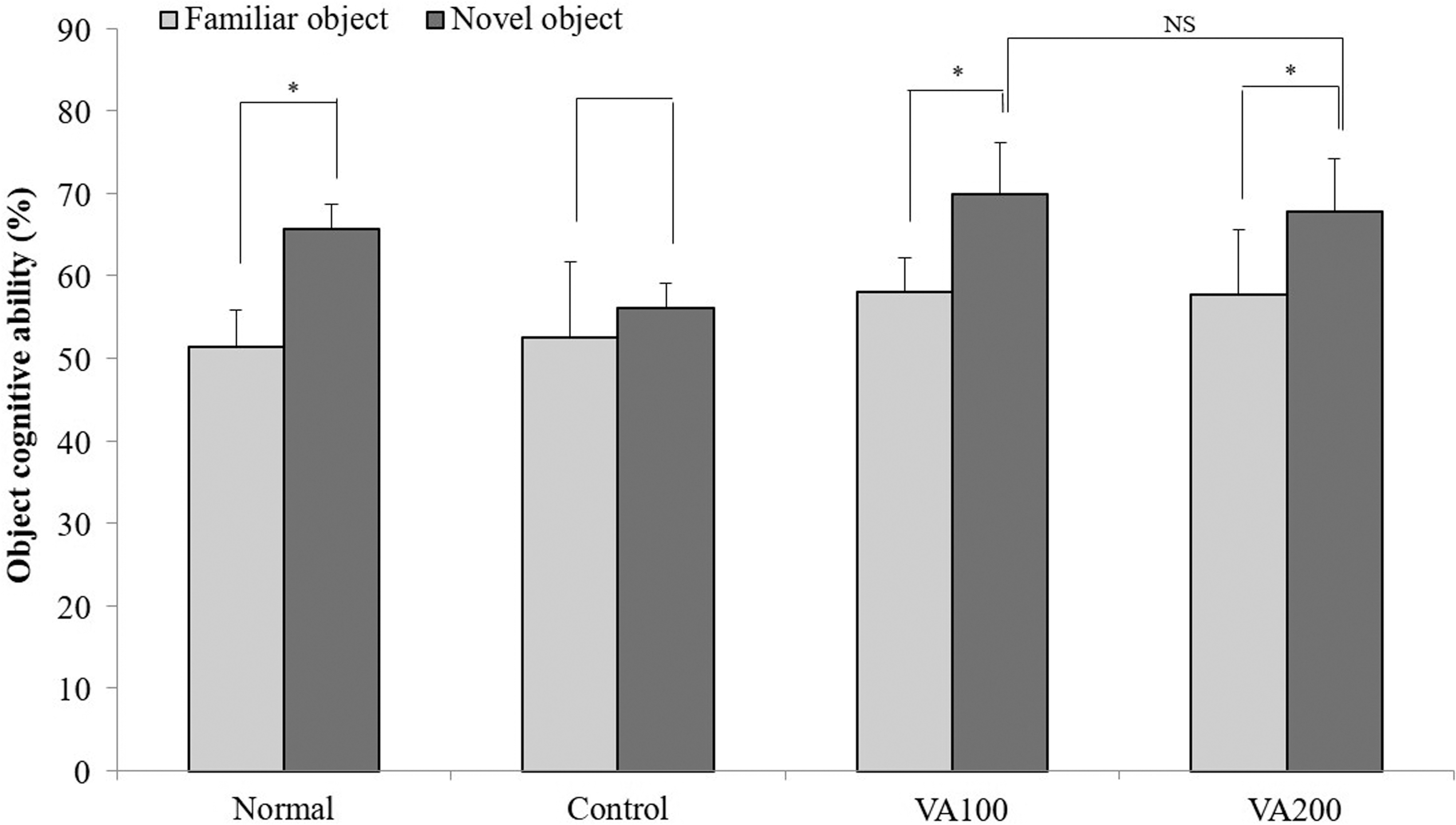
Effects of Vigna angularis on recognition memory in the novel object recognition test. The space perceptive ability is calculated as the percentage mean ± SD of the detection count a mouse in each object with in the 10 min. *The space perceptive abilities for old and new routes are significantly different as determined by Student's t-test (P < .05). There was no significant difference between VA 100 and VA 200 (Student's t-test, P > .05). Normal: chow diet + oral administration of drinking water; Control: 60% fat diet+oral administration of drinking water; VA 100: 60% fat diet+oral administration of EtOH extract from VA (100 mg/kg/day); and VA 200: 60% fat diet+oral administration of EtOH extract from VA (200 mg/kg/day).
Effects of VA on memory and learning ability in HFD-induced obese mice
The test was conducted to verify whether administration of VA enhanced learning ability and memory. HFD-fed control group showed a significantly longer swim path and latency to find the platform than the normal mice (Fig. 3). These results demonstrated that memory and spatial learning ability were significantly decreased in control group compared with the normal group. A significant reduction in the swim path and escape latency were observed in the VA-administered groups (17.0 and 11.7 sec) on training day (fourth day). Furthermore, the target quadrant swimming time was shorter in HFD-fed control group than normal group when the platform was removed. In addition, VA extract administration groups increased the swimming time in the target quadrant, similar to the normal group (Fig. 4). However, there were no significant differences in the latency to reach the exposed platform (Fig. 5A). However, compared with control group, VA extract-treated group significantly decreased latency to find the hidden platform (Fig. 5B).

Effects of Vigna angularis on representative swim pathways tracings
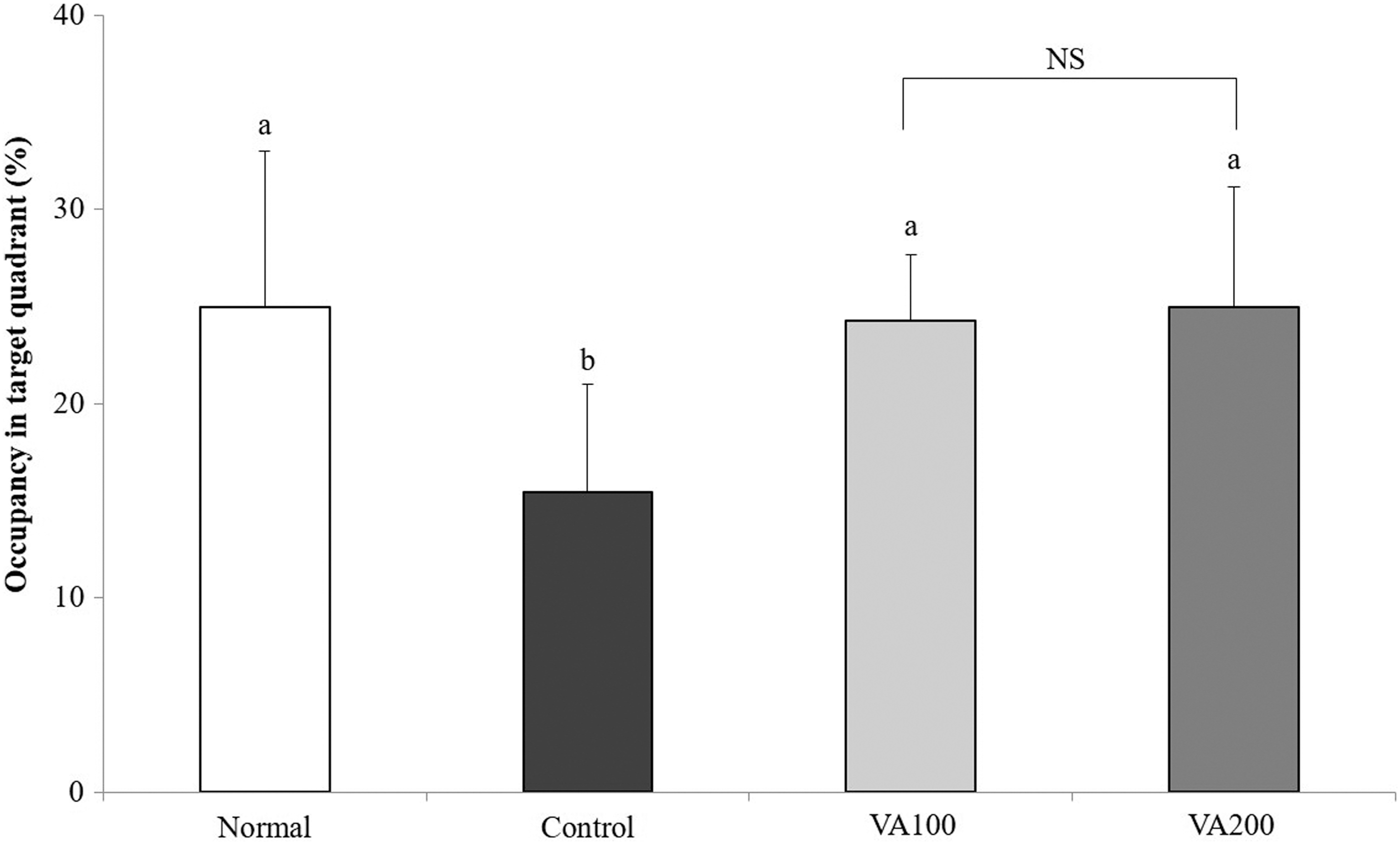
Effects of Vigna angularis on the percent of time to stay target quadrant in Morris water maze test. The mean ± SD percentage of time to stay target quadrant. abMeans with different letters are significantly different (P < .05) by Duncan's multiple range test. NS indicates no significant difference between VA 100 and VA 200 (Student's t-test, P > .05). Normal: chow diet+oral administration of drinking water; Control; VA 100 Normal: chow diet+oral administration of drinking water; Control: 60% fat diet+oral administration of drinking water; VA 100: 60% fat diet+oral administration of EtOH extract from VA (100 mg/kg/day); and VA 200: 60% fat diet+oral administration of EtOH extract from VA (200 mg/kg/day).
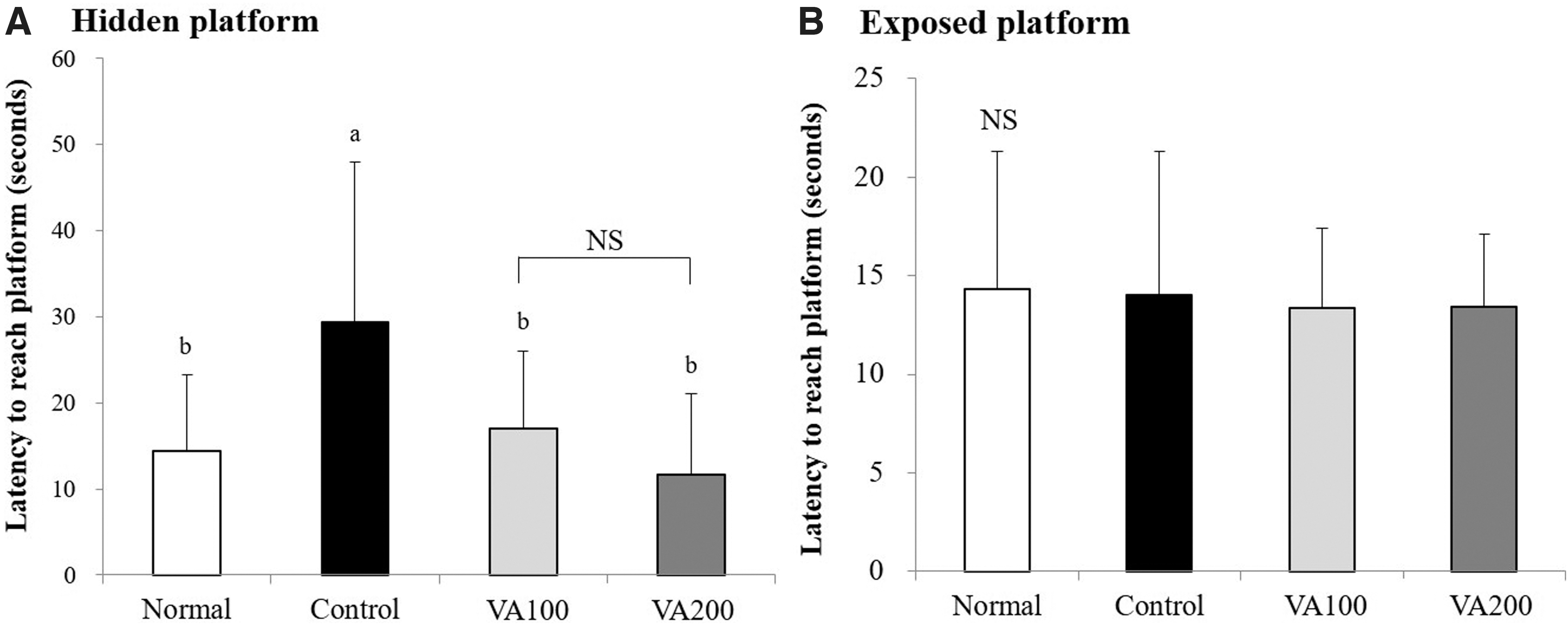
Effects of Vigna angularis on latency to reach the hidden platform
Discussion
Obesity is recognized as a major health problem worldwide, and it occurs due to excessive dietary intake and low-energy expenditure. Furthermore, obesity is associated with chronic diseases, including type 2 diabetes, atherosclerosis, hypertension, hyperlipidemia, and so on. 30 In addition, HFD-induced obesity is related to cognitive impairment. 31 Obesity-induced cognitive decline has been induced by oxidative stress, inflammation, and mitochondrial dysfunction in nervous system. 32,33 Recent studies are conducted to investigate the correlation of obesity with cognitive decline using a HFD animal model. 34,35 C57BL/6J mouse is commonly used as an in vivo model for studying HFD-induced cognitive impairment. According to Kim et al., 36 HFD- and amyloid beta (Aβ)-induced C57BL/6J mice showed cognitive impairment. HFD intake and Aβ accumulation led to oxidative stress by increases of reactive oxygen species, nitric oxide, and lipid peroxidation. Pistell et al. 37 also demonstrated the correlation between HFD and brain inflammation. The HFD group exhibited significantly upregulated inflammatory cytokines and chemokines (TNF-α, IL-6, and MCP-1) compared with chow diet-fed normal group. It has been shown that HFD-induced neuroinflammation and oxidative stress can lead to loss of the form of brain pericytes that play major roles in the structural maintenance of cerebral microcirculation. 38,39 Also, brain pericytes are important constituents of the BBB. Brain pericyte deficiency leads to BBB dysfunction and vascular cognitive impairment. 38,39 Various studies also supported the mechanisms and correlation between obesity and cognitive decline using the C57BL/6J model. 40,41 Therefore, we explored the HFD-induced cognitive impairment mouse model to evaluate the protective role of VA from obesity-induced memory and cognitive impairment.
VA has widely consumed as a food ingredient and traditional herbal medicine in Asian countries, including Korea, China, and Japan. Previously, various biological effects of VA have been investigated, especially improvement activity of obesity-associated symptoms, inflammation, and hypertension. 42,43 In addition, it was reported that VA contains several phenolic compounds with antiobesity effect, including saponin and proanthocyanidin. Kim et al. 44 demonstrated that saponin exhibited regulatory effects on body weight and fat accumulation in HFD-induced obese rat. Proanthocyanidin administration to obese rats improves dyslipidemia by regulating miR-33 and miR-122. 45 Since VA and its active compounds have antiobesity effect, it is expected that VA could improve obesity-induced cognitive impairment. Therefore, we studied the effect of VA extract under HFD-induced cognitive and memory dysfunction in mice.
During the experimental period, body weight and FER of control group were significantly higher than the normal group, indicating that obesity was induced in HFD-administered mice. However, VA extract administration groups showed significant decrease in body weight and FER. Kitano-Okada et al. 25 reported that VA reduced accumulation of hepatic lipid and fecal lipid secretion in HFD-fed mice, indicating that VA improved HFD-induced obesity. Furthermore, VA is a rich natural source of antiobesity agent such as polyphenols. Saponin from VA ameliorated HFD-induced obesity in ICR mice, showing decreases in body weight and adipose tissue weights. 26 These results suggest that VA can play a protective role against HFD-induced obesity.
To confirm the spatial cognition and short-term memory effects of VA, T-maze and novel object recognition tests were carried out. 27,46 We confirmed that VA extract elevated the abilities for spatial cognition and memory using these tests in HFD-fed mice. HFD-fed control group did not show significant preference to the novel object/route better than familiar object/route. This indicated that the HFD induced cognitive impairments. However, chow diet-fed normal group showed significantly better novel object/route results, and VA 100 and VA 200 groups showed similar levels as the normal group. Consistent with our results, HFD consumption mice were showed lower exploratory behavior toward a novel object or route in previous studies. 31,37,47 According to Sanna et al., 48 proanthocyanidin, one of polyphenol components of VA, ameliorated impairment of working memory that was assessed using T-maze test. Therefore, the VA extract improved cognitive ability of HFD-fed mice.
The water maze test was designed to evaluate the spatial learning and long-term memory of the mice. 29 HFD-fed control group exhibited memory impairment in this test, showing an increase in escape latency and decrease in time to swim in the target quadrant, but VA groups significantly decreased time to reach the platform and increased time spent in the target quadrant. Moreover, VA groups led to decrease mouse tracks for 4 days, similar to normal group. On the last test day, another test was conducted to identify if the mice reach the platform due to learning and memory abilities excluding visual recognition or exercise abilities. 36 When the exposed platform was clearly visible, the time to reach the platform was not significantly different in all the experimental groups (Fig. 4A). However, VA-administered groups significantly decreased latency to hidden platform compared with HFD-induced cognitive impairment control group (Fig. 4B). The results indicated that VA extract has improving effects on learning and memory ability.
VA contains various active compounds such as saponins and flavonoids. 26 In several studies, saponins and flavonoids have been demonstrated to improve cognitive abilities. 26,49 –52 Saponins improved spatial and memory ability, and prevent neuronal apoptosis in Aβ-injected rat. 49 Among the flavonoids in the VA, vitexin and isovitexin (an isomer of vitexin) are substances found in various medicinal plants. 50 The vitexin-administered group exhibited significantly lower step through latency than scopolamin-induced cognitive impairment group in passive avoidance tests. 51 In addition, the vitexin-administered group in the acquisition trials was followed by attenuated impairment retention and that was significantly reversed scopolamine-induced memory impairment. 51 Choi et al. 52 reported the anti-AD potential of vitexin and isovitexin using AD mouse model. Vitexin and isovitexin downregulated the acetylcholinesterase and butyrylcholinesterase, while only vitexin showed downregulated beta-secretase 1 (BACE1). Both types of cholinesterases are observed in AD associated with memory loss by cholinergic deficit. 52,53 BACE is also involved in cognitive decline by producing Aβ from amyloid precursor protein in AD. 52,54 Based on this evidence, further studies are needed to confirm the active compounds of VA with protective effects against cognitive impairment, and the protective mechanisms have to also be identified.
In conclusion, VA extract can improve ability of spatial cognition, novel object recognition, learning, and memory. Therefore, this study suggested that VA extract was useful to treat cognitive dysfunction and memory impairment induced by dietary obesity.
Footnotes
Author Disclosure Statement
No competing financial interests exist.
Funding Information
This research was supported by Basic Science Research Program through the National Research Foundation of Korea (NRF) funded by the Ministry of Education (2018R1A6A3A01012620).