




Abstract
The population widely uses babassu mesocarp (Attalea speciosa) as food and medicine. This study evaluated the use of babassu mesocarp as a food supplement during resistance training (RT). Male Swiss mice, 60 days old (weight 35–40 g), were divided into four groups (n = 8): control, untreated and untrained; babassu (babassu aqueous extract [BAE]), treated orally with aqueous extract of babassu mesocarp (25 mg/kg), five times a week, for 8 weeks; training (RT), submitted to RT consisting of stair climbing with progressive loads; and resistance training treated with babassu aqueous extract (RTBAE): RT and treatment with BAE. After 8 weeks, we analyzed the biochemistry of serum, the immunological, and histological parameters. The RT group showed maximum strength after the second week. A reduction in body weight, retroperitoneal and interstitial fat deposits, and activated helper T lymphocytes (TCD4+ CD69+) occurred in RT and RTBAE groups. The RTBAE group showed increased levels of aspartate aminotransferase, alanine aminotransferase, and macrophage and helper T lymphocyte count, whereas a reduction occurred in triglyceride levels and the total number of lymphocytes. Supplementation with BAE always reduced cholesterol and the population of activated macrophages but increased activated B lymphocytes and interleukin-6 levels. The combination of supplementation and RT resulted in a decreased production of tumor necrosis factor-α. We propose the use of babassu mesocarp as a food supplement during exercise because of its immunomodulatory effect on lymphocyte and macrophage populations and cytokine production. The additional impact on the control of cholesterol and triglyceride levels suggests its use, particularly for the treatment of dyslipidemias.
Introduction
Exercise or physical activity has been shown to reduce the risk of developing coronary artery disease, myocardial infarction, type 2 diabetes, and different types of tumors. In addition, exercise reduces blood pressure and improves the profile of lipoproteins, C-reactive protein, and other biomarkers. In diabetic individuals, exercise can improve insulin sensitivity and is an important ally in the maintenance of body weight. 1 In addition to reducing health risks, regular exercise promotes increases in strength, aerobic capacity, and flexibility. 2
The changes in body composition that occur during physical training can increase sports performance. Thus, nutritional supplementation with diets or formulations rich in carbohydrates and/or proteins should always be considered because of their ergogenic effect, especially for the preparation of elite athletes since physical fitness can be improved by the combination of physical training and adequate food supplements. 3
Carbohydrates ingested through the diet or as food supplement are the main source of energy in the form of glucose or glycogen and are therefore considered ergogenic aids. These compounds are metabolic fuels for both aerobic and anaerobic glycolysis. 4 Thus, the appropriate type, quantity, and time of use of supplements are determinant for the improvement of sports performance and for health promotion. 5 In general, the products used for supplementation should have nutritional function and exert effects on the activation of energy pathways, but anti-inflammatory and immunomodulatory activities are also important. 6
Babassu mesocarp (Attalea speciosa syn Orbignya phalerata Mart.) has shown immunomodulatory activity in various experimental models. Phytochemical analyses show that, in addition to carbohydrates, the mesocarp of babassu contains saponins, flavonoids, and tannins. Plants rich in tannins are used for the treatment of diarrhea, arterial hypertension, rheumatism, hemorrhage, wounds, burns, and general inflammatory processes. 7 These compounds might be associated with immunological activities already identified in babassu mesocarp. Ethnobotanical data indicate the use of babassu mesocarp by coconut breakers to treat inflammations, gastritis, wounds, and genital infections. 8
The biological properties of babassu mesocarp flour include anti-inflammatory 9 –12 ; immunomodulatory, 10,13 –15 antimicrobial, 15,16 antithrombotic, 17 antitumor, 18,19 and healing activities. 20 –22 The aqueous extract of babassu exhibits low toxicity to mice submitted to chronic treatment. 23
Considering its high carbohydrate content and the presence of chemical substances that are important for metabolism and immune system function, the aim of the present study was to evaluate the effects of the use of babassu mesocarp as a food supplement during resistance training (RT) in mice.
Materials and Methods
Ethical aspects
The study was approved by the Ethics Committee on Animal Research of the Federal University of Maranhão (CEUA/UFMA) (Approval No. 23115.004052/2012-13).
Animals and study design
Thirty-two adult male Swiss mice (60 days old and weighing 35–40 g), obtained from the Central Animals House of UFMA, were divided into four groups of eight animals each as shown in Table 1. All animals had free access (ad libitum) to water and ration and were maintained on a 12-h light/12-h dark cycle. Body weight and food intake were evaluated weekly in all groups.
Distribution According to the Training and Supplementation with Babassu
Untrained animals received saline (Control) or aqueous extract of babassu mesocarp as oral supplement (BAE) were compared with groups submitted to RT, and to those submitted to RT and supplemented with babassu mesocarp (RTBAE).
The control and RT groups received saline (0.87% NaCl) by gavage, five times a week, for 8 weeks, while the BAE and RTBAE groups received BAE (5 mg/kg) at the same intervals.
BAE, babassu aqueous extract; RTBAE, resistance training supplemented with babassu aqueous extract; RT, resistance training.
Plant material and preparation of the aqueous extract of babassu mesocarp
The babassu mesocarp flour was obtained in Arari, Maranhão, Brazil, between March 2017 and April 2018. A voucher specimen of the species containing leaves, flowers, and fruits was deposited in the Ático Seabra Herbarium from Federal University of Maranhão—UFMA (Registration No. 1135). The nutritional values of the flour used in the study are summarized in Table 2, considering the composition and daily values based on a diet of 2000 kcal or 8400 kJ.
Nutritional Values Per One Hundred Grams of Babassu Mesocarp Flour
Daily values based on a diet of 2000 kcal or 8400 kJ.
The mesocarp flour was added to deionized water at a concentration of 100 g/mL and extracted by maceration for 48 h, followed by filtration, evaporation under reduced pressure, and lyophilization. For preparation of the final extract, the extraction product was weighed and resuspended to a final concentration of 5 mg/mL. 14
Experimental procedure
The control and RT groups received saline (0.87% NaCl) by gavage, five times a week, for 8 weeks, whereas the babassu aqueous extract (BAE) and resistance training supplemented with babassu aqueous extract (RTBAE) groups received BAE (5 mg/kg) at the same intervals. After 8 weeks of RT and supplementation with babassu, the animals were weighed and euthanized with an anesthetic overdose (ketamine/xylazine, 1:3). Blood was collected from the retro-orbital plexus and serum was separated for biochemical and immunological analysis.
The organs (heart, liver, kidneys, spleen, and gastrocnemius muscle) and retroperitoneal fat were removed and weighed. Next, the organs were submitted to macroscopic inspection and fixed for histological analysis. The spleen and bone marrow were obtained for the evaluation of cellularity. Splenic cells were cultured for phenotypic analysis.
Resistance training
Animals of groups RT and RTBAE underwent RT consisting of stair climbing. The staircase was manufactured manually and measured 1 m in length, with 55 steps spaced 1 cm apart at an inclination of 45° (Fig. 1).

Schematic drawing of the staircase used for RT of mice. RT, resistance training.
A one-repetition maximum (1RM) test was performed at the beginning of training and every 2 weeks for load adjustment. The maximum load tests were conducted at the beginning of weeks 1, 3, 5, and 7. During each stair climbing event, the animal rested for 2 min before a new attempt. 24
In each training session, the animal climbed the stairs 12 times, with a variable progressive load of 50–80% of 1RM attached to the animal's tail. The first and last climb was performed without load and the animals could rest for 1 min between repetitions. The sessions were performed five times a week for 8 weeks.
The training macrocycle of the RT and RTBAE groups consisted of microcycles of 2 weeks using previously defined and adjusted loads according to the individual capacity of each animal obtained in the 1RM test. Table 3 and Figure 2 show the progressive increase in percent training loads at an intensity ranging from moderate to high.
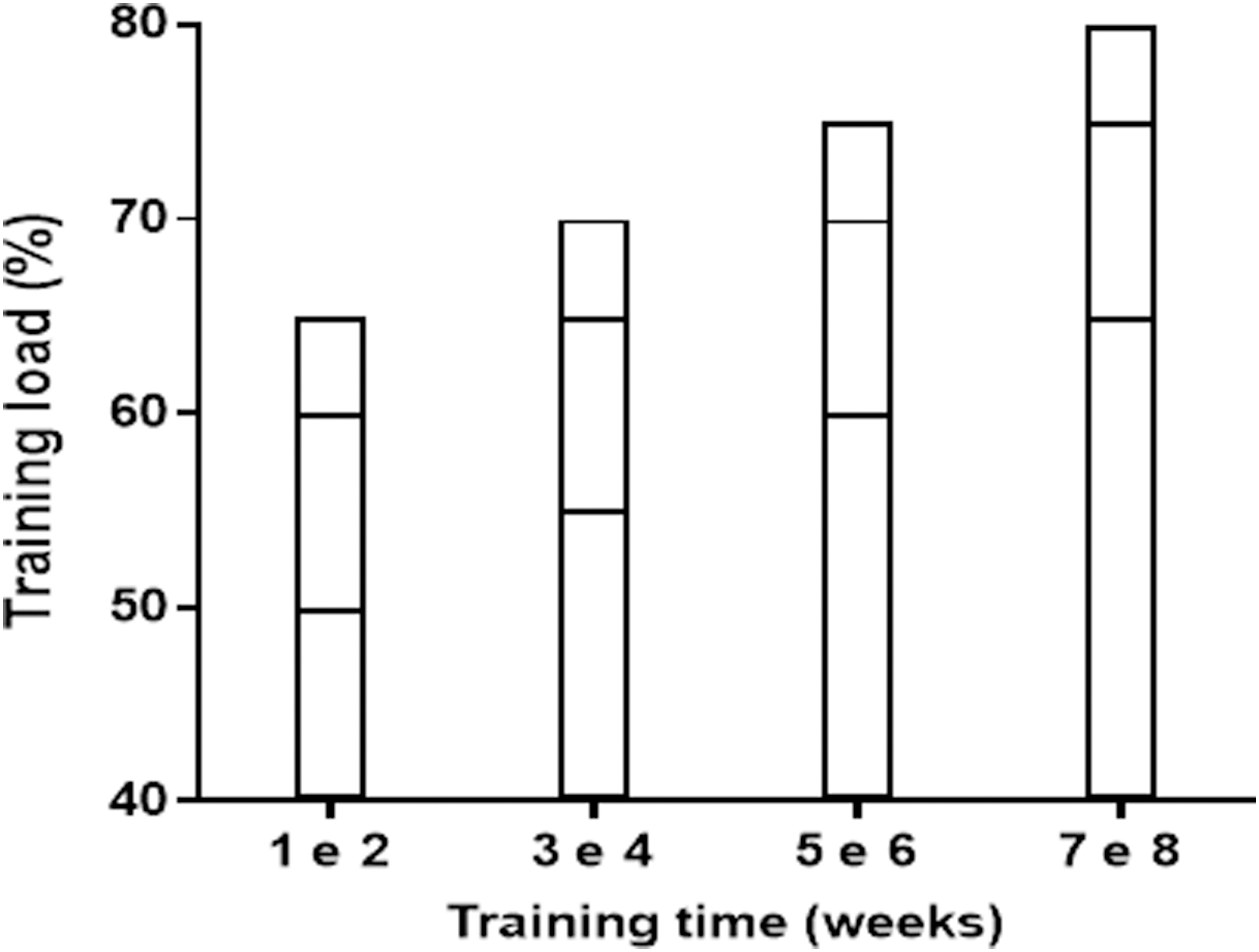
Percentage of weekly training load of the animals of groups RT and RTBAE. RTBAE, resistance training supplemented with babassu aqueous extract.
Weekly Training Loads of Mice Considering the Number of Climbs Versus the Percentual (%) of One-Repetition Maximum a
The RT consisting of stair climbing. A 1RM test was performed at the beginning of training and every 2 weeks for load adjustment. The maximum load tests were conducted at the beginning of weeks 1, 3, 5, and 7. In each training session, the animal climbed the stairs 12 times, with a variable progressive load of 50–80% of 1RM attached to the animal's tail. The first and last climb was performed without load and the animals could rest for 1 min between repetitions. The sessions were performed five times a week for 8 weeks.
1RM, one-repetition maximum.
Biochemical tests
Serum samples were collected at the end of the experiment by retro-orbital bleeding. Serum concentrations of the following biochemical parameters were obtained using specific kits (Labtest, Brazil) according to the manufacturer's instructions: alanine aminotransferase (ALT), aspartate aminotransferase (AST), total cholesterol, low-density lipoprotein, high-density lipoprotein, triglycerides, glucose, creatinine, and urea.
Immunophenotyping of splenic cells
The spleens were removed, weighed, and triturated in 2 mL supplemented Roswell Park Memorial Institute (Sigma). The cell suspensions were kept in an ice bath and diluted 50 × in phosphate-buffered saline (PBS) for counting. Cell viability was determined by the Trypan Blue exclusion method in a Neubauer chamber under a common light microscope. The splenic cells were resuspended in ice-cold PBS supplemented with 5% fetal bovine serum and 0.1% sodium azide and incubated with the antibodies shown in Table 4. 25
Panel of Cell Markers for Evaluation by Flow Cytometry
Panel of monoclonal antibodies specific for cell markers to identify the cell population and/or the activation by flow cytometry.
Histological processing of organs and tissues
The liver, kidneys, spleen, heart, and gastrocnemius muscle were removed, fixed in 10% formaldehyde (pH 7.2), and kept at room temperature. The blocks were cut and the sections were stained with Hematoxylin–Eosin. Slides were mounted in triplicate and analyzed under a common light microscope. The sections were photographed under an Eclipse Ti-U photomicroscope (Nikon®) at 10 × and 40 × magnification.
Statistical analyses
One-way analysis of variance followed by the Tukey–Kramer test were applied, adopting a level of significance of P ≤ .05 in all analyses. The results are expressed as the mean ± standard deviation of eight animals per group. Data analyses were performed with GraphPad Prism 7.0 software.
Results
RT always reduced the body weight of the animals by exercise week 3. This loss was more intense in the trained group that also received babassu after week 4, as shown in Figure 3.
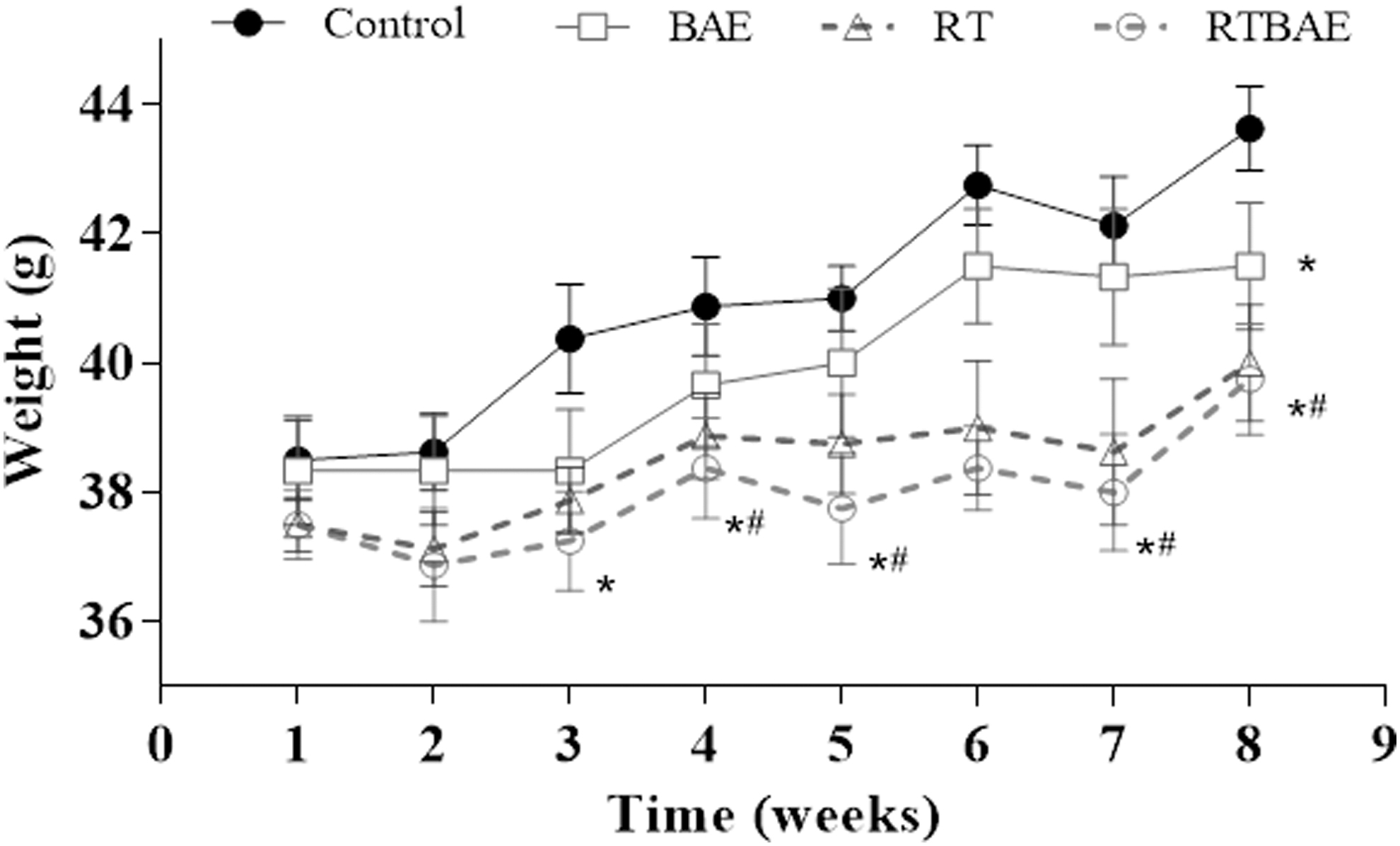
RT by stair climbing reduces the body weight of animals supplemented (RTBAE) or not (RT) with babassu mesocarp. Weight variation was compared between animals submitted to RT or untrained animals (control) and those receiving the aqueous extract of babassu mesocarp as oral supplement. Animals submitted to RT and supplemented with babassu mesocarp (RTBAE) were compared with those receiving only babassu (BAE). Values are the mean ± standard deviation of eight animals/group. *P < .05 compared with the control group; # P < .05 compared with the BAE group. BAE, babassu aqueous extract.
The ratio between fat percentage considering the total body weight was lower in the groups submitted to RT, regardless of supplementation with babassu, and in the untrained group supplemented only with babassu (Fig. 4).

Ratio between retroperitoneal fat percentage and body weight of animals submitted to RT and supplemented orally (RTBAE) or not (RT) with babassu mesocarp for 8 weeks compared with untrained animals treated (BAE) or not (control) with babassu. Values are the mean ± standard deviation of eight animals/group. *P < .05 compared with the untreated and untrained control group.
During the 8 weeks of the experiment, the groups underwent maximum strength testing and the result obtained was divided by total body weight (Fig. 5A). The results revealed that RT alone increased maximum strength (P < .05) between the third and fourth week of training. This effect was not observed in the group supplemented with babassu.

Ratio between maximum strength obtained in the one-repetition maximum test and body weight
Evaluation of delta strength, given by the difference between final and initial strength (Fig. 5B), showed that strength gain was greater in the RT group (P ≤ .05) compared with the untrained groups (control and BAE) and similar to that of the RTBAE group.
Table 5 shows the weight of spleen, heart, liver, kidneys, and gastrocnemius muscle relative to body weight. There was no difference in relative organ weight between groups, except for kidney, which was higher in the RT and RTBAE groups (P < .05).
Total Body Weight, Food Intake, and Relative Organ Weight of Mice Submitted to Eight Weeks of Resistance Training and Supplementation with Aqueous Extract of Babassu Mesocarp
Control: untrained and nonsupplemented animals; BAE: animals supplemented with aqueous extract of babassu mesocarp; RT: trained animals; RTBAE: trained animals supplemented with aqueous extract of babassu mesocarp (5 mg/kg), orally, during 8 weeks.
Data are reported as mean ± standard deviation of eight animals/group.
Organ weight in relation to body weight.
P < .05 compared with the control group.
Photomicrographs of the organs are illustrated in Figure 6. The kidney (Fig. 6A) and liver (Fig. 6C) exhibited preserved structures without detectable histological alterations. Evaluation of the heart musculature shows cellular activity of cardiac myocytes in the two trained groups (RT and RTBAE) (Fig. 6B), while an increase in the interstitial space was observed among cardiac fibers of control and BAE animals, indicating rest. In gastrocnemius muscle of the RT and RTBAE groups (Fig. 6D), characteristics of high cellular activity and an increase in the number of cell nuclei were observed in the absence of signs of inflammation, cellular infiltration, fibrosis, or fat accumulation. On the other hand, low cellular activity was found in the control and BAE groups.

The supplementation effect on the histology of the kidneys
Regarding lipid profile (Table 6), RT reduced serum triglycerides in RT and RTBAE groups (P < .05), with the lowest levels being detected in the RTBAE group. Total cholesterol concentration was reduced in the two groups treated with babassu (BAE and RTBAE). An increase in AST at the same proportion as observed in the RT group was found in the groups supplemented with babassu, regardless of training. Supplementation with babassu combined with training increased ALT concentration.
Serum Concentration of Total Cholesterol, Glucose, Triglycerides, Creatinine, Aspartate Aminotransferase, and Alanine Aminotransferase After Eight Weeks of Resistance Training and Supplementation with Babassu Mesocarp
Control: untrained and nonsupplemented animals; BAE: animals supplemented with aqueous extract of babassu mesocarp; RT: trained animals; RTBAE: trained animals supplemented with aqueous extract of babassu mesocarp (5 mg/kg), orally, during 8 weeks.
Data are reported as mean ± standard deviation of eight animals/group.
P < .05 compared with the control group.
P ≤ .05 compared with RT group.
P < .05 compared with the BAE group.
AST, aspartate aminotransferase; ALT, alanine aminotransferase.
Table 7 shows that supplementation of untrained animals with babassu increased the number of bone marrow cells, an effect controlled by RT, which reduced this cell population, as observed in the trained group (RTBAE). In the spleen, RT always reduced the number of splenocytes, regardless of the supplementation with babassu.
Total Number of Bone Marrow and Spleen Cells After Eight Weeks of Resistance Training with Progressive Loads and Supplementation with Babassu Mesocarp
Control: untrained and nonsupplemented animals; BAE: animals supplemented with aqueous extract of babassu mesocarp; RT: trained animals; RTBAE: trained animals supplemented with aqueous extract of babassu mesocarp.
Data are reported as mean ± standard deviation of eight animals/group.
P ≤ .05 compared with the control group.
P ≤ .05 compared with the BAE group.
Phenotypic evaluation of splenic cells showed that the RT reduced the total number of splenic lymphocytes (Fig. 7A) and concomitantly increased the total number of helper T lymphocytes (Fig. 7B), but reduced the population of activated Th lymphocytes (CD4+ CD69+) (Fig. 7C), regardless of supplementation with babassu. Neither RT nor supplementation with babassu altered the population of cytotoxic T lymphocytes in the spleen (Fig. 7D), even when the percentage of activated cells was evaluated (Fig. 7E).

Percentage of lymphocytes
The supplementation with babassu always increased the percentage of activated B lymphocytes in the group submitted to RT (RTBAE) and in the untrained group (BAE) (Fig. 7F, G)
RT increased the total number of macrophages in the spleen (Fig. 8A) but did not affect the population of monocytes (Fig. 8C). On the other hand, supplementation with babassu mesocarp always reduced the number of activated macrophages (Fig. 8B) both in the untrained (BAE) and trained groups (RTBAE) and training without supplementation reduced the percentage of activated monocytes (Fig. 8D).

Percentage of macrophages
As can be seen in Figure 9A, supplementation with babassu mesocarp always reduced the production of interleukin (IL)-6, regardless of whether the animals had been trained. On the other hand, either RT or supplementation with babassu increased the production of tumor necrosis factor (TNF)-α, with the highest levels being detected in untrained animals supplemented with babassu (Fig. 9B).

Concentration of IL-6
Discussion
Babassu mesocarp flour, a food widely consumed in the state of Maranhão, 8 is rich in carbohydrates. 26 In addition, some biological properties have been attributed to this flour, including anti-inflammatory and immunomodulatory effects, 10,13 –15,27 a fact that encouraged us to investigate the use of this product as an alternative food supplement for practitioners of RT.
RT combined or not with babassu supplement reduced the body weight of animals, although no difference in the total volume of the ingested food was observed between groups, indicating that the strength training program was effective as a measure of weight reduction in mouse. These observations were confirmed by evaluation of the retroperitoneal fat, which was also lower in the groups submitted to training, even when supplemented with babassu. Although babassu mesocarp is rich in carbohydrates, supplementation with this product during RT resulted in a reduction of retroperitoneal fat percentage ranging from 69% to 73%. The fat loss in the trained groups suggests that the protocol used was effective in changing body composition.
Chronic adaptation to fat reduction promoted by RT and supplementation is one of the goals of exercise programs. There is consensus in the literature that physical training reduces body fat. However, our data indicate that supplementation with babassu mesocarp can be used as an adjuvant in this process since the product was also effective in reducing body fat. The control of body fat is important for reducing cardiovascular risks and metabolic disorders. In this respect, the accumulation of adipose tissue renders the organism “inflamed” due to the influx of macrophages that secrete proinflammatory cytokines, such as TNF-α and IL-6. 28 Sedentarism and poor eating habits are associated with the accumulation of visceral fat, an independent predictor of high blood pressure, 29 myocardial infarction, 30 and insulin resistance 31 in humans. The accumulation of white adipose tissue also increases the risk of developing diabetes. Thus, supplementation with babassu mesocarp appears to be a good alternative because, in addition to reducing body weight and retroperitoneal fat, this product also reduced cholesterol and triglyceride concentrations but did not affect serum glucose, despite its high carbohydrate content. 26,32
The strength gain observed in the RT group compared with RTBAE was about 66%. This difference was detected after 4 weeks of training, suggesting that only 2 weeks of training were not enough to promote changes in the strength of mice. This finding might be explained by the fact that resistance exercise promotes medium- and long-term adaptations in muscle strength since it acts directly on the muscle by applying a force or weight. 33
Some energy substrates or stimulants, such as carbohydrates, amino acids, caffeine, and creatine, are used because of their known ergogenic effect, but they can also reduce physical performance. 34,35 We found no differences in strength variation between the RTBAE and untrained groups (control and BAE), suggesting that the babassu mesocarp exerted an ergolytic effect since it did not modify the strength of trained animals receiving the product.
Some biological activities of babassu mesocarp, such as anti-inflammatory and immunomodulatory effects, have been reported previously, but this is the first study demonstrating its supposed ergolytic activity. We believe that the ergolytic effect of babassu mesocarp, reducing strength performance, is associated with the process of muscle reconstruction that occurs after training. However, these data need to be confirmed in other RT models, since this type of training is an effective method to increase or maintain strength, promoting muscle hypertrophy. 36
For characterization of the sample, the organ weight of the animals was also analyzed. The relative kidney weight was increased by 21% and 15% in the RT and RTBAE groups, respectively, but no variation was detected in the other organs evaluated.
Microscopic analysis showed an increase in striated and cardiac muscle activity caused by RT (RT and RTBAE), regardless of supplementation. This finding indicates that training was effective in keeping the cell metabolism active, a factor that is essential for the maintenance of muscle health. 37,38 The physiological and metabolic repercussions of training combined or not with supplementation included changes in liver metabolism, with an increase of 7% in ALT levels in the RTBAE group compared with the other groups. However, the level found is considered normal for male mice 120 days of age. 39
RT alone or combined with babassu supplementation increased AST levels by 77% to 133% when compared with control. An increase in AST was observed in the two trained groups and in the group receiving only supplementation with babassu (BAE), indicating that both training and supplementation influenced liver function. Similar results have been reported by Huang et al.
40
who analyzed the effects of supplementation with
Elevated levels of AST and ALT have been used as indicators of oxidative stress since they are the result of an increase in liver lipid peroxidation. According to Hamden et al., 41 these elevated levels also indicate cell damage since exercise increases oxygen uptake by local mitochondria, where many free radicals are generated. In this respect, products with antioxidant activity have been useful in the control of oxidation processes and in the regulation and stabilization of reactive oxygen species to reduce cell damage.
Glucose, creatinine, and urea concentrations remained stable and were not influenced by RT or supplementation with babassu. Analysis of the lipid profile showed a significant reduction of serum triglycerides in the BAE, RT, and RTBAE groups, with this reduction reaching 50% in the RTBAE group compared with control. In the same group, a reduction was also observed in total cholesterol concentration (27%), even when compared with the RT group. The association of these data with the variations observed in body weight and retroperitoneal fat weight support the finding that supplementation with babassu, during RT, intensified the changes in body composition of the animals, with the observation of a reduction in serum triglycerides concentrations in all groups in which body fat was reduced.
It should be mentioned that the use of babassu mesocarp always reduced circulating total cholesterol concentration, an effect that was intensified in the trained group. Curiously, no change in cholesterol was observed in the group submitted to training without supplementation, indicating that this cholesterol-lowering effect is a property of babassu mesocarp. The total cholesterol-lowering effects of babassu might be associated with a reduction in lipoproteins, which are responsible for the transport of triglycerides and cholesterol. 42 –45
Evaluation of the number of cells in bone marrow, the primary lymphoid organ, showed that only treatment with babassu (BAE) increased this cell population. RT combined (RTBAE) or not (RT) with babassu supplementation always reduced the total number of splenic cells. These data were confirmed by cellular analysis, suggesting that training combined with babassu mesocarp can modulate the immune response by modifying the percentage of immune cells.
It was observed that RT combined with babassu reduced the percentage of activated Th lymphocytes but did not affect the population of cytotoxic T lymphocytes or monocytes, when the expression of the activation markers in splenic cells were analyzed. On the other hand, a reduction in the percentage of activated macrophages was observed in the groups treated with babassu, despite an increase in the total number of macrophages in the RTBAE group. In addition, a reduction in the population of activated monocytes was found in the RT group. Taken together, these data indicate that the protocol adopted maintained the immunomodulatory potential of training and babassu.
There is well-documented evidence of the effects of exercise and use of babassu mesocarp on the immune system. However, this is the first study that evaluated the effect of the combination of these two approaches on the activation of lymphocytes and macrophages. The use of immunomodulatory products in clinical therapy is an advancement in sports medicine. In fact, taking into consideration that exercise triggers an important inflammatory process, the use of compounds that can control this process is desirable.
Physical exercise is associated with the reduction in visceral fat, production of IL-6 by skeletal muscle, increase in circulating cortisol and adrenaline levels, inhibition of macrophage infiltration into adipose tissue, reduction in Toll-like receptor expression, decrease in blood monocytes, and increase in the number of T cells. 46 Similar results were observed in the groups supplemented with babassu, indicating that the reduction in the activated cell populations was either related to supplementation with babassu or to RT. IL-6 participates in the metabolic regulation of energy substrates during long-term exercise and its production might be influenced by the consumption of carbohydrates. 47
In an ethnopharmacological study, Souza et al. 8 observed that 68% of women working as babassu coconut breakers consumed its products for therapeutic purposes and babassu mesocarp was the most frequently used product (77%). The mesocarp is mainly consumed orally for the treatment of inflammatory diseases, such as gastrointestinal disorders as gastritis and is used topically to treat vulvovaginitis and skin wounds. In studies conducted by our group, the mesocarp is also administered orally in animal experiments.
The traditional use of babassu products has encouraged in vivo and in vitro studies conducted by our research group using models of inflammation to investigate the immunomodulatory capacity of babassu. 10,11,13 –15,19 Our group also investigated the cytotoxicity of babassu mesocarp. In this respect, Barroqueiro et al. 23 tested concentrations of 1000, 3000, and 5000 mg/kg and observed low acute toxicity.
The biochemical and histological data regarding the chronic effect of treatment with babassu for 8 weeks combined with RT also revealed low toxicity of this product, suggesting that babassu as a food supplement can be useful for patients with dyslipidemias, although it does not contribute to improve physical performance during RT.
Conclusions
The present results showed that supplementation with babassu is an important strategy for the control of dyslipidemias since it exerted a synergistic effect with RT on reducing circulating cholesterol concentration, as well as body weight and fat. Supplementation with babassu exerted immunomodulatory activity, contributing to the improvement of immunological interactions during RT. A diet supplemented with babassu, combined or not with physical activity, might be capable of reducing the risks of developing diseases related to body fat accumulation, such as diabetes, cardiovascular diseases, obesity, and dyslipidemias.
Footnotes
Disclaimer
The funders had no role in the design of the study; in the collection, analyses, or interpretation of data; in the writing of the article, or in the decision to publish the results.
Acknowledgments
The authors thank the Brazilian funding agencies Fundação de Amparo à Pesquisa e ao Desenvolvimento Científico e Tecnológico do Maranhão (FAPEMA), and Conselho Nacional de Desenvolvimento em Pesquisa (CNPq) for financial support.
Author Disclosure Statement
No competing financial interests exist.
Funding Information
Brazilian Council of Research—CNPq; State Foundation of Research of Maranhão – FAPEMA (Grant N° UNIVERSAL-01045/17).