




Abstract
Aquamin is a calcium-rich multi-mineral supplement derived from the red marine algae, Lithothamnion species. Calcium supplementation has been shown to exert a prebiotic-like effect on the gut microbiota and has been associated with distinct changes in lactate and short chain fatty acid (SCFA) production. Irritable bowel syndrome (IBS) subtype is associated with changes in SCFA levels compared with healthy controls. Using an ex vivo simulation model, and a fecal inoculum from a patient diagnosed with IBS, we evaluated the effects of Aquamin (at 6 and 30 mg/mL) on SCFAs and lactate production, pH and gas production, and human microbiota composition. Our results demonstrate that Aquamin increased SCFA production (acetate and propionate by 8% and 24%, respectively, at 30 mg/mL dose), significantly decreased lactate production (30 mg/mL), and increased colonic fluid pH without inducing changes in colonic gas production or gastrointestinal (GI) microbiota composition. These results indicate that Aquamin may play a role in optimizing GI microbial function in an ex vivo setting.
It is accepted that the gut microbiota play a key role in modulating intestinal health, 1 specifically in the maintenance of intestinal barrier function, immunity, protection against pathogens, food digestion, and energy metabolism. 2 Short chain fatty acids (SCFAs) acetate, propionate, and butyrate can modulate electrolyte and water absorption and represent an important energy source for host and bacteria. 3 Further, the balance between SCFAs in functional bowel disorders, such as irritable bowel syndrome (IBS), appears to be associated with gastrointestinal (GI) symptoms. 4
Aquamin is a multi-mineral supplement derived from the skeletal remains of the red marine algae, Lithothamnion species, that is rich in bioavailable calcium. 5 The mineral composition of Aquamin is detailed in Table 1. Calcium supplementation has been shown to exert a prebiotic-like effect on gut microbiota 6 and protect against bacterial pathogens. 7 –9 That Aquamin exerts beneficial effects on the GI tract has been demonstrated in inflammatory conditions in mice 10,11 and it improves GI barrier function compared with supplementation with calcium only. 12,13 In human subjects, treatment with Aquamin has been demonstrated to be superior to calcium in GI bacterial DNA modification, with a corresponding increase in SCFA production. 14
Mineral Composition of Aquamin (Lithothamnion sp.)
Whether Aquamin plays a role in IBS through the modulation of GI microbiota and SCFA production has not yet been investigated. To begin this line of inquiry, we first evaluated the effects of Aquamin on SCFAs and lactate production, pH and gas production, and human microbiota composition in an ex vivo simulation model, using an inoculum from an IBS-affected patient.
For semi-authentic anaerobic growth medium of the colon ex vivo simulation, four female pigs were fed a humanized diet (comprising canteen/cafeteria leftovers) for 7 days, after which distal ileum/proximal colon digesta were recovered, pooled, and centrifuged to remove bacterial cells, before combining the supernatant with anaerobic buffer. Pigs (weighing ∼100 kg) were chosen to provide the growth substrate for the experiment based on their relatively comparable (to human) GI physiology. 15 A fecal inoculum was obtained from a female volunteer (27 years of age; diagnosed with IBS) approximately 2 hours before initiation of the simulation. The inoculum was weighed, suspended in anaerobic buffer, and introduced into the simulation vessels, along with the substrate and test products in an anaerobic glove box. The test product concentrations used were Aquamin 6 and 30 mg/mL. The final inoculum concentration was 0.01g/mL. The simulation had five replicate vessels for each treatment, and the inoculation was carried out in a random order. The vessels were closed with butyl rubber stoppers, transferred to 37°C, and continuously mixed in a gyratory shaker (Gesellschaft für Labortechnik mbH [GFL], model number 3019) at 100 r.p.m. Incubation was continued for 22 hours, sampling for gas and pH was performed at 8 and 22 hours, and SCFAs (acetic, propionic, butyric acids) and lactate were analyzed at the end of the 22-hour fermentation.
For SCFA and lactate analysis, 0.4 mL of digesta sample was added to 2.4 mL of pivalic acid. Volatile fatty acids were extracted by shaking. The extract was centrifuged; 800 μL of the supernatant was precipitated by adding 400 μL of saturated oxalic acid; and the mixture was incubated at 4°C for 60 minutes, and it was centrifuged again. Samples were analyzed by gas chromatography using an 80/120 carbopack B-DA/4% Carbowax stationary phase, helium carrier gas, and a flame ionization detector.
The pH of the fermentation medium was measured with a calibrated pH electrode immediately after gas measurement (to avoid pH shifts caused by the escape of CO2).
Total gas production was measured by puncturing the rubber stopper with a needle connected to a 10-mL glass syringe with a sensitive ground plunger, and recording the volume of gas released.
At the end of the 22-hour stimulation, subsamples from the simulation vessels were collected for analysis of the abundance of the following bacterial groups or genera with real-time PCR: domain bacteria, Lachnospiraceae, Ruminococcaceae, Lactobacillus spp., Bifidobacterium spp., Bacteroides spp., and Veillonella spp. These were selected based on their dominance in the human colon, and their reported benefits on human GI health. 16 Bacterial DNA was extracted from the colonic digesta samples by using a standard protocol. Real-time PCR was performed with an ABI Prism Sequence Detection System 7500 instrument (Life Technologies, USA). The numbers of 16S rRNA gene targets or genomes were determined per one mL of intestinal material.
Statistical analysis consisted of two-tailed t-tests for all measured parameters. The tests were performed against the control treatment with no test product, and they were amended as per Dunnett's post hoc test. The t-test was chosen to let the individual treatments be independent of the other treatments tested simultaneously.
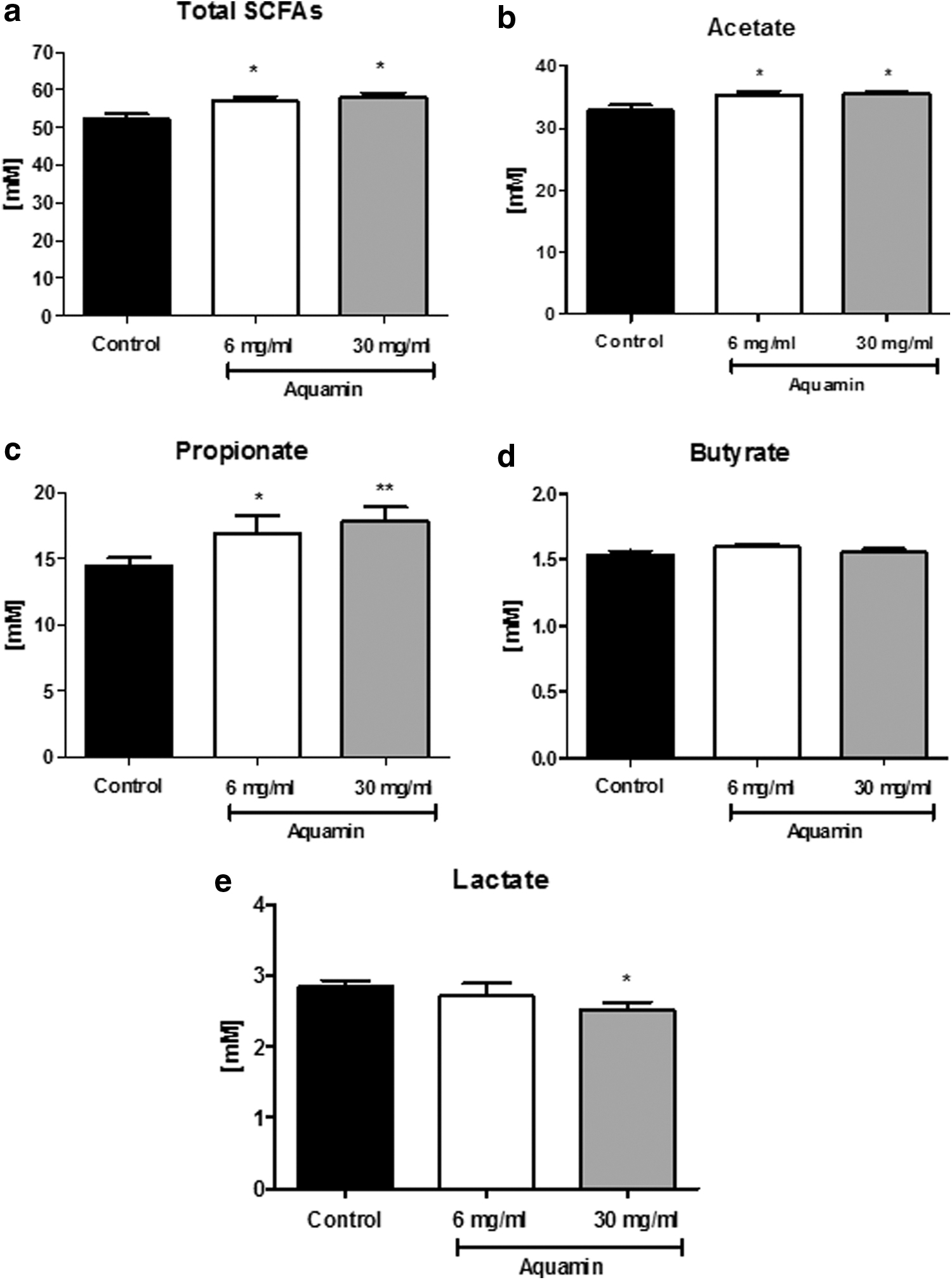
Total SCFA production was significantly increased after Aquamin supplementation at 6 and 30 mg/mL when compared with the control at the end of the 22-hour simulation (Fig. 1a). Specifically, acetate formation increased by 7% and 8% at 6 and 30 mg/mL doses, respectively (Fig. 1b) and propionate increased by 17% and 24% at 6 and 30 mg/mL doses, respectively (Fig. 1c). No significant changes in butyrate levels were observed (Fig. 1d). Lactate production was decreased in response to supplementation with 30 mg/ml of Aquamin at 22 hours (Fig. 1e).
Aquamin at 30 mg/mL demonstrated a significant buffering action on colonic pH at 8 hours (Fig. 2a), and this effect was more pronounced at the 22-hour sampling point (6 and 30 mg/mL doses) (Fig. 2b).

Aquamin treatment increased the colonic pH at 8 (30 mg/mL dose) (*P < .05)
No differences in gas production at either 8 or 22 hours after supplementation at either Aquamin concentrations were observed (data not shown). Gas production was less than 3.5 mL at 8 hours, but it accelerated subsequently to more than 12 mL in each individual sample by 22 hours.
The treatment with the multi-mineral supplement, Aquamin, did not induce statistically significant changes in the quantities of the selected bacterial groups or genera at either concentration after a 22-hour incubation (data not shown).
Decreased fecal levels of butyrate, acetate, and propionate have been observed in inflammatory bowel disease patients compared with healthy subjects, 17 –19 whereas lactate has been shown to be significantly increased. 18,19 Evidence also suggests that SCFAs may be effective in the treatment of distal ulcerative colitis. 20 –22
Alterations in SCFA profiles are also associated with the IBS subtype. 4 Patients with diarrhea-predominant IBS have a lower concentration of total SCFAs, propionate, and acetate and a higher concentration of butyrate when measured in an in vitro anaerobic fermentation system. 23 Moreover, total fecal SCFA levels and propionate have also been reported to be significantly lower in constipation-predominant IBS patients. 24 Although the data are not consistent across all studies, likely in keeping with the heterogeneity of this disorder, 25 a recent review and meta-analysis indicated that more predictable patterns exist depending on the IBS subtype. 4 Supplements with the ability to modulate SCFAs levels selectively may confer benefit in particular IBS subgroups.
Bacteria belonging to the Lachnospiraceae and Ruminococcaceae families are major constituents of the human large intestine microbiota. 16 Species within these clusters play a key role in the production of butyrate. 26 In keeping with our finding of no change in butyrate production, neither Lachnospiracea nor Ruminococcaceae numbers were altered. Other important bacteria playing a key role in the production of acetate and propionate were not included in our analysis, and very subtle changes in activity or numbers of species within the genus may account for alterations in SCFA levels. It is impossible to determine which of the mineral components of Aquamin is responsible for these changes; however, it is reported that Aquamin has effects beyond those of calcium alone on microbiome composition and SCFA production in vivo, 14 suggesting that the effects observed reflect the composite of minerals, rather than one individual component. Our results also showed a decrease in lactate concentration, in keeping with evidence that lactate is converted into SCFAs by the intestinal bacteria, although at pH 5.2, lactate accumulation is observed due to a reduction in utilization. 27 The increase in sample pH observed in this study in response to Aquamin treatment may have promoted the activity of lactate-utilizing bacteria that are capable of converting lactate to beneficial products such as acetate and propionate. The increase in sample pH despite the increase in SCFAs is interesting, and it is proposed that this reflects the interplay between Aquamin (pH 10), substrate availability, and SCFA production. It is also reported that calcium supplementation increases fecal pH in vivo. 28
It is recognized that this study used a donor inoculum from a single IBS patient, and as a result of this weakness, strong inferences about the potential role of Aquamin in ameliorating IBS symptoms through its effects on microbial SCFA production cannot be made. However, the dose-dependent results observed are considered to be of interest; in the context of existing research, these results deserve further investigation in asymptomatic subjects, and in a larger number of IBS-affected patients. In conclusion, the results demonstrate that the multi-mineral supplement, Aquamin, influences bacterial metabolic activity in an ex vivo simulated colonic fermentation model.
Footnotes
ACKNOWLEDGMENTS
Marigot Ltd. provided the test sample to Alimetrics free of charge. The authors are grateful to V.D.F., N.M.O., and N.P.H. for their input on the study design and article write-up.
AUTHOR DISCLOSURE STATEMENT
V.D.F. and D.M.O. are employees of Marigot Ltd. Marigot Ltd. commissioned this work to be performed at Alimetrics Ltd., but otherwise had no significant input on how the study results were generated. J.A. and T.R. are employees of Alimetrics Ltd. Alimetrics Ltd. was paid to perform this work on behalf of Marigot Ltd. Payment was pre-determined and independent of the study results. N.M.O. and N.P.H. are employees of University College Cork, and they have no competing interests to declare.
FUNDING INFORMATION
This study was funded in part by the Irish Research Council Enterprise Partnership Scheme (EPS) postdoctoral fellowship to V.D.F., grant number EPSPD/2015/52.