




Abstract
Pomegranate juice (PJ) has potential positive effects in patients with metabolic disturbances due to a high content of polyphenols. The objective of this study was to evaluate effects of a 2-week consumption of dietary doses of PJ on blood pressure, lipid metabolism, and oxidative stress markers in overweight patients with dyslipidemia. Twenty-four patients, 8 males and 16 females, 40–60 years of age, with established overweight and dyslipidemia were randomly assigned into intervention group, who consumed 300 mL of PJ daily for 2 weeks, or control group. After 2 weeks of juice intake, intervention group had significantly lower diastolic blood pressure, low-density lipoprotein cholesterol, aminotransferase, and activity of glutathione peroxidase. Furthermore, patients who consumed PJ had reduced percentage of docosahexaenoic acid (22:6n-3, DHA) in plasma phospholipids and increased estimated activity of stearoyl-CoA desaturase. In erythrocytes, we found a significant increase in the levels of dihomo-γ- linolenic acid (20:3n-6, DGLA) and DHA, as well as in estimated activity of Δ6 desaturase, and a decrease in estimated activity of Δ5 desaturase. These results show that even a short-term consumption of dietary doses of PJ exerts beneficial effects and affects lipid metabolism in overweight patients with dyslipidemia.
Introduction
Overweight and obesity are considered major risk factors for noncommunicable diseases such as cardiovascular diseases (CVD), diabetes, musculoskeletal disorders, and some cancers. 1,2 The presence of overweight and obesity implies adverse metabolic disturbances, including hypertension, high glucose level, and dyslipidemia. Dyslipidemia, defined as elevated levels of total cholesterol (CHOL), low-density lipoprotein (LDL) cholesterol, and/or triglyceride (TG) level, and decreased levels of high-density lipoprotein (HDL) cholesterol, is an important risk factor for coronary heart disease and stroke. Dietary intervention with an emphasis on an increased intake of vegetables, whole grains, and fruits, moderate aerobic physical activity, lifestyle changes, as well as pharmacological therapies, are recommendations for both decreasing weight and management of dyslipidemia. 3
Many plants and their extracts are under investigation for the prevention and therapy of overweight and dyslipidemia (ODL), as a cost-effective therapeutic option with low risk of adverse side effects. 4,5 Among them, polyphenol-rich plants have been highlighted as the most promising antiatherogenic and cardioprotective herbal medicines. Polyphenols have shown a significant potential to improve hyperlipidemia, 6,7 hypertension, 8,9 and obesity 5 ; therefore polyphenol-rich fruits and vegetables may be the cornerstone of a diet preventing the development and progression of ODL.
Pomegranate (Punica granatum L.) is a widely consumed fruit with a high content of different polyphenols. Commercial pomegranate juice (PJ) is produced by pressing the whole pomegranate fruit and thus contains significant amounts of numerous phytochemicals. 10 Among many bioactive compounds, PJ is rich in polyphenols, such as tannins, flavonoids, lignans, phenolic acids, and alkaloids. 11
Both PJ and fresh fruit exert a strong antioxidative and anti-inflammatory potential. Human intervention studies have demonstrated that pomegranate attenuates chronic inflammation and has beneficial effects in diverse ailments. 12 The PJ consumption reduces both systolic and diastolic blood pressure, which are major risk factors for CVD. 13 Moreover, PJ intake diminishes markers of oxidative stress, lipid peroxidation, and levels and aggregation of LDL-cholesterol, and increases paraoxonase activity. 14,15 A recent study has also reported a decreased conversion of glucose to fat in human adipocytes, suggesting beneficial effects of pomegranate in preventing obesity. 16 Nevertheless, studies are inconsistent and there is still no consensus on the doses and the duration of PJ intake, which would exert beneficial effects in patients with dyslipidemia.
Thus, the aim of this study is to evaluate effects of a short-term (2 weeks) consumption of dietary doses (300 mL) of PJ on blood pressure, biochemical and anthropometric parameters, and fatty acid (FA) profiles of blood phospholipids, as well as markers of oxidative stress in individuals with ODL.
Materials and Methods
Study protocol
Twenty-four patients, 8 males and 16 females, 40–60 years of age, overweight (body mass index [BMI] 25–30 kg/m2) with dyslipidemia were included in the study. Dyslipidemia is defined as CHOL >5.2 mM, LDL >3.34 mM, HDL <1.55 mM, and/or TG >1.7 mM, according to the guidelines to the National Cholesterol Program (NCEP) Adult Treatment Panel III. 17 The subjects were selected based on their medical records available at the Clinical Hospital Zemun, Serbia, as non-smokers, not suffering from any chronic disease, not receiving hormonal therapy, not being on restrictive diets or supplemented with any antioxidants, fish oil, or other supplements influencing lipid metabolism 6 weeks before the study. Nine of all patients (six women and three men) were regulating blood pressure by medications.
All study participants were adherent to dietary restrictions, defined by the study protocol, which relates to the avoidance of foods rich in polyphenols, such as nuts and berries, 2 weeks before the start of the study and strictly during the study. Also, study participants were explained to remain their usual eating habits during the study, to diminish the effects of the intervention. All subjects completed a 24-h dietary recall before the study commencement. Their dietary intakes have been monitored by two 24-h food recalls during the study, by phone, to confirm no change in dietary regimes during the study. Compliance was assessed by the empty bottles that the participants returned at the end of the 2-week intervention period.
The study protocols were approved by the Ethics Committee of the Clinical Hospital Zemun following the Declaration of Helsinki and principles of Good Clinical Practice (number 833/11). All subjects gave written participation consent. Patients were randomly divided into an intervention group (n = 12, 4 males and 8 females) who consumed 300 mL of PJ for 2 weeks, and the control group (n = 12, 4 males and 8 females) with no supplementation. All parameters were measured at the beginning (baseline) and the end of the supplementation period.
The sample size was calculated assuming a mean reduction of ∼4.36 mm Hg and standard deviation (SD) of ∼1.83 mm Hg for diastolic blood pressure, a mean reduction of ∼4.30 mm Hg and SD of ∼2.18 mm Hg for systolic blood pressure, and assuming a mean reduction of ∼arachidonic acid 2.49 and SD1 ∼ 0.97, with a power of 80%, a significance level of 0.05, according to previously published studies. 18,19 The minimum sample size estimated was n = 10. To avoid potential dropout or nonadherence to the study protocol, we included 12 persons per group. 20
The intervention beverage was prepared by pressing the whole pomegranate fruits as described in our previous study. 19 Total phenolic content in PJ was 2.938 ± 0.013 g/L, including flavonoids (0.183 ± 0.003 g/L), anthocyanins (0.021 ± 0.001 g/L), and ellagic acid (0.0389 ± 0.0019 g/L), while radical scavenging activity (IC50) of the juice was 0.00125 ± 0.00003 g/L. The total phenolic content of juice, as well as content of flavonoids, anthocyanins, and ellagic acid, was measured in our laboratory as described in our previous article. 19 The free radical scavenging activity of juice was determined as the ability to neutralize 50% of the initial amount of 2,2-diphenyl-1-picrylhydrazyl radical measured according to the method previously described by Braca et al. 21
Anthropometric measurements and blood pressure
Office monitoring of blood pressure was performed by three consecutive measurements, separated with 5-min intervals, in the sitting position with an automated device (OMRON IntelliSense, HEM-907XL; Vernon Hills, IL, USA). Body weight and body composition were determined using Tanita analyzer (TBF-300, Tanita Corp., Japan), while height was measured on a wall-mounted stadiometer (Perspective Enterprises, Kalamazoo, MI, USA). BMI was calculated as the ratio between body height (kg) and squared height (m2).
Waist circumference was measured from the midpoint between the lateral iliac crest and the lowest rib to the nearest 0.5 cm using steel tapes with cutoff points according to the NCEP-ATP III. 22
Hematological and biochemical analyses
Blood samples were taken at baseline and at the end of the PJ consumption period, after an overnight fast. Complete blood count was determined on the ABX MICROS 60 (Horiba ABX SAS, Montpellier, France) hematology analyzer. Lipid status, levels of glucose, urea, and uric acid, and activity of alanine aminotransferase (ALT) and aspartate aminotransferase (AST) were determined from serum within 2 h after the samples were collected, using the analyzer Cobas c111 and commercial kits (Roche Diagnostics, Basel, Switzerland) according to the manufacturer's instructions.
FA analysis
Total lipids of plasma and erythrocytes were extracted with a chloroform/methanol mixture (2:1, v/v) according to a previously described method. 23 The phospholipid fraction was derived from the lipid extract by one-dimensional thin-layer chromatography on Silica Gel GF plates (Merck, Darmstadt, Germany), using a neutral lipid solvent system of hexane: diethyl ether: acetic acid (87:12:1). Fatty acid methyl esters (FAMEs) were analyzed by gas-liquid chromatography in a Shimadzu chromatograph GC 2014 (Kyoto, Japan) equipped with a flame ionization detector on Rtx 2330 column (60 m × 0.25 mm ID, a film thickness of 0.2 μm; RESTEK, Bellefonte, PA, USA). The identification of FAMEs was made by comparing peak retention times with standard mixtures (PUFA-2 and/or 37 FAMEs mix; Supelco, Bellefonte, PA, USA) and content of FA expressed as a percentage of total FA identified.
Desaturase and elongase indices
Product-to-precursor ratios were used to estimate the activities of certain enzymes involved in FA biosynthesis: 18:0/16:0 for elongase activity, 16:1n-7/16:0 ratio for stearoyl-CoA desaturase (SCD-16), 18:1n-9/18:0 ratio for stearoyl-CoA desaturase (SCD-18) activity, 20:3/18:2 ratio for delta-6-desaturase (Δ6-desaturase) and elongase activity, and 20:4/20:3 ratio for delta-5-desaturase (Δ 5-desaturase) activity. 24 All enzyme activities were calculated for both plasma and erythrocytes.
Lipid peroxidation
The level of lipid peroxidation and activities of antioxidant enzymes were measured in erythrocyte lysates, which were prepared as follows: after centrifugation of blood at 2000 g for 15 min, and the plasma separation, erythrocytes were washed three times with 0.9% NaCl (w/w). Washed erythrocytes (0.5 mL) were then lysed by adding 3 mL of ice-cold distilled water followed by thorough mixing. The total hemoglobin (Hb) content of these hemolysates was measured as cyanmethemoglobin using the Drabkin method.
The levels of thiobarbituric acid-reactive substances (TBARS), as by-products of lipid peroxidation, in erythrocyte lysate, were determined using a commercial kit (Cayman, Ann Arbor, MI, USA). The method is based on the reaction of malondialdehyde (MDA) and other TBARS with thiobarbituric acid (TBA) at high temperatures, where a complex is formed with max absorption at 535 nm. Briefly, 100 μL SDS and 4 mL working reagent (530 mg TBA, 50 mL TBA in acetic acid, and 50 mL TBA in NaOH) were added in 100 μL lysate and incubated at 100°C for 60 min. Then samples were put on ice for 10 min and centrifuged for 15 min at 1600 g. The level of MDA was expressed as U/gHg. 25
Activities of antioxidant enzymes
Catalase (CAT) activity was determined in erythrocyte lysate according to method Aebi (1984). 26 CAT activity is defined as the amount of enzyme that decomposes 1 mmol hydrogen peroxide (H2O2) in 1 min and is expressed as U/gHb. Briefly, 2 mL of phosphate buffer (pH = 7) and 1 mL of 30 mM H2O2 were added to 50 μL lysate. Absorbance was measured at each 30 sec during the 3 min, at 240 nm.
Superoxide dismutase (SOD) activity was determined in hemolysate, using a commercial Ransod test kit (Randox Laboratories Ltd), which was based on the method of McCord and Fridovich. 27 Xanthine and xanthine oxidase were used to generate superoxide anion radicals, which react with 2-(4-iodophenyl)-3-(4-nitrophenol)-5-phenyltetrazolium chloride (INT) quantitatively to form a red formazan dye. SOD inhibits the reaction by converting the superoxide radical to oxygen. Briefly, 170 μL working reagent (0.05 mM xanthine, 0.025 mM INT, and 0.94 mM phosphate buffer), was added to 5 μL lysate and after 30 sec, 25 μL xanthine oxidase. Absorbance was measured at 505 nm for the 30 sec after the addition of xanthine oxidase. The SOD activity was expressed as U/gHb
Glutathione peroxidase (GPx) was determined using a commercial Ransel kit (Randox Laboratories), which was based on the method of Paglia and Valentine (1967). 28 GPx catalyzes the oxidation of glutathione by cumene hydroperoxide, in the presence of glutathione reductase and NADPH, and forms oxidized glutathione. The oxidized glutathione immediately converts to the reduced form with concomitant oxidation of NADPH to NADP+. The amount of enzyme that oxidizes 1 nM NADPH per minute is a GPX activity that is expressed as U/gHb. Briefly, 1 mL Drapkin reagent and 220 μL working reagent (4 mM glutathione, 0.5 mM glutathione reductase, 0.034 mM NADPH, 0.05M phosphate buffer, pH = 7.2, and 4.3 mM EDTA), and 10 μL cumene hydroperoxide (0.18 mmol) were added to 5 μL lysate. Absorbance was measured at 340 nm.
Statistical analyses
All chemical analyses were performed in triplicates, and the results are presented as the mean values with the SD. Prior comparisons, the normality of variables distribution was tested by Shapiro–Wilk test. The data that followed the normal distribution were analyzed by paired t-test for the difference between the pairs. When data did not follow a normal distribution, they were analyzed by the Wilcoxon test. Analyses were performed using the SPSS software (ver. 23.0; Chicago, IL, USA) and P < .05 indicated statistical significance. GraphPad Software (2365 Northside Dr. Suite 560 San Diego, CA 92108) was used for chart construction.
Results
Anthropometric parameters and blood pressure
The anthropometric parameters and blood pressure in subjects with ODL are presented in Table 1. As can be seen in the table, the intervention and control group were similar in terms of age, anthropometric parameters, fat percentage, and blood pressure. In addition, there were no differences between males and females, except in the waist circumferences (WC); thus, only WC was presented separately for men and women. After a 2-week PJ consumption, the intervention group had significantly decreased diastolic blood pressure (P < .05), while all other parameters remained unchanged.
Characteristics of Study Population Before and After the Study Period
Data are presented as mean ± SD.
P < .05 compared to baseline (before treatment).
BMI, body mass index; M, male; F, female.
Hematological and biochemical parameters
Among study participants, 22 had elevated CHOL, 21 had LDL-cholesterol above referent range, 14 had HDL-cholesterol below the referent values, and 6 had increased TG in blood. At the beginning of the study, there were no differences in hematological and biochemical parameters between the two groups (Tables 2 and 3, respectively). At the end of the study, the only level of LDL-cholesterol was significantly (P < .05) reduced in the intervention group (Table 3).
Complete Blood Count Parameters of All Subjects Before and After the Study Period
Data are presented as mean ± SD.
WBC, white blood cell; RBC, red blood cell; PCT, plateletcrit.
Biochemical Parameters Before and After the Study Period
Data are presented as mean ± SD.
P < .05 compared to baseline (before treatment).
M, male; F, female.
Among other biochemical parameters, we have detected a decrease (P < .05) in AST values in the intervention group after the 2 weeks (Table 3).
FA profiles of plasma and erythrocyte phospholipids
Plasma phospholipid FA composition and estimated activity of desaturases and elongases, before and after the study period, are shown in Table 4 and Table 6, respectively. We found a significantly reduced percentage of docosahexaenoic acid (22:6n-3, DHA) and increased SCD-18 index (P < .05) in the intervention group, after the consumption period in plasma phospholipids. In erythrocytes, we found a significant increase (P < .05) in the levels of dihomo-γ- linolenic acid (20:3 n-6, DGLA) and DHA (Table 5), as well as in estimated activity of Δ6 desaturase, and a decrease in the estimated activity of Δ5 desaturase (P < .05 and P < .01, respectively, Table 6).
Plasma Phospholipid Fatty Acid Composition Before and After the Study
Data are presented as mean ± SD.
P < .05 compared to baseline (before treatment).
Erythrocyte Phospholipid Fatty Acid Composition Before and After the Study
Data are presented as mean ± SD.
P < .05 compared to baseline.
Estimated Activity of Desaturase and Elongase in Plasma and Erythrocytes Before and After Study Period
Data are presented as mean ± SD.
P < .05.
P < .01 compared to baseline.
Lipid peroxidation and antioxidative enzymes
Among antioxidative enzymes, SOD and CAT were similar after pomegranate intake (Figs. 1 and 2), while only the activity of GPx was significantly lower after the consumption period (P < .05; Fig. 3). We also found no change in lipid peroxidation after the treatment (Fig. 4).
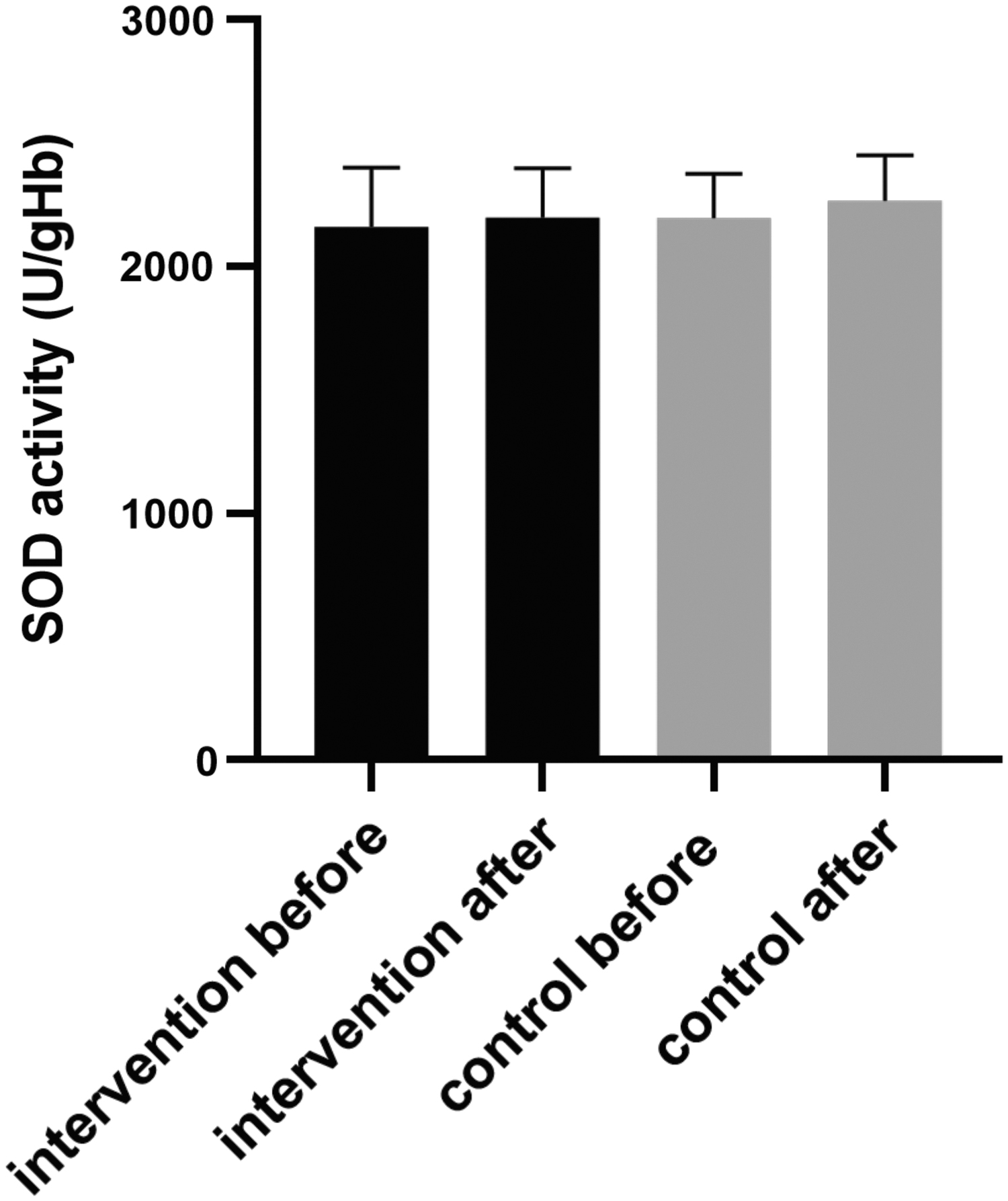
SOD activity in erythrocytes in the intervention and control group at baseline and after the intervention. Results are expressed as the mean ± SD. Statistical analysis was carried out using a paired t-test. SOD, superoxide dismutase.
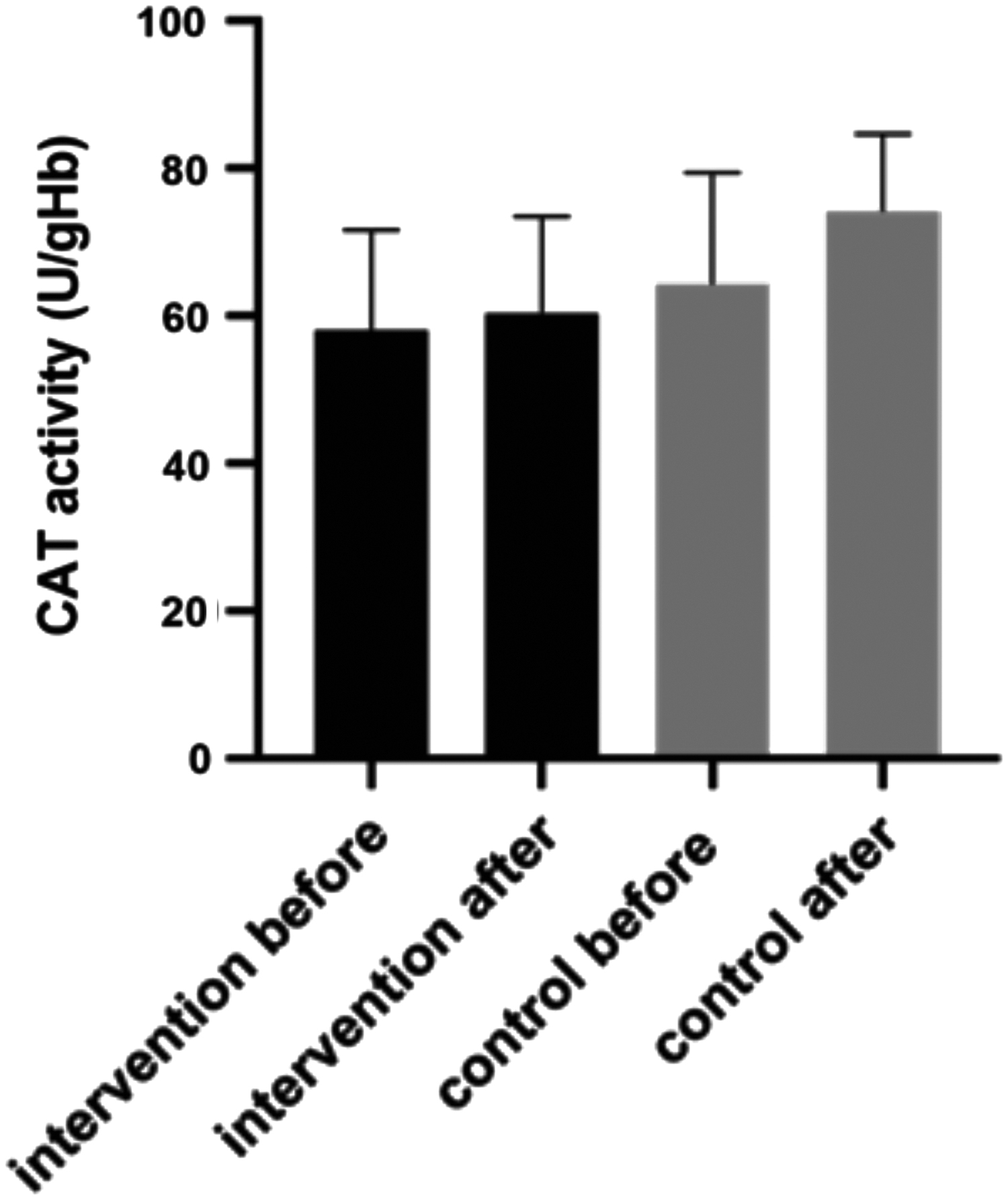
CAT activity in erythrocytes in intervention and control group at baseline and after the study period. Statistical analysis was carried out using a paired t-test.

GPx activity in erythrocytes in intervention and control group at baseline and after the study period. Statistical analysis was carried out using a paired t-test. *P < .05. GPx, glutathione peroxidase.

Level of MDA in erythrocytes in intervention and control group at baseline and after the study period. Statistical analysis was carried out by using a paired t-test.
Discussion
In this study, we investigated whether a short-term (2 weeks) PJ consumption may influence blood pressure and anthropometric, hematologic, and lipids parameters, as well as plasma and erythrocyte FA profile and activity of antioxidative enzymes in erythrocytes, in subjects with ODL. Anthropometric characteristics and systolic blood pressure values did not change significantly in either of the test groups at the beginning and the end of the study. However, diastolic blood pressure values were significantly decreased in the intervention group after a 2-week supplementation with PJ. Similarly, several trials also indicated blood pressure-lowering effects of PJ consumption in subjects at high CVD risk, 29 and in healthy adults as well. 30
In addition, although several studies have shown that blood pressure in people at high risk of CVD 31 and in those with metabolic syndrome, 18 as well as in healthy subjects, 29 lowers after consuming PJ, in our study, there was no such effect. Similar to our results, Basu et al. 32 did not show an effect of pomegranate on blood pressure in patients with type 2 diabetes. The mechanism by which some polyphenols, such as resveratrol and quercetin, can cause vasodilation and normalize blood pressure is based on neutralizing superoxide anion radicals from the circulation, thus increasing the bioavailability of one of the most potent vasodilators, nitric oxide. 33 In addition, some polyphenols may induce endothelial nitric oxide synthase, gene expression, thus having an upregulatory effect on NO levels. 34 What effect PJ will have on blood pressure probably depends on the amount of juice consumed and the content and nature of phenolic compounds in it, as well as the diagnosis of the persons being examined. 12
Among other biochemical parameters, we have detected a decrease in AST values in the intervention group after the 2 weeks. ALT and AST are the common liver enzymes of liver function tests and well-known markers of liver damage. 35 High ALT and AST serum levels are characteristic of non-alcoholic fatty liver disease and are associated with insulin resistance. Also, increased ALT and AST serum levels were found in mice fed a high-fat and high-cholesterol diet. 36,37 However, our patients had both ALT and AST within the normal ranges, and the significance of the decrease in AST level is still unclear, although it might suggest an improved liver function.
Furthermore, the analysis of biochemical parameters has shown a significant decrease in LDL concentration at the end of the intervention period. There is an inconsistency in the literature concerning the effect of PJ on lipid concentration and profile. A meta-analysis of 12 randomized studies 30 indicated that consumption of PJ did not affect the lipid profile in either healthy volunteers or moderately ODL and high blood pressure. However, this systematic review included consumption of PJ, seed oil, and pomegranate extract, the study period lasted from 2 weeks to 2 months and the amount of PJ ranged from 100 mL to 500 mL, and all these differences could influence the results of this meta-analysis.
On the other hand, several studies have shown that after a 6-week consumption of 200 mL of PJ and an 8-week consumption of 40 g of PJ concentrate, there was a significant decrease in LDL and total CHOL concentration 38,39 in hyperlipidemic patients with type 2 diabetes. Furthermore, it has been noted that polyphenols from pomegranate, such as gallic acid, and other phytochemicals, such as punicic acid, reduced total CHOL, triacylglycerol, and LDL-cholesterol concentration in obese mice. 40,41 Elevated LDL-cholesterol is linked to and an increased risk of development of coronary heart disease, the leading cause of death worldwide. A decrease in LDL-cholesterol of 1 mM decreases the likelihood of any kind of cardiovascular event by 20% and mortality by 10%. 42 The decrease in our study was around 0.28 mM, but it should be taken into account a short duration of our study.
The mechanism of PJ action is still unclear, but it is assumed that peroxisome proliferator-activated receptors (PPARs), the fundamental modulators of lipid metabolism, are involved. 43 Namely, punicic and gallic acid from a pomegranate can bind to PPAR-α and activate it, consequently activating the expression of genes involved in lipid metabolism. 44 This involves genes that code apolipoprotein (APO) APOA1, APOA2 and APOA5 enzymes involved in FA oxidation (acyl-CoA dehydrogenase, carnitine palmitoyltransferase (CTP) CPT-I and CPT-II), enzymes involved in FA desaturation such as Δ6-desaturase, stearoyl-CoA desaturase (SCD-18, also known as Δ9–desaturase), as well as enzymes involved in the metabolism of ketone bodies mitochondrial 3-hydroxy-3-methylglutaryl-CoAsynthase (HMGCS). 45,46 Our results show that the estimated activity of Δ9 – desaturase (SCD-18) in plasma significantly increases at the end of the study, indicating that PJ consumed by our test subjects can lead to increased expression of this enzyme in individuals with ODL.
Decreased plasma DHA concentration at the end of the intervention period is most likely a consequence of decreased conversion from eicosapentaenoic acid (EPA, 20:5 n-3), which is also a precursor of anti-inflammatory eicosanoids, 46 suggesting possibly increased conversion into anti-inflammatory mediators, rather than into DHA, leading to lower inflammation. On the other hand, the percentage of DGLA (20:3 n-6) and DHA in erythrocytes was significantly higher in the intervention study at the end of the treatment period. Having in mind not only that erythrocytes are the first line of defense against the harmful effect of free radicals but also that the level of lipid peroxidation is higher in ODL individuals in comparison to healthy population, 47 increased concentration of long-chain FA can be due to the protective effect of PJ on erythrocyte membrane, that is, its ability to scavenge free radicals, decreasing the level of polyunsaturated fatty acid (PUFA) oxidation. Polyphenol-rich beverages, such as PJ, are well-known antioxidative agents. The highest antioxidant activity of PJ indicates the multifactorial and synergistic effects of the action of multiple polyphenols of pomegranate compared to single purified active ingredients. 48
Erythrocytes are particularly vulnerable to oxidative stress because of their constant exposure to ROS, which is generated from both internal and external sources even under normal physiological conditions. Thus, they have a high antioxidant defense system as a means to prevent oxidative damage, containing SOD, CAT, and GPx, as well as other antioxidants. 25 Analysis of antioxidative enzymes at the beginning and the end of the study indicated that the activity of GPx significantly decreased in the intervention group, while the rest of the enzymes remained unchanged. Other studies have shown that the activity of antioxidative enzymes (SOD and GPx) in diabetic rats decreased after 4 weeks of supplementation. 49 They also showed that during 4 weeks supplementation of diabetic rats with pomegranate seed oil, the activity of some antioxidative enzymes in mitochondria heart and kidney extract first increases, but later decreases. 49
Exact mechanism of antioxidative action of pomegranate polyphenols is not clear, but free OH groups of phenolics can act as electron donors to free radicals, which can lead to their stabilization halting the free radical chain reaction. 50,51 We did not measure the concentration of free radicals in circulation, but it can be assumed that polyphenols present in PJ can scavenge certain amounts of free radicals, leading to a decrease in GPx. However, in this study, the level of lipid peroxidation only slightly decreased in both groups. On the contrary, polyphenol-rich chokeberry juice decreased the level of lipid peroxidation in both healthy women and active athletes. 24,51
One of the main limitations of this study was a small number of participants, which may influence the definite conclusion of this study. In addition, the duration of the intervention is an important factor that influences changes in examined parameters in most published interventional studies with dietary polyphenols. Thus, future studies should be designed with longer intervention periods. In our previous study, which lasted 6 weeks, we confirmed that PJ consumption influences lipid metabolism in patients with metabolic syndrome. The primary goal of this study was to examine whether shorter consumption of PJ may have a similar effect, in overweight patients with dyslipidemia.
In summary, despite this limitation, our study has shown that beneficial effects of PJ can be noted even during short-term intervention period in individuals with ODL, leading to a decrease in diastolic blood pressure, LDL, AST, and GPx, while at the same time, increasing erythrocyte DHA and DGLA, and Δ6 desaturase and elongase activity. Although further studies with a larger number of subjects and longer consumption time are required, improvement in lipid metabolism and liver function shows a clear advantage of PJ consumption. Daily intake of natural antioxidants, such as those present in PJ, may improve health conditions and prove to be valuable in the management of ODL.
Footnotes
Author Disclosure Statement
No competing financial interests exist.
Funding Information
This work was supported by the Ministry of Education, Science and Technological Development of the Republic of Serbia contract 451-03-68/2020-14/200015.