




Abstract
Neoglaziovia variegata (Arruda) Mez (Bromeliaceae) is a medicinal plant popularly known as “caroá.” The leaves are made up of highly resistant fibers, which is of great commercial value to the handicraft and textile industry. Some studies have demonstrated that ethanolic extract of N. variegata have gastroprotective properties. This study aimed to investigate the gastroprotective activity and cytoprotective mechanisms of ethyl acetate (Nv-AcOEt), hexane (Nv-Hex), and chloroform (Nv-CHCl3) fractions of N. variegata leaves. The gastroprotective activity of Nv-AcOEt, Nv-Hex, and Nv-CHCl3 was evaluated using the ethanol and ethanol/HCl-induced gastric injury model. To elucidate the gastroprotective mechanisms, the functions of prostaglandins (PGs), nitric oxide (NO), and KATP channels were evaluated. In addition, the nonprotein sulfhydryl groups and the mucus content in the gastric tissues were analyzed. All fractions of N. variegata leaves at oral doses of 100, 200, and 400 mg/kg significantly decreased ethanol and ethanol/HCl-induced gastric lesions, leading to gastroprotection, accompanied by an increase in reduced glutathione (GSH) and gastric mucus. Gastroprotective activity of Nv-AcOEt was inhibited after pretreatment with ibuprofen and N(G)-nitro-L-arginine (L-NOARG). Gastroprotective effect of Nv-Hex and Nv-CHCl3 was also inhibited after pretreatment with L-NOARG and with glibenclamide. The results indicate that N. variegata (Arruda) Mez exhibits promising gastroprotective activity with the possible participation of NO, PGs, mucus, sulfhydryl groups, and KATP.
Introduction
Gastric injury generates lesions that are difficult to heal, given that these lesion causes inflammation, irritation, and gastric mucosal cell loss. 1,2 The pathogenesis of the gastric lesion is complex and multifactorial, although Helicobacter pylori infection and the use of nonsteroidal anti-inflammatory drugs (NSAIDs) are predominant factors in the development of the lesion, other conditions such as alcoholism, smoking, and stress among others are also included 3,4
Currently, inhibitors or neutralizers of hydrochloric acid secretion are the drugs of choice for the treatment of gastric injury. However, despite the clinical efficacy of these drugs, the recurrence of gastric lesions after withdrawal from pharmacological treatment has been an important factor that has drawn the attention of researchers involved in this area. 5,6 Therefore, the search for more specific and effective new drugs is necessary to treat gastric ulcers and extracts from plants are potential therapeutic sources. 7
Therefore, the need for more effective and safer antiulcer agents is markedly evident. Hence, efforts are made toward the discovery of suitable treatments from natural product isolated from various sources especially derived from plants. 8 Both clinical and experimental studies have demonstrated that herbal medicines are effective in treating gastric ulcer with fewer adverse effects and lower recurrence rates. 9 Neoglaziovia variegata (Arruda) Mez is an endemic species from the Bromeliaceae family of Brazil, popularly known as “caroá” and widely distributed in the savanna region throughout the semiarid of northeastern Brazil and the southeastern region (Minas Gerais). Nowadays, the fibers of caroá plant constitute a source of employment to many and serve as a source of income to several northeastern families; they are used to produce handmade hats, purses, and other items. It is also a source of human and cattle feeding. 10
A preliminary study of the ethanolic extract of N. variegata (Nv-EtOH) conducted by our research group, revealed the gastroprotective action on different gastric ulcer models in rodents. Nv-EtOH (400 mg/kg) promoted a protective effect against gastric ulcers induced by absolute ethanol, HCl/ethanol, ischemia-reperfusion, ibuprofen, and acetic acid, as well as an increase in catalase (CAT) and glutathione activity, opening of KATP channels, and increase levels of nitric oxide (NO) and mucus. 11 Interestingly, the research shows that Nv-EtOH demonstrated antimicrobial, antinociceptive, antioxidant, anthelmintic and acaricidal activities. Besides, the phytochemical study of this plant indicated the presence of cinnamic acid, coumarin, flavonoid derivatives, and quercetin in Nv-EtOH. 12 –15 The acute toxicity of Nv-EtOH was performed at 2.0 g/kg intraperitoneally and 5.0 g/kg orally in mice. The results obtained showed that Nv-EtOH can be considered to be of low toxicity. 16
Hence, considering the importance of different chemical constituents responsible for the therapeutic effects promoted by the fractions of the vegetable extracts, this study proposes to assess the gastroprotective activity induced by the ethyl acetate (Nv-AcOEt), hexane (Nv-Hex), and chloroform (Nv-CHCl3) fractions obtained by the partition of the crude ethanolic extract of the leaves of N. variegata, as well as the possible participation of reduced glutathione, mucosa, NO, and KATP channels in its cytoprotective mechanism.
Materials and Methods
Plant and preparation of fraction
The leaves of N. variegata (Arruda) Mez were collected in the city of Petrolina (co-ordinates: S 08°59′16″; W 40°35′20″), State of Pernambuco, Brazil, in January 2011. The samples were identified by a botanist, and the voucher specimen was deposited at the Herbarium of San Francisco Valley (HVASF), at the Federal University of San Francisco Valley, with the code 6441. The dried and powdered flowers (1174 g) were repeatedly submitted to extraction three times during 72 h with 95% EtOH at room temperature. The extractive solution was concentrated under vacuum yielding after the distillation of the solvent, 44 g of crude ethanol extract (Nv-EtOH). Nv-EtOH was suspended in a mixture of H2O:MeOH (7:3) and extracted successively with hexane, chloroform (CHCl3), and ethyl acetate (AcOEt) in ascending order of polarity to obtain the respective fractions, which yielded 8, 4, and 7 g, respectively.
Animals
Female Swiss mice (25–30 g) and Wistar rats (180–220 g) (n = 6–8 animals/group) were kept under controlled conditions (24°C ± 1°C, 12-h dark/light cycle), with food and water ad libitum. The animals fasted for 18 h and were provided an adequate acclimation period to allow them to stabilize to the test environment for 2 h before each experiment. This study was carried out at the Federal University of Piauí (UFPI) and the experimental protocols were approved by the Ethics Committee for Animal Research (protocol number 008/12).
Absolute ethanol and HCl/ethanol-induced gastric ulcer
Mice were treated with vehicle (saline, 0.9% NaCl w/v), Nv-AcOEt (50–400 mg/kg), Nv-Hex (25–400 mg/kg), Nv-CHCl3 (25–400 mg/kg), or carbenoxolone (100 mg/kg po), orally. After 1 h, these animals were treated with the ulcerogenic agents, absolute ethanol, or HCl/ethanol solution (0.2 mL/animal). The animals were euthanized either 30 min after ethanol administration or 1 h after the ethanol/HCl administration, respectively, and the stomachs were removed and opened along the greater curvature to determine the lesion area using planimetry (mm2) using ImageJ (NIH, Bethesda, MD). 17,18
Ibuprofen-induced gastric ulcer in mice
Mice received orally vehicle (saline, 0.9% NaCl w/v), Nv-AcOEt (100, 200, and 400 mg/kg, po), Nv-Hex, Nv-CHCl3 (200 and 400 mg/kg, po), or cimetidine (100 mg/kg, po). One hour later, all groups were treated with ibuprofen (400 mg/kg, po). Six hours after that, the animals were euthanized, and the stomachs were removed and opened along the greater curvature. The area of gastric lesions was then measured using planimetry (mm2). 19
Ischemia and reperfusion-induced gastric ulcer
Mice pretreated orally (po) with vehicle (saline, 0.9% NaCl w/v), N-acetylcysteine (NAC, 200 mg/kg), Nv-AcOEt (25, 50, 100, and 200 mg/kg), or Nv-Hex, Nv-CHCl3 (50, 100, 200, and 400 mg/kg). After 30 min, animals were anesthetized (sodium thiopental, 17 mM, ip) and subjected for 30 min to ischemia induced by celiac artery occlusion (microvascular clamp) followed by reperfusion for 1 h. 20 Thereby, animals were euthanized, and stomachs were excised and analyzed for gastric damage.
Quantification of reduced glutathione
The animals were sacrificed and the stomachs that were submitted to ischemia and reperfusion (I/R) were excised, and 10% (w/v) stomach homogenates was prepared with 0.1 M sodium phosphate buffer (pH 7.4) for biochemical analysis. The gastric mucosal nonprotein sulfhydryls (NP-SHs, reduced glutathione [GSH] were determined in stomach tissue homogenates by Ellman's reaction using 5′5′—dithio-bis-2-nitrobenzoic acid (DTNB), according to the method described by Sedlak and Lindsay. The results on NP-SHs were expressed as lmol/mg of stomach tissue. 21
Assessment of gastric wall mucus
Glandular segments from mice stomachs submitted to pylorus ligature pretreated with vehicle, carbenoxolone (200 mg/kg, po) or Nv-AcOEt, Nv-Hex, and Nv-CHCl3 (100 mg/kg, po) were removed and weighed. Each segment was immediately transferred to Alcian Blue 0.25%. The free dye was removed by rinsing in sucrose solution 0.25 M. The gastric mucus bound dye was extracted with 0.5% magnesium chloride. A 4-mL sample of the blue extract was then vigorously stirred with an equal volume of diethyl ether. The quantity of Alcian Blue extracted per gram of glandular tissue was calculated. 22
Role of the NO, ATP-sensitive potassium channels (KATP channels) and PGs in the gastroprotective effect of Nv-AcOEt, Nv-Hex, and Nv-CHCl3
Mice were pretreated with vehicle (saline, 0.9% NaCl w/v, po), N(G)-nitro-L-arginine (L-NOARG) (70 mg/kg, ip), glibenclamide (5 mg/kg, ip), or ibuprofen (100 mg/kg, po). Vehicle, L-NOARG, or glibenclamide were administered 30 min before the administration of Nv-AcOEt, Nv-Hex, and Nv-CHCl3 (100 mg/kg, po), L-ARG (600 mg/kg, ip), or diazoxide (3 mg/kg, ip). Ibuprofen (100 mg/kg, po) was administered 1 h before the administration of vehicle, Nv-AcOEt, Nv-Hex, and Nv-CHCl3 (100 mg/kg, po), or misoprostol (50 μg/kg po). After 1 h of treatment, all animals received absolute ethanol (0.2 mL) to induce lesions. 23
Statistical analysis
The results are expressed as mean ± standard error of the mean. The statistical significance for differences between groups was calculated through the analysis of variance (ANOVA) and Tukey's post hoc test using the GraphPad Prism™ 5.0 software (San Diego, CA). The differences between groups were considered significant at P < .05.
Results
Effect of Nv-AcOEt, Nv-Hex, and Nv-CHCl3 on gastric ulcer induced by absolute ethanol or HCl/ethanol
In the model of gastric ulcer induced by ethanol, Nv-AcOEt (100–400 mg/kg, po), Nv-Hex, and Nv-CHCl3 (50–400 mg/kg, po) reduced significantly the lesioned area (3.56% ± 0.93%; 2.22% ± 0.62% and 1.02% ± 0.24%) (Fig. 1A), (5.643% ± 0.380%; 4.220% ± 0.464%; 3.160% ± 0.765% and 3.325% ± 0.384%) (Fig. 1B) and (5.433% ± 0.804%; 2.767% ± 0.804%; 1.783% ± 0.600% and 2.017% ± 0.294%) (Fig. 1C) when compared with the controls (9.13% ± 1.08%; 9.660% ± 0.908% and 9.780% ± 0.905%), respectively.

Effect of ethyl acetate (Nv-AcOEt), hexane (Nv-Hex), and chloroform (Nv-CHCl3) fractions leaves in the ethanol-induced gastric lesion model in mice.
Likewise, in the model of gastric ulcer induced by HCl/ethanol, Nv-AcOEt, Nv-Hex, and Nv-CHCl3 (100–400 mg/kg, po) reduced the percentage of gastric lesions (7.20% ± 0.93%; 3.55% ± 1.38% and 2.38% ± 0.83%) (Fig. 2A) (7.883% ± 1.197%; 6.440% ± 1.675% and 5.450% ± 1.198%) (Fig. 2B) and (3.486% ± 0.695%; 3.160% ± 0.431% and 2.750% ± 0.165%) (Fig. 2C) when compared with the control (14.72% ± 1.26%; 15.056% ± 0.983% and 14.067% ± 2.175%), respectively.
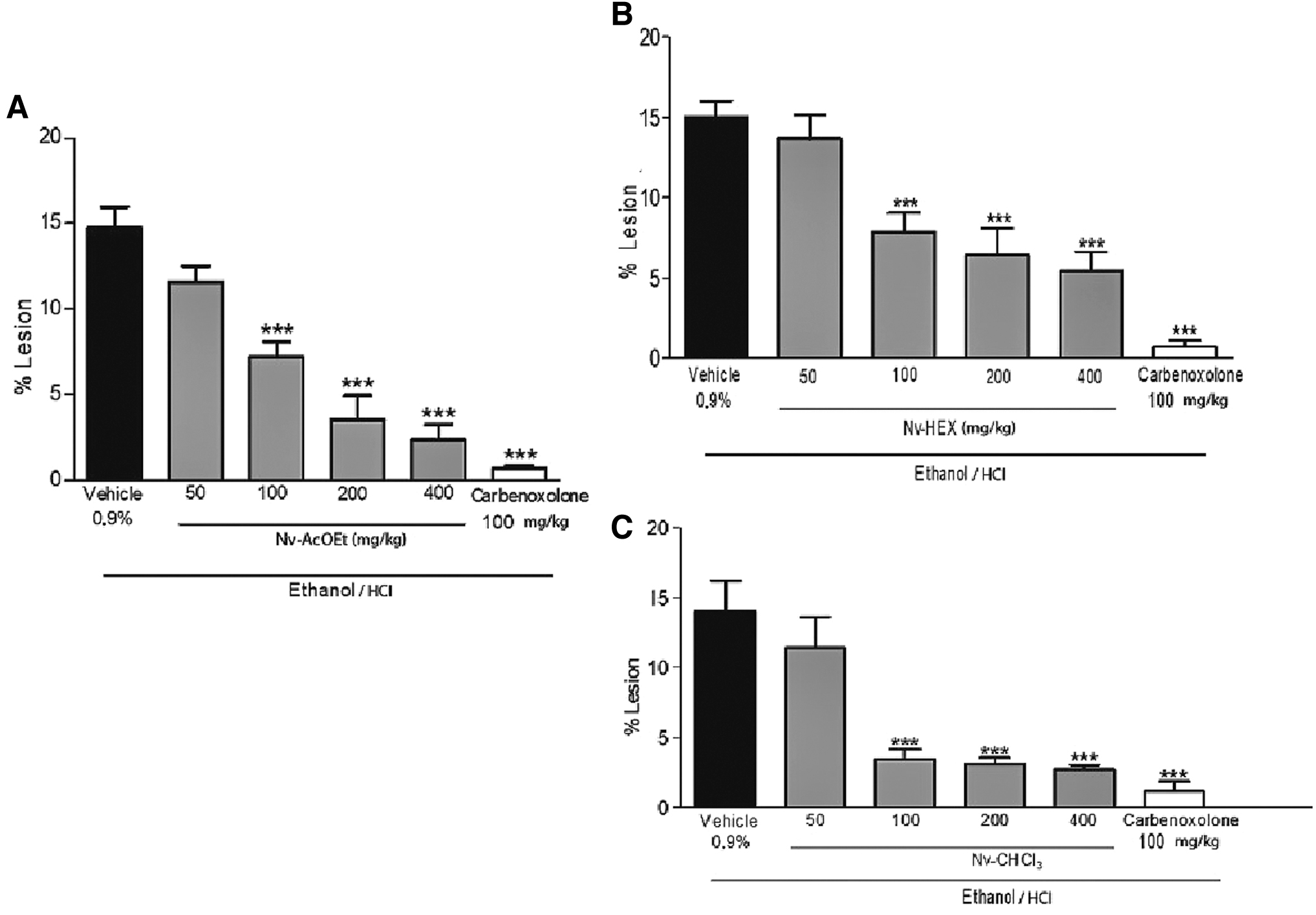
Effect of ethyl acetate (Nv-AcOEt), hexane (Nv-Hex), and chloroform (Nv-CHCl3) fractions leaves in the ethanol/HCl-induced gastric lesion model in mice.
Effect of Nv-AcOEt, Nv-Hex, and Nv-CHCl3 on the gastric ulcer induced by ibuprofen
In the model of gastric ulcer induced by ibuprofen, Nv-AcOEt (100–400 mg/kg, po) decreased the quantity of lesions induced by ibuprofen (400 mg/kg, po) (3.100% ± 0.613%; 2.700% ± 0.110% and 0.933% ± 0.123%) when compared with the vehicle (7.800% ± 0.555%) (Fig. 3A). Nv-Hex and Nv-CHCl3 were not capable of reducing the gastric damage caused by ibuprofen when compared with the vehicles (Fig. 3B, C), respectively.

Effect of ethyl acetate (Nv-AcOEt), hexane (Nv-Hex), and chloroform (Nv-CHCl3) fractions leaves in the ibuprofen-induced gastric lesion model in mice.
Effect of Nv-AcOEt, Nv-Hex, and Nv-CHCl3 on gastric ulcer induced by ischemia-reperfusion
The administration of Nv-AcOEt (100 and 200 mg/kg, po), Nv-Hex and Nv-CHCl3 (100, 200, and 400 mg/kg, po) reduced significantly the area of the gastric lesions (5.483% ± 1.441% and 3.409% ± 1.181%) (Fig. 4A), (4.640% ± 0.371%; 2.440% ± 0.631% and 2.120% ± 0.476%) (Fig. 4B) and (2.760% ± 1.013%; 2.640% ± 0.504% and 1.900% ± 0.548%) (Fig. 4C) when compared with the controls (14.337% ± 1.092%; 13.91% ± 1.35% and 12.2% ± 1.5%), respectively.

Effect of ethyl acetate (Nv-AcOEt), hexane (Nv-Hex), and chloroform (Nv-CHCl3) fractions leaves on gastric damage induced by ischemic-reperfusion in rats.
Participation of GSH in the gastroprotective effect of Nv-AcOEt, Nv-Hex, and Nv-CHCl3
The oral administration of Nv-AcOEt (100 mg/kg, po) did not prevent GSH degradation by the action of ethanol, as it can be seen from the decrease in the levels of GSH to 1411.5 ± 55.6 μg/g, compared with the control group (2065.3 ± 80.7 μg/g) (Fig. 5A). Both Nv-Hex and Nv-CHCl3 (100 mg/kg, po) prevented the GSH degradation by the action of ethanol, as it can be seen from the increase in the levels of GSH to 2025.535 ± 209.114 μg/g (Fig. 5B) and 1573.603 ± 108.989 μg/g (Fig. 5C), when compared with the control group (891.992 ± 16.984 μg/g), respectively.

Effect of ethyl acetate (Nv-AcOEt), hexane (Nv-Hex), and chloroform (Nv-CHCl3) fractions leaves, on the levels of GSH against ischemic/reperfusion-induced gastric damage in rats.
Effect of Nv-AcOEt, Nv-Hex, and Nv-CHCl3 on the gastric mucus content
Nv-AcOEt, at the dose of 100 mg/kg, caused a significant increase in the amount of mucus on the gastric wall (327.5 ± 23.4 μg/g) when compared with the control group (162.3 ± 4.01 μg/g) (Fig. 6A). Neither Nv-Hex nor Nv-CHCl3 caused alterations to the gastric mucus secretion when compared with the control group (Figs. 6B, C).

Effect of ethyl acetate (Nv-AcOEt), hexane (Nv-Hex), and chloroform (Nv-CHCl3) fractions leaves on gastric wall mucus produced in the stomach of mice.
Participation of PGs in the gastroprotective effect of Nv-AcOEt, Nv-Hex, and Nv-CHCl3
Nv-AcOEt (100 mg/kg, po) and misoprostol (50 μg/kg, po) significantly reduced the gastric lesions produced by the administration of absolute ethanol (5.92% ± 1.40% and 5.32% ± 0.37%, respectively) when compared with the control group (19.1% ± 2.25%). Pretreatment with ibuprofen (400 mg/kg, po) was able to partially revert the gastroprotection promoted by Nv-AcOEt and also by misoprostol (20.4% ± 3.22% and 15.6% ± 1.81%, respectively), when compared with the control group (40.2% ± 1.68%) (Fig. 7).

Effect of indomethacin pretreatment on ethyl acetate (Nv-AcOEt, 100 mg/kg po) fraction leaves induced gastroprotection on ethanol-induced gastric lesion in mice. Results are expressed as mean ± SEM (n = 6). ***P < .001, compared with the vehicle group and ### P < .01 compared with the (Nv-AcOEt) 100 mg/kg or misoprostol 50 μg/kg of control (vehicle 0.9%), respectively (ANOVA one way followed by Tukey's test).
Participation of the NO synthase in the gastroprotective effect of Nv-AcOEt, Nv-Hex, and Nv-CHCl3
The ethanol-induced gastric lesions in the control group were significantly reduced after pretreatment with Nv-AcOEt, Nv-Hex, and Nv-CHCl3 (100 mg/kg, po) and L-ARG (600 mg/kg, ip), when compared with the control group. Pretreatment with L-NOARG (70 mg/kg, ip) reverted the gastroprotection promoted by Nv-AcOEt, Nv-Hex, and Nv-CHCl3 (100 mg/kg, po) (1.89% ± 0.25% to 15.91% ± 3.03%), (3.520% ± 0.328% to 23.867% ± 3.161%) and (2.514% ± 0.725% to 11.714% ± 2.779%) (Fig. 8).
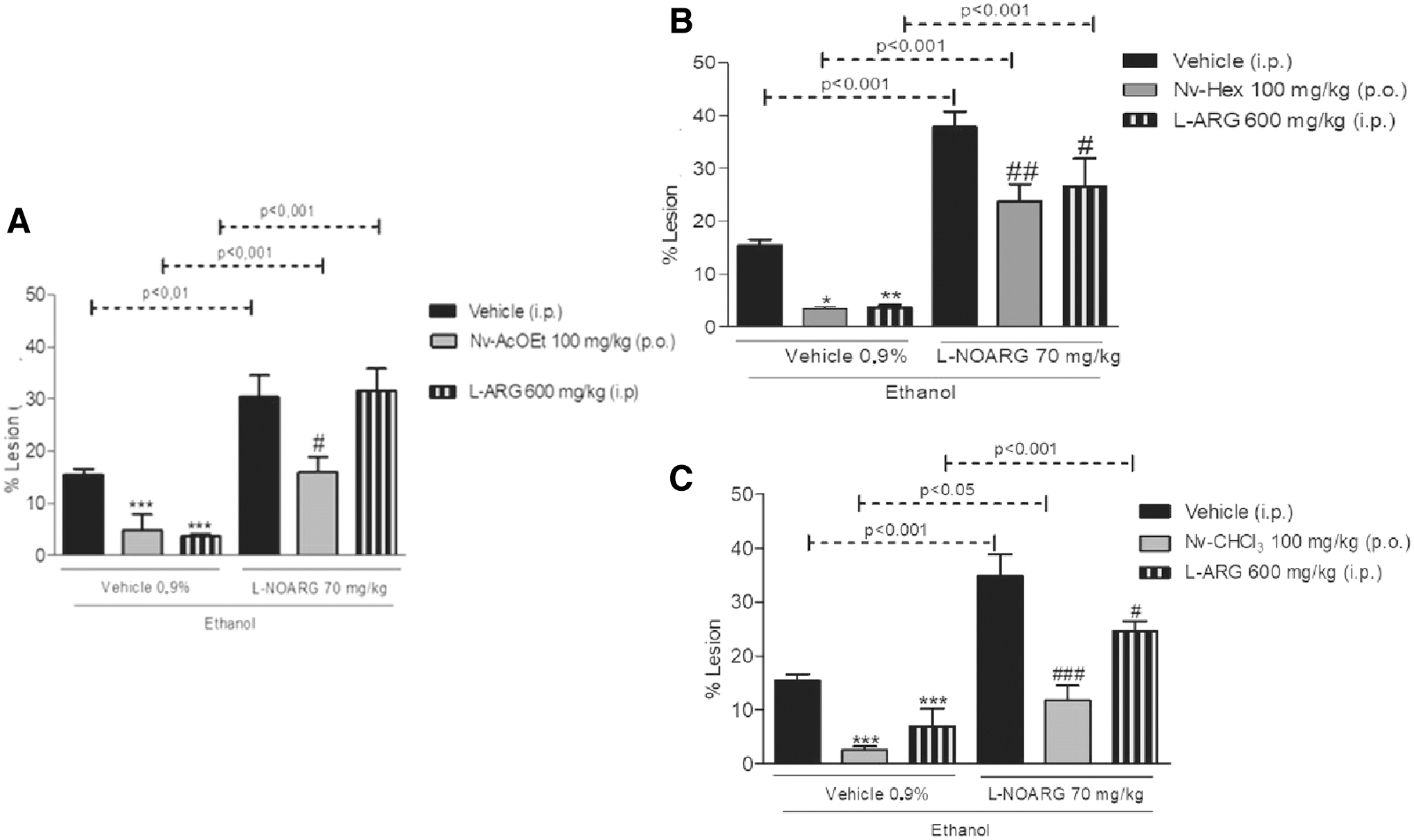
Involvement of NO in the gastroprotective effect of
Participation of the KATP channels in the gastroprotective effect of Nv-AcOEt, Nv-Hex, and Nv-CHCl3
The animals pretreated with the vehicle followed by Nv-AcOEt, Nv-Hex, and Nv-CHCl3 (100 mg/kg, po) or diazoxide (3 mg/kg, ip) presented a significant reduction in the gastric lesion area, when compared with the control group. In the groups treated with glibenclamide (5 mg/kg, ip), a KATP channel blocker, the protective effect of Nv-AcOEt was not altered (Fig. 9A). However, the gastroprotective effect induced by Nv-Hex and Nv-CHCl3 was partially reverted (1.25% ± 0.19% to 8.84% ± 1.22% and 0.96% ± 0.14% to 11.69% ± 0.90%), respectively (Fig. 9B, C).

Role of KATP channels in the gastroprotective effect of
Discussion
This study shows that the oral administration of ethyl acetate (Nv-AcOEt), hexane (Nv-Hex), and chloroform (Nv-CHCl3) fractions, extracted of crude ethanol extract (Nv-EtOH) of N. variegata leaves, exerts protective effects against damages to the gastric mucous membrane. A published study showed that high-performance liquid chromatography (HPLC) analysis of Nv-EtOH indicated the presence of cinnamic acid, coumarin, and flavonoid isoquercetin. 13 A phytochemical screening of Nv-AcOEt, Nv-Hex, and Nv-CHCl3 fractions obtained by the partition of the crude ethanolic extract from the flowers of N. variegata, revealed the presence of flavonoids, tannins, and diterpenes. 12 One of the most studied chemical constituents are flavonoids. 24 It protects the gastrointestinal mucosa from acute lesions induced by various experimental models and against different necrotic agents, including restraint stress, pylorus-ligation, indomethacin, acid-ethanol (EtOH/HCl), and ethanol-induced gastric ulcers. 25 In this study, the animals used in the experimental models were female rats, because a recent article evaluated specifically the sex differences in the gastrointestinal tract of rats and its implication on oral drug delivery, it also showed that gastrointestinal fluid, pH, buffer capacity, surface tension, and osmolality were found to be similar in the both sexes. 26
Gastric injury caused by EtOH/HCl is a widely used gastritis model, because the lesions produced are similar to those of gastritis in humans, the EtOH directly stimulates the gastric mucosa to remove free antioxidants, thereby increasing free radicals, lipid peroxidation, and PG, further exacerbating acute gastrites. 27,28 The results achieved in the models of gastric lesions induced by ethanol and ethanol/HCl was significantly reduced by Nv-AcOEt, Nv-Hex, and Nv-CHCl3 fractions, which significantly reduced the lesioned area in both models, demonstrating a gastroprotective effect over the mucous membrane possibly related to the cytoprotective and/or antioxidant factors, given that these lesion-induced models are associated with the processes of lipid peroxidation, oxidative stress, production of hemorrhagic lesions, as well as edema, mucosal destruction, and inflammatory cell infiltration. 29
Gastric ulcer is associated with diffuse gastritis. The gastric ulcers caused by NSAIDs involve gastric mucosal cell damage due to the increase of mucosal permeability of active radicals, the inhibition of cyclooxygenases 1 and 2, causing a decrease in the production of PGs. 30,31 Pretreatment with Nv-AcOEt in the animals subjected to the acute induction model with ibuprofen showed again a decrease in the lesion index with the doses tested. Phytochemical study revealed the presence of p-coumaric and protocatechuic acids in ethyl acetate extracts of N. variegata leaves. 24 Interestingly, a study showed that the p-coumaric acid may be considered a natural remedy for the treatment of gastric ulcers, by stimulating protective factors of gastric mucosa (PG E2 levels increased) and by accelerating gastric healing. 32
PGs are one of the main groups of chemical mediators of the body and are involved in a number of physiological processes, such maintenance of mucosal integrity by stimulating mucus secretion and cell differentiation. 33,34 The results obtained in the model of gastric lesion induced by ethanol in mice pretreated with ibuprofen corroborate the results obtained in the model of gastric ulcer induced by ibuprofen and suggest a possible involvement of PGs in the gastroprotective effect of Nv-AcOEt.
Gastric mucus forms the first protective physical, chemical, and immunological barrier of the mucosa, consisting of mucin-like glycoproteins. 35 Nv-AcOEt increased the secretion of gastric mucus. This finding certifies the involvement of PGs in the gastroprotective effect of Nv-AcOEt, because studies showed that PGE2 promotes mucus secretion in rabbit gastric epithelial cells, mediated through EP4 receptor stimulation and the subsequent activation of protein kinaseA. 36 It could be one of the potential mechanisms of the gastroprotective effect elicited by Nv-AcOEt.
Previous studies have demonstrated that the exposure to I/R led to production of reactive oxygen species (ROS) from xanthine-xanthine oxidase system and also led to an increase in tissue lipid peroxidation due to activated neutrophils, microvascular dysfunction, resulting in gastric mucosal hemorrhagic lesions. 37 Study carried out by our research group demonstrated gastroprotective activity of the ethanolic extract of N. variegata leaves (200 and 400 mg/kg) in a model of gastric injury induced by I/R. 11 From the results obtained in this study, all fractions (Nv-AcOEt, Nv-Hex, and Nv-CHCl3) also showed a gastroprotective effect at the lowest doses of 100 mg/kg, in the model of gastric injury induced by I/R. Thus, our results suggested that the gastroprotective effect may be due to the presence of chemical constituents in the extract and fractions of N. variegate with potential antioxidant activities.
The oxidative stress occurs when the balance between the pro-oxidants and the antioxidants is interrupted in favor of the pro-oxidants. The plant-derived natural antioxidants are extremely useful to combat oxidative stress, and antioxidant enzymes such as superoxide dismutase (SOD), CAT and GSH, in a preventive way, act as the first line of defense against the ROS. 38 The GSH is a tripeptide actively present in the cells. In its reduced form (GSH), its main function is to remove free radicals, a process that acts as protection against oxidant and xenobiotics. 39 Nv-Hex and Nv-CHCl3 promoted a significant increase in the GSH levels, suggesting that the gastroprotective effect offered by the fractions of N. variegate is dependent on the sulfhydryl compounds. The flavonoids found in the alcoholic extract of N. variegate have a strong antioxidant power, and are excellent free radical sequestrants, which could be a possible justification for this result. 24,25
Another relevant component of epithelial protection is NO, a ubiquitous molecule generated by NO synthase (NOS). In model of ethanol-induced gastric lesion the low levels of NO could also be due to the consumption of NO in the free radical reactions, resulting in overproduction of peroxynitrites (ONOO−) during ethanol metabolism. 40 The gastroprotective activity of Nv-AcOEt, Nv-Hex, and Nv-CHCl3 was inhibited after the administration of L-NOARG, a nonspecific inhibitor of the NOS enzyme that improves the ethanol-induced gastric lesions. This suggests a probable participation of the NO-synthase pathway in protection of gastric mucosa against damage induced by noxious agent such as ethanol.
This finding is in accordance with study of other plants of the Bromeliaceae family, such as Encholirium spectabile. The results of the experiment with the NOS inhibitor (LNOARG) demonstrated that the gastroprotective effect of ethanolic extract of E. spectabile was reversed by the prior administration of the inhibitor, suggesting that the activity of extract depends on the NOS pathway. 41
Recent studies have suggested the participation of the KATP channels in models of gastric lesions induced by ethanol and by indomethacin, where the PGs were shown as possible activators of these channels. 42,43 Glibenclamide, significantly antagonized the protective effect of Nv-Hex, Nv-CHCl3, and diazoxide. These results support the hypothesis that the K+ ATP channel opening is involved in the gastroprotective activity of Nv-Hex, Nv-CHCl3 fractions, with a subsequent increase in the gastric blood flow, thus preventing the formation of ulcers.
In conclusion, these results suggest that N. variegate (Arruda) Mez possesses significant gastroprotective properties against noxious agents that induce gastric mucosal lesions in rodents. The gastroprotective mechanism of fractions of N. variegate is multifactorial and possibly involves the participation of NO, PGs, mucus, sulfhydryl groups, and KATP. The activity of N. variegata displayed in this study suggests that it may be utilized as a promising therapeutic option for the treatment of gastric ulcers and inflammation due to its cytoprotective and antioxidant capacity.
Footnotes
Author Disclosure Statement
No competing financial interests exist.
Funding Information
This study was supported by UFPI, UNIVASF (Federal University of the São Francisco Valley), and CAPES (Coordenação de Aperfeiçoamento de Pessoal de Nível Superior, Brazil).