




Abstract
This study aimed to evaluate the influence of the carob powder (CP) and sweet whey powder (WhP) inclusion into weaning feed on the gut morphology, hemato-biochemical parameters, and antioxidant biomarkers. The addition of 10 g/kg (basal diet +10 g/kg of CP, of WhP) or the mixture (5 g/kg of CP and 5 g/kg of WhP) in the rabbit's standard diet was assessed. A total of 40 weaned New Zealand White rabbits (4 weeks old) was distributed according to body weight (BW) into four treatments (n = 10) and the feed additives were provided for 7 weeks. Tissue samples and blood were obtained after slaughter. Final BW, daily weight gain, feed conversion ratio, intestinal morphology, and carcass dressing were positively affected by CP–WhP treatments compared with the control diet. Also, CP–WhP treatments significantly increased total proteins, calcium and iron levels, fecal cholesterol excretion, total antioxidants capacity, superoxide dismutase, and catalase in different tissues and significantly decreased total cholesterol, triglycerides, and glucose in blood serum. These changes were associated with a diminution of blood tumor necrosis factor alpha, lipid peroxidation, and carbonyl proteins in rabbit tissues. Both the additives separately and especially in the mix may enhance productive performance, protein profile, gut function, immunity, and antioxidant activity, with reducing lipid peroxidation, essential inflammatory mediator, and protein-carbonyl residues of growing rabbits. These findings suggest that CP–WhP dietary supplementation provides novel insights into a variety of bioactive compound mixtures with different beneficial modes of actions.
Introduction
The gut is an obvious target for the development of functional foods. These have demonstrated gastrointestinal physiological/functional benefits and can reduce the risk of chronic disease beyond basic nutritional functions, including maintenance of gut health, 1 developing mucosal immune systems, 2 and improving probiotic bacteria. 3
For many years, whey was considered a bulky waste, a by-product of cheese factories and caseineries, whose use was limited to animal feed and fertilization of fields. 4 However, it is an interesting product because of its protein content rich in essential amino acids (lysine and tryptophan), in lactose, and by the presence of numerous vitamins such as thiamine and riboflavin. With its richness in nutrients such as lactose, soluble proteins, water-soluble vitamins, mineral elements and fat, whey is an excellent culture medium for microorganisms. 5 As a result, the whey-processing industry has developed considerably in recent decades. 6 This development has for economic reasons on the one hand that is to say the industrial dairy wanting the enhancement of this coproduct and for ecological reasons. The stimulation of this development is linked, on the one hand, to the enormous potential for pollution caused by this product and to the fact that the majority of its dry matter is composed of element with high nutritional value. 7 Previous research findings have shown that the incorporation of whey, with a potent prebiotic action, may improve growth performance and enhance the growth of the intestinal mucosa layer and cecal microflora community of broilers as well as stimulate short-chain fatty acid production, which could improve intestinal disorders. 8,9
The carob tree (Ceratonia siliqua L.) grows naturally throughout the Mediterranean region and produces fruit in pod form containing between 8 and 16 beans. It is very rich in sugars (40–60%) in particular, sucrose (27–40%), fructose (3–8%), and glucose (3–5%) but low in fat (0.4–0.6%) and 3–4% protein. In addition, the pulp also has very high fiber content (27–50%). 10,11 Equally importantly, the carob powder (CP) is composed of antioxidant compounds (tannins, flavonoids, phenolic acids), and mineral compounds (K, Ca, Mg, Na, Cu, Fe, Mn, Zn). Today, it is mainly used for the production of locust bean gum (food additive E-410). In addition, the carob pulp, seeds, and gum are traded in large quantities to Europe and are widely used in the food industry. 12 Previous studies investigated the use of carob in animal diets, however, few findings were conducted on the use of carob pods in rabbit feed. In this context, it has been shown that the inclusion of carob pods at 50 g/kg enhanced antioxidant activity and induced positive action on growth performance, carcass characteristics, and meat quality and reduced the internal pathogens. 13
Due to the aforementioned attributes of carob pods and sweet whey and their possible incorporation as an energy supplement in rabbit feed formulation, it is possible that they will beneficially alter gut morphology and function, improve feed intake (FI) and efficiency, and enhance performance characteristics, blood biomarkers, and antioxidant capacity in rabbits. Therefore, the objective of the current study was to evaluate the effect of carob pods and sweet whey powder (WhP) inclusion to the diet on the growth performance, gut morphology, biochemical and hematological parameters, and antioxidant properties in growing rabbits.
Materials and Methods
Chemicals and reagents
Chloroform, methanol, ethylenediaminetetraacetic acid (EDTA), sodium chloride, phosphate-buffered saline (PBS), Hematoxylin, Eosin, trichloroacetic acid (TCA), Enzyme-Linked Immunosorbent Assay (ELISA) Kits, 2,2-diphenyl-1- picrylhydrazyl (DPPH), hydrochloric acid (HCl), butylated hydroxytoluene (BHT), 2-thio-barbituric (TBA), 5,5′-dithiobis-(2-nitrobenzoic acid), 2,4-dinitrophenylhydrazine (DNPH), potassium phosphate (KHPO), trifluoroacetic acid (TFA), epinephrine, bovine catalase, tris, Coomassie Blue G-250 were procured from Sigma Chemicals Co (Sigma-Aldrich GmbH, Steinheim, Germany). Triglycerides (TG), total cholesterol (TC), glucose, high-density lipoprotein-cholesterol (HDL-C), calcium, and Iron Assay Kits and the rabbit ELISA Kits used in this study were purchased from the manufacturer, Biomaghreb (Tunis, Tunisia). All other chemicals used were of analytical grade.
CP and sweet WhP
The mature carob pods were collected from the region of Tabarka (North-West of Tunisia) during October 2018. Briefly, the plant material was later dried in an incubator at 50°C during 72 h and powdered in an electric blender (Moulinex Ovatio 2, FR). Sweet whey prepared from cow's milk and the liquid fraction obtained during the coagulation of milk and collected by dairy companies. The whey was pasteurized at 73°C for 15 sec, cooled, lyophilized, and stored in a nonhumid place until use.
Experimental design
The experiments were performed on New Zealand White male rabbit research unit after weaning. They are weaned at the age of 28 days of average weight (863.318 ± 116.06 g) and sacrificed at the age of 85 days. Animals were provided by the Hakim South Jendouba Agricultural Training Center (Jendouba, Tunisia), placed in cages (10/cage) and maintained under the standard conditions of the animal house (22 ± 2°C; 12-h dark/12-h light cycle). The animal protocols used in this study were approved by the committee for animal welfare at Jendouba University (JU2016-004) and were conducted in accordance with the Guide for the Care and Use of Laboratory Animals. 14
A total of 40 rabbits were divided into 4 groups of 10 young rabbits by group. The first group of rabbits received a normal diet. The second group is treated with 10 g/kg carob mixed with the normal diet. The other batch received 10 g/kg of WhP associated with the standard diet and the last batch received the mixture (5 g/kg CP and 5 g/kg WhP) and consumed in combination with standard diet. This experimentation was performed for 2 months.
Growth performance and carcass characteristics assessment
The animals were weighed at the beginning of the treatment and throughout our experiment using a Wei Heng digital scale. FI was recorded weekly during the same period. The body weight (BW) gain (BWG) was determined as Wt2 (g) − Wt1 (g), where Wt1 is the first live weight and Wt2 is the final live weight. The feed conversion ratio (FCR) was approximated as the quantity of feed consumed (g)/BWG (g). The carcass yields were measured and expressed as the dressing percentage:
Dressed carcass weight/live weight × 100.
Slaughtering of rabbits, sampling blood, and supernatant preparation
Rabbits were fasted for 12 h with free access to clean drinking water and slaughtered. Slaughtering and dissection were carried out according to World Rabbit Science Association recommendations. 15 Blood cell counts and plasma biochemical indicators were determined in the collected blood in EDTA and heparinized tubes. Also, the rabbit organs (liver, heart, kidney, and muscle) were weighed and homogenized in the PBS solution using a mixer (Ultra-Turax). The mixture was centrifuged 9000 × g at a temperature of 4°C for 20 min and the supernatant was collected in Eppendorfs and stored at −20°C until used in assays.
Intestinal morphological measurements
The small intestine of each group was cleaved into three segments (duodenum, jejunum, and ileum). Three sections of ∼5 cm were excised from each intestinal segment and fixed at 10% formalin in PBS, at 4°C for histomorphological analysis. The formalin-fixed samples were first dehydrated in a graded series of ethanol. These light microscopic observations were followed by the samples being embedded in paraffin wax. Then, the tissues were sectioned at 5 μm thickness and mounted in slides. After dewaxing, hydrating, and staining the tissues with Hematoxylin/Eosin, the thickness of muscle and mucous membrane, the width and depth of the crypts, and the height and width of villi of the gut tissues were determined by light microscopy (YJ-2016T-LCD; Yujie Microscope) and captured with a Nikon DS-Fi1 digital camera connected to a computer with Analysis-Opti Basic and soft imaging system software. Then, the villus height/crypt depth ratio was calculated. 16
Lipid profile and cholesterol excretion in fecal matter
To analyze lipid accumulation in plasma following rabbit's consumption of whey and CP separately or in combination, we estimated lipid indicators (TG and TC), which were measured using commercially available kits from the manufacturer, Biomaghreb, Tunisia. Fecal matter was collected during the last 3 consecutive days. Then, it is dried for 1 h at 60°C and milled in an electric mixer. The obtained powder was mixed with chloroform and methanol (2:1), and the fecal cholesterol content was measured by commercial enzymatic test kits according to the manufacturer's instructions (Biomaghreb).
Plasma proteins, glucose, and mineral levels
This evaluation was performed by a colorimetric assay based on the Bradford method. 17 It is based on the change in absorbance (measured at 595 nm), which is manifested by the change in the color of Coomassie Blue G-250 after binding (complexification) with the basic amino acids (arginine, histidine, and lysine) and the hydrophobic residues of the amino acids present in the proteins. Albumin of bovine serum was used as a standard. Glucose level in plasma was determined by glucose oxidase/peroxidase method using a reagent kit according to the method of Barham and Trendoer. 18 In brief, to 10 μL of plasma, standard and distilled water (blank) in 3 test tubes, 1.0 mL of the enzyme was added, mixed, and kept at 37°C for 15 min. The developed color was read at 505 nm against reagent blank and data were indicated as mg of glucose/dL. The nonheme iron was measured using ferrozine as described by Leardi et al. 19 Calcium level was measured using a colorimetric method according to Stern and Lewis. 20
Tissue qualities
The deterioration of quality in meat products has been estimated by cellular-component oxidative changes such as polyunsaturated fatty acids and proteins leading to malondialdehyde (MDA) and protein carbonyl group production. In this context, tissue MDA contents were estimated using the double heating method. Briefly, tissue supernatants were mixed with BHT–TCA solution composed by 10 mg/mL BHT and 200 mg/mL TCA. The mixture was centrifuged at 1000 g for 5 min at 4°C. The supernatants obtained were blended with 0.5 N HCl and 120 mM TBA in 26 mM tris and then heated in laboratory water bath at 80°C for 10 min. After rapid cooling, optical density absorbance reading has been carried out by UV–vis spectrophotometer (Beckman DU 640B) at 532 nm. MDA levels were calculated using an extinction coefficient for the MDA–TBA complex of 1.56 × 10⁵ M−1 cm−1. 21 Protein carbonyl generation was measured according to Levine et al. 22 design. Two hundred microliters of tissue supernatants were mixed with 200 μL of 10 mM DNPH in 2 M HCl or with 0.5 mL 2 M HCl alone for the blank. Samples were incubated at room temperature for 1 h in the dark, and then treated with 10% TCA and centrifuged. The pellet was washed three times in ethanol/ethyl acetate and solubilized in 1 mL of 6 M guanidine in 20 mM KHPO, then adjusted to pH 2.3 with TFA. The mixture was incubated for 15 min at 37°C. The carbonyl protein level was determined from the difference in absorbance at 370 nm between DNPH-treated and HCl-treated samples. The carbonyl content data were expressed as μmol carbonyl residues/mg proteins.
The reaction was constituted by carbonate buffer (0.05 M, pH 10.2) and epinephrine (150 mM). Absorbances were read every 15 sec for 2 min at 480 nm. The results were expressed as units per milligram of protein (U/mg protein), where each unit represents the amount of enzyme that produces 50% inhibition of epinephrine oxidation. 23 To evaluate catalase (CAT) activity, the reaction was composed of hydrogen peroxide (H2O2). (300 mM) and phosphate buffer (50 mM, pH 7.0). Using a spectrophotometer, we measured absorbance readings every 10 sec for 2 min at 240 nm. The results are expressed as nmol/min/mg proteins. 24
Blood count, plasma scavenging activity, and cytokine levels
Hematologic study, which covers the total erythrocyte number (red blood cell [RBC]), hemoglobin (Hgb), hematocrit (HCT), mean cell volume (MCV), mean corpuscular Hgb (MCH), MCH concentration (MCHC), leukocyte (WBC), lymphocytes (LYM), monocytes (MON), granulocytes (GRA), total platelet count (PLT), mean platelet volume (MPV), plateletcrit (PCT), platelet distribution width by volume, was performed using an automatic hematologic Synchron CX5 Analyzer according to the manufacturer's protocol. 25
Free radical scavenging activity of plasma was measured using the DPPH radical method. 26 In this respect, 100 μL of plasma sample was added to 2 mL of DPPH in methanol solution (100 mM). After incubation at 37°C for 30 min, 1 mL of chloroform was added and the solution was centrifuged at 3000 g for 10 min. The absorbance of clear supernatant was then determined at 517 nm using spectrophotometer (Beckman DU 640B). DPPH solution was used as a control and the plasma scavenging activities, expressed in percentage. Plasmatic tumor necrosis factor alpha (TNF-α) levels were quantified by standard cytokine-specific rabbit ELISA Kits and expressed in picogram per milligram of proteins.
Statistical analyses
All results were presented as mean ± standard deviation. Data were analyzed using Microsoft Excel 2007 (Redmond, WA, USA). A one-way analysis of variance test was used to determine the significance between the different groups of all animals. Statistical analyses were calculated using StatView statistical software. The data are representative of 10 distinct observations. Differences were stated as mean ± standard error of the mean. In all the groups, differences were considered statistically significant among groups when P < .05.
Results
Growth performance, carcass characteristics, and gut morphological changes
This study shows that the overall actions of dietary treatments on the growth and production performance of growing rabbits (Table 1). The data clearly showed that rabbits fed diets enriched with CP and WhP in combination improved final BW (P = .026), BWG (P = .030), and FCR (P = .042) as compared with those fed separately the CP and WhP, as well as control diets. Carcass dressing percent was also greater (P = .041) with WhP/CP supplementation (53.71%) than CP rabbit-group (48.25%), WhP alone group (50.12%), and standard diet group (48.25%). Diet supplemented with carob alone did not cause significant difference (P > .05) in carcass dressing as compared with the control group. FI was not significantly different (P = .534) among any of the experimental groups. Also, the results showed a significant difference (P < .05) in rabbit organ weights (liver, heart, and kidney), mainly in the group treated with the WhP alone and that treated with combined WhP/CP. Moreover, CP and WhP supplementation into postweaning feeds improved the villi height (P = .012) and their ratio (P = .005) of both the first small intestinal segments. Besides, the morphological results revealed an increase in villus height (P = .048), crypt depth (P = .042), and the ratio (P = .002) of the ileum when compared with the basal diet treatment (Table 2).
Action of Carob Powder, Whey, or the Mixture on Rabbit's Production and Growth Performance, Carcass Characteristics, and Organ Weights
WhP/CP or mixture effects reflected by production and growth performance, carcass characteristics, and organ weights in control and treated rabbits. Data are expressed as mean ± standard error (n = 10).
Means within the same row carrying different superscripts are significantly different at P < .05.
BWG, body weight gain; Cd, crypt depth; CP, carob powder; FCR, feed conversion ratio; FI, feed intake; Vh, villi height; Vh/Cd, villus height to crypt depth ratio; WhP, whey powder.
Effect of Carob Powder, Whey, or the Mixture (CP+WhP) on Blood Biochemical Traits of Rabbits Fed Experimental Diets
WhP/CP or mixture effects reflected by blood biochemical in control and treated rabbits. Data are expressed as mean ± standard error (n = 10), a–dMean within the same row carrying different superscripts are significantly different at P < .05.
ALAT, aspartate aminotransferase; ASAT, alanine aminotransferase.
Action of WhP/CP supplementation on lipids and fecal cholesterol excretion
WhP supplementation caused a significant increase (P = .0001) in serum levels of TC (68.43 ± 8.16 mg/dL) (P = .0001) and TG (141.46 ± 10.26 mg/dL) (P = .001) in experimental rabbits compared with controls fed the standard diet (52.35 ± 7.13 and 120.14 ± 9.33 mg/dL, respectively). However, WhP/CP supplementation (5 g/kg of CP and 5 g/kg of WhP) showed a significant decrease in these indicators (Table 3). Added to that, CP (10 g/kg) induced a significant (P = .0002) fecal cholesterol elimination (14.24 ± 0.56 mg/g) compared with the WhP supplementation (07.22 ± 0.34 mg/g) and basal diet group (5.03 ± 0.26 mg/g) of rabbits. Correspondingly, CP supplementation with WhP produced an excessive excretion of cholesterol (23.43 ± 0.57 mg/g) in rabbit's feces (Table 2).
Effect of Carob Powder, Whey, or the Mixture (CP+WhP) on Hematological Parameters, Plasmatic Scavenging Capacity, and Cytokine Levels of Rabbits Fed Experimental Diets
WhP/CP or mixture effects reflected by blood biochemical in control and treated rabbits. Data are expressed as mean ± standard error (n = 10), a–dMean within the same row carrying different superscripts are significantly different at P < .05.
GRA, granulocytes; HCT, hematocrit; Hgb, hemoglobin; LYM, lymphocytes; MCH, mean corpuscular hemoglobin; MCHC, mean corpuscular hemoglobin concentration; MCV, mean cell volume; MPV, mean platelet volume; PCT, procalcitonin; PDI, platelet distribution index; P-LCR, platelet large cell ratio; PSA, plasma scavenging activity; RBC, red blood cells; TNF-α, tumor necrosis factor alpha.
Influence of CP, WhP, or CP + WhP on biochemical contents
Following the consumption of CP and WhP by rabbits in the diet, we noticed a remarkable increase (P = .045) of protein levels in plasma. This elevation is greater mainly in the group of rabbits treated with WhP alone or in combination with CP. Moreover, this study also noted an improvement in mineral contents by the registration of an increase in calcium (P = .049) and iron (P = .002) levels in the plasma, especially in groups of rabbits, which consumed a diet enriched with a mixture of CP and WhP. Equally important, WhP supplementation induced a significant (P = .017) enhancement of blood glucose level (147.34 ± 8.72 mg/dL) in comparison with CP (127.67 ± 5.42 mg/dL) and control group (124.43 ± 6.47 mg/dL). In contrast, the inclusion of CP in the basal diet enriched with the WhP makes it possible to lower glucose in the blood (130.54 ± 6.47 mg/dL) compared with WhP-group. Aspartate aminotransferase, alanine aminotransferase, creatinine, uric acid, and urea were not significantly affected (P > .05) by the inclusion of CP and/or WhP in the ration (Table 2).
Improvement effect of CP, WhP, or CP + WhP on organs and muscle qualities
In this respect, many factors lead to a distributed effect on intracellular macromolecules, such as lipids and proteins and the generation of MDA and protein carbonyl residues. Data regarding organ-free radical-mediated cytotoxicity, lipid peroxidation, and antioxidant enzyme activities are presented in Figures 1 and 2. Dietary WhP/CP supplementation (5 g/kg of CP and 5 g/kg of WhP) significantly reduced MDA concentrations (P = .003) (Fig. 1) and protein carbonyl formation (P = .015) (Fig. 2). In contrast to these results, a higher level of superoxide dismutase (SOD; P = .011) (Fig. 3) and CAT (P = .021) (Fig. 4) activities were recorded following the consumption of basal postweaning feed combined with WhP and CP during 7 weeks.

Effect of the CP, WhP, or the mixture (CP + WhP) on lipid peroxidation. Data are expressed as mean ± standard error (n = 10). a–dMean within the same row carrying different superscripts are significantly different at P < .05. CP, carob powder; MDA, malondialdehyde; WhP, whey powder.
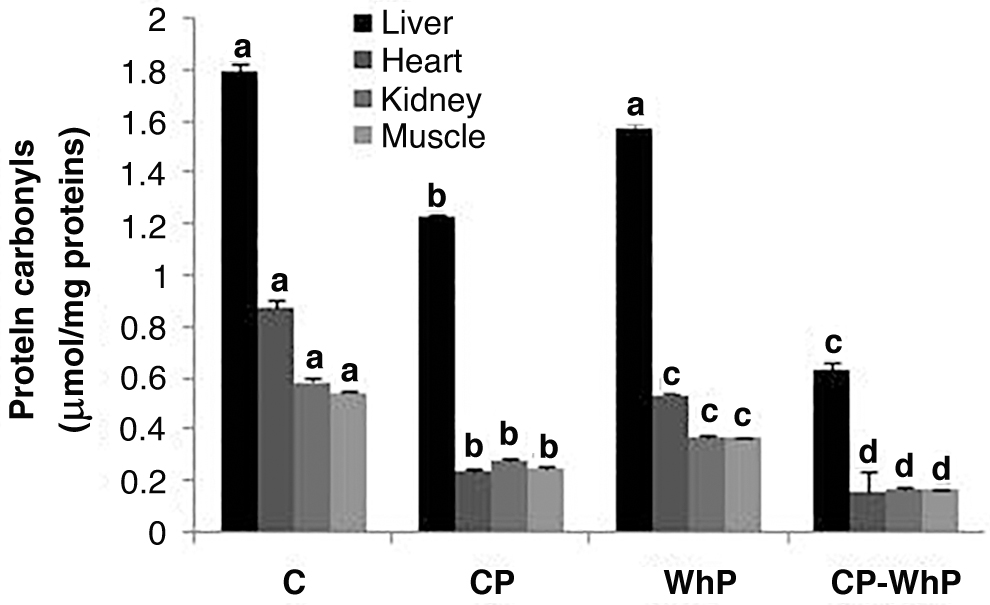
Effect of the CP, WhP, or mixture (CP + WhP) on protein-carbonyl residues. Data are expressed as mean ± standard error (n = 10). a–dMean within the same row carrying different superscripts are significantly different at P < .05.
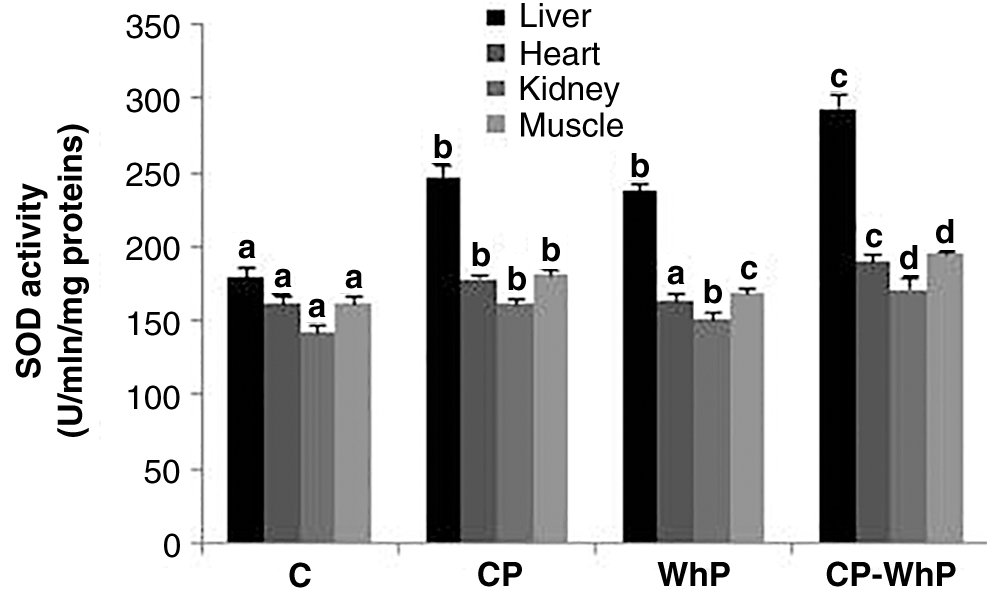
Effect of the CP, WhP or the mixture (CP + WhP) on SOD. Data are expressed as mean ± standard error (n = 10). a–dMean within the same row carrying different superscripts are significantly different at P < .05. SOD, superoxide dismutase.
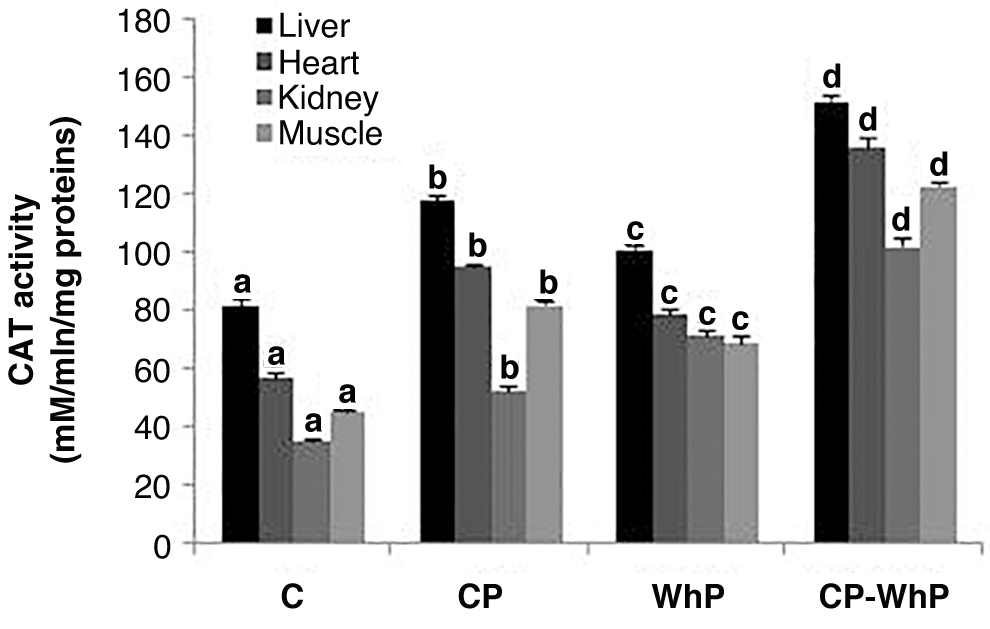
Effect of the CP, WhP or the mixture (CP + WhP) on CAT. Data are expressed as mean ± standard error (n = 10). a–dMean within the same row carrying different superscripts are significantly different at P < .05. CAT, catalase.
Action of CP, WhP, or CP + WhP on the blood indices, plasma scavenging capacity, and cytokine levels
Table 3 shows the action of CP/WhP supplementation on the hematological indices of rabbits. There were no significant differences (P > .05) in the LYM, GRA, mean cell volume (MCV), MCH, MCHC, MPV, and platelet distribution index of rabbit groups fed the experimental diets. However, there were significant differences (P < .05) in the WBC, Mid-Sized Cells (MID), erythrocytes, RBC, platelets, Hgb, HCT, mean cell volume (MCV), procalcitonin (PCT), and platelet large cell ratio (P-LCR). In this context, WBCs, erythrocytes, Hgb, and HCT were increased in group basal diet + CP/WhP, whereas, these indicators except MID cells were decreased (P < .05) in the group of rabbits fed basal diet + WhP compared with group of rabbits fed basal diet only. In contrast, MCV, platelets concentration, PCT, and P-LCR were reduced (P < .05) in the group of rabbits fed basal diet + CP/WhP, whereas, P-LCR increased in both groups, CP and WhP, compared with control group of rabbits.
In physiological conditions, the antioxidant systems have the ability to maintain the concentration of reactive oxygen species at an optimal level for the cell. In this respect, we observed an increase (P = .017) in the antioxidant capacity of plasma following the consumption of a diet containing 10% WhP, 10% CP, or Wh-CP (Table 3). The TNF-α concentration in plasma was significantly reduced (P = .020) following CP and WhP incorporations. This reduction was more noticeable in CP–WhP group.
Discussion
The present study investigated the effect of CP–WhP supplementation on the growth performance, gut morphology, biochemical and hematological parameters, and antioxidant properties in growing rabbits. The main findings were that CP–WhP combination was effective in improving rabbit's performance and gut morphology, fecal cholesterol excretion, total antioxidant capacity, and significantly decreased oxidative injury and blood TNF-α.
Sweet WhP contains all the constituents of fresh whey, except water, in the same relative proportion as in liquid whey. Liquid whey contained 6.5% dry matter, while samples of WhP chemically evaluated allows to give crude protein 13.2%, ether extract 2.1%, lactose 67.7%, ash 10.6, calcium 4.5%, and phosphorus 5.6%. 27
Whey protein (WP) is designed to be a high-quality protein. 28 It was found that most of these WPs are rich in sulfur amino acid (cysteine), including bovine serum albumin, β-lactoglobulin, and α-lactalbumin. Various studies recorded the presence of lactose in abundance and important vitamins as thiamine and riboflavin as well as five most abundant minerals, like potassium, calcium, chloride, phosphorus, and sodium. 29
There are diverse results about the chromatography designs performed by HPLC for identifying polyphenols in CP, which evaluated the existence of condensed tannins (proanthocyanidins), composed of flavan-3-ol groups and their galloyl esters, gallic acid, (+)-catechin, (–)-epicatechingallate, (–)-epigallocatechingallate, and quercetin glycosides
30
and many authors indicated again the presence of hydrolysable tannins (gallotannins and ellagitannins) in carob pods.
31
Owen et al.
32
have distinguished the polyphenols as tannins, flavonoids and phenolic acids (such as gallic acid, cinnamic acid, and p-coumaric acid), flavone glycosides (such as quercetin-3-O-α-
At the end of the growing period, statistical differences among groups were reported for the growth performance traits, carcass dressing, and significantly influenced the gut morphology. Throughout the trial, the FI indicated that 5 g/kg inclusion levels of both products were adequate to growing rabbits confirming a good acceptability of CP–WhP nutritional component sources. Our results are fully consistent with those reported by Kishawy et al. 27 who observed an improvement of growth performances (BW, BWG, protein efficiency ratio, and relative growth rate) in growing rabbits following supplementation of whey to the basal diet along with citric acid. Also, consistently with our data, Parsaa et al. 33 reported that combination of a chicken diet with distinctive levels of dried whey and protexin probiotic ameliorated the BW of chickens at 6 weeks. A related result was further provided by Shariatmadari and Forbes, 34 who found that the inclusion of undiluted fresh acid whey with lactic acid to drinking liquid twice a week for 4 h improved broiler chicken performance. The liver, heart, and kidney weights were modified by experimental treatments. These findings are in agreement with the data of Bahari et al. 35 who showed that the addition of 4% WhP to the broiler ration improved carcass weight, carcass percent, breast weight, drum stick weight, and wings weight. These consistent enhancements in growth performance and BW may be associated to the higher digestibility of WP and satisfactory essential amino acid level of WP. 36
The abovementioned findings are also supported by morphologic observation. The villus height and villus height to crypt depth ratio are indicators of the integrity and functionality of the intestine. An increase in villus height and villus height to crypt depth ratio can be translated to an increase in the absorptive surface area, which results in improved assimilation capacity. Jiang et al. 37 revealed that the morphology of the villi and crypts has been combined with bowel function and growth performance of animals. Our data are consistent with these results, as it was noticed that Agave fourcroydes powder supplementation elevated the height and width of the villi, due to appropriate gut situations. Other studies with diets rich in fructans established related findings to the structure of the villi, suggesting that there may indeed be a combination between the gut health status and the absorptive ability. 38
This amelioration in growth performance may be attributed to significant intensification in the digestibility of crude protein, fat, crude fiber, as well as well-developed intestinal glands and a development in the number of goblet cells in WhP and CP–WhP groups due to the higher levels of whey, which contain peptides and amino acids. WhP-lactose can lead to an increase in intestinal villi length in lactose-treated broilers pending the starter period, which was assumed to improve nutrient absorption and bird performance, which was reported by Szczurek et al. 39 Moreover, other explorations on the prebiotic properties of some oligosaccharides 40 showed a very identical action to the aforementioned on the jejunal and ileal tissues of chickens, along with higher digestive enzyme activities in the small intestinal contents. Consequently, this enrichment in FCR, BW, and total gain may be related to the higher digestibility of WP and equitable essential amino acid level ofWP. 27
In the present study, the outcome of CP addition is in agreement with those obtained previously by other researchers in the piglet. Therefore, CP is very good source of sugars, potentially stimulating the palatability and aroma of diets and therefore the consumption of food. It seems that the CP is a product perfectly adapted to the feeding of piglets. Its incorporation up to a 6% level in diets is very useful in supporting postweaning consumption, growth, and health. 41,42 Evidences have suggested that phytochemicals, particularly, the flavonoids could enhance the genomic stability and cellular integrity. These phytoconstituents are also known to promote immunity and gut function and increase animal performance. Some other recent researches have reported that purified flavonoids, hesperidin and genistein, 43 and flavonoid-rich fermented Ginkgo biloba leaves could improve the gut morphology and absorptive function in growing broilers. Thus, these flavonoid-compounds, both in purified and phytoextract forms could be the potential candidates to ameliorate the gut morphology, function, and health. 44
Rabbit feed enriched with WhP alone caused the generation of hyperlipidemia and hyperglycemia, which results in an increase in serum glucose and lipid, such as TG and cholesterol. Whereas, the cotreatment of animals with CP allowed to generate a significant decrease of these indicators. This action was accompanied by reduced intestinal absorption of cholesterol shown by increased excretion of fecal cholesterol following coconsumption of WhP in association with CP. Accordingly, the hypolipidemic effects of carob might be related to the inhibitory effects of its functional components on the absorption of cholesterol and fatty acids, increased fecal sterol excretion, and enhanced liver lipid metabolism. 45 Flavonoid-catechin decrease plasma cholesterol in various animal models and modulate favorably cholesterol metabolism in vitro, 46 through the upregulation of low density lipoprotein (LPL) receptors occurring through sterol regulatory element-binding protein-2 stimulation by (−)-epigallocatechin-gallate. Feeding rabbit diet with green tea catechins results in a serious augmentation in LDL receptor-binding action. The observed activity of green tea extract is related to an elevated fecal bile acid and cholesterol excretion. 47 Similarly, in our recent study, it was found that the carob extract inhibited the intestinal glucose absorption, showed with the inhibition of electrogenic sodium-dependent glucose transport in mice using an Ussing chamber technique. 48
More importantly, the present study revealed an increase in plasma antioxidant capacity, which is accompanied by a decrease in the level of lipid peroxidation and the amount of carbonylated proteins, and an improvement of antioxidant enzyme activities. The exact mechanism of antioxidant activity of WhP is unclear; however, several modes of action have been suggested. Antioxidant activity of WP is likely attributed to its high concentration of sulfur-containing amino acids (methionine and cysteine) as α-lactalbumin, β-lactoglobulin, and bovine serum albumin, which have a key role in the synthesis of glutathione. 49 –51 The antioxidant capacity of CP is due to its strong scavenging effect on reactive oxygen and free radicals, inhibition of the myeloperoxidase (MPO) activity, reduction of phosphorylation of p47phox Ser-328, modulation of reduced nicotinamide adenine dinucleotide phosphate-oxidase activity, and decrease of lipid peroxidation and carbonylated proteins caused by dextran sulfate sodium (5%) and ethanol (80%). 52 According to a recent study of Alagawany et al., 53 our findings demonstrated that dietary supplementation of CP–WhP to rabbit diets had beneficial actions on both SOD and CAT activities due to its ability to enhance expression of multiple antioxidant enzymes. From these results, it could be proposed that supplements with natural antioxidants could be efficient in the future to enhance the rabbit's health status.
Dietary ingredients could modify the blood profile of healthy rabbits. Indeed, hematological indices are an impression of the actions of these treatments on animals in terms of the quality of feed ingested and nutrients available. There was amelioration in the blood indicators of rabbits fed diets containing CP–WhP supplements. The hematological indices of improvement of rabbits fed CP/WhP-supplemented diets is traceable to its capacity to excite the generation of erythrocytes as it is reportedly used as blood tonic in medicine. 54 The WBCs and their differentials are responsible for the combat of affection infections. These cells transport antibodies during the immune system response and the subjects with low WBC are exposed to disease infections. Also in this context, PCT is widely recognized as a highly sensitive biomarker of severe inflammation and infection of bacterial origin. 55 In addition, Hgb is contained within the RBCs and it is an important protein that carries oxygen throughout the body. Low Hgb levels are an indicator of anemia. 54
The amelioration of hematological parameters after CP–WhP powder consumption in this study might be related to the strong antioxidant effect of CP–WhP bioactive compounds on hematopoietic cells. Hematopoietic cells appear to be principally exposed to the presence of uncontrollable reactive oxygen species (ROS) accumulation, because insufficiencies in many ROS scavengers result in either anemia that is severe or even lethal in some cases and/or malignancies of hematopoietic tissues. 56
In addition to possessing antioxidant action, CP–WhP powders have an anti-inflammatory effect shown by cell signaling cytokine reduction such as TNF-α. This mediator has a necessary role in the induction and development of inflammatory processes. 57 In our previous study, we showed that the aqueous extract of carob pod inhibited the MPO activity, 12 and the proinflammatory cytokine levels (TNF-α and interleukin-1β) 48 in a concentration-dependent manner by itself has the ability to reduce the production of hypochlorous acid from H2O2 that could attenuate the inflammatory reactions. Also, WP, which includes α-lactalbumin, lactoferrin, β-lactoglobulin, glycomacropeptide, and immunoglobulins, have the potentiality to inhibit the inflammatory cytokine production. 58
In conclusion, considering most pods and whey are discarded and not effectively utilized at present, these results suggested that these products could be utilized as a functional food or food ingredients that can promote human and animal health. The CP and WhP supplementation has the synergistic potential for improving the performance, gut morphology/health status, and antioxidant capacity. These findings may therefore help in the development of novel nutrition strategies using WhP/CP supplementation to improve/prevent intestinal diseases in early life.
Footnotes
Acknowledgments
Financial support from the Tunisian Ministry of Higher Education and Scientific Research/Ministry of Agriculture, Water Resources, and Fishing are gratefully acknowledged.
Declaration of Interest
Only the authors are responsible for the content of this article.
Animal Welfare Statement
The authors confirm that they have followed EU standards for the protection of animals used for scientific purposes.
Author Disclosure Statement
No competing financial interests exist.
Funding Information
No funding was received for this article.