




Abstract
Cranberry powder (CR) is reported to be effective against lower urinary tract symptoms (LUTS) and recurrent urinary tract infections. Benign prostatic hyperplasia (BPH) in men older than 50 years is a common cause of LUTS. Here, we attempted to evaluate if CR is also effective for treating BPH using a BPH-induced rat model, which was orally administered CR. Male Sprague-Dawley rats weighing 200–250 g were randomly divided into the following six groups (n = 9): noncastration group; castration group; BPH group; BPH and cranberry for 8-week (CR8W) group; BPH and cranberry for 4-week (CR4W) group; and BPH and saw palmetto group (saw palmetto). Compared with the BPH group, the CR8W group showed a significant decrease in prostate weight (by 33%), dihydrotestosterone (DHT) levels (by 18% in serum and 28% in prostate), 5-alpha reductase levels (18% reduction of type 1 and 35% of type 2), and histological changes. These results indicate that CR could attenuate BPH by inhibiting 5-alpha reductase and by reducing other biomarkers such as prostate weight and DHT levels. Thus, CR may be an effective candidate for the development of a functional food for BPH treatment. IACUC (USW-IACUC-R-2015-004).
Introduction
Most older middle-aged men after 50 years of age suffer from various age-related diseases including physical and mental losses. 1 Benign prostatic hyperplasia (BPH) is a disease wherein the prostate tissue is enlarged proportionally with age owing to excessive proliferation of epithelial and stromal cells. 2 When the prostate gland that surrounds the bladder outlet is enlarged, the pressure on the urethra causes lower urinary tract symptoms (LUTS), such as urination, nocturia, urinary hesitancy, and a sensation of incomplete emptying. 3 BPH is one of the common causes of LUTS in aged men, and can have a major effect on the quality of life. 4 Although the cause of prostate enlargement is not clearly known, aging and increased activity of steroid 5-alpha reductase (5AR) are known as major to be significantly associated with BPH. 5
BPH is considered to be an imbalance between androgen and estrogen in older men, accompanied by an increase in the prostate volume. 6 Androgen, particularly dihydrotestosterone (DHT), which is a potent ligand of the androgen receptor (AR), 7 plays a crucial role in prostate development and growth. 8 DHT is converted from testosterone by 5AR, an important mediator in prostatic hyperplasia. 9 The following three isozymes of 5AR are present in the prostate tissue: 5AR type 1, 5AR type 2, and 5AR type 3. 10 Among the three isozymes, 5AR type 1 and type 2 are dominantly related to BPH, and 5AR type 2 is predominantly overexpressed in BPH tissue. 11 Furthermore, 5AR type 1 is responsible for overall androgen metabolism and locally distributed 5AR type 1 shows a close association with prostate growth. 12 Thus, 5AR inhibitors (5ARIs) have been widely studied as an initial approach to treat BPH treatment. Finasteride, which inactivates 5AR, is the most highly used prostate hypertrophy pharmaceutical agent; however, this agent exerts some adverse effects such as sexual problems. 13 The key to treating enlarged prostate is to suppress conversion of testosterone into DHT with reduced side effects. Many studies have attempted to develop 5ARI from natural products such as clinical drug candidates; these include cocoa phenolic extract, 14 lipid extract of Roystonea regia fruits, 15 Piper nigrum leaf, 16 and saw palmetto. 17
Cranberries (Vaccinium macrocarpon) are widely consumed for a variety of health benefits. These health benefits are attributed to the constituents of cranberries, mainly polyphenols including proanthocyanidins, anthocyanins, catechins, flavonols, and quercetin. 18 Several studies have reported that cranberry polyphenols provide anti-cardiovascular, 19 anticancer, 20 and anti-inflammatory properties. 21 Recent studies have also reported that cranberries improve LUTS and recurrent urinary tract infections in human studies. 22,23 However, its efficacy in BPH and BPH-induced LUTS has not been investigated. Therefore, in this study, we evaluated whether cranberry powder (CR), which is a well-recognized supplement for LUTS, could attenuate BPH in animal model by evaluating the serum and prostate biomarkers related to BPH. In the previous BPH studies with rats, the prostate weight was increased 4 weeks after testosterone injection. 24,25 This study was divided into two different time periods to compare the effect of the CR administration between before and after BPH induction: one group was administered CR for 8 weeks from the first week, and the other group was administered CR for only 4 weeks after BPH induction.
Materials and Methods
Cranberry powder
CR (Flowens®; Naturex, Inc., Sagamore, MA, USA) was obtained from Ju Yeong NS Co., Ltd. (Seoul, Korea). Saw palmetto was obtained from the JinYong (Suwon, Korea). Testosterone-propionate (TP) reagent was purchased from TCI (Tokyo, Japan). Testosterone kits were purchased from ARBOR (Ann Arbor, MI, USA) and DHT ELISA kits were from Biovendor (Brno, Czech Republic). ELISA kits for SRAD5A1 and SRD5A2 were from CUSABIO (Houston, Texas, USA).
Animals
Male Sprague-Dawley rats weighing 200–250 g (6 weeks old; DBL, Eumseong, Korea) were housed in an air-conditioned room with controlled temperature (22°C ± 2°C), relative humidity 55% ± 5%, and automatic lighting (alternating 12-h light–dark cycle). The animals were kept under conditions specified in the guide for the Care and Use of Laboratory Animals, as adopted and promulgated by the Institutional Animal Care Committee, University of Suwon (USW-IACUC-R-2015-004).
BPH induction
Castration before BPH induction was performed after a 1-week adaptation period. To avoid the influence of intrinsic testosterone, all the rats except normal group were castrated. In brief, both testicles and epididymal fat were removed and incision line was sutured. This orchiectomy was performed by the OECD Hershberger assay of endocrine disruptor testing and assessment (National Institute of Toxicological Research, Sejong, Korea). After 1 week of recovery period, the castrated rats without Control group were subcutaneously injected with TP (3 mg/kg of bw/day) daily. Then, all rats were divided into six groups and received diets orally for 8 and 4 weeks with CR. For oral administration, CR was suspended in corn oil (35 mg/mL corn oil/kg BW/day). As a positive control, saw palmetto was administered by oral gavage (Fig. 1).
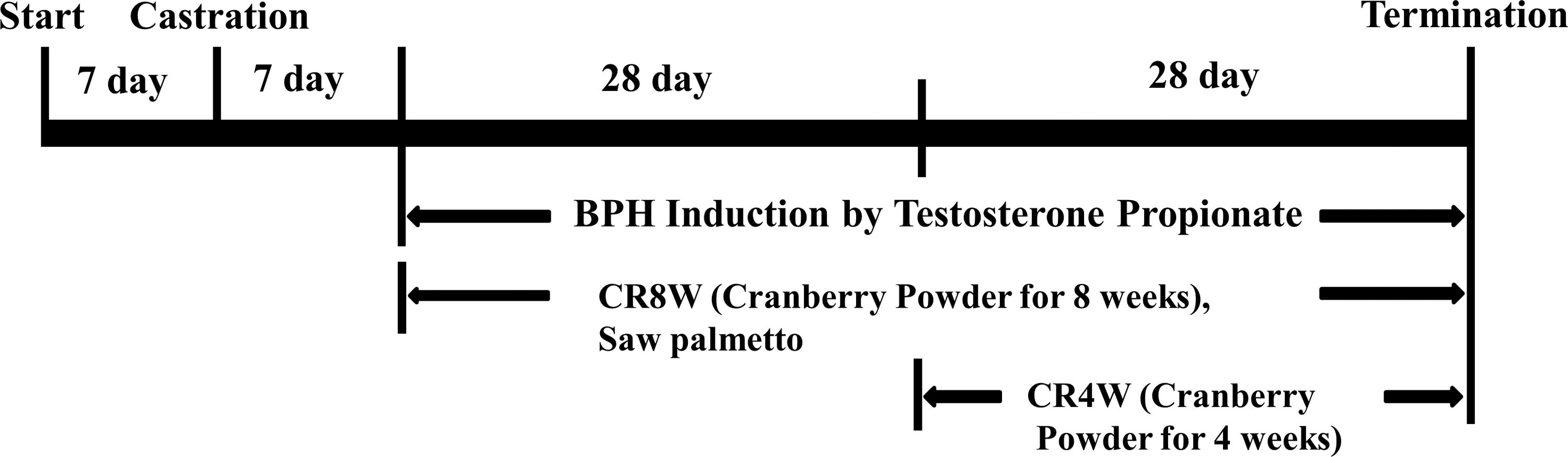
Experimental design of the study. After a 7-day adaptation period, Sprague-Dawley rats were castrated. BPH was induced with TP (3 mg/kg of body weight/day) daily for 8 weeks. BPH, benign prostatic hyperplasia; CR, cranberry powder; TP, testosterone-propionate.
Experimental design
All rats were divided into six groups (n = 9) as follows: (1) the noncastration group and (2) castration group, which received corn oil orally and injected subcutaneously; (3) BPH group, which received corn oil and injected TP (3 mg/kg of bw/day) subcutaneously; (4) BPH + cranberry 8-week (CR8W) group, which received CR (35 mg/mL corn oil/kg of bw/day) administered by oral gavage and TP (3 mg/kg of bw/day) injected subcutaneously; (5) the BPH + cranberry 4-week (CR4W) group, which received CR (35 mg/mL corn oil/kg of bw/day) administered by oral gavage and TP (3 mg/kg of bw/day) injected subcutaneously; (6) the BPH + saw palmetto group (saw palmetto), which received saw palmetto (100 mg/kg of bw/day) administered by oral gavage and TP (3 mg/kg of bw/day) injected subcutaneously (Fig. 1).
After overnight fasting, all animals were killed and blood was collected. The blood was centrifuged to separate serum at 1800 g for 20 min (Hanil Scientific, Inc., Gimpo, Korea). Prostate was removed and weighed immediately. Then, prostate was homogenized in 1 × phosphate-buffered saline (PBS) (pH 7.4) with glass homogenizer (Wheaton, Millville, NJ, USA), and were centrifuged at 5000 g for 5 min at 4°C (Thermo Scientific Sorvall, Waltham, MA, USA). Then, the supernatant was collected and stored at −70°C until analysis.
Testosterone and DHT in serum and prostate tissue homogenate
Testosterone and DHT levels in the serum and prostate tissue homogenate were determined using enzyme-linked immunosorbent assay (ELISA). Sample absorbance was measured at 450 nm using Epoch Microplate Spectrophotometer (BioTek Instruments, Inc., Winooski, VT, USA). The values were applied to the standard curve and converted to percentage after calculation using Curve Expert 1.3.
SRD5A1 and SRD5A2 in prostate tissue homogenate
Prostate tissue was homogenized using a homogenizer in 1 × PBS and centrifuged at 5000 g for 5 min at 4°C. After collecting the supernatant from centrifuged homogenate, the level of SRAD5A1 and SRD5A2 in prostate was quantified by ELISA assay (CUSABIO) according to manufacturer's instructions. The values were applied to the standard curve and converted to percentage after calculation using Curve Expert 1.3.
Histopathological examination
For the histological examination, the prostate tissue was fixed in 4% paraformaldehyde (Sigma-Aldrich) and embedded in paraffin. Then the blocks were cut into 2 μm thin sections. The sections were stained with hematoxylin and eosin (H&E) and was photographed using a light microscope (BX-51; Olympus, Tokyo, Japan).
Statistical analysis
All the values were expressed as mean ± standard error. The statistical significance of differences among groups was assessed using one-way analysis of variance followed by the Duncan's multiple range tests (P < .05) using SPSS (Ver. 20; IBM Corporation, Armonk, NY, USA).
Results
Prostate weight ratio
The increase in prostate weight is one of the critical indicators of development of BPH. As given in Table 1, the BPH group (1.52 ± 0.09 g) showed a significant increase in prostate weight compared with noncastration (0.80 ± 0.04 g) and castration groups (0.64 ± 0.07 g). In contrast, significant reductions in prostate weight was observed in the CR8W (1.02 ± 0.03 g) and CR4W (1.02 ± 0.07 g) groups, respectively, compared with that in the BPH group. The prostate weight ratio was calculated based on the prostate weight to body weight ratio. The prostate weight ratio in the BPH group (0.38 ± 0.02 g) was significantly increased by ∼250% compared with both noncastration (0.16 ± 0.01 g) and castration groups (0.15 ± 0.02 g). In the CR4W group and CR8W group, the prostate weight ratios were significantly reduced by approximately 35% and 31%, respectively, compared with that in the BPH group. The reductions in the prostate weight ratios in both CR8W and CR4W groups were similar to that in the saw palmetto group (positive control). In this study, there were no significant differences in ALT and AST among groups (Supplementary Table S1).
Body Weight, Prostate Weight, and Prostate Weight Ratio in Benign Prostatic Hyperplasia-Induced Rats
Noncastration, rats were administered with PBS and corn oil injection; castration, rats were administered with PBS and corn oil injection; BPH, rats were administered with PBS and TP injection; CR8W, rats were administered with CR (70 mg/kg of BW/day) and TP injection for 8 weeks; CR4W, rats were administered with TP injection for 8 weeks and CR (70 mg/kg of BW/day) for 4 weeks. Saw palmetto rats were administered with saw palmetto (100 mg/kg of BW/day) and TP injection. All data are presented as mean ± SE. Differences were considered statistically significant at P < .05.
BPH, benign prostatic hyperplasia; BW, body weight; CR, cranberry powder; CR4W, cranberry for 4 weeks; CR8W, cranberry for 8 weeks; PBS, phosphate-buffered saline; SE, standard error; TP, testosterone-propionate.
DHT and testosterone in serum and prostate tissue homogenate
Testosterone and DHT play a crucial role in prostate growth and are involved in accelerating prostate hyperplasia. As given in Figure 2A, serum DHT showed significant increase in the BPH group compared with the noncastration and castration groups. Serum DHT in CR8W group was ∼20% lower than that in the BPH group, whereas serum DHT in CR4W group showed an insignificant reduction compared with that in the BPH group. In the prostate tissue, DHT of BPH group was also significantly higher than those of the noncastration and castration groups, whereas DHT in CR8W and CR4W groups was significantly reduced by ∼27% and 23%, respectively, compared with that in the BPH group (Fig. 2B). In saw palmetto group, DHT in serum and prostate were significantly lower than those in the BPH group, and similar to those in the CR8W and CR4W groups.
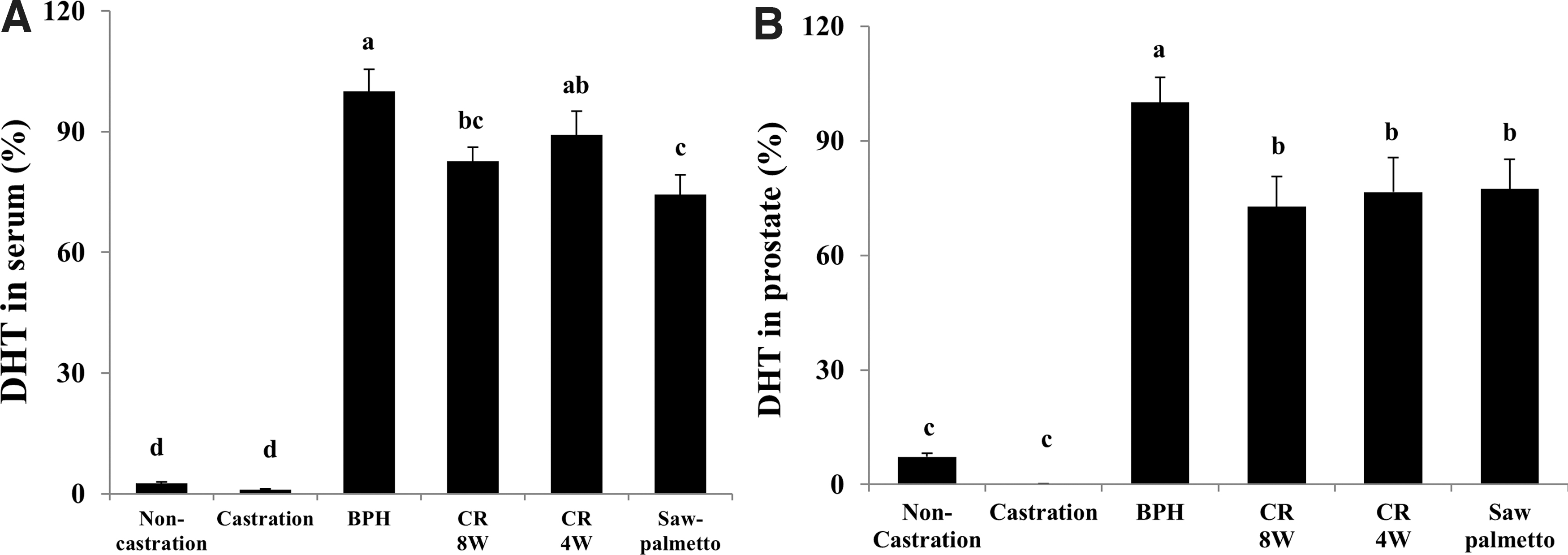
Effects of CR on dihydrotestosterone in BPH-induced rat. CR was orally administered and effects were assessed in
As given in Figure 3A, the BPH group showed significantly elevated testosterone levels in serum compared with the noncastration and castration groups. Serum testosterone levels in both CR8W and CR4W groups were reduced by 21%, compared with that in the BPH group. In the prostate, testosterone in the BPH group was also significantly higher than that in the noncastration and castration groups. However, CR8W group showed significant reduction (23%) compared with the BPH group, although the reduction observed in CR4W group was insignificant (Fig. 3B). In the saw palmetto group, the serum testosterone levels were significantly lower than those in the BPH group, although there was no significant difference in the prostate.

Effects of CR on testosterone in BPH-induced rat. CR was orally administered and effects were assessed in
5AR type 1 and type 2 in prostate
Both 5AR type 1 and type 2 are known to be significantly overexpressed in BPH tissue compared with that in normal prostate, and type 2 is the predominant form. 10 As given in Figure 4A, 5AR type 1 in the prostate of BPH group was significantly increased compared with that in the noncastration and castration groups. CR8W and CR4W groups, which were administered with cranberry powder, showed significant reduction of 5AR type 1 (by 18% and 13%, respectively) compared with the BPH group, with no significant difference between CR8W and CR4W groups. Similarly, 5AR type 2 was significantly increased in the prostate of BPH compared with that in the noncastration and castration groups (Fig. 4B). The 5AR type 2 in CR8W and CR4W groups were significantly decreased by ∼35%, compared with that in the BPH group. There was no significant difference among the saw palmetto, CR4W, and CR8W groups with respect to 5AR type 1 and type 2 levels.

Effects of CR on 5-alpha reductase 1
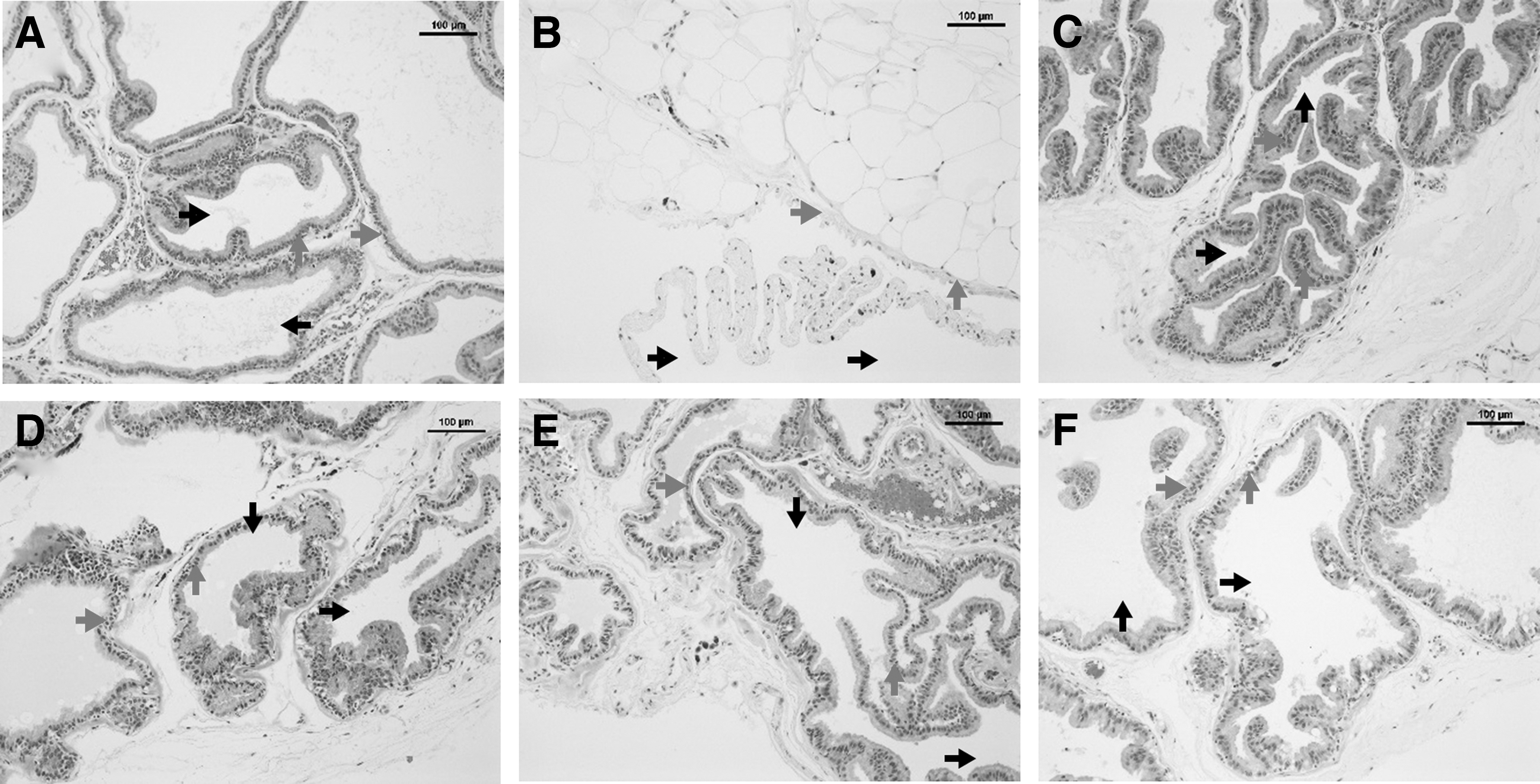
Histological examination in the prostate tissue of BPH-induced rats. Prostate tissues were stained with H&E and observed at × 100 magnification with an optical microscope. Increase of lumen areas were observed frequently in the prostates of CR group and saw palmetto group compared with BPH group (black arrows). Intraluminal polyp formation and epithelial appeared a lot in BPH group and decreased CR group and saw palmetto group (red arrows). Noncastration
Histopathological examination
To determine the histopathological changes in the prostate tissue in BPH-induced rats, the prostate tissues were fixed and stained with H&E (Fig. 5). The prostate of rat in castration group was almost degenerated 8 weeks after castration (Fig. 5B). The formation of intraluminal polyp in the tissues is an important indicator for confirming prostate hypertrophy. BPH group (Fig. 5C) showed greater intraluminal polyp formation than the noncastration (Fig. 5A) and castration (Fig. 5B) groups. In addition, compared with the normal group, the epithelial cells and lumen in the prostate tissue of BPH group showed abnormal morphology, the epithelial cells development and shrunken lumen space. Both CR8W and CR4W groups (Fig. 5D, E) showed reduction of intraluminal polyp formation, with decreases in hyperplasia and epithelial layer thickness. Furthermore, as the positive control, saw palmetto group (Fig. 5F) showed prostate features similar to that of the normal group.
Discussion
Major histological changes in enlarged prostate in BPH occur in 70% of the men older than 70 years of age. 26 About half of the men with enlarged prostate gland develop benign prostatic enlargement, and in about half of these men, such enlargements develop into BPH. 27 Current epidemiological studies support the hypothesis that prostate hypertrophy promotes bladder outlet obstruction, which causes LUTS. 28 In this study, we examined whether CR, which is known to be effective against LUTS, exerts a positive effect in BPH-induced rat models.
Testosterone is the primary male hormone synthesized and is secreted mainly in testicular Leydig cells. 29 Testosterone is converted to DHT irreversibly by the 5AR enzyme as a hormone precursor in the prostate gland. These androgens bind to the nuclear DNA sequence called the human AR complex and then increases the transcription of male hormone-dependent genes, leading to regulation of positive or negative gene expression. 30 Testosterone and DHT bind to the same AR at similar rates in the prostate, but because the DHT-AR complex is more stable than the testosterone–AR complex, most AR are present in a DHT-bound state rather than testosterone-bound state. 31 Therefore, 5ARI has been investigated to reduce DHT production. The commercial 5ARIs include finasteride and dutasteride; finasteride inhibits 5AR type 2 and dutasteride inhibits both types 1 and 2. 32
In our study, rats in the BPH group showed significantly increased prostate weight, DHT levels, and 5AR levels as well as histological changes such as epithelial thickening and reduced glandular luminal area compared with both noncastration and castration groups. In contrast, CR-treated group, especially the CR8W group showed decreased prostate weight, 5AR levels, and less histological changes, similar to the saw palmetto-positive control group. The biological efficacy of 5ARIs was previously determined to lower the serum and intraprostatic DHT concentration, although serum testosterone elevation in 5ARIs remain within the normal laboratory range. 32 In this study, testosterone level in prostate was not significantly different between BPH group and cranberry groups. Previous studies indicated that testosterone level was not shown to have similar patterns with DHT level. 33,34 Testosterone plays an important role in the development of the male reproductive system. Testosterone level was measured to observe the changes in serum and prostate tissue after TP injection. In our study, testosterone level in prostate was not significantly different between BPH group and cranberry groups. These results indicated that CR8W group was more effective for inhibiting BPH-induced effects when cranberry was immediately administered to the animals compared with the CR4W group. The CR8W group showed significant reduction in both SRD5A1 and SRD5A2 levels compared with the CR4W group. These results demonstrated that taking CR at the early stages of the disease or taking it for a long time might reduce the 5AR levels.
In this experiment, saw palmetto extract used as a positive control because it has been reported to be effective against BPH and BPH-associated LUTS. 35 CR has been reported to prevent LUTS and recurrent urinary tract infections in humans. 36 –38 In previous studies, anthocyanin extracted from black soybean, 39 bilberry, 40 and grape skin 41 showed beneficial effects against BPH. The amount of anthocyanin is very high in cranberry. American cranberry has glycosides of the six aglycones of the anthocyanidin family including cyanidin and peonidin. 42 In this study, anthocyanin family might be one of the important active compounds in CR (Supplementary Fig. S1).
In our investigation, the administration of CP significantly prevented the progression of BPH by reducing the 5AR levels, and consequently reducing DHT levels in the serum and prostate, along with reduction of the prostate size.
This study demonstrated that CR exerts positive effects against BPH, based on biochemical and histological changes in BPH-induced rats. Although further investigation and validation is required, our study provides evidence, for developing a potential treatment for BPH from natural products.
Footnotes
Author Disclosure Statement
No competing financial interests exist.
Funding Information
No funding was received.
Supplementary Material
Supplementary Table S1
Supplementary Figure S1
References
Supplementary Material
Please find the following supplemental material available below.
For Open Access articles published under a Creative Commons License, all supplemental material carries the same license as the article it is associated with.
For non-Open Access articles published, all supplemental material carries a non-exclusive license, and permission requests for re-use of supplemental material or any part of supplemental material shall be sent directly to the copyright owner as specified in the copyright notice associated with the article.
