




Abstract
Chylomicrons are large, triglyceride-rich lipoproteins that transport dietary lipids and lipophilic micronutrients through the lymphatic system and into the venous circulation. They therefore represent a valuable means of investigating the bioavailability of a range of bioactive molecules. Curcuminoids have a complex reputation, with most in vitro studies suggesting a beneficial effect (e.g., as an antioxidant), while in vivo work is often, at best, equivocal. We have prepared a curcuminoid extract from fresh turmeric and investigated the transfer of curcuminoids to chylomicrons by rapid ultracentrifugation. We subsequently characterized the chylomicrons in terms of their susceptibility to oxidation. There was a dose-dependent relationship between the curcuminoid level in chylomicrons and decreased levels of preformed lipid hydroperoxides (P < .05), which was broadly mirrored by paraoxonase arylesterase activity. At lower dosages (1000–3000 mg), curcuminoids protected chylomicrons against copper(II)-mediated oxidation, but at higher levels (4000–5000 mg), a pro-oxidant effect was observed. In conclusion, we report a clear biphasic (hormetic) effect of curcuminoids on lipid oxidation, which supports the theory that low dosages of bioactive compounds can have beneficial effects, while higher dosages may have an equivocal or negative impact on the disease.
Turmeric (Curcuma longa Lin.) is widely used as a culinary spice and botanical medicine across the world. The major phytoconstituents are a family of diarylheptanoids collectively referred to as curcuminoids, which represent between 2% and 6% of the turmeric rhizome. The biological activity of these compounds has been well established in vitro, but due to poor bioavailability and extensive metabolism, there are conflicting opinions about the benefits of turmeric in humans. 1 Immediately after absorption at the intestinal epithelium, lipid soluble micronutrients such as curcuminoids are packaged into chylomicrons and transported through the mesenteric lymph, eventually entering the venous circulation at the thoracic duct. 2 While curcuminoids have been shown to act on multiple target sites, we are specifically interested in their ability to ameliorate the oxidation of triglyceride-rich lipoproteins such as chylomicrons. The oxidation of lipoproteins has been linked to the development of atherosclerosis and a range of neurodegenerative conditions, 3 and so, minimizing oxidation is believed to confer beneficial effects. In this context, curcuminoids may act to sequester redox-active transition metals, which are involved in the oxidation of unsaturated fatty acids, 4 or they may act as chain-breaking antioxidants through hydrogen atom transfer or single-electron transfer. 5 The aim of this study was to verify the transfer of curcuminoids to chylomicrons and to then assess their effect on the copper(II)-mediated oxidation of the lipoproteins.
Fresh, finely chopped turmeric was macerated in 90% ethanol at a ratio of 1:4 (turmeric-to-ethanol) for 2 weeks in the dark. The extract was recovered and the volume reduced by 50% on a rotary evaporator. The total curcuminoid content was determined by isocratic reversed-phase high-performance liquid chromatography (HPLC) with UV detection. 6 This crude extract was found to contain 69.5% curcumin, 24.3% desmethoxycurcumin, and 3.2% bisdesmethoxycurcumin (Fig. 1). From this extract, five milkshakes were prepared to contain between 1000 and 5000 mg curcuminoids, 31.4 g saturated fat, and 19.1 g unsaturated fat. A control milkshake without added curcuminoids was also prepared.
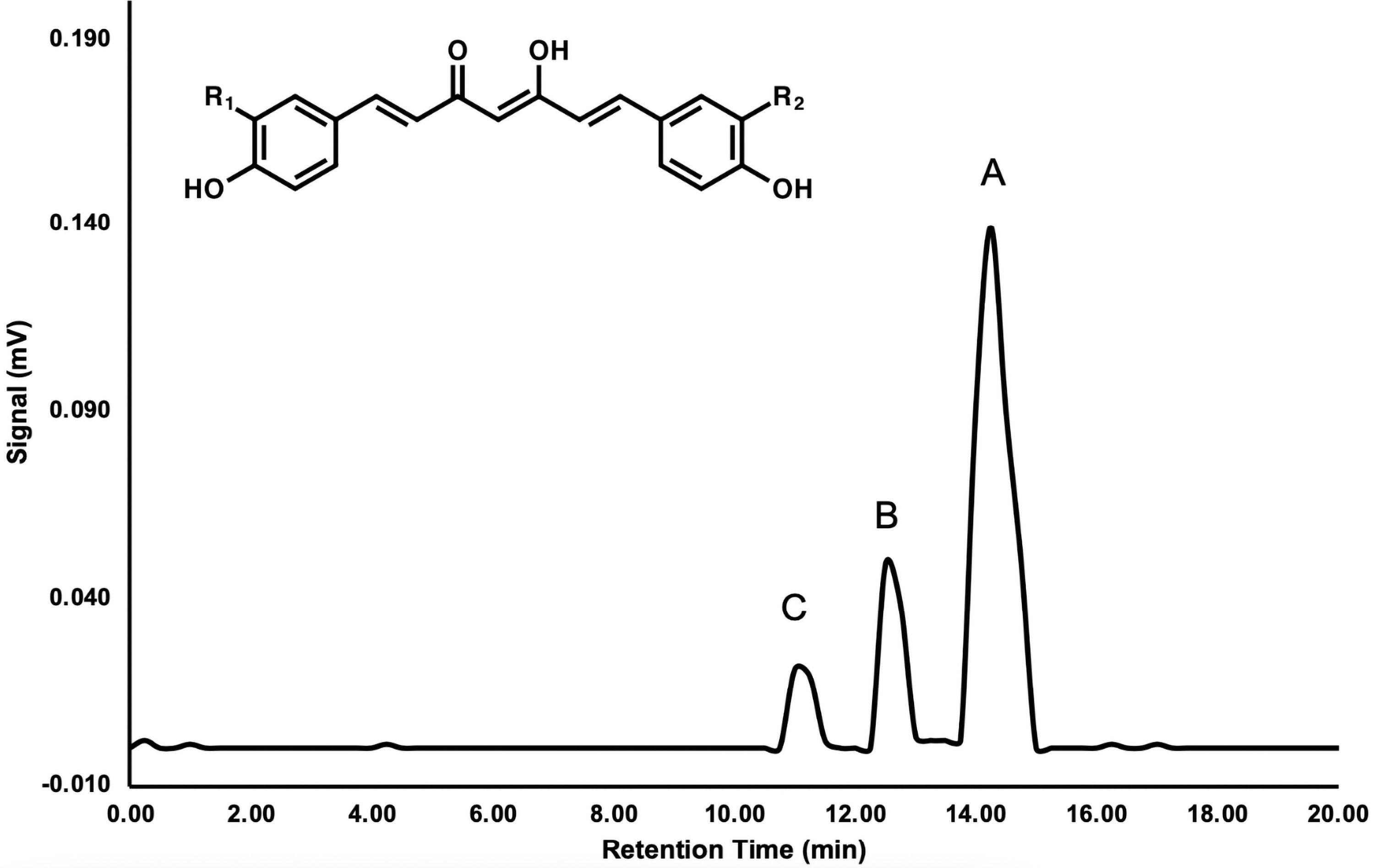
Reversed-phase HPLC chromatogram for curcuminoid extract. A, Curcumin (R1 = R2 = CH3O); B, Desmethoxycurcumin (R1 = H, R2 = OCH3); C, Bisdesmethoxycurcumin (R1 = R2 = H). HPLC, high-performance liquid chromatography.
Study approval was granted by the Institutional Research Ethics Committee, and healthy, normolipidemic volunteers (n = 50) were recruited in accordance with good clinical practice. We obtained written, informed consent before enrollment in the study. Volunteers were given the control milkshake and after 2 h, blood was obtained by standard venipuncture into lithium heparin vacutainers and placed immediately on ice. Plasma was recovered by low-speed centrifugation (1100 g max, 5°C) for 15 min. Aliquots of plasma were stored at −75°C until required. One week later, the participants returned and were randomized in a double-blinded manner into one of five groups and given a turmeric milkshake standardized to contain between 1000 and 5000 mg curcuminoids. Blood sampling was performed after 2 h as before.
The triglyceride-rich lipoprotein fraction was recovered from plasma as previously described. 7 Chylomicrons were then separated from very low-density lipoproteins (VLDL) by adjusting the background density of the chylomicron/VLDL fraction to 1.020 kg/L by addition of 0.019316 g potassium bromide. This was then overlaid by Chelex-100-treated double-deionized water and ultracentrifugation performed for 7 min at 135,240 g max. Complete separation of chylomicrons from VLDL was verified by agarose gel electrophoresis and measurement of apoprotein-B100 (ApoB100) by an immunodiffusion method. 8 The curcuminoid content of chylomicrons was determined by reversed-phase HPLC as before.
Chylomicrons were purified by size-exclusion chromatography on Sephadex-G25M and the eluate standardized for triglyceride content using a commercial assay (Randox GPO-PAP). Oxidation was mediated by aqueous copper(II) ions (10 μM CuCl2 per 0.5 mg/mL triglyceride) in oxygen-purged phosphate-buffered saline (0.02 M, pH 7.4) at 37°C. 9 The production of conjugated dienes was monitored by UV spectrophotometry in a thermostatically controlled 96-well plate reader at λ max 234 nm (ɛ max 9.6 × 10⁴ dm3/[mol·cm]). The kinetic parameter lag time was evaluated as previously described. 10 The concentration of preformed lipid hydroperoxides was determined through the ferric oxidation of xylenol orange. 11 Chylomicron-associated paraoxonase (PON-1) arylesterase activity was determined by monitoring the hydrolysis of phenylacetate at λ max 270 nm (ɛ max 1310 dm3/[mol·cm]). 12 The levels of malondialdehyde (MDA) in plasma were assessed by HPLC. 13 In brief, MDA was converted to a stable adduct by treatment with 2-thiobarbituric acid (TBA). MDA-TBA adducts were resolved by reversed-phase HPLC on a C18 column with detection at λ max 532 nm (ɛ max 1.56 × 10⁵ dm3/[mol·cm]).
The isolated chylomicron fraction had the expected electrophoretic mobility, with no evidence of preβ-migrating VLDL. The purity of the chylomicrons was further confirmed by the absence of any ApoB100 contamination (as verified by single radial immunodiffusion). Taken together, these findings gave us confidence that the separation of chylomicrons from the other lipoproteins was successful. The percent incorporation of curcuminoids into the chylomicrons is shown in Table 1. Levels of curcuminoids in chylomicrons were higher than that found in the systemic circulation (0.83 ± 0.05 μM 2 h after ingestion of 5000 mg curcuminoids). This is not unexpected, as curcuminoids are notoriously unstable and are rapidly cleared through phase I and phase II biotransformation reactions. The higher levels of lipophilic curcuminoids found in nascent chylomicrons will, in part, be physiological, as they will be incorporated directly into chylomicrons within the enterocytes. It is also noteworthy that since we used fresh turmeric in our study (rather than purified curcuminoids), there will be a range of other phytochemicals that may have a stabilizing effect and/or improve absorption. An example of this is ascorbic acid, which has been shown to increase the stability of curcumin in aqueous environments. 14
Summary of Analytical Findings
*P < .05 (treatment group vs. baseline, n = 10).
LOOH, lipid hydroperoxide; MDA, malondialdehyde; PON-1, paraoxonase.
Curcuminoids appeared to have a modest dose-responsive effect on the levels of preformed lipid hydroperoxides in chylomicrons. This relationship was statistically significant for all doses of curcuminoids (vs. baseline P < .05) when assessed by the nonparametric Mann–Whitney U-test. This would seem to imply that curcuminoids can act as a reductant for hydroperoxides, potentially disrupting the peroxidation chain reaction and minimizing the oxidized lipid load which enters the circulation. Similarly, the arylesterase activity of PON-1 was significantly increased in all groups (vs. baseline P < .05); however, at 3000–5000 mg, no significant additional increase in arylesterase activity was found. This may provide a partial explanation for the decrease in preformed lipid hydroperoxides, since PON-1 is a lipoprotein-associated esterase that can hydrolyze a range of substrates, including oxidized fatty acids. 15 Escalating dosages of curcuminoids did not appear to have any effect on plasma MDA. This is unsurprising given the short time interval used when assessing postprandial absorption of micronutrients, but does provide a basis for further investigation.
The copper(II)-mediated oxidation of chylomicrons isolated from control samples followed the expected kinetic profile with an average lag time of 365 ± 19 min (n = 50). The chylomicrons isolated from subjects who ingested the turmeric milkshake containing 1000–3000 mg curcuminoids were more resistant to oxidation (longer lag time), implying an antioxidant action of curcuminoids (Table 1; P < .05). However, those who consumed the milkshake containing 4000 and 5000 mg curcuminoids exhibited a statistically significant decrease in lag time (P < .05). These findings suggest that at lower concentrations, curcuminoids exert an antioxidant effect, while at higher levels they can become pro-oxidant. The change in the maximum concentration of conjugated dienes mirrored this pattern and that found for the levels of preformed hydroperoxides. Such hormetic effects of curcuminoids have recently been evaluated 16 where it was outlined that curcuminoids have a clear beneficial effect at low concentrations, but often a deleterious effect at higher dosages. While it is relatively easy to rationalize the antioxidant properties of curcuminoids through reduction of hydroperoxides, the pro-oxidant effect is more difficult to delineate. One possibility is that dihydroxy metabolites of curcuminoids may bring about the reduction of copper(II) to copper(I), as occurs with some polyphenols, 17 which in turn can lead to Fenton-like chemistry and production of hydroxyl radicals.
Chylomicrons provide a useful tool for investigating the assimilation of lipophilic micronutrients. Their role in transporting dietary lipids through the lymphatic system and to the liver exposes them to a large concentration of immune cells, potentially modulating the inflammatory response, depending on their cargo. 18 For those with diets high in plant-derived unsaturated fatty acids, the potential for ingestion of proinflammatory material is high, and so, agents that can reduce oxidized material have a clear benefit. Such a therapeutic potential of curcuminoids is often counterpoised by arguments based on poor bioavailability, labile chemical structure, and extensive metabolism. While it is true that the plasma levels of curcuminoids do not seem to correlate with their therapeutic actions, the gastrointestinal tract is an excellent bioreactor through which a host of physiologically active metabolites may be formed. This being the case, a metabolomic approach applied to curcuminoids may help resolve some of the disparities in this area of work.
Footnotes
Author Disclosure Statement
No competing financial interests exist.
Funding Information
Funding for this work was provided by the Northern Ireland Department for Economy and an unrestricted educational grant from Oleum Éireann (Grant Reference 03-19/21).