




Abstract
Bacillus subtilis fermented soybeans (natto) contain high vitamin K2 levels, mostly as menaquinone-7 (MK-7), and must be avoided by warfarin-dependent patients. This is the first report which demonstrates the characteristics and clinical relevance of a low MK-7 natto for such patients. We generated a novel, mutant B. subtilis strain TTCC2051 with short-term fermentation and reduced MK-7 production, yielding 19–24% of the normal MK-7 content. After functional assessments and a preclinical trial, 10 warfarin-dependent patients underwent a clinical trial with a 7-day ingestion test of the low MK-7 natto. Functional assessments were satisfactory, and the preclinical trial showed no increases in plasma MK-7 levels after 7 days of ingestion. In the clinical trial, 20 g/day of the low MK-7 natto significantly increased plasma MK-7 levels while 10 g/day did not. However, neither dose of low MK-7 natto changed international normalized ratio of prothrombin time (PT-INR) values in either group. The low MK-7 natto neither changed PT-INR values nor precipitated adverse events if ingested with a once-daily maximum of 20 g (46 μg of MK-7). Thus, this novel food product has potential for consumption by warfarin-dependent patients.
Introduction
Permanent warfarin treatment is a last-resort anticoagulation therapy for stroke prevention or treatment of deep venous thrombosis. In 2017, 17,204 prosthetic valves were implanted in Japan 1 and needed warfarin for at least several months, and factor Xa or thrombin inhibitors are not approved for cases requiring permanent anticoagulation therapy. A lack of optimal antithrombotic strategies across patient subgroups maintains the need for warfarin. 2
Warfarin antagonizes the vitamin K metabolic cycle by inhibiting synthesis of vitamin K-dependent coagulation factors II, VII, IX, and X, and recent systematic reviews have proposed that over 150 μg/day of vitamin K may affect coagulation. 3 –5 Natto, a traditional, Japanese, fermented soybean food produced by Bacillus subtilis natto, contains ∼900 μg/100 g or more hydrosoluble vitamin K2, mostly as menaquinone-7 (MK-7), 6 and is therefore forbidden to warfarin-dependent patients.
However, Japanese warfarin-dependent patients are deprived of this culturally significant food, risking decreases in medication adherence from lower emotional and cultural quality of life. 7 Therefore, we developed a novel, low MK-7 natto which is clinically acceptable for such patients.
Materials and Methods
Development of the low MK-7 natto
Commercial strain TTCC904–2 of B. subtilis (natto) was selected as the parental strain and mutated by ultraviolet light exposure to generate 823 mutant strains for screening. This ultraviolet-induced mutation technology is commonly and currently used by the food industry. B. subtilis (natto) strain TTCC2051 (low MK-7 Bacillus), which produces ∼44–62% as much MK-7 compared to standard B. subtilis (natto), was then verified. To further reduce MK-7 production, fermentation time was shortened by two thirds (7–12 h), yielding an MK-7 production of less than 220 μg/100 g. This is 19–24% of the MK-7 amount in standard natto (907–1190 μg/100 g; data from Takano Foods Co. Ltd., Omitama, Japan). To obtain stringiness (main component: γ-polyglutamic acid) and unique natto flavor, glutamic acid was added (0.1–0.5% by mass) before fermentation. This short fermentation method with the low MK-7 Bacillus plus glutamic acid is patent pending (patent application No. 2018-090514).
This newly developed “low MK-7 natto” was kept refrigerated at 5°C for 2–6 days after manufacturing to stop fermentation before assessments.
Functional assessment of the low MK-7 natto
High-performance liquid chromatography analysis for MK-7 of natto
All MK-7 experimental natto analyses were performed at Japan Food Research Laboratories. Each sample was stored chilled at 5°C or less or frozen at −20°C until analysis. Water twice the weight of the natto was added before grinding and milling to homogenize samples. Of this mix, 1.0–2.0 g (0.3–0.6 g natto) was analyzed by agitating with 3 g of sea sand and 80 mL of methanol before suction filtration with an 11G3 glass filter. Exactly 50 μL of this filtrate was analyzed by a High-performance liquid chromatography (HPLC)-fluorescence detector (HPLC-FL) with an LC-20AT solvent delivery unit (SHIMADZU Corporation, Kyoto, Japan), RF-20AXS fluorescence spectrophotometer (SHIMADZU Corporation, Kyoto, Japan), and L-column ODS (250 × 4.6 mm) (Chemicals Evaluation and Research Institute, Tokyo, Japan) with reduction column RC-10 (15 × 4.0 mm) (SHISEIDO, Tokyo, Japan). Column temperature was set at 40°C, and eluent composition was 30% ethanol and 70% methanol. Excitation and emission wavelengths of the fluorescence detector were each set at 240 and 430 nm. The flow rate of the HPLC was set at 1.0 mL/min. The limit of detection (LOD) was 1 μg/100 g.
Viscosity assessment of the low MK-7 natto
Viscosity was analyzed as follows: 150 g of natto was mixed with 200 g of distilled water at 25°C and agitated 10 times. Then, 400 g of distilled water was added and agitated for 30 times to remove lumps before straining through a 1410 μm-mesh filter. The viscous liquid was measured by a TVC-7 Viscometer (Toki Sangyo Co. Ltd., Tokyo, Japan). Viscosity was evaluated for four types of natto: low MK-7 Bacillus natto with short- or normal-fermentation time, with or without glutamic acid, and standard natto with normal fermentation without glutamic acid (Table 1). One sample per type was prepared and then viscosity (mPa•s) was analyzed twice to calculate an average value.
Viscosity Assessment of Four Different Natto Products
Sample A is the low MK-7 natto. Samples B and C are made with low MK-7 bacillus with short and normal fermentation method, respectively. Sample D is standard natto.
MK-7, menaquinone-7.
Sensory assessment of the low MK-7 natto
A sensory assessment was performed by three professional testers at Takano Foods with regard to appearance, odor, flavor, and texture.
Preclinical trials with healthy volunteers
A preclinical trial between low MK-7 and standard natto evaluated the effect of 7-consecutive day ingestion on plasma MK-7 levels in healthy volunteers. A total of 10 volunteers without current medications (age range: 20–59 years old) were enrolled. All candidates were free from alcoholism, diabetes, liver disease, renal disease, cardiac or pulmonary dysfunction, digestive system disease, history of gastrointestinal or other surgeries, and food or medicine allergies. Candidates engaged in strenuous sports, dieting, consumption of vitamin K-containing foods, or participating in other clinical trials were excluded.
Sample Foods
Natto was distributed three ways: Sample L-10g (10 g of the low MK-7 natto: half of a minimal commercial package, MK-7 = 27.3 μg/10 g, daily), Sample S-10g (10 g of standard natto, MK-7 = 119 μg/10 g, daily), and Sample S-50g (50 g of standard natto: general commercial package, MK-7 = 595 μg/50 g, daily).
Trial Protocol
The preclinical trial protocol design is shown in Figure 1. Ten volunteers were randomly divided into two groups: Group L (low MK-7 natto, n = 5) and Group S (standard natto, n = 5). Both groups had four hospital visits: on the first day (VISIT 1), the eighth day (VISIT 2), the 29th day (VISIT 3), and the 36th day (VISIT 4). All participants abstained from natto ingestion for 3 weeks before the trial (washout period). The period between VISIT 1 and VISIT 2 was the first session for either Sample L-10g (Group L) or Sample S-10g (Group S). The second session was held between VISIT 3 and VISIT 4, and both groups ingested Sample S-50g once daily for 7 consecutive days.

The flowcharts of preclinical and clinical trials. Sample L-10g: 10 g of the low MK-7 natto, Sample L-20g: 20 g of the low MK-7 natto, Sample S-10g: 10 g of standard natto, Sample S-50g: 50 g of standard natto, VISIT 1–4: all participants visit hospital for consultation, medical interview, physical examination, and blood test.
At every visit, participants had an in-person medical interview, physical examination (blood pressure and pulse), and blood test. Dietary content and sample intake were confirmed by patient diaries. Plasma MK-7 levels were measured at all visits. In addition, plasma levels of menaquinone-4 (MK-4) and vitamin K1 (phylloquinone, PK) were analyzed at VISIT 1 and VISIT 2.
All participants were prohibited from eating nonexperimental natto and instructed not to eat cruciferous vegetables or make significant lifestyle changes during the trial period. All blood samples were collected at Miura Clinic (Osaka, Japan) from February 29, 2016 to April 5, 2016. This trial adhered to the Declaration of Helsinki and was approved by the Internal Ethics Committee of the Miura Clinic (Approval number N1514). Informed consent was received from all participants.
Clinical trials for warfarin-dependent patients
Results from the preclinical trial were referenced to design a clinical ingestion trial of the low MK-7 natto in warfarin-dependent patients for 7 consecutive days.
Patient Selection
A total of 10 warfarin patients (age range: 20–69 years old) were enrolled. Patients with mechanical valve replacements were excluded for safety in case of temporary warfarin discontinuation. Participants were screened for the same conditions and diseases as in the preclinical trial.
Sample Foods
Since no significant elevation of plasma MK-7 levels occurred after 27.3 μg/day of MK-7 (10 g of the low MK-7 natto) for 7 days in the preclinical trial, 10 g and 20 g (minimal commercial size) of the low MK-7 natto were adopted as sample doses.
Each patient received the following experimental foods: Sample L-10g (10 g of the low MK-7 natto, MK-7 = 22.9 or 21.7 μg/10 g, daily) or Sample L-20g (20 g of the low MK-7 natto, MK-7 = 45.8 or 43.4 μg/20 g, daily). Two different MK-7 content lots were used.
Clinical Trial Protocol
The clinical trial protocol is shown in Figure 1. All patients started the first 7-day ingestion session with Sample L-10g. A 4.5 mL blood sample was obtained at each visit, and international normalized ratio of prothrombin time (PT-INR) and plasma MK-7 levels were measured. After VISIT 2, only those patients who evaluated and approved for continuation could advance to the second Sample L-20g session.
Diet regulation was similar to the preclinical trial. All blood samples were collected at the University of Tsukuba Hospital (Tsukuba, Japan) from June 1, 2018 to April 26, 2019. This trial adhered to the Declaration of Helsinki and was approved by the Internal Ethics Committee of the University of Tsukuba Hospital (Approval number; H29–216). Informed consent was received from all patients.
Discontinuation Criteria
More than 20% decrease in PT-INR or more than 50% increase in plasma MK-7 level at VISIT 2
Any critical complications or symptoms
Voluntary withdrawal by the patient
A stop order from the trial director
HPLC analysis of plasma MK-7, MK-4, and PK levels
All samples were analyzed at the Japan Institute for the Control of Aging, Nikken Seil Co., Ltd. (Fukuroi, Japan). To prepare samples, 500 μL of plasma was added to a solution of 50 μL saline, 1.5 mL of isopropyl alcohol, and distilled water to a final volume of 5 mL. Then, 5 mL of hexane was added before shaking for 10 min. The resulting organic layer was aspirated after centrifugation (20°C, 1200 g, 10 min) and dried under nitrogen gas (at 40°C). The final residue was dissolved in 200 μL of the eluent before HPLC-FL analysis.
Reverse phase HPLC-FL was performed with a Waters e2695 Separations Module and Waters 2475 Multi λ-Fluorescence Detector (Waters Corp., MA, USA) on an STR ODS-II column (250 × 4.6 mm) (Shinwa Chemical Industries Ltd., Kyoto, Japan) with an RC-10 postseparation, on-line reduction column (15 × 4.0 mm) (Shiseido Co. Ltd., Tokyo, Japan). The eluent was composed of 50% ethanol and 50% methanol for analysis. Excitation and emission wavelengths were each set at 320 nm and 430 nm. The flow rate and injection volumes of the HPLC were set at 1.0 mL/min and 30 μL. 8 The LOD was 1.0 ng/mL for MK-7, MK-4, and PK.
Statistical analysis
The data were analyzed using Easy-R (EZR; Saitama Medical Center, Jichi Medical University, Saitama, Japan), a graphical user interface for R 2.13.0 (R Foundation for Statistical Computing, Vienna, Austria). 9 Continuous variables were compared between groups with a paired Student's t-test and are presented as mean ± standard deviation. P values were 2-sided, and values < .05 were considered significant.
Results
Viscosity assessment of the low MK-7 natto
Viscosity assessment data are shown in Table 1. The viscosity of three types of low MK-7 natto (samples A, B, and C) was lower than standard natto (sample D). Viscosity was unchanged regardless of fermentation time. However, addition of glutamic acid doubled the viscosity in short-term fermented, low MK-7 natto. Statistical evaluation was not possible due to the small sample size.
Sensory assessment of the low MK-7 natto
Sensory elements were generally natto like in appearance with a slightly roasted, inoffensive aroma. Specific natto flavor was subjectively weaker than the commercial variety with a slightly firmer texture.
Preclinical trials with healthy volunteers
Participants had a mean age of 39.3 ± 11.8 years (21–57 years), and five were females (50%).
Participant baseline characteristics are presented in Table 2. Preclinical trial results are shown in Figure 2. Abstinence from forbidden foods was confirmed. After the 7-day consumption, plasma MK-7 levels were significantly elevated in both Sample S-10g ingestion (P = .03) and Sample S-50g (P < .001). However, after a 7-day ingestion of Sample L-10g, plasma MK-7 levels were not significantly increased (P = .11). Plasma levels of MK-4 and PK did not change significantly after consumption of either Sample L-10g or S-10g.

Changes in plasma vitamin K levels in preclinical trials with healthy volunteers. MK-4: menaquinone-4, MK-7: menaquinone-7, PK: phylloquinone; vitamin K1, Sample L-10g: 10 g of the low MK-7 natto, Sample S-10g: 10 g of standard natto, Sample S-50g: 50 g of standard natto, black markers (•♦▴▪): Sample S-10g or Sample S-50g, white markers (○▵□): Sample L-10g.
Baseline Characteristics of Candidates for Preclinical and Clinical Trials
The characteristics of candidates were comparable between preclinical and clinical trials.
Sample powers for MK-7 were calculated as 0.41, 0.57, and 0.99 for L-10g, S-10g, and S-50g, respectively.
Clinical trials for patients receiving warfarin
The mean age of patients was 35.2 ± 13.6 years (20–54 years), and four were female (40%). Four patients were on long-term warfarin therapy after total cavopulmonary connection, four had atrial septal defect patch closure, and two had ventricular septal defect closure and tetralogy of Fallot repair. All patients completed the trials without remarkable thrombosis, bleeding, or other complications.
Comparative baseline characteristics from preclinical and clinical trial patients are presented in Table 2, while clinical trial results are shown in Figure 3. All participants confirmed abstinence from forbidden foods. In the Sample L-10g group, both plasma MK-7 levels and PT-INR did not change significantly (P = .08, 0.46).
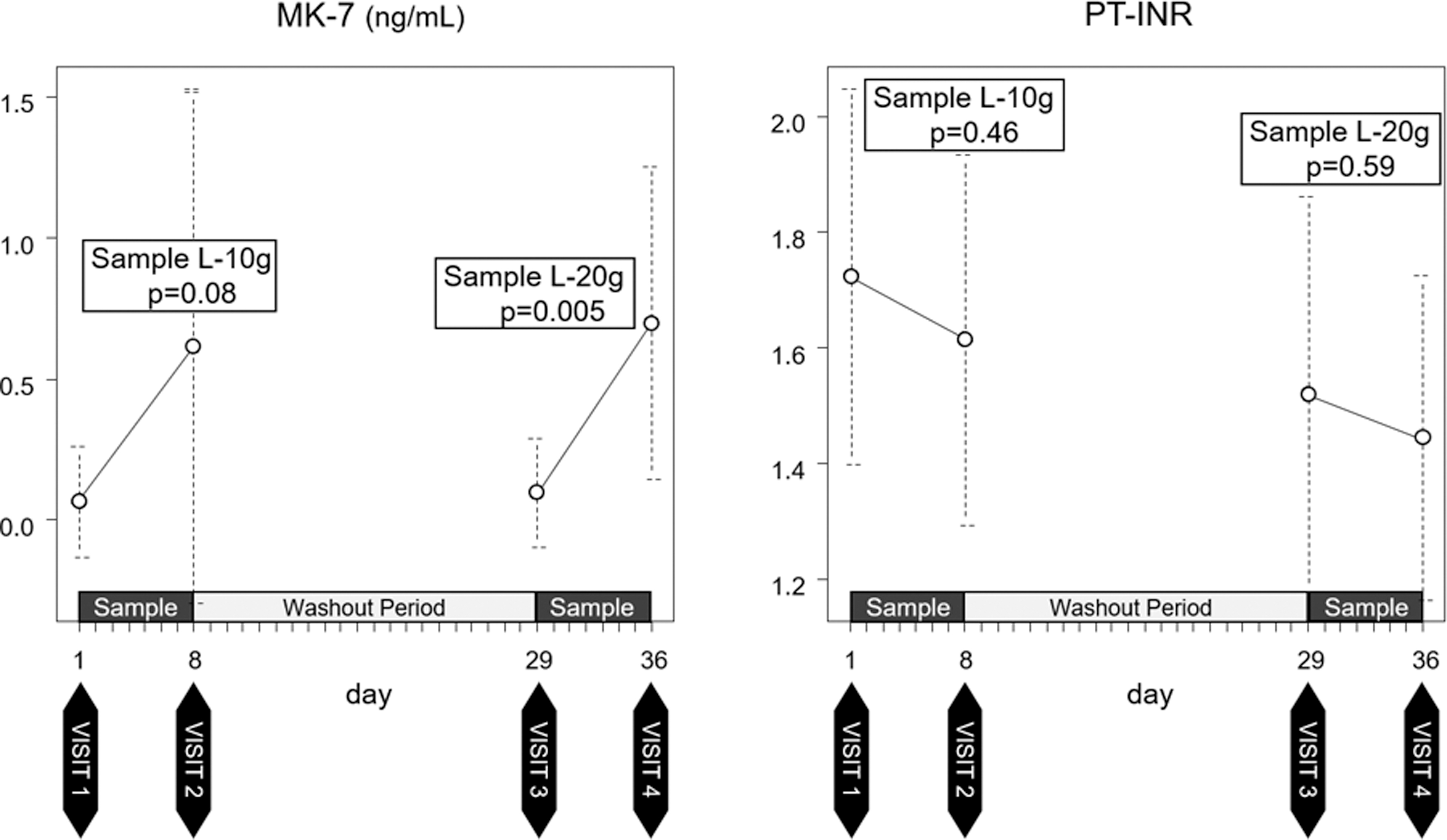
Changes in patient plasma MK-7 levels and PT-INR in clinical trials with 10 g and 20 g of the low MK-7 natto. MK-7: menaquinone-7, PT-INR: international normalized ratio of prothrombin time, Sample L-10g: 10 g of the low MK-7 natto, Sample L-20g: 20 g of the low MK-7 natto.
In the further 7-day trial with Sample L-20 g, plasma MK-7 levels significantly increased (P = .005). However, PT-INR had no significant changes (P = .59). No patient needed dosage adjustment during the trial period since PT-INR values were within the therapeutic range.
VISIT 1 to 2 sample powers were 0.16 for PT-INR and 0.60 for MK-7, whereas VISIT 3 to 4 values were 0.10 and 0.91, respectively.
Discussion
We are the first to report a novel, low MK-7 natto for warfarin-dependent patients. We conducted a 7-consecutive-day feasibility trial for warfarin patients as a proof of concept for our low MK-7 natto. We achieved our goal by overcoming two major issues.
Preventing warfarin interference by radical MK-7 reduction was the top development concern. While MK-7 levels in standard commercial natto are roughly 90–120 μg/10g, our low MK-7 natto only contains ∼23 μg of MK-7 per 10 g. At about 20 and 50 μg per 10 g, our low MK-7 natto is thus equivalent to boiled broccoli and fried spinach. 10
After absorption, vitamin K upregulates coagulation factor production and warfarin inhibits the enzymes at two parts in the vitamin K cycle, enhancing anticoagulation and bleeding. 3,4 Various forms of vitamin K, like PK and menaquinones (MKs), have differing bioactivities. MK-7 decreases PT-INR more remarkably than PK, 11 thus increasing clot risk. In addition, PK, contained within chloroplast membranes, is not absorbed as efficiently as MK-7, 4 meaning that the acceptable daily intake of vitamin K, based largely on PK, is not equivalent to MK-7. This implies that tolerable upper limits of MK-7 intake require establishment aside from conventional PK data. Since our preclinical trial revealed that intake of standard natto increased plasma MK-7 levels but not plasma MK-4 or PK levels, MK-7 intake limits are thus more relevant to PK in natto evaluation. A previous report proposed that MK-7 intake of up to 50 μg per day would not inhibit warfarin activity, 11 and our novel natto (∼46 μg/day) does not exceed this criterion.
Normal plasma MK-7 levels are not clearly defined but several reports suggest ranges of between 0.7 and 6.3 ng/mL. 12,13 Plasma MK-7 levels do increase with natto intake, 8 and once-per-week natto consumption results in plasma levels of 0.9–1.2 ng/mL. 14 In comparison, plasma MK-7 levels after 20 g of the low MK-7 natto in our clinical trial were even lower. However, as a limitation of this study, a 7-day trial may not be sufficient for observing peak or homeostatic levels of plasma MK-7. Although we saw no significant plasma elevation of MK-7 after 10 g of the low MK-7 natto, levels may take up to 2 weeks to plateau according to a previous report. 11 However, as plasma MK-7 levels reach a near-plateau state within the first week, the longer half-life of MK-7 15 may stabilize plasma concentrations after a 7-day ingestion.
Our results found that up to ∼46 μg of MK-7 (20 g of the low MK-7 natto) per day (reflective of green vegetable intake for 7 consecutive days) is acceptable, consistent with a previous proposal that MK-7 intake of up to 50 μg/day would not inhibit warfarin activity. 11 Even in warfarin-dependent patients, eating low MK-7 natto may be beneficial, since vitamin K plays essential roles in skeletal and vascular metabolism, 4,16 and at least 45–90 μg/day of MK-7 is recommended for bone turnover. 17,18
The second important issue was maintaining natto's characteristics, especially flavor and stringiness. Our novel processing method produced acceptable flavor and texture, fueling hope for further commercial-scale development of this novel, low MK-7 product for daily use. As power calculations indicate a high probability that plasma MK-7 concentration was not increased by our natto, such results serve as the foundation for larger studies to confirm maximum acceptable daily intake and long-term safety.
In conclusion, our low MK-7 natto does not significantly change PT-INR values if ingested at a once-daily maximum of 20 g. This novel food product is suitable for Japanese warfarin-dependent patients.
Footnotes
Author Disclosure Statement
Yuki Taya and Takanobu Nishikawa are employees of Takano Foods Co. Ltd. The other authors have no conflicts of interest.
Funding Information
This work was supported by Grants-in-Aid for Scientific Research from the Japan Society for the Promotion of Science [Scientific Research 16K12736, 2016–2018].