




Abstract
Advancing age is one of the risk factors for developing many diseases, including cancer, cardiovascular disorders, and neurodegenerative alterations, such as mild cognitive impairment (MCI), and Alzheimer's Disease (AD). Studies have indicated that supplementation with resveratrol (RSV) might improve cerebrovascular function and reduce the risk of developing dementia. Thus, the aim of this systematic review was to assess the effects of RSV on MCI and AD. MEDLINE-PubMed, Cochrane, and EMBASE were used to perform the search, and PRISMA guidelines were followed. Five studies met the eligible criteria; three with AD and two with MCI. In AD patients, the use of RSV reduces Aβ levels, improves brain volume, reduces the Mini-mental status score, and improves AD scores. In patients with MCI, this polyphenol prevents decline in Standard Volumes of Interest and increases the Resting-state Functional Connectivity score. RSV can activate the human silent information regulator 2/sirtuin 1 (Sirt-1) and can inhibit the cyclooxygenase-2 (COX-2), 5-lipoxygenase, and nuclear factor-κB, resulting in the reduction of the proinflammation pathways. It is also associated with the increase in the levels of interleukin (IL)-10 and reduction of interferon-γ and IL-17. Both anti-inflammatory and antioxidant effects can be related to preventing neurodegenerative diseases, doing maintenance, and enabling the recovery of these conditions directly related to inflammation and oxidative stress. We suggest that the use of RSV can bring beneficial effects to patients with MCI or AD.
INTRODUCTION
The current trend is that the world population will age more and more. The expectation is that in 2050, the global population will reach almost 10 billion people and that the predominant age group will be people over 60 years. Although the increase in life expectancy is celebrated, aging affects the brain, molecules, cells, vasculature, gross morphology, and cognition. 1 –3
Aging is an essential risk factor for many diseases, including cancer, cardiovascular disorders, and neurodegenerative diseases, such as dementia and mild cognitive impairment (MCI). Dementia is a progressive disease associated with the irreversible impairment and loss of cognitive abilities. The causes of dementia are numerous and include neurological, neuropsychiatric, and primary medical conditions. 1,4 –6 MCI is a heterogeneous clinical syndrome resulting from a modification in cognitive functions and reduced neuropsychological testing. Despite this, the daily activities remain relatively intact. It consists of a risk state for cognitive and functional deterioration, with ∼15% of the people falling ill with dementia per year. 7
Late-onset Alzheimer's disease (LOAD) is the most prevalent form of dementia, and it corresponds to memory deterioration and other cognitive domains that lead to death within 3 to 9 years after diagnosis. 8 –10 There are over 50 million people presenting dementia worldwide, and 60% to 70% are diagnosed with Alzheimer's disease (AD) (affecting almost 6 million people over 65 years in America). The incidence of AD doubles every 5 years. Some studies have shown 1275 new cases per year per, 100,000 people over 65 years. 8,11 –14
Current evidence suggests that 25–30% of ischemic stroke survivors develop immediate or delayed vascular cognitive impairment. The second most common dementia is vascular dementia (VaD). The risk factors for cognitive impairment and dementia after stroke are multifactorial, including older age, family history, genetic variants, and lifestyle. 15 –18
Moreover, even in this worrying scenario, all the pharmacological treatments for dementia are symptomatic, with low effects on cognitive function measures. Moreover, the available medications cannot block the progress of dementia. 19,20
Studies have been conducted to find new and more efficient therapies. However, this has been in vain. This failure has led to the reconsideration of other mechanisms for dementias, especially AD, which may generate new approaches or therapeutic opportunities. 21,22 Due to the diversity and multiplicity of pathogenic elements, it is conceptually improbable that putative therapeutic agents applied alone can halt the disease's progression or prevent it. In the last two decades, the vast experience showing the negative results of therapeutic trials with unique agents supports this conclusion and reinforces the active participation of lifestyle in the disease's development and progress. 23,24
Resveratrol (RSV) is a polyphenol compound commonly found in red wines and berries' skin. It is one of the most investigated natural compounds in aging research. RSV is associated with improving cardiometabolic conditions and results in longevity in many living organisms. 25 –28 Studies with humans have indicated that supplementation with this polyphenol can improve cognition and cerebrovascular function, and decreases the risk of developing dementia (EVANS et al., 2016). Other human studies have shown that it enhances immunity, reduces markers of neuroinflammation and oxidative stress, and decreases the burden of neurodegenerative disease. 29 –32
Since RSV has shown relevant effects in preventing various aspects of the aging process this study aims to systematically review this compound's effects on MCI and AD.
METHODS
Focal question
The focal question for this review was Does RSV promote beneficial effects on MCI or AD?
Data sources
For this review, the authors searched the MEDLINE-PubMed, Cochrane, and EMBASE databases following the PRISMA guidelines (Preferred Reporting Items for a Systematic Review and Meta-analysis). 33 This study's conduction was stipulated in a protocol that was registered with the PROSPERO International Prospective Register of Systematic Reviews under the registration number CRD42020221182.
The research included Randomized Clinical Trials (RCT), and the combination of terms and mesh terms used for this search was MCI or dementia or VaD or AD and RSV.
Based on the references from these keywords, we built the flow diagram (Fig. 1) that shows the RCT selection and inclusion and exclusion of studies. Other studies on RSV and dementias were used to build the discussion.

Flow chart showing the studies' selection according to PRISMA guidelines (MOHER et al., 2009).
Eligible criteria and study selection
Only articles published in English from the last 10 years showed correspondence with the keywords selected.
The eligibility criteria for this review followed the PICO (Population, Intervention, Comparison, and Outcomes) format for RCT. The studies involving patients with dementia who were treated with RSV were included. Only full articles published in the consulted databases were selected.
The exclusion criteria were articles not in English, cross-sectional studies, cohort studies, case reports, poster presentations, and letters to the editor.
Extraction of data
The extraction of the information data was performed independently by two judges who used the predefined inclusion and exclusion criteria and the descriptors presented above. Data were extracted from eligible articles that included the author, date, sample size, study design, information related to the use of RSV, and its relationship with dementia. Only original articles were selected for the construction of Table 1.
The Use of Resveratrol on Alzheimer's Disease and Mild Cognitive Impairment
Aβ40, 40 amino acid proteolytic product from the amyloid precursor protein; Aβ42, 42 amino acid proteolytic product from the amyloid precursor protein; AD, Alzheimer's disease; ADCS-ADL, change in activities of daily living; ADL, activities of daily living; CSF, cerebrospinal fluid; HbA1c, glycated hemoglobin; MCI, mild cognitive impairment; MMSE, mini-mental status examination; MRI, magnetic resonance imaging; Oz, ounce; RSFC, resting-state functional connectivity; RSV, resveratrol; sVOI's, standardized volumes of interest.
Quality assessment
The risk of bias (randomization, selection, detection, and reporting bias of each RCT) was evaluated according to the Cochrane Handbook for Systematic Reviews of Interventions.
RESULTS
Table 1 shows five studies (RCT) in the final selection of the research. Three studies included patients with AD, 29,34,35 and two were performed on patients with MCI. 36,37 These studies included 201 patients, 151 with AD (83 women and 68 men), 52 with MCI (26 women and 24 men). The patients aged between 49 and 80 years (a study did not inform the gender of the participants).
DISCUSSION
Aging and dementia
Aging is a significant risk factor for diminished physical and mental health and other neurodegenerative diseases. Brain morphology and physiology present considerable heterogeneity, suggesting that they change at different rates between individuals due to differences in genotype, environment or lifestyle, and disease. The aging process affects molecules, cells, vasculature, gross morphology, and cognition. As we age, our brain reduces in volume, particularly in the frontal cortex (Fig. 2). 2,38,39
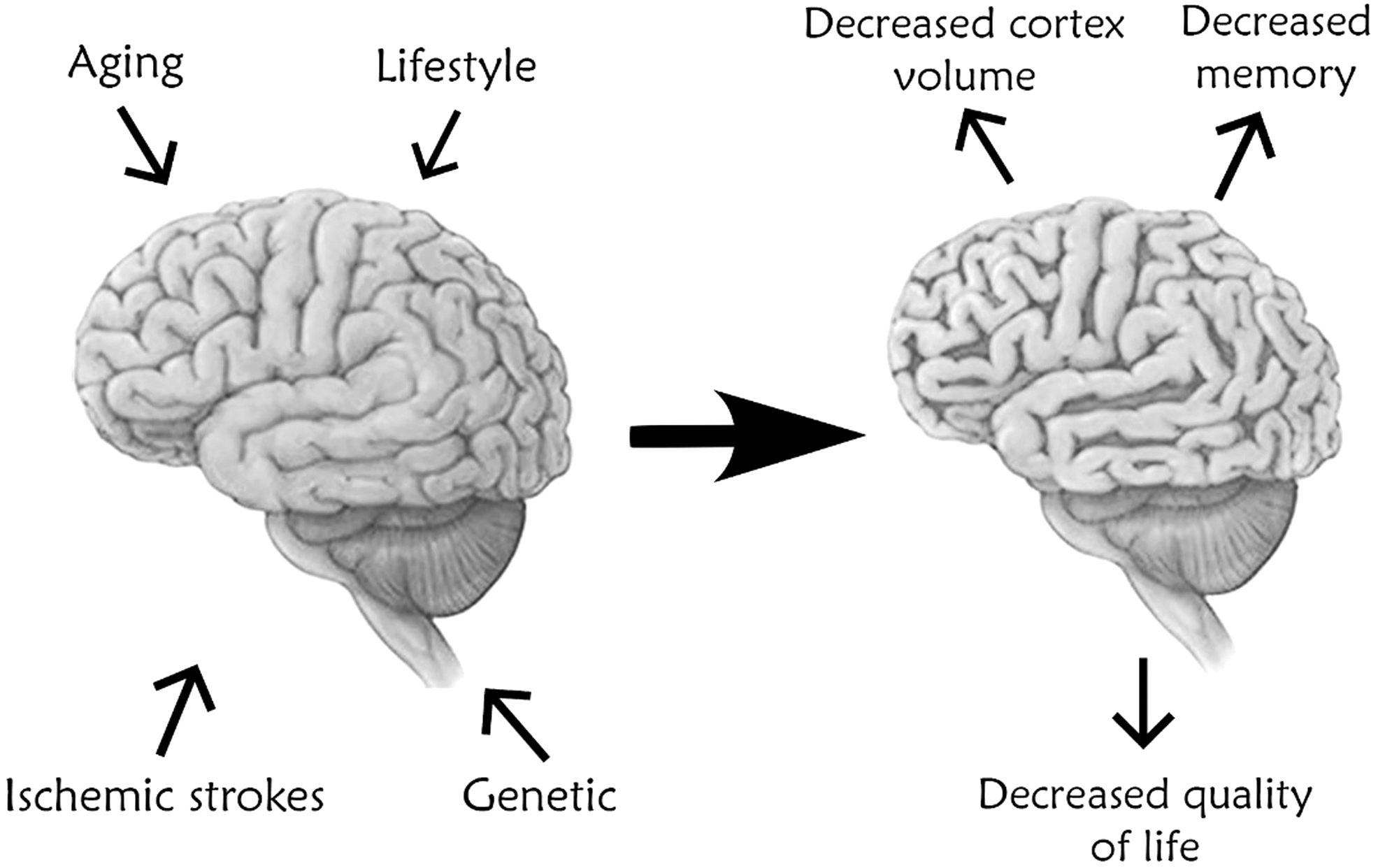
The effects of aging, lifestyle, ischemic strokes, and genetic factors on the brain resulting in decreased cortex volume, memory, and leading to poor quality of life.
The neurotransmitters most often discussed concerning aging are serotonin and dopamine. The dopamine levels reduce ∼10% per decade from early adulthood and may be associated with motor performance and cognition reductions. It may be that the dopaminergic process between the striatum and frontal cortex reduces with age, or the levels of dopamine itself decline, synapses/receptors reduce, or the binding to the receptors is impaired. 2,40,41
The serotonin and brain-derived neurotrophic factor levels also fall with aging and may be related to the neurogenesis and regulation of synaptic plasticity in the adult brain. 42 A substance related to neurotransmitter levels, the monoamine oxidase augments with age and may produce free radicals (VOLCHEGORSKII et al., 2004). Other factors implicated in the aging brain include calcium dysregulation, mitochondrial dysfunction, inflammation, and reactive oxygen species. 43 –46
Dementia is a progressive condition linked to the irreversible impairment and loss of cognitive abilities. The causes of dementia are numerous and include neurological, neuropsychiatric, and primary medical disorders, such as the factors discussed above. It is common for various diseases to contribute to the dementia syndrome. 1,4,5,47,48 Dementia is related to the deterioration of memory, thinking, learning, comprehension, decision making, and behavior. There are several subtypes of this condition that have distinct genetic and molecular etiologies. The spectrum of dementia includes LOAD, VaD, Lewy body dementia, and frontotemporal dementia. MCI is considered the mid-point between regular cognition and dementia and can share many molecular and pathological hallmarks with dementia. 49,50
Mild cognitive impairment
MCI is a transition between the normal aging process and dementia that affects older adults with cognitive, functional, and memory impairment. Understanding MCI is crucial since a significant percentage of the patient's progress to dementia will result in a severe impairment of their quality of life and increase their social and economic burden. For these reasons, early diagnosis and intervention could delay or even reverse the condition's progress due to which, it is a significant public health priority. 51
Although the aging process is the most decisive risk factor for MCI, there are other well-known factors such as the family history of cognitive impairment, the presence of the allele for apolipoprotein E, male sex, and the occurrence of vascular risks that may include hyperlipidemia, hypertension, coronary artery disease, and stroke. Type 2 diabetes mellitus (T2DM), obesity, alcohol intake, sedentary lifestyle, depression, vitamin B12 deficiency, and an unhealthy diet can also be related to MCI. Some authors have shown that controlling these associated risk factors in MCI subjects can effectively retard the onset and development of dementia. 7,52
Some medical disorders are associated with MCI, such as cerebrovascular accidents, traumatic brain injuries, Parkinson's, and Huntington's disease. Usually, the condition starts with cognitive impairment and then, the onset of the disease course. The cognitive impairment or behavioral symptoms can occur early in the disease with disorders that primarily affect cognition, such as AD, VaD, Lewy body disease, and frontotemporal dementia. 50,52
Alzheimer's disease
LOAD is the most seen form of dementia and corresponds to memory deterioration and other cognitive domains that lead to death within 3 to 9 years after diagnosis. Combined, AD and intracerebral vascular disease are responsible for another 13% to 17% of the cases. 8 –10
The main risk for AD is age and lifestyle, hypertension, dyslipidemia, and obesity in middle age, diabetes mellitus, smoking, physical inactivity, depression, and low levels of education. 8,11 –13
AD is characterized by the accumulation of Aβ and hyperphosphorylated tau. Many molecular lesions have been detected in this disease, but the pathology's cardinal features are amyloid plaques and neurofibrillary tangles (NFTs). Dystrophic neurites, neuropil threads, associated astrogliosis, and microglial activation are observed, and cerebral amyloid angiopathy frequently coexists. The downstream consequences of these pathological pathways include inflammation, oxidative stress, and neurodegeneration with synaptic and neuronal loss leading to macroscopic atrophy, and consequently, dementia. 53 –57
Researchers have conducted extensive studies on AD in the past few years, but its pathogenesis is not completely clear, and no effective treatment is available. Many studies have focused on the synthesis and degradation of Aβ and the impairment of tau's phosphorylation. 58 Others have focused on new possibilities, such as using compounds that can reduce inflammation and oxidative stress. 59 –61
Treatment of dementia
As we mentioned above, the pharmacological treatments for dementia are symptomatic and cannot paralyze the progress of this condition. Clinical trials were performed for LOAD, acetylcholinesterase inhibitors, and N-methylpartpartate (NMDA) antagonists. 19 Acetylcholinesterase inhibitors neutralize the low levels of acetylcholine (ACh) that contribute to memory impairment in dementia. 1
Pharmacological treatments for neurodegenerative diseases are symptomatic, with low effects on the measures of cognitive function. The available medications do not block the progress of dementia; they do not inhibit neuronal degeneration and do not directly interfere with the pathophysiology of the disease. Other points to be considered include the high cost of standard medications, the lack of responsiveness of many patients, and the numerous adverse effects. For these reasons, other therapies have been considered to maintain and promote health or as a therapeutic approach in older adults. These therapies can contribute to cognitive disorders and other chronic diseases. In this context, RSV has shown itself as a promising compound in the therapeutic approach of neurodegenerative diseases. 19,20,62,63
Almost all treatment trials in recent decades have attempted to correct just a single element (usually amyloid) of the disturbing molecular pathology. Besides the deposits of amyloid plaques and NFTs, the anatomical and physiological neuropathology of dementia involve impaired functions in parts of the brain, particularly in the hippocampus and frontal cortex: the cholinergic defects in the adrenergic neurons, extensive subcellular pathophysiology, and disturbed molecular pathology. 21,24,64,65 Indeed, astrocytes and the microvasculature play essential roles (FESSEL, 2017). Genetic factors, lifestyle, diet, and the contributions from systemic diseases such as hypertension, cerebrovascular disease, and diabetes are also associated. 11 –13
Despite the recently Food and Drug Administration (FDA)-approved Aducanumab and due to the diversity and multiplicity of pathogenic elements, it is difficult to say that putative therapeutic agents applied alone can halt the disease's progression or prevent it. The vast experience in the last two decades of negative results of therapeutic trials using unique agents supports this conclusion and reinforces the active participation of lifestyle in the process of forming the disease. 23,24,66 Therefore, interventions that influence the aging process can be a valuable part of this therapeutic arsenal.
RSV, AD, and mild cognition impairment
RSV is represented by 3,4,5 trihydroxystilbene, a non-flavonoid polyphenolic component synthesized in response to several plant species' bacterial and fungal attacks. Grapes are probably the most well-known sources of RSV that can be found in the skin, leaf, bud, stem, and seed. Massive amounts are found in the grape skin and less in wine or juice. 27
RSV can exert significant anti-inflammatory, antioxidant, antiproliferative, and chemopreventive effects (Fig. 3). Studies have shown that it can stimulate antioxidant genes through nuclear factor (erythroid-derived 2)-like (Nrf2). Moreover, it can induce the expression of antioxidant enzymes such as glutathione peroxidase, superoxide dismutase, heme-oxygenase, and catalase and can reduce the oxidation of a plethora of molecules, including glucose and low-density lipoprotein-cholesterol. 67,68

General effects of RSV that can be related to the improvement of cognition and brain functions. RSV, resveratrol.
This polyphenolic compound can also activate the human silent information regulator 2/sirtuin 1 (Sirt-1). It can inhibit cyclooxygenase-2 (COX-2), 5-lipoxygenase, and the nuclear factor-κB, reducing the proinflammation pathways. It is also associated with the increase in the levels of interleukin (IL)-10 and the reduction of interferon-γ and IL-17, suggesting its association with the resolution of inflammatory processes. 69,70
Both anti-inflammatory and antioxidant effects of RSV lead to different systemic actions on different cell types, tissues, and organs. These effects can be associated with preventing neurodegenerative diseases, maintenance, or recovery of these conditions directly related to inflammation and oxidative stress. 71 –74
One relevant pathway affecting the development of AD is the ubiquitin-proteasome system; this is a primary proteolytic mechanism to impaired clearance proteins such as Aβ and p-Tau. AD models have shown that RSV improves proteosome functionality, increases Aβ clearance, and reduces protein synthesis by stimulating proteasomal proteolysis, as observed in cell lines APP695 and an AD's Caenorhabditis elegans model. Moreover, RSV decreases mitochondrial dysfunction and can also induce autophagy and mitophagy, as observed in vivo model. 62,75 –78
RSV can reduce free radicals' release by inhibiting the nicotinamide adenine dinucleotide phosphate oxidase in vivo models and can promote the expression of antioxidant enzymes including catalase, superoxide dismutase, and glutathione peroxidase 79,80 leading to beneficial effects to AD.
Other authors investigated the effects of RSV on brain functions. An Australian randomized, double-blind, placebo-controlled trial involved 26 men and 10 women who were dementia-free and non-insulin-dependent T2DM older adults (49–78 years). The participants consumed synthetic trans-RSV (0, 75, 150, and 300 mg). Transcranial Doppler ultrasound was used to assess cerebrovascular responsiveness to a hypercapnic stimulus before and after 45 min of treatment. This study provided the first clinical evidence of the enhancement of the vasodilator responsiveness in the middle cerebral arteries and posterior cerebral arteries after the consumption of RSV (maximum improvement was observed with the lowest dose used) in a population who are known to have endothelial dysfunction and sub-clinical cognitive impairment. Moreover, RSV was well tolerated in the studied doses. However, researchers had difficulties performing the analysis due to the technical limitations of using transcranial Doppler ultrasound to evaluate the vessels. Thus, data from the posterior cerebral artery were obtained in less than half of the cohort due to challenges of deep posterior vessels. Furthermore, the results were compromised due to the sample number. 81
The first long-term study of RSV supplementation effects in postmenopausal women was developed in another Australian randomized, double-blind, placebo-controlled trial with 129 women who were 12 months post menopause and in the age bracket of 45 to 85 years. 82 Patients were randomized to take placebo or 75 mg trans-RSV two times daily for 12 months after which, they crossed over to the alternate treatment for another 12 months.
Compared to placebo, RSV improved the overall cognitive performance and attenuated the decline in CVR to cognitive stimuli. The adverse effects were itching (n = 1), exacerbation of gastric reflux (n = 1), and constipation (n = 1). The 12-month duration increases confidence in the sustainability of any benefits and eliminates seasonality influences on the outcomes. This is the first clinical trial to examine the effects of long-term RSV supplementation on multiple health outcomes in postmenopausal women and subgroups defined by age and menopausal status.
In the same sample, Thaung et al. 83 showed that a twice-daily low-dose RSV supplementation is well tolerated, resulting in a 33% improvement in the overall cognitive performance. Indeed, RSV improved the secondary outcomes, including cerebral blood flow velocity and cerebrovascular responsiveness, fasting insulin, and insulin resistance index. Moreover, 88% of the women reported that they would be likely to continue with RSV supplementation after the conclusion of the study. This could be partly due to the positive improvements that the participants perceived during the supplementation period.
Table 1 shows the studies included in our systematic review, and Table 2 shows the bias risk assessment for the included studies.
Descriptive Table Showing the Biases of the Included Randomized Clinical Trials
NR, not reported.
The study of Turner et al. 34 showed that RSV and its metabolites probably cross the blood-brain barrier (BBB). The authors have found exciting results and carried out the trial with more than 100 participants and did not have such a significant segment loss. However, although some biomarker trajectories were altered, they found no treatment effects on plasma Ab42, CSF Ab42, CSF tau, CSF phospho-tau 181, hippocampal volume, entorhinal cortex thickness, MMSE, CDR, ADAS-cog, NPI, glucose, or insulin metabolism. The altered biomarker trajectories must be interpreted with caution. Although they suggest the effects of RSV on the central nervous system, they do not indicate the benefits. A study with a larger sample of patients is required to determine whether RSV may actually be beneficial.
However, a pilot study that examined the impact of grape intake on cognitive function and brain metabolism in participants with a mild decline in cognition showed positive results. The placebo arm showed declines in the brain regions significantly affected in the early stages of AD, while the active formulation group spared such decline. This can suggest a protective effect of grapes against early pathologic metabolic decline. However, the authors included only a small sample size. 36
Other studies encourage further validation of the hypothesis that RSV may seal off a leaky BBB and contribute to cognitive and functional improvement in a larger follow-up study with AD patients. The authors suggested that RSV decreases CSF MMP9, modulates neuroinflammation, and stimulates adaptive immunity. SIRT1 stimulation may be a viable target for the treatment or prevention of neurodegenerative disorders. However, the authors did not present the patients' age and gender beyond the limited evidence of significant clinical benefits and the risk of excessive neuroinflammation. 29
A proof-of-concept study showed for the first-time that RSV can reduce glycated hemoglobin (HbA1c), preserve the hippocampus's volume, and improve hippocampus RSFC in at-risk patients for dementia. Some limitations should be addressed when interpreting these findings, such as the small sample in both groups. 37 More studies are needed to find whether these benefits can be validated and extended to cognitive functions as well.
The study of Zhou et al. 35 showed no conclusive results that the use of RSV could slow the progression of AD, although the authors observed improvement in some AD scores. However, the authors explain that more patients were needed for the study according to the sample calculation. As they have had difficulty in retraining, their results may not be conclusive. Thus, a larger sample is needed to determine whether low-dose RSV can be beneficial.
In conclusion, since neurodegenerative diseases such as AD have a significant financial burden and social impact, it is crucial to find new therapies that could reduce their frequencies and worsen. Our review shows that RSV is an adjuvant to the patients' therapeutic approach and can be used in the prevention or treatment once it is related to anti-inflammatory and antioxidant effects related to reducing biomarkers and disease scores.
Footnotes
AUTHORS' CONTRIBUTIONS
Conceptualization: S.M.B., L.T.M., and D.B.S.; Literature search: E.L.G. and A.C.A.; Writing: S.M.B., D.B.S., and L.T.M.; Review and editing: S.M.B., L.T.M., D.B.S., E.L.G., R.A.G., and A.C.A.
AUTHOR DISCLOSURE STATEMENT
No competing financial interests exist.
FUNDING INFORMATION
No funding was received for this article.