




Abstract
The extract of Clematis mandshurica Rupr. (CMR) inhibits the production of proinflammatory mediators from lipopolysaccharide-stimulated peritoneal macrophages and concanavalin A-stimulated splenocytes. Erigeron annuus Pers. (EAP) extract suppresses the production of reactive oxygen species (ROS) from preadipocytes. Furthermore, the mixture of the leaf extracts of CMR and EAP, YES-10®, protected against nerve injuries induced by ischemia/reperfusion, suggesting a ROS-scavenging action. These observations show the anti-inflammatory action of YES-10. Inflammatory cytokines can cause alterations in mental function, including depression, by influencing the neurotransmitter system. Thus, it was hypothesized that YES-10 could improve mental health, such as depression, anxiety, and sense of well-being. Seventy-two subjects were recruited and randomly divided into YES-10 or placebo groups (n = 36 per group). Each group was daily administered two capsules orally, containing 200 mg of YES-10 or placebo, for 4 weeks in a double-blinded manner and tested for levels of depression, anxiety, well-being, and mental fitness using the Beck Depression Inventory (BDI), Beck Anxiety Inventory (BAI), Psychosocial Well-being Index (PWI), and Mental Fitness Scale (MFS). In addition, the levels of cortisol (a stress hormone), interleukin-6 (IL-6) (an inflammatory cytokine), and 8-hydroxydeoxyguanosine (8-OHdG; a marker of oxidative stress) in the serum were measured. The BDI, BAI, PWI, and MFS scores decreased significantly, and the serum levels of cortisol, IL-6, and 8-OHdG were lowered significantly (P < .05), suggesting that YES-10 has the ability to improve mental health by relieving stress and by decreasing inflammation and oxidative stress.
INTRODUCTION
C
Traditionally, EAP is known for its antipyretic, anti-inflammatory, and hypoglycemic effects. Recently, the water extract of dried leaves and stems of EAP was observed to inhibit reactive oxygen species (ROS) production and fat accumulation in 3T3-L1 preadipocytes by activating the AMP-dependent kinase signaling pathway. These findings support the known anti-inflammatory and hypoglycemic effects of EAP. 3,4
The efficacies of these plants have further been confirmed in animal studies using a 1:1 mixture of the leaf extracts of CMR and EAP, named YES-10®. 5,6 Administration of YES-10 was shown to protect neurons from ischemia and attenuate reactive gliosis in the hippocampus after ischemia/reperfusion in gerbils. 5 Based on the fact that the damage induced by ischemia/reperfusion is caused by ROS production, the observed neuroprotective action of YES-10 may be due to antioxidant action. 6
Recently, inflammatory cytokines have been suggested to contribute to the development of depression in both ill and healthy individuals. 7 Cytokines are important for development and normal brain function, and they can influence the neurocircuitry and neurotransmitter systems to produce behavioral alterations. 8 Mechanisms of cytokine behavioral effects involve the activation of inflammatory signaling pathways in the brain, resulting in changes in monoamine, glutamate, and neuropeptide systems, and decreased growth factors, such as brain-derived neurotrophic factor. 7,8
On the contrary, CMR extract was shown to suppress the production of inflammatory cytokines from stimulated inflammatory and immune cells. 1 The EAP extract was observed to inhibit ROS production in adipocyes. 4 YES-10, a mixture of the CMR and EAP extracts, protected against brain injuries induced by ischemic insult, indicating its ability to suppress oxidative stress. 6 These observations strongly suggest that YES-10 exerts anti-inflammatory effects by suppressing oxidative stress.
Based on the fact that ROS are important mediators of inflammation, 9 YES-10 can exert anti-inflammatory action and is thus assumed to influence the mental or psychological state. In this study, we aimed to test this by observing the effect of YES-10 oral administration on depression, anxiety, well-being, and mental health in normal human subjects. To provide biochemical evidence for the action of YES-10, the serum levels of cortisol, interleukin-6 (IL-6), and 8-hydroxydeoxyguanosine (8-OHdG) were also measured.
MATERIALS AND METHODS
Preparation of YES-10
YES-10 was obtained from Famenity (Uiwang-si, South Korea). The aerial parts of CMR and EAP were selected and pulverized, and the extracts were produced using the patented method of Famenity. The resulting CMR extract suspension was filtered and concentrated to form a solid precipitate using spray dryer, and the EAP extract was also prepared using the same procedure. 5,6 These extracts were mixed in a 1:1 (w:w) ratio to yield YES-10, which was then formulated into capsules. Each capsule contained 200 mg YES-10. Identical hard gelatin capsules were filled with dextrin for use in the placebo group. The test and placebo capsules were administered twice daily for 4 weeks.
Human subjects
Seventy-two human subjects were recruited based on the following criteria: (1) age ≥20 years, (2) perceived stress-related mental health problem within 1 month, (3) able to communicate with the investigator and comply with the test regulations, and (4) voluntarily signed the written consent for participation in this study after listening to explanations regarding the purpose, procedures, and effects of the study.
The subjects were excluded based on the following criteria: (1) history of alcohol or drug abuse; (2) current or past mental disorders such as schizophrenia or bipolar disease; (3) received treatments for dementia within the past 3 months; (4) diagnosed with depression, anxiety disorder, post-traumatic stress disorder, or obsessive-compulsive disorder, or administered an antidepressant within the past 3 months; (5) received treatment for thyroid disease or administered a thyroid-related drug; (6) lactating, pregnant, or preparing for pregnancy; (7) not submitting a signed written consent; and (8) deemed unsuitable for this study.
Experimental schedule
The recruited subjects were shown to have depressive symptoms based on questionnaires. They were randomly divided into the YES-10 group (36 subjects) or placebo group (36 subjects). Each group was orally administered two capsules containing 200 mg of YES-10 or placebo for 4 weeks in a double-blinded manner. After 4 weeks of administration, the subjects underwent mental tests for depression, anxiety, well-being, and mental health, as well as blood tests for cortisol, IL-6, and 8-OHdG. This study was carried out according to the International Conference on Harmonization/WHO Good Clinical Practice standards and was approved by the institutional review board of Chung-Ang University College of Medicine (IRB No.: 12-0044).
Mental health tests
To assess the effects of YES-10 on mental function, the following tests were performed on the subjects after oral administration of YES-10 for 4 weeks.
Beck Depression Inventory
This test was developed by Beck et al. 10,11 to measure the level of depression in individuals aged 13 years or older. The questionnaire consisted of 21 items, and the response to each item was assigned a score ranging from 0 to 3, thus reaching a total score of 63. Higher scores indicate higher levels of depression. Scores ranging from 0 to 9 were assessed as minimal depression, 10–18 as mild depression, 19–29 as moderate depression, and 30–63 as severe depression.
Beck Anxiety Inventory
Beck Anxiety Inventory (BAI), developed by Beck et al., 12,13 measures the level of anxiety in individuals aged 17–80 years. The questionnaire consisted of 21 items, and the response to each item was assigned a score ranging from 0 to 3, thus reaching a total score of 63. Higher scores indicate higher levels of anxiety. Scores ranging from 0 to 7 were defined as minimal anxiety, 8–15 as mild anxiety, 16–25 as moderate anxiety, and 26–63 as severe anxiety.
Psychosocial Well-being Index
Psychosocial Well-being Index (PWI) is a tool used to measure psychosocial well-being to standardize stress measurements. 14 Originally, this questionnaire consisted of 60 questions on general health, but it was modified to suit the circumstances in South Korea by removing 15 items through a preclinical study. Thus, the resulting brief questionnaire consisted of 45 items, each was scored based on a 4-point Likert scale (0-1-2-3) that included the answers “not at all,” “sometimes,” “frequently,” and “always.” The scores ranged from 0 to 135.
Mental Fitness Scale
The Mental Fitness Scale (MFS) was developed by Cho et al. 15 to measure mental fitness. It consists of 20 items: 8 items for mental energy, 6 items for empathic communication, 4 items for psychological flexibility, and 2 items for self-conviction. Each item is scored on a 4-point Likert scale (0-1-2-3-4), including answers ranging from “not at all” to “very much so,” and total scores ranging from 0 to 80. Higher scores indicated poorer mental fitness.
Blood tests
After 4 weeks of administration, the effects of YES-10 were also assessed by measuring biochemical indicators in the blood, including cortisol for stress, IL-6 for inflammatory status, and 8-OHdG for oxidative stress. Blood was collected from the subjects, and serum obtained through centrifugation at 2000 g for 10 min was used for biochemical analyses. Cortisol was measured using a cortisol kit (Roche, Mannheim Germany) according to the manufacturer's protocol using an electrochemiluminometer (Cobas 8000; Roche). IL-6 and 8-OHdG levels were measured using the Quantikine HS Human IL-6 Immunoassay kit (R&D systems, Minneapolis, MN, USA) and the 8-OHdG Check ELISA kit (Jaica, Fukuroi, Japan), respectively, according to the manufacturer's protocol. 16 –18
Statistical analysis
Statistical analysis was performed using SPSS 24.0 software (IBM, NY, USA) and P < .05 was considered statistically significant. All data are presented as the means ± standard errors. In all group comparisons, efficacy analysis was based on the intention-to-treat principle.
The independent t-test was used to compare changes from week 0 to week 4 between the two groups. In addition, a paired t-test was used to compare changes from week 0 to week 4 in each group.
RESULTS
Subject characteristics
The experimental group and control group showed no significant differences in age, marital status, total Beck Depression Inventory (BDI) score, body weight, or blood pressure. There was no participant drop outs and adverse events were not apparent during the intervention period.
Effect on BDI score
The YES-10 group BDI score at week 0 was 9.76 ± 1.26, which fell to 6.54 ± 1.02 at week 4. The score decreased significantly compared with the baseline. In the placebo group, the score at week 0 was 8.17 ± 0.96, and the score at week 4 was 8.91 ± 1.19. The score increased, but the increase was not statistically significant. The change in total BDI after 4 weeks showed a significant between-group difference. Compared with the baseline, the BDI score improved by 32.99% in the test group and regressed by −9.06% in the control group after 4 weeks (Table 1 and Fig. 1).

Improved BDI scores after administration of 400 mg/day for 4 weeks. Mean changes of BDI scores are means ± SE. Mean changes were significantly improved in the YES-10® group compared with placebo groups
Summary of the Effects of YES-10 on Different Parameters
Data are expressed as means ± SEs.
The 72 subjects shown to have depressive symptoms based on questionnaires were randomly divided into placebo or YES-10 groups. Each group of 32 subjects was administered two capsules (each containing 200 mg gelatin or YES-10) for 4 weeks in a double-blinded manner. The four tests for mental function and blood assays for biological markers were performed at weeks 0 and 4. The details are described in the Materials and Methods section.
P < .05, compared between groups by t-test.
P < .05, compared with baseline by paired t-test.
8-OHdG, 8-hydroxydeoxyguanosine; BAI, Beck Anxiety Inventory; BDI, Beck Depression Inventory; IL-6, interleukin-6; MFS, Mental Fitness Scale; PWI, Psychosocial Well-being Index; SE, standard error.
Effect on BAI score
The YES-10 group BAI score at week 0 was 8.67 ± 1.38, which fell to 5.37 ± 0.66 at week 4. The score decrease was statistically significant compared with the baseline. In contrast, the scores of the placebo group at weeks 0 and 4 were 6.52 ± 0.88 and 7.91 ± 1.22, respectively. The change in total BAI after 4 weeks showed a significant between-group difference. Compared with the baseline, BAI improved by 38.06% in the test group and worsened by −21.32% in the control group after 4 weeks (Table 1 and Fig. 2).

Improved BAI scores after administration of 400 mg/day for 4 weeks. Mean changes of BAI scores are means ± SE. Mean changes were significantly improved in the YES-10 group compared with placebo groups
Effect on PWI score
The PWI assesses psychosocial well-being. The YES-10 group score at weeks 0 and 4 was 33.46 ± 3.24 and 27.91 ± 2.65, respectively. The score decreased significantly, compared with the baseline. In comparison, the placebo group scores at weeks 0 and 4 were 30.13 ± 2.74 and 31.17 ± 3.05, respectively. The change in total PWI score showed a significant between-group difference after 4 weeks. The PWI at week 4 improved by 16.59% in the test group and decreased by −3.45% in the control group, compared with the baseline (Table 1 and Fig. 3).

Improved PWI scores after administration of 400 mg/day for 4 weeks. Mean changes of PWI scores are means ± SE. Mean changes were significantly improved in the YES-10 group compared with placebo groups
Effect on MFS score
The MFS is a test used to assess mental health. The YES-10 group score at weeks 0 and 4 was 63.85 ± 2.83 and 52.22 ± 2.50, respectively. The score decrease was statistically significant, compared with baseline (P < .05). Conversely, the placebo group scores at weeks 0 and 4 were 59.83 ± 2.20 and 62.67 ± 2.38, respectively. The change in total MFS score showed a significant between-group difference after 4 weeks (P < .05). The MFS at week 4 improved by 18.21% in the test group and regressed by −4.75% in the control group, compared with the baseline (Table 1 and Fig. 4).

Improved MFS scores after administration of 400 mg/day for 4 weeks. Mean changes of MFS scores are means ± SE. Mean changes were significantly improved in the YES-10 group compared with placebo groups
Effect on cortisol and IL-6 serum levels
Cortisol is a well-known stress hormone. 16 The serum level of cortisol in the YES-10 group at week 0 was 10.29 ± 0.70 μg/dL and was 7.46 ± 0.48 μg/dL at week 4. The decrease was 27.50%, which was statistically significant. In comparison, the serum levels in the placebo group at weeks 0 and 4 were 9.23 ± 0.69 μg/dL and 10.27 ± 0.93 μg/dL, respectively. After 4 weeks, the change in serum level cortisol showed a significant difference between groups (Table 1 and Fig. 5).
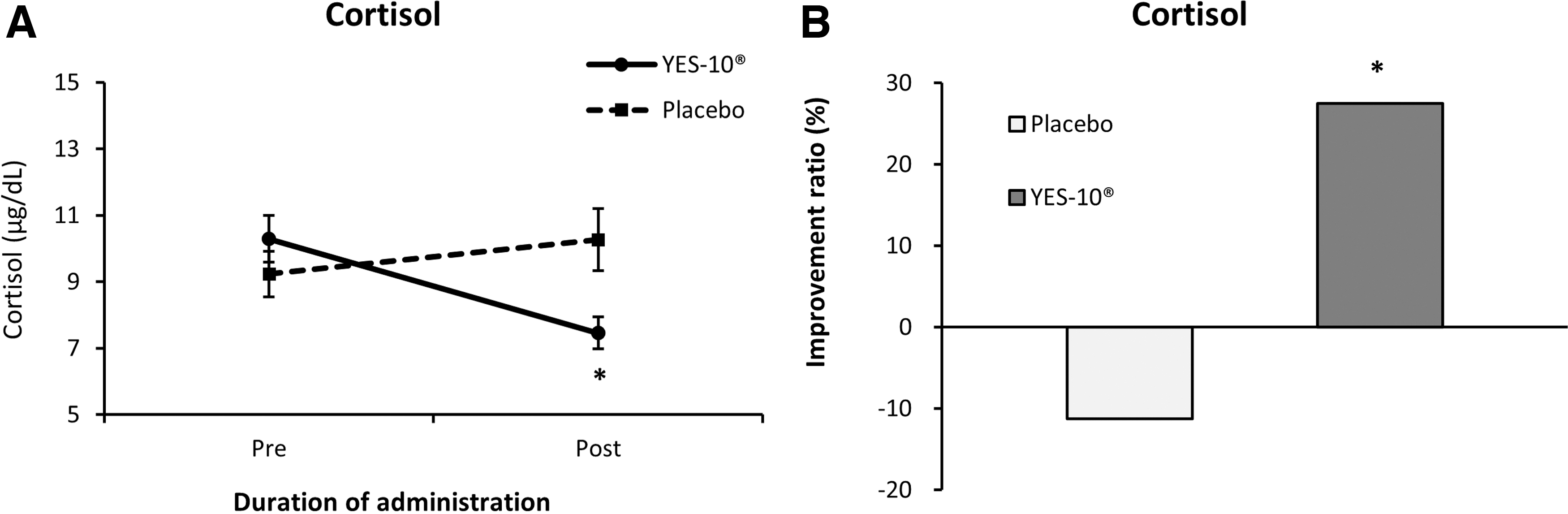
Improved cortisol level in serum after administration of 400 mg/day for 4 weeks. Mean changes of cortisol level are means ± SE. Mean changes were significantly improved in the YES-10 group compared with placebo groups
IL-6 is a potent inducer of acute phase response. Rapid production of IL-6 contributes to host defense during infection and tissue injury, but excessive IL-6 synthesis leads to pathological conditions. 19 The IL-6 serum level in the YES-10 group at weeks 0 and 4 was 1.11 ± 0.15 pg/mL and 0.81 ± 0.06 pg/mL, respectively. The decrease was 27.22%, which was statistically significant. In comparison, the serum levels in the placebo group at weeks 0 and 4 were 1.15 ± 0.25 pg/mL and 2.02 ± 0.43 pg/mL, respectively. After 4 weeks, the change in serum IL-6 level showed a significant difference between the groups (Table 1 and Fig. 6A, B).
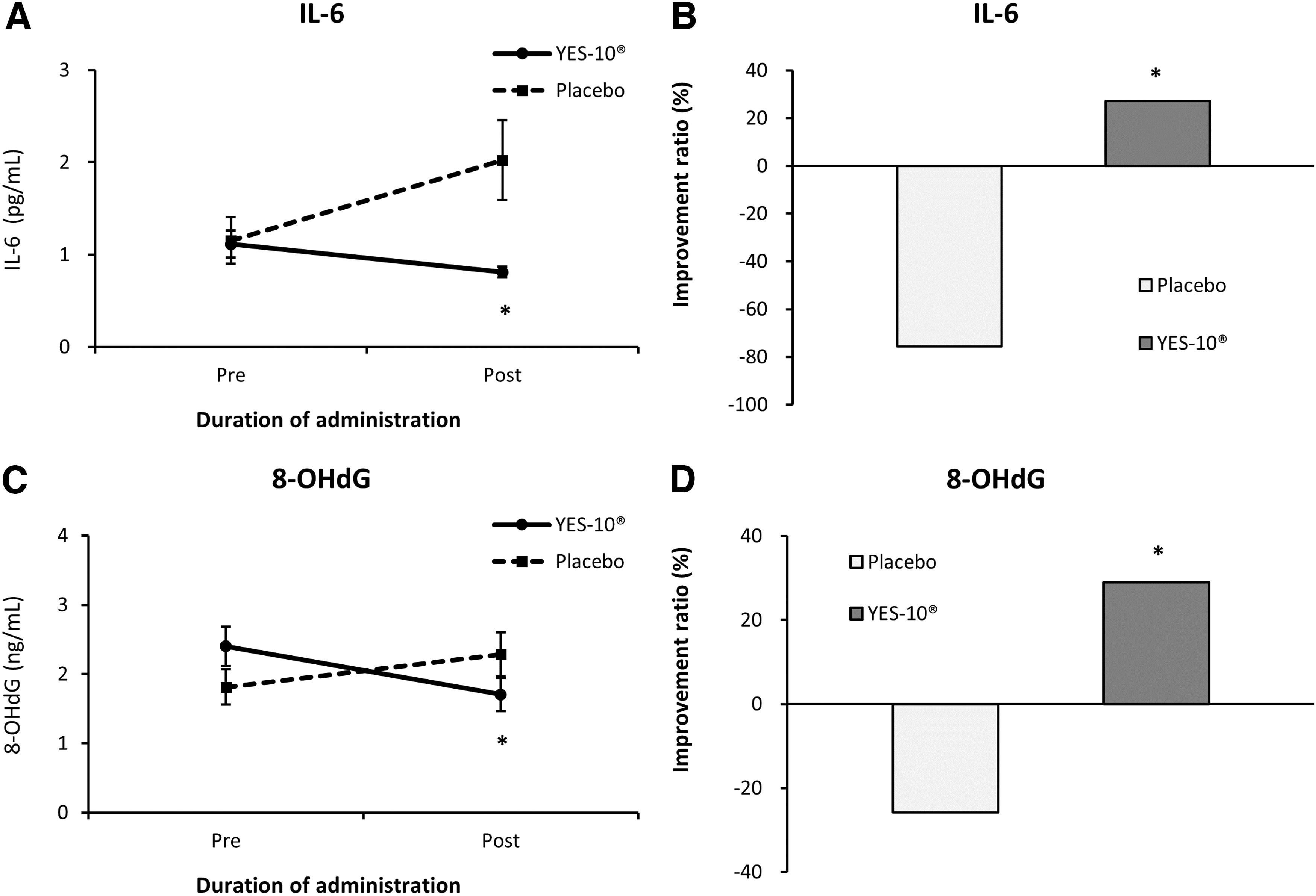
Improved IL-6 level in serum after administration of 400 mg/day for 4 weeks. Mean changes of IL-6 level are mean ± SE. Mean changes were significantly improved in the YES-10 group compared with placebo groups
Effect on 8-OHdG serum level
The serum level of 8-OHdG in the YES-10 group at weeks 0 and 4 was 2.40 ± 0.28 pg/mL and 1.71 ± 0.24 ng/mL, respectively. The decrease was 28.92%, which was statistically significant. Conversely, the serum levels in the placebo group at weeks 0 and 4 were 1.81 ± 0.25 ng/mL and 2.28 ± 0.32 ng/mL, respectively. After 4 weeks, the change in 8-OHdG level was significantly different between the groups (Fig. 6C, D).
Safety evaluation of YES-10
To test the safety of YES-10, the changes in blood levels of aspartate aminotransferase and alanine aminotransferase were observed during the 4-week administration, but no significant changes were observed. There were no significant changes in blood pressure or body weight. Moreover, no side effects were reported in the subjects during the 4 weeks of this study (data not shown).
DISCUSSION
Of the 72 subjects who showed depressive symptoms based on questionnaires, the 36 subjects who were treated with 400 mg orally of YES-10 daily for 4 weeks showed significantly reduced BDI, BAI, PWI, and MFS scores, which are the questionnaires testing levels of depression, anxiety, well-being, and mental fitness, respectively. However, the other 36 subjects who received the same dose of placebo showed increased scores in all tests. The results strongly suggest that YES-10 has the ability to improve mental health and status.
This ability of YES-10 was further supported by the finding that the cortisol, IL-6, and 8-OHdG serum levels in the subjects who received YES-10 were significantly lowered, whereas these levels increased in subjects who received the placebo. The reason why all the scores and serum levels of the subjects receiving the placebo increased is unclear. One possibility is that since the subjects who participated in this study showed depressive symptoms, these symptoms worsened during the 4 weeks of the experiment in the placebo group.
Cytokines are important for the development of normal brain function. Mechanisms underlying cytokine effects on behavior involve activation of inflammatory signaling pathways in the brain that result in changes in the concentrations of neurotransmitters such as monoamine, glutamate, and neuropeptides. More importantly, inflammatory cytokines have been suggested to contribute to the development of depression. 19,20 The CMR extract has been shown to suppress the production of inflammatory cytokines from stimulated inflammatory cells and immune cells. 1 The EAP extract has been observed to inhibit ROS production in these cells. 4 These findings indicate that the two plants exert anti-inflammatory effects. Therefore, YES-10, a mixture of CMR and EAP extracts, is expected to exert anti-inflammatory action, which mediates mental function improvement.
However, the primary mechanism underlying the beneficial effect of YES-10 on mental health seems to be ROS scavenging, which represents antioxidant activity. The following two reports support this mechanism. First, EAP was observed to inhibit ROS production in stimulated inflammatory cells. 5 Second, the antioxidant action of YES-10 was clearly evidenced by its protective action against brain damage induced by ischemia/reperfusion, which is a typical pathological process, where ROS are generated. 6 In this study, the antioxidant action of YES-10 was also demonstrated by a significant decrease in the serum level of 8-OHdG, a typical marker of oxidative stress. 21
ROS are generated in many physiological conditions, such as fatigue induced by severe exercise, physical and mental stress, smoking, inhalation of pollutants, drinking, exposure to sunlight, and infection. 22 –25 ROS generated under these conditions, if not removed adequately, cause a number of disorders, of which inflammation is the most common pathological result. 9 It is possible that YES-10 removes ROS, reduces inflammation induced by ROS, and ultimately leads to stress relief. This hypothesis is supported by the decrease in serum levels of 8-OHdG, IL-6, and cortisol by YES-10. In conclusion, the observed improvement in depression, anxiety, sense of well-being, and mental fitness by YES-10 might be achieved primarily by reducing oxidative stress.
Based on the observation in this study that ROS removal improved depression and other mental functions and the reports that cytokines are involved in the development of depression, 7,8 we propose a mechanistic circuit from ROS to mental function alteration, which is as follows: ROS–inflammation–generation of cytokines—generation of neurotransmitters—development of depression and abnormal mental functions. CMR was reported to block inflammatory mediators, including cytokines from inflammatory cells. 1 Thus, blocking cytokine production in inflammatory cells may be another mechanism of action of YES-10. This second mechanism is further supported by the fact that none of the antioxidants exerts an effect on mental function.
The two mechanisms may be triggered by one compound or a different respective compound.
Thus, it is necessary to isolate and identify compounds that can remove ROS and/or inhibit inflammatory cytokines. This effort is a new approach to develop therapeutic options for mental function disorders.
In conclusion, YES-10 is anticipated to be a natural multifunctional drug or dietary ingredient with verified safety and efficacy across various aspects of mental health, including stress, fatigue, depression, tension, and sleep.
Footnotes
AUTHOR DISCLOSURE STATEMENT
No competing financial interests exist.
FUNDING INFORMATION
This research was supported by the Agriculture, Food and Rural Affairs Convergence Technologies Program for Educating Creative Global Leader (Grant No. 714001-07), Ministry of Agriculture, Food, and Rural Affairs.