




Abstract
Several studies suggest a favorable effect of 100% fruit juice (100%FJ) on cardio-metabolic risk. However, international dietary guidelines disagree on recommendations regarding fruit drink consumption, and the published European Food Safety Authority draft, based only on epidemiological data, suggested a direct relationship between 100%FJ intake and the development of type 2 diabetes mellitus (T2DM) and gout. Thus, we performed a systematic review of both randomized controlled trials (RCT) and prospective studies that assessed the relationship between 100%FJ intake, uric acid metabolism, and glucose profile. Concerning previous meta-analyses, no new prospective studies were identified for the evaluation of T2DM, and no studies were identified for the assessment of gout risk in the general population; conversely, 3 studies were detected for the assessment of gestational diabetes risk. Moreover, new RCTs were detected and included in an updated meta-analysis on glucose profile and uric acid. 100%FJ intake was associated with a decrease in uric acid, and neutral associations were found for different markers of glucose metabolism and the risk of gestational diabetes. In summary, this meta-analysis confirmed that there was no difference between 100%FJ intake and the comparator on glucose metabolism. It also showed that 100%FJ intake resulted in lower levels of uric acid than the comparator. In addition, the analysis indicated a neutral effect of 100%FJ on gestational diabetes. Finally, the systematic review confirmed the neutral effect of 100%FJ on T2DM and suggested the need for further studies to evaluate the risk of gout.
INTRODUCTION
The health benefits of consuming fresh fruits and vegetables are well-known and widely recognized. However, there is conflicting evidence regarding the health effects of fruit juice drinks, the most popular beverage consumed worldwide. 1 This is mainly due to differences in added sugar content. In particular, observational data are limited by the combined effects of 100% fruit juice (100%FJ) (by law without added sugars) and fruit juice with added sugars. 2 Therefore, there is an obvious bias due to differences in added sugar content, which could influence the health impact of consuming sugar-sweetened fruit juice drinks.
Although 100%FJ is a source of minerals, vitamins, and bioactive substances that may benefit human health, its role is still debated due to its free sugar content and lower fiber content compared to equivalent whole fruits. Several studies investigated the correlation between 100%FJ consumption and cardio-metabolic health. Many of these studies have been included in some systematic reviews and meta-analyses. 3,4 Longitudinal data indicated a nonlinear association between 100%FJ consumption and risk of cardiovascular disease, particularly stroke, with benefits at a low-moderate intake. 3 In line with these data, intervention studies show a beneficial effect of 100%FJ intake on endothelial function, arterial stiffness, and blood pressure. 3 On the contrary, a neutral effect on body weight, glucose metabolism, and lipid profile was found. 3 These meta-analyses also found no association between 100%FJ intake and the incidence of type 2 diabetes mellitus (T2DM) over the years. 3,5 Moreover, in randomized controlled trials (RCTs), 100%FJ intake was associated with a beneficial effect on serum uric acid levels (SUA), 6 which is a risk factor for gout and cardiovascular disease. However, the results of prospective studies have shown that fruit juice drink consumption is associated with a higher risk of gout. 7 For these reasons, perhaps understandably, international dietary guidelines have varying recommendations on fruit juice intake. 8 –12 In this context, the European Food Safety Authority (EFSA) concluded that there is a relationship between fruit juice consumption and the risk of T2DM and gout but with very low to moderate degrees of certainty. 13 In particular, the EFSA opinion did not take into account RCTs on 100%FJ, as these did not meet the inclusion criteria to evaluate different sugar intakes. Therefore, considering (1) the large consumption of fruit drinks, (2) the high prevalence and future incidence of T2DM, (3) the crucial role of SUA in cardiovascular risk, (4) the direct association among SUA, insulin resistance, and T2DM risk, (5) the ongoing emerging evidence on this issue, and (6) in the context of a still open debate, the objective of this study was to perform a “de novo” comprehensive systematic review and, if merited, an updated meta-analysis of new longitudinal studies and RCTs that evaluated the relationship between 100%FJ consumption and glucose profile, uric acid, and risk of gout and T2DM. Additionally, the study aims to evaluate the possible association between 100%FJ consumption and the risk of developing gestational diabetes, given its highly predictive role in the development of T2DM. 14
MATERIALS AND METHODS
This systematic review and meta-analysis (SRMA) was carried out according to the statement Preferred Reporting Items for Systematic Reviews and Meta-Analyses (PRISMA) 15 (see Supplementary Data; Supplementary Table S1). The study protocol was registered (CRD42022335586). A “de novo” systematic search of the available publications was performed using Scopus, the Web of Science Core Collection, and MEDLINE/PubMed up to 31 March 2022, which was later updated to May 30, 2023. The search strategy is reported in Supplementary Table S2. Further information was retrieved through a manual search of references from reviews and relevant original published papers.
Data selection and extraction were carried out separately by L.D. and A.F.Z. following the PRISMA statement. 15 Discrepancies regarding the inclusion of studies and data interpretation were resolved in a conference with a third researcher (D.R.).
To be included in the SRMA, a published study had to meet the “a priori” established criteria stratified by study design (see Supplementary Data and Patient/Population, Intervention, Comparator/Control, and Outcome(s) (PICO) framework in Supplementary Table S3): The risk of bias in each study included in the SRMA was evaluated according to established criteria: 16 the Risk Of Bias In Non-randomized Studies of Exposures (ROBINS-E) tool was used for the evaluation of prospective studies 17 (Supplementary Table S4), and the Cochrane risk of bias tool was applied for the evaluation of RCTs 18 (Supplementary Table S5). Moreover, A MeaSurement Tool to Assess systematic Reviews (AMSTAR-2) was applied to assess study quality and risk of bias of our SRMA 19 (Supplementary Table S1). Two researchers (L.D. and A.F.Z.) independently entered and cross-checked data for the Risk Of Bias In Non-randomized Studies of Exposures (ROBINS-E) tool, the Cochrane risk of bias tool, and the AMSTAR-2 assessment, and discrepancies were resolved in a conference with a third researcher (D.R.). The quality of the entire body of evidence was assessed using the Grading of Recommendations Assessment, Development, and Evaluation (GRADE) methodology. 20
Statistical analysis
Statistical analyses were carried out using Stata Corp. software (version 11.2; College Station, Texas, USA).
Prospective studies
The linearity of the association between 100%FJ intake and gestational diabetes risk was carried out including estimates adjusted for the maximum number of potential confounders. A two-stage dose-response random-effects meta-analysis was carried out, 21 which takes into account the correlation between the estimates across categories of 100%FJ consumption. Statistical heterogeneity across the studies was explored using the Q-test. In addition, from the dose-response analysis of a single study, we assessed the risk of gestational diabetes for an increase of 100 mL/day of 100%FJ intake.
RCTs
Mean differences (MD) and standard errors (SE) of defined outcomes were extracted from the included studies. The data extracted were handled according to established methods. 22 If these were not available, MD and SE were calculated by comparing the outcomes of 100% FJ and control drink intake. 22,23 The pooled weighted MD and its 95% CI were assessed using a random-effects model. 24 The statistical heterogeneity among the studies was evaluated using the Cochrane Q test and the I 2 statistic. Potential publication bias was explored by visual evaluation of funnel plots and by formal tests (Egger’s and Begg’s tests). 25 In the event of significant asymmetry in the funnel plot, the pooled estimate was recalculated using the ‘trim and fill’ method. Possible sources of heterogeneity were explored by additional analyses (i.e., subgroup and meta-regression analyses). Finally, sensitivity analysis was performed to evaluate the influence of individual cohorts or a particular study.
RESULTS
Of a total of 22,004 publications retrieved, 8 prospective studies 26 –33 and 34 RCTs 34 –67 met the inclusion criteria (Supplementary Fig. S1). This SRMA was rated high quality by the AMSTAR-2 evaluation (Supplementary Table S6).
100% Fruit juice intake, diabetes, and glucose profile
Risk of type 2 diabetes mellitus
No additional studies have been published on 100%FJ consumption and risk of T2DM since the publication of a previous SRMA. 3,26 –30 As reported in a previous article, the meta-analysis of the 5 studies-which included 286,083 participants and 17,894 new cases of T2DM-indicated no association between 100%FJ consumption and T2DM risk, without evidence of heterogeneity among studies. 3
Risk of gestational diabetes
Three studies assessed the relationship between 100%FJ and the risk of gestational diabetes 31 –33 (Supplementary Table S7). All studies had a substantially low risk of bias (Supplementary Table S4). The dose-response meta-analysis of the 2 studies 31,32 (overall, 16,462 participants and 1,265 new cases of gestational diabetes) that reported data suitable for this type of analysis did not show a significant association (P for overall >.05, P for nonlinearity = .12) between 100%FJ and the risk of gestational diabetes, without heterogeneity among studies (P = .32) (Fig. 1A).

A separate analysis on gestational diabetes risk for 100%FJ increase of 100 mL/day (3 cohorts, 20,069 participants, and 1,550 events) 31 –33 again showed no significant association between 100%FJ and risk (RR: 0.99, 95%CI: 0.90 to 1.08, P = .79). Moreover, the analysis detected moderate heterogeneity among studies (P = .077, I 2 = 61%) (Fig. 1B).
Additionally, another prospective study on the risk of gestational diabetes was excluded from the meta-analysis because the type of fruit juice consumed was not specified. 68 Despite the potential misclassification of fruit juice drinks, its main results indicated a significant inverse association between fruit juice drink consumption during pre-pregnancy and early gestational phase and gestational diabetes risk.
The evidence for the association between 100%FJ consumption and gestational diabetes risk was of low quality according to the GRADE criteria.
Glucose metabolism
Blood glucose
The main analysis included 28 RCTs (29 cohorts) (Supplementary Table S8); 34 –42,44 –46,48 –54,57 –59,61,63 –67 one of them provided results for two cohorts, given two different types of 100%FJ as an intervention. 67 The pooled analysis showed that 100%FJ intake was not associated with changes in blood glucose (MD: −0.79 mg/dL, 95%CI: −2.91 to 1.33; P = .47) (Fig. 2A). A significant heterogeneity among studies was found (P < .01, I 2 = 65%). Visual analysis of the funnel plot suggested little asymmetry (Supplementary Fig. S2), while formal tests did not detect significant publication bias (Egger’s test: P = .78, Begg’s test: 0.84). Furthermore, 2 possibly missing studies were identified using the ‘trim and fill’ method, but without leading to substantial changes in the pooled estimate (MD: −1.10 mg/dL, 95%CI: −3.22 to 1.02). There was a trend towards an inverse association between 100%FJ intake and changes in blood glucose in 13 cohorts, with significant associations in 2 of them, while a direct association was observed in 16 cohorts, with a significant result in 1 of them (Fig. 2A). Sensitivity analysis showed that changes in blood glucose did not vary substantially with the exclusion of any individual study.
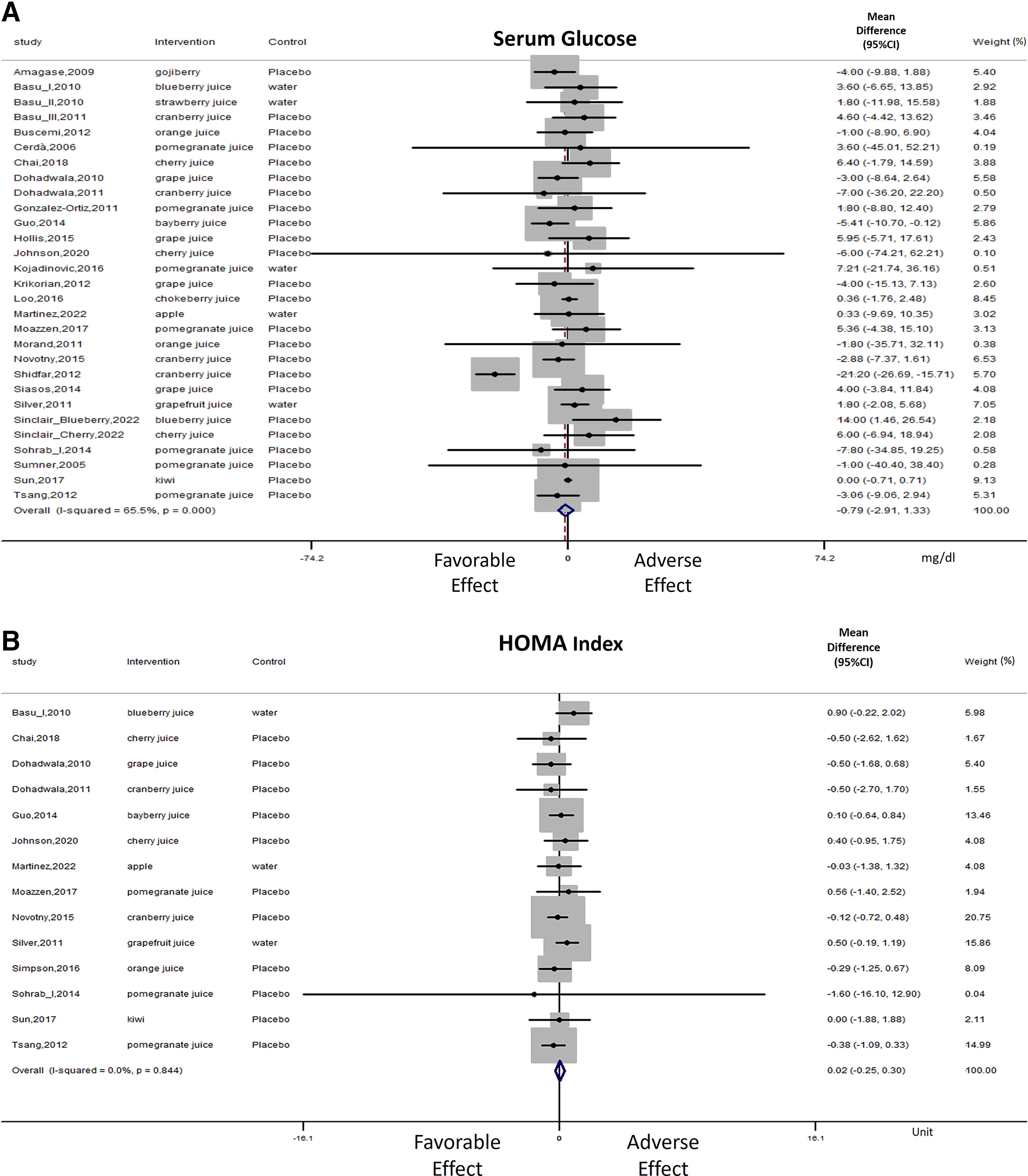
Forest plots of the effect of 100% fruit juice intake on glucose metabolism. (

(Continued)
Meta-regression and subgroup analyses detected gender, type of juice, country of origin, and type of blinding as significant sources of heterogeneity (Supplementary Table S9).
HOMA index
14 RCTs explored the effect of 100%FJ on the HOMA index (Supplementary Table S8). 35,40 –42,45,51,52,54,59 –61,64 –66 The analysis found a nonsignificant association between 100%FJ and changes in HOMA index (MD: 0.02 UI, 95%CI: −0.25 to 0.30; P = .87), without heterogeneity among studies (P = .84, I 2 = 0%) (Fig. 2B). No publication bias was detected by visual inspection of the funnel plot, which was confirmed by Egger’s and Begg’s tests (Egger: P = .89, Begg: P = .96) (Supplementary Fig. S3). Furthermore, the ‘trim and fill’ method did not detect any possibly missing studies. There was a trend toward an inverse nonsignificant association between 100%FJ intake and changes in the HOMA index in 8 studies, while a nonsignificant direct association was observed in 6 studies (Fig. 2B). Sensitivity analysis revealed that changes in the HOMA index did not vary with the exclusion of any individual study.
Meta-regression and subgroup analyses showed that the type of comparator is a significant source of heterogeneity (Supplementary Table S9).
Blood insulin
In the pooled analysis of 13 RCTs (Supplementary Table S8), 40 –42,45,46,49,51 –54,59,65,66 100%FJ intake was not significantly associated with changes in blood insulin (MD: 3.45%, 95%CI: −6.94 to 13.83; P = .51) (Fig. 2C). There was no heterogeneity among studies (P = .95, I 2 = 0%) and no evidence of publication bias, both by visual inspection of the funnel plot (Supplementary Fig. S4) and by formal tests (Egger’s test: P = .12; Begg’s test: P = .43). The results were confirmed by the “trim and fill” method which did not detect any possible missing studies. The evaluation of single studies indicated a trend toward an inverse nonsignificant association between 100%FJ intake and changes in blood insulin in 7 studies, while a nonsignificant direct association was found in 6 studies (Fig. 2C). Lastly, sensitivity analysis revealed that changes in blood insulin did not vary with the exclusion of any individual RCT.
Meta-regression and subgroup analyses did not detect significant sources of heterogeneity (Supplementary Table S9).
Glycated hemoglobin
Four studies were included in the analysis of the 100%FJ effect on glycated hemoglobin (Supplementary Table S8). 35,62 –64 The pooled analyses did not find a significant association between 100%FJ and this outcome (MD: −0.11%, 95%CI: −0.31 to 0.09; P = .27), without evidence of heterogeneity among study (P = .98, I 2 = 0%) (Fig. 2D). No publication bias was suggested by the visualization of the funnel plot (Supplementary Fig. S5). The ‘trim and fill’ method confirmed this result; no possible missing studies were identified. The evaluation of individual studies revealed an inverse nonsignificant trend between 100%FJ intake and glycated hemoglobin in all studies (Fig. 2D). Sensitivity analysis suggested that the changes in glycated hemoglobin did not vary substantially with the exclusion of any individual study.
The GRADE methodology indicated a high quality of evidence for the HOMA index and blood insulin, while for blood glucose it was downgraded to moderate due to the large heterogeneity among studies.
100% Fruit juice intake, gout, and uric acid
Risk of gout
No prospective studies on the association between 100%FJ consumption and the risk of gout were detected. We retrieved only two studies (3 cohorts) that explored the effect of unspecified consumption of fruit juice drinks on the risk of gout. 69,70 A previous meta-analysis, including these articles, showed a non-linear relationship with a significant positive association from low intake of fruit juice drink consumption. 7
Serum urea acid
The SRMA of the effects of 100%FJ intake on SUA included 8 studies (9 cohorts). 34,39,43,47,53,55,56,60 One of them, stratifying by a history of stone formation (yes or no), provided results for two cohorts, which were handled as two different cross-over studies. 47 The main characteristics of the included studies are reported in Supplementary Table S8. The assessment of the “risk of bias” showed that the majority of the studies were at low risk (Supplementary Table S5). Pooled analyses detected a significant reduction in SUA after 100%FJ intake compared to water or placebo (MD: −0.10 mg/dL, 95%CI: −0.16 to −0.04; P = .001) (Fig. 3), without heterogeneity among studies (P = .62, I 2 = 0%). No evidence of publication bias was suggested by visual inspection of the funnel plot (Supplementary Fig. S6). This result was confirmed by the “trim and fill” method, which did not identify any possibly missing study. The evaluation of individual studies found an overall inverse trend between 100%FJ intake and SUA in 6 cohorts, with significance reached in only one of them, 53 while a non-significant positive trend was observed in 3 studies (Fig. 3). Sensitivity analysis revealed that the average change in SUA did not reach a significant reduction when a single study was excluded 53 (MD: −0.099 mg/dL, 95%CI: −0.332 to 0.134).

100% fruit juice intake and serum uric acid. Forest plot of the effect of 100% fruit juice intake on serum uric acid. Results are expressed as Mean Difference (MD) and 95% confidence intervals (95% CI). Squares indicate study-specific MD (the size of the square reflects the study-specific statistical weight); horizontal lines indicate 95% CI; diamond indicates the overall MD with its 95% CI. HS: healthy subjects; SF: stone formers.
Meta-regression and subgroup analyses did not find significant sources of heterogeneity (Supplementary Table S9).
The GRADE methodology defines a moderate quality of evidence due to unstable results (imprecision).
DISCUSSION
The results of our SRMA confirmed that there was no significant association between 100%FJ consumption and the risk of T2DM and a neutral effect of 100%FJ intake on various markers of glucose metabolism. In addition, no association was detected between 100%FJ consumption and gestational diabetes risk.
Our analysis also confirmed that there was no detrimental effect of 100%FJ intake on SUA levels. On the other hand, prospective data were not available to analyze the effect of 100%FJ on the risk of gout. These results are in line with the widely acknowledged benefit of fresh fruit consumption on cardiovascular risk. However, our SRMA does not indicate that fresh fruit intake can be replaced by 100%FJ consumption, and fresh fruit consumption remains a major recommendation for good health.
Diabetes and glucose profile
Our SRMA on the risk of T2DM did not detect any new prospective studies after the publication of the previous meta-analysis. 3 Hence, the conclusion of a neutral effect of 100%FJ consumption on the risk of T2DM over the years remains valid. The previous meta-analysis also differentiated properly between 100%FJ and non-specified fruit juice drink consumption 3 and detected a nonlinear significant positive association between unspecified fruit juice drink consumption and the risk of T2DM. 3 This highlights a potential bias in the interpretation of the results of previous articles, possibly due to the misclassification of sugar-sweetened fruit juices as 100%FJ.
Beyond speculation on the direct effect of 100%FJ consumption on blood glucose, our updated analysis of RCTs supported the observational data, detecting and confirming no significant association between 100%FJ intake and different markers of glucose metabolism. In fact, 100% FJ intake did not affect blood glucose, insulin, HOMA index, or glycated hemoglobin levels. 3,71,72 These results are enhanced by a high-quality level, as suggested by the GRADE score, except for blood glucose, which was moderately good due to the high heterogeneity among studies. However, the results of the glucose profile should be taken with caution, considering that we explored the effect on surrogate markers of glucose metabolism. On the other hand, the results on the HOMA index, an excellent marker of insulin resistance 73 (a well-known predictor of cardiovascular and other diseases 74 ) go beyond glucose metabolism and may support the not detrimental effect of 100%FJ intake on cardiovascular risk.
Notably, the low glycemic index of 100%FJ 75 and the neutral effect of 100%FJ on adiposity in all of its expressions by RCTs 3 and observational studies on long-term weight changes 76,77 may support the neutral effect on the risk of T2DM and glucose metabolism. In this context, there is a recent SRMA of intervention studies that examine both sugar-sweetened beverages and other sources of fructose, including 100%FJ and fat accumulation in hepatocytes. 78 This found a positive association with sugar-sweetened beverages and intrahepatocellular lipids, but a null association with 100%FJ, again highlighting the different metabolic effects of these beverages and why they need to be studied separately.
In addition, several nutrients and bioactive substances in 100%FJ may also explain its benefit. Among the substances highly bioavailable in 100%FJ, polyphenols (e.g., punicalagin, hesperidin) may contribute to the beneficial cardiovascular and metabolic effects. For example, experimental studies found that polyphenols slow postprandial glucose absorption via partial inhibition of intestinal sugar transport from the gut, resulting in a blunted postprandial blood glucose peak. 79,80 In particular, hesperidin inhibits the sugar transporters Glucose Transporter 2 (GLUT2) and Glucose Transporter 5 (GLUT5), which in turn cause a significantly smaller rate of glucose uptake. Moreover, the polyphenol metabolites produced by the gut microbiota seem to have an effect much later than the postprandial period. 79,80 In contrast, a recent meta-analysis of RCTs detected that the polyphenol content in 100%FJ does not appear to directly mediate its effect on blood glucose. 81
The relationship between nitric oxide (NO) and insulin can also be counted among the mechanisms involved. Polyphenols can modulate the nitric oxide–cyclic guanosine monophosphate (NO–cGMP) pathway and therefore can affect insulin synthesis and secretion, regulating endothelial NO synthase levels and activity and NO bioavailability. 82,83
The potassium and magnesium content in 100%FJ may also exert a beneficial effect on glucose metabolism by modulating insulin secretion and insulin sensitivity. 84,85 In line with this trend, observational studies detect a nonlinear and inverse relationship between magnesium or potassium intake and the risk of diabetes. 86,87
Furthermore, considering the strong predictive role of gestational diabetes in the development of T2DM, 14 we also explored the potential association between 100%FJ intake and the development of this disease. The analyses indicate that there is no association between 100%FJ and this risk, both in the dose-response analysis and for an increase of 100 mL/day. These results are in agreement with a recent meta-analysis on different nutritional risk factors for gestational diabetes, 88 although this analysis also included data on unspecified fruit juice drink consumption. 68 Gestational diabetes is a complex metabolic disorder that involves different factors, mainly insulin resistance associated with inflammatory processes and nitroxidative stress. 89 In particular, dysbiosis of the intestinal microbiota during pregnancy leads to the amplification of inflammatory processes and nitroxidative stress and plays a key role in response to insulin sensitivity. In this context, 100%FJ may reduce inflammation, 90 and, like whole fruit, it may shift the gut microbiota to healthier species that, in turn, lower the risk of gestational diabetes by maintaining the defenses of tight junctions in the gut. 89 In addition to these mechanisms, this result may be due to the evidence that women with healthier lifestyles are more likely to consume 100%FJ and whole fruits and less likely to consume sugar-sweetened beverages. 91 –94 Hence, this dietary pattern is clearly less associated with the risk of gestational diabetes. 89
Gout and uric acid
Our SRMA on the risk of gout did not retrieve any prospective studies reporting data on 100%FJ consumption. As highlighted in a previous meta-analysis, 7 only three U.S. cohorts based on unspecified consumption of fruit juice drinks are available for the assessment of risk of gout. This dose-response analysis suggested a direct and linear association between these (potentially sweetened and unsweetened) fruit juice drinks and the risk of gout over the years.
On the other hand, nine RCTs were included in our SRMA to assess the effect of 100%FJ only on SUA changes. The analysis detected an inverse relationship between 100%FJ and SUA levels, with no study finding a significant positive relationship. The results are in agreement with a previous meta-analysis, 6 despite the inclusion of different RCTs in our analysis. Indeed, a study was not included because no comparison with the control drink was made. 95 On the other hand, three additional studies were included in the pooled analysis. 53,56,60 The apparent contrasting results between observational and intervention studies may be due to the following reasons.
First, there is no consistent and clear differentiation between 100%FJ and unspecified consumption of fruit juice drinks in observational studies while, in RCTs, only the effects of 100%FJ were explored. As expected, the health effects of 100%FJ and that of a combination of sugar-sweetened beverages and 100%FJ are different.
Second, the two outcomes need to be differentiated because high SUA is present in patients with gout, but not all people with high SUA will develop gout, largely determined by genetic factors. Therefore, this phenomenon did not allow a comparison of the effect of 100%FJ consumption on the risk of gout and changes in SUA levels. The results of our SRMA on the risk of gout and SUA are in agreement with those on the risk of T2DM and the glucose metabolism profile, given the positive association between SUA and blood glucose and the risk of T2DM. 96
Furthermore, also considering the direct association between SUA and cardiovascular risk, 97,98 the favorable effect of 100%FJ intake on SUA supports that on blood pressure, endothelial damage, arterial stiffness, and cardiovascular disease. 3
Similarly, the results are also supported by a neutral effect on body weight, 3 strongly and positively associated with SUA. Although it could be postulated that the fructose content of 100%FJ would have a negative impact on SUA, other nutrients and the high bioavailability of some bioactive compounds in 100%FJ 99 can contribute to the beneficial effect of 100%FJ intake, counterbalancing any detrimental effect of fructose on SUA levels. For instance, polyphenols such as hesperidin can reduce SUA by inhibiting xanthine oxidase activity in vitro and in vivo 100,101 and inhibiting liver xanthine oxidase in vivo. 101 Some flavonoids (e.g., hesperetin, naringenin) can also competitively inhibit xanthine oxidoreductase. 102 –104 Furthermore, the rich vitamin C content can contribute to reducing SUA levels by increasing their clearance. 105,106
Strengths and limitations
The results of this study are strengthened by: (1) the soundness of the results in agreement with each other and with previous meta-analyses; (2) the inclusion of both intervention and prospective studies; (3) the stringent inclusion criteria (i.e., only 100%FJ as intervention and placebo or water as comparator); (4) the inclusion of a large number of intervention studies; (5) the low heterogeneity among studies; (6) no evidence of publication bias; (7) the comprehensive exploration of possible sources of heterogeneity; (8) the evaluation of the shape of the dose-response relationship on the risk of gestational diabetes; (9) the evaluation of the overall quality of evidence using the GRADE assessment approach; (10) the high quality of our SRMA by AMSTAR-2 assessment.
Nevertheless, the study also has limitations. The observational nature of prospective studies limits conclusions about possible cause-and-effect relationships. In this context, the potential misclassification of the consumption of fruit juice drinks by questionnaire may also be another limitation.
The heterogeneity in the characteristics of the RCTs included in the SRMA is an important limitation (e.g., age, length of intervention, health status, type of 100%FJ utilized, serving size, and comparator). This issue was assessed by additional analyses (i.e., meta-regression, subgroup, and sensitivity analysis), which, in general, detected little evidence of subgroup differences. Nonetheless, in some subgroup analyses, the comparison evaluation was carried out including relatively few studies in one of the subgroups, and thus definitive conclusions cannot be reached in those cases. This SRMA was unable to detect the effect of single types of 100%FJ due to the low number of studies in each subgroup. Finally, another limitation is the residual possibility of publication bias and the difficulty in drawing definitive conclusions about interactions with age, race, and gender given the peculiar composition of the available study cohorts.
Implications for public health
The consumption of fruit juice has been the subject of debate due to the confusion between 100%FJ and the intake of unspecified fruit juice drinks. In this context, it is important to state that 100%FJ is well defined in European and UK law as the juice extracted from the fruit, and cannot be modified in terms of Brix (concentration) except by blending it with the juice of the same species of fruit. 2 Therefore, the sugar content of 100%FJ cannot be modified further. In contrast, fruit juice drinks can contain added sugars, water, or sweeteners that modify the nutritional composition of the drinks. These compositional differences may explain the different health outcomes seen in RCTs versus observational studies, where, in the latter, there is sometimes no clear differentiation between 100%FJ and other fruit juice drinks. These inconsistencies may explain why international dietary guidelines disagree on recommendations for 100%FJ consumption, as well as due to the 100%FJ free sugar content and the commonly lower fiber content compared to whole fruit. Furthermore, our results do not agree with the EFSA’s opinion on sugars document. 13 In particular, some conclusions were that 100%FJ intake is associated with a higher risk of T2DM and gout. However, it is noteworthy that in the document, ‘fruit juice’ was reported as ‘fruit and vegetable juices’, which included sugar-sweetened nectars in national intake data. Given this inconsistent classification, which differs from the European Union Fruit Juice Directive, 2 an expected bias due to misclassification between 100%FJ and other fruit juice drinks may have occurred for some studies. Moreover, another important limitation may be that only prospective studies were considered for the opinion, while no RCTs on 100%FJ were included. Therefore, there are limits to observational studies on the interpretation of the results, among which no cause-effect relationship can be determined, potential misclassification of the quality and quantity of dietary components could be derived from food frequency questionnaires of a single study, there may be no control for beverage intakes and no statistical adjustment for potentially confounding variables.
EFSA’s opinion on the risk of T2DM differs from our SRMA and a previous meta-analysis 3 since EFSA included a study that did not specify only 100%FJ consumption, 107 previously excluded for this reason. 3,5 Furthermore, EFSA did not consider a recent study, 30 included in a previous meta-analysis, because it was published after the specified time limit.
Actually, in the studies analyzed by EFSA, only the highest percentiles of the consumption of fruit juices were associated with a greater risk of adverse outcomes, while lower consumption, according to the current European intake of fruit juices 1,108 was not associated with an increased risk. In addition, our results of RCTs and previous meta-analysis 3 did not support this risk. Indeed, a relatively high 100%FJ consumption per day was not associated with detrimental effects on glucose metabolism. In support of these data, a similar intake of 100%FJ in the intake of RCTs was not associated with an unfavorable effect on body weight. 3
Regarding the risk of gout, the EFSA’s opinion was based only on two prospective U.S. studies that reported the risk of unspecified fruit juice drink consumption. In this case, the potential misclassification of fruit juice drinks can lead to a misinterpretation of the results. Moreover, our SRMA and previous meta-analyses of RCT on SUA 3,6 do not support these findings and, as explained above, other mechanisms may be involved beyond the fructose content of 100%FJ.
CONCLUSIONS
The results of our SRMA indicate that 100%FJ intake is not associated with detrimental effects on glucose metabolism and SUA levels. Furthermore, our analysis found a neutral association between 100%FJ consumption and the risk of gestational diabetes. On the other hand, the results of this SRMA are consistent with those of previous articles, which indicate a neutral impact of 100%FJ on T2DM risk and no data on the risk of gout. Given the importance of T2DM and elevated SUA, in turn, associated with cardiovascular risk, 97,98,109 and the popularity of fruit juice drinks around the world, 1 the relationship between 100%FJ intake and these metabolic markers assumes considerable importance.
Our findings are consistent with the widely recognized inverse association seen between regular fresh fruit consumption and health. 110 Nevertheless, these results do not suggest that fresh fruit in the proper amounts can be substituted by 100%FJ intake, as fresh fruit consumption remains one of the main recommendations for good health.
It should be noted from observational studies that more 100%FJ consumers (both children and adults) also have a tendency to eat more whole fruits and are closer to the recommended ‘5 a day’ than non-consumers 100%FJ. 92,93,111 This suggests that 100%FJ is used to complement, not replace, whole fruit.
Despite available data, it would be dangerous to establish ‘safe levels’ of consumption, considering the limited longitudinal data available and the high heterogeneity of the level of consumption among trials. In addition, it may also be prudent to suggest caution to patients with existing diabetes mellitus or those at risk of glucose and SUA metabolism disease.
More RCTs of the effect of long-term moderate 100%FJ intake are warranted to evaluate the effects on health outcomes and compare them with those of equivalent amounts of fresh fruit to determine possible cause-effect relationships, and to disentangle the effects of different types of 100%FJ from other potentially sweetened fruit juice drinks. In particular, RCTs with a carefully controlled intake of 100%FJ should evaluate the mechanisms of its effects on SUA and the risk of gout given the almost complete lack of reliable data available in this regard.
Footnotes
AUTHORS’ CONTRIBUTIONS
L.D.: Study concept and design; acquisition of data; database management; first draft of the article; statistical analysis; analysis and interpretation of data and critical review of the article for important intellectual content; full access to all data in the study and assumes responsibility for the integrity of the data and the accuracy of the data analysis. A.F.Z.: Acquisition of data; first draft of the article; prepared figures; Supplementary Data prepared; analysis and interpretation of data and critical review of the article for important intellectual content. I.L.P.: Database management; prepared figures; Supplementary Data prepared; analysis and interpretation of data and critical review of the article for important intellectual content. A.A.: Database management; prepared figures; Supplementary Data prepared; analysis and interpretation of data and critical review of the article for important intellectual content. D.R.: Analysis and interpretation of data and critical review of the article for important intellectual content. J.L.S.: Analysis and interpretation of data and critical review of the article for important intellectual content.
AUTHOR DISCLOSURE STATEMENT
J.L.S. has received research support from the Canadian Foundation for Innovation, Ontario Research Fund, Province of Ontario Ministry of Research and Innovation and Science, Canadian Institutes of health Research (CIHR), Diabetes Canada, American Society for Nutrition (ASN), International Nut and Dried Fruit Council (INC) Foundation, National Honey Board (U.S. Department of Agriculture [USDA] honey “Checkoff” program), Institute for the Advancement of Food and Nutrition Sciences (IAFNS; formerly ILSI North America), Pulse Canada, Quaker Oats Center of Excellence, The United Soybean Board (USDA soy “Checkoff” program), The Tate and Lyle Nutritional Research Fund at the University of Toronto, The Glycemic Control and Cardiovascular Disease in Type 2 Diabetes Fund at the University of Toronto (a fund established by the Alberta Pulse Growers), The Plant Protein Fund at the University of Toronto (a fund which has received contributions from IFF), and The Nutrition Trialists Net-work Fund at the University of Toronto (a fund established by an inaugural donation from the Calorie Control Council). He has received food donations to support randomized controlled trials from the Almond Board of California, California Walnut Commission, Peanut Institute, Barilla, Unilever/Upfield, Unico/Primo, Loblaw Companies, Quaker, Kellogg Canada, Danone, Nutrartis, and Dairy Farmers of Canada. He has received travel support, speaker fees and/or honoraria from ASN, Danone, Dairy Farmers of Canada, FoodMinds LLC, Nestlé, Abbott, General Mills, Nutrition Communications, International Food Information Council (IFIC), Calorie Control Council, International Sweeteners Association, and International Glutamate Technical Committee. He has or has had ad hoc consulting arrangements with Perkins Coie LLP, Tate & Lyle, Phynova, and Inquis Clinical Research. He is a former member of the European Fruit Juice Association Scientific Expert Panel and former member of the Soy Nutrition Institute (SNI) Scientific Advisory Committee. He is on the Clinical Practice Guidelines Expert Committees of Diabetes Canada, European Association for the study of Diabetes (EASD), Canadian Cardiovascular Society (CCS), and Obesity Canada/Canadian Association of Bariatric Physicians and Sur-geons. He serves or has served as an unpaid member of the Board of Trustees and an unpaid scientific advisor for the Carbohydrates Committee of IAFNS. He is a member of the International Carbohydrate Quality Consortium (ICQC), Executive Board Member of the Diabetes and Nutrition Study Group (DNSG) of the EASD, and Director of the Toronto 3D Knowledge Synthesis and Clinical Trials foundation. His spouse is an employee of AB InBev. The other authors declare that they have no conflict of interest.
FUNDING INFORMATION
This research was funded by the European Fruit Juice Association (AIJN). AIJN was not involved in the design, conduction, analysis, and interpretation of the results. J.L.S. was funded by a PSI Graham Farquharson Knowledge Translation Fellowship, Canadian Diabetes Association Clinician Scientist award, CIHR INMD/CNS New Investigator Partnership Prize, and Banting & Best Diabetes Centre Sun Life Financial New Investigator Award.
SUPPLEMENTARY MATERIAL
Supplementary Data S1
Supplementary Data S2
References
Supplementary Material
Please find the following supplemental material available below.
For Open Access articles published under a Creative Commons License, all supplemental material carries the same license as the article it is associated with.
For non-Open Access articles published, all supplemental material carries a non-exclusive license, and permission requests for re-use of supplemental material or any part of supplemental material shall be sent directly to the copyright owner as specified in the copyright notice associated with the article.
