




Abstract
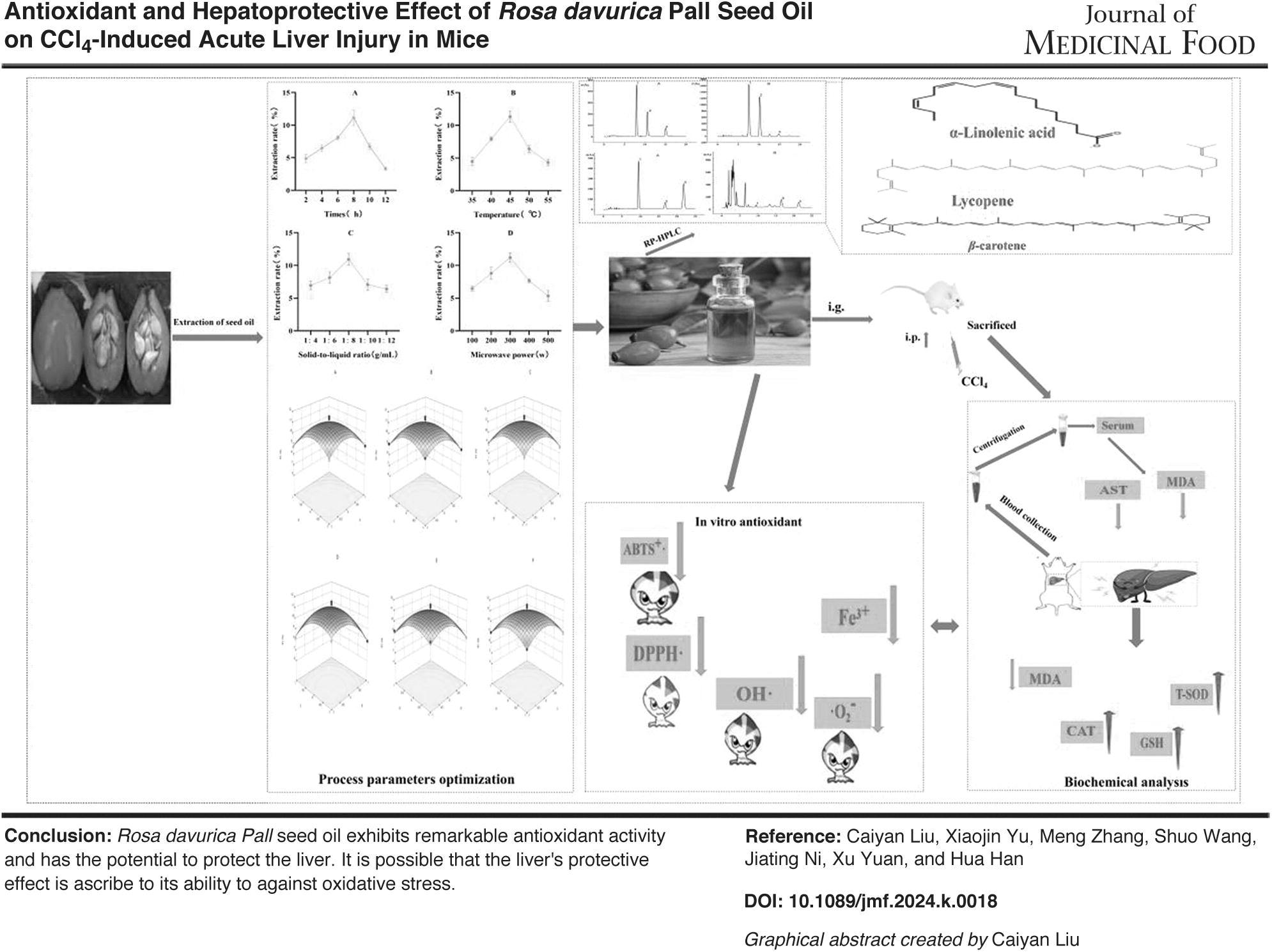
The liver, being the most metabolically active organ, is highly vulnerable to damage caused by oxidative stress. Rosa davurica Pall. seed oil (RDPO), a novel vegetable oil, and its bioactive components have been extensively researched in the field of antioxidants. In this research, the antioxidant properties and hepatoprotection by RDPO were evaluated. A series of antioxidant evaluation systems and a CCl4-induced acute liver injury model in mice were used to investigate the antioxidant activity and hepatoprotective efficacy of RDPO. The results showed that the extraction rate of RDPO was 11.12% using the optimal extraction process. Three major unsaturated fatty acids of the oil were α-linolenic acid (11.89 ± 0.017%), linoleic acid (18.52 ± 0.072%), and oleic acid (11.54 ± 0.425%). Furthermore, its antioxidant small-molecule compounds were β-sitosterol (1.429 ± 0.002 μg/g), α-tocopherol (1.273 ± 0.079 μg/g), β-carotene (0.012 ± 0.001 μg/g), lycopene (0.108 ± 0.002 μg/g), squalene (178.950 ± 0.794 μg/g), total polyphenols (1.114 ± 0.032 μg GAE/mg), and total flavonoids (0.504 ± 0.009 mg RU/g), respectively. In vitro, RDPO significantly inhibited the production of ABTS+•, DPPH•, O2 •−, and hydroxyl radicals, as well as Fe3+. In vivo, RDPO significantly reversed the activity of total superoxide-dismutase, catalase, L-glutathione, and the level of malondialdehyde (MDA) in liver tissue. It also obviously inhibited the activity of aspartate transaminase (AST) and the level of MDA in the serum. Therefore, RDPO has demonstrated excellent antioxidant activity and a potential liver protective effect. This effect may be ascribed to its capacity for decreasing AST activity, inhibiting lipid peroxidation, and boosting endogenous antioxidant enzyme activity. Therefore, RDPO has significant application value in the biopharmaceutical industry and as a dietary supplement.
INTRODUCTION
The liver, being the largest organ in the human body, has a vital function in various metabolic processes. 1 Liver disease remains a global significant health concern. Factors such as drugs, toxins, unhealthy diet, and alcohol consumption can contribute to liver injury, which serves as the underlying cause of many liver diseases. 2 The “Healthy China 2030” initiative, proposed by the Chinese government, highlights the prevention and treatment of liver injury as a complex and ongoing challenge in the medical and health industry. 3 Therefore, the search for a liver-protective agent that is both low in toxicity and effective holds immense importance.
Oxidative stress, caused by free radicals, is known to have detrimental effects on the human body and is closely associated with liver diseases. 4
A recent clinical study revealed that patients with liver cirrhosis had noticeably higher levels of liver lipid peroxidation compared with healthy individuals. 5 Natural antioxidants such as resveratrol and ursolic acid have shown promising results in the treatment of liver fibrosis. 6,7 Furthermore, many clinicians worldwide recommend the use of natural antioxidants to restore the endogenous enzyme system in patients with chronic diseases. 8 The accumulated evidence strongly suggests that preventing oxidative stress could be a promising strategy for ameliorating liver injury.
Rosa davurica Pall, a small shrub of Rosaceae, is widely distributed in Northeast China, Southern Mongolia, and Russia. Its fruit has been processed into health food. Rosa davurica Pall. seed oil (RDPO) contains various beneficial compounds such as α-linolenic acid, linoleic acid, vitamin E, squalene, β-carotene, lycopene, sterols, and polyphenols. 9
Studies have found that rose polyphenols have a positive impact on human health, primarily due to their antioxidant activity, which helps prevent oxidative damage to the liver. 10,11 Vitamin E has been found to protect the heart and kidney from dexamethasone-evoked oxidative stress injury. 12 Moreover, lycopene, a powerful antioxidant, has the ability to repair damaged hepatocytes and protect liver function. 13 Considering the composite carrier nature of RDPO, which contains these small-molecule compounds, it is hypothesized that it may also possess antioxidant activity and provide certain liver protection effects.
To test our hypothesis, we used various antioxidant evaluation systems and a mouse model of CCl4-induced acute liver injury, and compared it with olive oil (OLO) and camellia seed oil (CSO).
The objective of this experiment was to establish a theoretic foundation for the application of RDPO as a natural antioxidant, and an experimental basis for utilizing edible vegetable oil to prevent and treat liver injury.
MATERIALS AND METHODS
Materials
Rosa davurica Pall fruits were picked from the Zhangguangcai Mountain, which is located at 129.006075°E, 45.06989°N. CSO and OLO were purchased in the local market. The assay kits for L-glutathione (GSH), malondialdehyde (MDA), catalase (CAT), total superoxide-dismutase (T-SOD), and aspartate transaminase (AST) were acquired from Nan Jing Jian Cheng Bioengineering Research Institute in China. All other chemical reagents used in this research were analytic reagent grade.
Extraction of RDPO from Rosa davurica Pall fruits
The RDPO from Rosa davurica Pall. fruits was extracted using the microwave-assisted enzymatic hydrolysis method. Initially, 5 g of flour was mixed with 40 mL of a 0.025 mol/L citric acid buffer. The mixture was then microwaved for 2 min and allowed to cool. Following this, 1.25 g of enzyme preparation was added to the solution, and subsequently immersed in a stable temperature water bath set at 35°C in a steady temperature water bath at 35°C for 1 h to undergo enzymatic hydrolysis. Afterward, the temperature was increased to 45°C and incubated for 2 h. The enzyme was inactivated for 10 min at a temperature of 85°C. In addition, the seed oil was extracted using 30 mL of n-hexane, with 6 repetitions. Finally, the rotary evaporator was used to evaporate the solvent, and the RDPO was stored in a glass vial at −4°C for further analysis.
Single-factor experiment
This study conducted experiments with a single factor to examine the effect of four parameters on the extraction rate of RDPO. The parameters examined were enzymolysis time (2, 4, 6, 8, 10, and 12 h), enzymolysis temperature (35°C, 40°C, 45°C, 50°C, and 55°C), solid–liquid ratio (1:4, 1:6, 1:8, 1:10, and 1:12), and microwave power (100, 200, 300, 400, and 500 W). Through the analysis of these factors, the goal was to gain insights into their influence on the extraction rate of RDPO.
Optimization of extraction process parameters of RDPO
Response surface method (RSM) is an approach that involves conducting a sequence of predetermined “trials” to establish a response surface that mimics an actual limit state surface. 14 In our research, it was utilized to optimize the extraction parameters to acquire the best combination of variables. A four-factor (A, B, C, and D) and three-level (−1, 0, and +1) Box–Behnken Design (BBD) was used to acquire the optimal information from a sequence of tests. The parameters included enzymolysis time (A), enzymolysis temperature (B), solid–liquid ratio (C), and microwave power (D). The response R1 was applied to represent the extraction yield of RDPO. The coded parameters and their levels are presented in Table 1. The experimental data were analyzed using the Design-Expert 8.0 software (Stat-Ease, Inc., USA). The results for the extraction rate of RDPO are represented as means ± standard deviations (SDs).
Independent Variables and Their Levels Used for Box–Behnken Design
Determination of major unsaturated fatty acids and antioxidative ingredient content in RDPO
The contents of essential unsaturated fatty acids in RDPO were analyzed using reverse-phase high-performance liquid chromatography (RP-HPLC) based on a new method. 15,16 α-Linolenic acid, linoleic acid, and oleic acid were used as standards, respectively. The method documented previously by Zhao et al. 17 was used to measure the total phenolic content of RDPO, with gallic acid as the standard. The method reported by Xu et al. was utilized to ascertain the content of total flavonoids in RDPO, 18 with rutin as the standard. In addition, the contents of β-sitosterol, α-tocopherol, and squalene in RDPO were analyzed following the procedure detailed in the study published by Hosseini et al., 19 with β-sitosterol, α-tocopherol, and squalene serving as standards. Finally, the contents of β-carotene and lycopene in RDPO were quantified using the method previously described by Queiroz et al., 20 with β-carotene and lycopene serving as standards, respectively. All tests were repeated in triplicate.
In vitro
antioxidant properties of RDPO
The antioxidant activity of RDPO in vitro was assessed through multiple tests, such as scavenging assays for ABTS radicals, 21 DPPH radicals, 21 superoxide anion, 22 as well as the hydroxyl radical (•OH) scavenging 23 and reducing power assays. 24 The IC50 value was used to measure the capacity of RDPO to scavenge free radicals. The results of the triplicate analysis were presented as means ± SDs.
In vivo antioxidant properties of RDPO
Animals
The Institute of Cancer Research (ICR) mice were purchased from Liaoning Changsheng Biotechnology Co., Ltd. [No. SCXK(Liao) 2020-0001]. Thirty ICR mice, weighing 20 ± 2 g were used in this study. All animal experiments were approved by the Ethics Committee of Heilongjiang University of Traditional Chinese Medicine (No. 2019121101), and conducted in accordance with the Animal Research: Reporting of In Vivo Experiments (ARRIVE) guidelines for reporting experiments involving animals.
Experimental design
The ICR mice were separated randomly into five different groups, each group containing six mice. The first group, designated as group 1 and functioning as the control group, was given saline water daily for 15 days. Liver oxidative damage was induced in groups 2, 3, 4, and 5 by intraperitoneal injection with 1% CCl4 (0.1 mL/10 g body weight) once every 3 days during 15 days. Group 2 served as the CCl4 model. The RDPO, CSO, and OLO were dissolved in 0.5% carboxymethylcellulose sodium. Group 3 was pretreated with RDPO at a dose of 0.038 mg/10 g, administered orally daily for 15 days. Groups 4 and 5 were given CSO and OLO, respectively. The alterations in mice body weights are illustrated in Supplementary Figure S1.
Following the completion of the experiment, blood samples were gathered, centrifuged at −4°C for 10 min (3500 r/min), and serum was obtained for various biochemical assays. In addition, the liver samples were rapidly dissected, cleaned with a saline solution, and immediately stored at −80℃ for further analysis.
Determination of total protein, MDA, GSH, CAT, and T-SOD in liver homogenate
Liver homogenates were prepared using a homogenizer at a concentration of 10%. The homogenates were then centrifuged at 3500 r/min for 10 min using a centrifuge. The resulting clear supernatant was used to measure the levels of total protein, MDA, GSH, CAT, and T-SOD in the liver homogenate. Then, their levels were determined following the instructions provided with their respective commercial kits.
Determination of serum AST and MDA levels
Some of the serum was used to estimate MDA levels, whereas the other portion was utilized to assess AST activity.
Statistical analysis
Means ± SDs were used to express the experimental results. A one-way analysis of variance (ANOVA) was conducted using SPSS 23.0 statistical software. Results indicating statistical significance were denoted by P values <.05. Graphics were plotted using Origin 2021.
Results
Optimization of extraction process parameters of RDPO
Single-factor experiment of extraction of RDPO
To determine the appropriate range for BBD, we conducted a single-factor experiment considering four parameters: enzymolysis time, enzymolysis temperature, solid–liquid ratio, and microwave power. Figure 1 illustrates that the extraction rate initially increased with the enzymolysis time, ranging from 2 to 8 h, and then decreased between 8 and 12 h (Fig. 1A). A similar trend was observed for the enzyme reaction temperature, solid–liquid ratio, and microwave power. The maximum extraction rate of RDPO was achieved when the enzymolysis time was 8 h, the enzyme reaction temperature was 45℃, the solid–liquid ratio was 1:8, and the microwave power was 300 W (Fig. 1B–D).
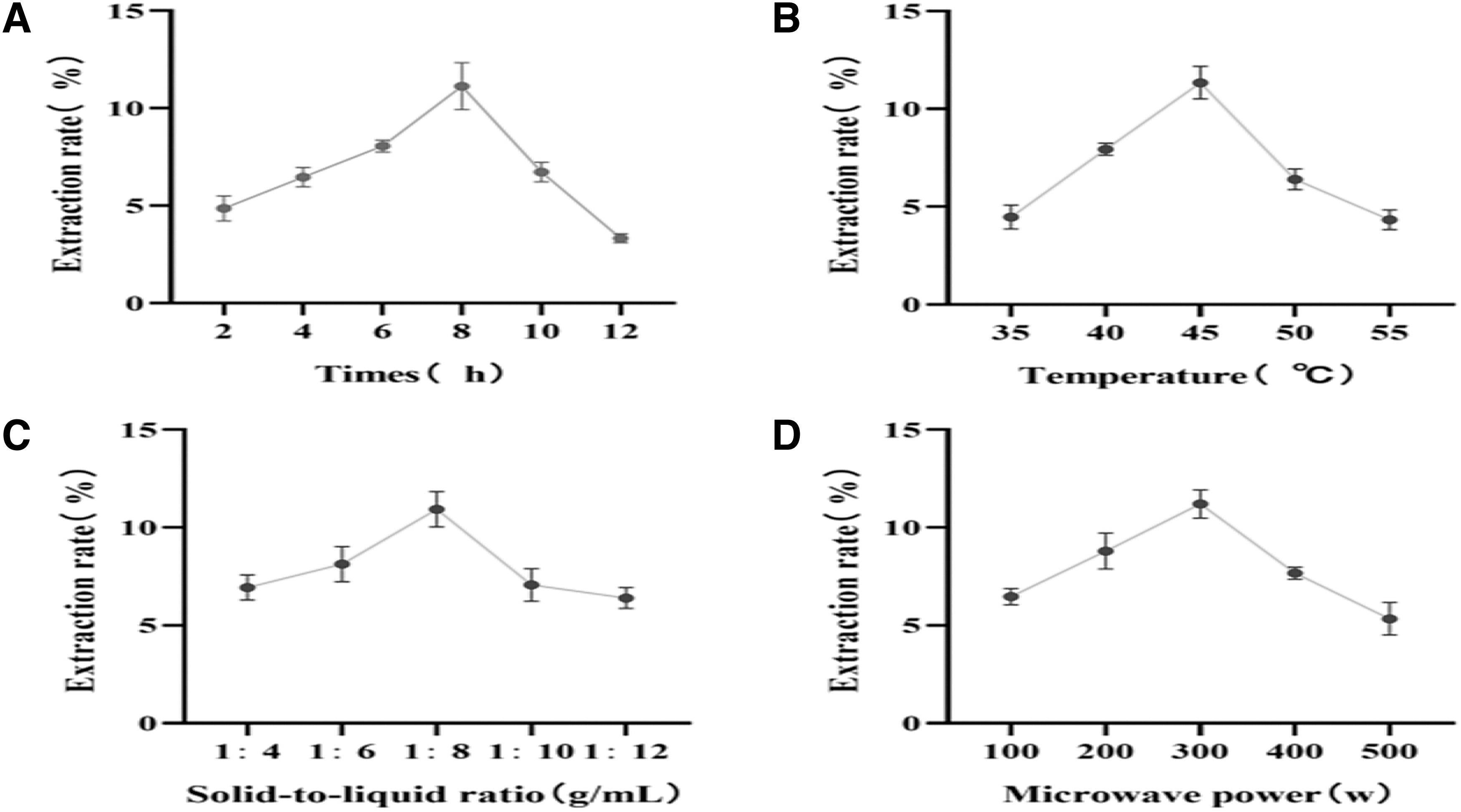
The influence of various factors on the extraction rate.
Optimization of extraction process parameters of RDPO
To improve the extraction rate of RDPO, we used the BBD-RSM to optimize the parameters of the extraction process. By analyzing the experimental results of BBD and conducting regression analysis, we established a quadratic polynomial equation to determine the correlation between the variables and the response of the extraction rate (R1). Utilizing Table 2, we conducted a total of 28 experiments, each with varying combinations of four factors. The response surface model equation is as follows:
Box–Behnken Experimental Design with Independent Variables and Experimental Data for the Responses (n = 3)
A, enzymolysis time; B, enzymolysis temperature; C, solid-liquid ratio; D, microwave power; R1, extraction rate.
The values of four independent variables (enzymolysis time, enzymolysis temperature, solid–liquid ratio, and microwave power) are represented as A, B, C, and D. Generally, a significance level of P < .05 means statistical significance. Results from Table 3 indicate significant differences across all models as determined by ANOVA (P < .05). The mismatch value of 0.9518 did not suggest any significant variance (P > .05). Therefore, the quadratic model was found to effectively fit the experimental data through ANOVA.
Response Surface Quadratic Polynomial Model Analysis Performed Using Analysis of Variance
P < 0.05 was represented as a statistically significant result.
P ≤ .01 was represented as a very significantly statistical result.
DF, degree of freedom; MS, mean square; SS, sum of square.
Interactions between different factors
The three-dimensional response surface diagram generated by the regression equation provides a more intuitive visualization of how various factors interact and influence the extraction rate of RDPO. 25 The response surface curve is visibly curved and exhibits rapid color changes, indicating the significant impact of the interaction between the two factors on the response value. 26 Figure 2 clearly illustrates that the interaction between enzymolysis temperature (B) and solid–liquid ratio (C) has the greatest effect on the extraction rate of RDPO, followed by the interaction between solid–liquid ratio (C) and microwave power (D).

Response surface plots of the interaction of various factors.
Verification simulation
The results revealed that the best extraction parameters for RDPO were as follows: enzymatic hydrolysis time of 7.54 h, enzymatic hydrolysis temperature of 43.59°C, solid–liquid ratio of 1:7.56, and microwave power of 280.85 W. These conditions resulted in a maximum extraction rate of 11.41%. To validate the practicality of these conditions, a verification test was conducted using the following parameters: enzymolysis time of 8 h, enzymolysis temperature of 45°C, solid–liquid ratio of 1:8, and microwave power of 300 W. The extraction rate of RDPO was found to be 11.12%, with a slight deviation of 0.29% from the predicted value. This indicates that the process parameters optimized by the RSM are reliable. 27
The contents of major unsaturated fatty acids and antioxidative substances
The contents of main unsaturated fatty acids in RDPO
Previous studies have determined that the unsaturated fatty acids in RDPO consist mainly of α-linolenic acid, linoleic acid, and oleic acid. 28 To measure the content of polyunsaturated fatty acids in RDPO, we used RP-HPLC (Fig. 3). The results, as shown in Table 4, indicate that the RDPO contains 118.891 mg/g or 11.89% α-linolenic acid, 185.153 mg/g or 18.52% linoleic acid, and 115.449 mg/g or 11.54% oleic acid. Studies have shown that supplementing with α-linolenic acid can significantly improve metabolic disorders and liver steatosis in patients with nonalcoholic liver disease. 29,30 Our research revealed that the α-linolenic acid content in RDPO was notably higher than OLO (1.268 mg/g) and CSO (41.794 mg/g). Consequently, RDPO may offer greater benefits in addressing liver disease compared with OLO and CSO.
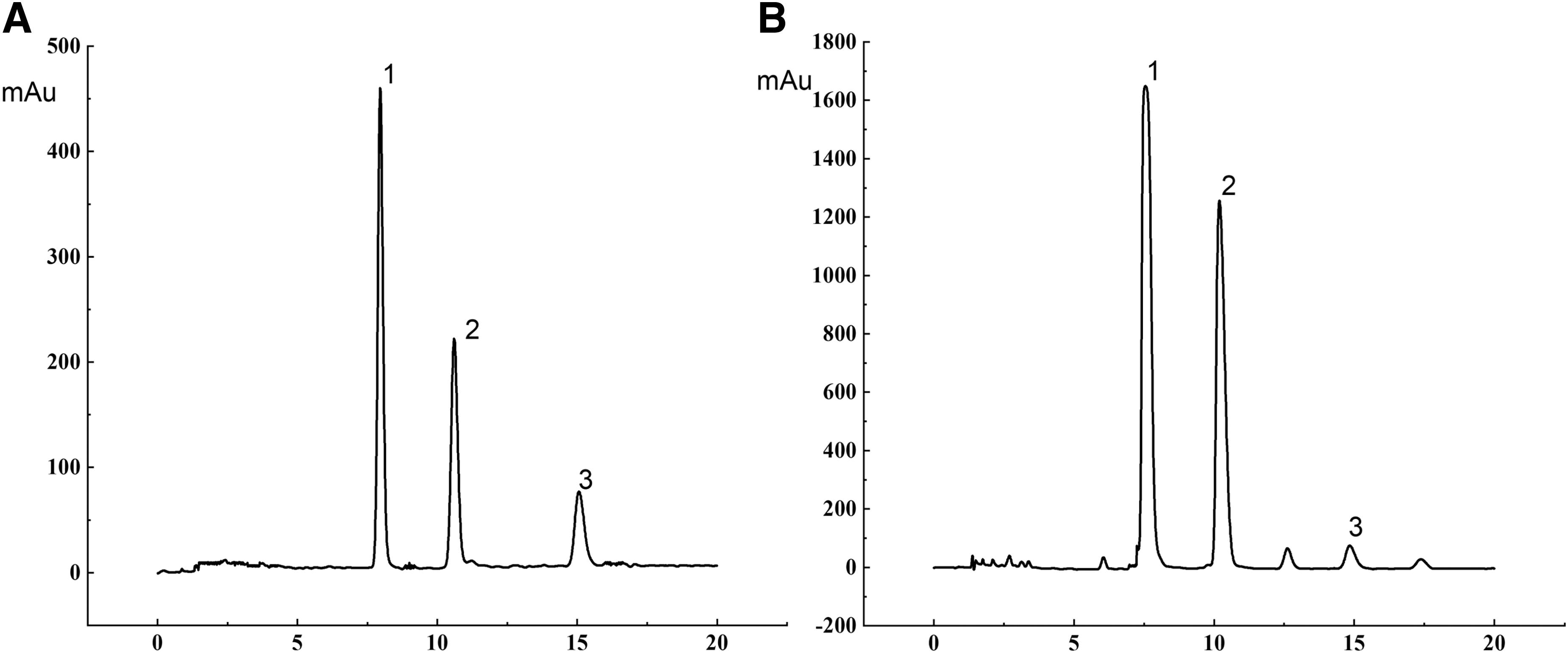
α-Linolenic acid, linoleic acid, and oleic acid in RDPO.
Contents of α-Linolenic Acid, Linoleic Acid, and Oleic Acid in Three Seed Oils (n = 3, Mean ± Standard Deviation)
P < .01 versus group camellia seed oil and olive oil.
CSO, camellia oil; OLO, olive oil; RDPO, Rosa davurica Pall seed oil.
The contents of antioxidative ingredients in RDPO
Numerous studies have provided evidence that seed oil is not only rich in unsaturated fatty acids but also contains beneficial components such as phenols, flavonoids, sterols, squalene, and tocopherols. 31 These antioxidant components have been found to exhibit concentration-affected scavenging activity against free radicals. These antioxidant components have been found to exhibit dose-dependent scavenging of free radicals. Table 5 presents a comparison of phenolic compounds, flavonoids, sterols, squalene, and tocopherol contents in RDPO (Fig. 4) with CSO and OLO. Interestingly, RDPO demonstrated higher levels of these components compared with the other oils. Furthermore, it is noteworthy that the RDPO contained β-carotene and lycopene in quantities of 0.012 and 0.108 μg/g oil, respectively, which were not detected in CSO and OLO.
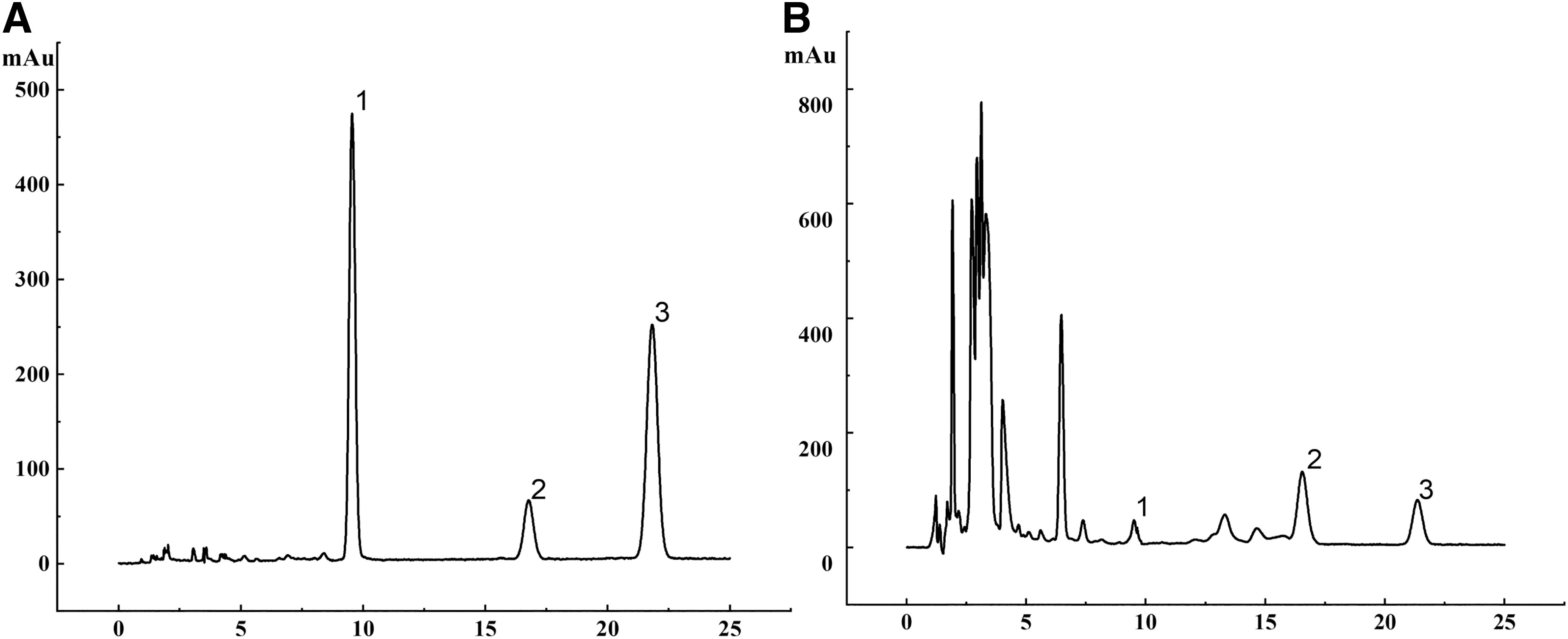
α-Tocopherol, β-sitosterol, and squalene in RDPO.
Contents of Antioxidative Substance in Three Oils (n = 3, Mean ± Standard Deviation)
P < .01 versus group camellia oil and olive oil.
ND, not detected; TFC, total flavonoid content; TPC, total polyphenol content.
In vitro antioxidant properties of RDPO
ABTS radical scavenging activity
The ABTS free radical scavenging method is commonly used to rapidly assess the antioxidant activity of substances in vitro. 32 ABTS can be oxidized by potassium persulfate to produce ABTS+•, which is a relatively steady free radical along with a strong absorbance at 734 nm. 33 Our study discovered that RDPO exhibited a dose-dependent ABTS+• scavenging rate in the concentration range of 10–60 mg/mL, ranging from 57.63% to 91.36% (Fig. 5A). Furthermore, the IC50 value for the ABTS+• scavenging activity of RDPO was 7.32 mg/mL, significantly lower than that of CSO (76.23 mg/mL) and OLO (80.06 mg/mL), suggesting that RDPO may possess a stronger antioxidant activity compared with CSO and RDPO (Table 6).

The antioxidant activity of RDPO in vitro.
The IC50 Value of Scavenging Free Radicals of Rosa davurica Pall. Seed Oil (n = 3, Mean ± Standard Deviation)
CSO and OLO served as control groups.
P < .01 versus group CSO.
P < .01 versus group SBO.
DPPH radical scavenging activity
DPPH• is a steady free radical. The methanol or ethanol solution turns purple and exhibits a significant absorbance at 517 nm. 34 When substances with antioxidant activity react with DPPH•, the purple solution lightens or may even become yellow. 35 Hence, the degree of fading in the reaction solution reflects the scavenging ability of the test subject against free radicals. Figure 5B illustrates that within the concentration range of 10–60 mg/mL, the scavenging rate of RDPO on DPPH• depends on the concentration. At 60 mg/mL, RDPO exhibits a scavenging rate of over 90%, whereas CSO and OLO demonstrate scavenging rates of 64.67% and 53.19%, respectively. The IC50 values, in the order of RDPO < CSO < OLO, indicate that RDPO possesses a potent antioxidant activity (Table 6).
Superoxide anion radical scavenging activity
Superoxide free radical (O2 •−) is an active oxygen free radical produced in the human body, which can cause lipid peroxidation and induce various diseases. 36 Endogenous SOD or ingested antioxidants can effectively eliminate it. 37 In vitro, the scavenging ability of antioxidants on O2 •− was measured using the biphenyl triphenyl method. 38 As depicted in Figure 5C, it was observed that the scavenging activity of Echinacea seed oil on O2 •− was at its peak when the concentration was 60 mg/mL. The IC50 value of RDPO was significantly higher than that of CSO but similar to that of OLO. These results indicate that RDPO has a certain capability to eliminate O2 •− (Table 6).
•OH scavenging activity
The •OH is a highly destructive reactive oxygen species (ROS) that can react with important biomolecules such as proteins, DNA, and unsaturated fatty acids within living cells. 36 This reaction reduces cell survival and leads to tissue damage. In our experiment, it was discovered that when the concentration of RDPO reached 60 mg/mL, the scavenging rate of •OH was 93.91% (Fig. 5D). In addition, the IC50 value of RDPO was 12.12 mg/mL, which was significantly lower than that of CSO and OLO. These results suggest that RDPO may possess a strong ability to scavenge •OH (Table 6).
Reducing power
The reducing power test is commonly used to assess the capacity of antioxidants to provide hydrogen atoms or electrons. 39 In experiments, substances with antioxidant activity can convert Fe3+ to Fe2+ and then utilize ferrous ions to produce Prussian blue. 38 The reducing power of the antioxidant was found to be directly related to its absorbance at 700 nm. 40 As depicted in Figure 5E, the reducing power of RDPO exhibited a concentration-dependent trend within the range of 10–60 mg/mL. At a concentration of 10 mg/mL, the reducing power of RDPO was measured to be 0.112. At the highest concentration of 60 mg/mL, RDPO exhibited the greatest reducing power. When compared with the same concentration of CSO and OLO, RDPO exhibited stronger reducing power, indicating a higher antioxidant activity.
The comprehensive analysis antioxidant activity of RDPO
The Technique for Order of Preference by Similarity to Ideal Solution (TOPSIS) method is utilized to assess the antioxidant activity of RDPO based on limited number of evaluation objects and their proximity to the idealized goal. 41 To comprehensively assess the antioxidant ability of RDPO, its antioxidant activity was evaluated using the TOPSIS method. Table 7 shows that among the three vegetable oils, RDPO had the highest Ci value of 0.93, indicating the highest overall antioxidant activity.
TOPSIS Analysis of Antioxidant Activity of Three Seed Oils (n = 3, Mean ± Standard Deviation)
di− in the table represents negative ideal values, and di+ in the table represents positive ideal values.
Ci, relative proximity.
RDPO can ameliorate acute liver injury induced by CCl4
RDPO significantly increased hepatic antioxidant enzyme activity and GSH level
We have observed that the RDPO exhibited significant antioxidant activity in vitro. However, it remains unclear whether the RDPO possesses antioxidant activity in vivo. To investigate the impact of RDPO on endogenous antioxidant enzymes in mice, we examined the CAT and T-SOD activities in the liver tissue. Figure 6A and B demonstrates that compared with the control group, the CCl4 group exhibited a significant decrease of 65% and 79% in the activities of T-SOD and CAT, respectively (P < .01). After administering RDPO, the CAT and T-SOD activities in the liver of mice showed a significant improvement. Furthermore, the activities of T-SOD and CAT in the RDPO group were significantly higher than those in the CSO group and OLO group, indicating that RDPO had a stronger protective effect against CCl4-stimulated liver oxidative damage compared with CSO.
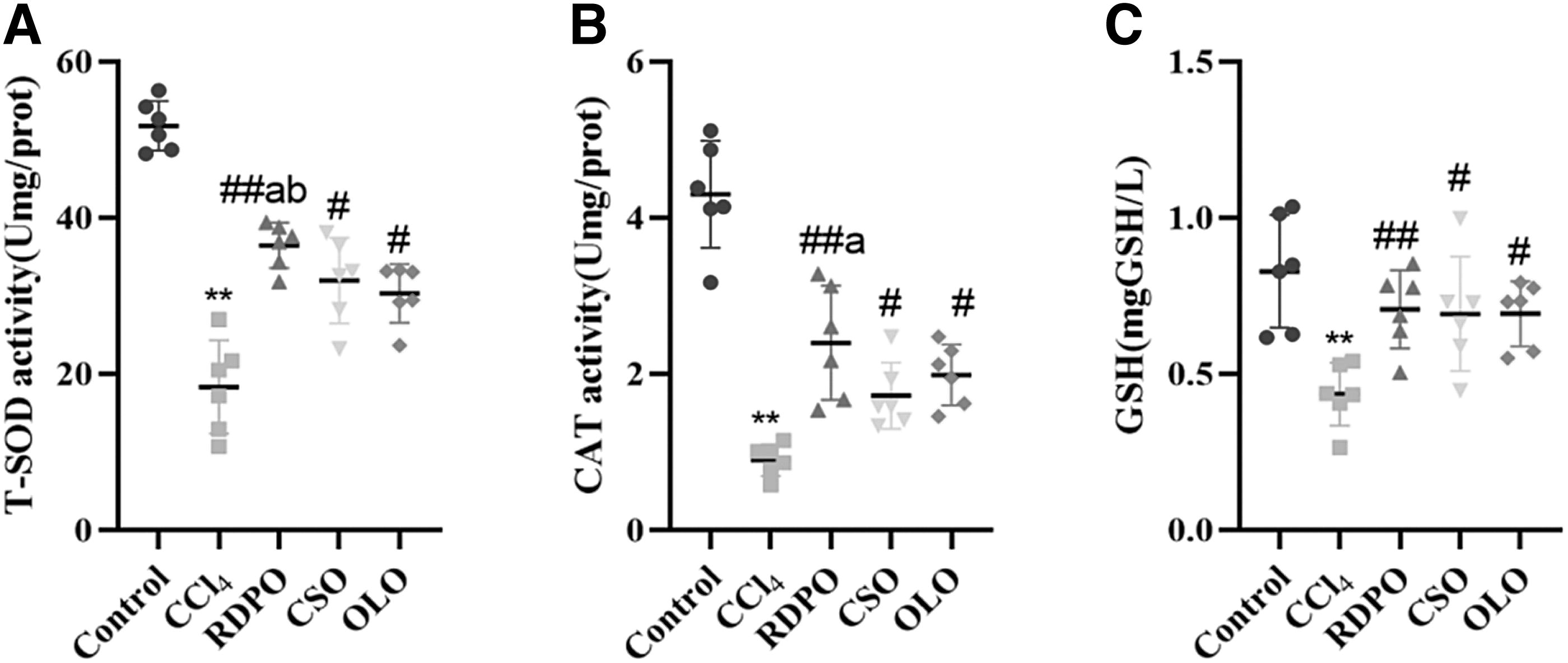
The effect of RDPO on antioxidant enzyme levels in the liver.
Moreover, GSH, a crucial antioxidant in cells, plays a significant role in eliminating ROS within the body and safeguarding cells against oxidative stress damage. 42 As depicted in Figure 6C, there was a notable decrease in the GSH levels in the liver of the model group in comparison with the control group (P < .01). However, the GSH level in the RDPO pretreatment group exhibited a significant increase (P < .01). These results indicate that RDPO has a significant impact on enhancing the antioxidant capacity of the liver.
RDPO significantly inhibited hepatic lipid peroxidation induced by CCl4 in mice
MDA generally serves as a marker to evaluate lipid oxidative damage in the body caused by lipid peroxidation. 43 During our investigation, we observed a noteworthy elevation in MDA levels in both the serum and liver of the model group in comparison with the control group (P < .01), indicating that CCl4 can induce liver lipid peroxidation damage in mice. Interestingly, the RDPO treatment group showed a significant reduction in MDA levels (P < .01), suggesting that RDPO effectively inhibits liver lipid peroxidation in mice (Fig. 7A, B).

The effect of RDPO on lipid peroxidation and hepatic injury enzyme in serum.
The protection of RDPO against liver injury induced by CCl4
In the early stages, it has been confirmed that RDPO exhibits a strong antioxidant activity. However, it is still unknown whether this oil has a protective effect on CCl4-induced liver injury in mice. As a widely used indicator in clinical detection of liver injury, AST was measured in the serum of mice to assess the liver injury induced by CCl4 in our experiment. As depicted in Figure 7C, it is shown that the mice in the model group had notably higher AST activity than those in the control group. Remarkably, after receiving RDPO treatment, the AST activity was obviously reversed (P < .05), indicating the RDPO's protective role against liver injury induced by CCl4.
TOPSIS comprehensive analysis results
To evaluate the protective effect of RDPO on the liver of mice, we used the TOPSIS method. Table 8 presents the Ci value, indicating that RDPO has the highest value among CSO and OLO. Thus, it can be concluded that RDPO has the most effective impact on safeguarding the liver from oxidative damage.
TOPSIS Analysis of Hepatoprotection of Three Seed Oils (n = 6, Mean ± Standard Deviation)
di− in the table represents negative ideal values, and di+ in the table represents positive ideal values.
DISCUSSION
The liver is crucial in maintaining human health as it is the main site for nutrient and drug metabolism. 44 However, oxidative stress injury can severely impact liver function, 45 making it clinically important to develop effective protective strategies against such injury for the prevention and treatment of liver diseases. In this study, we discovered that using an enzymolysis time of 8 h, an enzymolysis temperature of 45°C, a solid–liquid ratio of 1:8, and a microwave power of 300 W, the extraction rate of RDPO reached its maximum at 11.12%. Furthermore, RDPO exhibited strong free radical scavenging activity and reducing power, while also significantly enhancing the activity of endogenous antioxidant enzymes in the liver of mice. Notably, RDPO effectively suppressed liver lipid peroxidation induced by CCl4 and significantly reduced serum AST activity.
These findings suggest that RDPO could function as a natural antioxidant with protective effects for the liver.
Oxidative stress injury, resulting from an excess of free radicals generated during metabolic processes or ROS in the body, is considered to be the underlying cause of various diseases, including liver diseases. 46 Several studies have indicated that the ability of a substance to scavenge free radicals can be used to evaluate its antioxidant properties. 47 In line with this, our findings demonstrate that RDPO exhibits significant scavenging rates on ABTS+•, DPPH•, O2 •−, and·•OH radicals, suggesting its excellent antioxidant activity in vitro. Nonetheless, further investigation is necessary to ascertain whether the antioxidant effects of RDPO in vitro have any impact on liver oxidative damage induced by CCl4.
Changes in the antioxidant defense system are commonly observed in cases of liver oxidative damage. 48 Endogenous antioxidant enzymes, particularly T-SOD and CAT, are essential in eliminating intracellular harmful free radicals and ROS. 49 They also help inhibit lipid peroxidation and maintain the normal structure and function of cells. 50 GSH, a soluble thiol antioxidant primarily synthesized in the liver, is an essential component of the antioxidant system. 51 It shields cells from harm caused by free radicals and ROS by neutralizing them. 52 Previous research has shown that white peony polyphenols can prevent alcohol-induced liver oxidative damage in mice by upregulating the mRNA and protein expression of CAT and Mn-SOD in the liver. 53 Similarly, pomegranate glycoside has been found to enhance antioxidant activity in a CCl4-induced liver injury model by increasing the levels of GSH and SOD in the livers of mice. 54
Building upon these findings, the goal of our research was to assess the protective impact of RDPO on CCl4-induced liver oxidative damage through the analysis of CAT and CAT activity in the tissue, along with measuring GSH levels. Our results demonstrated that RDPO significantly increased T-SOD and CAT activities, along with the GSH level in liver tissue.
The liver metabolizes CCl4 to generate trichloromethyl radicals, as is commonly recognized. 55 These radicals induce the abnormal accumulation of ROS that covalently bind to nucleic acids, lipids, and proteins in liver cells, 56 resulting in damage to the liver cells, alterations in lipid metabolism, and reduction in protein levels, ultimately causing oxidative damage in the liver. Liver oxidative damage is characterized by an abnormal increase in MDA levels in vivo. 57 Previous studies have shown that Schisandra polysaccharide can reduce MDA levels in serum, liver tissue, and HepG2 cells of mice, thereby improving ethanol-induced lipid peroxidation damage. 58 Similarly, apigenin, a natural antioxidant, can significantly reduce the abnormal increase in MDA levels in both liver tissue and serum of rats induced by methotrexate, and inhibit liver lipid peroxidation damage. 59
Consistent with these findings, our study demonstrates that pretreatment with RDPO can normalize MDA levels in serum and liver tissues of mice, suggesting that RDPO may have the potential to inhibit liver lipid peroxidation damage.
AST is predominantly located in the cytoplasm and mitochondria of liver cells. 60 When liver cells are damaged, serum AST activity increases significantly. 61 AST is also an important indicator for assessing liver injury in clinical settings. 62 In a study conducted on ICR mice, it was observed that insect tea extract improved liver injury caused by CCl4 by enhancing serum antioxidant enzyme activity, reducing serum MDA levels, and lowering AST levels. 63 Similarly, our experimental results showed that pretreatment with RDPO effectively inhibited AST activity in the serum of mice experiencing acute liver damage, suggesting a possible shielding impact of RDPO against liver injury caused by CCl4.
Research increasingly indicates that the intake of OLO is associated with a decreased likelihood of malignant tumors, primarily due to its antioxidant properties. 64 Al-Seeni et al. have pointed out that OLO can significantly improve CCl4-induced liver injury. 65 Furthermore, studies have demonstrated that CSO can enhance the antioxidative stress ability of rats, leading to a significant improvement in CCl4-induced liver oxidative damage. 66 Based on these findings, we selected OLO and CSO as the comparison group for this study. As expected, our study revealed that both CSO and OLO have a positive effect on improving acute liver oxidative damage. Interestingly, our comprehensive analysis of serum transaminase levels and liver antioxidant injury-related indicators in mice showed that the protective effect of RDPO on liver oxidative damage was significantly stronger than that of CSO and OLO.
This variance could be due to the superior antioxidant capabilities of RDPO in comparison with OLO and CSO. In addition, it is noteworthy that the content of polyunsaturated fatty acids and antioxidant small-molecule compounds in RDPO is higher than that in OLO and CSO, which could explain the stronger liver protection effect of RDPO. 66 Consequently, in comparison with OLO and CSO, RDPO may be more promising as a dietary supplement for liver protection.
In this study, we investigated the protective effect of RDPO on CCl4-induced acute liver injury in mice from the perspective of antioxidation. However, previous research has suggested that α-linolenic acid, β-sitosterol, squalene, and α-tocopherol found in RDPO also exhibit properties that help prevent liver injury. Zhang et al. discovered that α-linolenic acid can inhibit endoplasmic reticulum stress-mediated apoptosis in rat primary cells. 67 Wang et al. found that dietary α-linolenic acid-rich linseed oil has the potential to prevent alcoholic liver steatosis in mice by improving lipid homeostasis in the adipose tissue–liver axis. 30 Furthermore, β-sitosterol has been shown to significantly reduce CCl4-induced oxidative stress injury in the rat liver. 68 Ramírez-Torres et al. demonstrated that squalene exhibits antihepatic steatosis properties. 69 Moreover, α-tocopherol has been demonstrated to provide liver protection by downregulating the expression of microRNAs that regulate liver steatosis and apoptosis in patients with nonalcoholic fatty liver disease. 70
Therefore, future studies will focus on isolating α-linolenic acid using the molecular distillation technology and separating β-sitosterol, squalene, and α-tocopherol through thin-layer chromatography and column chromatography.
CONCLUSION
In conclusion, our study discovered that RDPO exhibits remarkable antioxidant activity and has the potential to protect the liver. It is possible that the hepatoprotective effect is due to its ability to mitigate oxidative stress. These findings suggest that RDPO could be a promising functional vegetable oil with potential benefits for the prevention and treatment of liver diseases.
Footnotes
AUTHORs' CONTRIBUTIONS
Each contributor participated in the development and core concept of the study. C.L. and X.Y. designed the experiment, collected and analyzed the data, drafted the original article, corrected the main article, and did the final approval of the version to be published. M.Z., S.W., J.N., X.Y., and H.H. revised article drafts.
DATA AVAILABILITY STATEMENT
The experimental data in the present study can be obtained from the corresponding author upon request.
AUTHOR DISCLOSURE STATEMENT
All authors in this study declare no conflicts of interest.
FUNDING INFORMATION
This study was supported by a grant from the Natural Science Foundation of Heilongjiang Province (Grant No. SJGZ20220108).
SUPPLEMENTARY MATERIAL
Supplementary Figure S1