




Abstract
Gastrointestinal tumors have a major impact on human life expectancy and quality of life and are a major cause of personal and social hygiene stress. Gastrointestinal tumors are the main cause of cancer-related death, and the main treatment methods are surgery, radiotherapy, and chemotherapy. However, they also cause great damage to the body and have a poor prognosis after surgery. Therefore, we urgently need safe and effective drugs to intervene in gastrointestinal tumors. In recent years, Traditional Chinese Medicine has been widely used in tumor treatment as a complementary and alternative therapy. Astragalus membranaceus is one of the main herbal medicines with tonic effect and one of the important components of many antitumor herbal compounds. Astragalus polysaccharides, saponins, and flavonoids are the main active components of Astragalus, all of which have antitumor effects. In this article, we studied the mechanism of action of Astragalus and its active ingredients in the intervention of gastrointestinal tumors in recent years and suggested a new approach for the study of Astragalus intervention in gastrointestinal tumors from the perspective of the homology of medicine and food.
INTRODUCTION
At present, cancer has become one of the main causes of human death and gastrointestinal tumors are one of the main causes of cancer-related death in the world. 1 According to a new report on global cancer data released by the World Health Organization in 2020, liver, stomach, colorectal, and esophageal cancers account for four of the five gastrointestinal cancers worldwide. Gastrointestinal tumors have a high rate of complications and mortality, accounting for 20% of all cancer deaths. 2 The number of patients with malignant tumors of the gastrointestinal tract is increasing worldwide due to a number of reasons, such as dietary changes and genetic factors. At present, the main treatment methods are surgical excision, radiotherapy, and chemotherapy, but such treatment methods cause great damage to the body, and there are problems in the treatment process such as major toxicity and side effects, poor postoperative prognosis, and high recurrence rate. The quality of life of patients is still not effectively guaranteed, and its metastasis and recurrence cannot be prevented. 3 Therefore, there is an urgent need to find nontoxic natural drugs to treat gastrointestinal tumors.
With the vigorous development of Chinese medicine, Chinese medicine has become widely used in cancer treatment as a complementary and alternative therapy. Traditional Chinese Medicine (TCM) has the advantages of good therapeutic effects and few side effects, which can increase the quality of life of cancer patients and prolong the survival rate. 4 Astragalus, as a natural medicine, has been used in China for nearly a thousand years. Astragalus is sweet in flavor and slightly warm in nature. It belongs to the lung and spleen meridians. As a traditional medicine for strengthening deficiency, it is known as “the best of Fuzheng,” which has the effects of replenishing qi and increasing yang, promoting blood circulation, strengthening the body surface, and acting as an antiperspirant. Clinically, it is often used to treat the symptoms of zhongqi depression, qi deficiency, self-sweating, hemiplegia, numbness, etc. 5 With a wide range of uses and high popularity, Astragalus is often used to prevent and treat tumors in clinical practice. 6
With the development of chemical technology, there have been many reports about the pharmacological activities and mechanisms of Astragalus membranaceus and its active components. Its broad pharmacological effects include anti-inflammatory, antioxidant, heart, liver, and kidney protective effects, immune-enhancing effects, and significant antitumor activity. 7 In addition, studies have also shown that Astragalus and its active ingredients exert antitumor effects on gastrointestinal malignancies such as esophageal cancer, liver cancer, and gastric cancer through various pathways of action. 8 This article introduces the main active ingredients of Astragalus, and summarizes the mechanism of action of Astragalus and its active ingredients in the treatment of various gastrointestinal malignancies, for the purpose of promoting the clinical development and application of medicinal and dietary delivery systems for Astragalus in the field of antigastrointestinal malignant tumors.
The main active ingredients of Astragalus
The medicinal plants of Astragalus have numerous and varied complex chemical constituents. In recent years, scholars at home and abroad have conducted a lot of research on its chemical composition. Astragalus polysaccharide (APS), Astragalus saponins, and flavonoids are the main effective components of Astragalus against gastrointestinal tumors. 9
APSs are mainly divided into heteropolysaccharides and dextran; more than 30 kinds of APS have been isolated. 10 APS is an active ingredient with anticancer properties, mainly inhibiting solid tumors by blocking the cell cycle, inducing apoptosis, and immunomodulation. The experiments demonstrated that APS has a significant inhibitory effect on the proliferation of human gastric cancer cell line SGC-7901. This effect was observed in vitro at concentrations of 25, 50, and 100 μg/mL with incubation times of 12, 24, and 48 h, respectively. The inhibitory effect was both concentration and time dependent, with statistical significance at P < .05. The antitumor effect of IL-2R/LAK is improved by regulating cellular immunity, which can modulate the secretion of cancer-promoting factors, the expression of IL-2R receptor, and the proliferation of LAK precursor cells, which mediate its antitumor role. 11
Current research has identified nearly 40 kinds of saponins in Astragalus, which are among the important active ingredients of Astragalus. 12 Astragaloside IV (AS-IV) is present at the highest content among Astragalus saponins, and studies have reported that AS-IV has an antitumor activity against a variety of gastrointestinal malignancies. AS-IV inhibits the growth of colorectal cancer, 13 gastric cancer, 14 liver cancer cells, and reduces tumor size in nude mice. In addition, Astragaloside I, IV, and VII also showed antitumor properties in vitro and in vivo in human colon cancer models. 15
More than 30 flavonoids have been isolated from Astragalus, and flavonols are the most frequently isolated flavonoid compounds. Among them, quercetin, kaempferol, and their glycosides were most abundant in Astragalus. 16 Flavonoids exert antitumor activity by inhibiting metastasis of cancer cells, inhibiting new blood vessel formation, and promoting apoptosis. Experimental studies have demonstrated that flavonoids significantly inhibit the proliferation of human colon cancer cells HT-29, with an EC50 of 54.8 ± 1.3 μM, and can induce apoptosis in tumor cells. 17 In addition, flavonoids can significantly enhance cellular and humoral immunity and inhibit the growth of tumor cells in tumor-bearing mice. 18
Network analysis of Astragalus antitumor properties.
METHODS
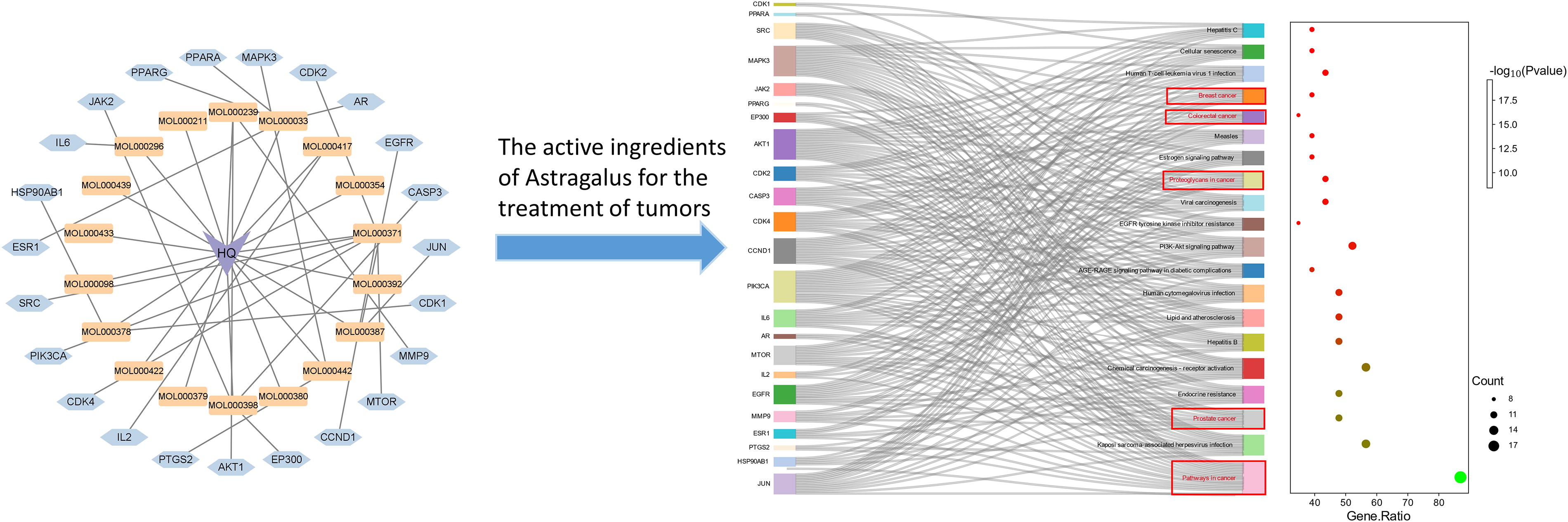
The active constituents of Astragalus were screened through the Traditional Chinese Medicine Database and Analysis Platform (TCMSP, https://tcmsp-e.com/) by the standard of oral bioavailability ≥30% and drug-likeness ≥0.18. TCMSP is used to predict the targets of the active ingredient, and the targets were compared and corrected by using the Uniprot database (https://www.uniprot.org/uniprot/). At the same time, the two-dimensional structure of the active ingredients—isomeric SMILES—were obtained from the PubChem database (https://pubchem.ncbi.nlm.nih.gov/), and the corresponding gene targets were further obtained from SwissTargetPrediction. The active ingredients and gene targets of Astragalus are imported into Cyto-scape 3.9.1 software, and its degree centrality is calculated by CytoNCA, a Cytoscape plug-in, to screen the important nodes in the interaction network. Then, the network of “active ingredient-target” was constructed. The David online analysis platform (https://david.ncifcrf.gov) was used to analyze Kyoto Encyclopedia of Genes and Genomes enrichment analysis, and visualization was performed using the online tool at www.bioinformatics.com.cn and output as a sangiogram.
RESULTS
Twenty effective active ingredients of Astragalus were obtained from the TCMSP database, and a total of 393 Astragalus gene targets were predicted by TCMSP, PubChem, and SwissTargetPrediction databases, and the top 23 gene targets were screened according to the degree value after being imported into Cyto-scape. The result of the sangiogram shows that 5 of the top 20 pathways enriched by the core gene targets of Astragalus are associated with tumors (Fig. 1). Therefore, it is hypothesized that Astragalus may have antitumor effects.

Network analysis of Astragalus active ingredients in the treatment of tumors.
Astragalus inhibits different gastrointestinal tumors
Esophageal cancer
Quercetin and ononetin are two of the most important components of Astragalus flavonoids. Liu et al. found that quercetin may significantly inhibit the invasion and angiogenesis of esophageal cancer cells by downregulating the expressions of VEGF-A, MMP2, and MMP9. 19 Li et al. found that formononetin treatment significantly reduced the growth of transplanted esophageal cancer in a mouse model. It also significantly inhibited the proliferation of KYSE170 and KYSE150 cells, and the protein expressions of COX-2 and cyclinD1. 20 Chang et al. used 0, 1.0, 1.5, and 2.0 mg·mL−1 APS to intervene in esophageal cancer EC109 cells for 24 h, and found that it had a dose-dependent inhibitory effect on the proliferation, migration, and invasion of the cells. In addition, the fluorescence expression intensity of LC3 was enhanced (P < .01), the expression level of P62 protein was significantly decreased (P < .01), and the expression levels of Beclin1 and LC3B was significantly increased (P < .05, P < .01). The results indicate that its mechanism of action may be achieved by inducing autophagy. 21 Sun et al. recruited a total of 40 patients diagnosed with esophageal cancer. Among them, 20 patients received treatment with APS, whereas the remaining 20 patients underwent simple surgery. Subsequently, adjacent noncancerous tissues were extracted for experimental purposes. The findings revealed that APS treatment led to a decrease in the expression of inflammatory cytogens IL-12, IL-6, and Vascular endothelial growth factor EPC=Endothelial progenitor cell (VEGF). Additionally, APS treatment significantly reduced the expression of AKT protein. These results suggest that APS can serve as an adjunctive therapy for esophageal cancer by targeting the p-AKT-AKT-VEGF signaling pathway in EPC. 22 In addition, AS-IV, a nonartificial saponin isolated from Astragalus membranaceus, has shown key antitumor regulatory effects in certain cancers. Hu et al. discovered that AS-IV effectively increased the protein levels of caspase-3 and caspase-9 while decreasing the expressions of SOX2, OCT4, and CD44, as well as the phosphorylation of PI3K and AKT. Additionally, AS-IV inhibited the membrane localization of AKT. These findings suggest that AS-IV may promote apoptosis and suppress stem cell-like properties in esophageal cancer TE-1 cells by blocking the activation of the PI3K/AKT pathway. 23
Gastric cancer
Yu et al. found that APS could inhibit the proliferation of human gastric cancer cell MGC-803 by arresting cells in the S phase and inducing the mitochondrial apoptotic pathway to promote apoptosis. 24 Wu et al. also found that APS combined with apatinib inhibited the expression of phosphorylated AKT and MMP-9 and triggered autophagy, thereby inhibiting cell proliferation, migration, and invasion. 25 The results showed that Astragalus saponins could arrest the cell cycle of gastric cancer cells at the G2/M phase and significantly reduce the number of cells. Furthermore, downregulation of VEGF, MMP-2, and MMP-9 expression could inhibit angiogenesis, and regulation of cyclin B1, p21, and c-myc expression could promote cell apoptosis. 14 Liu et al. found that AS-IV inhibited metastasis and angiogenesis of gastric cancer cells by upregulating miR-195-5p. 26 In addition, AS-IV also has an obvious inhibitory effect on the proliferation of gastric cancer MKN-74 cells, and the inhibitory effect is enhanced with the increase of AS-IV dose and the extension of processing time. 27 Li et al. found that AS-IV effectively inhibited the proliferation and metastasis of GC cells by inhibiting the expressions of CircDLST and EIF4A1. It is worth noting that EIF4A1 is one of the targets of miR-489-3p, and the upregulation of miR-489-3p can enhance the inhibitory effect of AS-IV on gastric cancer. Therefore, this discovery provides us with a completely new treatment strategy. 28 Di et al. found that Astragalus extract can regulate the expression of Bcl-2 and Bax apoptotic factors to play a proapoptotic role, thus playing an auxiliary role in the treatment of gastric cancer. 29 Astragalin is a natural flavonoid compound from Astragalus. Wang et al. found that astragalosides could inhibit the activation of PI3K/AKT signaling, which in turn hinders the survival, movement, and invasion of gastric cancer cells. It also reduces the expression of Bcl-2 and triggers apoptosis in gastric cancer cells. In addition, it reduces tumor size in MGC-803 tumor-bearing mice in a dose-dependent manner. 30 Ding et al. found that quercetin targets SLC1A5 in GC cells and inhibits the NRF2/xCT pathway, leading to the inhibition of GPX4 expression. Furthermore, it activates the p-Camk2/p-DRP1 pathway, thereby promoting lipid peroxidation. These dual effects accelerate iron deposition, led to ferroptosis in GC cells, and inhibit the progression of gastric cancer. 31 Ma et al. randomly divided 137 elderly patients with gastric cancer into a study group (68 cases) and a control group (69 cases). The control group received the FOLFOX chemotherapy regimen, whereas the study group received astragalus granule therapy in addition to the FOLFOX regimen. Both groups underwent treatment for 8 weeks. The levels of tumor markers CEA, CA72-4, CA125, and CA19-9 decreased in both groups after treatment, with the study group showing lower levels compared to the control group. The study group also exhibited higher levels of NK cells, CD3+, and CD4+ T cells compared to the control group, whereas CD8+ levels were lower. The study group experienced lower incidences of myelosuppression, nausea, and vomiting compared to the control group during treatment, with statistically significant differences (P < .05). The combination of astragalus granules and the FOLFOX chemotherapy regimen was found to significantly reduce tumor marker levels, enhance immune function, and alleviate chemotherapy-related side effects. 32
Liver cancer
Huang et al. found that APS reduced H22 cell survival in a concentration-dependent manner and induced apoptosis in hepatoma cells by regulating the expression of Bcl-2, BAX, Caspase-3, and Caspase-8 and inhibiting Notch 1 expression. 33 The antitumor effect of APS in H22 tumor-bearing mice may be related to its ability to enhance the expressions of IL-1α, IL-2, IL-6, and TNF-α, to reduce the expression of IL-10, and downregulate the expressions of MDR1 mRNA and P-GP. 34 It may also play a proapoptotic role by downregulating the expression of Bcl-2 protein and upregulating the expression of Bax protein. 35 Li et al. found that APS downregulates O-GlcNAcylation through decreasing OGT levels and increasing OGA levels in Hep3B cells, which exacerbates ER stress response and promotes Dox-induced apoptosis. 36 Liang et al. conducted an experiment where they treated Huh-7 hepatoma cells and M2 macrophages with varying concentrations of AS-IV (0, 50, 80, 100, 120, and 150 μM) for 48 h. They found that AS-IV reduced the expression of M2 macrophage markers CD206, CD209, and TGF-β (P < .05), indicating that AS-IV can inhibit the polarization of macrophages into the M2 phenotype. M2 polarization of macrophages is known to stimulate the expression of TLR4, p-STAT3, and p-p65. However, treatment with AS-IV attenuated the expression of these molecules. Additionally, AS-IV was found to inhibit the activation of the NF-κB signaling pathway, reduce phosphorylation of Iκb, and consequently reduce the nuclear translocation of NF-κB = Nuclear factor kappa-B IL6 = Interleukin-6 IL12 = Interleukin-12 (NF-κB). These results suggest that AS-IV may inhibit the polarization of M2 macrophages by regulating the TLR4/NF-κB/STAT3 signaling pathway. This inhibition of M2 polarization could potentially lead to the inhibition of proliferation, invasion, and migration of hepatocellular carcinoma. 37 Qu et al. found that AS-IV reduced the nephrotoxicity of cisplatin in mice with HCC and slowed the tumor volume growth rate. The antitumor effect of cisplatin was enhanced by inhibiting the expression of MRP2 in tumor cells. 38 Su et al. found that AS-IV could block liver cancer cells in the G0/G1 phase, promote the overexpression of antiapoptotic proteins, upregulate the Caspase family, and promote cell apoptosis. 39 Flavonoids can upregulate the expression of Caspase-21, Caspase-27, Bax, P7721, and P48, and downregulate the expression of cyclinB1, cyclinD1, CDK1, and CDK4 through mitochondrial apoptosis pathway, thereby inducing apoptosis of hepatocellular carcinoma cells. 40
Colorectal cancer
Law et al. found that AS-IV downregulated bFGF and VEGF expression, upregulated PTEN and p-mTOR expression, and inhibited the induction of HIF-1α and VEGF under CoCl 2-simulated hypoxia, which may exert anticancer activity in colon cancer cells by regulating mTOR signaling and downregulating COX-2. 41 Tin et al. found that AS-IV can inhibit the proliferation of colon cancer cells by blocking the cell cycle, while also reducing tumor volume in tumor-transplanted nude mice. 13 Auyeung et al. also found that AS-IV modulated the cycle of colon cancer HT-29 cells and induced extrinsic apoptotic responses by regulating mTOR and ERK signaling pathways. 42 They also found that Astragalus flavonoids inhibited angiogenesis and tumor cell invasion by downregulating VEGF. 43 Furthermore, it also inhibited the growth of colon cancer cells and promoted apoptosis by arresting the cell cycle at the G2/M phase. 44 Gu et al. found that both the number of tumor metastases and the area of necrosis were reduced in mice transplanted with colon cancer after treatment with Astragalus extract. Moreover, it can inhibit the growth and metastasis of colon cancer cells by inhibiting the polarization of M5 macrophages, which may be related to the regulatory axis of Sp2/ZFAS1/miR-1-153p/CCR3. 45 Zhao et al. found that APS has the ability to enhance the drug sensitivity of HT-29/DDP cells by downregulating the inhibitory effect of miR-20a on TGFBR2 expression and induce apoptosis of HT-29/DDP cells. The study also found that this effect was associated with the suppression of PCNA and Bcl-2 proteins and the promotion of Bax and Caspase-3 proteins. 46 In addition, APS can also reduce the phosphorylated STAT3 and Gal-3 levels, as well as LAG3 levels in colon cancer cells, which can specifically improve CD8+T cell function, regulate the tumor microenvironment, and inhibit colon cancer progression. 47 Zhang et al. randomly divided 70 elderly metastatic colorectal cancer patients into treatment and control groups, 35 patients in each group. The control group received a chemotherapeutic regimen of bevacizumab combined with oxaliplatin and capecitabine, whereas the treatment group received astragalus granule adjuvant therapy in addition to the control group’s regimen. Treatment was administered once a day for 14 days, followed by a 7-day break, with each cycle lasting 21 days. The patients underwent two cycles of treatment consecutively. The results showed that the total effective rate in the treatment group was significantly higher than that in the control group (P < .05). Additionally, levels of serum TIMP-1, MMP-7, and P53 antibodies were significantly reduced in both groups after treatment compared to before treatment (P < .05). Furthermore, the levels of these markers were significantly lower in the treatment group compared to the control group (P < .05). These findings suggest that combining astragalus with bevacizumab in chemotherapy may lead to improved clinical outcomes for elderly patients with colorectal cancer. 48
Pancreatic cancer
Wu et al. combined 40 μM apatinib with 50, 100, 200, and 400 μg/mL APS for 24 h and found that apatinib combined with 200 μg/mL APS had a stronger inhibitory effect on cell proliferation, migration, and invasion. This combination was found to inhibit cell migration and invasion by suppressing MMP-9 expression. Furthermore, the activation of AKT and ERK signaling pathways by the combination of VEGF and VEGFR-2 was shown to support the survival of pancreatic cancer cells. However, the researchers observed that the combination of Apatinib and APS could suppress the expressions of p-AKT and p-ERK, leading to the inhibition of Bcl-2 and the promotion of apoptosis in pancreatic cancer cells. 49 Wang et al. found that the mechanism by which flavonoids promote apoptosis in pancreatic cancer cells may be related to their inhibition of Notch-1 and reduction of NF-kB DNA binding and its downstream target genes. 50 In addition, Ding et al. found that Astragalus flavonoids could upregulate the expression of caspase-3 and Bax, downregulate the expression of Bcl-2 and Bcl-XL, and induce apoptosis. It can also play a key role in arresting the cell cycle in the G2/M phase. 51
The collated data are shown in Table 1, and the mechanisms of Astragalus against different gastrointestinal tumors are shown in Figure 2.
Antigastrointestinal tumor mechanism of Astragalus.
Therapeutic Mechanism of Astragalus and Its Active Ingredients Against Gastrointestinal Tumors
APS, Astragalus polysaccharide; AS-IV, Astragaloside IV.
Astragalus medicine and food homology and modern products development
Ancient medicinal diet
The earliest record of the medicinal use of Astragalus appeared in the Synopsis of prescriptions of Golden Chamber in which the Compound Astragalus porridge was recorded to be used to treat and prevent thrombosis. Astragalus porridge has a significant effect on preventing thrombotic cardiovascular and cerebrovascular diseases and improving the sequelae of cerebral infarction. In addition, tumor patients can take Astragalus ginseng and jujube porridge that tonifies middle, replenishes qi, strengthens the spleen, and nourishes blood to promote physical recovery. Patients with low immunity after surgery can take ginseng Aestragalus and jujube soup and Astragalus chicken soup to improve the patient’s physical condition and improve the body’s immunity. Astragalus also has hypoglycemic effects and Astragalus and yam porridge have the effect of tonifying qi, and strengthening spleen has a certain auxiliary therapeutic effect for diabetic patients. Glutinous rice Astragalus Yin in Taiping Holy Prescriptions for Universal Reliefcan play the role of regulating qi and blood and preventing abortion. Many medications are risky for pregnant women, but pregnant women with qi and blood deficiency can consume this formula to regulate the body. The finished prescription of the medicinal food can be seen in Table 2.
Astragalus Medicated Diets
Modern products development
Common products
In recent years, a large number of common foods with Astragalus as the main ingredient have been developed, including soup, beverage, powder, porridge, and paste. Soup and porridge are more common in medicinal food. Soups include Astragalus Mutton Soup and Astragalus Cordyceps Soup which strengthen kidney and spleen and improve the body’s immunity. The porridge includes Astragalus yam porridge, Astragalus codonopsis old hen health porridge, and goji berry Astragalus health porridge which tonifies middle, replenishes qi, and nourishes the spleen and stomach. Solid food is the most common and convenient type of food in your daily diet, such as Astragalus cake, which not only fills your stomach but also makes you healthy. After reviewing the literature patents, some of the existing products utilizing Astragalus are summarized and listed in Table 3.
Modern Development Products of Astragalus
Health food
Nutritional supplements have caught on with the public in recent years and become another popular item in the health industry. At present, there are 434 kinds of health food with Astragalus as the main ingredient in the market, including 417 kinds identified as “National Food Health Note,” 11 kinds using the words “National food health,” and 6 kinds identified as “Health food.” Its main functions are immune regulation, liver protection, improvement of gastrointestinal function, and nutritional anemia. Health foods containing Astragalus are obtained through the special food information inquiry platform of the State Administration for Market Regulation, and the main products are listed in Table 4.
Health Food Based on Astragalus
Summary
At present, conventional western medicine intervention is still the first choice for treating gastrointestinal tumors. Although it can kill tumor cells and reduce tumor load quickly, but it inevitably brings a series of toxic side effects and adverse reactions. According to Chinese medicine principles, tumors’ occurrence and development is closely related to healthy qi of the human body. The pathogenesis of gastrointestinal tumors involves deficiency of the root and excess in superficiality, and the Fuzhengjiedu method can be used to improve the body function of patients by supplementing with traditional Chinese herbs. TCM and its long-term clinical experience show that Astragalus can tonify qi and engender blood, thereby improving body immunity, which can regulate the cause of qi deficiency and blood stasis of gastrointestinal tumors. Modern studies have shown that APS, Astragalus saponins, and Astragalus flavonoids can play an antitumor role in the digestive tract by regulating oxidative stress, improving the immune environment, and improving vascular endothelial function. The concept of homology of food and medicine can be traced back to the Yellow Emperor’s Classical of Internal Medicine, in which it is mentioned that food can also be used as medicine (e.g., medicinal food) to enhance one’s immunity and thus achieve the effect of preventing or treating diseases. The ideas of “treating the future illness” and toning the body have been emphasized in TCM. The Chinese medicine Astragalus has the reputation of “the holy medicine of tonifying qi,” so it has great potential for the development and application of medicines, health foods, dietary supplements, and as a medicinal herb for both food and medicine. Despite its potential benefits, Astragalus can lead to various side effects when used in clinical settings. The most frequent side effect reported is the rapid onset of symptoms associated with “heatiness,” such as redness, upset stomach, insomnia, sore throat, and dizziness. Additionally, allergic reactions may occur, including skin allergies, high fever, asthma, and anaphylactic shock. The recommended dosage of Astragalus is typically between 9 and 30 g. However, excessive intake may lead to certain side effects. Therefore, when incorporating Astragalus into different recipes, it is important to carefully regulate the amount and frequency of usage. Additionally, it is advisable to start with a small quantity of Astragalus and gradually increase the dosage. If any discomfort arises, it is crucial to discontinue its consumption immediately.
Chinese medicinal preparations known as Astragalus granules contain natural active ingredients that have minimal toxicity and side effects. When used alongside chemotherapeutic drugs, these granules can help reduce the toxic side effects of chemotherapy by enhancing bone marrow hematopoietic function, improving patients’ immune function, and providing a safer treatment option. This is particularly crucial for improving patients’ prognosis. The efficacy of Astragalus granules has been confirmed through clinical use, and there is significant potential for them to be incorporated into standard treatment protocols. At present, there has been substantial domestic and foreign research on Astragalus treatment of various digestive tract tumors, but the research has mostly involved cell and animal experiments. There have been fewer trials using Astragalus in the clinical treatment of gastrointestinal tumors and the molecular mechanism of its action is unclear. Future research needs to study its mechanism of action and actively carry out new drug research of Astragalus and related medicinal dietary formulas and compound formulas for the treatment of gastrointestinal tumors. Taking the theory of homology of medicine and food as a guide and incorporating modern research methods, investigations of the treatment of gastrointestinal tumors by regulating the immune environment and improving the “state of the organism,” may advance new ideas for utilizing Astragalus to fight against gastrointestinal tumors.
Footnotes
ACKNOWLEDGMENTS
Thanks to all authors for their contributions to this article. The authors thank Ningxia Natural Science Foundation, National Natural Science Foundation of China, and Young Scholars of Western China(Class A)_West Light Foundation of the Chinese Academy of Sciences for funding this article.
AUTHORS’ CONTRIBUTIONS
Y.N. and L.Y.: Ideas; formulation, or evolution of overarching research goals and aims. Y.N. and Y.N.: Development or design of methodology. J.L., T.J., and W. J.: Application of statistical. J.L. and W.J.: Management activities to annotate (produce metadata), scrub data, and maintain research data for initial use and later reuse. J.L.: Writing—original draft. H.D. and Y.N.: Writing—reviewing and editing. J.L.: Visualization/data presentation. H.D.: Oversight and leadership responsibility for the research activity planning and execution.
DISCLOSURE OF RELATIONSHIPS AND ACTIVITIES
All authors certify that they have no affiliations with or involvement in any organization or entity with any financial interest or nonfinancial interest in the subject matter or materials discussed in this article.
AUTHOR DISCLOSURE STATEMENT
No competing financial interests exist.
FUNDING INFORMATION
This work was supported by